WHAT IT IS
Russian C3 is the set of systems by which the Armed Forces of the Russian Federation (Вооружённые силы Российской Федерации) are commanded and by which those commands travel. In the language of the Signal Troops, C2 is the decision loop and the automated control applications; C3 is that loop plus the circuits that carry it. This page covers both: the national command chain from the President as Supreme Commander down through the Minister of Defence and the General Staff; the nuclear-authorisation path (Чегет / Казбек / Кавказ); the National Defence Management Center (НЦУО); the Strategic Missile Forces combat-control nets (Сигнал and its relatives); hardened and airborne backup posts including Косвинский Камень / Object 1335 (Grot) and the Il-80 Maxdome; the submarine broadcast physics of ELF and VLF; the terrestrial and satellite communications architecture branded as ОАЦСС ВС РФ; tactical C2 such as Стрелец and Андромеда-Д; and what the war in Ukraine has shown about the gap between the slide and the foxhole. [DOCUMENTED as the public structure; details as labelled below]
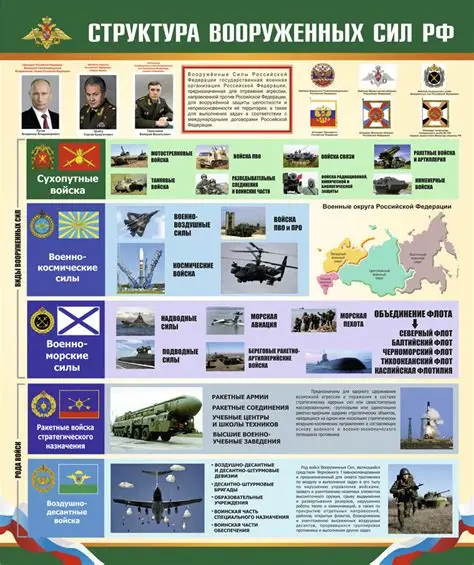
The named backbone of the communications side is ОАЦСС ВС РФ — Объединённая автоматизированная цифровая система связи Вооружённых сил Российской Федерации, the Unified Automated Digital Communications System of the Armed Forces. It is the closest single label to a Russian DISN-plus-DSN. It is not Акация-М, not Андромеда-Д, not НЦУО. Those are command-and-control systems. They ride this. [DOCUMENTED, carried from the previous version of this page]
People who run the communications plant are the Войска связи (Signal Troops), under the Chief of the Main Directorate of Communications of the Armed Forces — also a deputy chief of the General Staff. That office plans, develops and technically supports communications and automated control systems. Courier-mail (фельдъегерско-почтовая связь) lives in the same directorate family. [DOCUMENTED]
The short version. At the top, the President, the Defence Minister and the Chief of the General Staff share a nuclear-authorisation network (Kazbek / Kavkaz) whose portable terminals are the Cheget briefcases. Day-to-day force management runs through the НЦУО in Moscow and the joint strategic commands (ОСК) in the military districts. Strategic missiles are controlled by the Сигнал family of automated combat systems, with Perimeter as a backup if the living chain is cut. Submarines hear one-way orders through ELF (ZEVS at 82 Hz on the Kola Peninsula) and VLF shore stations and through trailing-wire antennas on Il-80-class aircraft. Ordinary military traffic rides fiber, radio-relay, troposcatter, HF, VHF/UHF combat radio and satellite (Meridian, Blagovest, Raduga and the older Molniya geometry). Early warning (Око / ЕКС Тундра satellites, Voronezh-class radars, Don-2N) feeds the same national picture. The war in Ukraine showed that when the tactical radios fail, units fall back to commercial phones and unencrypted nets — and that electronic warfare and interception punish that habit. [DOCUMENTED / SINGLE-SOURCE as marked below]
HOW TO READ THIS PAGE
Important claims carry a label:
Russian C3 is unusually layered with code-names (Caucasus mountains for nuclear C2, flowers for army C2, Signal / Blizzard for RVSN). Where sources disagree on whether two names are the same system, the page says so. Exact locations of underground command posts are omitted or kept at the region level; see the dedicated pages for Object 1335 and Perimeter for what is already public.
C2 VERSUS C3 — KEEP THEM APART
C2 / АСУВ (automated troop and weapon control):
C3 / система связи:
If the C2 terminal cannot reach a node, it is a dark screen. If the node has no C2 application, it is still a telephone and a data pipe. That is the whole distinction. [DOCUMENTED, carried forward and expanded]
THE NATIONAL COMMAND CHAIN
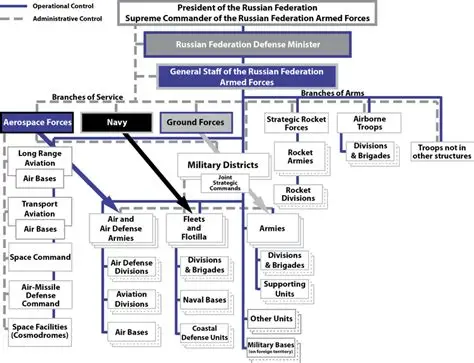
Constitutional top. The President of the Russian Federation is the Supreme Commander-in-Chief (Верховный Главнокомандующий) of the Armed Forces. Under him sit the Minister of Defence and the General Staff of the Armed Forces (Генеральный штаб ВС РФ), headed by the Chief of the General Staff. In peacetime the Minister administers the force; in wartime the General Staff is the working brain of operational command. Western analyses (CNA, RAND, Jamestown) describe the General Staff as the enduring institutional core of Russian military decision-making, with the НЦУО as its modern situation floor. [DOCUMENTED]
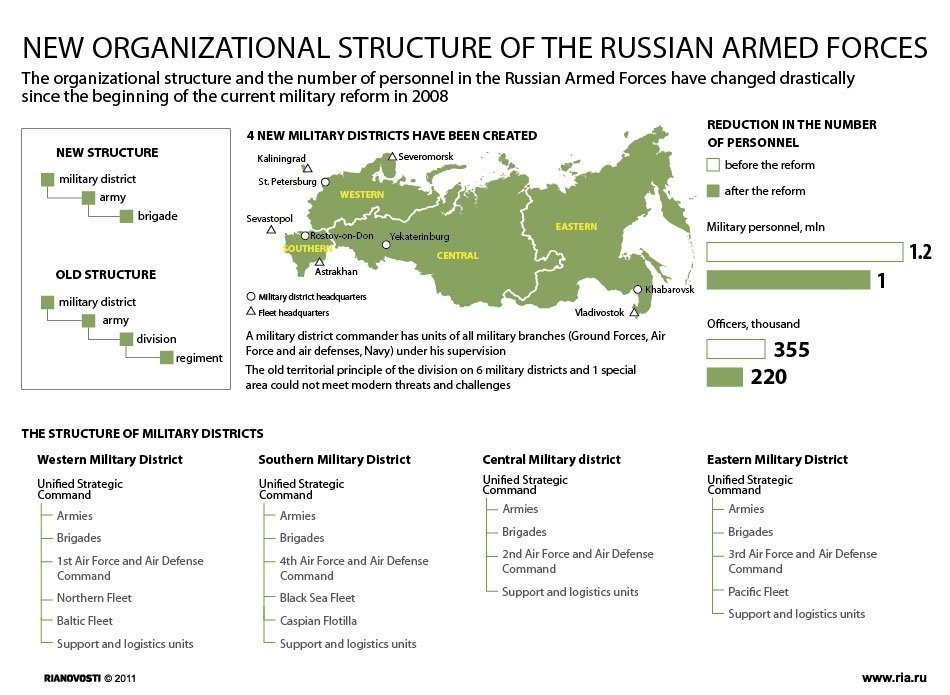
Operational versus administrative control. The 2008–2011 reforms reorganised the force into joint strategic commands (объединённые стратегические командования, ОСК) coincident with the military districts. In the public charts, the General Staff holds operational control of the districts / ОСК, of the Strategic Rocket Forces and of the Airborne Troops, while the service main commands (Ground Forces, Aerospace Forces, Navy) exercise administrative control of their branches. A district commander in this model has ground, air and naval forces of the theatre under one operational hat. The 2011 RIA Novosti graphic on this page (the third image) shows the four-district map of that reform; a fifth Northern ОСК was later formed (December 2014 in open reporting). [DOCUMENTED] District boundaries and names have since been adjusted again (including the recreation of Moscow and Leningrad military districts in the 2020s); treat any map as a snapshot. [DOCUMENTED that changes occurred; SINGLE-SOURCE for each specific redistricting claim]
The order path in ordinary war. Political intent → General Staff / НЦУО → ОСК / military district → combined-arms army → division or brigade → battalion. The published reform language said the number of stages an order passed through was cut from sixteen to five. [SINGLE-SOURCE, Jamestown citing Russian reform briefings] Nuclear release is a parallel path that does not ride the ordinary АСУВ stack; see the next section.
CHEGET, KAZBEK AND KAVKAZ
Caucasus mountain names are the cipher family for Soviet and Russian nuclear command. Kazbek is the mountain and the system; Cheget is the mountain and the briefcase; Kavkaz is the region and the leadership communications fabric. Some Russian sources treat Kazbek and Kavkaz-7 as one umbrella; others split them. In practice they are one political-military nervous system with two labels. See the dedicated Kazbek page. [DOCUMENTED]
Cheget (Чегет). The Russian President is accompanied by an officer who carries a special suitcase containing equipment to connect him to the Kavkaz communications system. Two other suitcases are kept with the Defence Minister and the Chief of the General Staff. The case is a hardened remote terminal, not a public-address launch trigger. Designer language and Western NC3 studies call it a communications terminal that moves encrypted authorisation symbols. Mikhail Loginov is credited with the everyday name "nuclear suitcase"; N.A. Devyanin is named as chief designer of the terminal; NIAA under Academician Vladimir Semenikhin won the enterprise contest. [DOCUMENTED / SINGLE-SOURCE as on the Kazbek page]
Why it exists. Until the portable terminal existed, a launch order in the Soviet picture meant getting a leader to a fixed command post. Pershing II and related NATO deployments in Europe crushed the clock: flight times to some Soviet targets were talked about in single-digit minutes. If the General Secretary was in a car or a dacha, the old geometry failed. Kazbek is mobile national command for a short-warning world. [DOCUMENTED]
Kavkaz-7 (Кавказ-7). The largest part of Kazbek is the complex communications system Kavkaz-7 (alphanumeric designation 65с37 in English NC3 studies, with modernisations 65с37-M and proposals for 65с37-2). It is the path for high-level consultation and for authorising nuclear use. It includes control posts (65с27), facilities at presidential residences, transmitters in Moscow, communications vehicles and airborne relay stations. Open lists of Kavkaz-equipped presidential sites have included Valdai, Sochi and other residences. Treat site lists as reported, not a complete map. [SINGLE-SOURCE, Nuclear Information Service / Podvig-adjacent literature]
Baksan. Named in English NC3 briefs as the terminal path that lets RVSN, Long-Range Aviation and the SSBN force receive authorisation from the national command authority. Another Caucasus name. Sparse in open Russian official text. [SINGLE-SOURCE]
What Cheget does not do. Although the President gives permission through Kavkaz-7, this system does not fire the missiles by itself. Senior military officers issue the launch instructions. They have several methods, each using multiple communications channels. Authority can be delegated to lower levels. At each level there are main, alternate and mobile command posts. [DOCUMENTED, Reuters and Nuclear Information Service summaries] Perimeter is the backup if the living chain is dead; see below and the Perimeter page.
Krokus. A 1995-era description names a notification terminal Krokus at the duty-general layer that wakes before Kazbek is lit for the principals, fed by early-warning. [SINGLE-SOURCE, carried via the Kazbek page]
THE NATIONAL DEFENCE MANAGEMENT CENTER (НЦУО)
The Национальный центр управления обороной Российской Федерации (НЦУО, NTsUO; Western abbreviation NDMC or NDCC) is the Ministry of Defence's central peacetime and wartime situation and command center. It is the successor in function to the General Staff's central command post, rebuilt as a whole-of-government defence watch. It answers to the General Staff. See also the dedicated page on the NDMC supercomputer. [DOCUMENTED]
Creation. President Putin's decision is dated 8 May 2013; a formal decree is also cited as 10 December 2013. Defence Minister Shoigu laid a foundation stone on 20 January 2014. Experimental combat duty ran from 1 April to 1 December 2014. Official opening was the first week of December 2014. On 22 December Shoigu handed the first chief, Mikhail Mizintsev, the personal standard. Later directors include Oleg Gorshenin in current open listings. The building is the old "Third House of the Ministry of Defence" on Frunzenskaya Embankment in Moscow (address and public map references are on the NDMC page). [DOCUMENTED]
Three rooms under one roof (published organization):
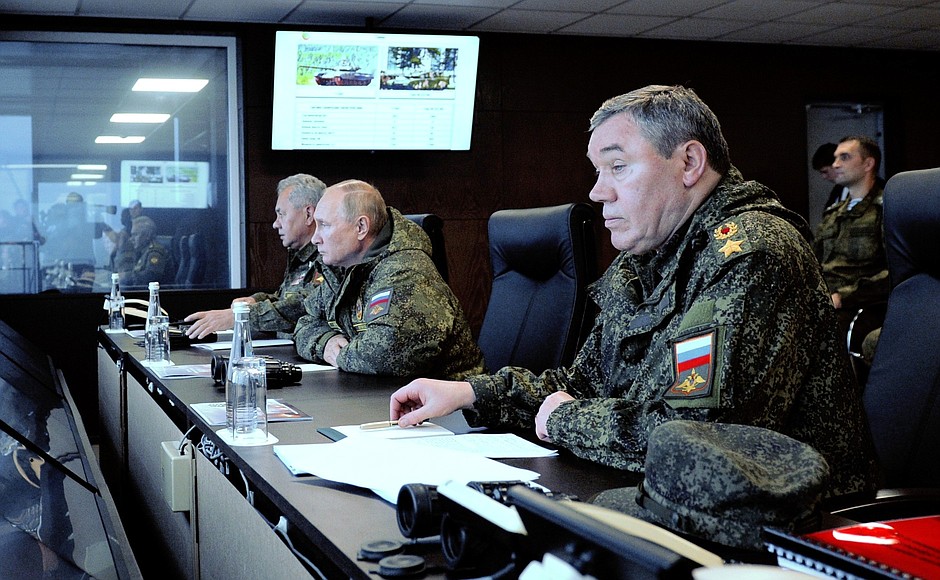
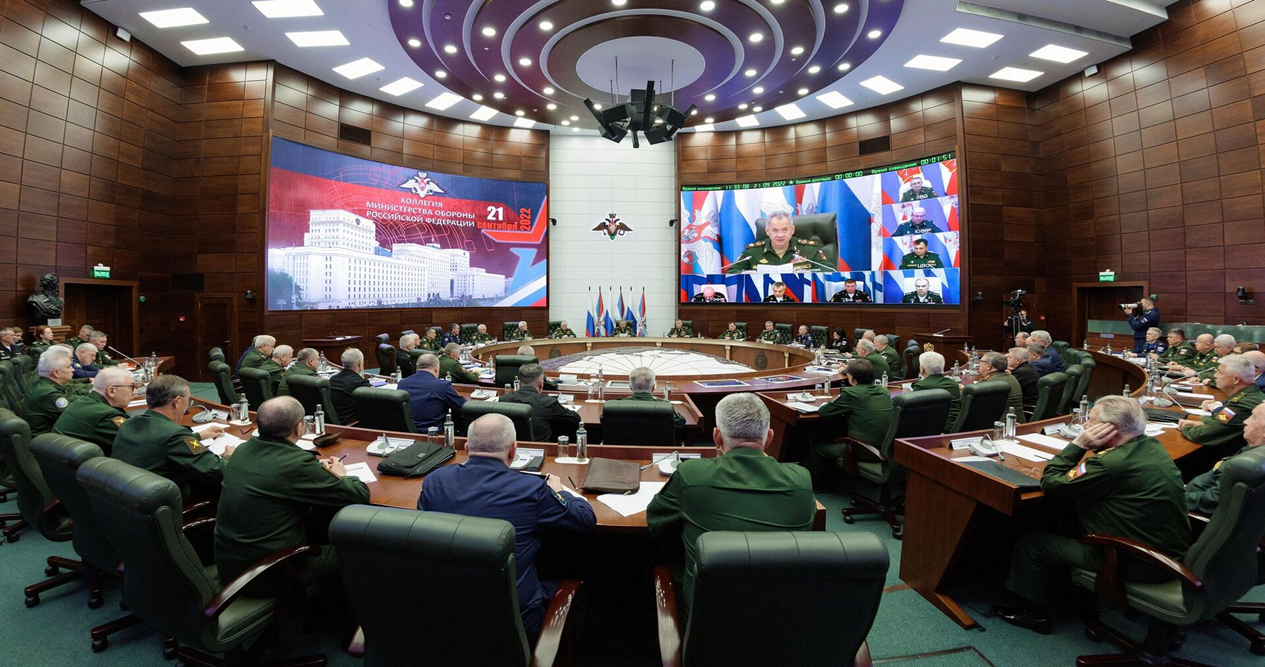
Kazbek and Perimeter remain separate nuclear-release architectures. НЦУО is the glass-and-video floor that watches the force every hour of the day. The fourth and fifth photographs on this page show the kind of briefing hall and leadership watch post that Western and Russian media associate with this layer of command. [DOCUMENTED]
The computer. Official figures, repeated by Shoigu and Mizintsev: 16 petaflops peak and 236 petabytes of storage. The installation does not appear on TOP500. Treat 16 PF / 236 PB as the published card, not a Linpack run anyone outside the building has seen. Integrator named in Western summaries: United Instrument-Making Corporation (OPK, Rostec). Operating system reported: Astra Linux (RusBITech). Processor mix in English secondary sources: Elbrus-8S plus Komdiv-128 accelerators — plausible for the period, not independently confirmed. [SINGLE-SOURCE for hardware mix; DOCUMENTED for the official performance claim as a claim]
Cable plant. Public figures cited on the order of 1,600 km of communications lines including hundreds of kilometers of fiber into the Moscow complex. [SINGLE-SOURCE, carried from the previous version of this page] ОАЦСС is supposed to be the common transport that НЦУО and the subordinate regional defence-management centers share.
What it is for and what it is not. Published jobs include forecasting how an armed conflict can develop, holding a running picture of troop readiness and of the state defence order, watching transport corridors, and ingesting industrial video. It is a C2 and logistics-intelligence floor, not a fire-control radar processor. It does not launch a 53T6 interceptor and it does not replace Cheget. [DOCUMENTED]
STRATEGIC MISSILE FORCES COMBAT CONTROL
The Strategic Rocket Forces (РВСН) have their own automated combat-control chain, sitting under the national authorisation layer.
Signal (Сигнал). English NC3 studies describe Signal as the two-way automated command system for the RVSN. Once authorisation procedures are satisfied, coded signals from central and alternate command posts can reach missile silos and trigger the launch sequence without a US-style two-key ceremony at every silo. Signal also provides feedback on the status of individual missiles to the central posts. [SINGLE-SOURCE for the remote-launch description, Nuclear Information Service and related literature; the existence of an RVSN automated combat-control system is DOCUMENTED in Russian open writing]
Blizzard (Вьюга) and one-way backups. The same literature names a simpler one-way transmission system, Blizzard, that can send commands directly to Missile Regiment Command Posts as a backup to Signal. [SINGLE-SOURCE]
Akatsiya / Granit and naming confusion. "Акация" appears in open sources both as an RVSN-era combat-control name and, separately, as the Ground Forces / air-defence Акация-М / Акация-Э battle-management family. Granit (Гранит) appears in older Soviet C2 writing for strategic automation. Do not merge the flower-named army C2 with the nuclear combat-control chain without a primary source that does so. [UNVERIFIED as a single system; DOCUMENTED that the names are used in more than one context]
Command posts. Open English summaries name a Central Command Post for the RVSN in the Odintsovo area, an Alternate at Balabanovo, and a deeper reserve associated with the Urals (Kitlim / Kosvinsky area). Radio messages are described as able to be transmitted through the granite of Kosvinsky mountain to missile bases. Exact layouts are not public; see Object 1335 (Grot). [SINGLE-SOURCE for the named posts]
Fourth-generation talk. Russian RVSN veterans' writing and MoD statements refer to successive generations of combat-management automation, including work around the Yars force. Treat generation numbers as Russian internal labels, not a Western taxonomy. [SINGLE-SOURCE]
HARDENED POSTS, GROT AND PERIMETER
Russian nuclear C2 assumes that fixed above-ground posts may die in the first minutes of a nuclear exchange. The answer is depth, mobility and a backup that can still speak.
Object 1335 / Kosvinsky Kamen / Grot. Beneath Mount Kosvinsky (Косвинский Камень) in the northern Urals sits Object 1335, associated in open literature with a deeply buried reserve command capability and with Perimeter. The site's own page on this wiki covers the geology, the public procurement trail and the contested "revived Dead Hand" claims of the 2020s. This page does not repeat coordinates or access detail. [DOCUMENTED as existence in open literature; see Grot page for labels]
Perimeter (Периметр), GRAU 15Э601. Perimeter is the guaranteed-retaliation command system Western writers call Dead Hand. It is not a fully automatic doomsday machine that launches without humans in every telling; the more careful Russian and Western accounts describe a semi-automatic backup. If sensors indicate nuclear detonations on Russian territory and contact with the main command posts is lost, officers in special radio command posts can be delegated authority to launch command missiles (15A11 / 15P011 complex in Cold War descriptions). Those missiles fly over the country and broadcast launch orders to surviving ICBM silos, and in later versions to mobile regiments, bombers and, indirectly, submarines. Perimeter is one of several channels that can deliver a launch command; it is the channel designed to work after decapitation. See Perimeter. [DOCUMENTED for the concept; SINGLE-SOURCE for specific GRAU indexes and unit histories]
Pavel Podvig's clarification (2026). A September 2026 note on Russian strategic nuclear forces restates that "Dead Hand" is the general approach — retaliation after ride-out, with preliminary commands enabling later launch orders — and that Perimeter is only one communication system among many. Claims that the Dead Hand was "switched back on" usually confuse public rhetoric with the continuous existence of the backup architecture. [DOCUMENTED as an analyst's synthesis]
Mobile and alternate posts. General Staff and RVSN alternate and mobile command posts (including train- and vehicle-based nodes in Cold War descriptions) can, if authorised, reach the force through Signal and related nets. Airborne posts are covered next. [DOCUMENTED as a class; details sparse]
AIRBORNE COMMAND: IL-80 MAXDOME AND IL-82
Russia and the United States are the two states that publicly operate strategic airborne command posts designed to control nuclear forces if the ground C2 is gone.
Il-80 (NATO Maxdome). Built on the Il-86 airliner, the Il-80 is the Russian analogue of the US E-4B. Open reporting puts about four aircraft in the fleet, normally based at Chkalovsky near Moscow and assigned to a specialist unit subordinated to the National Defence Management Center / General Staff structure. The mission suite is named Zveno-S (Звено-С) in secondary sources. A large canoe fairing above the forward fuselage houses satellite antennas. Two underwing pods each carry a turbine auxiliary power unit for the electronics. A rear fuselage pod contains the Fregat trailing-wire antenna, a VLF system for talking to submerged ballistic-missile submarines — the same job class as the US Navy E-6B Mercury. [DOCUMENTED / SINGLE-SOURCE as marked; TWZ and Russian defence press]
Il-82 (Il-76SK / Il-76VKP). Two aircraft built on the Il-76MD transport, reported as communications relays or as command posts with equipment partly shared with the Il-80. They support the Zveno airborne link. Exact roles remain partly opaque in open sources. [SINGLE-SOURCE]
Modernisation. In May 2019 Deputy Defence Minister Aleksei Krivoruchko said experimental design work on upgrading Il-80 and Il-82 communications and control systems was complete and that re-equipment of operational aircraft had begun, with NPP Polyot as lead developer. A Mi-38-based airborne command post was also mentioned as a future project. Polyot has also modernised Il-22M11 airborne command posts and Tu-142MR gear. [DOCUMENTED, TASS]
What airborne C2 buys. A flying post moves. It is harder to target with a silo-busting warhead aimed at a fixed bunker, and its VLF trailing wire can still reach boats that HF and SATCOM cannot. The cost is endurance, basing, and the fact that the aircraft themselves become high-value targets. Theft of equipment from an Il-80 on the ground in Taganrog, reported by The War Zone, was a reminder that the fleet's security is not only a nuclear problem. [DOCUMENTED as the incident report]
SUBMARINE COMMUNICATIONS: ELF, VLF AND THE SEA
A submerged submarine is a Faraday cage under a conducting blanket. Ordinary HF and VHF die in the first metres of seawater. The physics of that fact drives an entire branch of Russian (and American, Chinese, Indian) strategic communications.
Skin depth. The penetration depth δ of a radio wave in a good conductor is approximately
δ = sqrt(2 / (ω μ σ)) = 503 / sqrt(f σ) metres
with f in hertz and σ the conductivity in siemens per metre. For seawater take σ ≈ 4 S/m. Then: [ESTIMATE using standard formula]
| Frequency | Band | Skin depth in seawater (σ=4 S/m) | Practical note |
|---|---|---|---|
| 82 Hz | ELF | about 28 m | ZEVS band; one-way bell-ringer |
| 76 Hz | ELF | about 29 m | US Wisconsin/Michigan heritage |
| 3 kHz | lower VLF | about 4.6 m | deeper than HF, shallower than ELF |
| 15–25 kHz | VLF | about 1.8–2.3 m | Goliath / shore VLF broadcast band |
| 1 MHz | MF | about 0.25 m | useless for submerged copy |
| 1 GHz | UHF | millimetres | surface only |
A boat at patrol depth cannot copy a VHF net. It can, with a large enough loop and a quiet receiver, copy an ELF or low-VLF broadcast while still deep. The price of ELF is bandwidth: at 82 Hz the channel is measured in bits per minute, not megabits. ZEVS can say "come up for a message" or send a very short coded order; it cannot hold a staff conference. [DOCUMENTED for the architecture; ESTIMATE for the table]
ZEVS (ЗЕВС). The Russian Navy ELF transmitter on the Kola Peninsula near Murmansk. It works at a centre frequency of 82 Hz, frequency-modulated in a band around 81.0–83.3 Hz. The antenna is a ground dipole: two parallel horizontal grounded lines about 60 km long, oriented roughly east–west, with generators pumping 200–300 A and power up to about 2.5 MW in scientific papers (satellite-imagery studies of the feeders and Kolenergo substations have suggested higher facility ratings; treat power figures as a band). The signal has been received at antipodal distances (New Zealand, Antarctica) and by low-orbit satellites (DEMETER, CSES). [DOCUMENTED, scientific literature and Wikipedia summary] Compare the US Seafarer/Sanguine/Project ELF plant at 76 Hz, discussed on the Cutler / Jim Creek page's ELF notes and in the wider VLF literature.
Earth–ionosphere waveguide and Schumann cavity. Below a few hundred hertz the Earth and the ionosphere form a spherical cavity. The fundamental Schumann resonance sits near 7.8 Hz, with harmonics above. An ELF transmitter couples into this cavity and the field fills the Earth. That is why 82 Hz is a global bell. Attenuation is low (a few tenths of a decibel per megametre in good models), so the limit is transmitter moment, receiver noise and the bit rate the modulation will support. [DOCUMENTED for Schumann physics; ESTIMATE for link character]
VLF shore stations. For higher data rates at shallower depths Russia operates and has operated VLF transmitters in the 3–30 kHz band. The German wartime Goliath station was dismantled and rebuilt by the Soviets south of Nizhny Novgorod under the same name — a historical bridge between Kriegsmarine U-boat broadcast and Soviet SSBN broadcast. Other Russian VLF sites appear in open radio-hobby and defence writing (including stations associated with the Baltic and Black Sea approaches); treat individual site lists as incomplete and partly unverified. [DOCUMENTED for Goliath's postwar move; SINGLE-SOURCE for other site names]
Airborne VLF. The Il-80's Fregat trailing wire is the airborne half of the same idea: a kilometres-long antenna towing behind the aircraft, radiating in the VLF band to boats that cannot see a shore station's geometry. The US TACAMO mission is the direct analogue. [DOCUMENTED as role class]
Blue-green laser and other ideas. Occasional Russian and Western papers discuss optical or extremely-high-frequency paths to submarines. None replaces ELF/VLF as the public backbone of strategic submarine broadcast. [UNVERIFIED as operational capability]
RSDN-20 Alpha. A Russian very-long-wave navigation chain (around 11–15 kHz), analogous in job class to the old Western Omega. It is a navigation aid, not a command net, but it lives in the same part of the spectrum and the same engineering culture of large ground antennas. [DOCUMENTED as a navigation system]
HF, STRELA, BURAN AND THE TERRESTRIAL LONG HAUL
Why HF still exists. High frequency (2–30 MHz) reflects from the ionosphere. A shore or garrison transmitter can reach an aircraft or a distant headquarters thousands of kilometres away without a satellite. Cost: narrow bandwidth, fading, and the need for several frequencies so day, night and solar weather do not open a hole. The American analogue is HFGCS (see HFGCS). Russia maintains HF command nets for long-haul backup; open monitoring communities track strategic HF markers (including the famous UVB-76 buzzer, whose exact role remains debated). [DOCUMENTED for HF physics; UNVERIFIED for any specific assignment of UVB-76 to a named C2 system]
Ionospheric skip physics. A ray at frequency f launched at angle Δ reflects if f is below the maximum usable frequency set by the ionosphere's peak plasma frequency f_c and the geometry: MUF ≈ f_c / cos φ, where φ is the incidence angle at the layer. The F2 layer (roughly 250–400 km altitude) carries most long-haul HF. At night the D layer vanishes and absorption falls; by day the D layer eats the lower HF. Solar flares can black out the path for minutes to hours. None of this is unique to Russia; it is why every serious HF C2 net still uses multiple frequencies and sounding. [ESTIMATE / standard ionospheric physics]
Strela and Buran. Soviet and Russian writing uses names such as Strela (Стрела) and Buran (Буран) for generations of military communications and satellite or radio networks. Public sources do not always agree which generation is which, or whether a given Buran is the spaceplane, a satellite bus, or a radio net. Label carefully. [UNVERIFIED as a single coherent public taxonomy]
Radio-relay and troposcatter. The operational glue when fiber is missing or too fragile. Combined-arms armies still sketch static V/UHF masts on the order of tens of kilometres between army and division/brigade posts. Troposcatter (over-the-horizon microwave by forward scatter in the troposphere) bridges a few hundred kilometres without satellites; see also the site's troposcatter page if present. [DOCUMENTED as practice; ESTIMATE for typical hop lengths]
JOINT STRATEGIC COMMANDS AND THE THEATER PICTURE
The post-2008 reform's central operational idea was to stop fighting as separate services glued together at the last minute and to fight as a theater. Each military district in peacetime is dual-hatted as a joint strategic command (ОСК) in operations. The district commander is supposed to own the ground armies, the air and air-defence army, and the fleet or flotilla assigned to that theater. Jamestown's account of the reform notes that the high commands of the Ground Forces, Aerospace Forces and Navy became, in effect, structural subunits of the General Staff for manning, equipping and doctrine, while the ОСК fought the war. [DOCUMENTED]
Why it matters for C3. A joint commander needs a joint picture. That means the district node must ingest air tracks, maritime plots, ground locations and logistics status on one transport. ОАЦСС and ЕСУ ТЗ are the paper answers. In practice, each service still brings its own radios, its own encryption and its own habits. The Ukraine war, fought mostly under the Southern and Western (and later recreated Moscow/Leningrad) district umbrellas, showed both the power of a joint artillery-and-UAV kill chain when it works and the fragmentation when battalion radios cannot talk to brigade staff systems. [DOCUMENTED as pattern]
Northern Fleet as a fifth ОСК. Open reporting dates a Northern joint strategic command to December 2014, reflecting the Arctic's rise as a strategic theater — SSBNs, ice-edge aviation, and the Kola Peninsula's ELF and naval infrastructure. Arctic C3 has special problems: HF absorption in polar cap blackouts, limited fiber, and dependence on Molniya/Meridian geometry. [DOCUMENTED for the ОСК; ESTIMATE for the physics emphasis]
SOVIET ROOTS: SISTEMA UPRAVLENIYA AND THE AUTOMATED IDEAL
Long before ОАЦСС, Soviet military science spoke of a система управления войсками — a system of troop control — that fused reconnaissance, decision and strike. Marshal Nikolai Ogarkov's reconnaissance-strike complex was the operational expression of that idea: sensors find, C2 decides, missiles or aviation kill, on a timeline measured in minutes. The Oka and later the Iskander (see Iskander) were built as shooters for that complex. The communications half had to be as fast as the shooter. [DOCUMENTED]
Centre and Semenikhin. Academician Vladimir Semenikhin's design bureau work on automated command systems (including the Centre system and contributions to Kavkaz) is the engineering ancestry of much of what later became Kazbek-era automation. Leningrad OKB Impulse, associated with RVSN combat-control designer T.N. Sokolov, sits in the same genealogy for the missile force's own nets. [SINGLE-SOURCE for personal credits; DOCUMENTED as institutional lineage in NC3 literature]
Primary and secondary nets. The Soviet textbook split — primary (transmission) versus secondary (user services) — still structures how Russian officers talk about ОАЦСС. A Western reader who thinks in "IP network with apps on top" is not wrong, but the Russian professional literature still sounds like a PTT hierarchy: channels first, then telephone and data on those channels, then encryption wrapped around the services. [DOCUMENTED]
COMMAND SHIPS AND NAVAL C3
The Navy's contribution to national C3 is not only SSBN broadcast. Flagships and dedicated command ships carry the fleet commander's staff and the long-haul radios that tie a maritime theater to Moscow.
Shore and ship. Each fleet maintains shore communications centres that gateway HF, VHF/UHF, satellite and cable into ОАЦСС. Ships carry their own suites; major surface combatants and auxiliaries host staff spaces with satellite terminals (including stations that talk to Meridian and GEO birds). Exact fits are ship-class dependent and mostly unpublished. [DOCUMENTED as architecture; UNVERIFIED for any specific modern fit]
SSBN communication discipline. A ballistic-missile submarine on patrol minimises emissions. It listens on ELF/VLF for bell-ringers and scheduled broadcasts, comes to communications depth or streams a buoy/antenna for higher-rate traffic when required, and goes deep again. The asymmetry — loud shore and airborne transmitters, quiet boats — is the same asymmetry the Kriegsmarine lived with under Goliath, and the same one TACAMO and ZEVS serve today. [DOCUMENTED as doctrine class]
MORE ON ОАЦСС FIELDING AND VOYENTELEKOM
Open procurement and industry writing in the 2010s made Voyentelekom and related contractors the commercial face of military long-haul: leasing ЕСЭ capacity, building monitoring centres, delivering satellite ground stations. Corruption cases around some of those contracts are part of the public record and part of why fielding lagged the slides. [SINGLE-SOURCE for specific cases; DOCUMENTED as a procurement pattern]
Garrison "comprehensive fit-out". The modernisation language of the 2010s rebuilt many garrison nodes as turnkey objects with fiber cross-connects, open and closed ATS, and VoIP gateways. That work is real and visible. It is also peacetime infrastructure: a beautiful garrison switch does not help a brigade that has driven 200 km from its garrison into a jammed salient. The field KAS fleet and the tactical radios are the wartime half, and they are where Ukrainian experience has been most bruising. [DOCUMENTED as distinction]
Interoperability complaint. Russian professional journals have repeatedly noted that KAS sets built for MoD, Rosgvardiya, FSB and FSO do not all interoperate cleanly — different encryption, different management planes, different connector cultures. A whole-of-government crisis that needs MoD and Rosgvardiya on one net discovers that problem in the first hour. НЦУО was partly sold as the place that forces the picture together anyway. [DOCUMENTED as recurring complaint]
LINK BUDGETS AND JAMMING, IN PLAIN NUMBERS
Free-space path loss. FSPL (dB) ≈ 20 log10(d_km) + 20 log10(f_MHz) + 32.44. A 1 GHz link over 50 km already loses about 126 dB before antennas and atmosphere. A 10 W transmitter with 0 dBi antennas arrives at about −116 dBm before noise — workable for narrowband data, hopeless for uncoded video. This is why tactical video wants short hops, relays or satellites with real aperture. [ESTIMATE]
Jammer math. A jammer's advantage scales with its power and its proximity to the victim receiver (the jammer-to-signal ratio at the receiver). Frequency hopping and direct-sequence spreading buy process gain: a hop set of N channels, or a spreading chip rate R_c over data rate R_b, gives roughly 10 log10(N) or 10 log10(R_c/R_b) decibels of protection before coding. Azart's marketing claims live in this math; whether a given fielded set realises the brochure gain under a Ukrainian or Russian jammer is an empirical question the war is answering unevenly. [ESTIMATE for the math; DOCUMENTED that hopping/SDR are the design approach]
HF versus SATCOM under nuclear attack. Satellites can be blinded, jammed or kinetically attacked. HF ionospheric paths degrade under nuclear-induced ionisation (the same HEMP event that kills electronics also raises D-layer absorption). ELF in the Earth–ionosphere cavity is relatively robust to local ionospheric chaos because the cavity still exists. That is one reason nuclear C2 keeps ELF/VLF even in a satellite age. [DOCUMENTED as general NC3 reasoning]
COMPARISON CLASS: WHAT THIS IS LIKE AND UNLIKE
Western readers reach for NMCC, Cheyenne Mountain, NAOC (E-4B), TACAMO (E-6B), HFGCS and the Nuclear Football. Useful analogies, bad identities.
| Russian element | Closest Western analogue | Important difference |
|---|---|---|
| Cheget | Nuclear Football | Three cases (President, MoD, CGS); authorisation terminal, not a public "button" |
| Kazbek / Kavkaz | Presidential NC3 conference fabric | Caucasus code-name family; Baksan path language in English sources |
| НЦУО | NMCC + whole-of-government fusion floor | Also day-to-day defence-economy watch; supercomputer claims |
| Signal | SAOC / positive control to ICBMs | Remote silo enablement described differently from US two-key culture |
| Perimeter | No exact US equivalent (legacy Permissive Action / airborne options differ) | Command-missile broadcast backup |
| Il-80 + Fregat | E-4B + E-6B roles partly combined | Smaller fleet; VLF trailing wire on the command post itself |
| ZEVS 82 Hz | US Project ELF 76 Hz | Still characterised as active in scientific literature |
| ОАЦСС | DISN + DSN ambitions | Heavy peacetime reliance on civilian ЕСЭ leases |
| ЕСУ ТЗ / Strelets | WIN-T / JCR / ATAK class ambitions | Fielding and training gaps exposed in Ukraine |
[DOCUMENTED as analogy class; the differences column is the author's synthesis]
THE GENERAL STAFF AS AN INSTITUTION
Western writing on the Russian military often fixates on equipment. The General Staff (Генеральный штаб) is the older and deeper fact. It is a professional body that plans campaigns, runs the intelligence directorates that feed warning, owns the communications directorate that builds ОАЦСС, and staffs the duty shifts that would turn a Cheget authorisation into executed orders. CNA's institutional studies describe it as the "central brain" of the Armed Forces; Jamestown describes the post-2008 reforms as concentrating operational power there while service main commands shrank into force-provider roles. [DOCUMENTED]
Main Directorate of Communications. The Signal Troops' senior office is simultaneously a branch leadership and a General Staff deputy-chief function. That dual hat is how communications policy stays tied to operational planning rather than drifting into a pure PTT bureaucracy — at least on paper. Courier-mail (фельдъегерско-почтовая связь) remains in the same family for the documents that must still move as atoms. [DOCUMENTED]
Intelligence feeds. GRU and other intelligence paths into the General Staff are not "C3" in the Signal Troops sense, but they are inputs to the same decision loop. Space surveillance, SIGINT satellites (the Tselina lineage), UAV feeds and agent reporting all compete for the duty officer's attention. A C3 article that ignored them would describe pipes without water. [DOCUMENTED as relationship]
MOBILE COMMAND POSTS AND TRAINS
Cold War open literature described Soviet General Staff and RVSN mobile command posts on road vehicles and, in some accounts, on special trains — the logic being that a moving target in a rail-rich country is harder to find than a fixed bunker whose coordinates were known since the 1960s. How much of that mobile fleet remains active is not clearly published. The Il-80 fleet is the airborne half of the same idea. Ground-mobile nuclear C2 vans associated with Kavkaz appear in NC3 studies as part of the Moscow-area fabric. Treat survivability claims for any specific wagon or van as unverified. [SINGLE-SOURCE / UNVERIFIED]
CRYPTOGRAPHIC CULTURE VERSUS CONVENIENCE
Soviet ЗАС culture assumed that the enemy is always listening. Wartime Russian practice in Ukraine often assumed that the enemy is not — until a HIMARS round arrived on a headquarters that had been talking too long on an open net. The technical fix (issue Azart, train Strelets operators, enforce emission control) is easy to write in a directive. The cultural fix (make the secure path the easy path) is harder. Systems that require three times as many button presses as a cell phone lose to cell phones. That is a C3 design lesson, not only a discipline lesson. [DOCUMENTED as synthesis of open analyses]
STATUS
ОАЦСС is the official target architecture and the name used for the digital fusion of Armed Forces communications. Pieces exist: rebuilt nodes, satellite generation mix, district territorial nets, leased ЕСЭ trunks, C2 systems hanging off the same posts. Completeness is uneven by echelon and by year. Nuclear C2 (Kazbek, Signal, Perimeter, Il-80, ZEVS) is a different and older seriousness. Tactical C3 is a work in progress under fire. Treat official descriptions as design intent plus partial fielding, not as a finished DSN clone, and treat nuclear C2 claims with the respect due to a system built to outlast cities. [DOCUMENTED]
ОАЦСС: THE UNIFIED AUTOMATED DIGITAL COMMUNICATIONS SYSTEM
Soviet and Russian signal theory always split primary networks (the physical paths) from secondary networks (telephone, telegraph, data services on those paths). ОАЦСС is the project to stop treating service nets and service branches as separate empires and fuse General Staff, services, rear and military administration into one digital telecommunications space. [DOCUMENTED, carried forward]
Paper architecture has four physical echelons plus management and security:
Ground stationary component is planned as ИЦТСС — Integrated Digital Territorial Communications System — built by zones: a central zone plus military-district / OSK zones. It is described as a general-purpose digital net for mixed traffic using packet/IP and NGN ideas. [DOCUMENTED, previous version]
Structural pieces of ИЦТСС:
Functional slices listed in the design papers: transport net, access net, communications-management system, comprehensive information security, logistics/support, object (site) nets, mobile-subscriber net, navigation and IFF-type services. A main access-and-interconnect switching station (ГКСДС) plus central and zonal switches sit on top of that. MoD also talks about a departmental communications operator at every presence point and ЕСЭ interconnect — a military telco function so the army can buy, monitor and police quality on mixed military/civilian paths. [DOCUMENTED]
ЕСУ ТЗ / YESU-TZ and Sozvezdie. At the operational and tactical layers the Ground Forces digital C2 architecture is often named ЕСУ ТЗ (Единая система управления войсками и оружием в тактическом звене — Unified Command and Control System for Troops and Weapons at the tactical level), associated with the Sozvezdie (Созвездие) concern. Armada International and other defence press describe YESU-TZ as linking the НЦУО level down through military districts to combined-arms armies. Rubikon and Bastion appear in Russian procurement and industry writing as related automation / communications programme names; public English sources do not always agree on boundaries. [SINGLE-SOURCE for the YESU-TZ description; UNVERIFIED for a clean Rubikon/Bastion taxonomy]
NODES — WHERE C3 ACTUALLY LIVES
A узел связи is not a radio. It is an organizational-technical bundle of people and gear at a command post or a channel-switching point. Types:
Stationary or field. Automated or not. An OSK package on paper includes a nodal signals brigade, a territorial signals brigade, a rear signals battalion, the district HQ node, an automated-control center, a C2/comms control point, courier-mail and security-control nodes. [DOCUMENTED]
Nodal units deploy and run the command-post node, radio and satellite lines, and the "tie-in" lines that hang a headquarters onto the stationary ОАЦСС ground echelon and onto ЕСЭ. That tie-in is the Russian version of "the base switch hits the long-haul net."
A modernized garrison node typically carries: border router, VoIP gateway, open-segment digital ATS (the ordinary official phone), closed/encrypted segment, multiplex and fiber cross-connects. That open ATS is the everyday cousin of DSN dial tone. There is no public 312-style area-code directory. [DOCUMENTED]
Field equivalent is the комплексная аппаратная связи (КАС) — a shelter or vehicle set. Recent writing after the Ukraine war talks about modular blocks: channel-forming (radio-relay, HF/VHF, broadband wireless, tropo-relay, digital radio/cellular base, multiplex), infocomms (servers, routers, Ethernet, fiber and copper cross, media converters, IP-ATS for open and closed segments), encryption, masts, power, life support. Dozens of KAS types exist across MoD, Rosgvardiya, FSB, FSO. They do not all interoperate cleanly. That is a recurring complaint in Russian professional literature. [DOCUMENTED]
There is also an АСУ ОАЦСС — a management system for the comms system itself (organizational, operational-technical and technological control of resources and upkeep). Signal chiefs manage the net; combined-arms commanders use it. [DOCUMENTED]
BEARERS
[DOCUMENTED, carried forward and lightly expanded]
SATELLITES: MOLNIYA GEOMETRY AND THE MODERN CONSTELLATION
Molniya orbit physics. A Molniya orbit is a highly elliptical Earth orbit with inclination about 63.4 degrees, period about 12 hours, and apogee over the Northern Hemisphere. The critical inclination cancels apsidal precession caused by Earth's oblateness, so the apogee stays at high northern latitude. A satellite near apogee moves slowly (by Kepler's law: areal velocity is constant, so speed is least far from Earth) and can hang for hours over Russia, the Arctic and the North Atlantic — exactly the latitudes where a geostationary satellite sits on the horizon or below it. Three Molniya-plane satellites can give continuous northern coverage. The cost is a perigee that dives through the Van Allen belts and a ground antenna that must track. [DOCUMENTED for the orbital mechanics; ESTIMATE for the operational description]
Meridian (Меридиан). The modern Russian military and dual-use communications satellites in Molniya-type highly elliptical orbits, replacing older Molniya birds for Arctic, Siberian and Far East coverage. They support ships, aircraft and ground stations where GEO cannot. [DOCUMENTED]
Raduga / Globus. Geostationary military communications satellites (Raduga-1M / Globus-M class in open writing), carrying protected trunks in several bands (L, C, X, Ka appear in secondary sources). [SINGLE-SOURCE for band lists]
Blagovest (Благовест). A four-satellite geostationary constellation on the Ekspress-2000 bus, providing Ka/Q-band broadband, telephony and military links, with a published design life around 15 years. [DOCUMENTED, Wikipedia and satellite encyclopedias]
Luch / Olympic. Data-relay and other geostationary assets (see Luch) support space-to-ground and space-to-space links. Gonets (see Gonets) is a civilian/dual-use LEO messaging constellation sometimes discussed alongside military store-and-forward needs. [DOCUMENTED as separate programmes]
Tselina and ELINT. Tselina (Целина) was the Soviet electronic-intelligence satellite family, not a communications constellation. It belongs in the reconnaissance picture that feeds C2, not in the ОАЦСС trunk list. Lotus-S1 and other modern ELINT names appear in open space writing as successors. [DOCUMENTED as distinction]
Link budget sketch. A satellite downlink's received power is P_r = P_t G_t G_r (λ / (4 π R))^2 L, with L the non-ideal losses. At GEO, R ≈ 40,000 km; at Molniya apogee, R is smaller (roughly 40,000 km too at apogee altitude ~40,000 km — similar range, but the elevation angle from a Russian user is much better). The (1/R)^2 term means a 3 dB change in range is a factor of two in power. Jam resistance and anti-spoofing live in waveform and antenna design (nulling, frequency hopping, CRPA — see Kometa CRPA), not in orbit choice alone. [ESTIMATE]
EARLY WARNING, RADARS AND A-135
Command is blind without warning. The Russian missile-attack warning system (СПРН) and space and missile defence feed the national C2 picture.
Satellite early warning. The Soviet Око (Eye) constellation in Molniya and geosynchronous orbits watched for ICBM launches by infrared. Its successor is the Unified Space System (Единая космическая система, ЕКС) with Tundra (Тундра) satellites. Coverage, continuity and false-alarm history are contested in open literature; the 1983 Petrov incident remains the classic cautionary tale about trusting a single sensor path. [DOCUMENTED for the programme names; SINGLE-SOURCE for readiness claims in any given year]
Voronezh-class radars. Modern over-the-horizon and early-warning radars of the Voronezh family replace older Dnepr/Daryal/Volga nodes. See Voronezh and Solnechnogorsk SPRN. They provide the ground-radar half of the launch picture. [DOCUMENTED]
Don-2N and A-135/A-235. The Don-2N radar at Sofrino and the A-135 (modernising toward A-235/Nudol) ABM system around Moscow are both sensors and shooters in the strategic picture. They connect to national C2 as the defence of the capital and of the national command authority. See Don-2N and A-135 / A-235 Nudol. [DOCUMENTED]
Krona and space surveillance. Optical and radar space-surveillance nodes such as Krona catalogue objects on orbit — relevant to whether a launch warning is a missile or a routine space launch, and to ASAT situational awareness. [DOCUMENTED as role]
Integration point. Early-warning alerts are described as arriving through the special Kavkaz fabric so the three Chegets wake together, and as lighting duty-general terminals (Krokus in older descriptions) before political authorisation. The НЦУО Combat Control Centre is the peacetime glass floor for the same picture. None of this is a single wire; it is a set of overlapping paths with different latencies and failure modes. [SINGLE-SOURCE for the Krokus/Kavkaz wake-up path]
GLONASS AND POSITIONING
GLONASS (ГЛОНАСС) is the Russian global navigation satellite system. It is not a command net, but almost every modern Russian C2 terminal, artillery system, drone and precision weapon assumes a positioning source. Strelets and Azart variants can use GLONASS or GPS. Jamming and spoofing of GNSS have been routine in the Ukraine war, which is why controlled reception pattern antennas and inertial backups matter (see GLONASS, INS, Kometa CRPA). A C3 system that collapses when GNSS collapses is not a wartime C3 system. [DOCUMENTED]
EMP, BLACKOUT AND THE GARRISON PROBLEM
E1 coupling. The fast HEMP E1 pulse has a rise time of a few nanoseconds and a peak field that, in unclassified test standards, is treated on the order of tens of kilovolts per metre at the surface under the burst. A conductor of length ℓ picks up an open-circuit voltage on the order of E × ℓ. A 100 m Ethernet or power run in a 50 kV/m field is a multi-megavolt theoretical open-circuit number before breakdown and shielding; practical coupling is less, but unprotected electronics die. Fiber replaces the long copper antenna; metal buildings and cabinets provide attenuation measured in tens of decibels if seams and penetrations are treated. Strategic bunkers are built for this. A rented office housing a territorial node usually is not. [ESTIMATE for orders of magnitude; DOCUMENTED for the E1/E2/E3 taxonomy]
E3 and the long line. The slow E3 component couples to very long conductors — railroad tracks, power grids, long wire antennas — and drives geomagnetically induced currents that saturate transformers. A military net that leases ЕСЭ fiber still depends on civilian power at the nodes unless it has its own generation. Hardened C2 sites carry diesel and battery plants; the question is endurance in days, not minutes. [DOCUMENTED as engineering; UNVERIFIED for any specific Russian site's fuel endurance]
Operational blackout. Russian doctrine for nuclear and high-intensity war assumes loss of many nodes. The answer is not a single hardened path; it is many paths and the authority to keep commanding on whatever still answers. Perimeter exists because that assumption was taken seriously in the 1980s. Digitization that concentrates traffic through a few IP cores can fight that assumption unless the cores are themselves redundant and hard. [DOCUMENTED as design philosophy]
HUMAN FACTORS AND THE CHEGET OFFICER
Hardware is half of C3. The officers of the special strategic communications service who live with the Cheget cases (unit identities appear in investigative reporting; treat numbers as single-source) are trained to operate and guard the terminals under movement, under alcohol-free discipline, and under the knowledge that a wrong symbol is a geopolitical event. Early-warning duty generals who sit on Krokus-class terminals are trained to wake the principals without crying wolf — the 1983 Petrov episode is taught for a reason. At the other end of the force, a conscript with an Azart he was never trained on will use a Xiaomi phone. Both are "Russian C3." [DOCUMENTED as human-factors reality; SINGLE-SOURCE for unit details]
INFORMATION SECURITY AND ЗАС
Soviet and Russian practice wraps encryption (ЗАС — засекречивающая аппаратура связи) around telephone and data services as a layer distinct from the bearer. Open and closed ATS segments in a garrison node are the everyday expression: one dial tone for unclassified official traffic, another for encrypted. Nuclear C2 encryption is a separate, higher world. The Ukraine war's lesson that units used open cellular voice is partly a key-management and issue problem (not enough closed sets) and partly a culture problem (convenience under fire). No amount of ОАЦСС PowerPoint fixes culture. [DOCUMENTED]
WHAT SUCCESS LOOKS LIKE
On a day when the system works, a UAV operator marks a target in a Strelets-class terminal, the battery fires within minutes, НЦУО sees the readiness of the brigade and the factory that made the shells, a Voronezh radar tracks a foreign test launch without waking Cheget, and a Delta-class boat at depth copies an ELF group that means "all quiet." On a day when it fails, a colonel shouts into a jammed VHF net, a commercial phone reveals a dugout's location, a satellite terminal waits for a bird that is offline, and the joint picture at district level is six hours old. The architecture described on this page is the attempt to make the first day more common than the second. Open evidence from 2022–2026 says both days still happen. [DOCUMENTED as synthesis of open reporting]
TACTICAL C2: STRELETS, ANDROMEDA, AKATSIYA AND RADIOS
ЕСУ ТЗ / Sozvezdie-M2. The Ground Forces tactical digital architecture intended to give commanders a common operating picture from army down to battalion. Fielding has been uneven by year and by formation. [DOCUMENTED as intent; SINGLE-SOURCE for any claim of full fielding]
Akatsiya-M / Akatsiya-E. Акация-М for logistics, organisation and battle management at brigade/division level; Акация-Э for operational and tactical air battle management, linking to GBAD C2 such as Baikal, Universal, Fundament and Polyana. [SINGLE-SOURCE, Armada International]
Andromeda-D (Андромеда-Д). VDV (airborne) operational-tactical C2, providing a near-real-time plot of the battlefield to coordinate airborne forces. Capabilities are described as similar in class to Strelets. [SINGLE-SOURCE]
Strelets (Стрелец). Ruggedised small-unit reconnaissance and C2 kit, part of the Ratnik soldier system in many descriptions. It is meant to automate the transfer of target data between sensors and shooters — the reconnaissance-strike complex at squad and battery scale. In Ukraine, Western analysts (TRADOC G-2 Red Diamond, National Interest) report that Strelets exists but is often under-used for lack of trained operators, and that Russia has been grafting commercial wireless and mobile applications onto it to fill gaps. [DOCUMENTED as existence; SINGLE-SOURCE for usage rates]
R-168 Aqueduct and R-187 Azart. The declared tactical radio foundation and its software-defined successor. Azart was marketed as jam-resistant with built-in encryption. Corruption cases and delivery shortfalls around Azart and satellite-station contracts appeared in Russian and Western reporting in the 2010s–2020s. Interoperability with older R-168 and with allied radios is not publicly demonstrated. [DOCUMENTED / SINGLE-SOURCE]
Closed video. ЗВКС-М and mobile МК-ВКС closed video-conferencing kits are another payload on the ОАЦСС transport, used heavily at the НЦУО and district level. [DOCUMENTED as a named kit class in the previous version]
ELECTRONIC WARFARE AND THE UKRAINE WAR
The war in Ukraine is the largest open laboratory for Russian C3 since 1945. The lessons are harsh and unevenly absorbed.
Early failures (2022). Open analyses (RUSI "Russian Comms in Ukraine: A World of Hertz", Hudson, academic EW surveys) describe unencrypted or poorly encrypted radios, incompatible legacy and new sets, disrupted cellular networks, and widespread use of civilian mobile phones. Those habits made units vulnerable to interception, geolocation, jamming and ambush. Ukrainian forces and Western-supplied EW punished emitting and chatting on open nets. [DOCUMENTED as a consensus of open analyses]
Adaptation. By 2023–24 reporting described more use of field cable and short microwave links, more dispersed and hardened headquarters, tighter emission control in better units, and the grafting of commercial mesh and Android-style fire-control apps onto military kits (the Ukrainian Kropiva "Uber for artillery" being the model both sides noticed). Russia also fielded and iterated heavy EW (see R-330Zh Zhitel and related systems) against Ukrainian GNSS and tactical links. [DOCUMENTED / SINGLE-SOURCE]
The structural point. ОАЦСС and ЕСУ ТЗ describe a finished digital force. A motor-rifle company under fire experiences radios that may not match, batteries that die, and a cell tower that is jammed. C3 is only as real as the node that is up and the radio that is issued. Official media talking about multi-channel automated communications and modernised satellites does not delete the foxhole gap; it names the target architecture. [DOCUMENTED as the judgment of multiple open sources]
SURVIVABILITY, EMP AND HARDENING
Requirements on paper. Russian signal doctrine wants the same four adjectives every year: stable, continuous, timely, covert. Add jamming resistance, reconnaissance protection and information security. ОАЦСС is also supposed to present a common interface toward ЕСЭ so the military net can live inside the national telecom space without becoming just Rostelecom in uniform. That last point is the strategic vulnerability and the strategic convenience: lease civilian digital paths in peace; fight to keep or replace them in war. Same logic as AUTOVON riding AT&T, written in another language. [DOCUMENTED]
Nuclear effects on electronics. A high-altitude nuclear detonation produces a prompt gamma-driven electromagnetic pulse (HEMP) with E1 (fast, couples to short lines and unprotected electronics), E2 (intermediate, lightning-like) and E3 (slow magnetohydrodynamic, couples to long conductors and can damage transformers). Hardening means Faraday shielding, surge arrestors, fiber in place of long copper, redundant paths and operational procedures that assume some nodes die. Russian strategic C2 (Kazbek, Signal, Perimeter, Il-80) is designed around that assumption; garrison VoIP switches generally are not. [DOCUMENTED for HEMP physics as textbook; UNVERIFIED for the hardness of any specific Russian node]
Redundancy pattern. Main / alternate / mobile command posts; cable / radio-relay / satellite / HF / airborne relay; Signal / Blizzard / Perimeter; shore VLF / airborne VLF / ELF bell-ringer. The pattern is deliberate overkill. The question open sources cannot answer is how much of the Cold War redundancy still works after decades of deferred maintenance and how much was actually digitised. [ESTIMATE of the question; DOCUMENTED as the design pattern]
HISTORY IN BRIEF
PHYSICS APPENDIX: ORDERS OF MAGNITUDE
These calculations illustrate why the architecture looks the way it does. They are not measurements of classified transmitters.
1. ELF bit rate. A channel with bandwidth B hertz has a Nyquist symbol-rate limit of order 2B. Around 82 Hz with a modulation bandwidth of a few hertz, a few bits per second is already optimistic; practical ELF broadcast is often described in bits per minute. That is enough for a bell-ringer or a short coded group, not for video. [ESTIMATE]
2. VLF antenna efficiency. A vertical monopole much shorter than a wavelength has radiation resistance R_rad ≈ 40 π² (h/λ)² ohms. At 20 kHz, λ = 15 km; a 300 m effective height gives R_rad ≈ 0.16 Ω. Most of the transmitter power burns in ground and tuning loss unless the earth mat and helix are excellent — which is why Goliath-class stations occupy square kilometres of wet ground. [ESTIMATE]
3. HF skip distance. A one-hop F2 path with reflection at 300 km altitude and takeoff angle 10 degrees has a ground range on the order of 1,000–2,000 km; multi-hop paths girdle the Earth. Frequency must sit under the MUF and above the absorption-limited LUF. [ESTIMATE]
4. Molniya dwell. In a 12-hour elliptical orbit with apogee ~40,000 km and perigee ~500 km, the satellite spends a large fraction of each orbit near apogee (Kepler: time averages toward slow apogee motion). Roughly eight hours of useful high-elevation northern coverage per apogee pass is the engineering rule of thumb for Molniya communications design. [ESTIMATE]
5. Fiber versus radio under HEMP. Optical fiber does not pick up E1 the way a long copper pair does. A digitised garrison that has replaced copper trunks with fiber gains hardness on those trunks; the routers and power supplies at each end remain the soft points. [DOCUMENTED as general engineering]
WHAT IT IS NOT
DIFFERENCES BETWEEN SOURCES
TIMELINE
IN ONE SENTENCE
Russian C3 is the layered machine — Cheget/Kazbek/Kavkaz for nuclear authorisation, НЦУО and the ОСК for day-to-day force management, Signal and Perimeter for the strategic missiles, ELF/VLF and Il-80 for the boats, and ОАЦСС with its fiber, relay, HF and satellites for everything else — that is supposed to let Moscow command under fire, and that still depends, at the bottom, on whether the radio in a trench actually works.
RELATED ARTICLES
SOURCES AND HOW TO READ THEM