WHAT IT IS
Perimeter (Russian: Система «Периметр», GRAU index 15Э601, "15E601" in Latin script) is the Soviet, now Russian, guaranteed-retaliation command system. Its job is narrow and very serious: if the normal chain that carries a nuclear launch order from the national leadership down to missile units, submarines and bombers has been destroyed, cut or jammed, Perimeter provides a separate way to get a launch order to every strategic force that still exists. In the West it is called Dead Hand, from the Russian nickname «Мёртвая рука» (Mertvaya Ruka).
Perimeter is on combat duty today. It entered service in January 1985, was confirmed as operational by the commander of the Strategic Missile Forces in December 2011, and has been repeatedly modernised since, most visibly with the newer Sirena-M command missiles that went onto duty at Yurya in 2022. This article treats it as what it is: a working, maintained part of Russia's nuclear command structure.
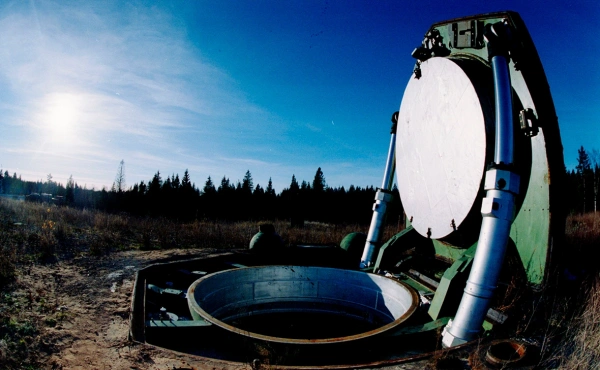
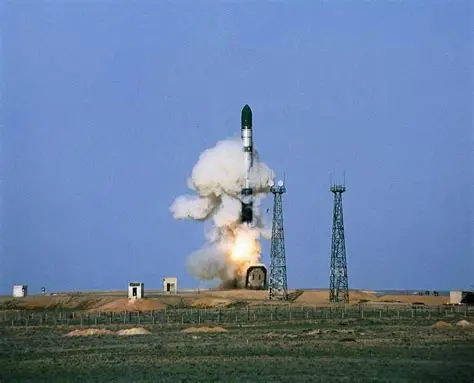
The visible, physical heart of Perimeter is a command missile: an ICBM-class rocket that carries a powerful radio transmitter in place of a nuclear warhead. It lifts out of a hardened silo (or, in later versions, a mobile launcher), climbs to an altitude of thousands of kilometres, and while it coasts over home territory it broadcasts coded launch orders to every launcher and command post that is equipped to listen. The nearest Western equivalent was the U.S. Emergency Rocket Communications System (ERCS), which used modified Minuteman II missiles as flying radio stations.
Around that missile sits the rest of the system: special command posts that can order it up, a network of hardened bunkers and automated communications, receivers fitted to every strategic launcher, submarine and bomber, and (according to the people who built it) a crisis-mode logic that watches for the signatures of nuclear attack and for the silence of the General Staff before it allows authority to pass to a duty crew deep underground.
This page is a one-stop reference. It covers why the system exists, how an order travels through it, what it monitors and why those particular signals, what the hardware is (with the command missile in depth), and the physics behind the parts that matter most: how a missile-borne transmitter beats jamming and nuclear effects, how a lofted trajectory buys broadcast time, and how seismic, optical, radiation and pressure sensors recognise a nuclear burst. Parts that are well documented are stated plainly. Where a detail comes from one source, from a single former insider, or is an engineering inference of mine rather than a published figure, the text says so.
QUICK FACTS
THE PROBLEM IT WAS BUILT TO SOLVE
Nuclear deterrence rests on one idea: the other side must believe you can strike back after they hit you. That belief fails if your retaliation can be prevented by killing the few people who can order it, or by cutting the wires and radio links that carry the order. By the early 1970s, Soviet planners had two reasons to worry.
The first was electronic warfare. The Soviet engineers who wrote the requirement for Perimeter said so directly: at the start of the 1970s, with real possibilities of highly effective radio-electronic suppression of the Strategic Missile Forces' combat-control equipment by a potential enemy, the task of guaranteed delivery of combat orders from the highest levels (the General Staff and the Strategic Missile Forces headquarters) to command posts and individual launchers on alert had become urgent. Ordinary links (cable, radio relay, HF and VHF radio, satellite) can be jammed or physically cut, and they can all be hit by the electromagnetic and ionospheric effects of high-altitude nuclear bursts.
The second was the shortening clock. Better missile accuracy, submarine-launched missiles that could approach close to the coast, and from December 1983 Pershing II missiles in West Germany with very short flight times made a decapitation strike (an attack on the leadership, the capital and the main command posts before retaliation could be organised) look feasible to Soviet planners. Soviet officers of the time assumed they might have only some 10 to 15 minutes between detection and impact. A leadership that expects to be killed in 10 minutes has two options: launch on unconfirmed warning, which is dangerous, or make sure that retaliation will happen anyway, which is Perimeter.
The Soviet Union had tried to solve this before. A 1967 system called «Сигнал» (Signal) is sometimes cited as an earlier attempt to push pre-prepared orders (around 30 of them, according to one account) from headquarters to missile units. Perimeter is the later and much more robust answer to the same nightmare: a communications path that does not use the infrastructure an attacker is going to destroy first.
THE SELF-DETERRENT IDEA
The most interesting thing the builders said about Perimeter is that it was not designed only to scare the Americans. It was also designed to slow down the Soviet leadership.
According to Valery Yarynich and Alexander Zheleznyakov (both quoted in Nicholas Thompson's 2009 Wired article), the system worked as a buffer against hasty decisions. If radar reported something that looked like an attack but was ambiguous (the famous examples are a malfunctioning early-warning sensor, a flock of geese that looks like a warhead, or a misread Western exercise), the leadership could switch Perimeter on and then wait. They no longer had to decide within minutes whether to launch, because they knew that if the attack was real and they were killed, retaliation would still happen. If it turned out to be a false alarm, nothing detonated, the sensors saw nothing, and Perimeter would stand down. Confirming actual nuclear detonations on your own soil is far easier than confirming distant launches from sensor tracks, so the system turned an unanswerable question ("is that a real attack?") into an answerable one ("did anything actually go off?").
Zheleznyakov put the purpose as "to cool down all these hotheads and extremists": whatever happened, there would still be revenge. Yarynich said: "We remove unique responsibility from high politicians and the military." Both of them said the point was to avoid a tragic mistake.
This is the reason Perimeter is a switched-on, crisis-mode system and not an always-armed one. In peacetime it is dormant; the logic that decides about authority to fire is only active after human leadership turns it on.
HOW THE SYSTEM IS ORGANISED
Russian reference sources and the people who built it describe four layers. Keep them separate, because Western writing tends to blur them.
The global-security reference literature draws the same distinction. GlobalSecurity describes Perimeter as the system designed to communicate retaliatory launch orders, and the "Dead Hand" element as the automated element for deciding whether Russia is under attack; the two operate in tandem, are frequently blurred together in Russian writing, and are in fact discrete capabilities. The command missile can carry orders that originate from other sources, and the attack-detection logic has other channels besides the command missile.
Where Don-2N fits. The Don-2N radar near Moscow is not part of Perimeter. It is the battle-management radar of the A-135 missile-defence system: it tracks incoming warheads, separates them from decoys and guides interceptors, and it is integrated into the national missile-attack warning and space-control system, taking its cue from the Main Missile Attack Warning Centre and reporting back to it, as the Don-2N article describes. That makes it one of the sensors in the wider warning and defence picture that the General Staff and the national command posts work from in a crisis. None of the open sources used here describes Don-2N as an input to Perimeter's attack-detection logic, which the sources describe as seismic, light, radiation and pressure sensing plus the state of the links to the General Staff, and this article does not claim that it is. Any link between them is the author's inference, not a sourced fact.
WHAT IT MONITORS AND WHAT IT LOOKS FOR
The best first-hand description of the monitoring and decision logic comes from Valery Yarynich, who spoke to Wired in 2009. As Thompson recorded it, the system "was designed to lie semi-dormant until switched on by a high official in a crisis. Then it would begin monitoring a network of seismic, radiation, and air pressure sensors for signs of nuclear explosions." Other insiders (Katayev, Korobushin) added light to the list. Russian reference descriptions add two more categories: the volume and intensity of traffic on military radio frequencies, and telemetry from command posts (including the idea that the system could tell whether anyone at a command post was still alive).
So the inputs fall into three groups.
The four checks
Yarynich's account, as Thompson reported it, is a chain of four if-then propositions that must all be satisfied before authority to retaliate moves:
Notice what the logic does not do. It does not launch missiles. It transfers authority. In Yarynich's own words, the people in the facility "can, I would like to underline can, launch." He also told Thompson that the Soviets had designed fully automatic counter-attack systems before 1985 and that the high command had rejected them all.
David Hoffman, in his book The Dead Hand (2009) and an NPR interview, describes the same arrangement from the Soviet side: a leader could flip a system that would send a signal to a deep underground bunker, where three duty officers sat. If real missiles were coming and the Kremlin had been hit, those three officers would have to decide whether to launch very small command rockets that would fly across the country and launch the remaining missiles. The Soviets had once thought of a fully automatic machine, drawn up the blueprint, looked at it, and decided it was too dangerous.
What the insiders said about automation
The documented Soviet statements, all recorded in the early 1990s, differ on how automatic the system was. They are best read as accounts from different vantage points rather than as contradictions about whether the command-rocket system existed.
The picture that emerges from the sources closest to the design is consistent: a human-activated, crisis-only system, with sensor and link-status logic that governs when authority passes, and a human decision at the bottom. That is the version this article describes. The "fully automatic doomsday computer that fires everything with no human left" is the version Soviet officers say they drew up and refused to build.
THE PHYSICS OF RECOGNISING A NUCLEAR ATTACK
The Soviet designs for Perimeter's sensor net have not been published. What can be explained is why the sensor categories named by Yarynich, Katayev and Korobushin are the right ones, how each works physically, and why combining them is robust against false alarms. The following is general nuclear-effects and detection physics; it explains the logic and is not a description of specific Soviet hardware.
Light (the flash)
A nuclear fireball radiates a large fraction of the weapon's energy as thermal radiation within a second or two, a few tens of percent in an air burst. The flash is bright enough to be seen from space and from hundreds of kilometres on the ground. For an air burst the optical power versus time shows a distinctive double pulse: a very brief first maximum as the shock front forms, then a dip as the shock front envelops the fireball and becomes opaque, then a second, much larger maximum as the shock front becomes transparent again and the fireball surface re-emerges. The time of the second maximum scales roughly as the square root of the yield, about one second for a megaton-class weapon. No lightning bolt, industrial fire or meteor produces that waveform. Detectors that use it (the U.S. "bhangmeters" on Vela satellites and elsewhere are the well-known example) are simple photodiodes with fast electronics that look for exactly that shape.
Light travels at the speed of light, so it arrives first at every sensor with line of sight. It is also the cheapest signal to detect, and the easiest to block with cloud, terrain or distance, which is why it is used as one input among several.
Prompt radiation and fallout (the radiation)
A nuclear explosion releases a very short pulse of gamma rays and neutrons (the prompt radiation, lasting around a microsecond or less), and then a longer-lived gamma field from fission products. Ionisation chambers, Geiger-Muller tubes and scintillation counters respond to these immediately. Natural background dose rates are of the order of 0.1 microsievert per hour; a nuclear burst or its fallout raises that by many orders of magnitude, a contrast unlike anything natural. Fallout dose rate decays roughly as time to the power of minus 1.2 (the familiar "7-10 rule": for every sevenfold increase in time after the burst, the dose rate falls by about a factor of ten), so a radiation sensor that sees a high reading in the first hour is looking at something with a definite, characteristic decay curve.
The neutron and gamma prompt pulse also travels at the speed of light and is attenuated by air (neutrons and gamma rays both thin out over a few kilometres of air at sea level), so it only reveals bursts that are fairly close to the sensor.
Ground shock (the seismic signal)
The energy of a ground or low-altitude burst couples into the earth as seismic waves. A compressional wave (P wave) travels through the crust at around 6 km/s, a shear wave (S wave) at about 3.5 km/s, and surface (Rayleigh) waves at around 3 km/s. A nuclear explosion is a nearly pure compression source, so it excites P waves strongly relative to shear waves, which is the standard way seismologists distinguish explosions from earthquakes, which release stored shear strain along faults. A megaton-class explosion fully coupled underground produces a seismic body-wave magnitude of roughly 6; a surface or air burst couples a much smaller fraction of its energy into the ground, but the ground shock close to the burst is still large and sharp.
Seismic sensors also have one property that the other sensors lack: they are buried. A geophone or seismometer in a hardened site is protected from blast, thermal and radiation effects, and the ground signal propagates through rock rather than through an atmosphere that may be disturbed. It arrives later than the flash (seconds to tens of seconds over tens to hundreds of kilometres), but it carries over long distances.
Blast wave (the overpressure)
The shock wave in air travels initially faster than the speed of sound (about 340 m/s) and then slows toward it; at the ranges where a pressure gauge would see something damaging, the blast arrives roughly three seconds late for every kilometre of range, so a gauge ten kilometres away sees the flash about half a minute before the pressure step. Normal ambient pressure is about 101 kPa. Thunderstorms and weather fronts change it by tens to hundreds of pascals; a pressure rise of several kilopascals (about 1 psi is 6.9 kPa) with a sharp leading edge and a following negative phase is an explosion, and the waveform is distinctive. Few natural phenomena and no ordinary industrial accident produce a pressure step of that size at ranges of kilometres.
Electromagnetic pulse
The fast component of the nuclear electromagnetic pulse (E1) is produced when gamma rays knock electrons out of air molecules (Compton scattering) and the electrons are bent by the Earth's magnetic field. It rises in nanoseconds and can reach tens of kilovolts per metre. It is detectable at very long range by a simple antenna and a fast detector, which makes it a good trigger signal and also the primary reason communications equipment must be hardened. E2 (a lightning-like pulse) and E3 (a slow disturbance of the geomagnetic field that induces currents in long cables and power lines) follow. Perimeter's design requirement of surviving "nuclear environment and active electronic countermeasures" fits this physics: the first thing a first strike does to ordinary communications is overload and burn out their electronics.
Why the combination works
The five signals travel at very different speeds: light, gamma and the electromagnetic pulse at about 300,000 km/s, ground shock at about 6 km/s, and the air blast at about 0.34 km/s. A burst at a given distance therefore produces a time-ordered sequence at each sensor: flash and radiation and pulse almost together, ground shock seconds later, blast later still. The delays encode the distance, and a network of sensors can find the burst location by comparing arrival times, a technique called time-difference-of-arrival.
Each natural false-alarm source gives only part of the pattern. An earthquake gives ground shock without the flash, radiation or blast. Lightning gives an electromagnetic pulse and a flash without ionising radiation, ground shock or a large pressure step. A meteor airburst gives a flash and a blast but no radiation. An industrial or mining explosion gives ground shock and blast but no radiation. Requiring several independent signatures in the correct time order drives the false alarm rate extremely low, and that is exactly why the Soviet builders could talk about "confirming actual detonations on Soviet soil" as a far more tractable problem than confirming distant launches from radar.
The silence check
The other half of the logic is not a physical signal at all but a communications one: has the line to the General Staff gone dead? A dead line is itself a measurable thing: a keep-alive signal that has stopped, a handshake that is not returning, a channel that carries no traffic. The sensors say something happened. The link check says whether anyone is left to decide what to do about it. Together they answer the question the system exists for: has an attack occurred, and has the leadership been removed?
HOW AN ORDER TRAVELS: FROM BUNKER TO SILO
Putting the published pieces together, the path of a Perimeter order looks like this. The stages are drawn from Russian reference descriptions of the command-missile complex, the Wired and NYT accounts, and the flight-test history; wherever a stage rests on a single source it is noted.
The Russian histories are explicit that Perimeter's task grew beyond the Strategic Missile Forces. During the flight tests a government decree extended the complex's task to delivery of combat orders not only to the Strategic Missile Forces but also to strategic missile submarines and to long-range and naval missile-carrying aircraft at airfields and in the air, and to the command posts of the Strategic Missile Forces, Air Force and Navy. Blair's description says the broadcast reaches "missiles, bombers and, via radio relays, submarines at sea." Submarines are a special case because seawater blocks the VHF and UHF frequencies that would be natural for a transmitter on a rocket; a boat at depth must either come up to a buoy or antenna depth, or be reached through a relay or very low frequency link. Those details of the naval leg are not published.
What it is not: UVB-76 and friends
A recurring piece of internet folklore connects Perimeter to the UVB-76 shortwave station ("The Buzzer"), because the station's silence and sporadic coded voice messages look mysterious. There is no published evidence that the two are connected. The site's UVB-76 article explains what the station is known to do. The one piece of connection that exists is that some Russian press retellings mention the idea in passing as speculation; it should be treated as such.
Where the "brain" is said to be
Until 2026 the deep command post for Perimeter was a rumour. Ron Rosenbaum named a bunker under Kosvinsky Kamen (Косьвинский Камень), a mountain in the northern Urals in Sverdlovsk Oblast, in Slate in 2007, and the location was often confused with Mount Yamantau. That has changed. In late September 2026 a joint investigation by Danwatch, the Dossier Center and The Sunday Times documented a large underground complex inside Kosvinsky Kamen near the settlement of Kytlym, called Object 1335 (Объект 1335), code name Grot (Грот), run by military unit 20003. The sources it used were public procurement records for 2018 to 2024 (at least 22,000 tonnes of steel, 56,500 tonnes of cement and about 600 km of cable), satellite imagery, photographs posted by former conscripts, and a photographed history poster of the unit. The Dossier Center reports that the poster describes Grot as a backup central command post of the Strategic Rocket Forces, approved in 1981, under construction from 1982 and the basis of a General Staff reserve channel from 2004. Pavel Podvig of russianforces.org, who translated the poster, accepts that the facility exists and has been upgraded. He argues that Perimeter is essentially a communication system, that Object 1335 is one of several reserve command posts, and that nothing was ever deactivated, so "reactivation" is the wrong word (Danwatch's headline uses it).
The link between Object 1335 and Perimeter specifically rests mainly on articles in the veterans' newspaper Ветеран-ракетчик by retired Maj. Gen. Viktor G. Khalin (who says a secret decree of 5 May 2005 created a new Perimeter control element at Object 1335) and Col. Yuri Andreev (who says it went on combat duty in 2023). Those are single-source claims that the investigators quoted but nobody has independently confirmed. The dates also differ between sources: the unit poster says combat duty began in 2017, Andreev says 2023, and Danwatch gives 1985 for the system as a whole. Russia has not acknowledged the site or commented on the reporting, and nothing public describes its interior, equipment or radio frequencies. For the full documented account, with the physics of radio, rock and heat, see the article on Object 1335 (Grot).
The line to the war room and to the other command centres also deserves a word. The Russian C3 network and Kazbek are the primary route. Perimeter is explicitly designed to still work when those are gone.
THE COMMAND MISSILE IN DEPTH: 15П011 / 15А11 / 15Б99
The command missile is the only part of Perimeter that is widely documented in detail, thanks mainly to the Russian histories of KB Yuzhnoye (notably the volumes edited by S. N. Konyukhov, and Nikolai Leonchenko's account of the command missile in the history of Yuzhnoye's ICBMs), which have been quoted extensively by Russian and Western reference sites.
Indexes and who built what
Responsibilities, as listed in the Russian histories:
The airframe
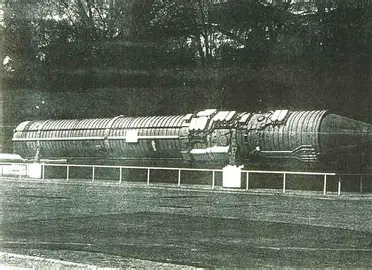
The missile started from the MR-UR-100 (15А15, NATO SS-17 Spanker) and was then based on the improved MR-UR-100UTTKh (15А16, SS-17 Mod 3). These are two-stage, liquid-propellant missiles that burn storable hypergolic propellants (UDMH fuel with nitrogen tetroxide oxidiser, which ignite on contact and can be kept loaded in the missile for years), and are launched cold, that is, ejected from a sealed container in the silo by gas pressure before the first-stage engine ignites. A storable-propellant, cold-launched missile is the right base for a command missile because it can sit fuelled in a silo for years and be launched within moments of an order. Russian sources state that the technical operation of the command missiles was identical to that of the base 15А16 missile, which let the Strategic Missile Forces maintain them with existing procedures and personnel.
The changes were in the control system (the missile was reworked "in the part of the control system"), which became the 15А11, and in the payload: the nuclear warhead was replaced with the 15Б99 head.
The 15Б99 head
The special head (published mass 1,412 kg) contains a "original radio-engineering system" designed by the Leningrad Polytechnic design bureau. For the radio system to do its job the head has to hold a constant orientation in space during the flight. The head therefore has its own system for calming (de-spinning and damping), orientation and stabilisation, built around cold compressed gas thrusters. The designers drew on experience from developing the propulsion for the "Mayak" (Маяк) manoeuvring warhead, which Yuzhnoye had developed for the R-36M, and this reportedly cut cost and development time substantially. The head was built at Orenburg and shipped directly to the test range or later to the troops, bypassing the Yuzhnoye plant because of that plant's workload. At the test site a shielded anechoic chamber was built in the assembly building for autonomous testing of the radio transmitter, a detail which tells you that the transmitter's radiation pattern and frequency behaviour mattered enough to demand a laboratory-grade test environment.
The transmitter frequency, power, modulation and message format have not been published in any source I could verify. What the sources do state is the function (broadcast of coded orders during the passive, unpowered, part of the flight) and the environment it was designed for (nuclear explosion effects and active jamming).
Test programme
Where the first-generation missiles were based
The 15А11 command missiles were stationed with the Strategic Missile Forces. Russian reference sources tie the 510th Missile Regiment, armed with command missiles, to the 7th Missile Division at Vypolzovo (Tver region), which was withdrawn from duty and disbanded on 1 September 1995 as the MR-UR-100 left service and the division re-equipped with Topol. Other accounts say the 15П011 complex came off duty in June 1995 under START I. This is retirement of a missile type, not of the system: later generations had already come on duty. Yurya, in Kirov Oblast, and Vypolzovo are the documented basing locations; Kozelsk, sometimes guessed in popular accounts, does not appear in the sources I checked.
Later generations
One Russian veterans' article from 2025 (Viktor G. Khalin, "Reflections aloud of a retired general", in Veteran-Raketchik no. 4, 2025, marking 40 years since the first stage of Perimeter was adopted) says the system has been on combat duty since 1986 and "continuously modernised" in its launch vehicles, the radio equipment of the heads and the ground equipment, and describes a new generation of equipment on duty from 2023 as part of an "object 1335" reserve command channel. This is a single retired-officer account, not an official statement, and the details of "object 1335" are not confirmed elsewhere; it is useful mainly as a Russian-side statement that the system is still being upgraded.
THE PHYSICS OF THE COMMAND MISSILE'S FLIGHT
The published flight-test figures (apex about 4,000 km, range about 4,500 km) describe a trajectory very unlike a normal ICBM warhead path. A standard ICBM trajectory to 10,000 km range peaks at roughly 1,200 km altitude. The command missile instead climbs more than three times that high while covering less than half the ground distance. This is a lofted trajectory, and it is chosen for its broadcast geometry, not for range.
Using the two published numbers and simple two-body orbital mechanics (a Keplerian ellipse, ignoring the powered phase, Earth rotation and atmosphere), I computed what such an arc implies. These are idealised numbers that show the character of the flight, not published performance data.
That is the real trade: a lofted arc converts range into time aloft. A minimum-energy 10,000 km trajectory is over in about 30 minutes and spends most of that time low; this arc keeps the radio station high over the country for the better part of an hour. For a transmitter whose job is to be heard by every launcher, the useful quantity is how long the transmitter is above the radio horizon of each receiver, not how far it flies.
Why altitude matters: the radio horizon
The distance to the horizon from altitude h above a sphere of radius R is the square root of 2Rh + h squared. From 4,000 km altitude the line of sight reaches about 8,200 km, and the circle on the ground that can see the transmitter has a radius of about 5,800 km, covering about 98 million square kilometres, roughly a fifth of the Earth's surface. The whole Soviet Union, about 17 million square kilometres, fits inside that footprint with room to spare. From 2,000 km altitude the radius is about 4,500 km, from 1,000 km about 3,400 km. (Receivers close to the horizon see the transmitter only at very shallow angles and need a good low-elevation pattern, so usable coverage is smaller than the geometric footprint; but near apogee the head can see the main missile fields from Europe to the Urals and beyond at once.)
The practical consequence: one command missile is enough to broadcast to the entire force, at the same time, over a path that does not touch the ground, the sea, or any cable. That is the property no terrestrial network has.
The ascent phase and the silo
The powered flight of a liquid two-stage missile like the 15А16 family lasts a few minutes. The missile is ejected from its container by gas pressure, the first stage ignites after it clears the silo, and then burns, separates, and the second stage completes the ascent. Because the head carries no heat shield for re-entry in the usual sense and no warhead, the energy that would have gone into carrying a warhead 10,000 km is spent on lofting a lighter payload to a higher apogee. The head then separates and uses its cold-gas thrusters to orient itself. Cold gas is a natural choice: a pressurised gas thruster has no combustion, no hot plume, almost no electrical or radio noise, can be switched on and off in small pulses for fine attitude control, and is simple and reliable.
Keeping the head's attitude fixed matters because the transmitting antenna has a directional pattern. An antenna that illuminates the ground below needs to point at the Earth (nadir). Seen from 4,000 km altitude, the Earth subtends a cone of about 38 degrees half-angle; an antenna that covers just that cone has a directive gain of about 10 dB (roughly a factor of ten) over an isotropic radiator. That is a free tenfold power increase on the ground, but only if the head is not tumbling. This is an engineering inference from geometry, not a published antenna specification.
THE PHYSICS OF THE RADIO LINK
What follows is general radio physics applied to the geometry above. The actual frequency and power of the 15Б99 transmitter are not published, so the numbers are illustrative.
Free-space path loss and link budget
Radio power spreads over a sphere. Free-space path loss in decibels is 32.45 + 20 log10(distance in km) + 20 log10(frequency in MHz). For a frequency of 300 MHz (an arbitrary UHF example) and a distance of 4,000 km (head directly overhead) the loss is about 154 dB; at the 8,200 km slant range of a receiver at the horizon it is about 160 dB.
Take an illustrative 1 kW transmitter (60 dBm) with 10 dB of antenna gain. Its effective radiated power is 70 dBm. With 160 dB of path loss, the received power is about -90 dBm. A receiver's thermal noise floor is about -174 dBm per hertz plus the receiver noise figure; for a narrow-band, low-rate coded message of 100 Hz bandwidth (20 dB) and a 5 dB noise figure, the noise floor is about -149 dBm. The signal-to-noise ratio is then about 59 dB. That is a very large margin, and it is the margin that lets the receiver ignore a lot of interference. If the real transmitter is more powerful or the message slower, the margin is larger still. The point of this arithmetic is not the number but the fact that a transmitter in the sky has a huge link margin because the path is clean line of sight with no terrain, sea or horizon losses.
Why jamming is so hard against an overhead transmitter
A ground-based jammer is limited by its own horizon. For two antennas at 10 m height the geometric radio horizon is only about 26 km (about 4.12 times the sum of the square roots of the two heights in metres); beyond the horizon, jamming energy reaches the receiver only through weak diffraction, atmospheric ducting or troposcatter (see Troposcatter). A ground jammer wanting to blanket silos spread across a continent needs a vast number of jammers, each close to the target. A receiving antenna on a silo, by contrast, points up: it can use an upward-looking pattern with strong gain toward the zenith and a deep null toward the horizon, where terrestrial jammers sit. A jammer's signal arrives at the horizon and is attenuated twice (distance, and the antenna's own rejection). A jammer that would defeat the system has to be in the sky as well, within view of the receivers, and has to know the frequency and waveform.
Message design adds further protection. Published sources do not describe the waveform, but standard military practice for a one-way command broadcast is to use a short, heavily error-corrected, authenticated message, and often a spread-spectrum or frequency-hopping waveform in which the transmitter spreads the signal across a wide bandwidth under the control of a secret code. The receiver correlates against the same code and recovers the narrow-band message, gaining "processing gain" (the ratio of the spread bandwidth to the data bandwidth) against any jammer that does not know the code. Whether Perimeter's head uses this is not stated in what I could verify; it is the standard technique for this kind of link, which is why it is worth explaining.
Which frequency band, and why it matters
The frequency is not public. A command-missile transmitter that wants to reach ground receivers from high altitude has to pass through the ionosphere, the layer of ionised gas between about 60 and 1,000 km altitude, and that sets a lower bound. The ionosphere reflects radio waves below its plasma frequency, about 9 sqrt(N) hertz where N is the electron density in electrons per cubic metre; in the daytime F2 layer this critical frequency is typically about 5 to 15 MHz. Signals well above that pass through. This is why HF signals (3-30 MHz) bounce around the world via the ionosphere (see HFGCS and UVB-76) while VHF, UHF and higher frequencies go through to space. A transmitter above the ionosphere that wants to be heard on the ground must therefore be at VHF or above, unless it is deliberately using the ionosphere. That is a good design inference: HF is poor for a signal that comes down from space, and a space-to-ground command broadcast is naturally in VHF or UHF.
The nuclear environment pushes the choice higher still. A high-altitude burst injects huge numbers of electrons and ions into the lower ionosphere (the D region), which absorbs radio energy at HF and lower VHF (absorption falls off roughly as the inverse square of frequency), blacking out HF circuits for minutes to hours, and creates structured plasma that makes radio signals fluctuate, called scintillation, which hits VHF, UHF and L-band links hardest during disturbed conditions. A design in the upper VHF to UHF range suffers much less absorption than HF and, with coding and sufficient power margin, can ride through the scintillation. The 1962 Starfish Prime high-altitude test is the standard example of how a single high-altitude burst disturbed HF communications across a wide region and crippled satellites for months. These considerations explain why a rocket-borne transmitter is attractive, not what its actual frequency was.
The ground-to-missile link
The command post must also talk to the missile in the silo. Bruce Blair's 1993 description says the orders go "over underground antennas" at low frequency. Low frequency is physical sense: radio waves penetrate rock to a depth of about one skin depth, the distance over which the amplitude falls to 37 percent. For a conducting earth with resistivity rho (in ohm-metres) at frequency f (in hertz), skin depth is about 503 times the square root of rho/f in metres. At a resistivity of 1,000 ohm-metres (a reasonable figure for dry crystalline rock) the skin depth is roughly 500 m at 1 kHz, 160 m at 10 kHz, and 1,600 m at 100 Hz. Lower frequency means deeper penetration, at the price of very low data rate. A hardened, buried antenna and a slow, short message is the combination that survives. (Very-low-frequency radio and its uses for submarine and hardened-site communication appear elsewhere on this site; see Goliath VLF for the physics of long wavelengths.)
SURVIVING A NUCLEAR ENVIRONMENT
The special head's stated design condition is operation under nuclear explosion effects and active electronic warfare. This matters physically because every component of a communications chain is vulnerable in a different way.
The shape of the design is clear. It reduces the vulnerable parts of a communications system to the minimum. The transmitter spends years inside a hardened silo and only a short time in the open; it takes the antenna above the ground clutter, the jammers and the atmosphere; and the receivers at the launchers need to hear only a short, authenticated message and act on it without any other communications.
RECEIVERS: HOW A SILO LISTENS
The Russian reference sources say that all launchers of the Strategic Missile Forces, all ballistic-missile submarines and all strategic bombers carry receiving devices that accept orders and codes from the command missiles in flight, and that the receivers are probably wired directly into the launch control equipment, so that a valid order executes autonomously. The flight-test history confirms that this was done physically: additional antennas and new receivers were installed on launchers of different missile types, and live ICBM launches were carried out on orders delivered in flight by the 15Б99.
The authentication problem is as important as the radio problem. Whatever receives the broadcast must be sure that the message is genuine, from the right authority, and not a replay or a spoof, since the receiver has no way to ask for confirmation. That is what "codes" means in the published descriptions: the missile transmits launch orders together with the authentication data that the receiving equipment can verify. How Perimeter integrates with the permissive-action and launch-authorisation hardware of the missiles is not public. The Kazbek and Cheget system carries the same kind of codes through the normal chain; see Kazbek.
COMMAND POSTS AND BUNKERS
Russian reference sources describe the command posts of the system as probably structures like the standard underground missile-control complexes of the Strategic Missile Forces: hardened capsules, with control equipment and communications, apparently integrated with the command-missile launchers but probably separated by a considerable distance for survivability. During the test programme the first such post (site 71) was a special command post equipped for remote control and launch of the missile on orders from higher levels of the Strategic Missile Forces.
David Hoffman's description (NPR, 2009) is of a deep underground bunker "in the shape of a globe" where three duty officers sat. That image, a spherical capsule hung on springs or shock absorbers inside a deep excavation, is a standard approach to hardened command posts: a sphere is the shape that best resists external pressure, and decoupling the capsule from the rock with shock isolators protects occupants from ground shock. The Kosvinsky Kamen mountain is repeatedly named as the site of a deep post. Granite overburden of hundreds of metres reduces the effects of any surface or air burst to a seismic shake, and shields from prompt radiation by many orders of magnitude, which is exactly the property a post meant to function after a first strike needs. All of that is generally true of deep hardened posts; the specific Perimeter site claim stays a claim.
THE U.S. COUNTERPART, AND WHY THEY DIFFERED
Both Wired and the Russian sources compare Perimeter to ERCS (AN/DRC-8, Emergency Rocket Communications System). The U.S. system used modified Minuteman II missiles carrying a UHF transmitter, flown on a high trajectory to broadcast launch orders to missile fields, bombers and ships if ground networks were lost; it was retired near the end of the Cold War. The U.S. also kept airborne command posts aloft for decades (the "Looking Glass" aircraft, 1961-1990) and later relied on the TACAMO aircraft and the HF Global Communications System. The hardened U.S. warning center in granite is described in Cheyenne Mountain Complex.
The conceptual difference, as Wired put it, is the weight put on people versus machines. Looking Glass kept senior officers in the air with authority to launch; Perimeter put authority transfer logic in a dormant, switched-on-in-crisis system with a duty crew below. The U.S. never combined its sensors, command rockets and decision logic into a single standing retaliation system, fearing accidents. The Soviet Union built a system of monitored conditions, but with a human decision at the end, and it kept the whole thing secret, which, as Wired and Yarynich noted, undermined part of its deterrent value.
TIMELINE
STATUS TODAY
Perimeter is operational. The last on-record official statement is from December 2011, when General Karakayev said that the system exists, is on combat duty, and that when a retaliatory strike is needed and a signal cannot be brought to some of the launchers, the order can come from Perimeter. The system has since been modernised: the Sirena-M command missile, based on the Yars family and deployed at Yurya, replaces the Topol-based missiles, and Russian sources describe continuous modernisation of launch vehicles, transmitter heads and ground equipment. The system is a standing, maintained, upgraded element of the Russian nuclear command structure, sitting beneath Kazbek and above nothing: it is the circuit of last resort.
Its role has not changed. It is not the way Russia plans to start or conduct a nuclear war. It is the way Russia makes sure that a war cannot be won by killing the people and cutting the wires. The modern missiles it commands include the RS-24 Yars, the new heavy RS-28 Sarmat, and the strategic glide vehicle Avangard, and in broader strategic discussion sit alongside the nuclear-powered Poseidon and Burevestnik. The early-warning net that feeds the leadership's decisions (Dnepr, Voronezh, Solnechnogorsk SPRN, Serpukhov-15) is separate from Perimeter and comes first in any real crisis; it is what tells the leadership to switch Perimeter on.
COMMON MISCONCEPTIONS
RUSSIAN TERMS USED IN THIS ARTICLE
SOURCES AND HOW TO READ THEM
What is solid: the command-missile programme, its designers, indexes, test history, the 1985 service date, the follow-on generations, the 2011 statement, the Sirena-M deployment. What is insider testimony: the sensor list and four-step logic (Yarynich, Katayev, Korobushin). What is documented by the September 2026 investigation (Dossier Center, Danwatch, Podvig) but never officially confirmed by Russia: the existence of Object 1335 at Kosvinsky Kamen; what is claimed but unconfirmed: its exact role in Perimeter, the exact organisation of the bunker network, and the radio frequency and modulation of the head. What this article adds as explanation: the physics sections, which apply standard physics to published figures and are marked as inference where they go beyond the sources.
RELATED ARTICLES
IN ONE SENTENCE
Perimeter (Система «Периметр», 15Э601, "Dead Hand") is Russia's operational last-resort nuclear command system: built under a 1974 decree and on duty since January 1985, it puts a crisis-mode watch on seismic, light, radiation and pressure signs of attack and on the silence of the General Staff, hands launch authority to a protected duty crew, and delivers launch orders through a command missile (15А11 / 15П011, now the Yars-based Sirena-M) that carries a radio transmitter instead of a warhead and broadcasts coded orders to every surviving launcher, submarine and bomber from near the top of a lofted trajectory.