WHAT IT IS
Object 1335 (Объект 1335), code-named Grot (Грот, "Grotto"), is a very large underground military complex in the Kosvinsky Kamen (Косьвинский Камень) massif in the northern Ural Mountains of Sverdlovsk Oblast, Russia, beside the settlement of Kytlym (Кытлым). It is run by military unit 20003. According to a poster from inside the unit, the facility was conceived in 1981 as a "backup central command post" of the Soviet Strategic Rocket Forces, and it has been under construction, expansion or modernisation ever since. In September 2026 a joint investigation by Danwatch (Denmark), the Dossier Center (a Russian exile investigative group) and The Sunday Times (UK) used procurement records, satellite imagery, photographs posted by former conscripts and the unit's own history poster to document what is being built there, and linked it to the Soviet-era last-resort command system known as Perimeter, or "Dead Hand".
Russia has never officially acknowledged the site, and has not commented on the 2026 reporting. No one outside the Russian military has published a verified picture of its interior. Almost everything on this page therefore comes from a small number of documents and testimonies, and the page labels each claim by how well it is supported. The reason the site is interesting is not that it is secret: it is that the physical facts which are known (the rock, the quantities of steel and cable, the cooling plant, the experiments done with radio waves in the mountain) fit together into a coherent engineering picture, and that picture raises some of the best physics questions in all of Cold War command and control. How do you make a radio transmitter work from inside a mountain? How deep is deep enough? What does five megawatts of refrigeration tell you about the equipment it serves?
This page also keeps a firm line between what the sources say and what the author works out from physics. The second kind of statement is marked as an estimate, and the numbers are meant to show orders of magnitude, not to describe the real installation.
HOW TO READ THIS PAGE
Every important claim carries one of these labels:
There are no coordinates on this page, and none will be added. The reporting this page rests on deliberately publishes none either, and nothing here is meant to help anyone find or approach the site. It is a military installation guarded by soldiers.
IN SHORT
THE NAMES
The sources use several names, and keeping them straight avoids a lot of confusion.
Object 1335 (Объект 1335) is the administrative designation, the one that appears in procurement tenders and in the retired officers' articles. Grot (Грот) is the code name from the 1981 design stage and appears on the unit's history poster. Military unit 20003 (войсковая часть 20003) is the garrison unit. According to the poster it began as the 979th Operational Commandant's Office (979-я оперативная комендатура), created in 1989 and 1990, and was reorganised as unit 20003 under a Defence Ministry directive of 8 November 2006, taking effect in 2007. [DOCUMENTED, poster] Some earlier Russian-language websites give the unit a different parent number, such as a "1231st command centre". This author could not reconcile those with the poster and treats them as unconfirmed.
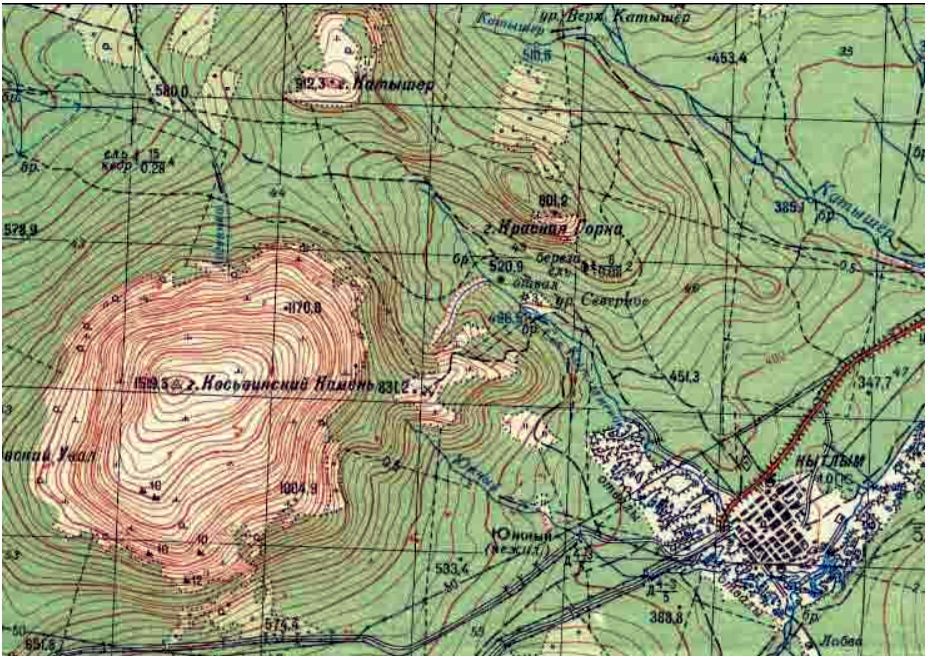
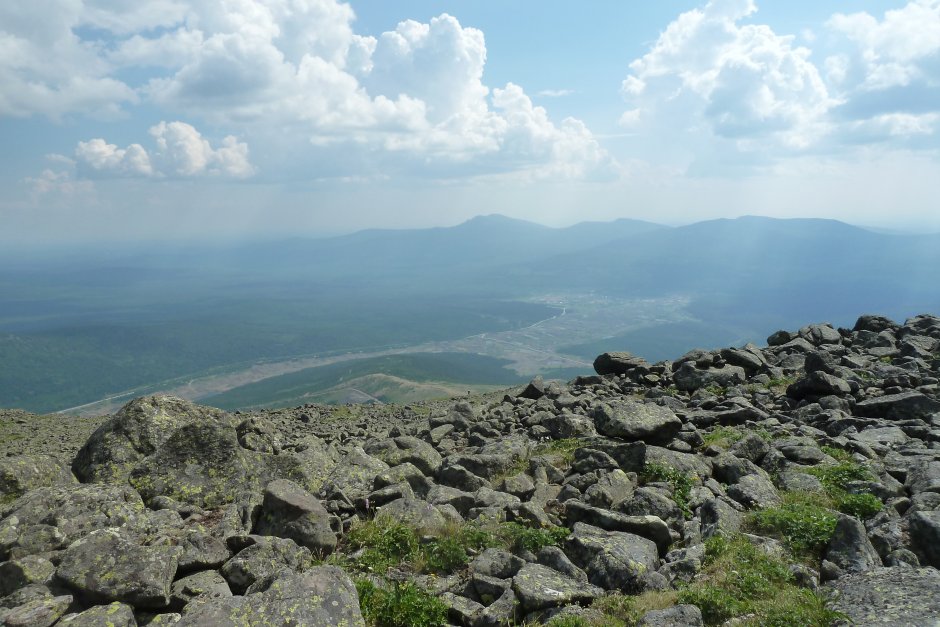
Kosvinsky Kamen (Косьвинский Камень) is the mountain: a roughly 1.5 km high domed massif, about 40 km in circumference, on the eastern side of the northern Urals. Kytlym (Кытлым) is the nearby village. The investigators describe two places that share the name: an old wooden village, and a military town next to it with apartment blocks, a kindergarten, a clinic, a boiler plant and helicopter pads.
TsKB TM (ЦКБ ТМ), the Central Design Bureau of Heavy Machine-Building, is named on the poster as the organisation that searched for the site in the late 1970s and, according to Dossier Center's reading of the veterans' articles, the one that developed the new Perimeter control element in 2005 to 2010. VPK is the Military-Industrial Commission, the Soviet body whose decisions started the project.
Perimeter (Периметр) is the system the site is linked to. It is covered in detail in its own article, which also explains the difference between the Soviet name, the Western nickname "Dead Hand" and the system's formal index. For this page the useful fact is Podvig's: Perimeter is "essentially a communication system", one layer of a much larger command network, and Object 1335 is one of several reserve command posts, not the whole system.
HOW THE WORLD LEARNED OF IT
For decades Western analysts treated the Kosvinsky Kamen site as a guess. Journalist Ron Rosenbaum named it in a Slate article in 2007, drawing on Russian military-history writing, and it appears in Russian Wikipedia as an assertion, not an official statement. Another large mountain complex, Mount Yamantau in the southern Urals near Beloretsk, was often named as the location of the "Dead Hand bunker" instead. The 2026 investigation says that placement was an error: it found Object 1335 at Kosvinsky Kamen. Yamantau is a different, still poorly understood mountain site, and the purpose of Yamantau is a separate unresolved question. [DOCUMENTED that the 2026 investigation puts 1335 at Kosvinsky Kamen; the purpose of Yamantau is UNVERIFIED]
The new chain of evidence started in a place few Westerners read: Ветеран-ракетчик ("Veteran-Raketchik"), a newspaper published by the Strategic Rocket Forces veterans' community. It carries memoirs and short histories by people who worked on the missile forces' systems. Retired Major General Viktor G. Khalin (Виктор Халин), who says he took part in the original Perimeter work in 1973 to 1975 and led its modernisation between 2005 and 2010, repeatedly refers in his articles to Object 1335. In 2022 he wrote that work was under way to put the system's automation on experimental combat duty there. In January 2026 he wrote that the Strategic Rocket Forces would, if necessary, "fulfil the historic mission of retaliation" and that the leadership had received a "practically reliable technical toolkit" for retaliation in both "automated" and "automatic" modes. Colonel Yuri Andreev (Юрий Андреев) wrote in 2025 that after many years of trial operation the object was placed on combat duty in 2023. [SINGLE-SOURCE: one newspaper, two authors; the articles are real publications that the investigators photographed and quoted, but nobody has independently confirmed the content]
Then the investigators added three kinds of physical evidence. First, the Danwatch collection of about 2.5 million Russian military procurement documents, assembled from a public tender database in 2024, which includes thousands of lots for Object 1335 from 2018 onward (the Insider's summary says files go back to 2011, with the peak in 2020 and 2021). Second, satellite imagery showing spoil heaps, a new road, and excavation at the mountain's entrances. Third, a photograph, taken by a relative of a conscript and posted on the Russian social network VKontakte, of a history poster of unit 20003. Podvig published an English translation of that poster, and it is the single most important source for the early history. [DOCUMENTED]
The reporting appeared on 26 and 27 September 2026. Danwatch and the Sunday Times framed it as the "reactivation" of a doomsday system. The Dossier Center was more cautious and focused on documents. Pavel Podvig answered within days that "nothing was ever deactivated": the facility was upgraded, but the Dead Hand was never switched off, and nothing shows a change in the basic principles of Russian command and control. Russian authorities did not respond to the press inquiries.
THE POSTER: HISTORY OF MILITARY UNIT 20003
The poster is the closest thing to an official biography. It is a display that the unit made for itself, photographed inside the base and posted online by a conscript's relative. The investigators and Podvig treat it as authentic. This page does too, with the caveat that it was not meant for publication, and its dates and claims are the unit's own. Below is a summary of the translation published by Podvig (the translation was machine-assisted, so wording may differ from the Russian original). [DOCUMENTED as a source; individual claims are the unit's own]
1975 to 1980. First proposals for a command post of "absolute" protection using reserve radio communication channels. The feasibility of deeply buried antenna-feeder systems is demonstrated for the first time. TsKB TM starts looking for a site.
1981. Under VPK Decision No. 48 of 11 February 1981, technical proposals are produced for "Grot" as the backup central command post (запасной центральный командный пункт, ZTsKP) of the Strategic Rocket Forces. The first measurements of the rock's electrical conductivity are made, together with geological and geophysical measurements of the chosen massif, which confirm its "unique radio transparency".
1982. Under VPK Decision No. 27 of 25 January 1982, construction of Object 1335 begins. The poster says work continues "to the present day" under presidential decrees, government resolutions and decisions of the defence minister. The object is described as a system of interconnected underground workings housing the main structures, with a core of "long-wave and short-wave radio centres at depths of tens to hundreds of metres". The poster says the only suitable massif in the country was found in the Central Urals, "composed entirely of radio-transparent rock with high dielectric and structural-strength properties".
From the early 1980s. Inside the massif, about thirty experimental fragments of VLF, LF, HF and satellite radio centres were built, with twenty types of antenna-feeder devices. Automated combat-control equipment was installed for a reserve channel and a duplicating channel called "Vyuga" (Вьюга), and about 150 path tests were conducted at ranges of up to 5,000 km.
1989 to 1990. The 979th Operational Commandant's Office is formed under a Defence Ministry directive of 11 February 1989 and staffing table of 22 March 1990, after the first phase of the main structures is completed.
Around 1990. The first construction phase of Grot ends after about eight years. The pace then falls sharply, which matches the collapse of the Soviet economy and of the USSR.
February 2000. A command for a real launch of a Topol-M ICBM is transmitted through the object. This matches a documented launch: on 9 February 2000 a Topol-M left a silo at Plesetsk and its dummy warhead reached the Kura range on Kamchatka. Vladimir Nikitin, then a deputy commander of the Strategic Rocket Forces, told the newspaper Trud that for the first time the launch was controlled centrally from a high-level command post. The poster adds that over 1994 to 2005 more than 500 orders were accepted across the main, reserve and duplicating channels by command posts including those of the Strategic Rocket Forces, the Northern Fleet's strategic submarines, an airborne command post, a Tu-160 and the posts of Long-Range Aviation and the Navy. [DOCUMENTED that the launch happened; the claim that the order was routed through 1335 is the poster's]
2004. The defence minister and the chief of the General Staff approve a provision under which Grot becomes the basis of the General Staff's reserve channel.
2007 to 2009. The commandant's office becomes military unit 20003 (2007), installation of the combat-control centre begins, and the unit receives its Battle Banner on 20 November 2009.
From April 2011. The unit stands duty to keep the installed equipment "intact and operational".
2017. The poster says unit 20003 "goes on combat duty".
THE MOUNTAIN
Kosvinsky Kamen belongs to a family of rock bodies known to geologists as Ural-Alaskan-type zoned ultramafic complexes. The Dossier Center says the massif consists mainly of dunite and pyroxenite. [DOCUMENTED by the investigators; the general geology is textbook] Dunite is an igneous rock that is almost entirely olivine (a magnesium-iron silicate); pyroxenite is mostly pyroxene minerals. Both are dense (roughly 3.2 to 3.4 g/cm3 for fresh dunite) and strong. Intact dunite has a compressive strength that is commonly cited in the range of 150 to 250 MPa. [ESTIMATE from general rock-property tables] For comparison, Cheyenne Mountain's granite is about 2.6 to 2.7 g/cm3 with similar strength. Dunite is about 20 to 25 per cent denser, so a given thickness of it weighs and shields more.
The same family of rocks is why the mountain has a mine. The zoned ultramafic bodies of the Urals are the source of platinum-group metals, and the Kytlym area has been mined for platinum since the nineteenth century. Placer deposits in the valleys at the foot of the massif are worked today (the Western Kytlym deposit). The company that held a controlling stake, Eurasia Mining of the UK, says it has no commercial or informal relations with the Russian Ministry of Defence or defence contractors, and agreed in late 2025 to sell its stake. Dossier Center notes that some mine workings lie within a few hundred metres of the unit's territory. [DOCUMENTED that the mine and base are close; any link between them is UNVERIFIED and denied by the company]
Two properties of this rock matter for the physics below. First, fresh, dry, crystalline ultramafic rock is a very poor conductor of electricity. Second, the Urals are an old, deeply eroded mountain belt: the rock has been through hundreds of millions of years of compression and is mostly sound, although the details of the fracture pattern inside Kosvinsky Kamen are not public. How wet the fractures are, how much of the dunite has been turned into serpentinite (olivine altered by water, which produces magnetite and can make the rock far more conductive and magnetic), and how much conductive chromite and magnetite is scattered through the massif, decide how "transparent" the mountain really is. The poster says the survey found exceptional transparency. The public does not have the survey.
THE SURFACE: KYTLYM AND THE BASE
What the public knows about the surface comes from the investigators, from photographs that soldiers and their families posted online between roughly 2008 and 2012, and from a few older accounts. [DOCUMENTED as reporting; individual photos are SINGLE-SOURCE]
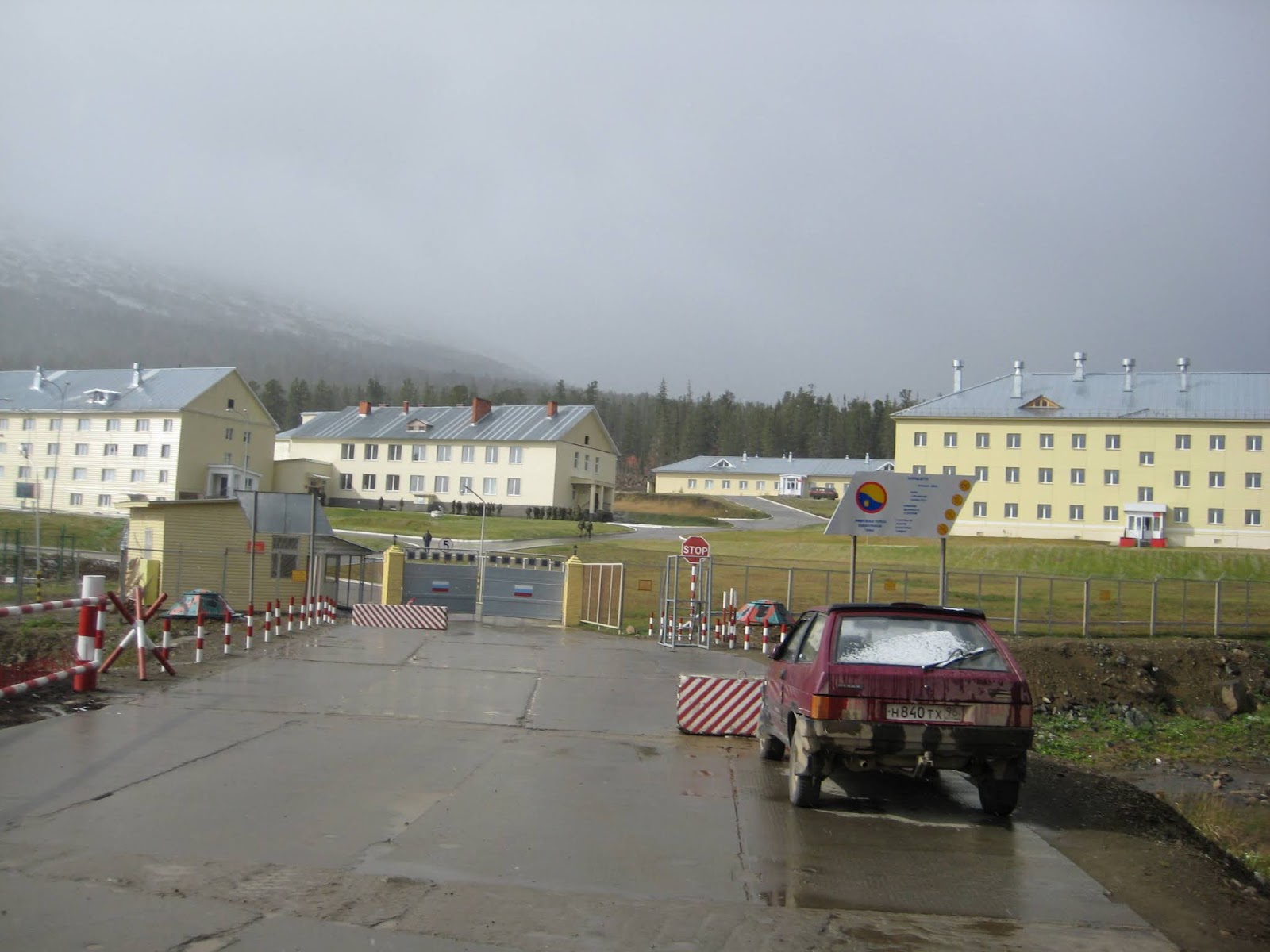
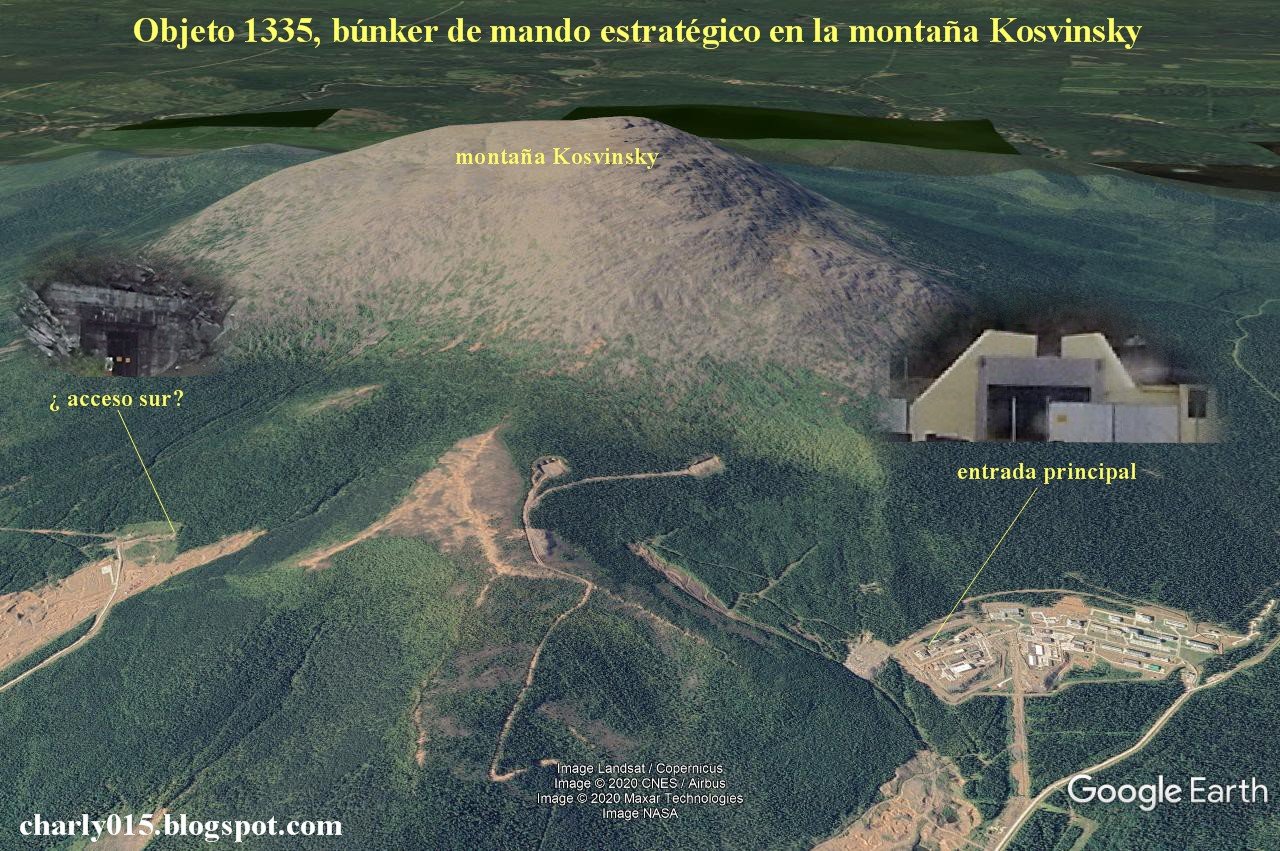
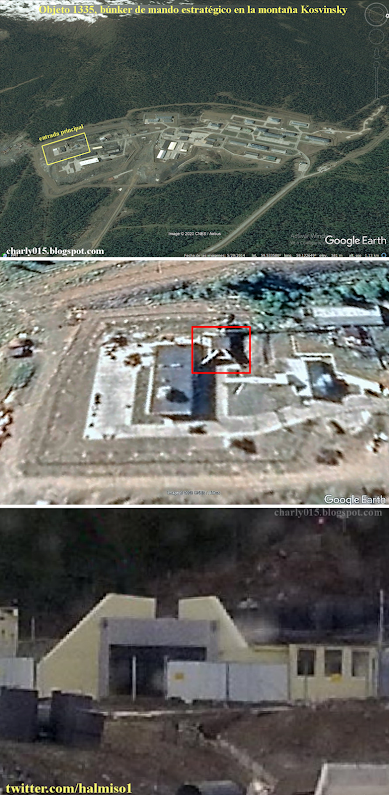
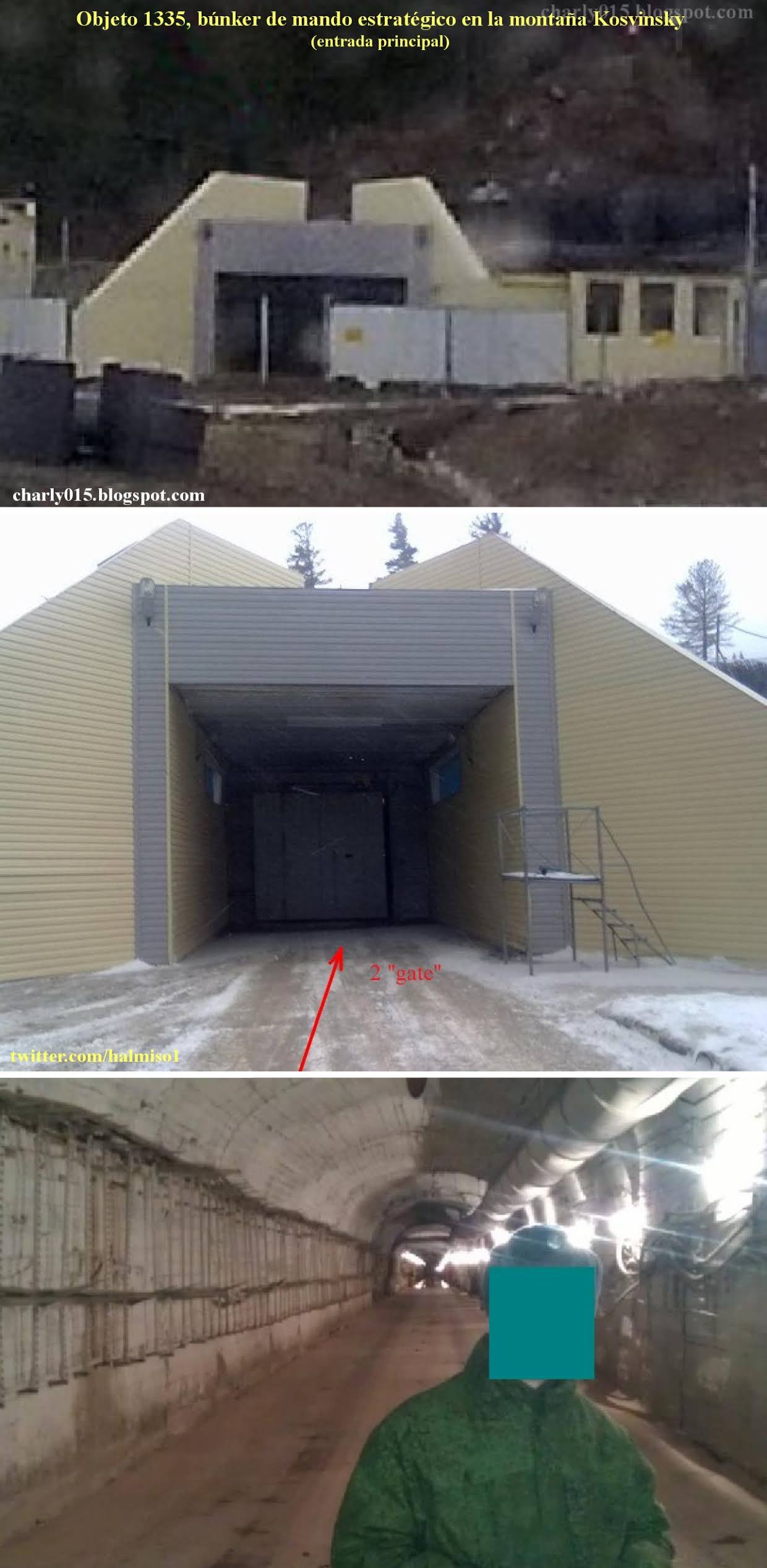
Kytlym is about four hours' drive from the nearest large city, Nizhny Tagil, and its residents travel some 60 km to see a doctor. Beside the old village is the military town, which the Dossier Center says was built over almost a decade from the mid-2000s and finished only in 2020, under a contract of about 1.5 billion roubles awarded to the Defence Ministry's 8th Main Directorate for Military Construction (ГВСУ-8). [DOCUMENTED] A road leads from the town to the foot of the mountain, where the base of unit 20003 stands behind checkpoints. Danwatch describes, from interviews and photographs, a gate into the mountain next to a building with a machine-gun tower, a large white building that houses diesel generators, and an older emergency exit guarded by soldiers. The investigators found only one image that seems to come from inside the tunnels; they say they cannot verify it, though the uniform and tunnel dimensions are consistent with other descriptions. Satellite pictures taken in 2003 show a much smaller base than in 2014, and pictures from the 2020s show large spoil heaps of excavated rock, a new road and what appear to be additional entrances (the Dossier Center counts at least four equipped entrances; Danwatch's imagery shows work at what look like six new ones). [DOCUMENTED]
The Danish and Russian reports describe a military checkpoint and guarded base. They do not describe a nature reserve or a formal restricted-zone boundary, and this page does not claim any. It also does not describe routes, boundaries or approaches.
Former conscripts who served in Kytlym give the only inside descriptions. One of them said the rooms were as big as a metro and then added that he had never been in a metro. Another heard from comrades who laid communication cables inside that the distances were so great that people moved around by bus. They said most of the heavy construction inside was done by hired civilian workers. All of them said they were afraid to talk about it because of the penalties for revealing military secrets. [SINGLE-SOURCE each; the "bus" detail is repeated by both Danwatch and Dossier Center, but all come from the same circle of interviewees]
WHAT THE PROCUREMENT RECORDS SHOW
Russia's military procurement runs through a public tender database. Even though the tenders use codes and numbers and say as little as the rules allow, thousands of lots name "Object 1335". Danwatch's minimum totals for 2018 to August 2024 (the real amounts are probably higher) are:
One tender, quoted by Danwatch, says: "Object 1335 is designed to contain a complex with equipment for control, communications and security systems, as well as permanent accommodation for personnel on combat readiness and in everyday life." The tender requires an FSB licence for work involving state secrets. Delivery drivers are forbidden phones and other electronics. [DOCUMENTED]
Several Western-made items appear in the paperwork: Rockwool insulation (Denmark), Danfoss valves, K-Flex insulation (Italy), Haulotte lifting equipment (France), Belimo valves (Switzerland), among others, including purchases after 2014 and after 2022. A sanctions lawyer quoted by the Dossier Center stresses that a product's presence in a tender does not by itself show that any company broke rules, since goods can pass through Russian distributors and subsidiaries. [DOCUMENTED that they appear in tenders; any wrongdoing is NOT established]
What the numbers imply (estimates)
The raw quantities are useful because they can be cross-checked against each other. These are the author's calculations. [ESTIMATE]
Reinforcement density. 22,000 tonnes of steel in about 150,000 cubic metres of concrete is roughly 147 kg of steel per cubic metre. Ordinary reinforced concrete uses roughly 80 to 150 kg/m3 and heavily loaded or blast-resistant structures use more. So the steel figure is in the right range if most of it is reinforcement and linings inside concrete structures. It does not need a hidden extra story to explain it.
Aggregate. Making 150,000 cubic metres of concrete takes on the order of 250,000 to 300,000 tonnes of sand and gravel, but the tenders list only 13,000 tonnes. The explanation is in the equipment list: the contractors bought a crushing and screening plant, and the Dossier Center says rock blasted out of the mountain was crushed and sorted into gravel and sand on site. In other words, the concrete aggregate was probably made from the mountain itself, and the mountain's own dunite is the filler for its own linings. This is an inference, but it fits the equipment, and it explains how large amounts of concrete could be made without long truck convoys of aggregate along a forest road.
Fuel. 3.2 million litres of diesel contain about 32 GWh of heat (10 kWh per litre). With a generator efficiency around 38 per cent, that is about 12 GWh of electricity, or about 100 days at a constant 5 MW. This fuel purchase may have been mostly for the construction machinery, and the tender does not say how much was stored for the generators, so the figure should not be read as the facility's endurance. The Danwatch description of a large white generator building at the entrance does support the idea that there is on-site diesel generation.
PHYSICS 1: A TRANSMITTER INSIDE A MOUNTAIN
A command post exists to send and receive orders. A deep command post that survives a nuclear strike by being deep has an obvious problem: depth is the opposite of radio. Radio waves are attenuated in any conducting medium, and rock, even dry rock, is a conducting medium. The deeper you go, the better you survive blast, and the worse your radio link becomes.
There are only a few ways to solve this, and each trades survival against communication:
The poster says Grot's "core" is long-wave and short-wave centres at depths of tens to hundreds of metres, built from antenna-feeder systems demonstrated as "deeply buried" in 1975 to 1980, and that thirty experimental fragments of VLF, LF, HF and satellite radio centres were tested. Read together, this suggests a hybrid design: the low-frequency channels use the rock as the transmission medium, and the higher-frequency channels use shafts or feed lines to reach the open air or the mountain slope. This is an inference from the poster and the physics, not a statement from any source. [UNVERIFIED]
PHYSICS 2: HOW ROCK CONDUCTS, AND WHAT "RADIO TRANSPARENCY" MEANS
An electromagnetic wave in a material is described by three properties: electrical conductivity (sigma, in siemens per metre), permittivity (epsilon, usually written as a relative value epsilon_r), and magnetic permeability (mu, close to the vacuum value for most rock).
Resistivity of rock. Geophysicists usually quote resistivity, the inverse of conductivity, in ohm-metres. Sea water is about 0.25 ohm-metres. Wet soil is tens to hundreds. Sedimentary rock with water in its pores is typically 10 to 1,000. Dry, intact crystalline rock (granite, gabbro, dunite) is typically 10,000 to well over 100,000 ohm-metres, and can reach a million in very dry, massive bodies. That is 5 to 7 orders of magnitude more resistive than sea water. [ESTIMATE from general geophysics tables; the range is deliberately wide because no one has published the resistivity of Kosvinsky Kamen]
What changes it. Water in cracks and pores is by far the biggest factor, because a thin film of water can carry current through otherwise insulating rock. Clay minerals, graphite and metallic minerals (magnetite, chromite, sulphides) also conduct. Fractured, wet rock can be 100 to 1,000 times more conductive than the same rock when sound and dry. For this reason a "radio transparent" massif is a rare find: it must be a large volume of sound, dry, low-metal rock with few water-bearing fractures. The poster says it searched for years for the only such massif in the country.
Permittivity. Dry crystalline rock has a relative permittivity of roughly 5 to 10, so radio waves travel through it at about a third of the speed of light (a refractive index of roughly 2.2 to 3.2). This changes the wavelength inside the rock and the way waves cross the surface, as discussed later.
Two regimes. In a material with both conductivity and permittivity, the wave behaves like a diffusing field at low frequencies, and like a travelling wave in a lossy dielectric at higher frequencies. The crossover is at the frequency where the conduction current equals the displacement current: f = sigma / (2 pi epsilon). For a rock with a resistivity of 100,000 ohm-metres and epsilon_r of 8, this is about 22 kHz. Below it, the attenuation drops as the frequency falls, and the skin depth grows (the classic "low frequencies penetrate better" regime). Above it, the attenuation settles at a constant value set only by the conductivity: alpha is approximately (sigma / 2) times the square root of (mu / epsilon). In a very good insulating rock the loss at high frequencies becomes small and almost independent of frequency, so the rock acts like a low-loss dielectric. This is probably what the poster's phrase "high dielectric properties" refers to. [ESTIMATE / interpretation]
That second regime is why some of the poster's claims are physically plausible, and also why they depend on a rock quality that is difficult to find. If the resistivity were 1,000 ohm-metres (wet, fractured rock) instead of 100,000, the loss at HF would be a hundred times higher in the lower range and the massif would be useless for through-rock propagation.
Why dunite could be good. Fresh olivine-rich rock is an excellent electrical insulator. Where it has not been serpentinised, it contains little free water and few conductive minerals. Zoned ultramafic complexes are also usually massive, with little jointing compared to sedimentary mountain belts. Against that, Ural-Alaskan complexes often contain disseminated chromite and platinum-group minerals (mineral grains that conduct), and many Urals ultramafics are partly serpentinised along fractures. Whether Kosvinsky Kamen has a "transparent core" surrounded by a conducting skin, or is uniformly transparent, is not known publicly. [ESTIMATE / general geology]
PHYSICS 3: SKIN DEPTH AND ATTENUATION, WITH NUMBERS
The skin depth is the distance over which the amplitude of a plane wave falls to 1/e (about 37 per cent, or 8.7 dB down). In a good conductor it is approximately 503 times the square root of (resistivity divided by frequency), in metres, where resistivity is in ohm-metres and frequency in hertz. The real calculation for rock also includes the permittivity, and the table below uses the full expression for a plane wave: alpha = omega times the square root of (mu epsilon / 2) times the square root of (the square root of (1 + (sigma / (omega epsilon))^2) minus 1), with epsilon_r = 8. Distances are measured along the direction of propagation in homogeneous rock. All values are [ESTIMATE]. They describe an idealised uniform rock and not the real mountain, which has fractures, voids, water and metal.
RESISTIVITY 100,000 ohm-m (very dry, sound rock)
  Frequency     Skin depth    Loss per 100 m   Loss per km
  76 Hz         18.3 km       0.05 dB          0.5 dB
  3 kHz         3.1 km        0.28 dB          2.8 dB
  10 kHz        2.0 km        0.44 dB          4.4 dB
  30 kHz        1.6 km        0.55 dB          5.5 dB
  100 kHz       1.5 km        0.58 dB          5.8 dB
  1 MHz         1.5 km        0.58 dB          5.8 dB
  10 MHz        1.5 km        0.58 dB          5.8 dB
RESISTIVITY 10,000 ohm-m (typical dry crystalline rock) 76 Hz 5.8 km 0.15 dB 1.5 dB 3 kHz 925 m 0.94 dB 9.4 dB 10 kHz 515 m 1.7 dB 17 dB 30 kHz 310 m 2.8 dB 28 dB 100 kHz 198 m 4.4 dB 44 dB 1 MHz 151 m 5.7 dB 57 dB 10 MHz 150 m 5.8 dB 58 dB
RESISTIVITY 1,000 ohm-m (damp or fractured rock) 76 Hz 1.8 km 0.48 dB 4.8 dB 3 kHz 291 m 3.0 dB 30 dB 10 kHz 160 m 5.4 dB 54 dB 30 kHz 93 m 9.4 dB 94 dB 100 kHz 52 m 17 dB 169 dB 1 MHz 20 m 44 dB 440 dB 10 MHz 15 m 57 dB 575 dB
Some things to take from the numbers:
The 1/e distances are the amplitude of the plane-wave field. They are the best case in a homogeneous medium. Real antennas, near fields and layered ground add geometric spreading (the field of a small antenna falls much faster than a plane wave close to it) and interface effects. Treat the table as a statement of what the rock does to a wave that is already travelling, and not as a link budget.
PHYSICS 4: ELF, VLF, LF AND HF: WHAT EACH BAND CAN DO
Each radio band has its own role, and the poster lists all of them, plus a duplicating channel. The reason for having many is the principle Pavel Podvig summarises as "duplication, duplication, duplication".
ELF (3 to 30 Hz) and SLF (30 to 300 Hz). The skin depth is kilometres, so rock is irrelevant. The price is bandwidth. The usable signal bandwidth is a few hertz, so the data rate is a few bits per minute at best. The channel capacity is limited by the Shannon-Hartley relation, capacity = bandwidth x log2(1 + signal-to-noise ratio). With 1 Hz of bandwidth and an SNR of 1 (0 dB), that is 1 bit per second at the theoretical limit, and practical coded systems are much slower. That is enough to send a short coded "go" message that was agreed in advance, and not enough for voice or data. The US Navy's ELF system worked at 76 Hz and 45 Hz, with a message of a few characters needing many minutes. A Russian ELF transmitter at about 82 Hz on the Kola Peninsula, known as ZEVS, has been described in public sources. Whether Object 1335 transmits or receives ELF is not public. [UNVERIFIED]
ELF transmitters need huge antennas. The US system used grounded wire dipoles tens of kilometres long, laid across rural Wisconsin and Michigan, which were chosen largely because the ancient Precambrian bedrock there is very poorly conducting. The reasoning is physical: in poorly conducting ground the return current flows deep, which enlarges the effective current loop and the radiated field, in effect making the antenna bigger. The same principle explains why a command-post designer would seek a massif with very high resistivity for a buried VLF or ELF antenna. High resistivity is good for transmission through the rock and for buried-antenna efficiency. [DOCUMENTED for the US ELF design; the application to Grot is an inference]
VLF (3 to 30 kHz) and LF (30 to 300 kHz). The waves bounce between the ground and the ionosphere, forming the Earth-ionosphere waveguide. Attenuation in this guide is low, about 2 to 3 dB per 1,000 km at 20 kHz in daytime, lower at night and lower over sea water, so VLF signals can reach most of the globe from a high-power transmitter. [ESTIMATE from published VLF propagation figures] The cost is that antennas are tiny compared to the wavelength (at 20 kHz the wavelength is 15 km), so efficiency is low and the antenna must be very large or very well grounded. Bandwidth is a few hundred hertz at most, so the usable rate is tens to a few hundred bits per second. That is enough for short, coded, authenticated messages, which is exactly what launch orders and authentication codes are. The poster's 150 tests at distances of "up to 5,000 km" sit in the range of VLF and LF ground-wave and sky-wave paths. The tests would measure received field strength against time of day, season and ionospheric disturbance, which is the kind of dataset needed to be sure the channel works under the worst conditions, including the disturbed ionosphere that a high-altitude nuclear burst produces. [UNVERIFIED as to purpose; the physics is general]
HF (3 to 30 MHz). This is the long-distance band that works by refraction from the ionosphere (see HFGCS, Automatic Link Establishment, and UVB-76 for Soviet and Russian HF practice). It offers real data rates (hundreds to thousands of bits per second) and flexible frequency choice, and it needs a good antenna in free space, which a deep mountain cannot give directly. It is also the band most hit by a nuclear environment: a high-altitude burst or surface burst creates absorption (blackout), though not forever, and HF can come back in minutes to hours. The poster lists HF as one of the radio centres' bands, implying shafts, feed lines or antennas on the surface.
PHYSICS 5: THROUGH-THE-EARTH COMMUNICATION AND THE BURIED ANTENNA
Through-the-earth (TTE) communication is a real technology used in mines and caves: a transmitter in a loop of wire sends a magnetic signal that passes through the rock to a receiver on the surface or in another tunnel. Commercial systems use frequencies from a few hundred hertz to a few kilohertz, and can work through hundreds of metres of rock, in the best rock a kilometre or so, at data rates of tens of bits per second to voice at the shallow end. The technique uses the magnetic near field of a loop, which does not depend on a radiated wave: it falls off with the cube of distance (1/r^3) and is additionally cut by the factor exp(-r / delta), where delta is the skin depth. At 3 kHz in 10,000 ohm-metre rock the skin depth is about 925 m, so at a distance of 300 m the extra rock loss is only about 28 per cent of the amplitude (3 dB), while the geometric 1/r^3 spreading dominates. The loop must therefore be large or driven with a large current. Typical TTE magnetic moments are on the order of hundreds of ampere-square-metres or more. [ESTIMATE from general TTE practice]
This supports an important point about Grot: there is a physically sound, real-world way to get a low-frequency signal out of a deep rock chamber, and it works best in exactly the sort of rock the poster describes.
For frequencies that radiate (VLF and above), a buried antenna's behaviour is more complicated:
PHYSICS 6: WHY THIRTY EXPERIMENTAL RADIO CENTRES
The unit's poster says thirty experimental radio-centre fragments with twenty types of antenna-feeder devices were built in and around the massif, and about 150 path tests were run, with correspondents up to 5,000 km away. That is a research programme worth thinking about, because it tells you what the designers were afraid of.
A deep antenna has an unknown performance that depends on the specific rock, so the designers could not rely on handbook figures. They had to build test antennas at different depths, orientations and frequencies, measure the field at the surface and at long range, and fit the results to a model. The 150 path tests were then the end-to-end checks: transmit from a given fragment, receive at a distant post, record signal strength, noise and error rate over seasons and times of day. Doing so for 20 types of antenna suggests a systematic search across loops, horizontal dipoles, vertical grounded wires and feed lines. [ESTIMATE / inference]
PHYSICS 7: DEPTH, ROCK AND THE NUCLEAR BLAST
The Dossier Center and Danwatch both describe the complex as lying "hundreds of metres" inside the mountain, and the poster speaks of radio centres at "tens to hundreds of metres". The exact depth of the main chambers is not public. [SINGLE-SOURCE for "several hundred metres" (Danwatch)] The following explains what depth does, in general terms.
Overburden pressure. Rock at depth is under lithostatic pressure of density times gravity times depth. For dunite at 3,300 kg/m3: about 3.2 MPa at 100 m, 9.7 MPa at 300 m and 16 MPa at 500 m. Intact dunite is 10 to 25 times stronger than this in compression, so a well-shaped tunnel or chamber in sound rock holds without much support at these depths, though real rock has joints and faults that need bolting, shotcrete and concrete lining. The 56,500 tonnes of cement are consistent with a large amount of lining. [ESTIMATE]
Why depth helps against a nuclear weapon. A nuclear explosion on or just above the surface produces an air blast and a ground shock. The air blast does not penetrate rock. The ground shock travels through the rock as a stress wave and weakens with distance, partly by geometric spreading and partly by heating and cracking the rock close to the burst. Three effects matter for an underground chamber:
Earth-penetrating weapons. The question the investigators raise is whether the new construction is a response to "bunker-buster" weapons. Tom Røseth of the Norwegian Staff College tells Danwatch that the United States has bunker-buster weapons, which have been used against deep targets in Iran, so to protect command facilities "they have to dig even deeper and reinforce the site even more". [SINGLE-SOURCE expert opinion] Physics supports the direction of the argument. A penetrating weapon can burrow only a few metres into hard rock or frozen ground, because it is limited by its structural strength. A nuclear warhead in such a weapon couples a larger fraction of its energy into the ground than an air burst does, and so can threaten buried targets that an air burst would not. Unclassified analyses (for example Robert Nelson's 2002 paper in Science and Global Security) concluded that this coupling is still limited, and that targets buried a few hundred metres deep in hard rock are beyond what a modest-yield penetrator can destroy. The conventional "bunker buster" works differently: large conventional penetrators attack the entrances, ventilation shafts and shallow chambers rather than rock at depth. [ESTIMATE / summary of public literature; the author has not re-checked the cited paper's figures]
Where a mountain is better than flat ground. A dome like Kosvinsky Kamen puts hundreds of metres of rock above a chamber even when the chamber is only a few hundred metres from the foot of the slope, because the ground rises above it. A tunnel driven horizontally into the foot of a mountain reaches great overburden over a short distance, which means a short, defensible entrance tunnel (a "portal") and a long rock path. The weak points are the portals and the shafts, since they go straight to the surface. Photographs show the main entrance as a massive iron door set in the mountain base. The distance of about 2.5 km between the main and emergency exits is itself a hardening measure: one weapon cannot easily block both. [ESTIMATE / general design reasoning]
PHYSICS 8: ELECTROMAGNETIC PULSE AND WHY A DEEP MOUNTAIN IS HARD TO SEAL
A nuclear burst, particularly a high-altitude one, produces an electromagnetic pulse in three parts: E1 (nanosecond-scale, megahertz to gigahertz, damaging to electronics), E2 (similar to lightning, microsecond to millisecond) and E3 (a slow geomagnetic disturbance lasting tens to hundreds of seconds, which induces currents in long conductors such as power lines and pipelines).
Rock as a shield. Rock alone is a good shield against E1. Using the table above, even at 1 MHz in ordinary dry rock the 1/e distance is about 150 m, so 300 m of rock reduces the field by about 17 dB (a factor of 7), and 600 m by 35 dB. Rock with some moisture does much better. In reality E1 couples poorly into rock at all, and most of the energy never reaches the chamber through the rock. [ESTIMATE]
Where the energy gets in. The threat to a deep facility is not the rock. It is everything that has to cross the rock: antennas, feed lines, power cables, ventilation ducts, water pipes, communication cables, door frames. Each acts as a collector. E1 couples into overhead wires and surface antennas, and the energy travels down the cable into the chamber. Because the facility needs hundreds of kilometres of cable (the tenders list about 600 km), and radio centres that connect to antennas, the number of potential penetrations is very large. A command post that listens for radio has deliberately made holes in its shield. [ESTIMATE / general principle]
E3 and deep rock. At the very low frequencies of E3 (on the order of 0.01 to 1 Hz), the skin depth in rock is tens of kilometres: for 1,000 ohm-metre rock at 0.1 Hz it is about 50 km. Rock does nothing against E3. Long conductors, such as an external power line, pipes or a cable run of several kilometres, pick up quasi-DC currents that can saturate transformers and trip protection. The usual protective measures are series blocking capacitors, isolating transformers, fibre-optic links and local generation instead of grid power. An underground site with its own diesel generators (the white generator building in the pictures) is, whatever else it is, a solution to the E3 problem. [ESTIMATE]
The radio paradox. A VLF or ELF receiver is simple, solid-state and needs no antenna on a tower. A big loop in a tunnel or a long wire in rock cannot be reached by E1 in the same way as a mast, so low-frequency channels are naturally the most pulse-resistant paths, and this is another reason the poster puts the "long-wave" centres at the core.
PHYSICS 9: VENTILATION, FILTRATION AND LIFE SUPPORT
The tenders include 182 ventilation units, mine-type ventilation equipment, air filters for "chemical and biological materials and radioactive dust", more than 200 explosion-proof electric heaters, and an air-supply system. 160 of the ventilation units were bought in 2020. [DOCUMENTED]
An underground facility has three air problems:
PHYSICS 10: HEAT, AND WHY FIVE MEGAWATTS OF COOLING IS A CLUE
In 2019 the 8th Main Directorate bought refrigeration equipment with a total capacity of about 5 MW for Object 1335. [DOCUMENTED] The Dossier Center notes that a system of this size could serve tens of thousands of square metres of ordinary rooms, or a few thousand square metres of rooms packed with computing and communication equipment. The tender does not say whether the 5 MW is thermal (cooling) or electrical power, and a typical chiller delivers 3 to 5 times as much heat removal as the electricity it uses, so the plant may represent 1 to 2 MW of electrical load. [ESTIMATE]
Why not just let the rock absorb the heat? Rock does have a large heat capacity, but it conducts heat slowly. Dunite has a thermal conductivity of about 3 to 4 W/(m K) and a thermal diffusivity of about 1 to 1.5 x 10^-6 m2/s. If a tunnel wall is held 10 K above the undisturbed rock temperature, the heat flows into a rock layer whose thickness grows as the square root of (diffusivity x time): about 11 m after one year and about 34 m after ten years, and the heat flux through the wall falls as the layer thickens, from about 3 W per square metre at one year to about 1 W per square metre at ten years. Even with 30,000 square metres of tunnel and chamber surface (a rough guess for a complex of this size) that is only about 100 kW at one year and 30 kW at ten, a small fraction of the megawatt-scale heat released by transmitters and computers. [ESTIMATE]
So the rock is a good place to hide but a poor heat sink. A deep complex cannot reject its heat into the mountain; it has to move it to the surface (chilled-water loops to outdoor chillers or cooling towers, or an air-cooled system) or store it. In a sealed condition after an attack, when the outside cooling plant may be damaged, the facility would have to rely on thermal mass: the chilled water inventory, the rock and the concrete, and a reduction in electrical load. This is a classic design problem for underground command posts. Cheyenne Mountain handles it with large chilled-water systems and with reservoirs of water. [ESTIMATE / general]
Another clue: continuous transmitters, computers and electronics produce "a significant amount of heat that has to be removed regardless of the surface temperature" (the Dossier Center's wording). Five megawatts of refrigeration therefore points to heavy, continuous electrical equipment, and not to a cold-store or a barracks alone. The thermal load of people is trivial in comparison: a person gives off about 100 W, so 300 people produce about 30 kW. [ESTIMATE]
POWER
The tenders list 21 electrical substations, 30 transformers and 3.2 million litres of fuel, plus explosion-proof, earthquake-resistant electrical equipment. Danwatch describes the electrical infrastructure as capable of powering "small cities". A hardened command post usually has several layers of power: connection to the national grid, local diesel generators, batteries or flywheels (UPS) for switchover, and a stored fuel supply that sets its sealed endurance. How much of each is present, and the generator ratings, are not public. [UNVERIFIED]
WHERE IT FITS: SOVIET AND RUSSIAN STRATEGIC COMMAND
Russia's nuclear command system is layered, and Object 1335 is one component of one layer. The framework is explained in detail in the Kazbek, Russian C3 and Perimeter articles. In brief:
The piece Object 1335 supplies is the ground-based reserve command post and its radio channels, which sit above the command missiles in the chain. In Podvig's reading, the command post decides, and the command missile delivers. The poster's statement that the object transmitted a Topol-M launch command in 2000 shows that in the late 1990s it was already used as an ordinary reserve channel for launch orders, and not only as a doomsday curiosity.
Why have both a bunker and a missile? They defeat different failures. A bunker's radio centres can fail if the ionosphere is disturbed, if antennas are damaged or if the band is jammed. A command missile flies above the disturbed region and above the horizon, and transmits at close range in line of sight to each silo, using frequencies that do not have to propagate far. A command missile can be destroyed on the ground before it flies, and a bunker can be isolated. Each covers the weakness of the other. See the Perimeter article's section on flight and radio-link physics. [ESTIMATE / design reasoning]
Where Don-2N fits. The Don-2N radar near Moscow belongs to the warning and defence side of the same system of systems, not to Object 1335. It is the battle-management radar of the A-135 missile-defence system: it tracks incoming warheads, separates them from decoys, guides interceptors, and is integrated into the national missile-attack warning picture, as the Don-2N article describes. That picture is part of what Russia's command posts, primary and reserve, would act on. No source reviewed for this page says that Don-2N is connected to Object 1335, and this page does not claim it. It is mentioned only as part of the wider warning and defence picture that the command chain depends on. [Context; no source ties the two sites together]
THE AMERICAN COMPARISON
The United States made the opposite choice about publicity, and the same physics applies to both sides.
Cheyenne Mountain (see Cheyenne Mountain Complex) has had a public address and photographs for decades. It sits under about 1,800 to 2,000 feet of granite, uses 15 steel buildings on springs and 25-ton blast doors, and was built to hold the NORAD combat operations center. Since 2006 to 2008 its daily operations have run from Peterson Space Force Base, and the mountain is an alternate site. Its publicity was deliberate: the Americans wanted the Soviets to know it was there and that it could not easily be destroyed, as a deterrent.
Raven Rock Mountain Complex (Site R) in Pennsylvania and Mount Weather in Virginia are known to exist but are described far less in public. They are alternate command posts for the national leadership and for continuity of government. [DOCUMENTED that they exist; their interiors are not public]
Differences worth noting:
DIFFERENCES BETWEEN SOURCES
The sources disagree in ways that are worth stating plainly. They should not all be forced into one story.
When did it go on duty? The unit's poster says 2017. The retired officers' articles say the object was put on combat duty in 2023 (Andreev) and describe work on "experimental combat duty" in 2022 (Khalin). Danwatch says the system was activated in 1985, and cites David Hoffman's book. The simplest reconciliation: 1985 is the activation of Perimeter, the system, whose command missiles went on duty in January 1985, while 2017 and 2023 refer to this particular facility and to its newer equipment. "Combat duty" in Russian military usage also has stages (experimental, trial, full). The sources do not settle it. [UNVERIFIED reconciliation]
Reactivated or never deactivated? Danwatch's headline says "reactivated" and describes analysts who believed the object "had fallen dormant". Podvig says the poster shows the unit has stood duty to keep the equipment operational since 2011, and nothing was ever switched off. The two readings agree that a major upgrade happened and disagree on what it means. The poster is the stronger evidence for continuity, and the tenders are the stronger evidence for a large new build. [DOCUMENTED upgrade; interpretation disputed]
Automated or automatic? Khalin writes that after the upgrade the system works "both in automated and in automatic mode". The difference is large: in automated mode people confirm a step, and in automatic mode a pre-armed sequence continues without a new human decision. Podvig argues that in a reserve command post the practical difference is small (whether an operator or a circuit turns the key), that Soviet planners considered and rejected full automation, and that the dangerous automation is in the early warning assessment, which both Russia and the US already automate. The Insider reports Podvig's view that Perimeter "did not and does not have an automatic response". The Dossier Center quotes Jeffrey Lewis saying that the Soviets considered a fully automatic system and then decided to keep humans involved, and quotes Khalin's modern claim as a possible change. [SINGLE-SOURCE vs expert reading; unresolved]
Names. Some earlier sources give the veterans' author's first name as Valery. The Dossier Center, Danwatch and The Insider call him Maj. Gen. Viktor G. Khalin (V. G. Khalin), and this page uses Viktor.
WHAT IS KNOWN, AND WHAT IS NOT
Documented
Single-source
Unverified
WHY IT MATTERS EVEN IF IT IS UNCERTAIN
A handful of facts are clear even when the rest is not.
It is evidence of a long-term commitment. A project that began in 1981, ran for about eight years before the first stage was finished, was kept alive through the 1990s, was made the basis of the General Staff reserve channel in 2004, and absorbed at least 22,000 tonnes of steel between 2018 and 2024 is not a rumour or a hobby. It is a heavily resourced piece of the strategic infrastructure that states do not build unless the logic of deterrence demands it. That holds whether or not an "automatic" mode exists.
It tells you about the logic of retaliation. The reason to build such a place is that deterrence depends on the enemy believing retaliation is certain, even after a decapitating strike. Steven Pifer, a former US diplomat quoted by Danwatch, says Perimeter was not designed to scare the Americans but to give Moscow's leaders the confidence to "cool down" and not react in panic to a warning, since a fallback exists. A survivable reserve command post therefore lowers the pressure to launch on warning. This is the stabilising reading, and Jeffrey Lewis notes that the Russians consider the system a stabilising element that gives leaders more time. [SINGLE-SOURCE expert opinions, but widely held]
It also raises worries. Pifer says it makes him "a little bit nervous" to hear that the automation was updated, because "it sounds like you are taking the human out of the loop". Podvig's counter is that the more important automation is in the assessment of the warning data, where people on both sides already rely on machines. The page does not take a side. The honest position is that the claim of an automatic mode is single-source, that Soviet and Russian planners have historically kept humans in the chain, and that no one outside has verified the interior.
It may be a signal. Andy Weber speculates that the public tender records could amount to "authorised leaks", since "what good is such a system if the other side doesn't know about it?" This is the Dr. Strangelove argument, in which a doomsday machine has no deterrent value if it is kept secret. It is a theory, and no evidence in the sources supports it beyond the fact that the tenders were public. [UNVERIFIED]
TIMELINE
GLOSSARY OF RUSSIAN TERMS
THE PHOTOS ON THIS PAGE
All six images were supplied by Robert from public web sources. None is an official Russian image, none comes from the investigators' verified material, and the annotated ones carry other people's labels. Treat every identification below as the claim of the person who made the image. [UNVERIFIED unless stated]
IN ONE SENTENCE
Object 1335 ("Grot") is a Strategic Rocket Forces reserve command post of "absolute" protection that has been built since 1982 inside the dunite and pyroxenite of Kosvinsky Kamen near Kytlym, chosen for its radio transparency and expanded between 2018 and 2024 with at least 22,000 tonnes of steel, 56,500 tonnes of cement, about 600 km of cable and about 5 MW of refrigeration; it is documented by a unit poster, procurement records and satellite imagery, tied to Perimeter by veterans' articles, and never officially acknowledged by Russia, so its interior, its radio equipment and its supposed automatic mode all remain unverified.
RELATED ARTICLES
SOURCES AND HOW TO READ THEM