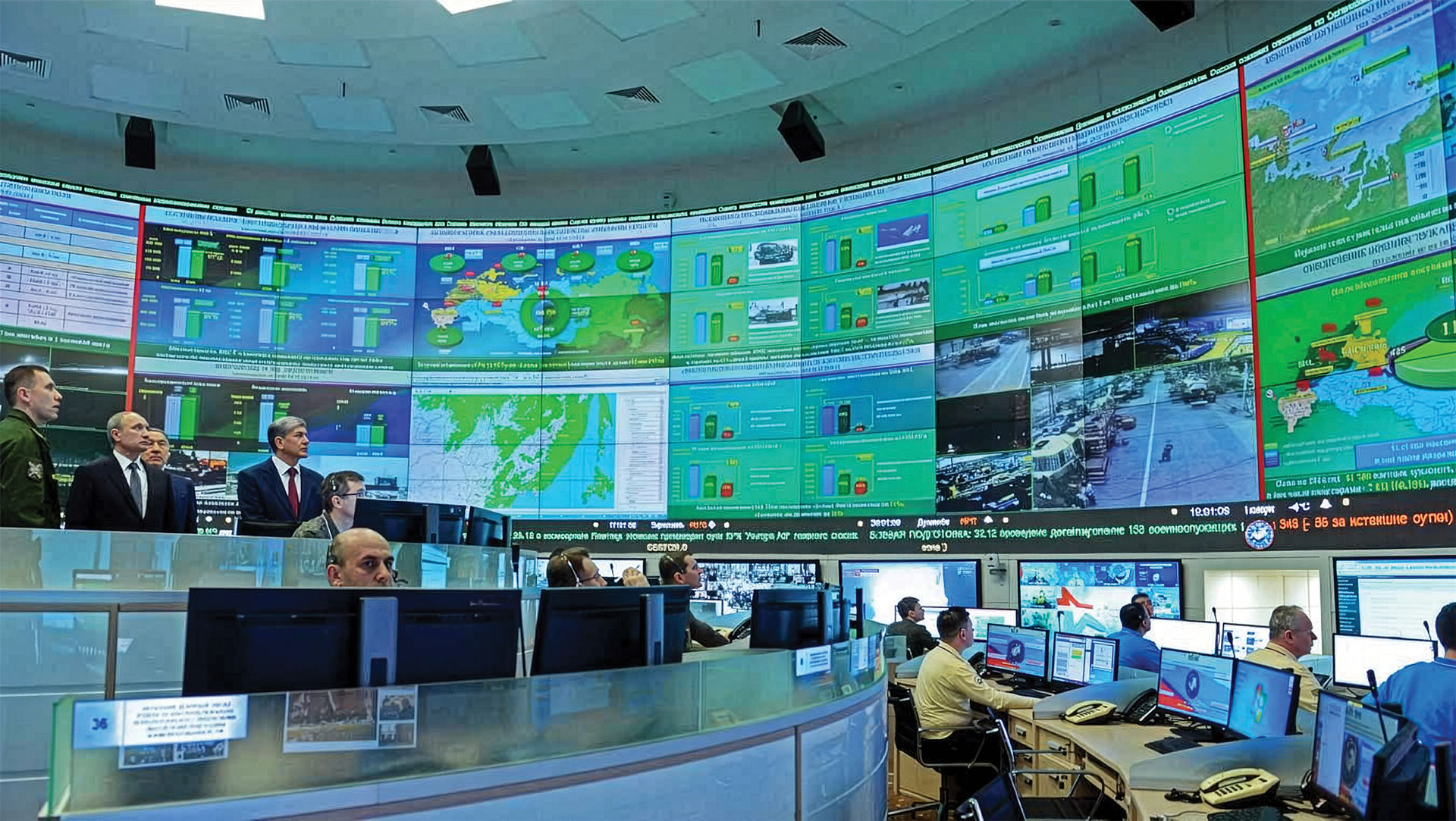
WHAT IT IS
NDMC in Western copy is the National Defence Management Center of the Russian Federation — Национальный центр управления обороной, NTsUO. The “NDMC Supercomputer” is the published name for the program-hardware complex that sits inside that building. It is not Don-2N’s Elbrus-2 floor and not the SKKP catalogue shop at Noginsk-9. It is the Ministry of Defence’s 24-hour strategic C2 machine room, billed in 2014 as the only supercomputer in the Russian defence system.
Official figures, repeated by Shoigu and by the first chief Mikhail Mizintsev: 16 petaflops peak and 236 petabytes of storage. Processing talk of the period compared that stream to “50 Lenin Libraries per second.” The same briefings put a Pentagon machine at 5 petaflops and 12 petabytes. Those numbers are Ministry statements. The installation does not appear on TOP500. Russian-language encyclopedic notes say the performance claim cannot be checked in the public lists. Treat 16 PF / 236 PB as the published card, not a Linpack run anyone outside the building has seen.
THE BUILDING AROUND IT
Address: Frunzenskaya Embankment 22, Moscow — the old “Third House of the Ministry of Defence,” formerly Ground Forces main staff. Coordinates in open maps: about 55°44′56″ N, 37°36′08″ E. President Putin’s decision to create the center is dated 8 May 2013; a formal decree is also cited as 10 December 2013. Shoigu laid a foundation stone on 20 January 2014. Experimental combat duty ran 1 April to 1 December 2014. Official opening was the first week of December 2014. On 22 December Shoigu handed Mizintsev the personal standard. A quay and helipad on the river were opened 10 December 2014. The center answers to the General Staff. Later directors include Oleg Gorshenin in current open listings.
NTsUO is described as three rooms under one roof:
Strategic Nuclear Forces Command Centre — control of nuclear-force use in the published organization chart. Combat Control Centre — world military-political picture, domestic socio-political picture, threat forecast, employment of the Armed Forces and of non-MoD troops. Day-to-day Operations Centre — state defence order, finance, personnel, medicine, housing, international military activity, industry watch.
It is the successor in function to the General Staff central command post, rebuilt as a whole-of-government defence watch rather than a single-service bunker. Kazbek and Perimeter remain separate nuclear-release architectures. NTsUO is the glass-and-video floor that watches the force every hour of the day.
WHAT THE COMPUTER IS FOR
Mizintsev called the suite the heart of the center. Published jobs:
forecast how an armed conflict can develop, using a database of modern wars; hold a running picture of troop readiness and of the state defence order from contract signature through factory floor to the unit; watch transport: road load, rail, river and sea routes, weather, emergency damage on movement corridors; ingest video from industry — period figures were about 700 cameras at 500 defence-industry sites, reviewed several times per shift; support later “artificial intelligence” overlays on that same picture.
It is a C2 and logistics-intelligence computer, not a fire-control radar processor. It does not launch a 53T6. It tells the duty general whether the plant finished the batch and whether the road to the garrison is open.
HARDWARE — WHAT IS PUBLISHED
Integrator named in Western summaries of Russian briefings: United Instrument-Making Corporation (Объединённая приборостроительная корпорация, OPK, Rostec). Official line in 2014–15: hardware and software fully Russian, protected against cyber attack. Operating system of the center’s network in open reporting: Astra Linux (RusBITech), the same special-edition line the Ministry later named as the unified C2 desktop/server standard (2018 talk of making it the army-wide floor). That is a change from the MSVS (MCBC) generation covered in the previous article.
Processor mix in English Wikipedia’s NDMC Supercomputer stub: Elbrus-8S plus Komdiv-128 RIO floating-point accelerators. That pairing is plausible — Elbrus-8S (MCST, 28 nm, 8 cores, 1.3 GHz, ~250 GFLOPS peak per chip in 2015 cards) was the fastest general-purpose Russian CPU on the shelf when the center opened; Komdiv is NIISI’s MIPS-descended military RISC, used as a coprocessor in other classified boxes — but the Ministry has not published a rack diagram. Do not treat socket counts as known. A 16 petaflop Elbrus-8S-only machine would need on the order of tens of thousands of those chips; mixed nodes and later refreshes (8SV, then 16S-class if they ever landed in that hall) would change the arithmetic. After 2021–22 the same building could in principle have taken newer E2K or other Russian boards. Open sources do not say they did.
Storage at 236 PB is the second official number. It is two orders above a typical 2014 university cluster disk farm and is the figure Shoigu used when he compared NTsUO to the Pentagon. Whether that is spinning disk, tape, or a marketing sum of every archive the center can mount is not broken out.
Cooling, power and floor area are not in the public spec. A 16 PF class machine in 2014, if the number is real, is a multi-megawatt hall. The reconstructed Third House was gutted for exactly that class of plant.
WHAT THE NUMBERS ARE WORTH
TOP500 in 2014 was led by Tianhe-2 at about 34 petaflops Linpack. A verified 16 PF machine would have been near the world top ten. No Russian military system was submitted. English Wikipedia’s “7th in 2017” line on the NDMC Supercomputer page is not a TOP500 record; the public list does not contain it. The honest statement is: Moscow published 16 PF / 236 PB in 2014 and has not published a successor Linpack. AI modernization is mentioned in later Western notes on the center. That is software talk on top of the same classified hall.
PLACE IN THIS DATABASE
Don-2N / Elbrus-2 then Elbrus-90S — radar fire-control and ABM track math under Sofrino. Noginsk-9 — SKKP catalogue and space-object C2. MSVS — the 2002 troop Linux that Astra replaced. NTsUO — the 2014 national watch floor and its unpublished cluster, running Astra, fed by industry cameras and staff nets, sitting one level below the Minister and beside the General Staff.
Perimeter and Kazbek can still function if this building goes dark. That is the point of those older systems. NTsUO is what the Ministry built so that, on a normal day, it would not have to.
STATUS
The center has been on duty since December 2014. The supercomputer figures have not been publicly revised. Hardware inside is a classified refresh problem: Elbrus-8S was current in 2014; 8SV and 16S exist on the civil-military catalogue; Astra Linux Special Edition remains the named OS. Director and staff rotate. The mission set — force picture, defence-order watch, conflict forecast — is unchanged in official language.
IN ONE SENTENCE
The NDMC computer is the unpublished 16-petaflop / 236-petabyte hall inside the National Defence Management Center on Frunzenskaya Embankment — Astra Linux on a claimed all-Russian cluster (Elbrus-8S and Komdiv cited, not confirmed rack-by-rack) that watches the force, the factories and the roads so the General Staff has one floor that sees all three.