WHAT IT IS
Kometa (Russian: «Комета») is a family of Russian controlled-reception-pattern antennas for satellite navigation. The array listens to GPS L1 and GLONASS G1 from several patches at once, weights them, and puts a null on a jammer so the receiver still sees the satellites. It is an antenna and a small adaptive processor, not a flight computer and not a map-matcher.
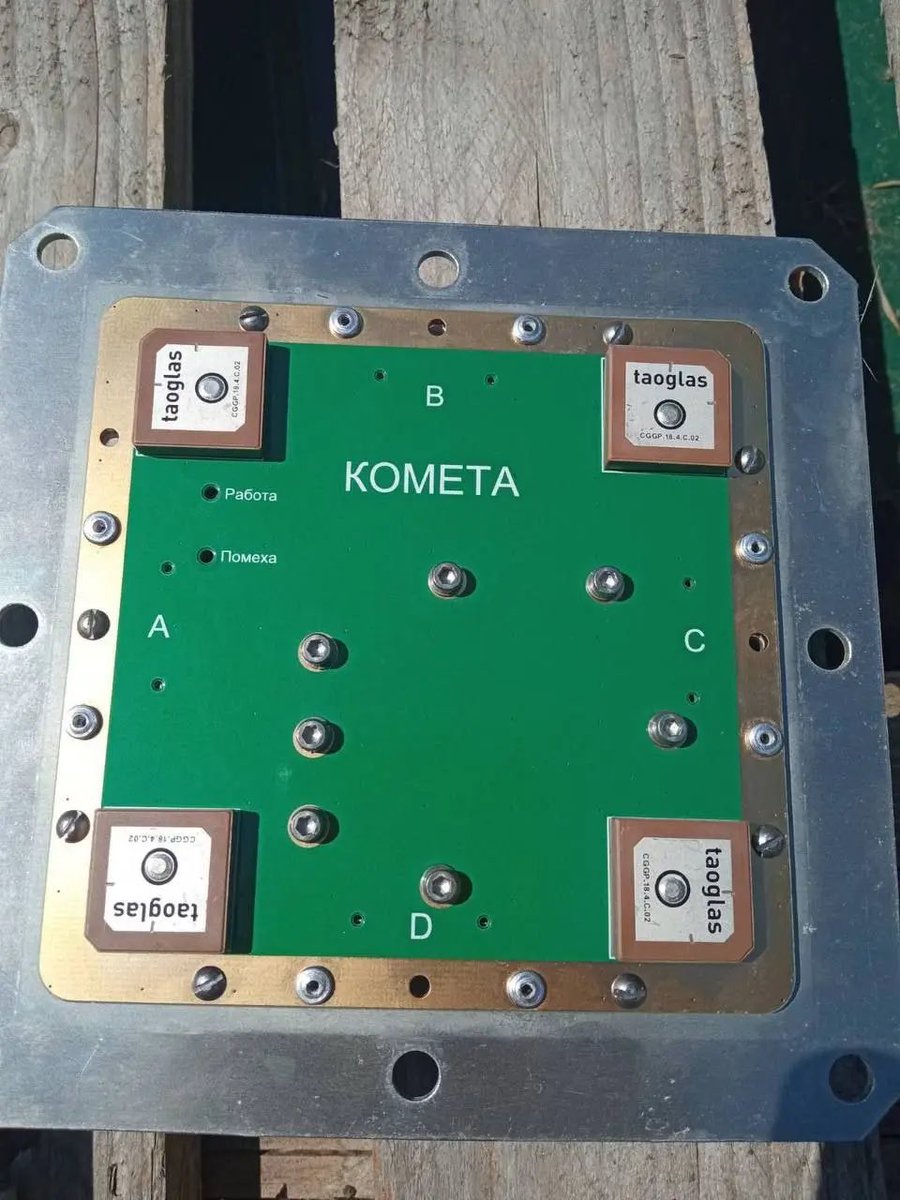
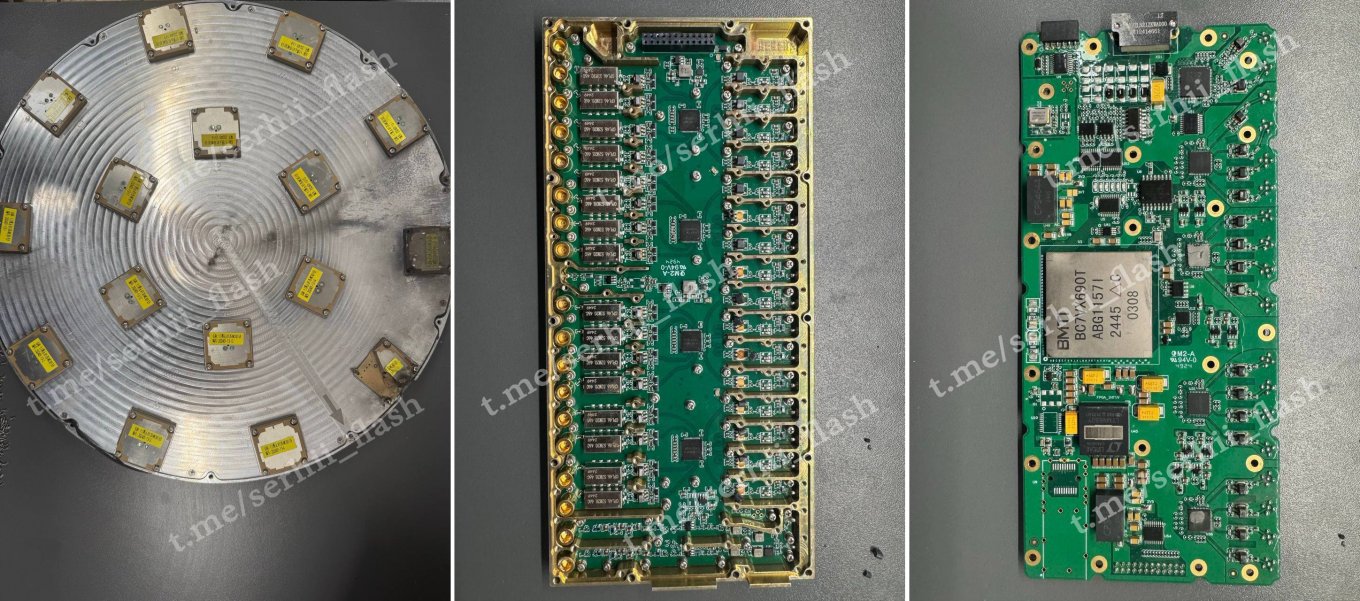
Maker is AO VNIIR-Progress, Cheboksary, Chuvash Republic, in the ABS Electro group. The plant was struck on 9 June 2025. Recovered boards have used commercial patch elements, including Irish Taoglas parts routed through intermediaries. Chinese CRPAs of similar element counts have also been pulled from Geran wreckage and are not this factory’s stencil.
HOW A CRPA WORKS
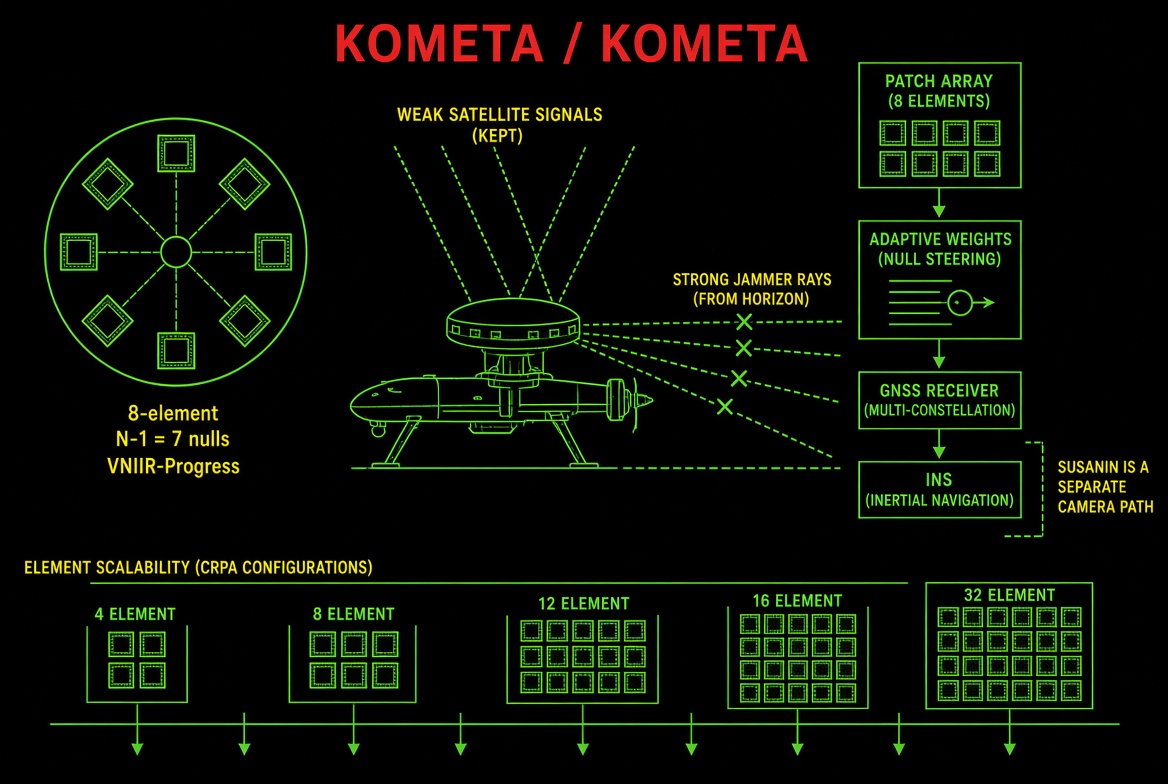
A single patch cannot tell a satellite from a jammer on the same frequency. N elements give N−1 independent nulls. A 4-element Kometa can steer three nulls. An 8-element unit can steer seven. The processor measures phase across the face, treats the strong ground signal as interference, and keeps the weak signals from above. Spatial separation of jammers spends nulls. One loud jammer is cheap. Several jammers on different bearings fill the budget, which is why the element count climbed.
The module does not invent a position. It hands a cleaner RF stream to a GNSS receiver (Unistrong and similar multi-constellation boards have been documented in the same Geran bay). If every look-angle is jammed, or the receiver is spoofed inside a null that was never formed, Kometa is done. Spoofing that mimics a satellite from above is a different problem from barrage noise from the horizon.
THE LADDER
Element count is the public version number.
4-element. Early-war Geran and the first UMPK kits. Three nulls.
8-element. From about 2023. Standard on later glide-bomb kits and many drones. Kometa-M is the name used on UMPK.
12-element. Recovered on Geran-2 by early 2025. Ukrainian volunteer reporting in May 2025 said most Geran-2 then carried a 12-element set.
16-element. Kometa-M16 cited on Garpiya-A1 in early 2026. A 16-element array found in March 2025 was identified as Chinese, not VNIIR-Progress.
32-element. Shown on jet Geran-4 / Geran-5 control modules in October 2026 Ukrainian accounts. Same N−1 rule: 31 nulls if the processor can form them. Claimed, photographed in wrecks, not a factory brochure.
WHERE IT IS FITTED
Geran-2 and the jet Geran-4 / Geran-5. UMPK glide-bomb kits (Kometa-M). Iskander-M 9M723, in the same class of protected GNSS. Cruise missiles and other guided bombs are named in Russian press roundups. It sits beside the inertial unit. On the 2026 Geran-4 card the companions are the SADRA inertial module, the MOH magnetometer, and Susanin optical correlation. Kometa is the satellite path. The others are what remains when the satellite path dies.
WHAT IT DOES NOT DO
It does not guide on terrain. It does not replace an INS. It does not defeat a jammer that is stronger than the adaptive range, or a set of jammers that outnumber the nulls. Raising the element count is the factory answer to a denser jammer belt, which is evidence the belt still works often enough to force the redesign.
NOT THESE
Susanin — downward camera versus a stored map. No RF.
SADRA / MOH — inertial module and PNI magnetometer. Drift control, not a satellite null.
Otblesk-U — Kh-101 optical corrector.
Iranian CRPA on early Shahed — replaced on Russian-built Geran by this family, and less resistant on Ukrainian assessments.
Chinese 8 / 12 / 16-element arrays — same job, different plant. Do not stencil them Kometa from element count alone.
CAVEATS
“Kometa” is used loosely for any round anti-jam plate on a Geran. Patch vendor, receiver chip, and array maker are three different lines. The 32-element fit is a 2026 wreck report. Null count is the textbook N−1 limit, not a measured jammer trial.
STATUS
In production and in use. Element count still rising as of autumn 2026.
IN ONE SENTENCE
Kometa is VNIIR-Progress’s CRPA — four elements, then eight, twelve, sixteen, and a reported thirty-two — bolted to Geran, UMPK, and Iskander so GPS and GLONASS survive a jammer by nulling it, until the jammer count exceeds the elements minus one.