WHAT IT IS
The RS-24 Yars (РС-24 «Ярс»; NATO SS-27 Mod 2; GRAU indices commonly given as 15Ж55 for the mobile missile and 15Ж65 for the silo version, with some sources using related 15Ж55M / complex indices) is Russia's primary modern land-based intercontinental ballistic missile. It is a three-stage, solid-propellant, MIRV-capable ICBM derived from the single-warhead RT-2PM2 Topol-M (РС-12М1 / РС-12М2, NATO SS-27 Mod 1). It can be launched from a 16×16 road-mobile transporter-erector-launcher (TEL) — the MZKT-79221-based 15У175М — or from a silo. It is designed by the Moscow Institute of Thermal Technology (МИТ) and produced at the Votkinsk Machine-Building Plant.
Yars is the workhorse of the Strategic Missile Forces in the 2020s. Where Sarmat is the troubled heavy liquid replacement for the SS-18, and Avangard is a small specialised glide-vehicle force, Yars is the missile Russia actually fields in large numbers: on the order of 180 road-mobile and roughly two to four dozen silo launchers as of open 2025–2026 estimates, carrying three warheads each under typical loading assumptions. Variants include the improved Yars-S (Ярс-С), reported to carry more powerful medium-yield warheads for harder targets.
As with every strategic system in this database, published numbers must be separated from measured ones. Range figures of 10,500–12,000 km, warhead yields of roughly 100–200 kt, and CEP claims in the low hundreds of metres are reference-work and press figures, not flight-test press releases with instrumentation data. Where this site already has related articles they are linked: RS-28 Sarmat, Avangard, INS, GLONASS, Kazbek, Perimeter / Dead Hand, Russian C3, SPRN, Voronezh, Don-2N, A-135 / A-235 Nudol, S-400, S-500, Patriot, and the nuclear-powered systems Poseidon and Burevestnik.
QUICK FACTS
Not to be confused with: Topol-M (single-warhead predecessor, SS-27 Mod 1); Topol (РТ-2ПМ, older SS-25); RS-26 Rubezh (cancelled/suspended mobile IRBM/ICBM project); Sarmat (heavy liquid silo missile); or the Bulava SLBM, which shares design DNA with the Topol-M / Yars family but is a submarine missile.
PURPOSE AND PLACE IN RUSSIAN STRATEGIC NUCLEAR FORCES
Russia's land leg is a mix of old heavy liquids (SS-18 Voevoda), a small Avangard force on recycled SS-19s, remaining Topol-M singles, and Yars. Yars is the modernisation path: solid fuel (safer to handle, faster to bring to readiness than storable liquids), MIRV (more warheads per launcher under New START-era counting logic that counted warheads), and road mobility (survivability through dispersal). The Bulletin of the Atomic Scientists 2026 estimate puts roughly 180 mobile Yars and 24 silo Yars in the force, for on the order of 600+ warheads if each carries three — the single largest slice of the modernised ICBM force.
Politically, Yars is also the missile Russia launches in almost every strategic forces exercise that the public sees: Plesetsk to Kura shots in October 2025, May 2026 and August 2026 were Yars (or Yars from Krona shelters), not Sarmat. When Moscow wants to show that the land leg works, it lights a Yars.
HISTORY AND DEVELOPMENT
Development is generally dated from about 2004 as a MIRV evolution of Topol-M. First flight test: May 2007 from a mobile TEL. Further tests in December 2007 and November 2008. Road-mobile units were the first declared operational, in February 2010 (Teykovo area often cited for early deployments). Silo testing and deployment followed; a December 2014 report described a successful silo shot, and silo rearmament of former SS-19 or SS-18 fields (notably Kozelsk) has been a multi-year crawl — open imagery analysis in 2024–2025 showed only about two silo loadings per year at Kozelsk, with completion repeatedly promised "this year."
Yars-S appeared in open reporting around 2019 (Yoshkar-Ola, Barnaul). Exact differences are not officially published; Russian specialist press describes more powerful "medium" warheads for hardened targets, as opposed to "light" warheads on the baseline loadout. By late 2010s Karakayev was claiming "more than 150" Yars launchers in service and production of around twenty missiles a year. Through 2025–2026 the mobile force is largely complete across seven missile divisions in open tallies; silo conversion and the replacement of remaining Topol-M at Tatishchevo and Teykovo continue.
WHO BUILDS WHAT
Moscow Institute of Thermal Technology (MIT) is the design bureau for the Topol / Topol-M / Yars / Bulava solid-fuel family. Votkinsk builds the missiles. The TEL uses the MZKT-79221 chassis from the Minsk Wheel Tractor Plant (Belarus) — a strategic dependency that has drawn attention since 2022. Launchers, command vehicles and support gear form the full «Ярс» complex, not just the missile. Solid propellant grains, composite motor cases and the post-boost vehicle are the usual industrial choke points for any solid ICBM; Russia does not publish yields or grain formulations.
DESIGN OVERVIEW
Yars is a three-stage solid rocket with a post-boost vehicle (bus) that dispenses MIRVs and penetration aids. Compared with Topol-M it keeps the same basic diameter and road-mobile architecture but replaces the single warhead with a MIRV bus. Open length is about 22.5 m and launch mass about 49 tonnes — roughly a quarter of Sarmat's claimed mass, and small enough to move on roads and hide under Krona shelters. The missile is cold-launched or mortar-ejected from the TEL canister / silo canister in the usual Russian solid-ICBM fashion: a powder charge pops the missile clear, then the first-stage motor ignites in the air. That protects the launcher from the full exhaust and is the same family of technique used on Topol-M.
PROPULSION AND WHY SOLID FUEL MATTERS
Each stage is a solid-propellant rocket motor. Solid propellant is a cast grain of fuel and oxidiser (typically a hydroxyl-terminated polybutadiene binder with ammonium perchlorate oxidiser and aluminium powder fuel in Western grains; Russian formulations are not published but follow the same chemistry family). Once cast, the grain is ready for years. There are no propellant loading trucks, no toxic UDMH/N2O4 handling, and no long countdown to chill or top off liquids. The trade-off is lower specific impulse than the best storable liquids, and the inability to throttle or restart a solid stage once lit — which is why the MIRV bus needs its own liquid or gel thrusters for fine deployment.
For a mobile force, solids are decisive. A Yars regiment can disperse onto forest roads, park under a Krona arched shelter, and remain at a high readiness state without the logistics train a liquid regiment needs. That is the engineering reason Yars replaced Topol and is replacing Topol-M, while Sarmat remains stuck in the silo-liquid niche.
THE TEL, THE KRONA SHELTER AND ROAD-MOBILE OPERATIONS
The launcher is the 15У175М on an MZKT-79221 16×16 chassis — a very large, multi-axle tractor designed so that axle loads stay within rough road limits and the missile canister can be elevated to vertical for launch. In garrison, TELs often sit under «Крона» (Krona) shelters: arched, drive-through covers that hide the launcher from optical satellites and weather. Plesetsk test launches in May and August 2026 were filmed exiting / firing in connection with Krona shelters, matching routine training patterns.
A road-mobile regiment is not a single truck. It is TELs, mobile command posts, security, engineering and logistics vehicles, operating from garrison and from field dispersal areas. Survivability comes from not being in a surveyed silo when the first warheads arrive. The price is communications, security and the need to receive launch orders in the field — the same C3 problems discussed in Russian C3, Kazbek and Perimeter.
Note: the optical space-surveillance complex also called Krona is a different system entirely (a radar/optical ASAT-support complex in the North Caucasus). Same Russian word, unrelated hardware.
SILO BASING
Silo Yars reuses hardened pits formerly occupied by older missiles (SS-19 fields at Kozelsk are the clearest public example). Silo basing trades mobility for hardness and simpler peacetime security. Conversion is slow: each silo needs mechanical, electrical and command upgrades, and open-source monitoring through 2025 showed Russia loading only a couple of Kozelsk silos per year. Tatishchevo's Topol-M silos are the next large conversion target in Russian statements for 2025–2026.
A FLIGHT, STEP BY STEP
1. Order and erection. On the TEL, the canister elevates to vertical; in a silo, the missile is already vertical in its cup. Authentication follows the Strategic Missile Forces chain.
2. Cold launch / mortar eject. A powder charge ejects the missile from the canister. First-stage ignition occurs after clear.
3. Boost. Three solid stages burn in sequence over a few minutes. Early-warning satellites see the plume (SPRN). Burn is shorter and more intense than a heavy liquid's leisurely boost — one reason Russia advertises "short boost" as a defence-penetration feature on newer missiles generally.
4. Post-boost bus. After last-stage burnout, the bus orients and dispenses MIRVs and decoys onto slightly different trajectories (see below).
5. Re-entry. Each warhead follows a ballistic (or, if manoeuvring RVs are fitted, semi-ballistic) path to its aimpoint. Open sources have claimed newer Yars RVs can manoeuvre; hard public evidence of operational manoeuvring RVs on Yars is thinner than for Avangard.
THE POST-BOOST VEHICLE (BUS) AND MIRV MECHANICS
A MIRV bus is a small spacecraft. After the boost stages finish, it is above the atmosphere with a stack of re-entry vehicles and decoys. It uses its own thrusters — usually storable liquid bipropellant — to change velocity slightly between releases. Each release puts one RV on a trajectory to a different target, within the "footprint" the bus can reach with its remaining propellant. Penetration aids (balloons, replica RVs, electronic decoys) are released on related trajectories to confuse midcourse radars.
Physics constraints: the bus has limited Δv; targets must lie within a footprint hundreds of kilometres across, not on opposite sides of a continent. Release must be done before the bus itself re-enters. Timing and orientation errors become miss distance on the ground. This is why bus guidance and the quality of the inertial platform matter as much as the missile's boost guidance — see INS. Yars is assessed to carry three warheads in day-to-day loading even if the bus could physically hold four; New START-era incentives and throw-weight limits both push toward three-plus-decoys rather than maximum warhead count.
GUIDANCE
Open descriptions are consistent: a modern strapdown inertial system with GLONASS satellite updates during boost (and possibly for the bus). Astro-correction is sometimes mentioned for the broader Russian ICBM family but is not specifically documented for Yars in official releases. CEP figures in the open literature vary; treat any specific metre number as unverified. For 100–200 kt warheads against cities or soft military targets, CEPs of a few hundred metres are adequate; against hard silos, either better accuracy or higher yield (the Yars-S story) is required.
PAYLOADS AND YARS-S
Baseline open estimate: three MIRVs, each roughly 100–200 kt. The Bulletin's 2026 table footnotes about 100 kt and three warheads as the working assumption. Yars-S is described in Russian specialist media as carrying more powerful medium-yield warheads for hardened targets. Penetration aids are assumed. There is no public evidence that operational Yars missiles carry Avangard; Avangard remains an SS-19 (and future Sarmat) payload.
SPECIFICATIONS (PUBLISHED FIGURES)
COMMAND, CONTROL AND LAUNCH READINESS
Yars regiments sit inside the same national nuclear C3 architecture as the rest of the RVSN: Kazbek as the presidential/general-staff channel, backup systems including Perimeter, and the day-to-day regimental command posts. Mobile missiles add the problem of reaching TELs that have left garrison. Russia has invested in multiple redundant links (including airborne relays and the Sirena-M backup launch-code transmitters mentioned in open force tables). Launch readiness for solids is inherently high once the regiment is on alert — minutes, not hours — which is the point of the solid-fuel mobile force.
TESTING AND RECENT LAUNCHES
Development tests 2007–2008; service entries from 2010; ongoing training and confirmation launches from Plesetsk to Kura. Notable recent public shots: 22 October 2025 strategic forces exercise (Yars from Plesetsk plus Sineva SLBM and Tu-95MS cruise missiles); May 2026 strategic exercise Yars from Krona; 28 August 2026 mobile Yars from Plesetsk Krona shelter, warheads reported to Kura. These launches are routine confirmation shots, not developmental first flights.
COMPARED WITH OTHER ICBMS
Versus Topol-M: same family, but MIRV instead of one warhead. Versus SS-18 / Sarmat: much smaller throw weight, solid instead of liquid, mobile option, far more units in the field. Versus US Minuteman III: similar solid three-stage concept; Minuteman is silo-only and now typically one warhead under US loading choices; Yars emphasises mobility and three-warhead loading. Versus Chinese DF-41: both are modern solid MIRV mobiles; public data on both is limited. Versus Avangard: Yars throws several simpler RVs; Avangard throws one hard-to-predict glider.
ARMS CONTROL
Under New START, each deployed Yars launcher counted, and each attributed warhead counted toward the 1,550 ceiling. The treaty expired 5 February 2026. Converting single-warhead Topol-M silos to three-warhead Yars is one of the quieter ways Russia can grow accountable (or formerly accountable) warhead numbers without building new bases. That conversion is still underway at Tatishchevo in open reporting.
LIMITS AND VULNERABILITIES
Mobile TELs can be found by persistent ISR if they stay in peacetime patterns. Belarusian chassis supply is a political-industrial risk. Silo Yars are fixed targets. Three warheads per missile is a lot less than an SS-18. Solid motors cannot be thrust-terminated as cleanly as liquids in some abort modes. And MIRV buses still fly predictable midcourse tracks — unlike Avangard — so they remain the design problem that midcourse interceptors and the Moscow ABM system were built to face (see A-135 / A-235, Don-2N).
STATUS AND OUTLOOK (OCTOBER 2026)
Yars is the backbone of the Russian ICBM force: roughly 180 mobile launchers operational, silo conversion continuing slowly, Yars-S fielded in at least some regiments, and regular Plesetsk confirmation launches through 2025–2026. It is not exotic. It is the missile that actually underwrites the land leg while Sarmat, Burevestnik and Poseidon absorb headlines and budget. Expect continued Topol-M replacement and gradual silo growth rather than a sudden jump in numbers.
SOLID-MOTOR ENGINEERING
A strategic solid motor is a pressure vessel wrapped around a cast grain. The case is typically high-strength steel or composite fibre; the nozzle is a throat insert (carbon-carbon or tungsten-copper class materials in various world programmes) that must survive two to three minutes of hot gas. Thrust-vector control on Russian solids has used flexible nozzles and, on older designs, secondary injection. Stage separation is pyrotechnic. None of the Yars grain geometry (finocyl, star, end-burner, etc.) is public, but three stages imply a trade of burn time and mass fraction familiar from Minuteman and Topol-M.
Aging of solid motors is a real logistics issue. Plasticisers migrate; cracks can form; inspectors use non-destructive testing and service-life surveillance firings. Votkinsk's production rate (Russian officials have said roughly twenty Yars-class missiles a year in some periods) must cover both new deployments and eventual replacements of aging stock. That industrial tempo is why silo conversion at Kozelsk looked slow in 2024–2025 imagery: the bottleneck is not only civil engineering at the hole in the ground.
REGIMENTAL STRUCTURE AND DISPERSAL
A road-mobile missile regiment typically fields several TELs (often discussed as nine in a full Russian regiment, though exact tables vary by division and modernisation state), a mobile command post, and support. In crisis the regiment leaves garrison for field positions surveyed in peacetime or chosen for canopy and road access. Krona shelters at home base defeat casual optical satellites; in the field, camo nets, tree cover and movement defeat a fraction of overhead ISR — not all of it, especially against persistent drones and radar satellites. The classic Cold War game of mobile ICBM survival is now played with better sensors on both sides.
Divisions publicly associated with Yars in open tallies include units at Teykovo, Yoshkar-Ola, Nizhny Tagil, Novosibirsk, Irkutsk, Barnaul, Kozelsk (silo) and others as rearmament proceeds. Tatishchevo's large silo farm remains the prize for converting remaining Topol-M holes to Yars MIRVs — each conversion multiplies warheads per silo by roughly three under standard assumptions.
PENETRATION AIDS AND THE MIDCOURSE FIGHT
Unlike Avangard, a Yars MIRV stack still spends a long time in space on Keplerian arcs. That is the battlespace of midcourse defence and of the Moscow ABM system's original design. Penetration aids — lightweight decoys that mimic RV radar signatures in vacuum, chaff, jammers, timing envelopes — exist to raise the cost of discrimination. Russian statements routinely credit Yars with a modern countermeasures suite; the inventory list is classified. The practical point for this encyclopedia: Yars defeats missile defence primarily by numbers, decoys and short boost, not by Avangard-style atmospheric manoeuvre.
COMPARISON WITH BULAVA AND THE SOLID-FUEL FAMILY
Bulava (RSM-56), the Borei-class SLBM, shares MIT design heritage with Topol-M/Yars. Similar solid-fuel philosophy, different dimensions, different launch environment (underwater cold launch from a submarine tube). Problems that plagued early Bulava testing were a reminder that solid strategic missiles are not "easy" just because the US and USSR mastered them decades ago — quality control in grains, nozzles and bus software still bites. Yars' smoother public test record after 2010 is one reason it became the land-leg default.
WHY YARS MATTERS MORE THAN THE HEADLINES
Sarmat, Avangard, Poseidon and Burevestnik dominate English-language headlines. Yars launches are what actually light up Kamchatka ranges several times a year. If one asks which land-based missile would carry the majority of Russian ICBM warheads in a 2026 exchange under open estimates, the answer is Yars. Understanding Yars — TEL, Krona, three-warhead bus, solid motors, GLONASS-aided INS — is understanding the real RVSN, not the brochure.
COLD LAUNCH DYNAMICS
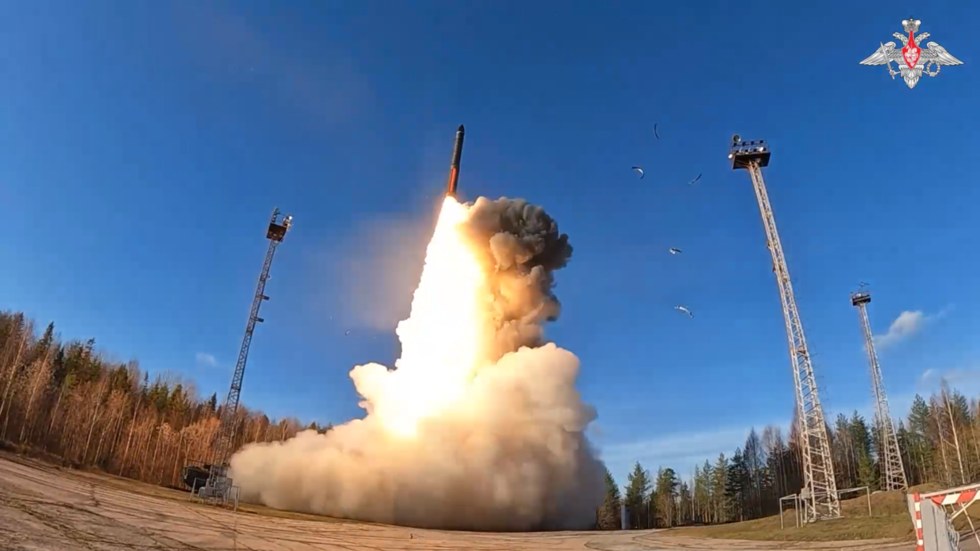
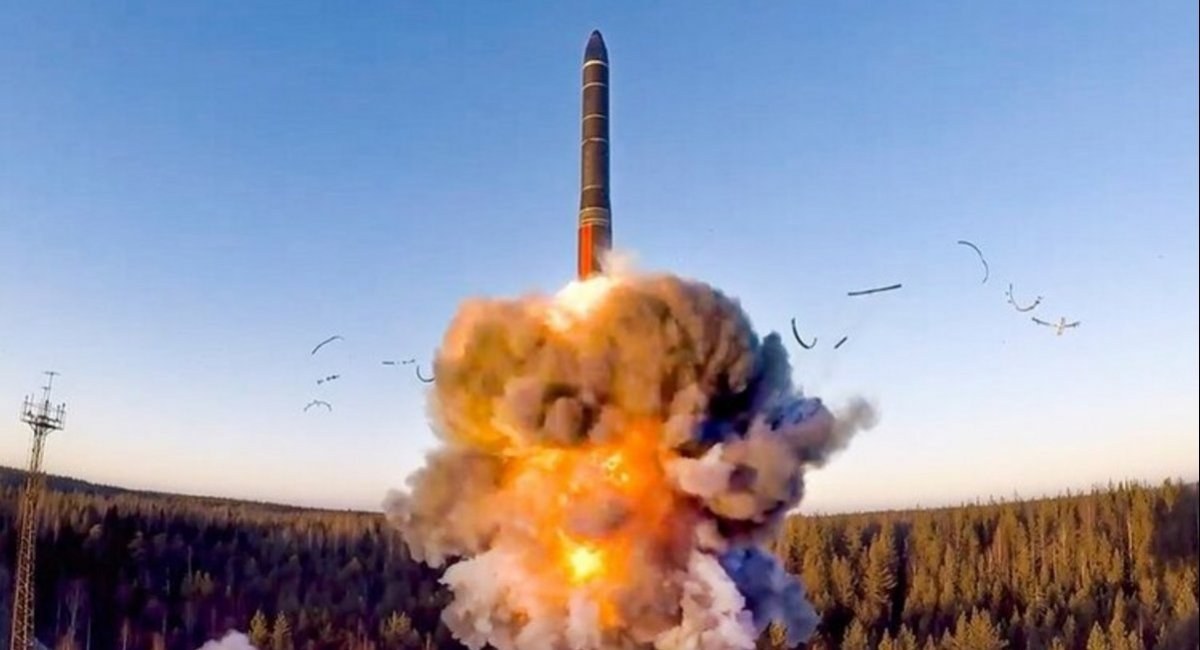
Yars leaves its canister under powder-gas pressure before the first-stage motor lights. High-speed video of Plesetsk launches shows the missile climbing, then the bright ignition and the shedding of sabots or protective elements — debris arcs visible in the fireball photographs on this page. Cold launch protects the TEL and silo hardware from the full solid-motor plume and lets the regiment reuse expensive ground equipment. The trade is a short period of nearly ballistic rise on residual eject velocity before thrust builds; guidance must capture that hand-off cleanly.
THE MZKT-79221 CHASSIS
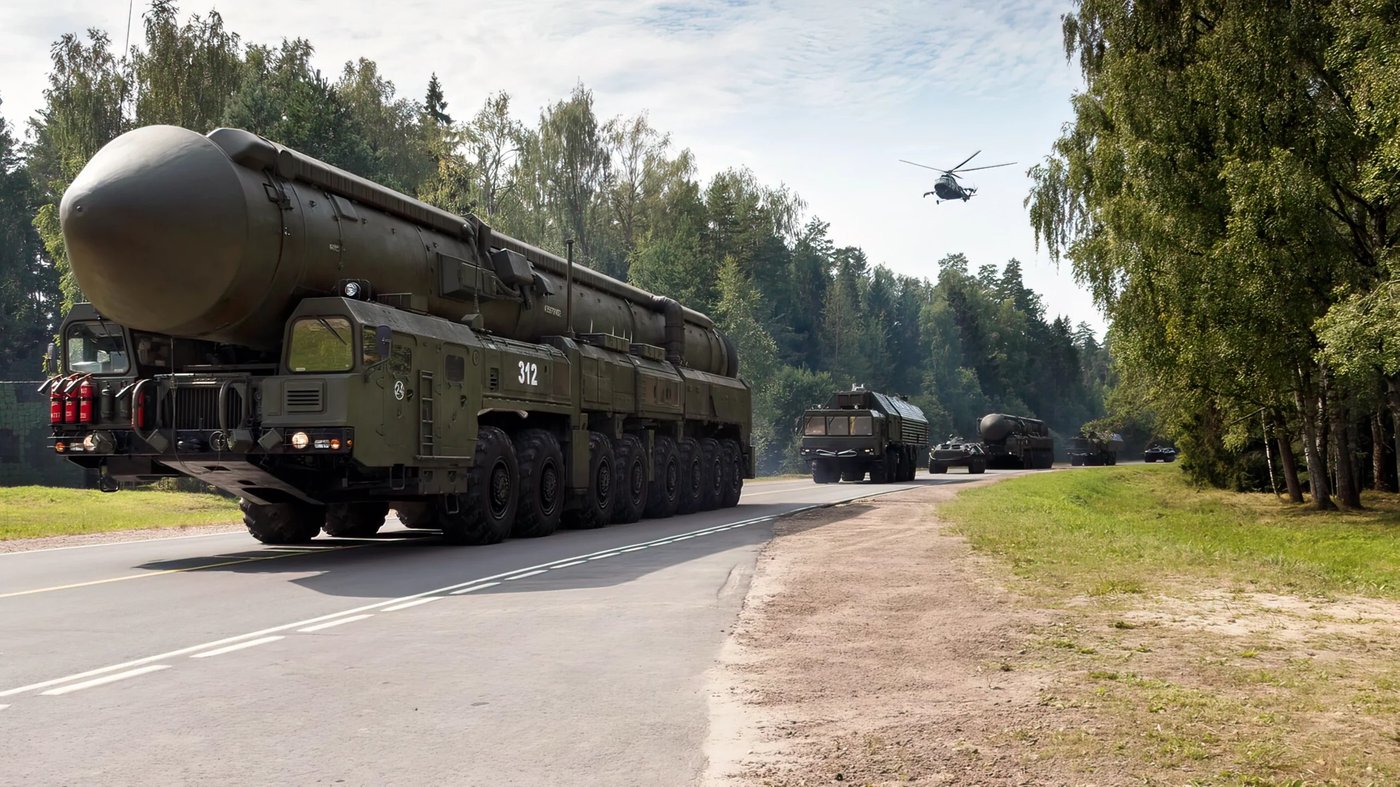
The 16×16 Minsk chassis spreads roughly fifty tonnes of missile-plus-launcher across many axles so that soft forest roads remain usable. Central tyre inflation, high ground clearance and a turning radius managed by steerable axles are typical of this vehicle class. Dependence on a Belarusian plant is a strategic-industrial fact: wheels, frames and spare parts are not trivial to relocate overnight. Photographs of TEL "312" on a paved road with helicopter escort show the peacetime convoy face of a regiment that, in war, would leave the asphalt as soon as it could.
SILO LOADING SEQUENCE
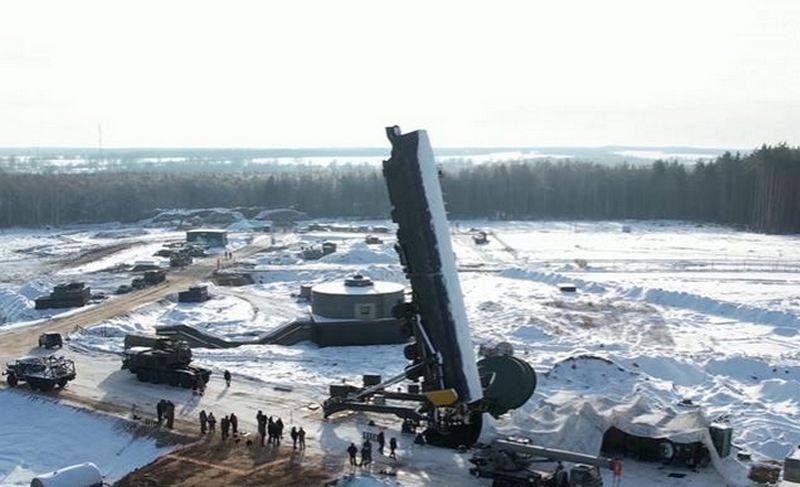
The snowy erector photograph on this page shows the other basing mode: a canister being raised beside a circular silo headworks while a small crowd of personnel watches. Loading a silo Yars is a heavy-lift, high-precision job involving transporter, erector, alignment and electrical mate to the launch cup. That is why open-source analysts can watch Kozelsk and Tatishchevo for crane activity and infer the pace of rearmament — a couple of silos a year in some recent seasons is a logistical tempo, not a political slogan.
READING THE 2010 RIA INFOGRAPHIC CAREFULLY
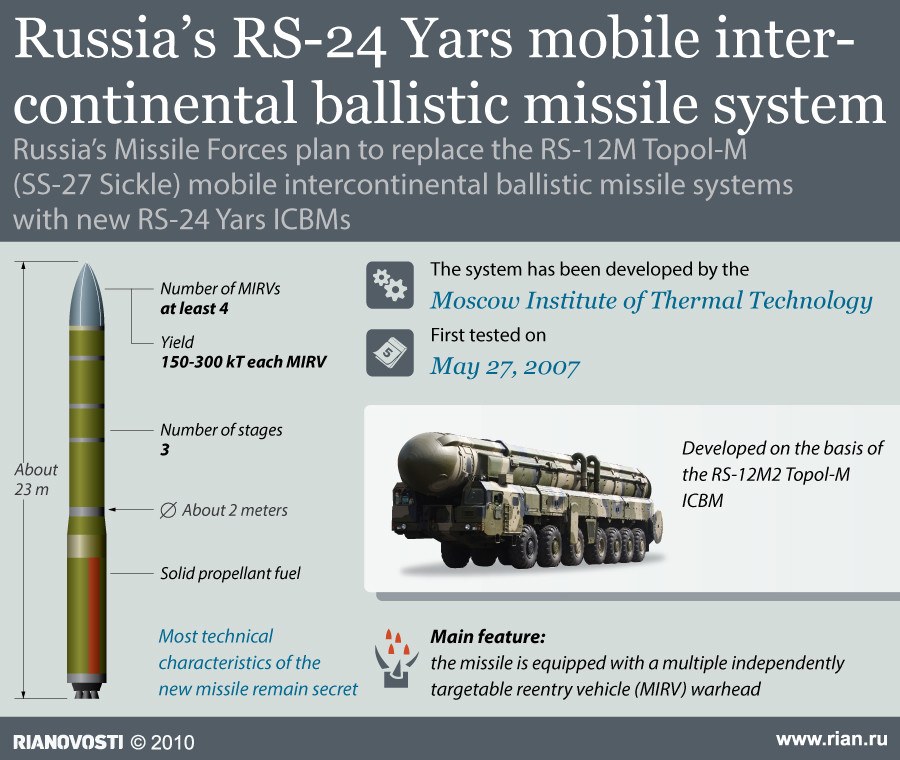
The RIA Novosti infographic reproduced here dates from 2010, when Yars was new. It lists height about 23 m, diameter about 2 m, three solid stages, and "at least 4" MIRVs of 150–300 kt. Later open assessments (Bulletin 2025–2026, CSIS) more often assume three warheads of roughly 100–200 kt on day-to-day loading. The infographic is a primary document of what Russian state media said early; it is not a binding loading table. Where this article disagrees with the 2010 graphic, the disagreement is flagged as the difference between early press claims and later specialist estimates.
EXERCISE PATTERN 2025–2026
The October 2025 strategic forces exercise paired a Plesetsk Yars with a Sineva SLBM shot and Tu-95MS cruise-missile launches — a full-triad show. May and August 2026 Plesetsk Yars shots from Krona shelters were framed as confirmation of tactical-technical characteristics, with the August missile reportedly brought from a remote deployment base. That pattern — exercise shot, then routine confirmation shots — is what a mature solid ICBM force looks like. Sarmat's sporadic and sometimes catastrophic tests are the opposite pattern.
SURVIVABILITY UNDER NUCLEAR ATTACK
A silo Yars lives or dies with the hardness of its pit and the accuracy/yield of the attacker's counterforce shot. A mobile Yars lives or dies with whether it has left garrison, how well it hides, and whether the attacker is willing to barrage large areas. Russian doctrine and Western analysis both treat mobile solids as the survivable land leg; silo liquids and silo solids are the prompt, high-readiness, high-accuracy leg that also draws fire. Yars uniquely plays both roles depending on basing. That dual role is why the slow Kozelsk/Tatishchevo silo conversion still matters politically: each new silo Yars is three warheads on a known coordinate, while each new mobile TEL is three warheads on a moving problem.
CEPs, HARD-TARGET KILL AND YARS-S LOGIC
Hard-target kill probability rises with yield and falls with CEP squared (in simplified treatments). If baseline Yars warheads are "light," they are fine for cities and soft military targets. Hardened command bunkers and adversary silos push designers toward either better accuracy or hotter warheads — the open-source story of Yars-S. Without official numbers, the reader should take Yars-S as evidence that the RVSN wanted a harder-hitting loadout on the same bus, not as a known yield table. Guidance quality (INS + GLONASS) is the other half of that kill-probability equation.
DECOYS VERSUS MANOEUVRING RVs
Two different penetration philosophies exist on modern Russian ICBMs. One is classical: many MIRVs plus lightweight decoys that look like RVs in space. The other is manoeuvre: make each RV or glider unpredictable. Avangard is the extreme of the second. Yars is primarily the first, with occasional Russian claims of manoeuvring RVs that lack the public flight-test theatre Avangard received. A manoeuvring RV that still re-enters steeply is not the same vehicle as a long-range glider; the heating times and control problems differ. Keep those categories separate when reading press copy.
COMMAND LINKS TO THE FIELD
Launch orders must reach TELs that may be under trees hundreds of kilometres from garrison. Russia layers ground radio, satellite, airborne relay and specialised backup transmitters (Sirena-M appears in open force tables as a launch-code backup role). The mobile force is only as deterrent as its C3 is reliable under attack — the theme of Russian C3, Kazbek and Perimeter. A perfect missile with a severed order wire is scrap metal.
PRODUCTION, EXPORT AND PROLIFERATION NOTE
Yars is not an export missile. Its technologies — solid grains, TEL design, MIRV bus — are national strategic assets. Closely related MIT design practice feeds Bulava at sea. Industrial failure at Votkinsk or MZKT would hit the modernisation plan harder than a delayed Sarmat shot, because Yars is the volume product. That is the quiet manufacturing story behind the parade TELs.
THROW WEIGHT, FOOTPRINT AND TARGET PLANNING
Throw weight (~1,200 kg in open estimates) is the mass the boost stack can deliver to a reference trajectory for the bus, RVs and decoys. It is not the same as warhead mass alone. Mission planners carve a footprint — the ground area within which the bus can still dispense RVs with its remaining Δv — and assign aimpoints inside it. A three-warhead Yars might cover a bomber base, a port and a city sector on one booster, or three silos in one missile field, depending on spacing. That flexibility is the operational meaning of MIRV for the RVSN day-to-day force.
MINIMUM RANGE AND SAFETY FANS
Open sources sometimes cite a minimum range around 2,000 km for Yars-class missiles. Solid ICBMs have geometric and heating constraints on very depressed short shots; test ranges also need cleared safety fans for stage drops. Plesetsk-to-Kura is the classic Russian long confirmation profile; shorter in-country profiles exist for some developmental work but are less often publicised for Yars.
ELECTRONIC WARFARE AND GNSS DENIAL
An adversary who can jam or spoof GLONASS along the boost path forces the missile back onto pure inertial performance. Cruise missiles feel GNSS denial acutely; ballistic missiles less so, because boost is short and the bus can still do inertial releases. Even so, modern Russian strategic guidance is built assuming GNSS will be contested. Antenna design, beam forming and filtering (see also Kometa CRPA for the general anti-jam antenna family used on Russian platforms) are part of that contest. Public detail on Yars-specific anti-jam hardware is thin.
RELATIONSHIP TO PERIMETER AND DAY-TO-DAY ALERT
Mobile Yars regiments on routine alert are the living part of the land deterrent. Perimeter is the dead-hand backstop if the leadership is killed. The two should not be conflated: one is how Russia expects to fight a nuclear war if ordered; the other is how it threatens retaliation even if command is decapitated. Yars serves both stories because it is numerous, dispersed and solid-fuel quick.
PHOTO INDEX FOR THIS ARTICLE
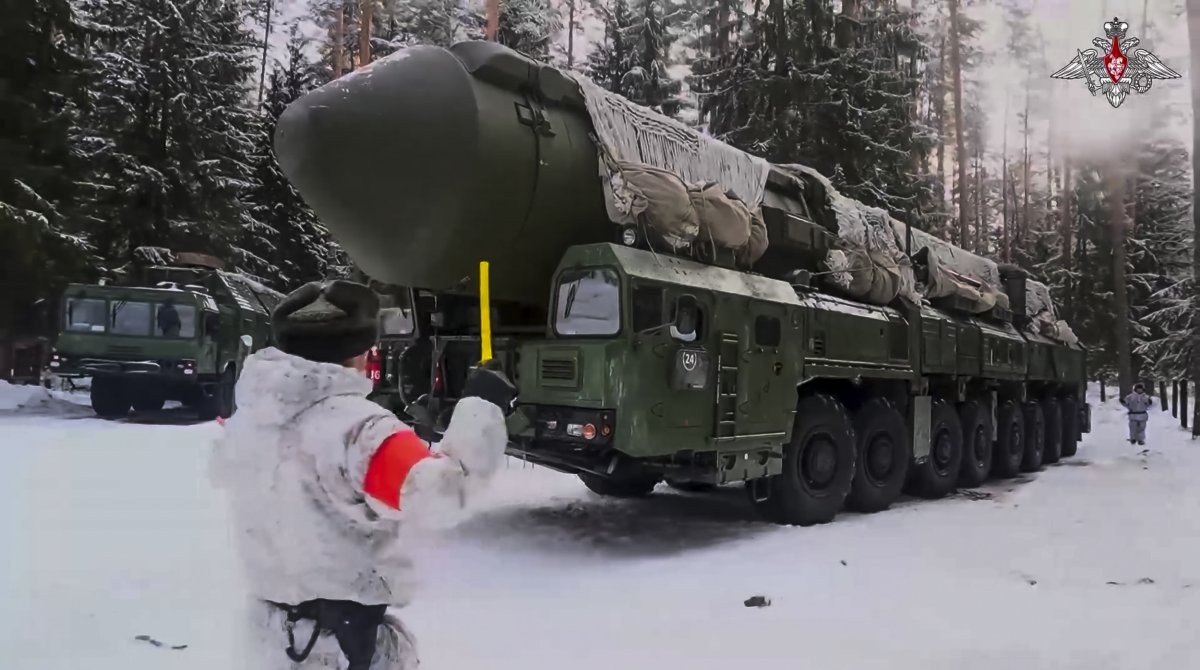
The six photographs on this page, in order: (1) a road convoy TEL numbered 312 with helicopter escort — peacetime mobile face; (2) a TEL in snow guided by a white-camouflage signalman — field dispersal; (3) an erector raising a canister beside a circular silo headworks in winter — silo loading; (4) the 2010 RIA Novosti infographic — early public specs; (5) an MoD launch from a pad with lattice towers — instrumented test aesthetic; (6) a fireball launch over forest with shedding sabots — first seconds of flight. Together they document mobility, silo loading and launch better than any single parade shot.
HISTORICAL LINEAGE FROM TOPOL
The RT-2PM Topol (SS-25) taught the RVSN how to run a solid road-mobile ICBM force in the late Cold War and 1990s. Topol-M (SS-27 Mod 1) modernised that into a single high-accuracy warhead on both road and silo mounts. Yars is the MIRV turn of that crank. Watching parade footage, the casual eye sees "another big green truck"; the institutional eye sees thirty years of solid-fuel practice, garrison drill, Krona procedures and Plesetsk range craft. That institutional capital is why Yars modernisation could proceed even while exotic programmes slipped.
Early arms-control debates asked whether a MIRVed Topol-M derivative would destabilise New START ceilings. In practice Russia deployed Yars under the treaty, declared loadings, and used the MIRV option as both military capability and negotiating fact. With the treaty expired in February 2026, the same missiles now sit in a transparency gap — still countable by satellites as launchers, no longer formally limited as warheads.
MOBILE BASING GEOGRAPHY
Yars mobile divisions occupy a belt of central and Siberian garrisons chosen for road nets, forest cover and distance from borders. Open tallies over the years have named Teykovo, Yoshkar-Ola, Nizhny Tagil, Novosibirsk, Irkutsk, Barnaul and others as Yars or Yars-S hosts; Kozelsk is the clearest public silo conversion story; Tatishchevo and remaining Topol-M sites are the next conversion wave in Russian statements. Exact order of battle shifts; satellite analysts (including Bulletin authors) update counts annually. Readers should treat any single blog's regiment list as a snapshot.
WHAT IS UNCERTAIN IN THIS ARTICLE
TIMELINE
RUSSIAN TERMS USED IN THIS ARTICLE
IN ONE SENTENCE
The RS-24 Yars (РС-24 «Ярс», SS-27 Mod 2) is Russia's main solid-fuel, MIRV-capable ICBM — a Topol-M derivative built by MIT/Votkinsk, launched from MZKT-79221 TELs or silos, typically assessed at three ~100–200 kt warheads and ~11,000 km range, and fielded in roughly 180 mobile plus two to four dozen silo launchers as the real backbone of the land-based force as of October 2026.