Home |
Data Base |
Technical |
Radio |
Search
DON-2N
Radar 5N20 Don-2N
NATO reporting name: Pill Box
Project Orlan Data Base // public encyclopedia
WHAT IT IS
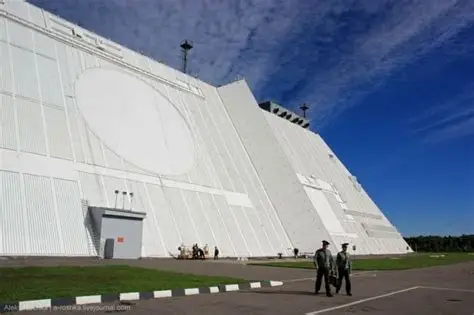
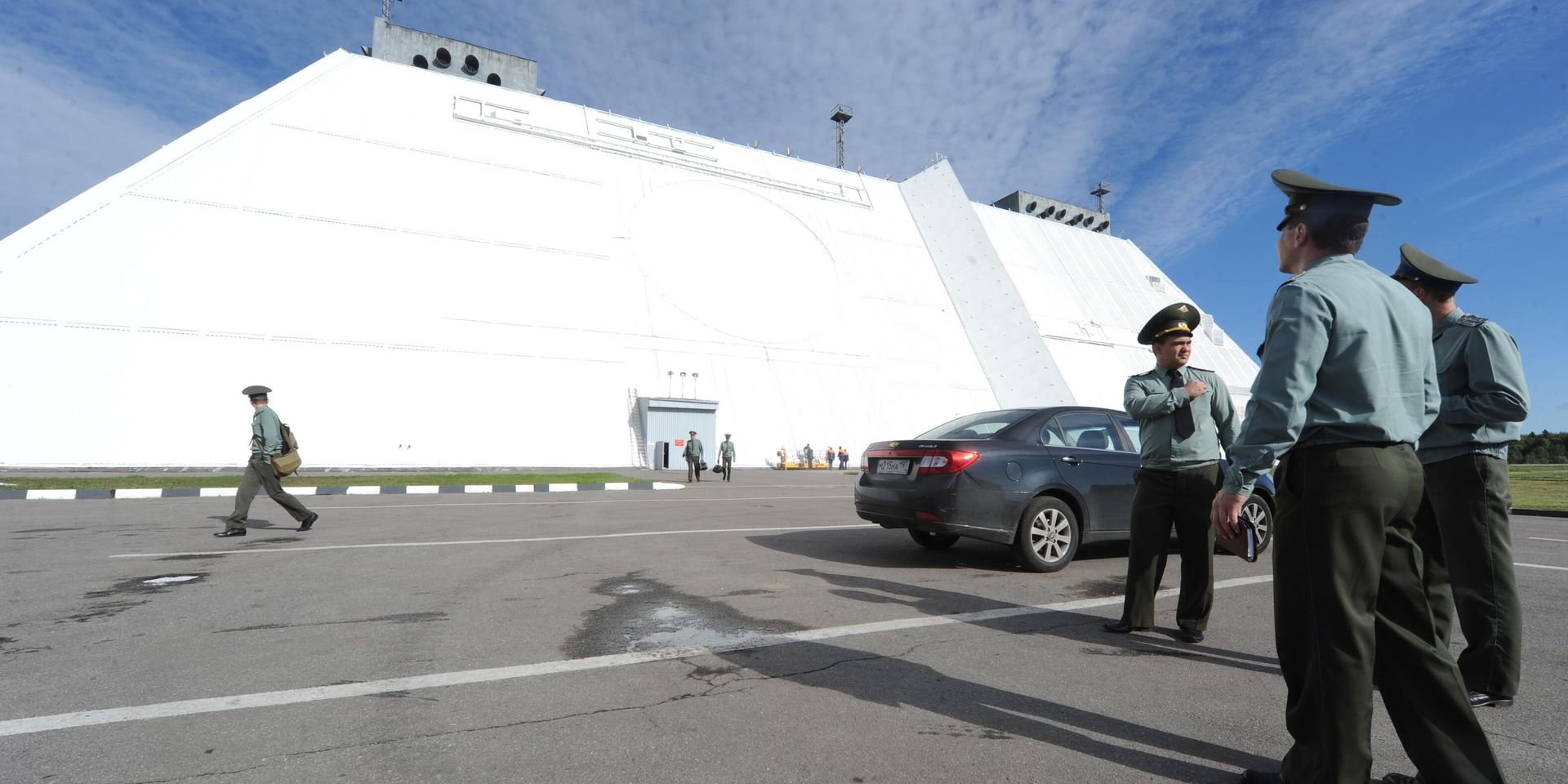
Don-2N (Дон-2Н; GRAU index 5N20, 5Н20; NATO reporting name Pill Box) is the battle-management radar of the Moscow anti-ballistic-missile system, A-135 «Амур» (Amur), in full "Московская система ПРО А-135 «Амур»". It stands in the woods near Sofrino-1, Pushkinsky District, Moscow Oblast, a few tens of kilometres north-east of the capital. It is a four-sided truncated concrete pyramid with a large fixed phased-array antenna on each face, so it has no rotating parts and looks at the whole upper hemisphere at once.
It does three jobs with one set of hardware. In the Moscow ABM role it finds incoming ballistic-missile warheads, tracks them with high precision, separates the real warheads from decoys, and sends command-guidance signals to the interceptor missiles. For missile-attack warning (СПРН) it is a precise confirming sensor inside the national picture. For space surveillance (СККП) it catalogues satellites and debris and, in peacetime, that is most of its work.
There is exactly one Don-2N. A prototype sector version, Don-2NP (Дон-2НП, NATO Horse Leg), stands at the Sary-Shagan range in Kazakhstan. Nothing else of this kind was built by anyone. As with every system in this database, almost every performance number below is a developer, ministry or reference-work figure and not a measured one; the places where sources disagree are marked.
Where this site already has a related article it is linked: see A-135 / A-235 Nudol for the whole missile system, Elbrus and Elbrus in command and control for the computers, PESA radar and AESA radar for the antenna types, SPRN at Solnechnogorsk, Voronezh and Dnepr for the early-warning side, and S-400, S-500 and 91N6E for the air-defence systems that Don-2N is often confused with.
For how the warning and defence picture relates to the last-resort command system, see Perimeter (Dead Hand) and Object 1335 / Grot. Don-2N is not described in open sources as part of Perimeter's trigger logic or as connected to Object 1335.
QUICK FACTS
- Designation: Дон-2Н, GRAU index 5N20; NATO Pill Box. Prototype 5N20P / Don-2NP, NATO Horse Leg. Part of the complex 5Zh60 (5Ж60) "Amur" / RTC-181 (РТЦ-181), the A-135 system.
- Developer: Radio Technical Institute of the USSR Academy of Sciences, now RTI named after Academician A. L. Mints (Радиотехнический институт им. академика А. Л. Минца, RTI Mints), inside the Vympel (ЦНПО «Вымпел») cooperation. Chief designer of the radar: Viktor Karlovich Sloka (Виктор Карлович Слока). General designer of A-135: Anatoly Georgievich Basistov (Анатолий Георгиевич Басистов).
- Site: Near Sofrino-1, Pushkinsky District, Moscow Oblast; about 56°10′24″ N, 37°46′09″ E. Operated by the 9th Missile Defence Division (9-я дивизия ПРО) of the 1st Air and Missile Defence Army, Russian Aerospace Forces (reported).
- Timeline in one line: Concept 1960s; chief designer named June 1972; construction from 1978; accepted 1989; on combat duty 1996 (the A-135 system as a whole is dated to 17 February 1995 by some sources).
- Building: Truncated pyramid, about 33-35 m high, about 130-144 m on a side at the base and about 90-100 m at the roof (published figures). Four fixed arrays, circular radomes about 18 m across.
- Band and wavelength: Centimetre band, 7.5 cm, about 4 GHz (published). Digital signal processing, monopulse measurement.
- Pulse power: About 250 MW peak pulse (published; not average power).
- Range (published): About 3,700 km against an ICBM-class warhead; altitude coverage quoted to 40,000 km. Range against small objects depends on the case, see the specifications section.
- Tracking capacity (published): Automatic tracking of up to about 100 elements of a complex ballistic target; guidance of about 20 short-range and 16 long-range interceptors at once in RTI wording, or up to 100 in other sources.
- Computers: Originally two ten-processor Elbrus-2 complexes at the radar and two at the Sofrino command-computing post (one account), plus a purpose-built digital signal processor. Reported replaced by the "Эльбрус-90С" system at the command post by January 2021.
- Operator: Russia only. Never exported, never duplicated.
PURPOSE AND PLACE IN THE MOSCOW ABM SYSTEM
The 1972 ABM Treaty let each side defend one region. The United States chose a missile-field site at Grand Forks, North Dakota, and later switched off its short-lived Safeguard system. The Soviet Union kept and modernised its defence of Moscow and the Central Industrial Region (Центральный промышленный район). Don-2N is the eye and the brain-stem of that defence.
A-135 is a layered system on paper. Early warning comes from the national network: satellites of the Oko type, then over-the-horizon and ground radars of the Dnepr, Daryal and Voronezh families (see Dnepr, Voronezh and SPRN). Those sensors give minutes of warning and a rough track. They are not precise enough to aim an interceptor. Don-2N takes over: it picks up the cloud of objects as it rises over the horizon, measures each object, decides what is a warhead and what is junk, and passes the result to the command-computing post (5К80), which assigns interceptors. Don-2N then tracks both the objects and the interceptors and sends the steering commands up to the missiles over its own data-link antennas.
The design goal, stated by its developers, was a single radar able to do both long-range (outside the atmosphere) and short-range (inside the atmosphere) interception. Sloka told the story in RTI veterans' memoirs: in the early 1970s it was still undecided whether one radar could guide both kinds of interceptor, and the bet that it could is what made Don-N win. The same account says the radar was built to work on its own if everything around it failed: "in case of missile attack it remains combat operational in stand-alone mode", and all its systems are duplicated so parts can be replaced without cutting power (official description given to the Valdai Club visitors in 2011).
BEFORE DON-2N: A-35, THE DUNAY RADARS AND THE FIRST MOSCOW SYSTEM
Moscow's first ABM system, A-35 (А-35, later A-35M) with the A-350 Galosh interceptor, was built in the 1960s and accepted in the 1970s. Its eyes were different radars. Long-range detection was done by the Dunay-3 (Дунай-3) stations at Kubinka (construction began in 1962) and the Dunay-3U (Дунай-3У) stations at Chernetskoye near Chekhov, which went on combat duty on 15 May 1978 (NATO Cat House; the test version Dunay-3UP at Sary-Shagan was Top Roost). They were sector radars with continuous linear-FM emission and mechanical-electronic scanning of a limited sector, and the Dunay-3U is reported to have looked towards China. Firing was done by the Yenisei and Tobol (Енисей, Тобол) radars. They are not ancestors of Don-2N: the veteran accounts trace Don-2N to a separate line, the centimetre-wave project 5N12N "Don", and not to the Dunay family.
The line of thought that led to Don-2N is documented in the RTI veteran history. In 1963 designer Vladimir Chelomei put his S-225 system into the "Taran" ABM concept and Mints set up a laboratory under Rimily Avramenko to build the detection radar. A decimetre set (5N12G) and then, from early 1964, a 7.5 cm centimetre-wave attachment (5N12N) were started. By 1965 Avramenko had been removed and the decimetre work went to Mikhail Veisbein. In February 1966 Viktor Kelzon was told to draw up the preliminary project "Don" for the second stage of A-35, and a 1968 sketch design of the centimetre station 5N12N followed. It was a 90-degree sector radar: four would be needed for all-round cover, and the 1960s estimate for one station was 600 million roubles, so about two billion for four. This is why the later four-faced single building was attractive.
HISTORY AND DEVELOPMENT
- 1969-1970: Minister Valery Kalmykov orders RTI to draft the "Don-N" radar for the next Moscow ABM system; in 1970 RTI concentrates all effort on the multi-function station.
- June 1972: About a month after the ABM Treaty was signed (26 May 1972), a Ministry commission visits RTI for a final competition between radars. Kisunko presented Istra-2, Burlakov presented Neman, Sloka presented Don-N. In Sloka's account Minister Kalmykov announced Sloka's appointment as chief designer at the end of the meeting.
- 1973: Sketch design of the main station, now called Don-2N: a four-faced truncated pyramid with fixed phased arrays and coverage of the whole upper hemisphere (RTI veteran account). Development of the Amur-P test complex with the sector radar Don-2NP followed.
- 1974-1976: Additions to the sketch design after the 1974 Protocol limited each side to one ABM site; digital processing is extended to all signals.
- 1977: Sloka becomes director of RTI.
- 1978: Construction at Sofrino begins. The built-up total is reported as over 30,000 tonnes of metal (one source says 32,000), 50,000 tonnes of concrete, 20,000 km of cable, hundreds of km of pipes and more than 10,000 cast-iron valves, with over 20,000 military builders (1027th construction directorate, Colonel A. I. Gorovatsky) and over a thousand cabinets of equipment.
- 25 May 1979: The General Staff signs the directive forming military unit 20007, the command-computing post unit of the ABM formation (per a 2024 report from the unit).
- 1980: Installation and adjustment of equipment starts.
- Mid-1981: The transmit module and its "Servant" amplifier chain pass a continuous test; the customer insists on a five-day run, which they complete (memoir of the head engineer of the Dnepropetrovsk plant).
- 1989: Station accepted for service (RTI, Ministry of Defence, Valdai Club tour description). State tests of the whole A-135 were held in December 1989 and December 1990 by ru.wikipedia's account.
- 17 February 1995: The A-135 system as a whole is adopted by Russia (one account says 1989 for the Soviet Armed Forces).
- 1996: Don-2N goes on combat duty as part of A-135 (RTI, Valdai, TechInsider). English Wikipedia lists 1991 and 1996 in the infobox; 1996 is the common Russian date.
- 2007: Two Sary-Shagan interceptor firings (11 and 30 October). The Space Forces commander said the second tested the "new computational system and its software" being installed at Don-2N. The software was tried on the Don-2NP prototype, the upgrade itself is for the real station.
- 26 May 2011: About 30 Valdai Club experts from ten countries tour the station.
- January 2021: Major General Sergei Grabchuk, commander of the ABM formation, says the transmit and receive parts of the radar are being modernised, the new command-computing post is built and running, and the station is being prepared for tests. See the Russian status section.
LOCATION AND CONSTRUCTION
Sofrino-1 is a closed military settlement in the woods of Pushkinsky District, about 56°10′ N, 37°46′ E. People also call the station "the Pushkino radar". It is well outside the Moscow ring road. The approach road runs between large concrete screens that shield it from the radar's radiation: a 2024 visitor report says that when the station goes "to high power" (на высокое, the crews' slang for the full-power working mode) a car caught in the beam can lose its electronics, and visitors are routed by a safe path. A 2024 report also describes a long reinforced-concrete tunnel under the field that was used during construction so that building materials and equipment could not be tracked from space (as claimed).
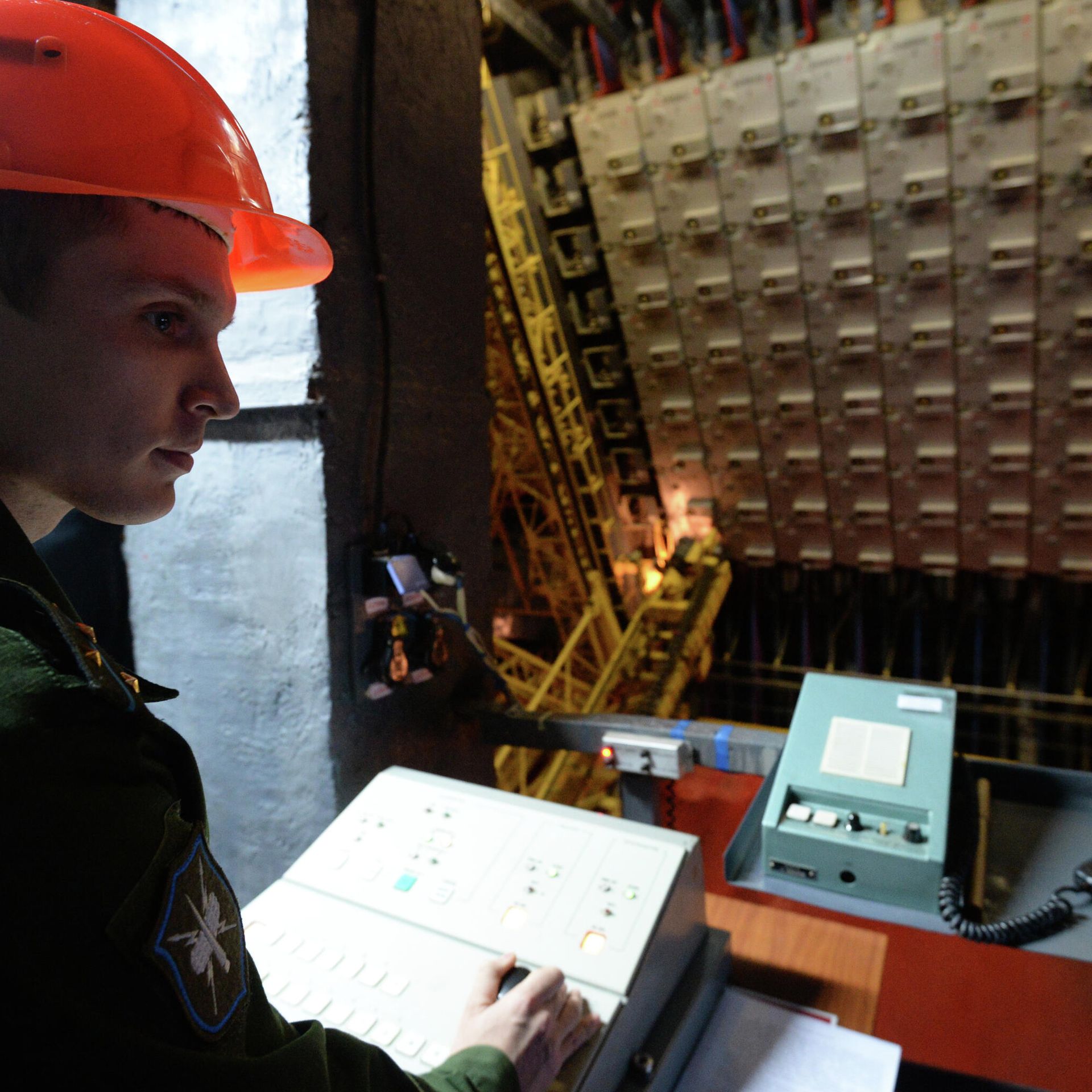
The command-computing post (КВП 5К80, unit 20007) is a buried bunker at the foot of the radar. It is described as a thick-walled underground complex with a communications node, a data-transmission combat post, and a machine hall of about 1,200 square metres. Elements of the full A-135 complex were spread over distances up to about 100 km and linked by a data-transmission system (5Я67, see below). A 53T6 silo group of twelve launchers is co-located with Don-2N at Sofrino.
THE BUILDING AND THE FOUR FACES
The structure is a regular four-sided frustum (a pyramid with the top cut off):
- Height about 33-35 m. English Wikipedia says 33 m; ru.wikipedia says 33-35 m. The old figure of "up to 45 m" that appeared in an earlier version of this article is not supported by the sources found; an underground part exists but its size is not published.
- Base sides about 130-144 m (ru.wikipedia: 130-144 m; one 2022 article says about 140 by 140 m).
- Roof sides about 90-100 m.
- Faces oriented to give 360° azimuth coverage. The site article on A-135 gives 60 / 150 / 240 / 330°; this is from an unattributed source and is kept as a reported value only.
Each of the four faces carries two antennas, per the RTI description and English Wikipedia (citing the 2020 reference book by Borisov and Pervov):
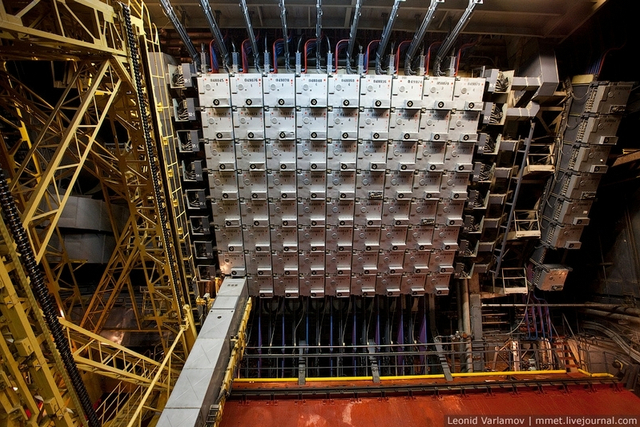
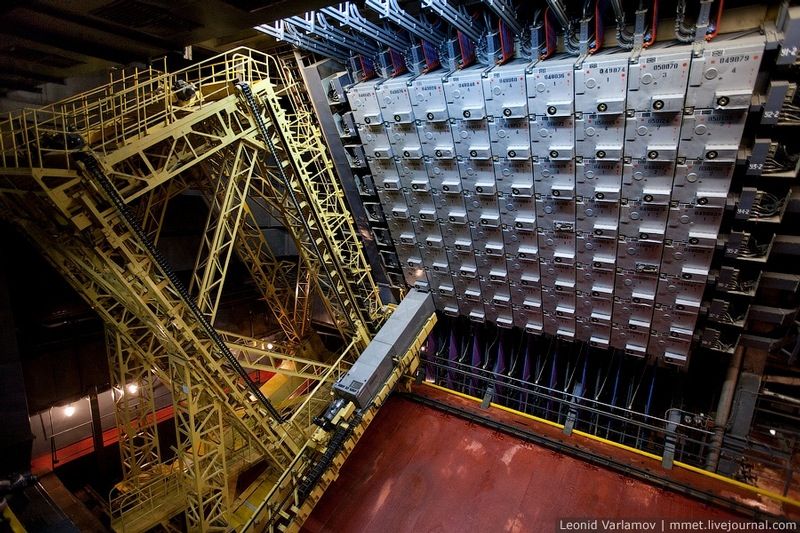
- Circular main array: about 18 m in diameter, under a radio-transparent cover, for search, tracking and target measurement. RTI and ru.wikipedia say the 18 m arrays both receive and transmit; vpk.name instead says the circular antenna is the receiver and the rectangular one to its right is the transmitter. Sources differ. Russian sources describe the arrays as "крупноапертурные активные фазированные антенные решётки" (large-aperture active phased arrays).
- Square data-link array: to the right of the circular one (Wikipedia: separated from it by a vertical shield so the two do not interfere). About 10 m on an edge. Per English Wikipedia (citing Borisov and Pervov, 2020) it is the antenna used to guide the interceptors by data link.
Element counts: the 2021 RTI Systems and press descriptions say "hundreds of thousands" of radiators in total; TechInsider gives about 60,000 emitters per array, which is consistent (about 240,000 in all). An earlier version of this article said "more than 250,000"; treat that as a round figure for "a couple of hundred thousand". The arrays are made of replaceable modules: in 2011 Valdai visitors saw one array element being removed for repair from inside the building.
Why four faces: a flat electronically steered array loses gain as the beam moves away from straight ahead. About ±60° off broadside is the usual practical limit for a flat array (see PESA radar). Four faces, each covering a quarter of the horizon, give all-round cover without any moving part, and the pyramid's tilt helps point each face upward. The structure also has to be hardened and screened: there are concrete shields around it and a requirement that the radar keep working independently if outside links are cut.
HOW THE RADAR WORKS
Active or passive? Earlier versions of this site, and some western sources, class Don-2N as a passive electronically scanned array (PESA). The Russian developers do not. Sloka's colleagues describe it as an active phased array (АФАР) in which the transmit power is generated inside the antenna: the head engineer of the Dnepropetrovsk plant wrote that the older Moscow radars (Yenisei-Tobol, for A-35) used a chain of amplitrons feeding a semi-active antenna with up to about 120 MW in the pulse, while Don-2N "adopted the model of an active phased array with distributed power in the aperture". The transmit module (6ДГУ with its modulator 6ДГМ) contains a three-stage microwave amplifier chain codenamed "Servant" (Сервант) with megawatt-class pulse output, mounted on one base, about 300 kg. The memoir says tens of such modules in the array give 50-60 MW of pulse power per array. That is a very coarse, large-module active array, not the thousands of tiny transmit/receive modules of a modern AESA (see AESA radar). The memoir also mentions 300 transmit modules in a pricing example for the 5N20, without saying whether that is per array or total. My reading is "active, large-module"; the point is argued and the module count is not public.
Waveforms and processing. The station is described as a monopulse multi-function radar of the centimetre band with large-module active phased arrays, electronic control of both the position and shape of the transmit and receive beams, and digital processing of the radar signals (vpk.name, RTI). The decision to make all signal processing digital in the 1970s was Sloka's and was bold for the time. The station has a large library of probing signals that differ in energy, carrier frequency, repetition period, spectral width and duration, and it can change the beam width instantly. Different waveforms are used for searching a sector, for precision tracking and for discriminating objects inside a complex target; the stated design includes a wideband signal for fine range resolution (vpk.name says "широкополосным зондирующим сигналом"), which is what makes it possible to see the length structure of a re-entering object. The station has separate channels for five measurements of a target's coordinates (RTI).
Normal and emergency modes. A statement in the veterans' account describes the design assumption: in a "normal situation" the station would search for targets out to 3,500 km in a narrow sector; if the enemy exploded high-altitude nuclear warheads that blinded the metre-wave early-warning radars, Don-N would begin detecting at about 300 km in a wide sector. That is a rare official explanation of why one radar was given both a long-range and a short-range mode. It is a design intention from memoirs, not a test result.
Jam resistance. RTI lists high jam resistance from high frequency selectivity, a narrow beam, wide frequency range, automatic jammer cancellers, the ability to reduce sensitivity in the direction of jammers, and special signal structures. Its stated features also include modular construction, high automation, ability to find and track fast targets, and ability to detect low-observable targets.
SPECIFICATIONS (PUBLISHED FIGURES)
- Band / wavelength: centimetre; 7.5 cm; about 4 GHz. By the common IEEE letter bands 4 GHz is at the S/C edge; Russian sources just say "centimetre". An earlier version of this article hedged on frequency; the 7.5 cm value comes from RTI veterans and has been repeated for decades, and the UHF numbers some pages copy belong to other radars.
- Azimuth coverage: 360°; whole upper hemisphere (the quoted "угол обзора"). Elevation limits are not published.
- Detection range, ICBM warhead: about 3,700 km (ru.wikipedia, Military-Review). Design requirement in the memoirs: 3,500 km narrow sector in the normal situation.
- Altitude coverage: to about 40,000 km (RTI; Russian Wikipedia). A 2021 Rossiyskaya Gazeta article gives 4,000 km in azimuth and 40,000 km in altitude, "able to distinguish an object the size of a tennis ball". Another station official said that in 2005, when a spacecraft was launched toward geostationary orbit at about 35,000 km, the station tracked it past 20,000 km.
- Pulse power: about 250 MW peak (published). Not average power. The memoir figure of 50-60 MW per array, if it is right, adds to the same order for four arrays; no source says all four faces transmit together.
- Range accuracy: about 10 m. Angular accuracy about 0.6 arc minutes (the best-known figure; an older version of this article quoted 25-35 arc seconds from other writeups, which is not confirmed).
- Warning time: about 8-9 minutes for warheads coming from the Northern and Barents Sea line (RTI; ru.wikipedia).
- Tracking: up to about 100 elements of a complex ballistic target automatically (RTI; confirmed by a 2024 unit officer: "up to 100 targets at once").
- Interceptor guidance: about 20 short-range and 16 long-range interceptors simultaneously (RTI wording). Other sources say "up to 100", and a former version of this article said "at least 36". The long-range ones are out of service now.
- Pulse repetition, bandwidth, element count per face: not published.
- Station size: over a thousand equipment cabinets (RTI); five equipment parts (transmit, receive, computing, signal-forming, and receive-processing) built modularly. The Dnepropetrovsk plant built four of the five.
WHY THE RANGE NUMBERS DISAGREE
Range for radars of this kind depends on the size of the object, its radar cross-section, the viewing angle, the waveform and the time spent on it. Four different numbers circulate, and they are mostly answers to different questions:
- 3,500-3,700 km: against a warhead-sized target in the standard mode; design requirement and published figure.
- 1,500-2,000 km: the range at which the design targets a complex ballistic target, as quoted by Sloka for the original 1960s requirements ("detect and precisely track complex ballistic targets at 1,500-2,000 km" was beyond the electronics of the time). English Wikipedia's infobox repeats it as a range against a 5 cm object. That is a mix-up.
- 500-800 km on a 5 cm sphere: the result of the 1994 ODERACS experiment, see below. The earlier version of this article put this at "800 km in one Russian listing" and then said "1,500-2,000 km is widely repeated from the 1994 ODERACS debris experiment". The second half is incorrect: ODERACS gave tracking out to about 800 km, not thousands.
- "Tennis ball at 4,000 km": a 2021 Rossiyskaya Gazeta line (not a measured figure).
Because a five-centimetre sphere has a far smaller radar cross-section than a re-entry vehicle, there is no contradiction between "800 km on a 5 cm sphere" and "3,700 km on a warhead". Don-2N is a high-power fire-control radar, not a long-range search fence. The long-range fence work belongs to the stations in the Voronezh and Dnepr articles.
DISCRIMINATING WARHEADS FROM DECOYS
This is the central reason the radar exists. A ballistic missile with a multiple warhead or penetration aids releases several real warheads and a cloud of lighter things: heavy and light decoys, chaff dipoles, jammers. In space, with no air, a feather and a hammer travel together. The Russian doctrine for A-135, set out in the memoirs of its designers, used two kinds of discrimination:
- Outside the atmosphere: by the effect of a nuclear burst. An interceptor with a nuclear warhead explodes near the cloud, and the way the objects' trajectories change under the burst separates heavy from light ones (ru.wikipedia, quoting Legasov's memoir). Don-2N measures that change.
- Inside the atmosphere: by deceleration. As objects meet air, light decoys slow down and fall behind the heavy warheads. Don-2N tracks each object finely enough to see the difference in the last tens of seconds, and the short-range interceptor is aimed at what is still coming at full speed.
- By radar signature: wideband signals show the length and structure of an object, and repeated measurements show spin and wobble. The 2024 unit officer said identification is done "with 2-3 measurements" (as quoted). Details of the discrimination algorithms are secret; the algorithm library is the thing that gets tested on Don-2NP at Sary-Shagan.
The system also relies on volume: the design is to track a hundred objects, discriminate, and shoot only what matters. In a real attack the number of objects could exceed that, and no source claims otherwise.
THE COMPUTERS
Don-2N needs fast computing for four separate things: real-time digital processing of the radar signal itself, the radar's control and tracking computer, the battle algorithm that discriminates and plans the engagement, and the guidance computation for the interceptors. The sources describe them as separate systems, and the old version of this page blurred that.
Signal processor (спецвычислитель, СВУ). The first plan was to use a special computer by Mikhail Kartsev (the M-13 line). In Sloka's account it "could not pull it" and was dropped. RTI and the design bureau of the Dnepropetrovsk Machine-Building Plant (КБ Днепровского машиностроительного завода, DMZ) built a special digital processor instead. It was led by Vladimir Yurko, took about a decade, and was made of tens of thousands of printed cells in over 500 cabinets, cables with gold-plated conductors, and was designed with a purpose-built CAD system called "Dnepr". The cells used multilayer boards of up to 18 layers. The test of the prototype on the Sary-Shagan Don-2NP "worked at first switch-on". This computer is not an Elbrus; it is the real-time signal front end.
Elbrus-2. The control and battle computers are the Elbrus-2 multiprocessor complex (МВК «Эльбрус-2») of the Institute of Precision Mechanics and Computer Engineering (ИТМиВТ), designed under chief designer Vsevolod Burtsev. It is also covered in Elbrus and Elbrus in command and control. Published figures:
- ECL logic, the IS-100 series (ИС-100); up to ten processors, usually described as eight working and two spare; modular design so that failed modules drop out automatically; 12.5-125 million operations per second depending on the configuration (about 12.5 million per processor and 125 million for ten).
- Main memory up to 144 MB, channel throughput up to 120 MB/s.
- Power of 195-816 kW depending on configuration and about 430 m² for the central part of a ten-processor complex (computer-museum.ru, a Russian computer history site).
- Elbrus-1 (TTL logic, about 15 million operations per second, first delivered in 1979) preceded it. Elbrus-2 passed state tests about six years later, in the mid-1980s.
- Tagged architecture and high-level language hardware support, as in the Elbrus pages on this site.
How many? Academician Boris Babayan, the chief of the later Elbrus family, wrote that two ten-processor complexes were installed at the combat facilities at the command-computing post in Sofrino and two at the Don-2N radar, so four in all. Russian Wikipedia and RTI say the radar's computing complex "built on four ten-processor Elbrus-2 supercomputers" delivers up to a billion operations per second. Four times 125 million is 500 million, so "up to a billion" is a round-up of the headline numbers; one source on this site (A-135 / A-235 Nudol) gives about 250 MIPS each. The two accounts differ on where each complex sat, so I give the split as reported rather than as established.
Replacement in 2021. In January 2021 General Grabchuk told the Ministry of Defence newspaper Krasnaya Zvezda that the modernised command-computing post "works on the new computing system Эльбрус-90С with a performance of about 100 billion operations per second". He said the area occupied by the equipment would fall four times and power consumption forty times, and that heavy redundancy would cut the time to restore readiness. The article compared this with open-source data that the old Elbrus-2 "could do no more than 12.5 million operations". That comparison is apples to oranges: 12.5 million is a figure for one processor, and the old complex had many. The honest ratio of the old complex (125 million per ten-processor machine, up to a billion for the full set per RTI) to 100 billion is roughly 100 to 800 times, and the headline "10,000 times" is not a like-for-like figure. Whether "Эльбрус-90С" is built on a SPARC (Elbrus-90micro line) or on the later E2K processors is not stated in the sources found. The command post is also reported to use an Elbrus-90micro server network earlier.
2024. A May 2024 report from inside unit 20007 says the machine hall is 1,200 square metres of tall cabinets, the Elbrus-2 machines are obsolete but kept in working order in reserve, and "the modern intellectual core fits in just three small cabinets" with four computers each, one of which exceeds the entire Elbrus-2 hall. The unit was fully re-equipped about a year earlier. Whether the hall is truly kept in reserve or only partly so, no source says. This confirms the earlier version's summary and puts it into one picture: Elbrus-2 was the original brain, the 2021 command post moved onto newer Russian machines.
Reports in 2007 said a new computing system and its software were being brought to the radar, and the 2021 interview speaks of "high-performance specialised electronic computing means" coming into use. The more detailed claim, that the radar's own signal processor was replaced, is not stated in the sources found.
POWER, COOLING AND SHIELDING
- The station is reported to need huge cooling: hundreds of kilometres of pipes and over 10,000 cast-iron valves were used mostly for water cooling of the equipment.
- Peak pulse power of 250 MW (published) is the instantaneous power during the pulse; the average power and the grid supply are not published. One 2024 article claims the emission equals "what a city uses in a day"; it confuses power and energy and is not used.
- Screening: during factory tests of the equipment, rooms with at least 95 dB of radio-frequency attenuation had to be built, 800-1,600 cubic metres each, and one underground hall of over 10,000 cubic metres with about five kilometres of sealed weld seam (memoir). Separately, the concrete screens along the access road shield visitors from the beam (2024 report).
- The radar has a "high-power" mode and a quieter working mode (crew slang: going "на высокое"); when it goes to high power the surroundings are affected, which is why the access road is screened (2024 report).
COMMUNICATIONS AND CONNECTIONS
Public information on the links is thin. The following structure is what the open sources support.
- Command-computing post 5К80 (КВП): the bunker at the foot of Don-2N, unit 20007. The 5K80 assigns interceptors to targets and carries the battle algorithm. Russian Wikipedia lists it as the "5К80 with the Elbrus computing system (Pushkino, Moscow Oblast) and Zarya (Balashikha)", which is a separate listing worth treating as reported. (An earlier suggestion of a "Zaryad" name could not be confirmed.)
- Data-transmission system 5Я67: ties the elements of the Amur complex together: the radar, the command post, the silo groups and the technical positions, which were spaced up to about 100 km apart (vpk.name). Cable, radio-relay and other media are not detailed publicly. Battle control is described as fully automatic.
- Interceptor data link: the square arrays of Don-2N talk to the interceptors directly with coded command signals; the radar also measures the interceptor's position by a transponder in the missile (the 53T6 control system is radio-command with a transponder and an autopilot 5А13).
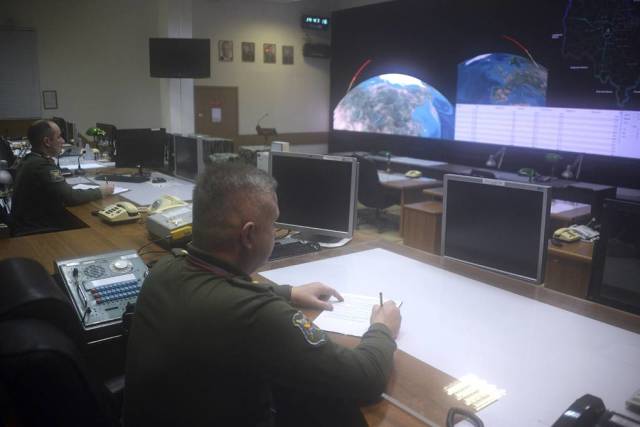
- Missile-attack warning (СПРН): Don-2N is integrated into the unified missile-attack warning and space-control system. The cue arrives from the Main Missile Attack Warning Centre (ГЦ ПРН, Solnechnogorsk, see SPRN), which is fed by the Voronezh and Daryal radars and satellites. A 2024 report says that when a foreign missile test crosses its sector the station switches to an "attacking ballistic missiles" mode and informs the Main Centre, usually as the missile is already leaving, and mentions foreign tests tracked in 2013, 2018 and 2019 (the report names Israeli Iron Dome, which is an odd choice for a tactical system; this is as quoted).
- Space surveillance (СККП): the radar sends trajectory measurements to the Main Space Situation Centre (Главный центр контроля космического пространства, near Noginsk), as in the Valdai description.
- Higher command: the General Staff authorises combat use; once authorised, the radar and the command computers run automatically and the controls are blocked so people cannot interfere with the cycle (2024 report). The Aerospace Forces chain of command: 9th Division, 1st Army, VKS.
- Fibre, relay and bearer details: not public.
THE A-135 SYSTEM AND ITS INTERCEPTORS
A-135 is built around one radar and two kinds of interceptor in underground silos. The full list below is from ru.wikipedia, English Wikipedia, vpk.name and the Military Balance 2023, and it matches the details on A-135 / A-235 Nudol.
- 5N20 Don-2N: the radar.
- 5К80: the command-computing post.
- 51T6 (А-925, "Azov"; NATO SH-11 / ABM-4 Gorgon): long-range exo-atmospheric interceptor, about 19.8 m long, 2.57 m in diameter, 33 t (some sources 45 t), two-stage (solid then liquid), nuclear warhead (yield estimates vary widely, from 10-20 kt to megatons; reliable figures are not public). Published envelope: range 350 km (another source 850), altitude from about 70 km up to about 670 km. The two firing sites (Naro-Fominsk, 8 silos; Sergiev Posad-15, 8 silos) were also used in A-35. Taken off duty: dates quoted are 2002-2003, 2006 and February 2007. A claim that some are still in silos near Solnechnogorsk is unverified.
- 53T6 (ПРС-1, "Gazelle"; NATO SH-08 / ABM-3A): short-range endo-atmospheric interceptor, about 10-12 m long, about 10 t, about 1 m diameter, solid motor; speed about 5.2-5.5 km/s; flight time up to about 12 s; acceleration limits 210 g longitudinal and 90 g lateral (published); range about 80-100 km, minimum about 20.8 km; altitude about 5-45 km; nuclear warhead (AA-84, about 10 kt per some sources). Radio-command guidance from Don-2N. Silo launch from a glass-fibre transport-launch container.
- 53T6M / PRS-1M (45T6): modernised short interceptor with a new motor and, reportedly, a conventional option. Tested at Sary-Shagan: November 2017 (altitude of 100 km reported), a Ministry video in early 2018. Reported claims: range up to 350 km and altitude 50 km (DFRLab/Wikipedia), which conflicts with other tables. Details are not official.
- Silo groups (53T6, 68 missiles per the Military Balance 2023): Sofrino 12 (next to Don-2N), Korolyov 12, Vnukovo 12, Skhodnya 16, and a group of 16 at Lytkarino / the Razvilka-Aparinki area (the name differs between sources; some say the group was reduced).
Under the treaty-era limits of one site and 100 interceptors, the Moscow site has never been more than a small system. Pavel Podvig quoted a mid-1980s memo (by Vitaly Kataev) that the system "will be completed in 1987 to provide protection from a strike of 1-2 modern and prospective ICBMs and up to 35 Pershing 2-type intermediate-range missiles". Its capacity against a large strike is limited, as the memo implies.
HOW AN ENGAGEMENT WORKS, STEP BY STEP
This follows the published descriptions of the A-135 design. The real procedures and software are secret, and the system has never been used against a real attack.
- 1. Early warning. A launch is seen by satellite sensors (Oko, then the newer EKS) and then by early-warning radars at the edge of the territory: Voronezh and Daryal stations, and Dnepr-class legacy sets. The Main Missile Attack Warning Centre confirms it and cues the Moscow ABM formation. This gives minutes, not seconds, and only coarse tracks.
- 2. Cueing Don-2N. The command post 5K80 passes the cue to Don-2N. The radar looks at the sector where the objects will rise over the horizon. In the normal situation it searches in a narrow sector at long range; in a blinded-warning situation it covers a wide sector from about 300 km (design intent, memoir).
- 3. Acquisition. Don-2N detects the cloud of objects. For the northern and Barents Sea approaches the quoted warning time is about 8-9 minutes before the objects arrive.
- 4. Tracking and measurement. The radar tracks up to about 100 elements of a complex ballistic target, measuring range, angles, velocity and signature with the accuracy figures above. The signal processor and Elbrus computers produce trajectories and predict impact points.
- 5. Discrimination. Heavy warheads are separated from decoys, dipole clouds and jammers by trajectory, deceleration and signature. In the original concept some of this is helped by an exo-atmospheric nuclear burst.
- 6. Assignment. The 5K80 assigns interceptors to the objects that matter and chooses long-range or short-range missiles. In the system as designed, the long-range 51T6 takes the cloud above the atmosphere and the short-range 53T6 takes what is left inside it. Today only the short-range layer is on duty.
- 7. Launch. Interceptors are launched from silo groups spread around Moscow. A 53T6 leaves its silo in a fraction of a second in its container and accelerates at very high load.
- 8. Command guidance. Don-2N tracks both the target and the interceptor, computes the intercept, and sends steering commands by its square data-link antennas. The interceptor has a transponder and an autopilot but no homing seeker in the classic design.
- 9. Intercept. The warhead explodes near the target (the 53T6 nuclear warhead) or, for a conventional round, tries to kill it directly. A 2024 report says several interceptors may fly to the same target and burst at the same time, with timing synchronised by satellite signals.
- 10. Assessment and re-engagement. The radar checks whether the objects have been killed and what remains, and the cycle repeats while time allows. Late in the engagement the geometry is very tight, which is the reason for the 53T6's extreme acceleration.
NUCLEAR WARHEADS AND THE MOVE TO NON-NUCLEAR KILL
The 51T6 and the 53T6 carry nuclear warheads. In the 1970s hit-to-kill against a cloud of decoys was not trusted, and a nuclear blast can destroy warheads and decoys together. That means that if A-135 were used as designed, there would be nuclear explosions over the Moscow region. In 2011 Major General Vladimir Derkach told the Valdai visitors that Russia planned to move to conventional warheads only as detection, targeting and interception improved (reported by Richard Weitz). Modernisation materials since then have spoken of conventional or kinetic options for the new short interceptor and for A-235 as a whole. No source states that any silo round has actually been converted. The only safe statement is that conversion is the declared direction.
A-235 AND NUDOL: WHERE DON-2N FITS
A-235 is the planned modernisation of Moscow's defence. Public design history: a research project called "Samolet-M" (Самолёт-М) under the state contract of 31 January 1991 with the Radio Instrument Engineering Research Institute (НИИРП) of Vympel, due in 2015; after the 1990s stall it was taken up again by Almaz-Antey from about 2011. The planned elements on paper included a command-computing post, an information radar complex "Kiev", a multi-function radar "Narva", the Amur firing complex, the Kivach and Ilek firing complexes, an aircraft-based optical-electronic complex "Onega" for atmospheric discrimination, and three interceptor layers: an A-925 (51T6) modification at long range, a medium-range 58R6, and the PRS-1M (45T6) at short range. These are paper lists from ru.wikipedia and may not describe what was fielded.
Don-2N is the existing radar that all of these would use. Some Russian writers give a "Don-2M" as the radar of A-235 (ru.wikipedia, citing a 2012 article); others assume the old Don-2N, upgraded. The 2021 modernisation of the transmit and receive parts and the computers fits the second reading. The role of the station in the updated system has not been given officially.
"Nudol" (Нудоль) in Western writing usually means something narrower: the road-mobile 14Ts033 complex (14Ц033), with the 14A042 interceptor, 14P078 command post and 14Ts031 radar. The US calls the missile PL-19. It has been flown from Plesetsk, not Sary-Shagan, many times (see the testing section) and it destroyed the defunct satellite Kosmos 1408 at about 470 km on 15 November 2021. The Secure World Foundation assesses it as a separate direct-ascent anti-satellite project rather than the successor of A-135, and leaked-document reporting (UNITED24 Media) says the same question remains open. This article keeps them apart: A-135 / A-235 is the Moscow ABM belt that Don-2N guides; Nudol is a mobile ASAT-capable interceptor whose place in that belt is argued. See A-135 / A-235 Nudol.
OTHER JOBS: SPACE SURVEILLANCE AND THE ODERACS TEST
In peacetime the main business is space. The station tracks satellites for the Main Space Situation Centre and, as the 2011 and 2024 visitors were told, helps avoid collisions and follows launches, orbit changes and decays. In the 2024 report the crew tracked a satellite at 810 km falling to 720 km, probably before deorbiting. The same report claims the station follows every Starlink launch, which could not be checked.
The best public calibration of its sensitivity is the ODERACS experiment (Orbital Debris Radar Calibration Spheres). In February 1994 the US Space Shuttle mission STS-60 released six metal spheres, three pairs of 15, 10 and 5 cm. Russian and American radars saw the larger ones. Don-2N, according to a 2024 article, was the only participating radar to detect the smallest, 5 cm, spheres, and did so at an altitude of 352 km, with tracking at a range of about 800 km. ru.wikipedia says the detection and tracking range was 500-800 km, and says "1996" for the experiment, but the Shuttle release was in February 1994 (STS-60). The statement in the old version of this page, "1,500-2,000 km from the 1994 balloon test", is incorrect: they were solid spheres, not balloons, and the tracking range was up to about 800 km.
TESTING HISTORY
- Amur-P at Sary-Shagan: the test complex 5Zh60P (5Ж60П) at Sary-Shagan, Kazakhstan, with the sector radar Don-2NP (object No. 8 of the 10th State Research and Test Range, ГНИИП) was used for firings. By one count (Mikhailov, via ru.wikipedia) the complex saw 19 firings of 51T6, 37 of 53T6, 28 tracks of target missiles and 1,900 simulation cycles. The Don-2NP is a working radar and still takes part in tests.
- 18 June 1982: in the "Shield-82" exercise (the "seven-hour nuclear war"), two interceptors at Sary-Shagan are reported to have intercepted warheads of an RSD-10 launched from Kapustin Yar and an R-29 SLBM from a Northern Fleet submarine (ru.wikipedia). This is a Russian-source claim.
- 1999 onward: interceptor firings are held about yearly mainly to extend the service life of the stockpile; the 42nd 53T6-type launch since 1983 was reported on 11 October 2007. First test of a 53T6 with a newly made motor: 20 December 2011. Successful test: 21 June 2016.
- 2007: a firing on 30 October tested the new computing system and software for Don-2N.
- 2017-2018: tests of the 53T6M / PRS-1M, including a Ministry video published on 1 April 2018.
- 2020: flight test of a new interceptor at the 10th range with a combined crew from the ABM division (Grabchuk interview).
- 2 December 2022: Ministry of Defence says the Aerospace Forces launched a new missile of the ABM system at Sary-Shagan (RIA Novosti report).
- Nudol flights: at least 12 tests are on record through 2021 (SWF, ru.wikipedia table), nearly all from Plesetsk, with the first from a standard mobile launcher on 26 March 2018 and the Kosmos 1408 intercept on 15 November 2021. ru.wikipedia lists a 13th on 16 March 2024 without a source. I found no confirmed Nudol flight reported in 2025 or in 2026 up to this date.
COVERAGE AREA
From the display shown to the Valdai visitors in May 2011: the station covers most of Europe except Spain and Portugal, the western half of the former USSR and a large part of the Middle East. The southern edge runs through the Mediterranean from the French-Spanish border, south of Sicily and along the Egyptian coast; Syria and Iraq are covered, northern Jordan too; in Central Asia it includes Turkmenistan, Uzbekistan and Kazakhstan but not Kyrgyzstan or Tajikistan. The hosts said it could see any missile launched from Iran towards Europe. This is a display seen by a visitor, not a published specification, and the shape is for the working mode shown that day.
TREATY CONTEXT
- 26 May 1972: the ABM Treaty is signed. Each side may have two ABM sites; the 1974 Protocol cut that to one, with up to 100 interceptor launchers and interceptors at the site. The USSR chose Moscow, the United States chose the Grand Forks missile field.
- 1975-1976: the American Safeguard system at Grand Forks briefly became operational and was then shut down. Moscow's A-35 stayed, and later A-135 replaced it (general knowledge, not drawn from the Russian sources above).
- 13 December 2001 / 13 June 2002: the United States gave notice of withdrawal and the treaty ended on 13 June 2002 (general knowledge). After that, Moscow's system became, for practical purposes, an unconstrained capability, although it did not expand.
- Effect on Don-2N: the treaty explains why there is only one, why it is near the capital, and why the design has a "stand-alone" mode. It did not change the building afterwards.
DON-2N COMPARED WITH OTHER RADARS AND SYSTEMS
- US PAVE PAWS (AN/FPS-115) and Cobra Dane (AN/FPS-108): long-range early-warning and tracking phased arrays at lower frequencies (UHF and L-band respectively, to my knowledge), larger in surveyed volume but less suited to fine discrimination. Don-2N is closer to a missile-site fire-control radar like the Safeguard MSR, but built far larger and in a single four-face building. Russian Wikipedia calls PAVE PAWS the "nearest analogue", which is a loose comparison.
- Soviet/Russian early-warning radars: Dnepr (article), Daryal, Voronezh (article) give hours-to-minutes strategic warning at metre and decimetre waves over thousands of kilometres. Don-2N is the opposite: a short-wave radar for precision after the warning.
- Dunay-3 / 3U: earlier sector early-warning radars of A-35; different design line (see the section above).
- Air-defence radars: the S-400 radars (91N6E, 92N6E) are far smaller, mobile and made for aircraft and shorter-range ballistic targets. S-400 and S-500 are not Moscow's strategic ABM; the S-500 may take over part of the high-altitude role in future, but is a separate programme.
- US GBI, Aegis and Patriot: the US homeland system (Ground-Based Midcourse Defense, with a few dozen interceptors at Fort Greely and Vandenberg) and Aegis SM-3 use hit-to-kill, non-nuclear warheads, which is the design philosophy A-235 is meant to adopt. Patriot (see Patriot) is a theatre system, not a strategic homeland defence; Moscow has no equivalent role for a Patriot-class system. All counts are approximate.
LIMITS AND VULNERABILITIES
Public analysis of these points is thin and mostly comes from foreign writers. What follows combines what the sources say with my own assessment, marked as such.
- Single point: one building with one set of electronics. The design intent is that it stays alive on its own, all systems are duplicated, and replacements can be made live, but a successful strike on it would remove the discrimination capability. It would be among the first targets of any attack on Moscow (assessment).
- Limited interceptors: the only live interceptor layer is 68 short-range missiles in five silo groups (Military Balance 2023, as reported). The long-range layer is off duty. Capacity against a large raid is small.
- Nuclear effects: the system is designed to survive and work after high-altitude bursts, for which the wide-sector 300 km mode was devised. It is also the system that would use nuclear interceptors over its own territory.
- Decoys and jammers: the radar lists jammer cancellation and decoy discrimination as strengths. How well they would work against modern countermeasures is not public and has never been tested.
- Hypersonic and manoeuvring warheads: the design predates them. Modernisation has been described as aimed at "perspective means of air-space attack" (Grabchuk), without detail.
- Cyber and electronics supply: no public information. A station modernised with domestic computers, after 2022 sanctions, relies on domestic electronics and Russian supply chains; see Elbrus on the limits of Russian chip making (assessment).
- Age: the building is over four decades old; the electronics are being replaced bit by bit.
COST (APPROXIMATE)
No official cost is published. Two data points exist. A 1960s estimate for one 90-degree sector station of the earlier 5N12N project was 600 million roubles; four would be about two billion. The head engineer of the Dnepropetrovsk plant wrote that the equipment of the prototype and the standard radar was "more than a billion dollars in prices of the time". Neither number is a verified total, and exchange rates in the Soviet period were administrative. The construction workforce (over 20,000 builders) and materials (tens of thousands of tonnes of metal and concrete) give a sense of the scale.
RUSSIAN STATUS AND MODERNISATION
- Duty status: on combat duty continuously since 1996. The station is staffed round the clock by the division's combat crew; the division commander takes over if a combat signal arrives (2024 report). Tasks have included reconnaissance work in the war in Ukraine period, as the unit said, without detail.
- Modernisation without leaving duty: the ABM formation says the system is upgraded in stages without being taken off duty: moving to a modern element base, new high-performance computing, new weapons (Grabchuk, January 2021).
- 2021: the transmit and receive parts of the radar are reported modernised and the new command post built and running. The head of RTI Systems, Yury Anoshko, said the station was in tests and that "functional capabilities" had changed, with both quantitative and qualitative characteristics improved, without detail. Official statements later promised a doubling of detection and engagement figures, which Russian press reads as a Don-2N upgrade.
- 2022: the ABM division marks its 60th anniversary; its commander says the deep modernisation of Moscow ABM is to be completed soon. No completion date or new-configuration announcement was found afterwards.
- 2024: the unit report described above: round-the-clock duty, Elbrus-2 hall in reserve, new computers in three cabinets.
- 2025: Western and Russian articles (The National Interest, 1 July 2025, and Russian reprints) repeat that the radar is "continuously modernised" but add no new official facts.
- 2026: I found no official news of a new Don-2N upgrade or of a new Sary-Shagan interceptor firing in 2025 or 2026. One unreliable-looking October 2026 website analysis speaks of "digital beamforming" and Elbrus processors; it contains errors and is not used. Satellite-imagery observations are not cited because I found no reliable sourced analysis.
STATUS AND OUTLOOK (OCTOBER 2026)
As of 16 October 2026 Don-2N is the operating battle-management radar of Moscow's A-135 system, modernised in place, with its Elbrus-2 computer hall obsolete and the work moved to new Russian machines. The 53T6 silos around Moscow are still the live shooters; the 51T6 layer is off duty. The new interceptors (53T6M / PRS-1M, and the A-235 long-range echelon in whatever form it takes) have been tested but no public statement says the full A-235 is on duty. The mobile Nudol has flown from Plesetsk and has hit a satellite once; whether it is part of the Moscow belt is not settled. The most defensible one-line status: Moscow still has a nuclear-era silo ABM defence with an upgraded radar and computers, and a long, partly secret programme to make it conventional and longer-ranged.
WHAT IS UNCERTAIN IN THIS ARTICLE
- Exact dimensions: the sources give ranges (height 33-35 m, base 130-144 m, roof 90-100 m).
- Array type: Russian developers say active, a few sources say passive; the module counts are not public.
- Number and location of Elbrus-2 complexes (two at the radar and two at the command post, or four at the radar).
- Type of the "Эльбрус-90С" system (SPARC-line or E2K).
- Peak power of 250 MW, range of 3,700 km, elements per array, tracking capacity, number of interceptors guided at once: published, never independently measured.
- Dates of acceptance: 1989 and 1995 and 1996 are all used for different things.
- Interceptor details of 53T6M, PRS-1M and the A-235 echelons; 51T6 withdrawal date and yield.
- Nudol test count after 2021, and Nudol's relation to A-235.
TIMELINE
- 1963-1966: Chelomei's S-225 / Taran, Avramenko's laboratory, 5N12G and 5N12N, Kelzon's "Don" project.
- 1968: sketch design of 5N12N.
- 1969-1970: Don-N for the next Moscow ABM system; RTI focuses on it.
- 1972: ABM Treaty (26 May); June competition; Sloka is named chief designer.
- 1973: sketch design of Don-2N, the four-faced pyramid.
- 1974-1976: Protocol; additions to the design; Amur-P test complex begun.
- 1978: construction begins at Sofrino.
- 1979: unit 20007 (command-computing post) formed.
- 1980: installation begins.
- 1981: transmit chain passes five-day test.
- 1985 or so: Elbrus-2 passes state tests.
- 1989: station accepted for service.
- 1994: ODERACS spheres tracked.
- 1995: A-135 adopted.
- 1996: Don-2N on combat duty.
- 2002: ABM Treaty ends (US withdrawal).
- 2007: computer and software upgrade tests on Don-2NP; 51T6 deactivated (date varies by source).
- 2011: Valdai Club tour.
- 2014-2021: Nudol test series; 53T6M / PRS-1M tests.
- 2021: modernised command post with Elbrus-90S; Kosmos 1408 intercepted.
- 2022: new ABM missile tested (2 December); Moscow ABM deep modernisation said to be near completion.
- 2024: unit report; Nudol launch reported (16 March, unsourced).
- 2025-2026: no new official Don-2N news found.
RUSSIAN TERMS USED IN THIS ARTICLE
- Дон-2Н - Don-2N; 5Н20 - GRAU index of the radar; Дон-2НП - the test-range prototype; «Пилл Бокс» (Pill Box) - NATO name; «Лошадиная нога» (Horse Leg) - NATO name of the prototype.
- Московская система ПРО А-135 «Амур» - Moscow ABM system A-135 Amur; А-235 «Нудоль» - the modernisation; «Самолёт-М» - its earlier project name; 5Ж60 - the firing complex; РТЦ-181 - the system's complex code.
- противоракета - anti-missile, interceptor; 51Т6 «Азов» (Gorgon) - long-range interceptor; 53Т6 / ПРС-1 (Gazelle) - short-range interceptor; шахтная пусковая установка (ШПУ) - silo launcher; транспортно-пусковой контейнер (ТПК) - transport-launch container.
- многофункциональная радиолокационная станция (МРЛС) - multi-function radar; фазированная антенная решётка (ФАР) - phased array; активная ФАР (АФАР) - active phased array; спецвычислитель (СВУ) - special computer.
- командно-вычислительный пункт (КВП) 5К80 - command-computing post; воинская часть 20007 (в/ч 20007) - military unit 20007; система передачи данных 5Я67 - data-transmission system.
- Эльбрус-2, Эльбрус-90С - the computers; ИТМиВТ - Institute of Precision Mechanics and Computer Engineering; Радиотехнический институт (РТИ) им. А. Л. Минца - RTI Mints; ЦНПО «Вымпел» - Vympel; НИИРП - Radio Instrument Engineering Research Institute; Днепровский машиностроительный завод (ДМЗ) - Dnepropetrovsk Machine-Building Plant.
- система предупреждения о ракетном нападении (СПРН) - missile-attack warning system; система контроля космического пространства (СККП) - space surveillance system; Главный центр предупреждения о ракетном нападении (ГЦ ПРН) - Main Missile Attack Warning Centre; Главный центр контроля космического пространства - Main Space Situation Centre.
- 9-я дивизия ПРО - 9th Missile Defence Division; 1-я армия ПВО-ПРО - 1st Air and Missile Defence Army; Воздушно-космические силы (ВКС) - Aerospace Forces; Центральный промышленный район - Central Industrial Region.
- «Дунай-3», «Дунай-3У» - the A-35 early-warning radars; «Енисей», «Тобол» - A-35 firing radars; «Сервант» - the transmit-chain amplifier project; выход на высокое - going to high power (crew slang).
IN ONE SENTENCE
Don-2N is the single four-faced centimetre-wave phased-array radar at Sofrino that picks warheads out of decoy clouds for Moscow's A-135 missile defence and steers its interceptors by radio command, built over two decades from 1969 around a purpose-built digital processor and Elbrus-2 computers, moved onto new Russian computing in the early 2020s, and still the only radar of its kind in the world.
Project Orlan // Underground Information Database