Home |
Data Base |
Technical |
Radio |
Search
R-330ZH ZHITEL
Automated jamming station
NVP Protek | army EW, GNSS / satcom / GSM
Project Orlan Data Base // public encyclopedia
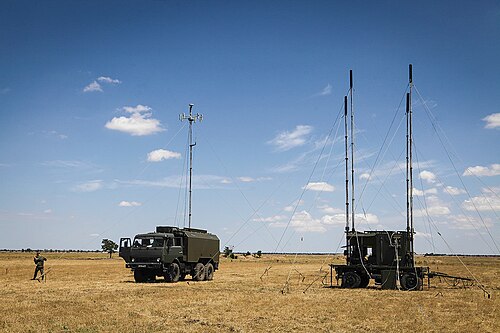
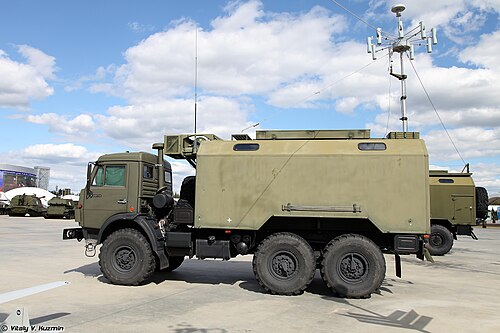
WHAT IT IS
The R-330Zh Zhitel (Р-330Ж «Житель», "Resident"; also written R-330ZH, and occasionally translated as "Resident" in Western papers) is a Russian army automated jamming station (автоматизированная станция помех, АСП) built by NVP Protek (НВП «Протек») of Voronezh. It is a tactical electronic warfare truck, not a radar and not a missile. Its job has three parts: listen across 100-2000 MHz, find and direction-find radio emitters, and jam a short list of civilian and military user terminals that live in that part of the spectrum: satellite-navigation receivers (GPS/NAVSTAR, and in practice GLONASS), Inmarsat and Iridium satellite handsets, and GSM base stations and phones. It was accepted into Russian service in 2008 according to Russian reference sources, and it is the best-known Russian system of its kind because it was photographed in Crimea and Donbas in 2014-2020 and has been one of the most-publicised electronic warfare kills in Ukraine since 2022.
It is built as a system of two vehicles: a Ural or KamAZ truck carrying the operator cabin and the reconnaissance / direction-finding gear, and a trailer carrying the generator, four active transmit phased arrays on telescopic masts and their power supplies. The transmitters are deliberately separated from the crew (see How AESA Radar Works for what an active phased array is; the Russian acronym АПФАР means "active transmitting phased antenna array"). A station can work alone, as one half of a pair (master or slave) that triangulates emitters, or under a R-330KMA control post as part of the larger R-330M1P Diabazol (Р-330М1П «Диабазол») automated jamming complex.
Do not confuse it with the older R-330 Mandate family or the R-330BMV Borisoglebsk-2 complex, which are VHF/HF radio jammers, and do not confuse it with Krasukha, which is a radar jammer. Zhitel is the one that is aimed at satellite navigation, satellite phones and cellular networks. In this article, as everywhere in this database, a performance number is a manufacturer, ministry or reference-work figure unless the text says otherwise; combat claims on both sides of the war are labelled as claims, and numbers that are my own arithmetic from published figures are labelled as that.
QUICK FACTS
- Designation: Р-330Ж «Житель» (R-330Zh Zhitel). Export card on Rosoboronexport: R-330ZH. Part of the Р-330М1П «Диабазол» complex with the Р-330КМА control post.
- Developer and manufacturer: АО НВП «Протек» (NVP Protek), Voronezh. Protek is a private company; it is not part of the state KRET concern. Open sources say it was bought by Ego-Holding in January 2013, and it is under US and EU sanctions (see below).
- Service: Russian sources give 2008 as the year of adoption. Combat use claimed by Russian TV for "early versions" in the Second Chechen War is unverified.
- Role: automated detection, direction finding and technical analysis of emitters; jamming of Inmarsat and Iridium terminals, GPS/NAVSTAR navigation receivers and GSM base stations.
- Receive (reconnaissance) band: 100-2000 MHz.
- Jamming bands (Russian specification): 800-960 MHz; 1227.6 MHz (GPS L2); 1575.42 MHz (GPS L1); 1500-1700 MHz; 1700-1900 MHz. The English Rosoboronexport card prints a shorter list: 1227.6, 1575.42 and 1500-1900 MHz.
- Transmitters: four active phased arrays; total "energy potential" at least 8,000 W (Protek and Russian Wikipedia) or at least 6,000 W (Rosoboronexport card and the last line of the Russian table). Each array beam is 90-120 degrees in azimuth and up to 20 degrees in elevation.
- Simultaneous jamming signals: not more than 12.
- Bearing error: not more than 2 degrees (Protek, Russian Wikipedia) or 3 degrees (Rosoboronexport).
- Scan rate: at least 800 MHz/s in detection mode and at least 400 MHz/s in direction-finding mode.
- Published jamming range: 20-25 km against ground user equipment; at least 50 km against equipment on aircraft. Some Russian pages say 20-30 km. These are brochure figures.
- Vehicles: truck plus trailer. Standard carrier Ural-43203 (6x6); KamAZ-43114 also photographed.
- Crew: 3 in peacetime, 4 in wartime (specification); 4 in most descriptions.
- Set-up and tear-down: not more than 40 minutes.
- Power: 220/380 V, 50 Hz, from the trailer diesel generator or a mains supply; 2.5 kW without the life-support system and 10 kW with it; emergency battery supply for the electronics.
- Mean time between failures: at least 1,600 hours (specification).
- Cost: price on request from the exporter. A Ukrainian drone regiment has put it at about 10 million US dollars; that is an estimate, not a price list.
- Losses: Oryx lists 25 R-330Zh destroyed as of early September 2026 (see below); Ukrainian units counted 24 "visually confirmed" in May 2026 and 23 in October 2025.
WHAT IT DOES, AND WHAT IT DOES NOT
The open mission statement, in the maker's and Rosoboronexport's words, is to find, direction-find and jam portable and mobile satellite-telephone terminals (Inmarsat, Iridium), jam GPS/NAVSTAR navigation equipment, and jam GSM base stations. Secondary descriptions add that the 0.1-2 GHz listening window also contains many VHF and UHF radio links, including some drone control and video links, and that the station is meant to protect a brigade or division command post from GPS-aided munitions. Russian TV (Zvezda, 2015) described it as able to intercept and suppress drone control channels. Ukrainian units that have destroyed Zhitels repeat that line, saying it jams UAV control channels out to 25 km and command channels out to 50 km. That is an interpretation: the brochure itself lists jamming of satellite, navigation and cellular equipment, and whether a given drone link falls inside the jamming windows depends on its frequency (see the band analysis below).
What it does not do: it does not jam HF; it does not jam radars (that is Krasukha and similar sets); it does not cover 2.4 GHz and 5.8 GHz Wi-Fi-style links, which are above its 2000 MHz ceiling; and it does not jam military satellite communications above 2 GHz, or Ku-band Starlink uplinks (14.0-14.5 GHz), which is the problem the separate trailer system described in VOLNA / KUPOL / GARANT is built for. It is a point-defence and front-area truck. It is not a silent signals-intelligence van either, because when it jams it is by definition one of the loudest transmitters for miles around.
HISTORY AND DEVELOPMENT
Russian electronic warfare (радиоэлектронная борьба, РЭБ) was run down in the 1990s and rebuilt after the 2008 Georgia war and the military reform that followed. Jamestown's 2021 study (Sukhankin) describes how, after 2008, a vertically integrated EW command chain appeared and EW companies were created in virtually all reformed rifle and tank brigades and divisions, the Airborne Troops and special forces. Zhitel arrived in that period: Protek developed it in the 2000s, Russian sources date its adoption to 2008, and the manufacturer claims it was tested in "combat conditions" without saying where or when.
The program context is the Diabazol complex. Protek's R-330M1P Diabazol (also seen written R-330KMK in some French and Western pages) is an automated radio-electronic suppression complex that works in the same 100-2000 MHz range. It consists of a R-330KMA control post and a number of jamming stations, of which the R-330Zh is the best-known. The Russian Wikipedia article and several secondary sources state that the control post can run stations in pairs or as a group; one secondary source claims a single R-330KMA can control up to 20 stations, which I could not confirm from a primary source.
Two older stories need to be treated carefully. The first is that Zhitel was used in the assassination of Chechen leader Dzhokhar Dudayev in April 1996. That claim appears in Wikipedia and in Jamestown as "allegedly". Chronology argues against it: the production Zhitel is dated to 2008. What is widely reported about 1996 is that Dudayev was located when he used a satellite phone and was then killed by missiles from a Russian aircraft; reports differ on the type of aircraft. I treat the Zhitel connection as a name mix-up unless a primary source appears. (An earlier version of this article named the aircraft as an Su-25; that detail is not reliably established and has been removed.) The second is that early versions of Zhitel were used in the Second Chechen War; the only source is a Zvezda TV claim repeated in Russian Wikipedia.
WHO BUILDS IT
NVP Protek (Научно-внедренческое предприятие «Протек», AO NVP Protek) is a Voronezh company that makes army electronic warfare and communications equipment: the R-330Zh Zhitel, the R-330M1P Diabazol complex and the R-330KMA control post, according to Protek's own pages and Rosoboronexport. Sanctions databases list the company at 6 Bazovaya Street, Voronezh. Open registry material says it was acquired by the holding company Ego-Holding (ЭГО-Холдинг) in January 2013 and that Ego-Holding is itself on EU sanctions lists; Protek appears on US (Executive Order 14024) and EU sanctions lists. Protek is separate from KRET (Radio-Electronic Technologies Concern, part of Rostec) and from the Sozvezdie concern, which are the other big names in Russian EW. An earlier version of this article hinted at Sozvezdie in a garbled sentence; the correct statement is that the Borisoglebsk-2 complex is a Sozvezdie product and Zhitel is a Protek product.
One production event matters. On 17 February 2025 the Ukrainian Main Intelligence Directorate (GUR) claimed that two R-330Zh complexes that were intended for the front were destroyed in a fire at the Protek plant in Voronezh on the night of 28 January 2025. GUR did not state the cause of the fire. I found no independent confirmation; treat it as a Ukrainian claim.
THE TWO VEHICLES
Standard set is two pieces of equipment, which Russian and export sheets call the "equipment vehicle" and the "antenna trailer".
- The truck. The standard transport base in Protek's specification is the Ural-43203 (Урал-43203), a 6x6. Secondary sources (Wikipedia, photos) also show a KamAZ-43114 chassis. The truck carries the operator cabin with the reconnaissance, direction-finding, analysis and control equipment and the life-support system. A direction-finding antenna array is reported to be raised from the roof. No manufacturer road-speed figure was found.
- The trailer. The antenna trailer carries the diesel generator set, the four active transmit phased arrays on telescopic masts, and the antenna power supplies. This is the part that radiates. Protek's own text says that putting the emitters in a separate mobile container gives the system high survivability against an enemy using precision weapons: the truck with the crew and the brains can sit away from the trailer that is going to attract attention. How far away is not published.
Crew: 3 in peacetime and 4 in wartime in the specification. Deployment: not more than 40 minutes to set up or tear down. A COGINT analytic report prepared for Ukrainian users (2023) notes that antenna installation is done manually, with no mechanisation, and passes on a Russian crew's remark that a station in operation has about 20 minutes before the danger of detection gets too high. That is anecdotal, but it matches the Ukrainian experience described below.
Power: the specification gives 220/380 V, 50 Hz, from the trailer's diesel generator or from a mains supply, and an emergency battery supply for the electronics. Russian Wikipedia prints 24 V DC; one Western sheet quotes +27 V and 6ST-190 batteries; I treat the exact emergency voltage as unresolved. Power drawn from a mains supply is not more than 2.5 kW without the life-support system and not more than 10 kW with it. The 1,600 hours figure is the specified mean time between failures; a previous version of this article noted that it is sometimes misread as an endurance on one tank of diesel, which it is not.
HOW IT WORKS: THE SIGNAL CHAIN
Think of Zhitel as a receiver, a direction finder, a database, a controller and a bank of amplifiers, in that order.
- Search. The receive system scans the 100-2000 MHz range. The published minimum scan speeds are 800 MHz/s in detection mode and 400 MHz/s in direction-finding mode. By my arithmetic a full 1.9 GHz sweep takes about 2.4 seconds in detection mode and about 4.75 seconds in direction-finding mode at the stated minimum rates. Short bursts, such as a satellite handset's transmission slot or a frequency-hopping radio, are the hard targets.
- Detect and classify. Signals found in the scan are analysed ("technical analysis", технический анализ): frequency, bandwidth, modulation and timing are measured and compared with what the operator is looking for. The Russian description lists automatic testing of the equipment, an electronic map, and the ability to plot reconnoitred emitters on a topographic map or a rectangular grid.
- Direction-find. The station measures the bearing to each emitter. The published accuracy is 2 degrees (Protek) or 3 degrees (Rosoboronexport). Protek does not publish which direction-finding method it uses.
- Task. The operator, or the control post, tells the station which emitters or bands to jam. The station can jam standalone, as a master, as a slave, or under the R-330KMA.
- Jam. The control system builds jamming signals, which are fed to the transmit arrays, and they radiate at the selected frequencies. Up to 12 jamming signals can be radiated quasi-simultaneously.
- Report. The station reports results to the control post by telecode link (see the interfaces section).
Direction finding, in general terms
Protek's materials say that the station direction-finds and can compute coordinates with a second station, but do not say how. Generally, a tactical direction finder does one of three things. An amplitude system (a Watson-Watt or Adcock set, for example) compares signal levels on crossed antennas. A phase or interferometer system compares the phase of the same wavefront at spaced antennas, and can be more accurate with more elements but needs more calibration. A correlative system compares the measured response with a stored calibration for every angle. Which one is in Zhitel is not published, so I do not guess. What I can say from the numbers: a 2-degree bearing error at 20 km is about 0.7 km of sideways error for a single bearing (1.0 km at 3 degrees) if that figure is a root-mean-square value. The Russian description says a pair of stations exchange information "for synchronous direction finding of emitters in order to calculate their coordinates", so the intended use is two stations, with bearings from two places crossing at the emitter. Two good bearings give a fix that is far better than one, but with errors of a degree or two the result is a patch of ground measured in hundreds of metres, not a weapon-quality coordinate. Treat it as cueing.
What "energy potential" means
Both the Protek page and Russian Wikipedia list the "total energy potential of the four active transmit phased arrays" (суммарный энергопотенциал АПФАР). The Russian term is usually understood as transmitted power combined with antenna gain, but brochures do not define it, and different Russian pages print "at least 8,000 W" and "at least 6,000 W". The Rosoboronexport card says 6,000 W. RUSI's 2023 commentary says open sources give about 10 kW. I use the 6 kW figure for the arithmetic below because it is the most conservative and the export one.
HOW IT JAMS
The target: a very weak signal
A satellite-navigation signal is extremely faint when it reaches the ground. A GPS satellite is about 20,200 km above the Earth, and the minimum received power of the civil C/A code at L1 is specified at about minus 158.5 dBW, or about minus 128.5 dBm (RUSI quotes about minus 127 dBm). The receiver recovers it only because the spreading code gives a large processing gain. A ground transmitter in the same band does not need to out-shout the satellite from orbit; it only needs to deliver a signal at the receiver that is stronger than the satellite signal by more than the receiver's anti-jam margin. For a typical unprotected receiver that margin is commonly cited as being of the order of 30-40 dB of jamming-to-signal ratio (approximate, and it varies greatly with receiver design). Military receivers with controlled-reception-pattern antennas can do much better; see the countermeasures section and Kometa CRPA for the Russian equivalent of that technology.
An illustrative link budget (my arithmetic)
This is a simple free-space calculation to show scale, not a measured performance. Assumptions: 1,500 W radiated by one array (6,000 W divided by four arrays, taking the stated "energy potential" as radiated power with no extra antenna gain, which is conservative); frequency 1575.42 MHz; a receiver with an isotropic antenna; free-space propagation; minimum GPS C/A signal about minus 128.5 dBm.
- At 5 km: jamming signal about minus 49 dBm; jamming-to-signal ratio about 80 dB.
- At 10 km: about minus 55 dBm; about 74 dB.
- At 20 km: about minus 61 dBm; about 68 dB.
- At 25 km: about minus 62.5 dBm; about 66 dB.
- At 50 km: about minus 69 dBm; about 60 dB.
For comparison, RUSI's own back-of-the-envelope figure was about minus 70 dBm at the source and about minus 53 to minus 56 dBm at 30 km, which are in the same region. The point is that jamming-to-signal ratios of 60 dB and more are available well beyond the published range. The brochure range figures therefore are not set by transmit power. They are set by geometry.
Geometry: the radio horizon sets the range
At these frequencies radio waves travel in nearly straight lines, so the range from a ground transmitter to a receiver depends on the heights of the two antennas. A standard approximation is that the radio horizon in kilometres is 4.12 times the sum of the square roots of the two antenna heights in metres. Assuming a 10 m mast on the trailer (my assumption; the mast height is not published):
- Receiver at 2 m (a soldier or a vehicle antenna): about 19 km. This matches the published 20-25 km ground figure.
- Receiver at 100 m: about 54 km.
- Receiver at 1,000 m: about 143 km.
- Receiver at 5,000 m: about 304 km.
This explains the structure of the brochure: 20-25 km against ground users (horizon-limited), and "not less than 50 km" against equipment on aircraft (a floor, since higher receivers see the jammer from farther away). It also explains how a jammer on the ground can affect a glide bomb or a guided rocket high above the battlefield. Each array has an elevation beam of up to 20 degrees; if the lower edge of such a beam is at the horizon, its upper edge at 25 km is about 9 km up (my geometry). A guided munition descending through that cone is in the jamming beam. The Washington Post, in its 2024 account of Ukrainian assessments, described Russian ground jamming as sending up a cone-shaped area through which any guided munition or aircraft is at risk.
Jamming modes
The Russian specification lists three kinds of jamming signal:
- Aimed in frequency (прицельные по частоте): a signal concentrated on the exact channel or carrier of a target, such as a GPS L1 centre frequency or a specific GSM channel. This puts the most power on the victim for the least total power.
- Aimed-barrage in frequency (прицельно-заградительные): a signal spread over a group of channels or a small band around the target.
- Barrage in frequency (заградительные): noise spread over a whole band, used when the target frequency is not known or hops.
Zhitel is described as a noise jammer. There is no public evidence in the sources I found that Zhitel spoofs navigation signals (feeds a receiver a false position); spoofing is a different technique, and the claims about it in Donbas (Jamestown, Ukrainian officers) refer to Russian EW in general, not to this station.
Which bands it covers, and which it doesn't (my analysis of the published windows)
This is my own reading of the published jamming windows against the standard frequency allocations. It is useful because it shows that the station is a 2000s design with a particular target list.
- GPS: L1 (1575.42) and L2 (1227.6) are named. GPS L5 (1176.45 MHz) is not in any listed window, and M-code signals sit around L1 and L2.
- GLONASS: the G1 band is around 1598-1606 MHz, which is inside the 1500-1700 MHz window, so it should be covered even though the English brochure names only NAVSTAR. The G2 band (around 1242-1249 MHz) is not in the printed list. Jamestown quotes a Ukrainian general who said Russian forces on some occasions jammed their own drones' GLONASS reception in the 1.589-1.6 GHz range.
- Galileo and BeiDou: Galileo E1 shares 1575.42 MHz with GPS L1, so it is hit with it. Other Galileo and BeiDou signals fall in or out of the windows depending on the exact band.
- Iridium: its handset band is about 1616-1626.5 MHz, inside the 1500-1700 MHz window.
- Inmarsat / Thuraya handsets: the L-band satellite-to-handset bands (about 1525-1559 MHz) and handset-to-satellite bands (about 1626.5-1660.5 MHz) are inside the same window. Jamming the satellite-to-handset link at the handset is the cheap way to do it.
- GSM-900: uplink 890-915 and downlink 935-960 MHz, both inside the 800-960 MHz window.
- GSM-1800: uplink 1710-1785 and downlink 1805-1880 MHz, inside the 1700-1900 MHz window.
- GSM-1900 (American PCS band): the 1850-1910 / 1930-1990 MHz allocations are only partly inside a window that ends at 1900 MHz, and this band is not used in Ukraine. The English Rosoboronexport card says GSM-1800; the claim of "GSM-1900" in Wikipedia and in some Russian pages looks like a copying error or a partial-coverage claim. I treat it as unreliable.
- LTE and 3G: the windows overlap some LTE bands (the 800-960 MHz window covers bands around 800 and 900 MHz, and the 1700-1900 MHz window covers 1800 MHz LTE), but UMTS at 2100 MHz and LTE at 2600 MHz are above the top of the jamming list. The specification is a 2G and satellite-era design, so its effect on modern cellular networks is partial.
- UAV links: the 800-960 MHz window contains the 868 and 915 MHz bands used by some long-range control links, and the 0.1-2 GHz receive range includes 433 MHz. Whether a given drone is affected depends on its link; 2.4 GHz and 5.8 GHz are not covered.
This list is what the published windows imply; it is not a Protek statement and it does not tell you how much power goes into each window.
SPECIFICATIONS IN ONE PLACE
Source tags: P = Protek (and Russian Wikipedia copy of it), R = Rosoboronexport English card, B = brochure figure that has not been independently measured. Every number below is a brochure figure; none is an observed combat figure.
- Receive band: 100-2000 MHz (P, R).
- Jamming bands: 800-960; 1227.6; 1575.42; 1500-1700; 1700-1900 MHz (P). 1227.6; 1575.42; 1500-1900 MHz (R).
- Bearing error: not more than 2 degrees (P); not more than 3 degrees (R).
- Scan rate: at least 800 MHz/s detection; at least 400 MHz/s direction finding (P, R).
- Transmit arrays: four active phased arrays, each 90-120 degrees azimuth, up to 20 degrees elevation (P, R). Four times 90 degrees makes 360 degrees, so all-round coverage is possible in principle (my observation).
- Total energy potential of the four arrays: at least 8,000 W (P); at least 6,000 W (R).
- Jamming signal types: aimed in frequency, aimed-barrage, barrage (P).
- Simultaneous jamming signals: not more than 12 (P, R).
- Range against ground user equipment: 20-25 km (P, R). Range against airborne user equipment: at least 50 km (P, R).
- Data exchange rate: the Protek and Russian Wikipedia list gives at least 256 kbit/s between paired stations and at least 48 kbit/s between a station and the control post; the Rosoboronexport English card gives a "telecode information exchange rate" of at least 1,200 bit/s. These conflict; the earlier version of this article printed only the 1,200 bit/s figure. They may describe different links or different revisions.
- Power: 220/380 V, 50 Hz, own diesel generator or mains; emergency battery supply (24 V DC per Russian Wikipedia). Consumption not more than 2.5 kW without the life-support system, not more than 10 kW with it.
- Transport base: Ural-43203 (P). KamAZ-43114 also seen.
- Set-up and tear-down: not more than 40 minutes.
- Crew: 3 in peacetime, 4 in wartime.
- Mean time between failures: at least 1,600 hours.
The 2 versus 3 degrees, 6 versus 8 kW and 1,200 bit/s versus 256 kbit/s disagreements probably reflect different datasheet editions (export cards often state looser limits). That is a guess; no source says so.
INTERFACES AND COMMUNICATIONS
The station has three kinds of connection.
- Pair working. One station is the master and the other the slave. The point is simultaneous direction finding from two places so that bearings can be crossed to give emitter coordinates. The Russian specification says the stations exchange data by telecode link at not less than 256 kbit/s (Protek) or 1,200 bit/s (Rosoboronexport card).
- Control post. Under a R-330KMA-type control post, one or several stations get their tasks and report their results by telecode exchange at not less than 48 kbit/s. The post is the link to the higher command echelon. How the control post connects to the Russian army's wider automated command system is not published; for how Russian tactical communications are organised in general see Russian C3.
- Positioning. The station needs its own position to turn bearings into coordinates and to put emitters on a map. The sources I found do not name the navigation receiver, though an army station of this period would be expected to use GLONASS (see GLONASS). That is an assumption, not a published fact. A station that jams GPS and GLONASS also has to protect its own navigation receiver from its own jamming, which is one reason for the antenna separation and for the sector-limited beams.
I found no open source that ties Zhitel to Strelets, Reflex or any other named reconnaissance-and-strike chain.
WHERE IT FITS IN RUSSIAN ELECTRONIC WARFARE
After 2008, EW companies were created in rifle and tank brigades and divisions, and a vertically integrated EW command system was set up (Jamestown). Zhitel belongs to the "front" layer: it is a brigade- or division-level asset that sits a few kilometres behind the front. Defence Ukraine's September 2026 survey, quoting RUSI fieldwork from 2023, says Russian forces were deployed with roughly one major EW system per ten kilometres of front, a few kilometres behind the line, with more specialised systems at higher echelons. Positioning guidance in the 2023 Russian counter-UAV manual, as summarised in the same survey, puts stations three to five kilometres behind the front, about ten kilometres apart, pointed at the expected approach axis, with sector widths of about 90 to 120 degrees, and orders rapid relocation after emitting. (That guidance is for the smaller R-934BMV and Palantin-U type systems; Zhitel's own 90-120 degree array beams match the same idea.)
Around Zhitel in the same Russian EW toolbox, with the role of each:
- R-330 Mandate / R-330BMV Borisoglebsk-2: HF and VHF communications intelligence and jamming. A different job, a different band, a different manufacturer.
- R-934B Sinitsa: a VHF jammer aimed at air-to-ground and aircraft data links.
- Krasukha-2 and Krasukha-4: radar jamming against airborne and space-based radars.
- Leer-3 (RB-341V): a cellular-network jammer with the transmitter payload on an Orlan-10 drone, the KamAZ ground station standing off.
- Pole-21: distributed GNSS-denial posts; in the Russian MoD manual cited by Defence Ukraine each antenna post suppresses navigation signals at not less than 25 km.
- Volna-Kupol-Garant: the Starlink uplink jammer in its own article.
- Kometa and other CRPA antennas: the defensive counterpart, which lets Russian GNSS receivers (for instance on Geran-2 drones) survive jamming; see Kometa CRPA.
Zhitel's niche inside this list is that it is one of the few Russian sets that combines a direction finder with a jammer aimed at satellite navigation and satellite phones. Its limits follow from that niche.
OPERATIONAL HISTORY
The record is a mix of OSCE drone sightings, Ukrainian military reports, Russian state media claims and open-source loss lists. Each item is attributed.
- 2014: a Zhitel was reported (New York Times, C. J. Chivers) on a road in Crimea in spring 2014; Jamestown says it was allegedly used in the annexation of Crimea. Russian Wikipedia says use in eastern Ukraine began from 2015.
- 2015: photographs of a Zhitel appeared in the hands of DNR forces (a Vostok brigade fighter posted them on a social network on 14 June 2015). Jamestown places it in Horlivka, Makiivka and Zaitseve in 2014-2017 and possibly near Debaltseve in 2015.
- 2016: the OSCE Special Monitoring Mission drone spotted R-330Zh stations near Andriivka (about 15 km south of Donetsk) in June 2016 and, two weeks later, north-west of Debaltseve. InformNapalm reported one burned out in Donbas in spring 2016.
- 2017: a Zhitel seen in Luhansk region at Zemlyane, about 7 km from the line of contact (November 2017).
- 2018: Russia reported moving EW systems to Syria after the Il-20 shoot-down (September 2018); one Russian-language source lists Zhitel among them, but that is a press claim.
- 2019: reports of "Russian GPS-jamming systems return to Ukraine" and an OSCE and Ukrainian observation of increased drone losses; Janes reported in June that Russia tried new EW tactics with Zhitels that could interfere with satellite communications, navigation and phones within a 30 km radius. On 29 June a Torn-MDM system was hit near Mayorove; InformNapalm said a Zhitel was probably destroyed with it (Ukrainian-source claim).
- 2020: the OSCE drone spotted a Zhitel at night on 28 November, about 4 km north-west of Kovske in Novoazovsk district and about 5 km from the Russian border, and another EW system (probably Zhitel) on 27 December near Mykhailivka. Jamestown also lists a Zhitel among three EW systems seen by OSCE drones near Verbova Balka (about 28 km south-east of Donetsk) in its post-2017 period.
- 2022: photographs from the Kyiv region in March show remains of an R-330Zh; one destroyed by artillery in May after a drone found it; one destroyed in Kharkiv region on 26 September 2022 with a 30 mm cannon from a BTR-4E (Ukrainian reports; Wikipedia also mentions a Bayraktar TB2 sighting). A Kyiv-region trailer left behind in 2022 was reportedly later identified in Ukraine (see below).
- 2023: on 26 March Ukraine reported the destruction of a Zhitel with an M982 Excalibur round, observed through a drone camera (posted by UAWeapons). In June RUSI published Withington's commentary on jamming of JDAM.
- 2024: February, a Zhitel destroyed near Bakhmut; Ukrainian sources said it was found by the 80th air-assault brigade's aerial reconnaissance and hit by rocket artillery. In July, Russian media quoted a Russian military expert as saying that a Diabazol complex and Zhitel jammed the GPS correction of a JDAM-ER bomb; a Russian expert's claim, not verified.
- 2025-2026: a run of Ukrainian drone strikes, described in the next section.
UKRAINE: WHY ZHITELS DIE, AND HOW MANY
A jammer is a transmitter, and a transmitter can be found. Ukrainian tactics, as described by RUSI fieldwork and Defence Ukraine's survey: passive direction-finding sensors locate the emitter; drones confirm it; artillery or strike drones finish it. RUSI's reporting says tracking Russian EW positions has become a prerequisite for Ukrainian drone operations, shaping routes, timing and altitude, and that artillery is used against Russian EW before drones go into the same sector. RUSI's 2023 JDAM commentary said the same thing in one line: a powerful jamming signal is comparatively easy to detect, so its latitude and longitude can be determined and passed to artillery.
Counts, with their source:
- Russian Wikipedia, citing an RFE/RL article of September 2023: Oryx then listed 13 R-330Zh destroyed.
- Ukrinform, 8 October 2025: a destroyed Zhitel in Luhansk region; "only 23" visually confirmed destroyed since the full-scale invasion. The 412th Nemesis regiment and Border Guard reconnaissance claimed that one.
- Militarnyi, 3 May 2026: the Lasar's Group National Guard unit claimed a Zhitel in Kharkiv region and gave "24 visually confirmed as destroyed or damaged".
- Defence Ukraine, 10 September 2026, citing Oryx: 107 Russian jammer and deception entries including 25 R-330Zh, as of early September 2026. Oryx counts only photo or video-documented losses, so it is a minimum. (I could not load the Oryx page directly; this number is from the secondary survey.)
These counts come from different organisations with different rules and they are not a single series. They agree in order of magnitude: a couple of dozen Zhitel hulls documented, out of a fleet that has never been published.
Recent strikes (Ukrainian claims):
- 26-27 January 2026: the 413th Unmanned Systems Regiment "Raid" claimed to have hit the station's antennas, which it said disabled the system; it gave a cost estimate of 10 million US dollars and said restoration needs complex electronics and at least several months.
- 19 March 2026: the 413th claimed another near Balochky in Zaporizhzhia region, about 30 km from the front line, hitting the antenna.
- 3 May 2026: Lasar's Group claimed one in Kharkiv region with a bomber drone, together with a command and staff vehicle.
- Summer 2026 (published 7 September): Lasar's Group claimed that it flew home-built bomber drones 55 km behind the line to destroy a Zhitel that it said had been used mainly against Ukrainian reconnaissance drones near Sievierodonetsk.
These units describe the Zhitel as a drone-jamming asset. Ukrainian reports say the destruction "opens space" for Ukrainian drone operations. The reports are claims by the units that carried out the strikes; independent imagery for individual cases is what Oryx uses.
Capture and analysis. I found no report of a complete Zhitel captured intact. One report (Defense24, retold by Topwar in July 2025) says a trailer left by Russian troops in the Kyiv region in 2022 was hidden in a barn by a local resident who told Ukrainian soldiers it was a generator; it was later identified as a component of an R-330Zh, apparently the antenna trailer. A comment on the Topwar page notes that the trailer is useless without the truck; the truck holds the electronics and software. Separately, Ukraine's TrophyLab programme has listed captured Russian systems for vetted technical examination, with Zhitel components named in at least one report. I could not see the underlying list, so I do not claim any particular Zhitel analysis has been published.
EFFECT ON WESTERN PRECISION MUNITIONS
The most-discussed Western consequence of Russian GNSS jamming is the degradation of GPS-guided munitions. It cannot be attributed to Zhitel alone: Russian GNSS jamming comes from several systems, including Pole-21 and others. Zhitel is the one that is named in the RUSI commentary and in secondary sources.
- RUSI (Withington, 6 June 2023): leaked US documents showed concern that Russian jamming was causing some JDAM-ER bombs to miss. RUSI names the R-330Zh as a notable example, says open sources put its jamming power at about 10 kW and an official-document jamming range at up to 30 km, and notes that a JDAM falls back on its inertial system when GPS is lost: about 5 m accuracy with GPS or better, and about 30 m on inertial alone (open-source figures). It also says Russian forces suffer "electromagnetic fratricide" from this jamming. For what an inertial fallback is, see INS Inertial Navigation System; for a terrain-matching alternative see TERCOM.
- The Washington Post (24 May 2024), from confidential Ukrainian assessments: Excalibur's success rate fell from more than 50 percent early in 2023 to under 10 percent as Russian jamming adapted, with the caveat that fewer shells were fired and many were not observed; JDAM bombs missed by from about 20 m to about 1.2 km during some periods (the article says "from as little as 65 feet to about three-quarters of a mile") and the hit rate recovered after a fix and fell again; HIMARS rockets could miss by 15 m or more. The article describes Russian jamming in general, not Zhitel specifically.
- The Telegraph (May 2023) reported that Ukraine had to update HIMARS software after Russian jamming of the rockets; Wikipedia links this to Zhitel. The attribution to this one station is not established.
- Russian media in 2024 attributed jamming of Excalibur and JDAM-ER to Zhitel and Pole-21; these are claims.
The US has since pursued anti-jam upgrades; Defense News (March 2025) reported work on refitting artillery and rocket systems with GPS protections.
COUNTERMEASURES
The counters to a Zhitel are mostly the counters to any GNSS jammer or any large emitter.
- Kill the jammer. The Oryx numbers are the result. Ukrainian tactics put passive direction finding, drone reconnaissance and strike together.
- Better antennas. A controlled-reception-pattern antenna (CRPA) with several elements can place a null in the direction of a ground jammer and keep listening to satellites above. Each jammer in a different direction needs a separate null, and several jammers can use up the available nulls (see Kometa CRPA for the principle).
- Do not rely on GNSS. Inertial navigation, terrain or visual matching, and seeker homing mean a weapon can continue without satellites.
- Approach from a direction or altitude that avoids the beam. The jamming cone is limited to the sector in front of each array.
- Frequency agility and other links. Frequency-hopping and spread-spectrum radios (see R-168 Akveduk and R-187 Azart for Russian examples) are harder for a barrage jammer to hit. Ukrainian drone operators moved control links to different parts of the spectrum when one became jammed.
- Fibre-optic drones. A fibre-optic FPV has no radio control link for Zhitel to jam. Defence Ukraine says typical fibre-FPV ranges were 15 to 25 km by early 2026.
- Emissions control. The simplest defence against being hunted by emissions is not to emit, which for a jammer is a contradiction. That is the central weakness of the system.
VULNERABILITIES AND LIMITS
- It is the loudest object in its sector. The more power it radiates, the easier it is to find by direction finding and the more attractive it is as a target. Defence Ukraine's survey argues that high-power jammers have run into a "power race" limit where more output only improves the detection signature.
- Its beams point in a fixed pattern. A sector 90-120 degrees wide wastes power if the threat is not inside it, and leaves gaps if it is not covered.
- Electromagnetic fratricide. Jamming 1575.42 and 1500-1700 MHz also affects Russia's own GLONASS receivers and satellite phones nearby. Ukrainian Maj. Gen. Kremenetskyi, quoted by Jamestown, said Russian forces jammed their own drones' GLONASS reception on some occasions; RUSI says the Russian army regularly suffers it.
- Set-up time and manual labour. Forty minutes to set up and strike is long under drone and artillery pressure; antenna erection is manual.
- Narrow target list. Its published jamming windows do not cover 2.4 GHz and 5.8 GHz links, Ku-band satellite terminals, or modern 3G and 4G bands above 1900 MHz, as shown above.
- Cost. Each station is expensive and slow to replace relative to the commodity drones that kill it. A Ukrainian unit puts it at about 10 million US dollars. Defence Ukraine notes that Russia has moved a large share of its effort to cheap "domes" and handheld jammers, for which the cost per target is far smaller.
- Separate truck and trailer. The design intent is that the crew survives a hit on the trailer. In practice, Ukrainian reports describe hits on the antennas as disabling the system.
COMPARISON WITH WESTERN SYSTEMS
Zhitel has no close Western counterpart because the missions are cut differently. The best-known US Army ground communications jammer of the Cold War and 1990s, the AN/MLQ-34 TACJAM, worked in VHF (about 20-200 MHz) and could jam a small number of signals at a time, with something like 3-4 kW of effective radiated power; it was retired from the Army in 1999 (Forecast International; Military Review 2019). So the US system was a VHF radio jammer, not a satellite-navigation and satellite-phone jammer. Western militaries have generally treated GNSS jamming as something done by specialised or air-launched systems and not as a standard ground-brigade truck; I have not found a public Western truck-mounted equivalent in the same class. The approach is also different: This comparison is broad; it is not a capability assessment.
COST, PRODUCTION AND EXPORT
Rosoboronexport lists the price as "on request". The only figure in circulation is the Ukrainian drone regiments' estimate of about 10 million US dollars (January and March 2026), with no source given. Production is at Protek in Voronezh at an unpublished rate; see the fire claim above. I found no confirmed export customer, and the Russian-language reports of delivery to Syria are press claims. The size of the Russian fleet has never been published, so the loss counts cannot be turned into a percentage.
RUSSIAN STATUS AND MODERNIZATION
The station is still in service and still being shown in Russian state media as a component of Russian EW. I found no confirmed newer variant: searches for a "Zhitel-M" or a newer Diabazol version did not turn up any source. What the sources show is a stable product that is not being redesigned in public. The 2024 Russian media reports of Zhitel and Diabazol suppressing JDAM-ER and Excalibur are about use, not about a new model. Protek continues to sell Diabazol, and the R-330KMA control post still appears in the Diabazol listing.
The wider modernisation story is that Russian EW investment has shifted. Defence Ukraine's survey says the marginal Russian ruble now goes to cheaper, software-defined and more numerous systems (Pole-21 posts, vehicle-mounted domes such as Volnorez and Saniya, Lesochek, handheld anti-drone rifles, and a prototype named Tishina), with a US Army Military Review figure of about 5,000 lightweight counter-UAV devices a month available to the Russian military by late 2024. A heavy truck-and-trailer station like Zhitel is the older style. It remains useful where long-range GNSS denial and command-post protection are needed, and Ukrainian planners treat it as a high-value target for that reason.
STATUS IN OCTOBER 2026
- Service: in Russian service; used on several sectors in Ukraine. Ukrainian units reported strikes on it in Luhansk (October 2025), Zaporizhzhia (January and March 2026), Kharkiv (May 2026) and the Sievierodonetsk area (summer 2026).
- Losses: at least 25 documented destroyed (Oryx via Defence Ukraine, early September 2026); 24 "visually confirmed destroyed or damaged" per Militarnyi in May 2026. No later count was found.
- Capture: no intact capture reported; a trailer component was reportedly identified in the Kyiv region.
- Modernisation: none confirmed.
- Production: continuing at Protek by the evidence available, with the January 2025 fire claim unconfirmed.
- Latest source check: 16 October 2026. The numbers above will move, and loss counts in particular are snapshots.
WHAT IS UNCERTAIN OR DISPUTED
- Jamming power: 6,000 W or 8,000 W (or 10 kW in RUSI's open-source summary), and what "energy potential" actually measures.
- Bearing error: 2 or 3 degrees. Data rates: 1,200 bit/s or 256 kbit/s between paired stations.
- GSM-1900 coverage (weak) and GLONASS coverage (implied by the 1500-1700 MHz window, not named in the English brochure).
- UAV jamming: claimed by Russian TV and by Ukrainian units, depends on the link frequency.
- Dudayev 1996 and Second Chechen War use: unverified.
- Syria deployment: press claim only.
- Press stories that Zhitel jammed E-3 and E-2 aircraft (2022) or RQ-4 drones (2021): unconfirmed.
- Protek plant fire: Ukrainian claim.
- The 10 million US dollar cost, the captured trailer and the Oryx count of 25 (a minimum, seen only through a secondary source).
TIMELINE
- 2008: adopted into Russian service (Russian sources). 2013: Ego-Holding reportedly buys Protek. 2014-2017: sightings in Crimea and Donbas.
- 2019-2020: renewed sightings; OSCE drone records at Kovske and Mykhailivka. 2022: invasion; first Zhitels lost near Kyiv and Kharkiv.
- 2023: Excalibur strike (March); RUSI JDAM commentary (June). 2024: Bakhmut strike (February); Washington Post jamming report (May).
- 2025: claimed Protek fire (28 January); Luhansk strike (October). 2026: strikes in January, March, May and summer; Oryx count 25 by September.
RELATED ARTICLES
GLOSSARY
- Р-330Ж «Житель» - the R-330Zh Zhitel; автоматизированная станция помех (АСП) - automated jamming station; радиоэлектронная борьба (РЭБ) - electronic warfare.
- радиоразведка - radio reconnaissance (signals intelligence); пеленгование - direction finding; радиоподавление - radio jamming (suppression); технический анализ - technical analysis of a signal.
- АПФАР - active transmitting phased antenna array; энергопотенциал - energy potential (power combined with gain, as usually understood; not defined in the brochures).
- прицельные по частоте / прицельно-заградительные / заградительные - aimed / aimed-barrage / barrage jamming signals.
- Диабазол Р-330М1П; Р-330КМА - Diabazol automated jamming complex; its control post.
- НВП «Протек» - NVP Protek, the Voronezh manufacturer; ЭГО-Холдинг - Ego-Holding.
- Урал-43203; КамАЗ-43114 - the Ural and KamAZ carrier trucks; телекодовый обмен - telecode data exchange; средняя наработка на отказ - mean time between failures.
- ГЛОНАСС - GLONASS; NAVSTAR - the US GPS constellation name used in Russian sources.
- Jamming-to-signal ratio (J/S) - how much stronger the jamming signal is than the wanted signal at the victim receiver. Burn-through - the range at which the wanted signal is strong enough to overcome the jamming.
- CRPA - controlled reception pattern antenna, which nulls jammers. EMCON - emissions control.
- Oryx - the open-source project that counts photo or video-confirmed equipment losses.
IN ONE SENTENCE
The R-330Zh Zhitel is NVP Protek's truck-and-trailer jamming station that listens from 100 to 2000 MHz, direction-finds what it hears, and jams GPS and GLONASS receivers, Inmarsat and Iridium handsets and GSM networks out to a horizon-limited 20-25 km on the ground and at least 50 km against aircraft, alone, in a pair or under a Diabazol control post, and in 2026 it is still in Russian service but is one of the most-hunted pieces of Russian electronic warfare, with at least 25 documented losses because a station that jams has to transmit.
Project Orlan // Underground Information Database