WHAT IT IS
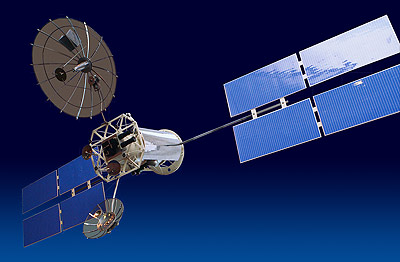
Luch (Луч, “Ray”) is Russia’s geostationary data-relay constellation. Official name of the current generation: Multifunctional Space Relay System, MKSR Luch. Three Express-1000 class birds sit over the Atlantic, Indian and Pacific oceans and bounce commands, telemetry, video and navigation corrections between low-Earth objects and Russian ground stations that cannot see those objects. It is the functional cousin of the U.S. Tracking and Data Relay Satellite System. It is not Gonets (LEO store-and-forward messaging) and not Rassvet (LEO broadband). Gonets SatCom is only the operator.
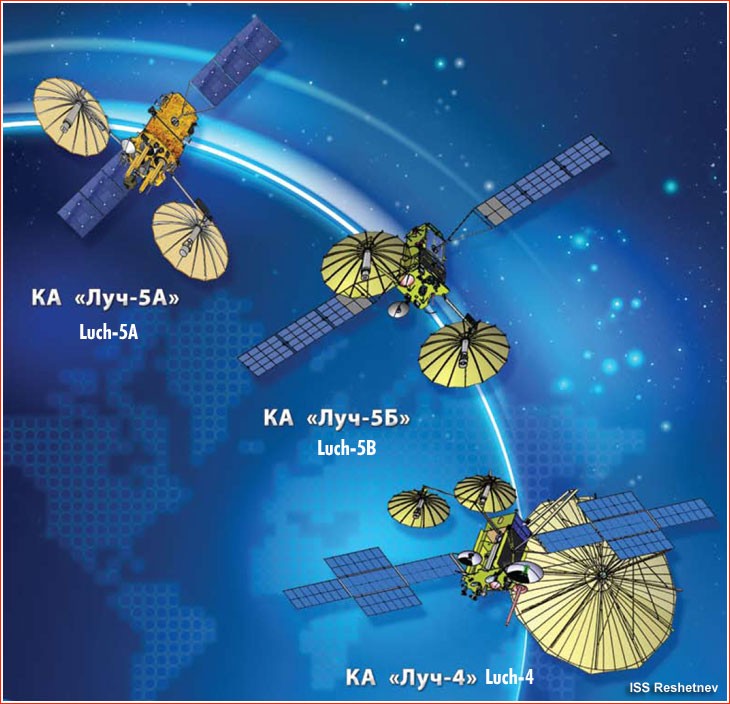
Design slots: Luch-5A at 167° E (Pacific), Luch-5B at 16° W (Atlantic), Luch-5V at 95° E (Indian Ocean). One satellite sees up to about 60 percent of the Earth; three give near-global coverage to about 72° latitude. Ku-band user pipe up to 150 Mbit/s; S-band up to 5 Mbit/s. Accepted into experimental service December 2015; still the working ISS and launch-vehicle relay in 2026.
HISTORY
First generation flew as Altair / Luch (11F669) on the heavy KAUR-4 bus, about 2,400 kg, Proton-K from Baikonur. Kosmos-2054 (Altair 14L) December 1989; Luch-1 (Altair 13L) December 1994; Luch-2 / Gelios 12L October 1995. Those birds supported Mir and early ISS-era coverage, then aged out. Luch-2 failed in 1998.
Roscosmos contracted NPO PM / ISS Reshetnev in the mid-2000s for a light-bus rebuild. Original plan was a heavy Luch-4 on Express-2000 plus Luch-5A and 5B on Express-1000. Luch-4 was suspended and the third operational slot was filled by Luch-5V, a 5A twin. MKSR Luch with three 5-series satellites replaced the old Altair net. Luch-4 hardware later appeared as the experimental Yenisei-A1. A separate heavy bird launched 28 September 2014 as Olymp-K / Luch (and a second Olymp-K 2 / Luch-5X on 12 March 2023) is widely treated as a military SIGINT / inspection satellite that borrowed the Luch name; it is not counted as an MKSR relay in Roscosmos service descriptions.
MKSR entered trial use in December 2015. TsNIIMash mission control flies the constellation. By 2024 Roscosmos had given JSC Satellite System Gonets the operator role for Luch as well as the LEO messenger fleet. March 2026 Progress MS-33 still used Luch-5A and 5B for 17 relay sessions once it left ground-station view.
HOW IT IS BUILT
Platform: Express-1000A / 1000K, unpressurized light bus from Reshetnev. Launch mass about 950–1,150 kg (Roscosmos card for 5A: 1,140 kg). Power ~2.2 kW. Design life 10 years — already exceeded on the 2011–2014 trio. Station-keeping 0.2° in longitude. Two 4-metre unfurlable spot antennas, composite ribs, gold-plated mesh: one Ku, one S. Repeaters originally Thales Alenia Space; other RF from Sumitomo / NEC on early birds. Six to seven S and Ku transponders. EIRP cited 23–59.6 dBW; G/T 16.5–25.1 dB/K.
Bands in the service cards: S (~2.1 / 2.3 GHz) for the low-rate command and telemetry path; Ku (~11 / 14–15 GHz) for the 150 Mbit/s trunk; P and L payloads on 5A for COSPAS-SARSAT and Planeta-S weather-buoy traffic. 5B and 5V also carry a laser-radio crosslink experiment. SDCM (GLONASS / GPS differential corrections) is broadcast through the same birds — Luch is how the Russian SBAS leaves the continent.
User segment: subscriber relay sets (AAR) in S and Ku on Soyuz-MS, Progress-MS, the Russian ISS segment (Lira / Regul paths), launch vehicles and upper stages, and some LEO remote-sensing and weather spacecraft. Coverage is for objects up to about 2,000 km altitude.
Luch-5VM is the mid-life refresh. Reshetnev was tasked in 2026 to build 5VM No. 2 and No. 3 with a thicker onboard relay complex. Earlier notes also listed 5VM contracts for 2024–2025; cadence slipped, as usual.
HOW IT IS LAUNCHED
Proton-M / Briz-M from Baikonur, dual manifest. 5A rode with AMOS-5 on 11 December 2011. 5B with Yamal-300K on 2–3 November 2012. 5V with KazSat-3 on 28 April 2014, pad 81/24. Briz-M five-burn GEO insertion. First-generation Altairs used Proton-K / Block DM-2. Olymp-K flights used the same Proton-M / Briz-M path but are a different programme.
WHAT IT RELAYS
Russian ISS segment voice, telemetry and video when the station is out of Russian ground view — the reason MKSR exists. Soyuz-MS and Progress-MS from liftoff through docking: the March 2026 Progress MS-33 example is the current public drill, 17 sessions on 5A and 5B. Launch-vehicle and Briz / Fregat telemetry after the rocket drops below the horizon of the tracking chain. Earth-observation and Rosgidromet dumps. COSPAS-SARSAT beacon relay. SDCM corrections for GLONASS (and GPS) users. Occasional TV bridges and news feeds between Russian centres.
Without Luch, MCC-M only talks to a LEO craft while it is over Russian or partner dishes. With Luch, the GEO bird stares at the LEO user and at Moscow at the same time. That is the TDRSS trick.
HOW IT SITS WITH THE OTHER PIPES
GLONASS tells you where you are; SDCM corrections often arrive via Luch. Gonets stores a short message on a 1,400 km bird. Rassvet is the coming Ku/Ka LEO internet. Express and Yamal are GEO commercial trunks. Luch is the bent-pipe between a flying Soyuz and TsUP when neither can see the other. Olymp-K / Luch-5X is a named cousin in GEO that is not part of the published MKSR service list.
STATUS
Three MKSR birds still cited as the operational set in 2026, all past design life. Operator: Gonets SatCom. 5A had early star-tracker trouble; the net is still used for Progress and ISS. 5VM replenishment announced, not yet the new constellation. Altair generation is historical. Treat Olymp-K as a separate GEO intelligence programme that reused the brand.
IN ONE SENTENCE
Luch MKSR is Reshetnev’s three-satellite GEO relay — 5A / 5B / 5V at 167° E, 16° W and 95° E, S-band 5 Mbit/s and Ku 150 Mbit/s — the Russian TDRSS that carries ISS and Soyuz/Progress when they leave the ground horizon, plus SDCM and COSPAS, operated today by the Gonets company.