WHAT IT IS
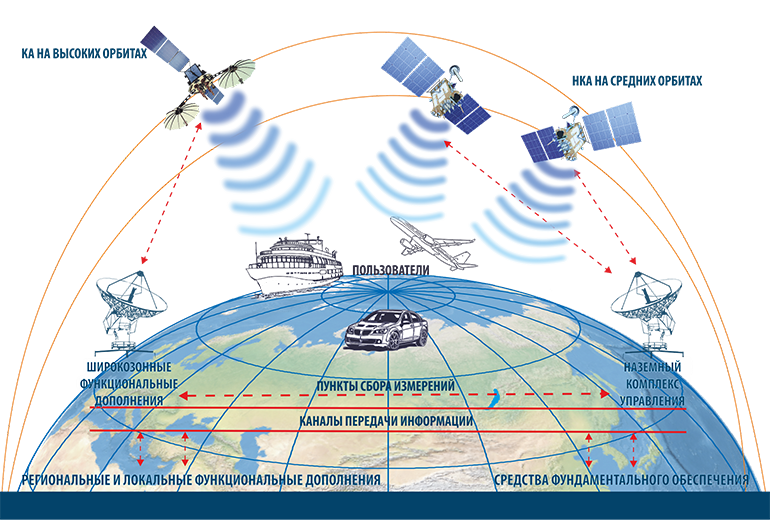
GLONASS is the Russian global navigation satellite system. A receiver that sees enough healthy birds computes position, velocity and time the same way a GPS set does: range from each satellite by measuring how long a known code and a known carrier took to arrive, then solve four unknowns (x, y, z, clock). The military needed a sovereign PNT layer that did not depend on NAVSTAR. The civil world uses the open signals as a second GNSS, usually paired with GPS.
Design constellation: 24 operational satellites in three orbital planes, plus in-orbit spares. Official Information-Analytical Centre snapshot for 9 September 2026: 27 satellites in the constellation, 23 in operation, 1 in maintenance, 2 under check by the prime contractor, 1 spare. That is a working global service with thin margin, not a packed GPS-III fleet.
Builder: ISS Reshetnev (NPO PM), Zheleznogorsk — the same house that flies Gonets. Operator lineage: military space forces / Roscosmos / JSC Navigation-Information Systems. Ground time and integrity live at the system control centre; the public status board is glonass-iac.ru.
HISTORY
December 1976: Central Committee and Council of Ministers decree to deploy a unified space navigation system, GLONASS. NPO PM had already tabled the 11F654 Uragan spacecraft that spring. A 1979 decree set flight-test dates. First launch: 12 October 1982 from Baikonur, Proton, mixed live birds and mass models. The system reached a full 24-satellite set in 1995, then decayed with the 1990s budget. First-generation Uragan design life was 3–3.5 years and often less; keeping 24 up required more than seven launches a year.
The 2002–2011 federal target programme rebuilt the fleet with GLONASS-M. Full operational capability returned in the early 2010s. GLONASS-K introduced an unpressurized bus and the first CDMA signal (L3OC). GLONASS-K2, first flown 7 August 2023 from Plesetsk, adds L1 and L2 CDMA and more power. Last GLONASS-M, serial 761, launched 28 November 2022. First-generation birds are gone; M still carries most slots.
ORBIT AND WHY 64.8 DEGREES
Medium Earth orbit, circular, altitude about 19,100 km, semi-major axis 25,420 km, period 11 h 15 min 44 s (8 orbits in 17 sidereal days). Three planes, 120° apart, eight slots per plane. Inclination 64.8° — higher than GPS at 55°. That is the high-latitude choice: more time above the Russian Arctic, poorer geometry on the equator than a 55° walker. Right-hand circular polarization. Each bird repeats its ground track every 17 days.
Time scale: GLONASS time, steered to UTC(SU) with a known integer-second offset from GPS time that a dual-system receiver must apply. Geodetic frame: PZ-90 (Parametry Zemli 1990), now close enough to ITRF that civil multi-GNSS sets treat the difference as a centimetre-to-decimetre transformation, not a kilometre error.
HOW A FIX IS MADE
Each satellite radiates a ranging code and a navigation message (ephemeris, clock, almanac, health). The receiver copies the code, measures code phase and carrier phase, applies the satellite clock and the Earth-rotation / relativity terms, and solves. Four satellites give a 3-D fix plus receiver-clock error. More satellites tighten dilution of precision. Civil accuracy on open FDMA is typically several metres standalone, better with SBAS or a combined GPS+GLONASS solution. Official K2 talk is decimetre-class with the new signals; independent notes still quote around half a metre to a metre until the CDMA constellation is dense.
Military users get the restricted SF / SC codes, higher power on some components, and — in Russian briefings — improved anti-jam processing on later birds. Open-source claims of “2,000× jam resistance after a 2025–26 software load” are not independently verified here; treat as a claim, not a measured number.
SIGNALS — FDMA THEN CDMA
Legacy GLONASS does not share one carrier like GPS. It uses FDMA: each satellite has its own frequency channel. L1 centre family 1602 MHz + k×0.5625 MHz; L2 1246 MHz + k×0.4375 MHz. After radio-astronomy protection deals, operational channels are k = −7 to +6 (14 channels; antipodal slots reuse a channel). Open service: L1OF and, from GLONASS-M, L2OF. Restricted: L1SF and L2SF. Same standard-accuracy code on every bird; the frequency is what names the satellite.
CDMA is the modernization path so a cheap mass-market chip can treat GLONASS like GPS and Galileo. L3OC flew first on GLONASS-K and on late M birds (serials 755–761). K2 adds L1OC (civil, near GPS L1 / Galileo E1 at ~1600.995 MHz), L1SC, L2SC and keeps L3OC, while still radiating the old FDMA set so existing receivers do not go dark. K2 therefore carries both worlds: L1OF, L1SF, L2OF, L2SF plus L1OC, L1SC, L2SC, L3OC — up to nine signal components versus five on M and seven on K.
Naming: O = open, S = sanitized / restricted, F = FDMA, C = CDMA, digit = band. L1OC is the civil “mass” CDMA signal intended to sit in a multi-GNSS front-end next to GPS L1 C/A and Galileo E1.
THE SATELLITES
Uragan / GLONASS (11F654), 1982–2005. Pressurized bus, ~1,500 kg, ~1,400 W, 3–3.5 year design life, often ~22 months real. L1OF, L1SF, L2SF. Proton triples from Baikonur. Retired; last first-gen off the almanac 2009.
GLONASS-M (Uragan-M, 14F113), 2003–2022. Still pressurized, ~1,415 kg, ~1,270 W, 7 year design, three cesium clocks at 1×10⁻¹³. Added civil L2OF. Late units (755–761) also radiate L3OC. Last launch 28 November 2022 (No. 761). These still fill most of the 23 operational slots in September 2026.
GLONASS-K (K1), from 2011. Unpressurized, ~935 kg, 10 year life, first CDMA (L3OC), COSPAS-SARSAT search-and-rescue payload on some. Lighter so Soyuz-2.1b / Fregat from Plesetsk can fly one at a time instead of a Proton triple.
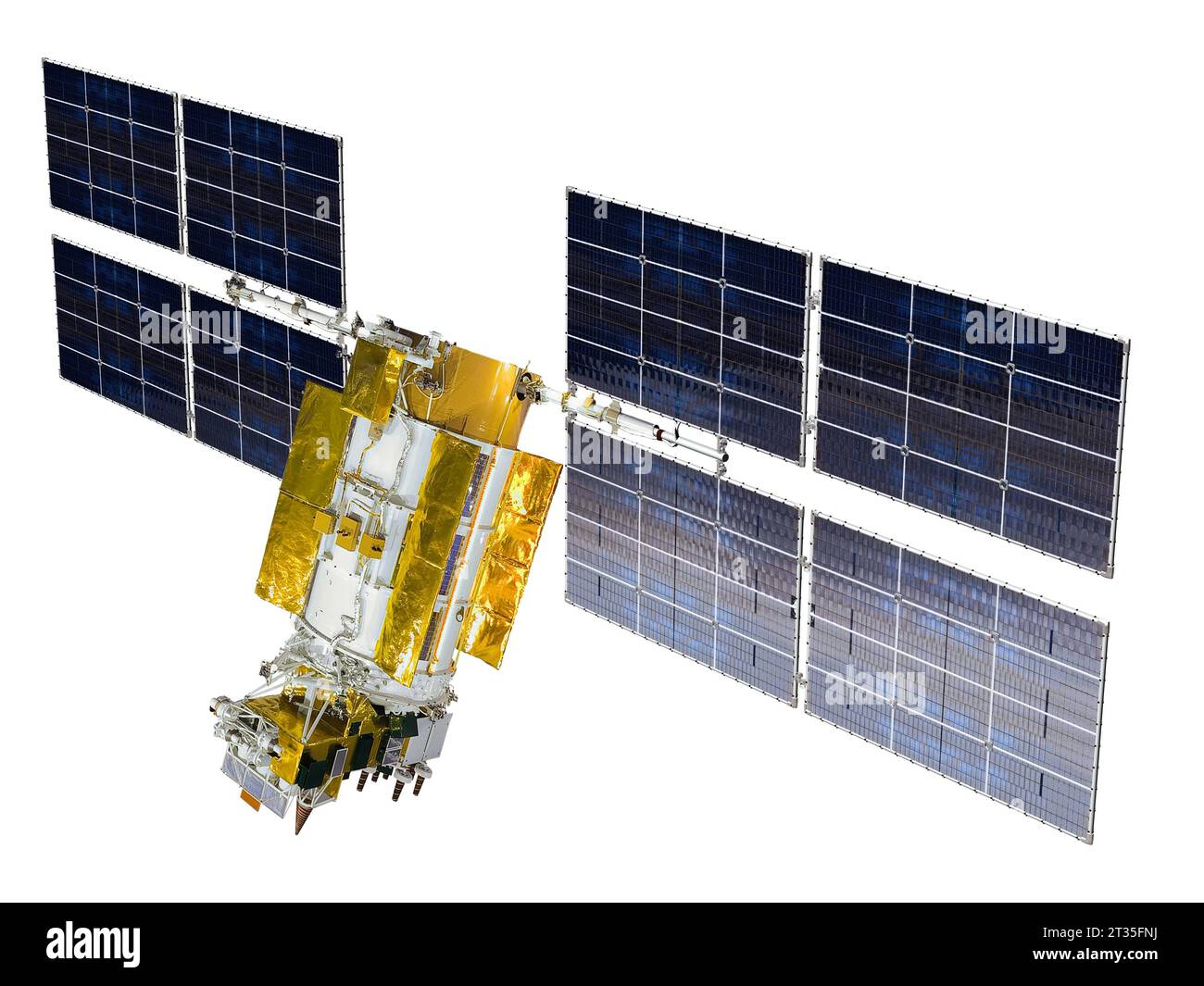
GLONASS-K2, from 2023. Express-1000A / 1000K-class unpressurized bus, launch mass ~1,645–1,800 kg, 4,370 W, 10 year life, two cesium plus two rubidium clocks, laser ranging, COSPAS-SARSAT, space-environment package. First: Kosmos-2569 / No. 703, 7 August 2023, Plesetsk, Soyuz-2.1b / Fregat — listed as spare on the 9 September 2026 IAC board. Second: Kosmos-2584 / No. 704, 2–3 March 2025, in operation (slot with channel −4). A later K-series bird (708 / Kosmos-2596, September 2025) is also on the tracking lists. K2 is 70% heavier and about 170% more powered than K1. GLONASS-KM is the paper follow-on.
Launchers: Proton-M triples from Baikonur for the M era; Soyuz-2.1b / Fregat from Plesetsk for K and K2 singles. Ground cannot command three brand-new M birds in one pass; the onboard computer puts each into sun-point first.
GROUND AND AUGMENTATION
System Control Centre plus a command-and-tracking network on Russian territory, later expanded. SDCM (Sistema Differentsial’noi Korrektsii i Monitoringa) is the SBAS: integrity and differential corrections, conceptually WAAS/EGNOS for GLONASS (and GPS). Luch GEO relays carry some of that. ERA-GLONASS is the automotive emergency service that dials a position off a GNSS fix — often dual GPS/GLONASS — into the rescue net. Foreign monitor stations have been added in fits (Venezuela among the 2025 announcements) to thicken the orbit determination and the advertised accuracy path toward decimetres in the 2030s.
User equipment: every modern Russian military radio and vehicle nav set that quotes “GLONASS/GPS” (Azart, tank BMS, Kalina-related maps) is a dual-system receiver. Civil phones and survey kits do the same. A GLONASS-only fix still works; a combined fix is what the army actually wants when GPS is jammed or denied.
MILITARY USE
GLONASS is the PNT backbone for Russian C2, artillery, aviation, ships and precision munitions that are not flying a purely inertial or terrain-match profile. Restricted codes and the higher-inclination geometry are the sovereign piece. Dual-GNSS receivers keep working if one constellation is spoofed or sparse. Jamming of L1 still hurts; FDMA spreading across channels is not magic immunity, and battlefield GNSS war in Ukraine has been a contest of power, geometry and antenna quality, not a clean GLONASS win. The system’s value is independence and a second set of clocks in the sky, not invulnerability.
It does not replace Gonets (messaging), Rassvet (broadband), or the tactical radios. It tells those nets where the terminal is.
STATUS
9 September 2026 IAC: 27 in constellation, 23 operational, 1 maintenance, 2 contractor check, 1 spare. M-generation majority; K and K2 filling in. Last M already flying. K2 CDMA service is real on the new birds but not yet a 24-satellite CDMA fleet. Ambition remains 24+spares, with talk of 30. Accuracy and integrity still depend on SDCM, multi-GNSS and the health of aging M clocks. The constellation is a living global GNSS, thinner and older in the slots than GPS, and in the middle of the FDMA-to-CDMA decade.
IN ONE SENTENCE
GLONASS is Russia’s 19,100 km, 64.8° GNSS — 24-slot Uragan family from Reshetnev, FDMA L1/L2 plus growing CDMA on K/K2 — 23 operational of 27 on the September 2026 board, the sovereign clock in the sky for every dual-system Russian radio, tank and munition that cannot live on GPS alone.