WHAT IT IS
Kazbek (Казбек) is the primary automated command system for Russia’s strategic nuclear forces (стратегические ядерные силы). It is how the national command authority talks to the missiles, the boats and the bombers when the subject is nuclear use. It does not fly a warhead. It authenticates people, stitches a conference, and moves an order onto the military combat-control chain — and, critically, it is a communications machine. A box of codes that cannot talk is furniture. This page is written around that fact. [DOCUMENTED]
The famous black case is not named Kazbek. The case is Cheget (Чегет) — a portable subscriber terminal of Kazbek. Three of them exist in the classic description: President (Supreme Commander), Minister of Defence, Chief of the General Staff. Officers of a dedicated strategic-communications service carry them. The case is a hardened remote handset into a larger machine. [DOCUMENTED]
Caucasus mountain names were the cipher family for this work. Kazbek the mountain, Cheget the mountain, Kavkaz the region. Some Russian sources treat Kazbek and Kavkaz-7 as the same umbrella. Others split them: Kavkaz as the special leadership communications fabric, Kazbek as the strategic-forces command automation that Kavkaz plugs into. In practice they are one political-military nervous system with two labels. See also the broader picture on Russian C3. [DOCUMENTED]
The short version. Early warning wakes duty officers. The three Cheget holders can conference and authorise over Kavkaz-7. Their decisions appear on Baksan terminals at central command posts. Military officers then issue launch instructions through the Strategic Rocket Forces’ Signal (Сигнал) automated combat-control system (and parallel Navy and Long-Range Aviation paths), using many bearers at once — cable, radio-relay, HF, satellite, troposcatter, airborne relay, VLF/ELF for the boats. Signal is two-way: status comes back. If the living chain is dead, Perimeter and deep posts such as Object 1335 (Grot) are the backup. Timing language from outside specialists is on the order of minutes for authorisation and tens of seconds for an automated Signal launch once the order is at a central post. Almost every detail of codes, keys and exact radio frequencies is classified; what follows is the public architecture. [DOCUMENTED / SINGLE-SOURCE as marked]
HOW TO READ THIS PAGE
Exact authentication algorithms, key lengths, frequency plans and silo wiring are not published. Where popular accounts invent a “red button,” this page says so.
WHAT IT IS NOT
WHY IT WAS BUILT
Until the portable terminal existed, a launch order in the Soviet picture meant getting a leader to a fixed command post. Pershing II and related NATO deployments in Europe crushed the clock. Flight time to some Soviet targets was talked about in single-digit minutes. If the General Secretary was in a car or a dacha, the old geometry failed. [DOCUMENTED]
Designer Valentin Golubkov later put it plainly: tie the whole missile inventory into one centralized control so the head of state could reach nuclear forces from wherever he was. Kazbek is mobile national command for a short-warning world. [DOCUMENTED]
The communications implication is the whole point. Mobility is useless without a path that follows the leader: cable into residences, radio into cars, satellite into aircraft, airborne relays when the ground nodes are gone. Cheget is the human-facing end of that path.
THE HIERARCHY: CHEGET, KAVKAZ, KAZBEK, BAKSAN
English NC3 studies (Nuclear Information Service and related literature) give Kazbek three named components: Cheget, Kavkaz-7 and Baksan. Russian open writing sometimes folds the labels differently. Keep the jobs clear even when the names blur. [SINGLE-SOURCE for the three-component split; DOCUMENTED that the names are used]
| Name | What it does | Notes |
|---|---|---|
| Kazbek | Umbrella ASU for strategic nuclear command / authorisation | Caucasus mountain; “the system” |
| Cheget | Portable subscriber terminal in the briefcase | Three primary holders; ~10 kg case in secondary descriptions |
| Kavkaz-7 (65с37) | Leadership communications fabric for consultation and authorisation | Semenikhin lineage; modernisations 65с37-M, proposals 65с37-2 |
| 65с27 | Fixed control posts inside Kavkaz-7 | Eight numbered posts in one contract-derived list |
| Baksan | Path/terminals that present authorisation at central military posts | Sparse in open Russian text |
| Krokus | Duty-layer notification before principals are lit | 1995-era description |
| Signal (Сигнал) | RVSN automated combat control — launch and status | Downstream of political authorisation |
| Blizzard (Вьюга) | One-way backup toward regiment posts | Simpler than Signal |
| Perimeter | Guaranteed-retaliation backup if the living chain is dead | Not part of Kazbek; see Perimeter page |
| Monolith (257L1) | High-level handling of Signal messages (in English NC3 contracts literature) | SINGLE-SOURCE |
| Centre (KCBY) | General Staff automated command system, nuclear and non-nuclear | Interfaces with Signal for SRF detail |
THE PIECES IN MORE DETAIL
Kazbek — the ASU. Automated command of the strategic nuclear forces. Connects the three principals to each other and to the military machinery that would actually launch. Later RVSN generations of combat-management automation (including fourth-generation talk around Yars) sit downstream of this political-military layer. [DOCUMENTED]
Cheget — the portable terminal in the briefcase. Opens a path through satellite and other special links to the General Staff command post and reserve posts. Mikhail Loginov is credited with the everyday name “nuclear suitcase.” Chief designer of the terminal is named as N.A. Devyanin. NIAA under Academician Vladimir Semenikhin won the enterprise contest. Leningrad OKB Impulse, associated with RVSN combat-control designer T.N. Sokolov, was in the earlier / competing stream. Secondary descriptions call the case waterproofed and shock-resistant, about 10 kg, transmitting and receiving encrypted symbol data rather than open voice, and requiring a personal authentication code before it will operate. Treat weight and “symbols not voice” as single-source detail. [DOCUMENTED for designers; SINGLE-SOURCE for physical specs]
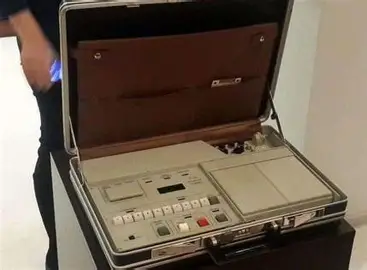
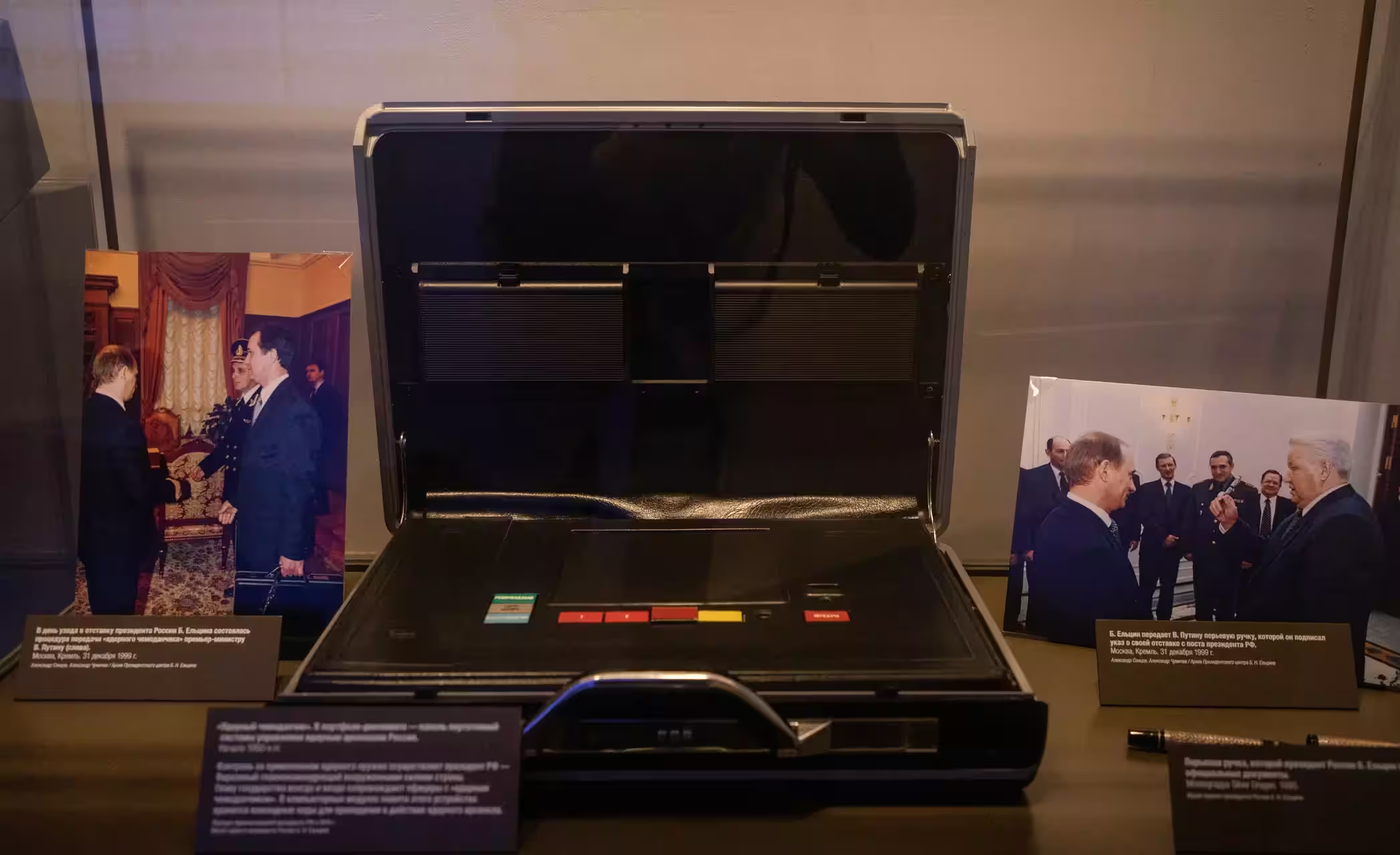
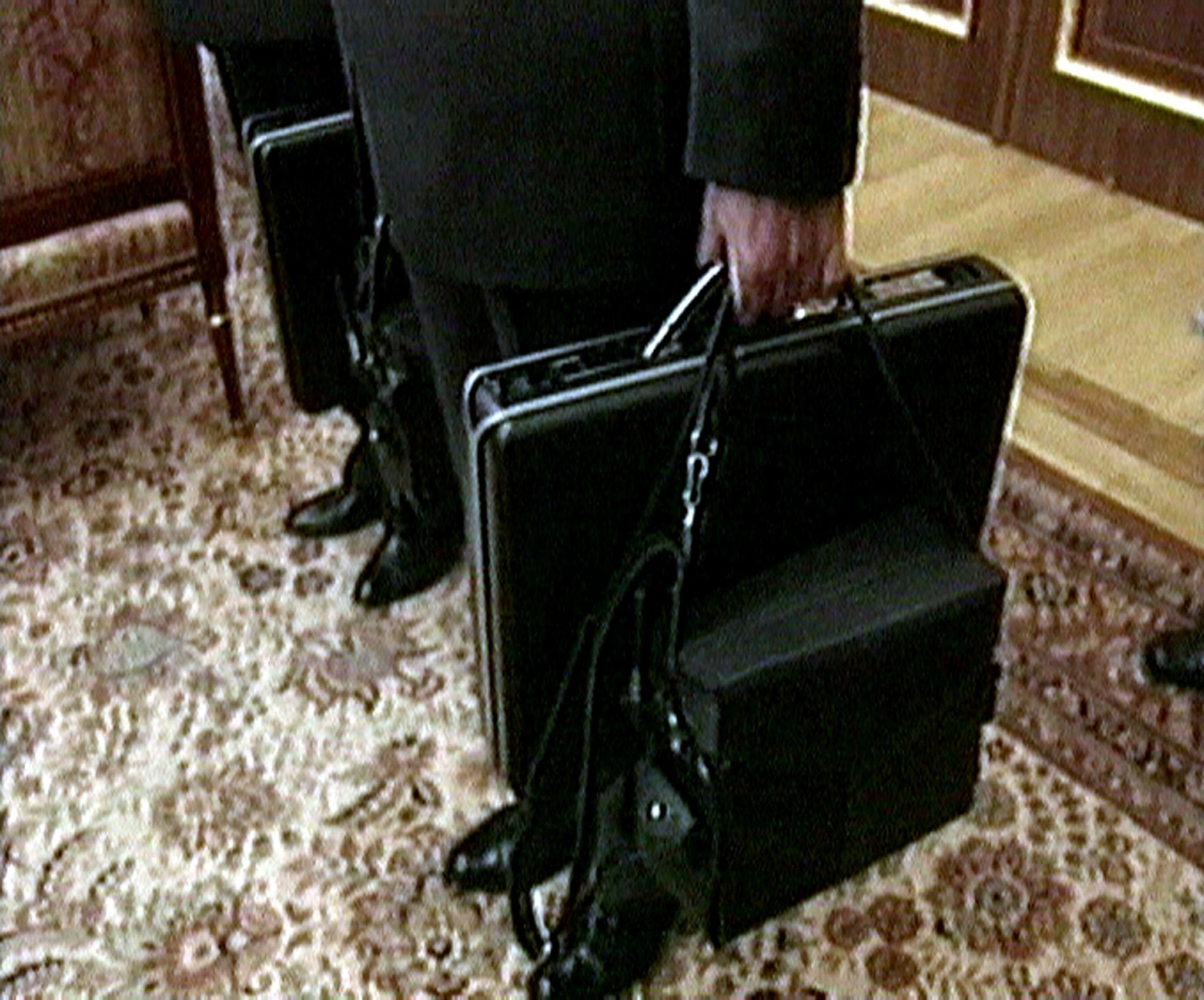
The photographs on this page show what open museums and press have shown of the interface: rows of illuminated keys, a small display, colour-coded action buttons, and — when carried — a rigid black case often with a secondary soft pouch strapped to it (likely power or radio accessory; not officially described). A Yeltsin-era unit is on display at the Yeltsin Center. [DOCUMENTED]
Kavkaz — dedicated leadership communications: cables, radio, satellites, relays, nodes in presidential facilities and vehicles, airborne command posts (Il-80 class), transmitters. Alert of an incoming attack is described as arriving through this special fabric so the three Chegets wake up together. Open lists of Kavkaz-equipped presidential sites have included Valdai, Sochi and other residences. A Moscow University-area radio node (“Message-1” in some English notes) is claimed to talk to modified presidential cars. Treat site lists as reported, not a complete map. [SINGLE-SOURCE for site lists]
Baksan — named in some English NC3 briefs as the path that lets RVSN, Long-Range Aviation and the SSBN force receive authorisation from the national command authority. Another Caucasus name. Sparse in open Russian official text. [SINGLE-SOURCE]
Service K — Special Strategic Communications Service of the President (unit 26299 in investigative reporting). The officers who live with the cases: colonels and navy captains drawn from RVSN, nuclear C2, space surveillance, airborne posts. They are not aides with a prop. They operate and guard the terminals. [SINGLE-SOURCE for the unit number]
Early-warning feeds (radar and satellite SPRN) hit duty generals first. A 1995-era description names a notification terminal Krokus at that duty layer before Kazbek is lit for the principals. Solnechnogorsk / RVSN central command-post geography is the usual Moscow-region duty picture (Vlasikha bunker for RVSN CCP in open accounts). See Solnechnogorsk SPRN and Voronezh. [DOCUMENTED / SINGLE-SOURCE]
THE PROBLEM A BRIEFCASE MUST SOLVE
Cheget has to do four communications jobs at once:
None of those jobs is “press a big red key and an SS-18 leaves the silo.” The silo listens to Signal (or to a Perimeter broadcast). Cheget listens to Kavkaz. The seam between those worlds is the entire design. [DOCUMENTED as architecture; UNVERIFIED for any specific key legend on the panel]
HOW AUTHORISATION IS DESCRIBED
Public doctrine: the President is Supreme Commander. The Law on Defence and military doctrine language put the decision to use nuclear weapons with the President. The other two cases are not independent nuclear monarchs. Analysts split into two readings: [DOCUMENTED for presidential authority; contested for the rest]
Valery Yarynich, a retired colonel who worked on Soviet strategic C3, wrote that the three individuals “together prepare the authorisation for the use of nuclear weapons.” That phrase is compatible with either reading. Open sources do not publish the real voting rule. [DOCUMENTED that Yarynich wrote it; UNVERIFIED as a formal two-of-three electronic lock]
What is consistent across serious sources: Cheget does not remotely arm a silo by itself. The signal goes to command posts. Those posts pass authorisation onward or, in some descriptions, the General Staff can remotely launch selected land-based missiles through Signal. Perimeter exists in case that whole chain is gone. [DOCUMENTED]
Personal codes. Secondary descriptions say the terminal will not operate until the holder’s personal authentication code is entered. That is ordinary for a cryptographic subscriber unit: something you have (the case) plus something you know (the code). The officers of Service K do not replace that step; they operate and guard the machine. [SINGLE-SOURCE]
What the codes are not. Popular media sometimes treats Cheget as containing “the launch codes” in the Hollywood sense. More careful language treats it as generating or releasing authorisation messages that the military combat-control systems will accept. The distinction matters: an authorisation without a combat-control path does nothing; a combat-control path without authorisation should do nothing. [DOCUMENTED as careful wording]
THE FORWARD PATH: FROM CHEGET TO THE FORCE
The public path, assembled from NIS, Podvig-adjacent literature, Reuters explainers and the previous version of this page:
| Step | What happens | Who / what | Communications note |
|---|---|---|---|
| 0 | Early warning | SPRN radars and satellites | Feeds Krokus / duty layer, then Kavkaz wake-up |
| 1 | Conference / decide | President, MoD, CGS via Chegets | Kavkaz-7 carries voice/data among the three |
| 2 | Authorisation out | Cheget → Kavkaz-7 → Baksan | Encrypted symbols to central posts |
| 3 | Military order | General Staff / RVSN CCP | Centre / Monolith / Signal interface |
| 4 | Force direction | Signal (and Navy Sea / Air Force Wing systems) | Many bearers in parallel |
| 5 | Launch enable / launch | Regiment posts, LCCS, silos, TELs, SSBNs, bombers | Remote launch described for ICBMs; crews still in the picture for many legs |
| 6 | Status back | Signal telemetry / acknowledgements | Two-way on Signal; one-way on Blizzard |
[SINGLE-SOURCE for Navy “Sea” and Air Force “Wing” names; DOCUMENTED for the overall shape]
Remote launch versus crew launch. English NC3 studies state that once procedures are satisfied, coded signals from Chekhov-area General Staff posts and from RVSN posts can reach silos through Signal and trigger the launch sequence without a U.S.-style two-key ceremony at every silo. Alternate and mobile posts can do the same if permission has been granted. That is a description of capability, not a claim that every wartime launch would be hands-off. Mobile TELs and SSBNs have their own crew and communications problems. [SINGLE-SOURCE for the no-two-key claim]
SIGNAL, BLIZZARD AND THE COMBAT-CONTROL LEG
Signal (Сигнал). The Strategic Rocket Forces’ automated command system. Versions in open English literature: early Signal (late 1960s), Signal-M (1970s), Signal-A (deployed 1985 as primary, with more complex retargeting and detailed status feedback), Signal-A1 under development in later contract talk. Missiles “can be launched within 30 seconds of the order being issued at a central command post” in that literature — a brochure-class number, not an outside stopwatch. Signal uses a wide range of communications methods and is interfaced with earlier versions. [SINGLE-SOURCE for version history and 30-second figure]
Blizzard (Вьюга). A simpler one-way backup that can send commands directly to Missile Regiment Command Posts if the full Signal hierarchy is impaired. [SINGLE-SOURCE]
Monolith (257L1). Described as handling transmission of Signal messages at the highest command level; possibly tied more to Signal-M than Signal-A in contract reading. [SINGLE-SOURCE]
Centre. General Staff automated command system for nuclear and non-nuclear operations; can process some SRF functions inside General Staff central posts, but detailed instructions to SRF units still go through Signal. Navy and Long-Range Aviation nuclear operations are described as handled to a greater extent inside Centre, with service-specific systems (“Sea”, “Wing”) alongside. [SINGLE-SOURCE]
The important systems point: Kazbek authorises; Signal (and cousins) execute. Confusing them is how popular accounts invent a briefcase that launches missiles by radio from a hotel.
ACKNOWLEDGEMENT AND THE RETURN PATH
A command system that cannot hear is as dangerous as one that cannot speak. Signal is explicitly described as two-way: it issues instructions and provides feedback on the status of individual missiles to central command posts. That feedback is how a duty general knows a regiment went to higher alert, a silo faulted, or a launch order was accepted. [SINGLE-SOURCE]
Cheget’s own return channel is less well documented in open sources. Logical minimum requirements for any such terminal:
Whether the live terminal shows silo-by-silo status to the President, or only high-level acknowledgements, is not published. Treat cinematic “missile map on the lid” depictions as unverified. [UNVERIFIED]
Blizzard, being one-way, cannot acknowledge. Perimeter’s command-missile broadcast is likewise a shout, not a conversation. The living primary is the path that can talk both ways. [DOCUMENTED as design contrast]
THE BRIEFCASE AS A RADIO SUBSCRIBER
In telephone language Cheget is a subscriber set. Kavkaz is the exchange. Kazbek is the service that the exchange exists to provide. Thinking in those terms prevents the usual mistake of treating the leather case as the whole system. A subscriber set without dial tone is mute; Cheget without Kavkaz is mute; Kavkaz without Signal still cannot move a silo. The three layers fail differently and are repaired differently. [DOCUMENTED as model]
Subscriber problems: dead battery, wrong personal code, officer incapacitated, case destroyed. Exchange problems: cut cable, jammed radio, dead satellite, airborne relay grounded. Service problems: political isolation, false warning, refused orders, Perimeter branch. Foros was an exchange problem (cut links) that became a subscriber irrelevance. 1995 was a service-input problem (warning quality) with a working exchange. [DOCUMENTED]
KAVKAZ-7 AS A NETWORK, NOT A CABLE
English NC3 contract archaeology describes Kavkaz-7 (65с37) as a special automated command system with fixed control posts (65с27), facilities at presidential residences, transmitters in Moscow, communications vehicles and airborne relays. One contract-derived list places seven of eight numbered control posts: four in Moscow, two in the Chekhov region, one in the Penza region. Treat that list as a single-source map of contracts, not a tourist guide. The design intent is clear even without addresses: the leadership fabric has many doors, so the President at Sochi, Valdai or in a motorcade is never more than a gateway away from the same conference the Defence Minister and CGS can join. [SINGLE-SOURCE for post counts and regions]
Mobile Moscow subnet. Kavkaz is described as including a mobile communications network in Moscow — vehicles that can trail or precede a motorcade and keep Cheget on the air without waiting for a residence cable. That is the urban half of the same idea as Molniya for the Arctic: the path follows the principal. [SINGLE-SOURCE]
Wake-up fan-out. When SPRN declares a missile attack, the special fabric is supposed to light the three Chegets together so that no holder is minutes behind the others. Krokus at the duty-general layer is the older name for the first ding; Kavkaz is the fan-out. A system that woke only the President, or only the General Staff, would recreate the pre-Cheget geometry the Pershing clock made obsolete. [SINGLE-SOURCE]
CHEKHOV, VLASIKHA AND THE BURIED END OF THE WIRE
Open English studies place the General Staff Central Command Post complex in the Chekhov area south of Moscow, with Centre modernisation components (Fort) and Monolith / Kavkaz exchange gear in the same underground world. RVSN’s central command post is associated in open accounts with the Vlasikha / Odintsovo area. Alternate posts and the Urals deep reserve (Kosvinsky / Object 1335) exist so that a single crater does not end the war plan. This page does not add coordinates; the dedicated Grot and Perimeter pages cover what is already public. [SINGLE-SOURCE for naming; DOCUMENTED as a class of posts]
The communications moral: Cheget’s satellite and radio paths are trying to reach someone still alive in one of those posts who can still speak Signal. If every surface gateway is ash, the Il-80 and the deep posts are the remaining telephone numbers.
WHAT THE OFFICER ACTUALLY DOES
Service K officers are not ceremonial bag-carriers. In the Foros narrative they were on nuclear duty in a guest building near the President; they decided when the path was dead and moved the terminal. In peacetime they authenticate, maintain link checks, replace batteries or modules, and refuse the curious. Secondary writing draws them from RVSN, nuclear C2, space surveillance and airborne-post communities — people who already understand that a wrong symbol is not a career event but a historical one. [SINGLE-SOURCE]
A useful mental model: the officer is the physical and procedural half of the authenticator; the personal code is the knowledge half; Kavkaz registration is the network half. All three must line up. [ESTIMATE of the model]
DUAL-KEY CULTURE VERSUS REMOTE LAUNCH
American silo culture made the two-key ceremony famous: two officers, one order, local concurrence. Russian open descriptions of Signal remote launch sound like the opposite extreme — central posts firing the force without local keys. Both stereotypes are incomplete. Even in a remote-launch architecture there are humans at central posts, humans who can refuse, humans who maintain the regiment, and humans on boats who must copy a broadcast. Yarynich’s career straddled design of C3 for silo and mobile missiles; his later arms-control writing stresses that stability lives in procedures and survivable command, not in denying that automation exists. [DOCUMENTED as framing]
For the reader of this page: when a source says “Cheget launches missiles,” replace that sentence with “Cheget authorises; Signal and the services launch.” When a source says “no human in the loop,” replace it with “no silo crew two-key in the loop on some paths.” The second sentence is already alarming enough without science fiction. [DOCUMENTED as careful reading]
THE BEARERS: HOW THE BITS ACTUALLY MOVE
Kazbek/Kavkaz is not one radio. It is a bundle of paths chosen so that no single physical insult — a cut cable, a jammed band, a dead satellite — silences the leadership. The same philosophy appears in American NC3 (hardline, HFGCS, ALCS, TACAMO, satellite). The Russian names differ; the physics does not. Broader military communications sit on Russian C3 / ОАЦСС; nuclear C2 keeps its own hardened overlay.
1. Wireline and fiber. Fixed residences, the Kremlin, General Staff posts and RVSN bunkers are stitched by dedicated cable. Hardened and buried routes, sometimes in the same civil ducts as ЕСЭ, carry the peacetime load. Fiber resists HEMP E1 coupling better than long copper; the terminals and power supplies at each end remain soft points unless shielded. [DOCUMENTED as practice; ESTIMATE for HEMP note]
2. Field cable and rail-mobile nodes. Cold War open literature describes cable detachments and special trains as General Staff / RVSN mobile command posts. A moving rail node is harder to pre-target than a bunker whose coordinates have been in NATO folders since the 1960s. How much of that fleet remains active is not clearly published. [SINGLE-SOURCE / UNVERIFIED for present status]
3. HF and VHF radio. High frequency (2–30 MHz) skywave still carries strategic backup traffic when satellites are impaired — the same reason the U.S. keeps HFGCS. VHF/UHF line-of-sight links stitch local command-post complexes and mobile columns. Kavkaz is described as including transmitters in Moscow and communications vehicles. [DOCUMENTED as class]
Ionospheric skip (why HF works). A ray below the maximum usable frequency reflects from the F2 layer (~250–400 km) and returns hundreds to thousands of kilometres away. Daytime D-layer absorption and solar flares can close the path; night opens lower frequencies. A nuclear-hardened HF plan uses many frequencies and sounding. None of this is unique to Kazbek; it is why HF will not die in NC3. [ESTIMATE / standard physics]
4. Troposcatter. Forward scatter in the troposphere bridges a few hundred kilometres without satellites or skywave. Useful for theater backup between hardened posts. [DOCUMENTED as bearer class; see also troposcatter notes on the C3 page]
5. Satellite relay (Molniya / Meridian / GEO). Cheget is repeatedly described as linking via satellite to General Staff and reserve posts. Molniya-type highly elliptical orbits hang for hours over the Northern Hemisphere — essential when a leader is at high latitude and geostationary satellites sit on the horizon. Meridian continues that geometry; Raduga/Blagovest-class GEO birds carry other trunks. A portable terminal may talk to a nearby gateway (car, residence, aircraft) that does the heavy satellite work, rather than radiating a full uplink from the briefcase itself. Open sources do not publish the antenna split. [DOCUMENTED for Molniya role; SINGLE-SOURCE for Cheget-via-satellite; UNVERIFIED for antenna split]
Molniya dwell physics. Inclination ~63.4°, period ~12 hours, apogee over the north: apsidal precession cancels, and Kepler’s law keeps the satellite slow near apogee. Roughly eight hours of useful northern coverage per apogee pass is the engineering rule of thumb. [ESTIMATE]
6. Airborne command and relay — Il-80 / Il-82. The Il-80 Maxdome (and Il-82 relay) carry the leadership or a battle staff when the ground is untenable, with a Zveno-S communications suite and a Fregat VLF trailing-wire antenna for SSBNs. Kavkaz-7 is described as including airborne relay stations. If the President is on an Il-80, Cheget’s “satellite and other special links” are inside a flying node of the same system. See the airborne section of Russian C3. [DOCUMENTED]
7. VLF and ELF for the boats. Authorisation that must reach a submerged SSBN eventually becomes a shore or airborne VLF broadcast, or an ELF bell-ringer (ZEVS at 82 Hz on the Kola Peninsula) telling the boat to come up for traffic. Cheget does not radiate ELF; the Navy’s broadcast system does, after the order has entered the naval chain. Skin depth in seawater at 82 Hz is on the order of 25–30 m; at 15–25 kHz VLF, about 2 m — enough for a loop at depth or at periscope depth respectively. Compare Cutler / Jim Creek and Goliath VLF. [DOCUMENTED for ZEVS; ESTIMATE for skin depth]
8. Optical and exotic paths. Occasional papers discuss free-space optical or other backups. Not attested as Cheget bearers in open reliable sources. [UNVERIFIED]
MULTIPATH ON PURPOSE
When an authorisation leaves a central post toward the force, open descriptions say military officers use several methods and each method uses multiple communications channels. That sentence is doing a lot of work. It means the same logical order is launched onto cable and radio and satellite at once, so that the first intact path to win the race delivers the bits. Duplicated delivery requires idempotent receivers: a silo that hears the same authenticated order twice must not interpret it as two orders. That is a standard reliable-messaging problem; the classified implementation is unpublished. [SINGLE-SOURCE for multi-channel claim; ESTIMATE for idempotence requirement]
LINK BUDGETS, JAMMING AND WHY SHORT MESSAGES WIN
Nuclear authorisation messages are short. That is not only doctrine; it is link-budget engineering.
Free-space path loss: FSPL (dB) ≈ 20 log10(d_km) + 20 log10(f_MHz) + 32.44. A weak portable uplink cannot push video through weather and jamming; it can push a few hundred encrypted bits if the gateway is close and the waveform is narrow. Frequency hopping and one-time pads (or modern symmetric equivalents) buy integrity and confidentiality; they do not create signal-to-noise ratio from nothing. [ESTIMATE]
A jammer’s advantage scales with power and proximity to the victim receiver. Strategic NC3 answers with diversity (many bands, many paths), not with a single loud transmitter. ELF is almost impossible to jam locally across a continent; it is also almost impossible to use for a staff conference. The architecture matches the physics: ELF/VLF for “come up” and short orders to boats; wider bands for conference and status on land. [DOCUMENTED as reasoning]
EMP, HARDENING AND FARADAY PRACTICE
A high-altitude nuclear detonation produces HEMP with E1 (fast), E2 (lightning-like) and E3 (slow, grid-coupling) phases. Strategic terminals and bunkers are built as Faraday cages with filtered penetrations, surge protection, fiber trunks and on-site generation. Cheget’s case is described as hardened; the weak link when the President is in a hotel is the local radio path and the commercial power under the gateway, not the leather of the lid. Il-80 and deep posts (Grot) exist because the designers assumed cities and soft nodes die. [DOCUMENTED for HEMP taxonomy; UNVERIFIED for the hardness of any specific Cheget generation]
MORE ON SATELLITE AND AIRBORNE LEGS
A portable terminal of Cheget’s size rarely hosts a high-gain satellite dish. Practical architectures used worldwide put the dish on a vehicle roof, a residence pedestal or an aircraft fuselage, and give the handset a short local link (cable, UHF, optical) into that gateway. Russian open text says Cheget opens a path “through satellite and other special links” without publishing the split. The accessory pouch visible in carry photographs is consistent with a modem, battery or local radio — and equally consistent with rain covers and spare modules. Do not invent an antenna. [UNVERIFIED for pouch contents; DOCUMENTED for satellite path language]
Il-80’s canoe fairing and underwing APUs exist because a flying command post is a power-hungry radio hotel. Fregat’s trailing wire, kilometres long, is how that hotel speaks VLF to boats — the same physics as TACAMO. If national authorisation must reach an SSBN on a short clock, someone has to be radiating VLF already or very soon; ELF ZEVS can only ring the bell. [DOCUMENTED]
ELECTROMAGNETIC QUIET VERSUS ELECTROMAGNETIC LOUD
SSBNs want quiet. Shore VLF and ELF want loud. Cheget holders in peacetime want invisible. Those desires conflict at the system level. The compromise is asymmetric: loud fixed and airborne transmitters, quiet receivers on boats, short and rare authorisation bursts on leadership nets, long silent watches the rest of the year. A Cheget that chattered continuously would be a geolocation beacon for every intelligence service on Earth. Link tests must be carefully scheduled and masked. Open sources do not publish the schedule. [ESTIMATE]
TIMING
Time language from U.S. specialists who watch Russian NC3: the system is exercised to obtain release authority on a very short clock — on the order of ten minutes from President, Defence Minister or CGS through Cheget. Signal-A literature claims launch within about 30 seconds after a central-post order. Early-warning flight times for submarine-launched missiles to Moscow-region targets have long been discussed in single-digit to low-teen minutes. Those numbers set the design pressure; they are not a public stopwatch of a real crisis. [SINGLE-SOURCE for the ten-minute and thirty-second figures]
| Phase | Order-of-magnitude time | Notes |
|---|---|---|
| SPRN detect and assess | tens of seconds to a few minutes | Sensor and human fusion |
| Cheget conference / authorise | minutes (claim ~10) | Human decision dominates |
| Baksan / CCP processing | seconds to a minute | Automation |
| Signal to silo | seconds (~30 claimed for automated path) | SINGLE-SOURCE |
| SSBN VLF/ELF leg | minutes (boat must copy and act) | Physics + crew |
| ICBM time of flight | ~25–35 min intercontinental | Separate from C2 clock |
[ESTIMATE for the table structure; cited claims labelled]
END-TO-END WALKTHROUGH (PUBLIC MODEL)
The following walkthrough is a teaching model assembled from open sources. It is not an official checklist.
Peacetime check. Each Cheget periodically proves it can reach Kavkaz (link test). Duty officers at Krokus-class terminals watch SPRN. Il-80 crews train. Signal carries routine status. Nothing nuclear happens. [ESTIMATE of routine]
Warning. Voronezh-class radars and EKS/Tundra satellites report a launch track. Duty generals assess. If the track meets attack criteria, Kavkaz wakes the three Chegets. Conference opens. [DOCUMENTED as sequence class]
Decision. The holders see warning data (how much detail on the lid is unpublished). They talk. They enter personal codes. In the two-of-three reading, a second holder’s concurrence is required before the authorisation message is valid; in the transmission-link reading, the President’s order is passed through the other terminals as required relays. [CONTESTED]
Authorisation delivery. Encrypted symbols travel Kavkaz-7 to Baksan terminals at central posts. Acknowledgements return if the path is two-way at this layer. [SINGLE-SOURCE]
Combat control. General Staff / RVSN officers, under Centre/Monolith procedures, issue Signal orders: raise alert, retarget, enable, launch. Parallel orders move toward Navy and Long-Range Aviation through their systems. Blizzard stands by as one-way backup to regiments. [SINGLE-SOURCE]
Last metres. Silos receive Signal. TELs receive regiment nets. SSBNs copy VLF/ELF. Bombers copy aviation nets. Status flows back on Signal where the channel exists. [DOCUMENTED as class]
If silence. If central posts do not answer and nuclear detonations are confirmed on Russian territory, Perimeter’s branch of the tree becomes relevant — command missiles, radio broadcast of launch orders, deep posts. That is a different article. [DOCUMENTED]
CHANNEL TYPES INSIDE THE AUTHORISATION MESSAGE
Open sources never print a Cheget frame format. Communications engineering still constrains what any such format must contain if the system is to work:
Everything else — maps, video, staff chatter — belongs on wider Kavkaz conference channels, not in the authorisation caspule. [ESTIMATE of necessary fields; UNVERIFIED as actual format]
REPLAY, SPOOF AND THE EXERCISE PROBLEM
Any digital authorisation system must survive its own training. Forces exercise Kazbek-class procedures; those exercises generate real-looking messages on real paths. Freshness fields, exercise flags and compartmentation between training and combat crypto are the usual engineering answers worldwide. Russian open text does not describe the mechanism. The 1995 alert was not an exercise flag problem; it was a sensor interpretation problem. Both classes of failure matter. [ESTIMATE]
Spoofing Kavkaz from outside is hard if the crypto is sound; spoofing the political meaning of a real message (a coup junta claiming authority) is a human problem, as 1991 showed. Technology authenticates keys; it does not appoint presidents. [DOCUMENTED as moral of 1991]
CAPACITY PLANNING: BITS VERSUS MINUTES
Suppose an authorisation capsule is 1 kilobit with coding. On a 1 kbit/s protected channel it clears in about one second. The minutes in the ten-minute specialist claim are almost entirely human: reading warning, arguing, deciding, typing codes, waiting for the other holders. Compressing the radio path further does not compress the President. Designers still fight for every second of path delay because warning flight times are also measured in minutes. [ESTIMATE]
SSBN legs break this arithmetic. A boat at depth may need minutes to copy ELF/VLF and act. Triad employment on a short clock is therefore not symmetric: land ICBMs under Signal remote launch are the fast leg; boats and bombers are slower. Doctrine that depends on boats for first response is physics-illiterate; doctrine that depends on them for assured second strike is physics-native. Russian ride-out / retaliation culture sits in the second camp. [DOCUMENTED as reasoning]
GROUND ENTRY POINTS FOR A MOVING PRESIDENT
Public descriptions imply a ladder of gateways:
Each step down the ladder adds radio exposure and subtracts hardness. Cheget itself stays in the officer’s hand; the ladder is Kavkaz reaching out. [ESTIMATE of the ladder; DOCUMENTED that overseas escort occurs]
RELATIONSHIP TO ОАЦСС AND DAY-TO-DAY C3
ОАЦСС and the garrison VoIP switches on the Russian C3 page are the peacetime nervous system of the Armed Forces. Kazbek/Kavkaz is a parallel, older, stricter overlay. In peacetime the two may share buildings and even fiber ducts. In nuclear war the overlay’s job is to keep working when the day-to-day net is a memory. Budget politics sometimes blur the two in speeches; engineering should not. A refurbished garrison ATS is not a Cheget path. [DOCUMENTED as distinction]
WHY POPULAR ACCOUNTS SKIP THE RADIOS
Films show a close-up of a hand and a key. Radios are boring until they fail. The 1991 Foros episode is the corrective: the most powerful man in the country with a Cheget in the next building was nuclear-irrelevant once the links were cut. The 1995 episode is the other corrective: when the links work, the quality of the warning data dominates. This page privileges bearers, acknowledgements and failure modes because that is what makes Kazbek a system rather than a prop. [DOCUMENTED as historical moral]
FAILURE MODES: WHEN THE PATH BREAKS
Every serious NC3 design is a catalogue of failure modes. The public Russian catalogue, read through history and doctrine, looks like this.
1. Leader isolated. August 1991: Gorbachev under house arrest at Foros, communications cut. The Cheget group flew the terminal back to Moscow; secondary accounts say its magnetic memory was erased in transfer, ending his effective nuclear authority. The coup failed for many reasons; one lesson written into later practice is that isolating the constitutional commander without a clean transfer is a crisis of its own. [DOCUMENTED as historical episode; SINGLE-SOURCE for memory-erase detail]
2. False warning. 25 January 1995: the Black Brant XII sounding rocket from Andøya. Russian early warning treated the track as Trident-like. Kazbek went into a combat-decision posture. Yeltsin, Defence Minister Grachev and CGS Kolesnikov had Chegets in play and held an emergency conference while the rocket flew. It was not an attack. It is the only widely documented live use of the briefcase set in a war-alarm sense. The communications path worked; the sensor interpretation nearly killed the planet’s luck. [DOCUMENTED]
3. Decapitation. If the three holders and the central posts die in the first minutes, Kavkaz cannot conference the dead. Perimeter and deep reserve posts (Grot / Object 1335) exist for that branch of the tree. Preliminary commands and ride-out retaliation doctrine are the intellectual frame; see Perimeter and Pavel Podvig’s clarifications that “Dead Hand” is a family of backup methods, not a single movie switch. [DOCUMENTED]
4. Bearer death. Cut fiber, jammed HF, blinded satellite, grounded Il-80 fleet. Diversity is the answer; completeness of today’s diversity is the open question after decades of budgets and the Ukraine war’s consumption of military electronics. [ESTIMATE of the question]
5. Authentication failure / split authority. During the 1991 coup, service chiefs (Air Force Shaposhnikov, Navy Chernavin, RVSN Maksimov in secondary accounts) signalled they would refuse nuclear orders from the junta. Technical authentication cannot solve a political fracture; it can only refuse messages that fail cryptographic checks. [SINGLE-SOURCE for the named refusals]
6. Soft compromise. Theft of equipment from an Il-80 on the ground (reported by The War Zone) is a reminder that the airborne leg’s security is physical as well as cryptographic. A stolen Cheget without codes and without Kavkaz registration should be inert; that “should” is a design goal, not a public proof. [DOCUMENTED as incident class; UNVERIFIED for Cheget specifically]
FROM COMMAND POST TO SILO AND TEL
Once authorisation is accepted at a central post, the RVSN picture in open literature is hierarchical: army → division → regiment → launch-control → silo or TEL. Signal automates much of that hierarchy. For silo forces, remote enablement and remote launch from central posts are described. For road-mobile Yars/Topol-class regiments, the regiment and battalion command posts and the TELs themselves must still receive and act; mobility helps survivability and complicates the last metre of radio. See Yars. [DOCUMENTED / SINGLE-SOURCE]
SSBNs receive via the naval broadcast chain (VLF/ELF/airborne VLF), then local authentication aboard. Bombers receive via Long-Range Aviation nets and would need to be airborne with weapons to matter on a short clock — a slow leg compared with missiles. Non-strategic systems (including nuclear-capable Iskander) sit in a different custodial and political category; they are not the primary Kazbek story, though national authorisation culture touches them. [DOCUMENTED as distinction]
ENCRYPTION AND REDUNDANCY LAYERS
Open sources describe layers without publishing algorithms:
Hollywood collapses these into one password. Engineering keeps them separate so that theft of one layer does not gift the arsenal. [DOCUMENTED as layering principle; UNVERIFIED for algorithms]
HARDENING CHECKLIST (UNCLASSIFIED)
What every open NC3 textbook repeats, and what Kazbek’s architecture implies:
The museum Cheget behind glass is not proof of the live system’s hardness. It is proof that the interface was real enough to declassify a generation. [DOCUMENTED as principle]
WORD ON NON-STRATEGIC NUCLEAR C2
Tactical nuclear weapons (including nuclear-capable systems discussed on the Iskander page and storage in Belarus in 2020s reporting) are under presidential authority in doctrine but do not all ride the same Signal-A ICBM paths. Open sources are thinner here. Do not assume a Cheget press moves a non-strategic warhead the way Signal moves a silo. Custodial units, 12th Main Directorate culture and separate combat-control paths apply. [DOCUMENTED as caution]
THE ONE TIME THE CASES OPENED IN PUBLIC
25 January 1995. Norway launched a Black Brant XII sounding rocket from Andøya. Russian early warning treated the track as Trident-like. The alert climbed. Kazbek went into a combat-decision posture. Yeltsin, Defense Minister Grachev, and CGS Kolesnikov had Chegets in play and held an emergency conference while the rocket flew. It was not an attack. It is the only widely documented live use of the briefcase set. [DOCUMENTED]
The episode is a communications success and a warning-system scare. The paths woke; the humans had minutes; the rocket was science. Every NC3 brief that uses it is really talking about early warning quality as much as about Cheget keys. Sensors that feed Kazbek include the Voronezh radar family and space-based SPRN; integration with Moscow ABM sensors such as Don-2N sits in the same strategic picture without being part of Cheget itself.
HISTORY
REDUNDANCY MATH AND CORRELATED FAILURE
Suppose five bearer classes (cable, HF, SATCOM, airborne relay, troposcatter) each independently unavailable 1% of the time in a crisis model. Naïve independence gives joint unavailability 1e-10 — fantasy. In a nuclear environment the failures correlate: HEMP hurts radios and unprotected electronics together; a campaign against satellites hurts every SATCOM user together; a coup cuts many leadership cables at once. The engineering response is not more identical satellites; it is different physics — ELF that ignores local HF jamming, buried cable that ignores space weather, airborne nodes that ignore cratered residences. Kazbek’s public architecture looks like a correlation-aware design even when the classified availability numbers are unknown. [ESTIMATE]
WHAT “ACKNOWLEDGEMENT” MUST MEAN AT EACH LAYER
A President who sees only green lights on Cheget does not know a silo has launched; he knows his authorisation machine is talking to its network. Over-promising the lid display is how fiction writers create false confidence. [ESTIMATE]
TRAINED CREWS AS PART OF THE CHANNEL
Radios do not aim themselves. Service K officers, CCP duty shifts, Signal maintenance regiments, VLF transmitter crews and Il-80 avionics technicians are part of the channel’s capacity. Attrition of skilled people is a C3 threat equal to jamming. The Ukraine war’s consumption of electronics and trained troops is mostly a conventional story, but any long war that steals from the strategic communications workforce eventually shows up as longer mean-time-to-repair on the overlay that Kazbek needs. [ESTIMATE of risk; DOCUMENTED that skilled crews matter]
INTERACTION WITH EARLY WARNING QUALITY
Kazbek can only be as calm as SPRN. The 1983 Petrov incident (correct human rejection of a false satellite warning) and the 1995 Black Brant alert (Chegets open on a science rocket) bookend the same lesson. Improving Voronezh radars and EKS satellites is therefore also improving Kazbek — not because the briefcase changes, but because the humans holding it get fewer nightmare minutes. Cross-links: Voronezh, Solnechnogorsk, Don-2N. [DOCUMENTED]
LEGACY NAMES STILL SEEN IN CONTRACTS
Signal-M, Signal-A, Monolith, Centre, Fort, Crocus/Krokus modernisation — these names reappear in procurement snippets long after newspaper fashion moves on. They are evidence that the Soviet layered approach was never replaced by a single IP network with a fancy GUI. When a modernisation contract mentions an old name, read it as a graft onto a living tree, not as proof the old leaf is unchanged. [SINGLE-SOURCE for contract name persistence]
ORDER LENGTH AND ERROR CORRECTION
A strategic authorisation that must cross HF fading or a stressed SATCOM link needs forward error correction. Simple repetition (send three times, vote) costs bandwidth but needs little compute — attractive for 1980s hardware still in the genealogy. Modern block codes and authenticators cost more compute and fewer repeats. Which generation of coding sits in today’s Cheget is unpublished; the constraint is eternal: every parity bit is a bit that is not new command information, and the channel is narrow on purpose. [ESTIMATE]
Acoustic-coupled or inductive local links between a briefcase and a car gateway (if used) add another short hop with its own error rate. Designers usually make that hop absurdly over-provisioned in signal-to-noise so that the hard problem remains the long-haul bearer. [ESTIMATE]
PHYSICS APPENDIX
1. Why the message must be short. At a few watts radiated from a gateway on HF or a constrained SATCOM channel, energy per bit sets the error rate. A 256-bit authenticating payload with heavy coding is realistic; a live video briefing from the briefcase is not. Conference voice among the three holders needs a wider channel — hence Kavkaz’s mix of bearers, not Cheget alone as a telephone. [ESTIMATE]
2. Seawater skin depth. δ ≈ 503 / sqrt(f σ) metres, σ ≈ 4 S/m: about 28 m at 82 Hz, about 2 m at 20 kHz. [ESTIMATE]
3. EMP and cable. E1 couples to conductors as roughly E × length before shielding and breakdown. Replacing long copper with fiber removes the antenna; filters on power and copper stubs remain mandatory. [ESTIMATE]
4. Diversity gain. If each independent path has unavailability u, n independent paths have unavailability u^n if failures are independent. Real failures correlate (solar flare, HEMP, political isolation). The design still multiplies paths because correlated failure is not total failure. [ESTIMATE]
COMPARISON: CHEGET AND THE FOOTBALL
| Topic | Cheget / Kazbek | U.S. Football / NC3 |
|---|---|---|
| Portable terminal | Three cases (President, MoD, CGS) | One primary presidential satchel |
| What it carries | Encrypted authorisation terminal into Kavkaz/Kazbek | Authentication materials, options format, comms to NMCC/looking glass |
| Who launches | Military posts via Signal etc.; remote ICBM launch described | Crews / authenticated presidential order through military chain |
| Backup if decapitated | Perimeter / deep posts | Airborne command posts, redundant NC3; no public “Dead Hand” twin |
| Boat broadcast | ZEVS ELF, VLF, Il-80 Fregat | TACAMO E-6B, shore VLF |
| HF backup culture | Russian strategic HF | HFGCS |
[DOCUMENTED as analogy class]
READING ZVEZDA AND MUSEUM SHOTS
Zvezda television and museum displays have shown briefcase interiors with coloured keys. Those images prove form factor and the existence of a human interface; they do not prove the live key legends, the live crypto, or the live bearer plan. This page uses them as illustrations of the terminal class (see the photographs above), not as a field manual. [DOCUMENTED as caution]
STATUS
Operational as the named primary strategic nuclear command system. Cheget still means the briefcase. Kazbek still means the ASU behind it. Kavkaz still means the leadership communications fabric. Perimeter still means what you use if this machine and its people are already ash. The museum lids on this page are history; the live generation is unpublished. [DOCUMENTED]
UNCERTAIN CLAIMS WORTH KEEPING VISIBLE
Readers scanning for caveats should watch for: two-of-three electronic concurrence; Cheget weight and “symbols not voice”; accessory-pouch function; exact Kavkaz post map; Signal 30-second launch; ten-minute authorisation clock; Service K unit number; serial-number transfer lore; remote-launch prevalence in wartime practice; live hardware generation versus museum lids. Each appears in the body with a label. [DOCUMENTED as index of caveats]
DIFFERENCES BETWEEN SOURCES
TIMELINE
WHAT THIS PAGE REFUSES TO PROVIDE
The encyclopedia’s job is architecture, history, physics and labelled uncertainty — not a targeting aid. [DOCUMENTED as policy of this page]
PRACTICAL READING GUIDE FOR FUTURE REPORTS
When a new article claims “Russia changed its nuclear briefcase,” ask:
If the answers are weak, the article is describing a prop. This page tries to describe a network. [DOCUMENTED as method]
CLOSING NOTE ON METHOD
This encyclopedia cannot know classified frequency plans. It can insist on the right question. The right question is not “what does the red key say in the movie?” The right question is “how does an authorisation leave a moving human, survive jamming and fire, arrive at a buried post, become a Signal order, and bring status back — and what happens when any step fails?” Kazbek is the Soviet and Russian answer to that question, under Caucasus code-names, with Cheget as the part the public can photograph. [DOCUMENTED as method]
NOTE ON FILENAMES
The three images on this page are stored on the server as kazbeck1.webp, kasbech4.avif and kazbeck2.jpg. An earlier HTML draft pointed at kazbek1.webp and kazbek2.jpg (without the second “c”), which 404’d. The rewrite keeps the photographs and corrects the src attributes to the on-disk names so the pictures load. The misspellings in the filenames themselves (kazbeck / kasbech) are historical accidents on the server and were left alone. [DOCUMENTED as file-system note]
IN ONE SENTENCE
Kazbek is Russia’s primary nuclear command automation — Caucasus-coded, built so a leader does not have to reach a bunker to speak — and Cheget is only the portable terminal that three holders carry into Kavkaz’s many bearers so that authorisation can reach Signal, the boats and the bombers before the clock runs out.
RELATED ARTICLES
SOURCES AND HOW TO READ THEM