WHAT IT IS
UVB-76 is the popular (and slightly wrong) name for a Russian military shortwave channel that has sat on 4625 kHz for about half a century. Listeners call it The Buzzer (Жужжалка). ENIGMA catalogue S28. The signal most of the day is not a message. It is a channel marker: a nasal one-second buzz, roughly 21–34 times a minute, commonly cited near 25/min, 24 hours a day, so that nobody else parks on the frequency and so that outstations know the pipe is alive.
When there is traffic, a live Russian voice — male or female — breaks the buzz and reads a short formatted string: a collective callsign spelled in names, a codeword, and groups of digits. Then the buzz returns. That is the whole public product.
The letters “UVB-76” are a Western mishearing of the first logged callsign UZB-76 (УЗБ-76). Native-speaker recordings from 1997 onward are UZB, not UVB. The nickname stuck anyway.
FREQUENCY AND MODE
Primary: 4625 kHz. Emission is analog voice, usually USB or AM with the lower sideband suppressed. Bandwidth on the order of 3 kHz. Occasional night or overflow mentions of 6998 kHz and other nearby channels exist in logs; 4625 is the one that never left. Power is enough to be heard across Europe and, on winter nights, much of the Northern Hemisphere. It is not a megawatt “boom” transmitter in the Goliath class. It is an HF command channel that happens to run continuously.
CALLSIGNS
Collective callsigns change when the net is reorganized. Published sequence:
УЗБ-76 / UZB-76 — 24 Dec 1997 (first widely logged voice) through 7 Sep 2010 МДЖБ / MDZhB — 7 Sep 2010 through 28 Dec 2015 ЖУОЗ / ZhUOZ — 28 Dec 2015 through early 2019 (Wikipedia dates 1 Mar 2019) АНВФ / ANVF — early 2019 through 30 Dec 2020 НЖТИ / NZhTI — 30 Dec 2020 to present
Each letter is read as a Russian given name (Mikhail, Dmitri, Zhenya, Boris, etc.). Priyom and related monitors treat the station as belonging to the Western Military District command-net family, with control associated with the 60th Communication Hub “Vulkan” in the Saint Petersburg area and transmitters that have been switched among hubs.
WHAT THE VOICE SAYS
Messages are clear voice. There is no on-air modem, no Enigma-style five-letter stream as the main product, no published ciphertext that outsiders have broken. The “encryption” is a codebook sitting off the air: a codeword plus digit groups that mean something only to the addressee who has the book and the day’s key. Outsiders hear “NZhTI 01263 BOLTANKA 4430 9529” and stop there. Priyom’s line is that hundreds of logged messages have not been decoded in the open, which is what a working one-time or unit codebook looks like from the outside.
The common traffic format (often called Monolit / monolith in the monitoring scene) is:
1. Collective callsign, spoken twice or as names. 2. A five-digit (or similar) group. 3. A codeword — sometimes a real Russian word (billiards, alphabet, parcel), sometimes a coined lump (BOLTANKA, BLEFOPUF, SPINOBAZ). 4. Two more two- or four-digit groups. 5. Repeat of the same string.
First widely cited voice log, 24 Dec 1997, 21:00 UTC: “Ya UVB-76, Ya UVB-76. 180 08 BROMAL 74 27 99 14…” plus names. The skeleton has not changed much. Traffic is irregular — weeks of marker only, then a cluster. December 2024 and other spike days logged two dozen messages in a day; that is unusual, not a published war clock.
Data modes: the service product is analog USB voice. Press and hobby logs sometimes mention Morse or odd tones during faults and hijacks. Those are not the station’s published working mode. Open-mic leaks (chairs, phones, local radio, even music) happen because the marker chain is analog and someone left a channel up. That is a hardware clue, not a second waveform family.
HOW THE MARKER IS MADE
Until about 1990 the marker was a short high beep every two seconds. Then it became the present foghorn buzz. Generation method has never been officially described. What listeners can say: it is a tone, not a voice reading “buzz”; it is keyed or gated on a timer; when a message starts the tone stops or is ducked; after the read it comes back. Faults (tone stuck, tone missing, two transmitters beating, mains hum, a second site coming up off-frequency) show that more than one transmitter plant can feed 4625 and that the audio chain is ordinary analog program feed — line or radio-relay from a hub to a transmitter building — not a sealed digital beacon box.
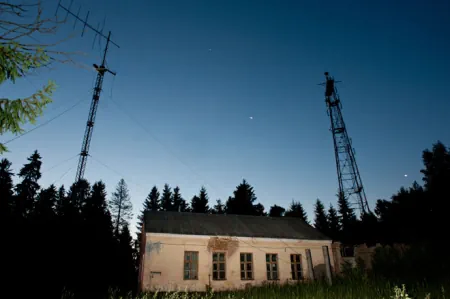
No public part number for the transmitter. Expect a standard Russian HF military set in the low-kilowatt class, dipole or curtain at a communications hub, remotely keyed. Urban-explorer photos from the abandoned Povarovo site showed ordinary racks and logbooks, not a unique “Buzzer machine.”
SITES
Povarovo / Lozhki (56.08 N, 37.09 E class), 143rd Communication Hub, northwest of Moscow. The classic Cold War site. Voice ID in 1997 pinned it. Abandoned after the 2010 district reform. Explorers in 2011 found an empty voyenny gorodok and paperwork mentioning 4625 kHz.
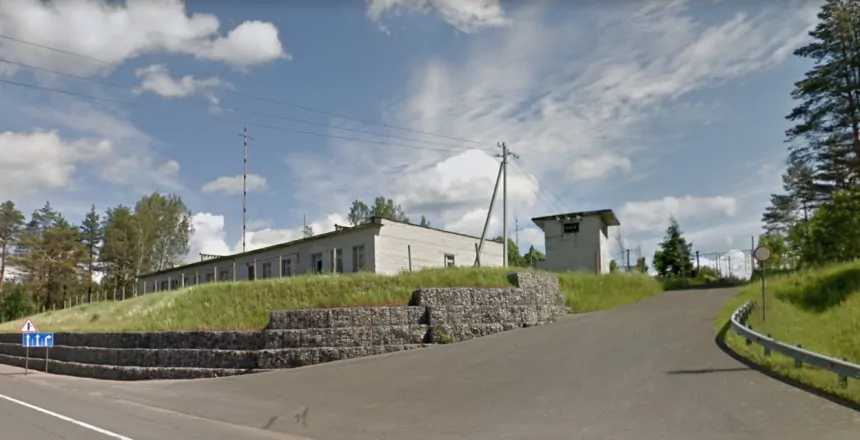
Kerro Massiv / “Irtysh” near Saint Petersburg (about 60.311 N, 30.279 E). Used after 2010; Priyom associates 60th Hub “Vulkan” / related Leningrad-side plants. Logs say this path faded as a 4625 source around August 2015.
Naro-Fominsk, 69th Communication Hub “Iskra” (about 55.43 N, 36.71 E). Frequently cited as a current or recent Moscow-side radiator for the Western Military District staff net.
Priyom’s working picture: control in the Saint Petersburg hub system, transmitters swapped among Western MD comms centres. Sites change; the frequency does not.
PURPOSE — WHAT HOLDS AND WHAT DOES NOT
Holds. It is a Russian Armed Forces HF channel. Marker keeps the frequency reserved and gives receiving offices a go/no-go on the path. Voice shots are formatted command or duty traffic to units and commissariats that still keep a 4625 watch — Rimantas Pleikys (Lithuania, former communications minister) wrote that the reads also prove the operator on the far end is awake. A Russian military journal cited in later reporting treats this class of link as strategic-communications plumbing, not theatre. Sister markers on other frequencies — The Pip, The Squeaky Wheel — use the same idea: occupy, then talk.
Does not hold as fact. Dead Hand / Perimeter “if the buzzer stops, missiles fly.” Perimeter is a real Soviet/Russian command system; it is not this AM foghorn. The Buzzer has gone silent, drifted, been hijacked, and run two transmitters at once. Missiles did not fly. Numbers-station-to-illegal-residents is a weak fit: fixed frequency, modest power, irregular timing, openly military callsign changes after district reforms.
State media has at times fed the “doomsday radio” line anyway. That is narrative, not a technical paper.
HISTORY IN BRIEF
First listener reports: mid-to-late 1970s (1976 is a common citation; some logs start later). Beep marker into the 1980s; buzz from ~1990–92. First famous voice shot 24 December 1997. September 2010: Moscow/Leningrad districts merge into Western MD, Povarovo empties, callsign flips to MDZhB, transmitter weight shifts northwest. Later flips to ZhUOZ, ANVF, NZhTI track further net renumbering. Pirates have injected music, memes, and Swan Lake. Ukrainian-strike power cuts have knocked feeds offline for hours; the channel comes back. Activity clusters get read as omens before Ukraine 2022, Trump–Putin calls, and other news weeks. Correlation is cheap. Causation is not in the logs.
CAVEATS
No official station handbook. Site IDs are DFing plus satellite plus explorer photos plus Priyom’s running book — good, not a General Staff org chart. Message counts on “record days” depend on who was listening. Hardware is inferred from faults, not a Krug or R-140 data plate on a public bench.
STATUS
Active on 4625 kHz as of the mid-2020s, callsign NZhTI, marker plus occasional live Monolit reads. Still the most famous unused-looking frequency on shortwave.
IN ONE SENTENCE
The Buzzer is a Russian Western MD HF command channel on 4625 kHz — a continuous analog marker buzz that yields to live-voice codebook messages under rotating callsigns (UZB-76 → MDZhB → ZhUOZ → ANVF → NZhTI) — a reserved pipe, not a published Dead Hand trigger and not a broken cipher anyone has read in the open.