
WHAT IT IS
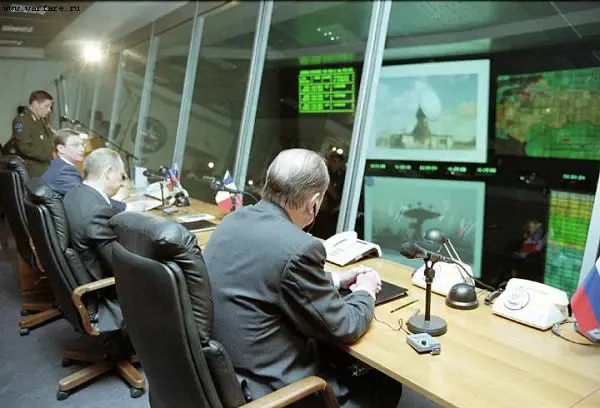
Solnechnogorsk-7 is the headquarters and combat fusion hall of the Russian (formerly Soviet) missile-attack warning system — СПРН, SPRN. The organization on the hill is the 820th Main Centre for Missile Attack Warning (820-й главный центр предупреждения о ракетном нападении, ГЦ ПРН). The hall that actually grades a raid is the 514th Command Post (514-й командный пункт системы ПРН, KP SPRN), v/ch 12556, formed 16 July 1966. Both sit in the closed town next to Timonovo, Solnechnogorsk District, Moscow Oblast, Senezh side. Open plots: about 56°14′29″ N, 37°00′50″ E. Current unit on the Centre: v/ch 26302. The old army/division number that still rides on chevrons and 1990s lists is 03366.
There is no Voronezh face on this campus. Solnechnogorsk is the node the faces call. Radar tracks, satellite infrared, ABM-radar cues, and space-catalogue cross-checks arrive on dedicated lines. The duty shift decides whether the country is under ballistic-missile attack, from whom, on what corridors, and with what impact fan — then pushes that grade toward the General Staff, the supreme commander’s nuclear-release path, Moscow ABM, and the strategic-force staffs. Krokus is the historic name of the warning-dissemination kit.
SENSORS THAT FEED IT
SPRN is built as two echelons plus neighbors that share the same CP.
Ground echelon — over-the-horizon-in-name-only, actually line-of-sight LPARs. Separate radio-engineering nodes (ОРТУ) on the perimeter. Living generation: Voronezh-M / DM / VP / SM (77Ya6 family) at Lekhtusi, Armavir (two DM faces), Pionersky, Mishelevka, Yeniseysk, Barnaul, Orsk, Zeya, and nodes still rising at Vorkuta, Olenegorsk, Sevastopol/Yakhroma. Legacy still on the map in 2025–26: Dnepr/Daugava at Olenegorsk (57th ORTU, v/ch 16605), Daryal at Pechora (378th, v/ch 96876), Volga at Baranovichi, Belarus. Lost after 1991 and replaced by Voronezh: Skrunda (Latvia), Mukachevo and Sevastopol Dneprs (Ukraine; those two kept pumping Solnechnogorsk under a 1992–2007 lease at $0.8–1.5 million a year until the feed died), Gabala Daryal (Azerbaijan, 2012), Balkhash faces. Each ORTU was wired to GTsPRN on purpose-built high-reliability lines from the late 1960s; radio-relay was the designed parallel. Russian wiki circa 2024: on the order of ten ORTU still tied in.
Space echelon. First generation US-KS / US-KMO (Oko / Oko-1), infrared launch flare from highly elliptical and GEO birds, designed at TsNII Kometa under Anatoly Savin, combat duty from 1982–83. Replacement: EKS “Kupol,” Tundra satellites. Those constellations are not flown from Timonovo. Western satellite CP: Serpukhov-15 (Kurilovo, Kaluga; 916th ORTU / object 455I; v/ch 03340, older lists also 22251) — 300-ton antennas under radomes. Eastern satellite CP: Komsomolsk-on-Amur / Lake Hummi (1127th ORTU, v/ch 20117). Processed space product goes Solnechnogorsk. Last Oko-1 GEO (Kosmos-2479) died March–April 2014. The 26 September 1983 false alarm that Lt. Col. Stanislav Petrov refused to escalate happened at Serpukhov-15, not at the 514th hall.
Neighbors on the same picture. Don-2N (Sofrino, Moscow ABM “Pillbox”) contributes engagement-quality tracks that SPRN can use as confirmation. SKKP (Main Space Situation Centre, Noginsk-9 lineage) shares the Kartsev-machine generation and some radar volume; early Dnestr cells at Mishelevka and Balkhash were dual-hatted satellite-catalogue / warning. A-135/A-235 is a consumer of GTsPRN cueing, not a sensor for it. 29B6 Container OTH is a different physics stack; it is not listed as a core SPRN face.
Duty-mode secondary job, in official language: instrumented intelligence on other states’ test and training launches.
HOW THE HALL WORKS
A Voronezh or Tundra event is a detection. The 514th CP is the place that applies the combat-program criteria and emits a warning signal — or does not. Open description of the automated processing system: take every station and every bird, establish the fact of a missile attack, name the aggressor state, grade the threat to C2 and to the strategic forces. Outputs:
— designation / cue to Moscow PRO (A-135/A-235, Don-2N); — warning packet onto Krokus (and its successor “information-delivery complex,” TASS: new complex placed on combat duty, date in the 2020s not fixed in the leak); — report from the duty commander to the General Staff central command post; — parallel report from the duty engineer to the VKS / VKO commander; — the picture that sits under the supreme commander’s launch-on-warning decision (Cheget / “nuclear briefcase” language in briefings).
The Centre does not turn a launch key. Perimeter / Dead Hand is a separate last-resort layer. Telegram copy that “the retaliatory strike is executed here” is rhetoric.
Krokus («Крокус»). First warning fan-out from the RO/SPRN CP was telegraph. Special apparatus designed under V. P. Traubenberg replaced it. The upgraded first-stage SPRN that went to an improved combat program bundled: new program at the CP, Krokus, new computing complex 5K31, and five Dnestr-M nodes (Murmansk, Riga, Gulshad/Balkhash, Irkutsk, Sevastopol). System-level “Krokus” introduction is dated 1978 in English wiki. The name still appears in 2026 strike reporting as the Kremlin-notification channel. Whether the box in the rack is 1978 iron or a namesake circuit is unpublished.
Reserve. 1383rd Reserve Command Post, Kolomna-1, v/ch 17204 (Sosnovy Bor in some lists). 2026 Ukrainian-side writing assigned callsigns «Квадрат» to Solnechnogorsk-7 and «Швербот» to Kolomna-1 and claimed Voronezh / Daryal / Krokus circuits dropped after hits on space-communications nodes at Dubna, Beloomut, and Gus-Khrustalny. Combat claim, not a TOE.
COMPUTING HARDWARE
The machines that made SPRN a real-time fusion system were Mikhail Aleksandrovich Kartsev’s.
M-10 (MoD cipher 5E66). Government order 1969, first industrial set 1973, third-generation synchronous multiprocessor, vector/“numeral cluster” architecture out of the M-9 paper machine. Serial for about fifteen years, several dozen complexes. Designed explicitly for SPRN and for SKKP space-object work. Kartsev’s own 1979 Doklady paper is the open technical stamp. Same family fed Daryal site computers (complexes 63I6 and 68I6) and Savin’s SKKP complex.
SPRN command-post suite. Russian technical-history texts name a CP complex 17L6 of six M-10-class machines. First-stage upgraded CP also listed a 5K31 computing complex next to Krokus. Those are the two public designations for what sat in the Solnechnogorsk hall in the 1970s–80s. M-10M followed; M-13 (1978 project, first Soviet vector-conveyor, an “ensemble” of up to 225 processors on the large model) is the next Kartsev generation. Whether 17L6 was ripped out for M-13, Elbrus, or a 2000s server farm is not in a public parts list. Voronezh nodes themselves use a later VME / Eurocard server described in industry copy (~1011 ops/s, 1.5 kW); that is the radar, not proof of the 514th’s current box.
What the software did, from the men who wrote it (V. G. Repin and the first-stage crew): combat programs that encode the criteria for a warning signal, interaction with every node, control of CP equipment, generation of the notification. Debug at the object ran three shifts around the clock.
HOW IT IS STAFFED
This is a combat-duty headquarters, not a 15-man Voronezh cabin. Open structure around the campus:
820th Main Centre — v/ch 26302 — divisional HQ, commander listed Maj. Gen. Sergey Suchkov on current wiki. 514th Command Post — v/ch 12556 — fusion hall. First commander Col. Vladimir Polikarpovich Glovatsky (1966). 487th Communications Centre — v/ch 13626 — the lines. Plot used: 56°13′08″ N, 37°01′06″ E. 468th Guard and Protection Company — same town.
On watch: a duty commander (attack report to the General Staff) and a duty engineer (report to the aerospace-defense commander), plus the shift that runs the combat program, displays, and Krokus / successor fan-out. Construction-era memoir: three shifts, 07:30 walk-through of the night’s take, midnight wash-up, next cycle. That tempo is how a 24-hour strategic CP is manned; published headcount for the whole 820th is not released. Officers named in unit-history copy after Medvedev’s October 2010 visit are 514th-shift grades (lieutenant colonels and majors), which is the right layer for a duty crew, not a TOE table.
ORTU crews (Voronezh “not more than 15” in factory talk) belong to their own v/ch at Lekhtusi, Armavir, Pechora, and the rest. They send; they do not sit at Senezh.
HISTORY
January 1965: political decision to build the first-stage warning CP; first 25 men to Senezh under a major-engineer. 16 July 1966: v/ch 12556 stands up. 30 March 1967: 1st Missile Attack Early Warning Division activated (later the core of the 3rd Army); 514th CP + 487th comms + 468th guard already on the books with Olenegorsk and Skrunda nodes.
15 February 1971 — defense minister’s order: separate anti-missile observation division on combat duty. Birthday still used by Space Forces. Initial live set: Solnechnogorsk CP + Dnestr-M at Olenegorsk and Skrunda. 1972–73: Irkutsk and Gulshad/Balkhash Dnestr-M cells and the OS (satellite-catalogue) complex CP cut into Solnechnogorsk. 1975–77: Sevastopol and Mukachevo Dneprs, Daugava receiver at Olenegorsk. Mid-1970s CP modernization: Kartsev machines, new display, Krokus. 1977: 3rd Independent Missile Attack Early Warning Army of Special Designation (3-я ОА ПРН ОН), HQ Solnechnogorsk, v/ch 03366 — 1st PRN division (warning nodes) + 2nd division at Serpukhov-15 (space). 1978: Krokus system date; M-10 in serial. 1982–85: Oko on duty, Daryal Pechora and Gabala.
1991–2009: foreign faces drop off the duty cycle; Ukrainian Dneprs persist on a paid feed into GTsPRN until 2007. 1 October 1998: 3rd Army of RKKO of Special Designation inherits PRN + PRO + SKKP. 1 June 2002: that army leaves RVSN for Space Troops. 2011: GTsPRN + Main Space Situation Centre + GIKTs into VKO Space Command. 1 August 2015: Space Forces re-created inside VKS; GTsPRN still theirs. Voronezh from Lekhtusi (experimental late 2000s, combat duty 11 February 2012) is the rebuild that puts a continuous field back on Russian soil. Medvedev in the CP, October 2010. TASS, later 2010s–20s: new command posts of the PRN system commissioned, new warning-delivery complex on duty, next modernization pass running.
Commanders of the 1967–98 army line (ww2.dk / open lists): Lt. Gen. V. K. Strelnikov 1967–81; Lt. Gen. N. I. Rodionov 1981–88; Col. Gen. V. M. Smirnov 1988–91; Lt. Gen. A. V. Sokolov 1991–98.
PLACE IN NATIONAL C2
Above Voronezh, beside Serpukhov-15, under Space Forces, feeding General Staff and Cheget. Same strategic layer as Kazbek / Kavkaz special communications and the Perimeter last-resort system — different boxes. A-135 is a shooter that takes the cue. SKKP is the catalogue cousin that grew from the same Dnestr and Kartsev soil.
CAVEATS
26302 vs 03366 both circulate. 17L6 / 5K31 / 5E66 are period designations; the 2020s rack is unpublished. Krokus-today vs Krokus-1978 is a name collision. Callsigns Kvadrat / Shverbot and the July 2026 circuit-kill story are one side’s OSINT. Petrov 1983 is Serpukhov-15. “Executed here” is not the legal act.
STATUS
Live GTsPRN / 514th CP under VKS Space Forces. Ground field Voronezh-heavy; space field Kupol in work; Kartsev-era logic still the idea of the hall even if the iron has turned over.
IN ONE SENTENCE
Solnechnogorsk-7 is the 820th Main Centre and 514th Command Post of SPRN — the Senezh fusion site, on duty since 15 February 1971, that takes Voronezh and leftover Dnepr/Daryal/Volga tracks plus Serpukhov-15 and Far-East satellite infrared, runs them through combat programs first hosted on Kartsev M-10 / 17L6 / 5K31 machines, and emits a Krokus-class attack warning to the General Staff and the nuclear briefcase.