WHAT IT IS
Gonets (Гонец, “Messenger”) is Russia’s low-Earth-orbit personal satellite communications system. It stores a short message or a packet of telemetry on a passing satellite and dumps it when that bird sees a ground station or the addressee. Data rates are tens of kilobits, not gigabits. That is why calling it a Starlink analog is a category error. Rassvet is the LEO broadband stack. Gonets is the store-and-forward UHF pipe that grew out of the military Strela-3 special-communications constellation.
Operator: JSC Satellite System Gonets (АО «Спутниковая система „Гонец“»), a Roscosmos company. Builder of the spacecraft: ISS Reshetnev (NPO Prikladnoi Mekhaniki / NPO PM), Zheleznogorsk. The same firm flies GLONASS. Gonets SatCom also runs the geostationary Luch (Луч) relay system for launch-vehicle and spacecraft telemetry, and in 2024–2026 Roscosmos named it operator for new Sfera groupings and for Express-RV.
HISTORY
Strela-3 was the late-Soviet LEO system used by the security services and the General Staff to move documents and images without a geostationary bird. In 1989 Alexander Kiselev (NPO Soyuzmedinform) and Mikhail Reshetnev opened a conversion programme: same class of satellite, civilian personal messaging. First two demonstration Gonets-D satellites rode a Tsyklon-3 from Plesetsk on 13 July 1992. The first operational Gonets-D1 trio went up on 19 February 1996, also Tsyklon-3 from Plesetsk. The first three on orbit were given Kosmos numbers; later civil birds were not.
D1 launches ran through 2001. Three were lost with a launcher on 27 December 2000. A first modernised Gonets-D1M flew on Kosmos-3M on 21 December 2005; a second on Rokot on 8 September 2010. Regular Gonets-M replenishment from 2010 rebuilt the constellation. Second generation was called complete around 2015. Three more Gonets-M joined on 22 October 2022. The company marked thirty years of operational service in February 2026.
HOW THE SATELLITES ARE BUILT
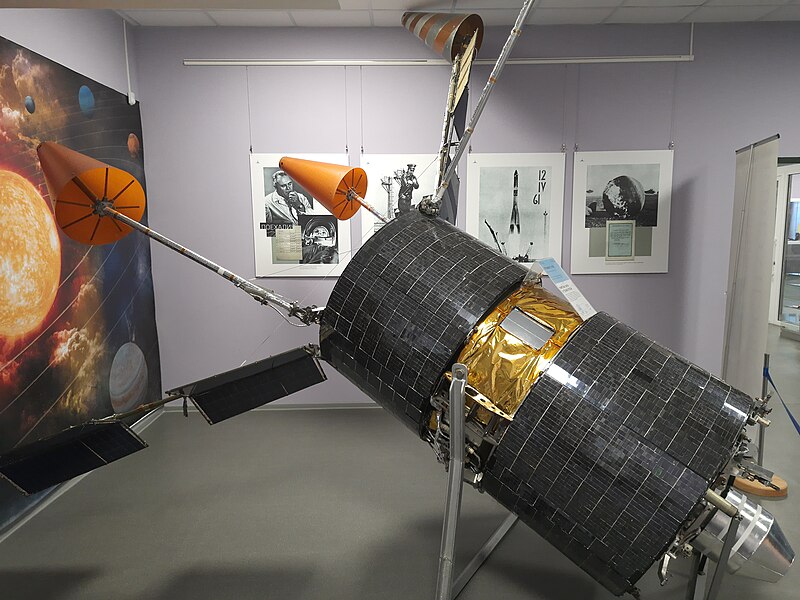
Gonets-D1 — launch mass about 240 kg. One uplink and one downlink channel. On-board store 1.5 MB. Power system about 120 W. Design life 1.5 years; at least one first-generation bird ran nearly twenty years. No orbit correction.
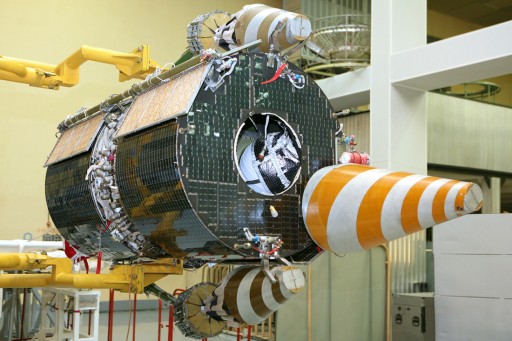
Gonets-M (D1M network) — about 280 kg. Fourteen Earth-to-space channels and two space-to-Earth. Store 8 MB. Power about 200 W (English-language cards also quote ~40 W for the payload from the arrays). Nickel-hydrogen batteries. Design life 5–7 years; many have outlasted that. Orbit correction added. UHF transponders in B-band / D-band. User data up to 64 kbit/s. Handheld and small vehicle terminals in the 1–3 kg class.
Gonets-M1 — next generation at Reshetnev: new unpressurized bus for group launch, active phased-array payload, P-, S- and C-band (S and C new to the family). Planned 28-satellite constellation at ~1,500 km. First flights have slipped; public targets sit in 2027–2028 with completion into the early 2030s. Ten-year life is the brochure figure. Telephony across Russia plus thicker global data relay is the stated job.
Orbit for the working system: about 1,400–1,500 km, inclination 82.5°, period ~114 minutes, single-satellite footprint about 5,000 km across. Twelve birds give near-real-time service in high northern latitudes; wait times grow toward the equator. Original plan was 24 Gonets-M; the staged plan became 12 M then 12 M1.
Ground segment: regional stations in Moscow, Zheleznogorsk, Yuzhno-Sakhalinsk, Murmansk, Rostov-on-Don, Norilsk and Anadyr. The satellite only talks when it sees a station or a subscriber terminal. That is store-and-dump, not a continuous Ka/Ku user beam.
HOW IT IS LAUNCHED
Plesetsk is the home pad. Early packs: Tsyklon-3. Then Kosmos-3M and Rokot for single or small groups. Later replenishment on Soyuz-2. Triple Gonets-M launches were planned on Angara-1.2 from Plesetsk Site 35/1 for the later M blocks. The 22 October 2022 trio was a public Soyuz-class replenishment. Group launch is the Reshetnev design point for M1.
WHAT IT IS USED FOR
Short messages and telemetry where there is no GSM: taiga, Arctic, sea, pipelines, power lines, rail. Vehicle and vessel tracking. Integration with ERA-GLONASS emergency service. Environmental and industrial monitoring. From 1 January 2026 Russian fishing vessels must use domestic satellite stations as the technical control means into Rosrybolovstvo’s monitoring system; Inmarsat was dropped. Gonets terminals are the named replacement, with Yamal and Express also carrying some of that traffic. Polar coverage is a real advantage over equatorial GEO birds.
Military and dual-use layer: the architecture is still Strela’s — a passing LEO bird that will take a burst and drop it later. That is useful for special services, remote units and ships that only need a telegram, a position or a small file. Presentations have talked about UAV terminals; the existing modem is a messaging brick, not a video pipe. In July 2026 Roscosmos and STEKCOM reported a compact AT-Gonets (URM-D2) IoT modem about six times smaller than the previous generation, tested from 10 bytes to 20 kB with power-cycle recovery. Serial production of that modem was the next stated step.
Company side jobs: operator of Luch GEO relay; from 2024 operator mandate for new Sfera constellations; March 2026 operator of Express-RV (four highly elliptical satellites for Arctic / Northern Sea Route broadband, first launch briefed by late 2026–2027). Separate Manoilo statements in 2026 sketched a new 102-to-180 smallsat M2M/IoT LEO at ~750 km under the national Space project — that would be another Gonets-operated layer, not the current 1,400 km UHF fleet.
HOW IT SITS WITH THE OTHER PIPES
R-168 / Azart / R-173 are line-of-sight and HF tactical radios. Gonets is the national store-and-forward satellite when those nets end. Luch is GEO relay for space and launch. Express and Yamal are GEO television and trunk data. Express-RV is the coming HEO Arctic broadband. Rassvet is the Ku/Ka LEO internet. Gonets does not replace any of them. It is the cheap, polar, delay-tolerant channel that has been flying since the 1990s.
STATUS
In service. Company figure at the February 2026 anniversary: 18 working Gonets-M satellites, design life five years, many flying longer. M1 and the larger IoT constellation are still ahead of first metal. Fishing-fleet mandate is live from 1 January 2026. Ukrainian cyber reporting in 2026 treated the operator as a defence-industry target and noted that “Russian Starlink” branding on Gonets does not match the bit-rate. The system is what it has always been: a converted Strela messenger that still works in the high latitudes.
IN ONE SENTENCE
Gonets is Reshetnev’s 1,400 km, 82.5° store-and-forward UHF constellation — civilian Strela-3, 64 kbit/s messages and ship/IoT telemetry, eighteen Gonets-M on orbit in 2026 — the polar messenger beside Rassvet’s broadband and Express-RV’s coming Arctic pipe, not a Starlink analog.