WHAT IT IS
OS MSVS (ОС МСВС — Мобильная система Вооружённых сил) is a Russian Ministry of Defence general-purpose secure operating system. In Latin letters it is often written MCBC, because the Cyrillic С is typed as C. It is a POSIX Unix-class, multi-user, multi-tasking, networked OS built by VNIINS (All-Russian Research Institute of Automation of Management in the Non-Industrial Sphere named for V. V. Solomatin) on a Red Hat Linux / RHEL base. It is an RPM distribution with a hardened access-control layer, Russian documentation, and military certificates — not a from-scratch kernel and not a real-time flight computer.
It was accepted for supply to the Armed Forces in 2002 and was the standard desktop/server OS on many staff and automated-control machines through the 2000s and into the 2010s. From the mid-2010s the troops moved mass adoption toward Astra Linux Special Edition. МСВСфера (MSVSphere), sold later by NTsPR and then Inferit / Softline, is a related civilian/government Linux line that inherited the name, not the same build as MSVS 3.0 on a Baget box.
HISTORY AND DATES
Need and requirements were set after studies at 22 TsNIII MO under A. V. Pavlov. First public release date on the Russian Wikipedia card: 21 May 1999. Acceptance for supply to the Armed Forces: 2002.
MSVS 3.0 is the version that actually lived on troop machines for about a decade and a half. Builds are identified as FLIR / TsAVM numbers with “izmeneniye” (change) indexes; 3.0 variant 12 change 4 and change 6 appear in open hardware lists and training texts. A leaked 3.0 R12 image described in public archives used a 2.4-series “MCBC” kernel on i586. Ministry of Defence information-security certificates for 3.0 cluster in 2005–2008 (open numbers include 126/1 of 8 Dec 2005 and a run through 2008).
MSVS 5.0 (TsAVM.11004-01 and -05) received MoD certificates in 2011–2012 for Intel 64 and PowerPC. Open accounts state 5.0 was certified but was not formally accepted for mass supply in the same way 3.0 had been. By then RusBITech’s Astra Linux was already the Ministry’s chosen unified platform for automated C2 (decision commonly dated 2013). MSVS remained on older approved hardware — including some army laptops still listed with 3.0 into the late 2010s.
A 2015 Minkomsvyaz import-substitution protocol still named certified MSVSphere client builds as a support project. That is the fork toward the later commercial «МСВСфера» 6.x / 7.x / 9 line (FSTEC class A, 4th trust level in 2024–25), which is RHEL-compatible enterprise Linux for government and industry, not the 2002 troop image.
HOW IT IS BUILT
The system is Linux. Modules were taken from contemporaneous Red Hat distributions and rebuilt to MoD requirements. It is not Android, not Elbrus OS as a separate product (though it runs on Elbrus-90micro SPARC hardware), and not JetOS / Baget RTOS on a fighter.
It provides preemptive multitasking with a multi-level priority scheme, virtual memory, SMP, and optional cluster configurations. Work is command-line or graphical (Russian GUI; KDE is named in period descriptions). POSIX compliance is an explicit design claim, so standard Unix process, file, and socket semantics apply.
Programming. There is no unique MSVS language. Applications are written in the ordinary Unix set: C and C++, with assembly on the metal, using GCC-class toolchains shipped with the distribution. POSIX APIs, RPM packaging, and the usual scripting shells are the integration surface. Special-purpose military applications sit on top of that, as they would on any certified Unix; the OS does not replace Ada on a missile computer or RelMK32 on an old Su-27 mission box.
Platforms named in open specs: Intel (32- and later 64-bit), SPARC (Elbrus-90micro), IBM System/390, MIPS on Korund-M Baget complexes.
HOW NODES TALK
MSVS is described as a network-transparent Unix. Inter-node communication is the standard TCP/IP stack: sockets, IP routing, the usual Unix services (file share, remote shell, directory), plus whatever military message and C2 applications were compiled for that userland. There is no public MSVS-only tactical radio protocol. Radios, satellite terminals, and staff data systems sit beside the OS and hand it packets. “Network transparency” in the VNIINS texts means a remote resource can be used with local Unix semantics when the link is up — NFS-class thinking — not a new waveform.
ESU TZ, Sozvezdie-M, and other ASUV families are separate automated-control products that may run on MSVS or, later, Astra boxes. The OS is the floor. The C2 system is the furniture.
WHAT IT WAS USED FOR
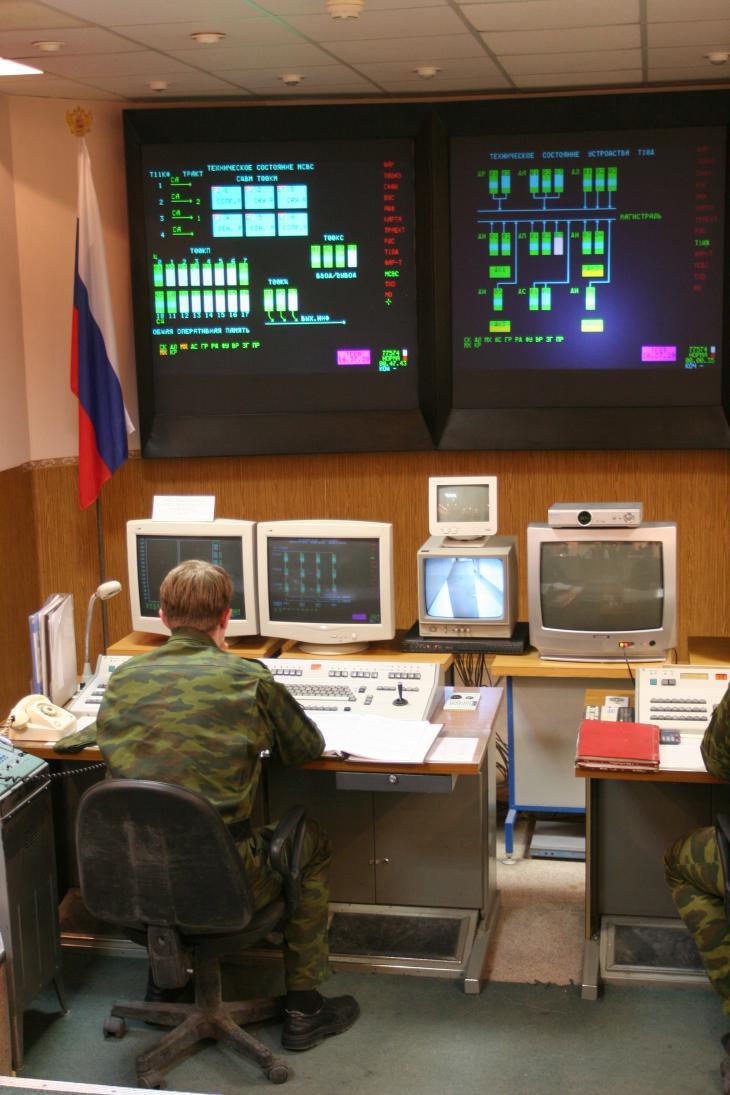
Stationary and mobile protected automated systems: staff workstations, servers in command posts, situational-analytical centres, and dual-use state/military information systems. Period training texts also list industrial ACS, process control, information and queuing systems — i.e. general-purpose secure Unix, not a fire-control loop. Combat-control centres of the Ministry are named among intended homes for the 3.0 line. Laptops fielded to the army were specified with MSVS 3.0 (and sometimes Astra 1.4/1.5 as an alternate).
SECURITY
The military value was certification and mandatory controls, not a secret instruction set. Open descriptions include:
mandatory access control (MAC);
access-control lists;
a role model;
built-in unauthorized-access protection tools.
Certificates cited for 3.0: Ministry of Defence information-security system, plus FSTEC and FSB in institute literature. 5.0: MoD certificates 1607 (28 Sep 2011, Intel 64) and 1785 (5 Feb 2012, PowerPC). Those papers allow the OS into classified automated systems at the levels written on the forms. They do not make a 2.4-kernel Red Hat fork immune to the defect classes of its decade.
Distribution of troop images is controlled. Copies of 3.0 have nonetheless circulated in public archives; that fact is why later policy pushed Astra, whose Special Edition is the current MoD standard line for C2 desktops and servers, including the National Defence Management Centre network in open reporting.
WHAT IT IS NOT
Not Astra Linux (RusBITech; unified C2 OS from 2013).
Not МСВСфера 9 (Inferit / Softline enterprise Linux, FSTEC 4th class, 2024–25).
Not Elbrus architecture OS as such — MSVS can run on Elbrus-90micro hardware.
Not KasperskyOS, RED OS, ROSA, Alt, or JetOS.
Not the Elbrus-2 / Elbrus-90S number-crunchers inside Don-2N.
STATUS
MSVS 3.0 is a legacy certified build. New automated-control work in the Armed Forces is specified on Astra Linux. The MSVS name survives in the civilian МСВСфера product and in remaining approved 3.0 installations that have not been migrated. VNIINS remains the historical developer of the military line.
IN ONE SENTENCE
OS MSVS (MCBC) is VNIINS’s 1999–2002 Ministry of Defence Linux — a hardened Red Hat / POSIX / RPM workstation and server, certified by MoD, FSTEC and FSB, fielded from 2002 on Intel, SPARC, S/390 and MIPS Baget machines, and largely superseded in the troops by Astra Linux after 2013.