Companion frequency and procedure sheet already on this site: USAF HFGCS SYSTEM
WHAT IT IS
The High Frequency Global Communications System (HFGCS) is the U.S. Department of Defense worldwide high-power HF command-and-control net used when satellite paths are unavailable, denied, or simply not the right tool. It talks to aircraft, some Navy surface units, and selected ground users on upper-sideband voice and on automatic-link-establishment (ALE) data. Air Combat Command’s public fact sheet lists customers that include the President, USSTRATCOM, USTRANSCOM, Space Force, USSOCOM, USNORTHCOM, the National Command Authority, Air Force Global Strike Command, Air Mobility Command, Navy submarine and fleet forces, and ISR platforms (P-8, E-3, U-2).
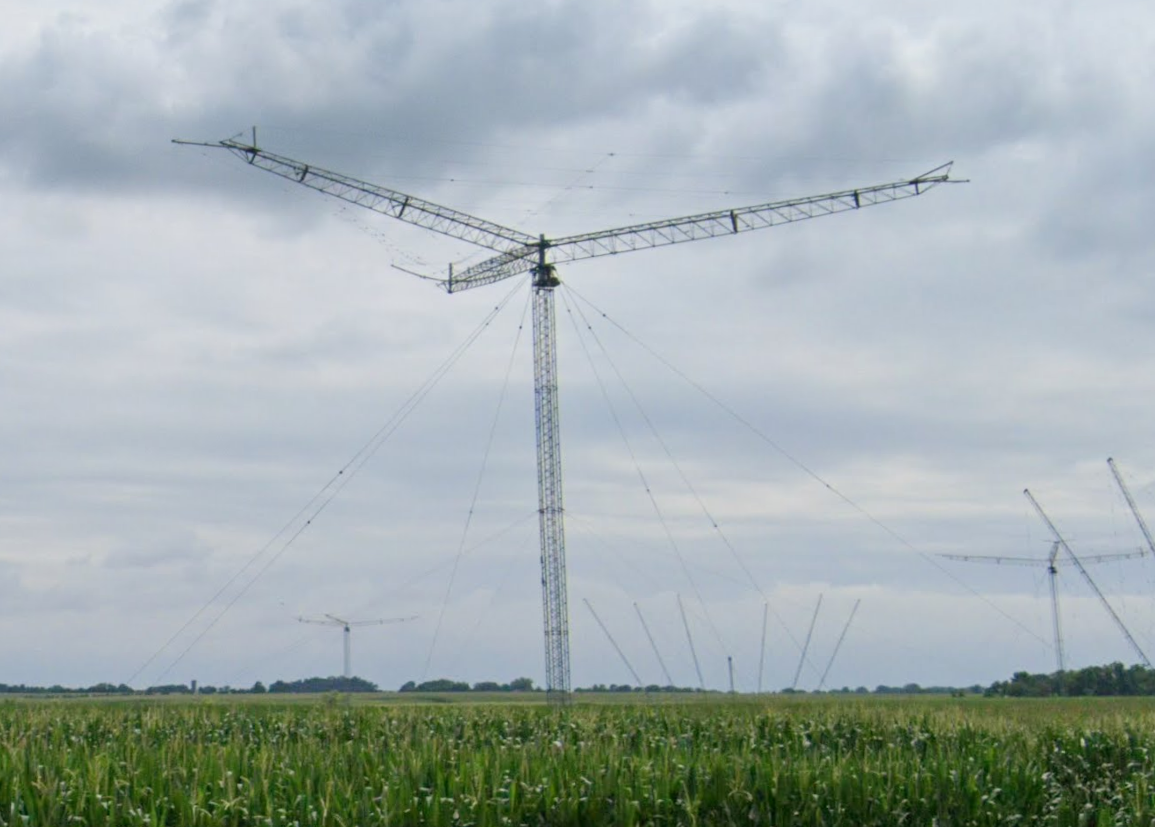
HFGCS is not a single transmitter. It is a ring of roughly thirteen fixed stations on four continents and several islands, remotely keyed from two network control stations. Before 1 October 2002 the same architecture was called the Global High Frequency System (GHFS). The equipment generation that replaced older GHFS radios is SCOPE Command (System Capable Of Planned Expansion). A follow-on sustainment contract, Next Generation SCOPE Command, was awarded to Collins Aerospace in the 2020s.
What outsiders hear on the published voice channels is a mix of routine air-mobility radio, phone patches into the Defense Switched Network, and one-way strategic broadcasts — Emergency Action Messages and the higher-priority Skyking / Foxtrot format. The alphanumeric strings are encrypted. This encyclopedia does not treat them as something a listener can read in the clear.
WHY HF STILL EXISTS
HF (2–30 MHz) reflects off the ionosphere. A 1 kW-class shore station can reach an aircraft thousands of kilometres away without a satellite. That is the point in a GPS- or SATCOM-degraded war. Cost is narrow bandwidth, fading, and the need for several frequencies at once so day, night, and solar weather do not open a hole. ACC describes HF as part of the Joint All-Domain C2 communications pillar for beyond-line-of-sight resilience.
Aircraft also use MARS HF (a commonly published frequency is 13927 kHz) and Canadian Forces HF (11232 kHz) as extra relays. Those nets are adjacent practice, not HFGCS stations.
CONTROL AND OWNERSHIP
The net was ordered into being by Chairman of the Joint Chiefs memo MCM-10-93 (1993), which told DoD to fold high-power (1 kW and above) fixed HF into one system. Full operational capability is dated 2001. The result is a joint Air Force / Navy plant: Air Force as lead service, about 8.5 stations plus both network control stations under the Department of the Air Force, about 4.5 stations under the Navy, roles written in a memorandum of agreement.
Network Control Stations: Joint Base Andrews, Maryland, and Grand Forks AFB, North Dakota. Older writing said Offutt would be the second CNCS; Grand Forks took that job. Offutt remains a transmit/receive site and is sometimes described as an interior backup. Secondary sources split station control as Andrews NCS over Hickam, West Coast, Andrews, Sigonella, Diego Garcia, and Yokota; Grand Forks NCS over Elmendorf, Offutt, Puerto Rico, Ascension, Croughton, and Andersen. Treat that split as reported practice, not a public order.
Department of the Air Force sites are operated and maintained by Space Force and by ACC, AMC, PACAF, and USAFE. Navy sites include Sigonella, Diego Garcia, Naval Base Guam (paired with Andersen), Joint Base Pearl Harbor–Hickam, and the Navy half of the West Coast station at Dixon, California.
STATIONS
Voice call for any station on the net is MAINSAIL. Individual sites answer as “[place] Global.” The Network Control Station of the day uses a one- or two-word callsign that changes at 00:00 UTC. Published site list:
Andersen / Guam (GUA) — Barrigada transmit, Finegayan receive. Andrews (ADW) — Davidsonville transmit, Brandywine receive; also a CNCS. Ascension (HAW) — RAF Ascension Island / auxiliary field. Croughton (CRO) — RAF Croughton, United Kingdom. Diego Garcia (JDG) — U.S. Naval Support Facility. Elmendorf (AED) — Joint Base Elmendorf-Richardson, Alaska. Hickam (HIK) — Joint Base Pearl Harbor–Hickam; Lualualei / Wahiawa antenna farms. Lajes (PLA) — Lajes Field, Azores; Cinco Picos / Vila Nova. Offutt (OFF) — Elkhorn transmit, Scribner receive, Nebraska. Puerto Rico (JNR) — Salinas transmit, Isabela receive. Sigonella (ICZ) — NAS Sigonella, Sicily. West Coast (MCC) — Dixon (Navy) / Lincoln–Beale (Air Force); formerly called McClellan after the closed California base. Yokota (JTY) — Tokorozawa / Owada, Japan.
Keflavik and a “South Atlantic / MPA” ALE identity appear in older Flight Information Handbook tables. They are not in the current ACC station list. Do not treat them as live HFGCS voices without a fresh copy.
VOICE NET
Published core USB voice frequencies, also listed on this site’s companion page: 4724, 8992, 11175, and 15016 kHz. Working habit among monitors: 11175 by day, 4724 by night, 8992 almost always up, 15016 as a day backup. Official FIH-style guides also name 6712, 6739, and 13200 kHz as scheduled backups by season and path length. Discrete frequencies exist at each station and are used once a phone patch or long exchange is moved off the calling channel. The published four are for initial contact, EAM simulcast, and short C2.
Two-way traffic: air mobility (Reach ###), bombers (Doom, Rogue, Skull and other tactical words), tankers, command posts, and many other callsigns. Aircraft check in or out with a three-letter challenge and a one-letter reply, or more rarely enter in the blind with a two-letter authenticator. Authenticated nets outrank casual calling. Phone patches to DSN are asked for on the calling frequency and moved. MARS operators sometimes take the patch load.
One-way traffic is usually simulcast on the core frequencies, which is why a listener hears a stacked echo. Test counts mark NCS shift change: a station identifies, counts 1–5 and 5–1, and goes out. Emergency Action Messages are the common encrypted broadcast — typically a 30-character alphanumeric group, preamble of the first six characters three times, then the full string twice. Skyking (also heard as Foxtrot in some descriptions) is the time-sensitive “do not answer” format: codeword, minutes of the hour, two-letter authentication, then the whole thing again. In SIOP-era language Skyking addresses SIOP-committed air and missile crews; Skybird is the wider command-post collective; Skymaster addresses airborne command posts. Those are callsign meanings from old ACP / monitoring literature, not a decoder ring for the payload.
ALE AND DATA
2G ALE (MIL-STD-188-141 family) runs on a separate published USB set: 3137, 4721, 5708, 6721, 9025, 11226, 13215, 15043, 18003, 23337 kHz. Ground ALE addresses match the three-letter site codes above. Aircraft ALE IDs often track tail-number tails (1##### C-5, 2##### C-17, 4##### KC-10, 5##### KC-135, E3#### E-3, NW1 for E-4 Nightwatch). Stations sound about every three hours. Traffic is mostly AMD text and link setup; voice radio-checks also occur on ALE channels.
A parallel published set (3113, 5702, 6715, 8968, 11181, 15091, 17976, 27870 kHz) is used as an HF gateway toward SIPRNet. Addresses take an SPR suffix (ADWSPR, OFFSPR, and so on). Link on 2G ALE; data modem commonly described as MIL-STD-188-110A. Same architecture as the ALE net with DAT / IGM-style suffixes in some logs.
WHAT A LISTENER CAN AND CANNOT KNOW
Open monitoring can log that an EAM or Skyking went out, how long it was, which frequencies stacked, and whether aircraft are checking in. It cannot read the one-time encrypted voice groups. STANAG vocoder / AES-class data on the ALE and SIPR paths is likewise not a hobbyist decrypt. Operational inference from traffic volume — exercises, SKYMASTER-scale floods, extra “window” frequencies such as the 9031 kHz path monitors call a Charlie Echo window — is inference, not content. This page does not print a how-to for exploiting the net.
HISTORY
GHFS was the 1990s consolidation of older Global / Strategic HF. HFGCS name from 1 October 2002. SCOPE Command replaced discrete high-power radios with remotely keyed, ALE-capable suites controlled from Andrews (and later Grand Forks). FOC 2001. Next Generation SCOPE Command IDIQ (FA810222D0004, Collins / Cedar Rapids) covers sustainment, amplifiers, servers, scanning receivers, logging, and cybersecurity into the late 2020s across the listed sites.
HOW IT SITS WITH OTHER ORLAN PAGES
HFGCS is the surviving U.S. high-power HF C2 plant. AUTOVON / DSN is the switched voice cloud the phone patches dump into. Russian C3 and Perimeter are the other side’s strategic-warning and retaliation architecture, not an analogue of this radio net. U-boat Goliath / Nauen were one-way VLF downlinks to submerged boats; HFGCS is two-way HF plus one-way strategic broadcast to aircraft and missile crews that can raise an HF antenna. The live companion page on this site holds the frequency tables and the word-for-word broadcast choreography. The U.S. warning and assessment center that depends on networks like this one is described in Cheyenne Mountain Complex.
CAVEATS ON THE NUMBERS
Station counts move (13 is the usual modern figure; older lists add Keflavik or South Atlantic). Seasonal FIH tables for 6712 / 6739 / 13200 are not all still live. Discrete frequencies are unpublished on purpose. Skyking codewords as “rock bands and movie titles” is monitor folklore that happens to match many heard words; it is not a doctrinal list. Grand Forks versus Offutt as second CNCS is settled in ACC language toward Grand Forks, with Offutt still on the air as a site.
STATUS
In service. ACC fact sheet current into 2026. Core voice channels remain 4724 / 8992 / 11175 / 15016 kHz USB. SCOPE Command hardware is in a paid sustainment / increment cycle, not a museum net.
IN ONE SENTENCE
HFGCS is the U.S. Air Force–led, Navy-shared, Andrews- and Grand Forks–keyed worldwide HF C2 net — SCOPE Command radios on a handful of published USB voice frequencies plus ALE and SIPR gateways — used for air mobility, DSN patches, and one-way encrypted EAM / Skyking traffic when satellites are not enough.