WHAT IT IS
R-168 Akveduk (Р-168 «Акведук», export R-168E) is a Russian fifth-generation digital tactical radio complex. It is a family, not one box: about sixteen portable, manpack and vehicle sets from 0.1 W to 100 W, plus technical-masking units and about fifteen auxiliary devices. Design authority: Voronezh Scientific Research Institute of Communications (VNIIS / Zarya). Series production from about 2000 at AO Elektrosignal (Voronezh) and Yaroslavl Radio Plant.
It is not R-173 Abzats. R-173 is a third-generation 30–76 MHz FM tank transceiver from the 1980s. Akveduk is the 1990s–2000s programme that was supposed to give the army a digital, masked, hopped net from squad to division after the incomplete fourth-generation Arbalet effort. R-187 Azart is the sixth-generation SDR that came later and was written to handshake Akveduk’s hop waveform at about 100 hops per second.
Planning figures for the family: VHF up to 30 km on the move and 70 km halted; HF up to 350 km on a dipole. Data 100 / 200 / 1,200 bit/s on HF and 1.2–16 kb/s on VHF. T-90M and T-80BVM manuals name the vehicle set R-168-25U-2 as the hull radio.
HISTORY
After 1991 the Russian army still lived on third-generation sets (R-123, R-173) and a half-finished fourth-generation Arbalet line. The Ministry of Defence opened a fifth-generation tactical programme named Akveduk. Voronezh NII Svyazi designed the complex. Sets reached service in the 2000s and became the intended standard from section and tank crew up to motor-rifle and tank division.
Fielding never covered the whole force. R-173 stayed in unrebuilt hulls. Azart was ordered in the 2010s as the next handheld and vehicle SDR. In Ukraine the army has fought with three generations on the same net: R-173 analog, R-168 digital/masked, and limited R-187-P1. Western and Russian notes both say many R-168 vehicle sets are left in open fixed-frequency simplex on low VHF because hop and masking are unused or the higher net is empty.
HOW THE FAMILY IS BUILT
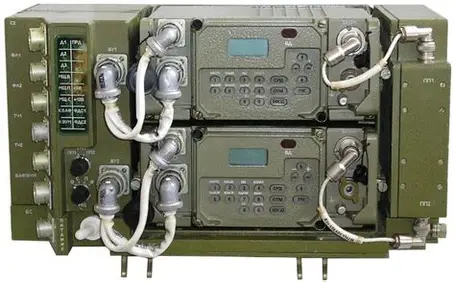
Naming is power and band. U = UKV (VHF/UHF). K = KV (HF). N = nosimaya (manpack). V or U suffix after the power figure = vozimaya (vehicle). Numbers are watts: 0.1, 0.5, 5, 25, 100. E on the tail is export. M is a later mark. A dual-set vehicle box such as R-168-25U-2 is two manpack-class transceivers in a 27 V rack so the tank can talk down and up at once.
Common modes across the line: simplex and two-frequency simplex on a fixed channel (FCh / FChS); scanning receive on 4–8 prepared frequencies (ZPCh); technical masking of speech (TM) with R-168-MA / MA5-class units; adaptive address communications (AAS / AS); software hop (PPRCh); selective and circular call; RS-232 data; remote control from a handset tens of metres away. HF sets add SSB telephone, CW, and FSK telegraph (ChT-200 / ChT-500).
Hop rate on the VHF vehicle line is 100 hops per second on up to 256 frequencies — that is the “Akveduk waveform” Azart also implements. Some 25U-2 kits quote 240 hops/s on the second delivery set. HF manpack cards quote about 22 hops/s. That is two orders of magnitude slower than Azart’s native 20,000 hops/s. Technical masking is analog/digital concealment, not a modern crypto waveform by itself; external ZAS boxes (T-230 / T-231 / T-235 family) can be patched for higher secrecy.
THE SETS
Portable VHF (squad–platoon–company) R-168-0.1U / 0.1UME / 0.1UM1E — pocket sets, typically 33–56 or 44–56 MHz, 0.1–5 W, 25 kHz step. Soldier–section–platoon. R-168-0.5U / 0.5UME / 0.5US / 0.5UDE — company bricks. 0.5U splits into three band cards (30–48, 45–76, 70–108 MHz). 0.5UDE sits 146–174 MHz. 0.5US around 94–100 MHz. Power 0.25–1 W class, some later monoblocks 1 / 5 W.
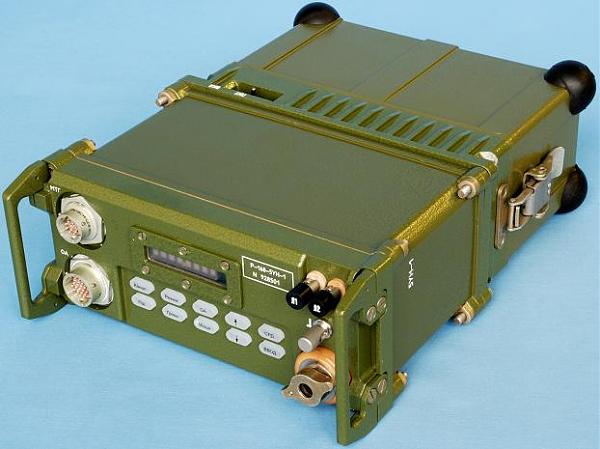
Manpack VHF R-168-5UN / 5UN-1 / 5UN-2 — 30–88 or 30–108 MHz, 25 kHz, 0.1 / 2–3 / 8 W. Company–battalion–regiment. 5UN-2 is the brick inside the 25U-2 vehicle rack. Whip range on the order of 10 km analog.
Vehicle VHF — the tank radio R-168-25U / 25U-2 / 25UE — 30–108 MHz, 25 kHz, power steps 0.1 / 8 / 40 W (some cards add 1.5 and 4 W). Weight of the working set about 27 kg. 27 V board net. Two-channel 25U-2: one transceiver to subordinates, one to the higher commander. T-90M and T-80BVM fit: R-168-25U-2 version 04, with a second face on some kits at 390–440 MHz, 30 W. Planning range ~20 km moving on R-168BShDA, ~45 km halted on a mast whip. Modes on the indicator: F (fixed simplex), two-frequency simplex, SP scan, PPRCh hop, AS adaptive, TM mask.
R-168-100U / 100U-2 / 100UF — 100 W VHF for command vehicles and navy (UF). Command-staff vehicles also carry R-168-5UT and the R-168UP receiver.
HF manpack and vehicle R-168-5KN / 5KNE — 1.5–29.999 MHz, 100 Hz step, 1 / 10 W. Battalion–division and reconnaissance. Whip ~10 km, sloper ~40 km, dipole ~300 km. R-168-5KV / 5KVE — vehicle HF, 10 W or 100 W marks, 27 V armour and KShM. R-168-100KA / 100KAE / 100KB / 100KBE — 10–100 W HF. Dipole on R-168MK mast ≥350 km. SSB, masked speech, ChT, CW. Transceiver ~28 kg plus ATU ~19 kg.
High-rate data R-168MRA / Akveduk-K-MR (R-168-K-MRA vehicle, K-MRD manpack) — about 1.5–1.75 GHz, 100 mW to 1 W with PA, Ethernet, TCP/IP. This is the T-90M’s second radio for Sozvezdie-class tactical ACS data, not the voice whip.
Helpers R-168PP search receiver, R-168MP marker transmitter, R-168-MA5 / MV masking boxes, R-168PU2 remote panel (named in the T-80BVM book), antenna tuners and the BShDA / ShDAM / BShPA whip family.
HOW IT WORKS ON THE NET
A company net sits on one of the prepared VHF channels. The tank’s 25U-2 keeps that net on one transceiver and the battalion net on the other. Hop, when used, walks a list of up to 256 frequencies at 100 hops/s so a slow jammer and a simple direction finder have a harder time than they do against R-173’s fixed 30 W carrier. Adaptive address mode tries to pick a usable channel without the operator spinning the knob. Masking scrambles the voice on the same FM path. Data at 16 kb/s is the same rate R-173M advertised, which is why an Azimuth / GLONASS position can be pushed as a short packet if the command post is listening.
HF manpacks and 100 K sets carry the same traffic over the horizon when VHF dies in folds of ground. The K-MR microwave slice is for maps and orders inside a parked or slow ACS bubble, not for a company attack on the move.
LAYERED INTEROP
Down. Fixed-frequency analog FM on 30–76 MHz talks to R-173 / R-173M and, in the overlap, to leftover R-123. That is why a T-90M on Akveduk and a T-72 on Abzats can still shout on low VHF. R-163 and R-169 sit on the same analog clause Azart was written to honour.
Sideways. Same-family sets on matching hop keys and ZPCh lists form the intended digital company–battalion–regiment net. Dual 25U-2 / 100U-2 racks give two independent nets from one hull.
Up and forward. R-187-P1 Azart implements the 100 hop/s Akveduk waveform as well as its own 20,000 hop/s mode, plus analog FM into 27–50 MHz so a dismount can enter the tank net. R-187VE is the vehicle Azart that is supposed to replace these racks; T-90M and T-80BVM books still say R-168-25U-2. Above the radio sit ESU TZ / Sozvezdie-M command systems. R-168MRA is the short pipe into that furniture. External ZAS (T-230 / T-231 / T-235 / T-236 / T-237) hangs on an S1-FL interface when technical masking is not enough.
What it does not replace. R-173 remains in unrebuilt tanks. Azart handhelds are the infantry brick. Civilian Motorolas appear in reporting when the official stack does not talk to the next battalion.
THE BATTLESPACE STACK
Soldier / section: 0.1U and 0.5U portables, or Azart if issued. Platoon / company: 5UN manpack; tank and BMP hull R-168-25U-2 (or leftover R-173). Battalion / regiment: second channel of 25U-2, 100U vehicle sets, 5KN HF for the staff that has left line-of-sight. Brigade / division: 100K HF, mast VHF, KShM racks, then ESU TZ. Combined-arms army posts in later drawings move toward R-187BV-class masts.
On paper this is one fifth-generation family from rifle to division. In practice the hop is slow by 2020s standards, the force is mixed-generation, and low-VHF analog remains the language armour actually uses when the digital net is not built.
STATUS
In service and still the named hull radio on T-90M (R-168-25U-2) and in the T-80BVM manual (R-168-25U-2 with R-168PU2 panel). Being displaced at the handheld layer by Azart and, on paper, at the vehicle layer by R-187VE. Not withdrawn. Export E-suffix sets were catalogued through the 2000s–2010s.
IN ONE SENTENCE
R-168 Akveduk is Voronezh’s fifth-generation HF/VHF family — 0.1 W pockets to 100 W command sets, 100 hop/s and technical masking — the radio in the T-90M and T-80BVM rack, the waveform Azart still speaks at 100 hops, and the digital middle layer between 1980s R-173 analog and sixth-generation Azart.