WHAT IT IS
9K720 Iskander (9К720 «Искандер», NATO reporting name SS-26 Stone) is a Russian road-mobile operational-tactical missile complex, in Russian оперативно-тактический ракетный комплекс (ОТРК). It was developed by the Kolomna Machine-Building Design Bureau (КБМ, KBM) and entered service in 2006. A single launcher, the 9P78-1 (9П78-1) on an 8x8 MZKT-7930 chassis, carries two missiles. The ballistic round is the single-stage solid-propellant 9M723 (9М723), which flies a depressed, manoeuvring, "quasi-ballistic" trajectory. The same launcher can instead carry cruise missiles of the 9M728 (9М728, also called R-500, Р-500) family, and a longer cruise missile, the 9M729 (9М729), is associated with a modified launcher. [DOCUMENTED]
It is one of the most used missiles in the war in Ukraine, and one of the most argued about. The arguments are about range (is it 500 km, 390 km, 550 km, or more?), about accuracy, about how often it is intercepted and why, and about what its cruise-missile sibling meant for the INF Treaty. This page works through the system from the physics outward: what a solid rocket motor can do, why a missile that flies at about 50 km altitude and manoeuvres in its last minute is so hard to catch, how it finds its target, what its warheads are, how the launcher, loader and command vehicles fit together into a brigade, and what is publicly known about its combat use. Where sources conflict the page says so, and it keeps the spread of numbers instead of picking one.
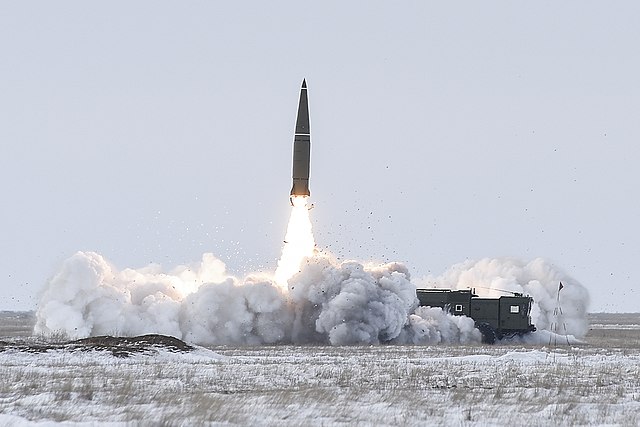
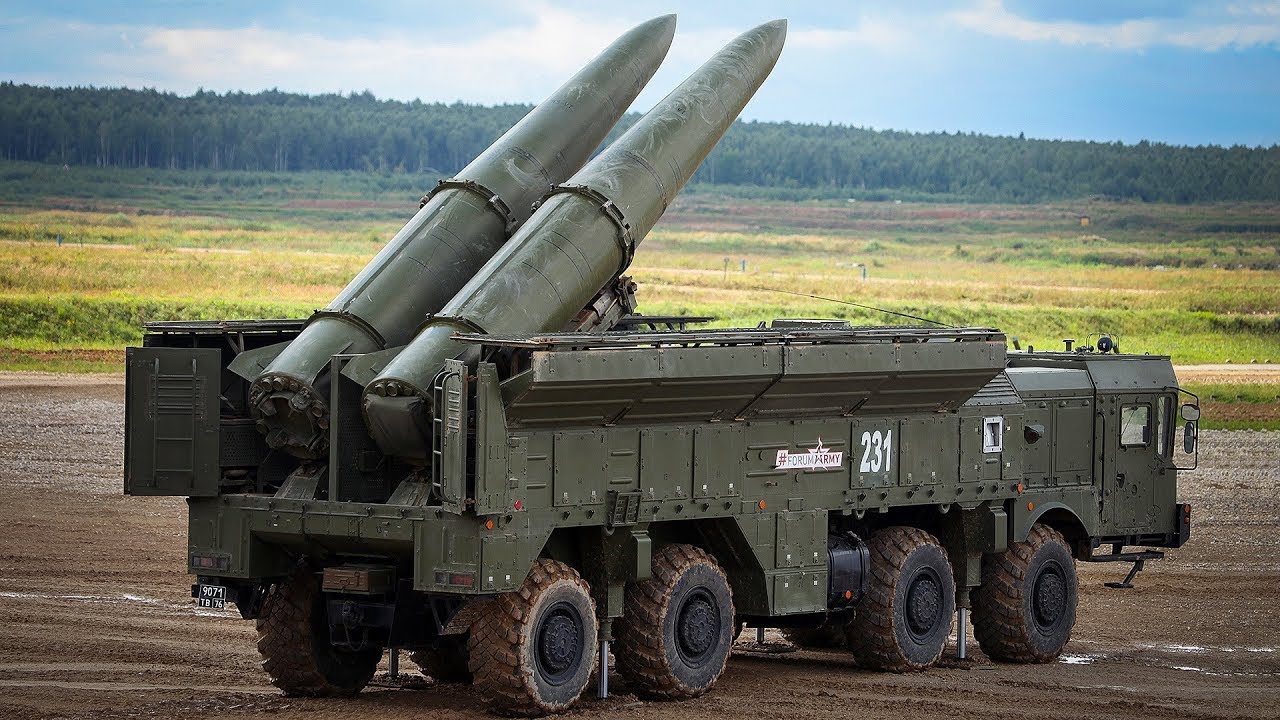
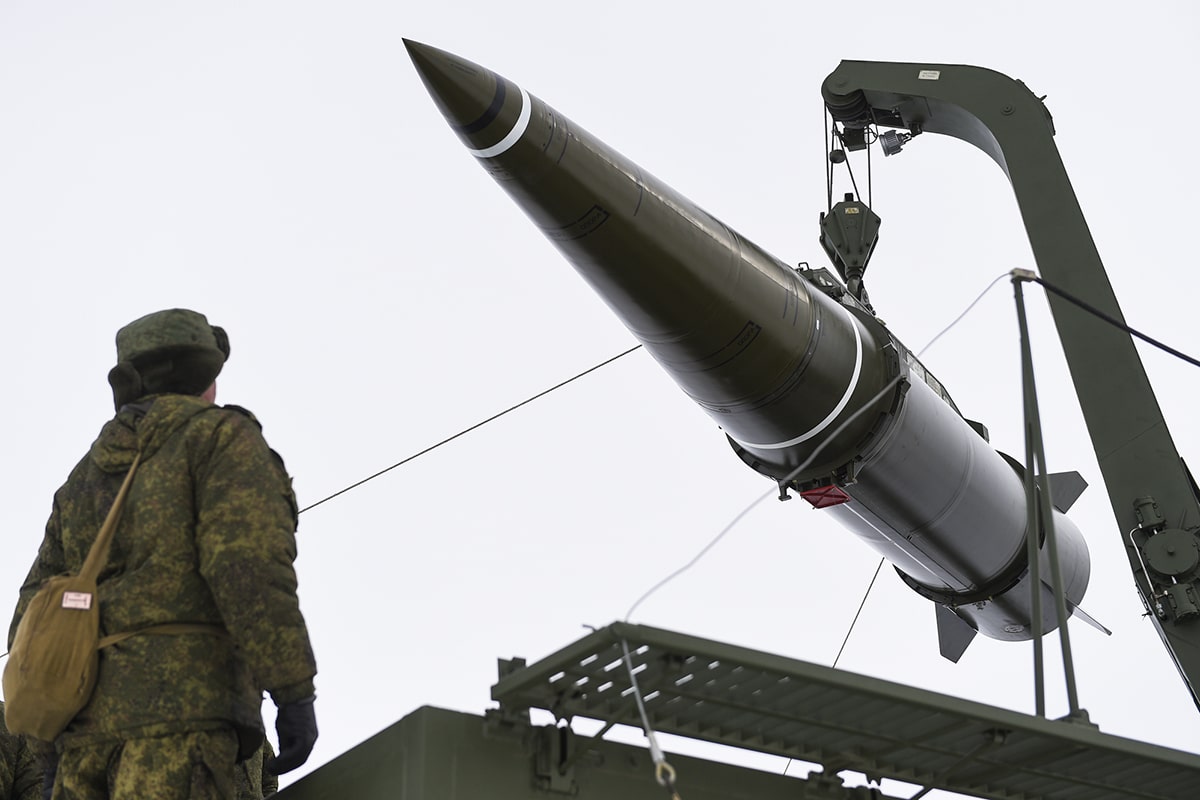
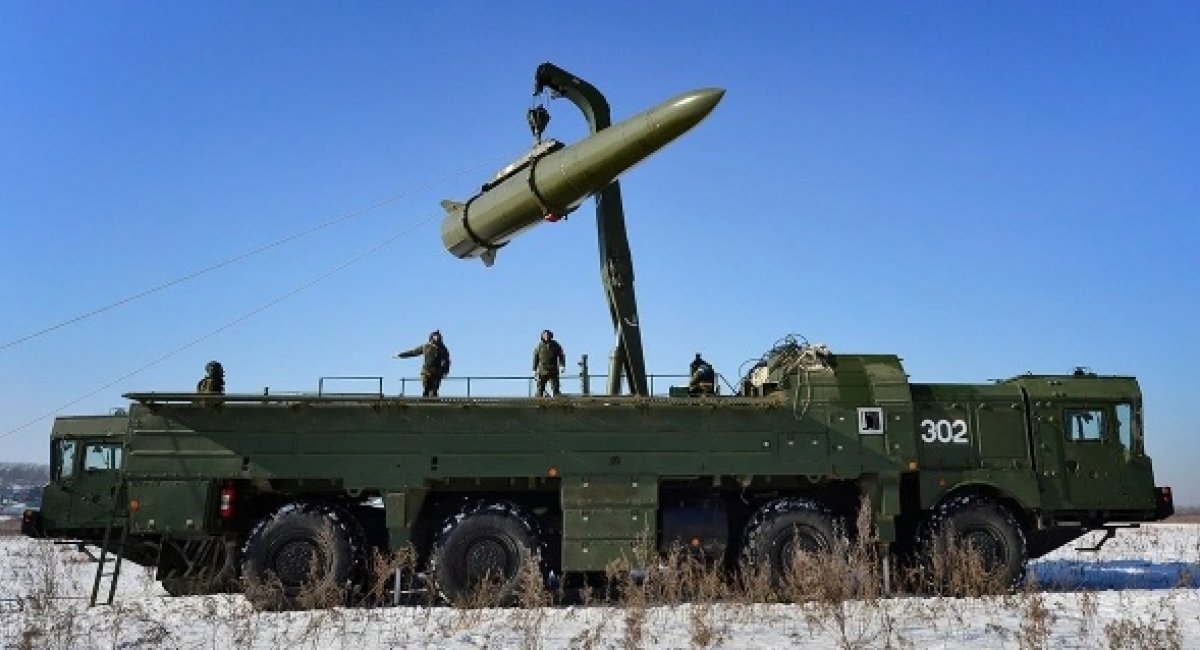
The name is a Central Asian and Caucasian form of Alexander (Alexander the Great), and the system is not a single missile. "Iskander" in a news report can mean the ballistic 9M723, a cruise missile fired from the same truck, or the truck itself, and the three have very different performance.
The short version. The 9M723 is a roughly 3.8-tonne, 7.3-metre solid-fuel missile with an exhaust speed of around 2.5 km/s (a figure given by the Royal United Services Institute, RUSI) and a burnout speed of around 2.1 km/s. It climbs to around 50 km and not much higher (reports range from 50 km to 100 km), comes down steeply at roughly Mach 4 to 6, and can steer with fins and gas jets throughout. Its guidance combines an inertial platform, satellite navigation, and in some versions an optical correlation seeker that compares a camera image of the target area with a stored picture. Its warhead, 480 to 700 kg depending on version, can be a cluster warhead of dozens of submunitions, a unitary high-explosive or penetrating warhead, a thermobaric (volume-detonating) charge, or a nuclear device. The launch vehicle can be ready to fire in about 4 to 5 minutes from a halt and 16 minutes from the march, and then drive away. It has been used against Georgia in 2008, almost certainly in Syria, and, from 2022, by the hundreds against Ukraine. [DOCUMENTED / SINGLE-SOURCE as marked in the sections below]
HOW TO READ THIS PAGE
Important claims carry a label:
The numbers in this subject are unusually contested. Russian brochures, Ukrainian intelligence, Western think tanks and journalists quote different ranges, accuracies and production rates, and a lot of the data is wartime data from interested parties. Where this page quotes a figure it says whose figure it is.
NAMES AND DESIGNATIONS
The Iskander family has many names. Keeping them apart avoids most confusion.
| Name | What it is | Notes |
|---|---|---|
| 9K720 Iskander (9К720 «Искандер») | The whole complex | SS-26 Stone is the NATO name for the ballistic missile. Some sources write the GRAU index as 9K270, which appears to be a transposition. |
| Iskander-M (Искандер-М) | Russian service version of the ballistic complex | Two 9M723 missiles per launcher. |
| 9M723 (9М723), 9M723-1, 9M723-1K5 | The ballistic missile and its variants | Letters and digits after the dash mark improved versions and warhead types. |
| 9M723-2 | Longer-motor version, press name "Iskander-1000" | Reported by Ukrainian intelligence as part of "Bora-M". Needs a longer launcher. |
| Iskander-K (Искандер-К) | Cruise-missile loadout, "К" for крылатая (winged) | Same launcher family. |
| 9M728 (9М728), R-500 (Р-500), 9M727 | Cruise missiles of the Iskander-K | NATO name SSC-7 Southpaw. Range about 500 km published. |
| 9M729 (9М729) | Longer cruise missile | NATO name SSC-8 Screwdriver. The INF Treaty dispute. |
| 9P78-1 (9П78-1) | Transporter-erector-launcher (ТПК / СПУ, "самоходная пусковая установка") | 8x8, two missiles. "СПУ" is the generic Russian abbreviation for self-propelled launcher. |
| 9T250 / 9T250E (9Т250) | Transporter-loader (ТЗМ, транспортно-заряжающая машина) | Two spare missiles and a crane. |
| 9S552 (9С552) | Command-and-staff vehicle (КШМ) | KAMAZ chassis. |
| 9S920 (9С920) | Information-preparation (data-processing) station | KAMAZ chassis. |
| Iskander-E (Искандер-Э) | Export version | 280 km, simplified guidance. |
| Iskander-M1 / 9P701 | Modified launcher for the 9M729 | Reported; the details are not officially published. [SINGLE-SOURCE] |
The vehicles. A complete brigade set also includes a maintenance and repair vehicle (МРО), a life-support vehicle (МЖО), depot equipment and training equipment. [DOCUMENTED, CSIS Missile Threat and the Wikipedia component list]
WHERE IT CAME FROM
The Soviet ancestors. The Iskander is often described as the replacement for the Tochka (OTR-21, SS-21 Scarab) and the older Scud-family missiles. RUSI argues that its direct technological predecessor was a different Soviet missile: the OTR-23 Oka (SS-23 Spider). The Oka was a solid-fuel missile that could be set up and fired in about five minutes, and it was part of a family of systems that Marshal Nikolai Ogarkov described as the reconnaissance-strike complex (разведывательно-ударный комплекс): a network of sensors and prompt-strike missiles able to hit targets across a theatre at short notice. The Oka was eliminated under the INF Treaty of 1987, which banned ground-launched missiles with ranges of 500 to 5,500 km. [DOCUMENTED] The Oka used a combination of inertial guidance and an early scene-matching area correlator (DSMAC-style) in its terminal phase, and its accuracy was estimated at 50 to 100 m, good enough for large fixed targets but not for hardened or mobile ones. [DOCUMENTED, RUSI]
The Iskander programme. Design work started in December 1988 under KBM, initially directed by Sergey Nepobedimy, and carried on through the collapse of the Soviet Union. The first successful launch was in 1996. In September 2004 the defence minister, Sergey Ivanov, announced that static tests were complete and that series production would begin in 2005. Serial production of the Iskander-M began in 2006 and the system was adopted by the army. [DOCUMENTED, Wikipedia and GlobalSecurity] RUSI suggests the Oka work continued in the 1990s under cover of a satellite programme at KBM. [SINGLE-SOURCE] The Iskander-M inherited an electro-optical seeker that had been planned for the Oka, which RUSI says reduced circular error probable (CEP) by an order of magnitude, to 5 to 10 m. [DOCUMENTED, RUSI]
The role. The Iskander is assigned to the army's missile brigades (ракетные бригады), separate from the Strategic Rocket Forces. At least one brigade per military district was the plan. Its job is operational-tactical precision strike: air bases, air defences, command posts, depots, bridges, troop concentrations, artillery and rocket launcher positions, and in a nuclear role, targets for non-strategic nuclear weapons. [DOCUMENTED] KBM's own list of intended targets (via Wikipedia) includes "hostile fire weapons (missile systems, multiple launch rocket systems, long-range artillery pieces), air and missile defence weapons, aerodromes, fixed- and rotary-wing aircraft at airfields, command posts and communications nodes, troops in concentration areas, critical civilian infrastructure facilities," and hardened targets such as bunkers or aircraft shelters. [DOCUMENTED]
THE BRIGADE: HOW THE SYSTEM IS ORGANISED
Organisation. An Iskander-M brigade has three battalions (дивизионы), each with four 9P78-1 launchers, so 12 launchers and 24 ready missiles per brigade, plus loaders, command vehicles and support. [DOCUMENTED, RUSI citing Janes, and CSIS] With the reload vehicles, the brigade carries a further two missiles per 9T250 transporter-loader.
How many brigades. Russia was re-equipping with the system through the 2010s. CSIS counted 11 combat brigades of Iskander-M as of 2019, the last set was delivered to the 448th Missile Brigade in November 2019, and Wikipedia gives a total of 13 brigades (160 launchers with one battalion of four at the Kapustin Yar test range) in its present text. One more brigade set and two battalion sets were delivered in late 2021. [DOCUMENTED for the deliveries, SINGLE-SOURCE for the exact present count] Brigades are spread across the military districts: for example the 26th Missile Brigade at Luga (south of St Petersburg), the 92nd at Kamenka near Penza, the 103rd at Ulan-Ude, and others in the Far East, on the Southern Military District, and near the Ukrainian border. [SINGLE-SOURCE, Stratfor 2010 as quoted; brigade locations and numbers have changed]
Stockpiles. Wikipedia, citing the Institute for the Study of War, says Russia held roughly 600 Iskander-M ballistic missiles and 300 Iskander-K cruise missiles as of June 2025. [SINGLE-SOURCE] Since then, mass use has probably reduced it. The same article says leaked or classified documents point to orders for 1,202 9M723 missiles in 2024 and 2025 (589 in 2024 and 643 in 2025), 303 9M728 cruise missiles in 2024 and 2025, 95 modernised 9M729 missiles in 2025, and 18 9M723-2 missiles in 2025. [SINGLE-SOURCE, via Militarnyi; treat as unverified] Production figures are covered in the combat section.
Who gets what. The command vehicle (9S552) can communicate with several launchers and send new target coordinates to the crews. Each launcher can operate independently. [DOCUMENTED, CSIS] A single brigade can therefore operate as a dispersed collection of launchers that gather for a salvo and scatter, which is the basis of the system's survivability.
THE LAUNCHER: 9P78-1 ON THE MZKT-7930
Chassis. The 9P78-1 TEL is built on the 8x8 MZKT-7930 all-terrain chassis from the Minsk Wheel Tractor Plant (МЗКТ, Belarus). This is a chassis in the "Astrolog" family. The Wikipedia text says 8x8 MZKT-79306. RUSI gives a gross vehicle mass of 42.3 tonnes. CSIS gives about 43 tonnes loaded with two missiles, and says the vehicle is amphibious, can travel at up to 70 km/h on a road, has a range of about 1,100 km, and has an operating temperature range of -50 to +50 degrees Celsius. [DOCUMENTED] The old version of this page, quoting a published Russian set, gave a length of about 13.1 m, width 3.5 m, height 3.45 m, a YaMZ diesel engine and a road range of about 1,000 km. [SINGLE-SOURCE, carried forward] The crew is three.
Belarus. The reliance on a Belarusian chassis is a recurring point in the literature. RUSI notes in a 2023 commentary (via Wikipedia) that MAZ/MZKT remained the main chassis supplier because domestic Russian chassis were of lower quality. [SINGLE-SOURCE] A Russian programme to replace foreign chassis is plausible but not documented here. It is one of the system's dependencies on a third country, along with its electronic components (discussed later).
Armour and CBRN. The TEL has an armoured roof to protect the two missiles and its cab is sealed against chemical, biological, radiological and nuclear hazards, with heating and cooling. [DOCUMENTED, CSIS] That is protection against fragments and fallout, not against a direct hit. A TEL is a soft-skinned truck in the sense that matters: a modern drone or a loitering munition can disable it.
Gas-turbine power. RUSI says the TEL has a gas-turbine generator that powers the elevation of the missiles and their programming. [DOCUMENTED] This matters in practice because a vehicle running its main diesel at an idle emits heat and noise that infrared sensors and acoustic arrays can detect. A separate auxiliary power unit lets the launch crew prepare the missiles with less signature. (Whether the Iskander's signature is lower than that of older launchers is not documented.)
The launch sequence. The sequence described in the open literature is: [DOCUMENTED / SINGLE-SOURCE as marked]
Physics of the launch signature. A solid rocket with about 2.5 tonnes of propellant releases energy at a rate of order a gigawatt during burn. [ESTIMATE: propellant mass 2,500 kg from the rocket-equation calculation later in this page, specific energy about 5 MJ/kg and a burn time of order 30 s give about 0.4 GW; the plume gas temperature is around 2,500 to 3,000 K] That infrared signature is detectable by space-based early-warning sensors (the American SBIRS and its successors) and by airborne and ground sensors. The reason is the same as for the larger missiles discussed on the Voronezh and Solnechnogorsk SPRN pages: launch is the moment of greatest detectability. The Iskander's answer is not stealth but the time spent at the launch site. The missile is up and away in less than a minute after the second launch, and the truck is gone before a human analyst has finished reading the alert.
Both missiles, different types. RUSI notes it may be possible for a single TEL to carry two different missiles (a 9M728 cruise missile and a 9M723 ballistic missile, say) and launch both so that they arrive together. [SINGLE-SOURCE, speculation] That is an old and good idea: a cruise missile flying at 50 to 150 m altitude and a ballistic missile descending at Mach 5 arrive from different directions and altitudes, and the radar picture shows two kinds of target. The air defence must handle both. The time of flight of the slower cruise missile sets the launch order.
THE TRANSPORTER-LOADER AND THE LAUNCH CYCLE
The 9T250 (9T250E in export documents) transporter-loader (ТЗМ) is also on the MZKT-7930 chassis and carries two further missiles and a crane. RUSI says a crew of two reloads the TEL in about 16 minutes, and the crane can dock and undock warheads. The vehicle mass is reported as about 40 tonnes. [DOCUMENTED / SINGLE-SOURCE] A brigade therefore has a total magazine of 48 missiles on wheels (24 on TELs, 24 on loaders), plus whatever stocks exist at depots. The loader is one of the vehicles whose survival determines how fast the brigade can fire a second salvo, and which Ukrainian forces and others consider a priority target.
The weak link. A missile brigade fires its first 24 missiles from the TELs quickly. After that, the rate of fire depends on the loaders, whose reload time of 16 minutes is the same as the time from the march to fire. It follows that a TEL, if allowed to, could fire two missiles every half hour from one position, but the physics of detection and counter-battery fire argues that nobody will stay at the position for that long. In practice a TEL fires, moves, and gets reloaded elsewhere. [ESTIMATE of cycle times from the reported numbers]
THE 9M723 MISSILE
Dimensions. Length about 7.3 m (Ukrainian intelligence gives 7.2 m), body diameter 0.92 m, launch mass about 3,800 kg (sources range from about 3,750 to 4,020 kg). The warhead is 480 to 700 kg depending on version. Ukrainian intelligence lists a 450 kg warhead for the 9M723-1. Burnout speed is about 2,100 m/s (the old version of this page said Mach 6 to 7, which is the way the number is often phrased). Minimum range is about 50 km. [DOCUMENTED / SINGLE-SOURCE; the spread in the numbers is real]
Configuration. It is a single-stage missile with a solid-propellant motor. Wikipedia and other open sources describe thrust-vector control during boost by graphite jet vanes in the exhaust, in the layout familiar from the V-2 and Scud families, and aerodynamic control with small fins that reduce the radar cross-section, together with gas-dynamic (jet) control elements that give control authority at altitudes where the air is too thin for fins. The missile is controlled throughout the flight and its warhead is described as non-separable (inseparable) in some sources, though cluster-warhead variants are reported to release submunitions. [DOCUMENTED / SINGLE-SOURCE; the details of the control system are not officially published]
Solid rocket motor physics. A rocket's ability to change its own velocity is governed by the Tsiolkovsky equation:
delta-v = v_e x ln(m_0 / m_1)
where v_e is the effective exhaust speed and m_0 and m_1 are the initial and final masses. For a solid motor the exhaust speed is set by the propellant chemistry: ammonium perchlorate oxidiser, powdered aluminium and a polymer binder (the standard composite propellant family). Typical specific impulse is about 240 to 265 s at sea level and more in vacuum, so v_e = I_sp x g = about 2.4 to 2.6 km/s. RUSI says "roughly 2.5 km/s (comparable to a space shuttle booster)" for the 9M723. [DOCUMENTED for the figure's source]
To reach a burnout speed of about 2.1 km/s starting from rest, the missile must supply more than that, because gravity and air drag subtract energy during the climb. Assuming about 600 m/s of gravity and drag losses (a typical figure for a short, steep tactical missile), the required delta-v is about 2.7 km/s. [ESTIMATE, the losses are an assumption] Then:
m_0 / m_1 = exp(2,700 / 2,500) = 2.94
so the propellant is about 66 percent of the launch mass. With m_0 = 3,800 kg, the burnout mass is about 1,290 kg and the propellant about 2,500 kg. That includes the warhead, guidance, structure and the empty motor case, which together are on the order of a tonne or more. The result is plausible for a tactical missile and it is the basis for the later energy estimates. [ESTIMATE; the true mass fraction is not published]
A different delta-v budget shows why range is such a sensitive subject. Because delta-v depends on the logarithm of the mass ratio, adding a few percent more propellant (the Iskander-1000 reportedly has a longer motor) or removing 100 kg of warhead raises burnout speed by only 50 to 150 m/s. But ballistic range goes roughly as speed squared, so 5 percent more speed gives about 10 percent more range. That is why an Iskander with a lighter warhead can go much farther than one with a heavy warhead: the 2007 comment by Colonel General Zaritsky quoted by RUSI says exactly this, that the range can be doubled depending on the warhead size and the trajectory. [DOCUMENTED for the statement; the doubling is an assertion]
Burn time. It is not published. A burn of 25 to 35 s would imply an average acceleration of about 8 to 11 g (delta-v of 2.7 km/s divided by 30 s is 90 m/s^2, about 9 g), which is ordinary for a solid-fuel tactical missile. [ESTIMATE]
Why solid propellant matters. A liquid-fuelled Scud has to be fuelled before launch, with toxic and corrosive propellants, taking an hour or more. A solid rocket is stored ready, so the 9M723 can sit in its launcher for months and be fired in minutes. The cost is lower specific impulse, higher cost per kilogram of propellant, and ageing: the assigned service life of the missile is reported as 10 years. [DOCUMENTED, Wikipedia] The reliability of ageing solid motors, with cracks forming in the propellant grain, is one reason for the continuous production that Russia has needed.
FLIGHT PATH PHYSICS: BALLISTIC AND QUASI-BALLISTIC
A missile burnout at velocity v and path angle gamma, at some altitude, then follows an elliptical orbit (an arc of a Kepler ellipse) that intersects the Earth, if nothing else acts on it. Such a pure ballistic path has three features: it is predictable (so radar can compute the impact point within seconds of the burnout), it is high (so it is seen early from far away), and its terminal speed is the same as the burnout speed plus the energy of the fall. The term quasi-ballistic describes a path that is mostly ballistic but not entirely: the missile stays in the atmosphere or on its edge, and it can steer.
A calculation. To see the numbers, the author integrated a spherical-Earth trajectory with a burnout speed of 2,100 m/s at an altitude of 25 km and different path angles, ignoring drag and the rotation of the Earth. [ESTIMATE, the burnout altitude and speed are assumptions]
| Burnout path angle | Range | Apogee | Time of flight | Impact speed (no drag) |
|---|---|---|---|---|
| 15 degrees | 313 km | 41 km | 155 s | 2.2 km/s |
| 20 degrees | 367 km | 53 km | 188 s | 2.2 km/s |
| 30 degrees | 452 km | 85 km | 252 s | 2.2 km/s |
| 40 degrees | 491 km | 124 km | 312 s | 2.2 km/s |
| 45 degrees | 491 km | 144 km | 340 s | 2.2 km/s |
Several things follow. First, with a burnout speed of 2.1 km/s the maximum possible range is about 490 km. That is a physical upper bound for this speed and altitude, reached on a high path with an apogee of 120 to 145 km. This is the origin of the "500 km" figure: it is about what a missile with this performance can do on the best possible path with a light warhead. Second, if the missile flies a depressed path with an apogee of about 50 km, which is the figure usually given for the Iskander, its range is about 365 km and its flight time about 190 s, or just over three minutes. That agrees surprisingly well with the Ukrainian intelligence figure of about 390 km for the standard 9M723-1, and with the "400 km confirmed, 415 km published" figure on the Wikipedia page. [ESTIMATE, a consistency check not a proof] Third, any quasi-ballistic manoeuvring and atmospheric drag costs further range. So a missile that really does fly low and manoeuvre will not reach the maximum. This is the reason a range of 500 km on an official sheet is a statement about the lightest warhead on an optimal path, not a statement about what a missile does against a real target.
Flight time and warning. A flight of roughly three to five minutes is typical for 150 to 400 km. [ESTIMATE; KBM and press accounts give similar numbers] Ukrainian intelligence says ballistic missiles reach Kyiv "in a few minutes". Detection, tracking, classification, decision and engagement all have to fit in that time, and an interceptor launched only after the target is classified as ballistic has less time still.
Why a depressed path? The depressed path keeps the missile in dense air for longer. That has three effects.
Terminal manoeuvre physics. A missile in the atmosphere can generate side force F = q x S x C_N, where q = 0.5 x rho x v^2 is the dynamic pressure, S the reference area (for a body diameter of 0.92 m, S is about 0.66 m^2) and C_N the normal-force coefficient at the angle of attack used (a value of 1.5 is plausible for modest angles of attack at supersonic speed). The lateral acceleration is F divided by the mass, which after burnout is about 1,300 kg. [ESTIMATE, assumptions as stated]
| Altitude | Speed (assumed) | Mach | Dynamic pressure | Lateral acceleration | Turn radius | Ideal stagnation temperature |
|---|---|---|---|---|---|---|
| 40 km | 1,900 m/s | 6.4 | 7 kPa | 0.6 g | 650 km | about 2,000 K |
| 30 km | 1,800 m/s | 6.1 | 30 kPa | 2.3 g | 140 km | about 1,800 K |
| 20 km | 1,600 m/s | 5.4 | 114 kPa | 9 g | 29 km | about 1,500 K |
| 10 km | 1,300 m/s | 4.3 | 350 kPa | 27 g | 6 km | about 1,060 K |
| 5 km | 1,100 m/s | 3.4 | 445 kPa | 35 g | 3.5 km | about 860 K |
This table, which the author calculated using a standard atmosphere, shows what the "up to 30 g" claims mean. The missile cannot manoeuvre hard at 40 km, where the air is too thin. It can pull several g at 30 km, and tens of g at 10 km. The airframe structural limit and the actuators limit it too. So the missile's manoeuvre is a late event: most of the effect comes in the last 20 km of altitude, in the last 20 to 40 seconds of flight. A lateral acceleration of 20 g sustained for 10 s moves the missile sideways by 0.5 x 200 x 100 = 10 km, but the guidance can only turn in directions that keep the aim point reachable, so a typical evasive deviation is much smaller, hundreds of metres to a few kilometres. [ESTIMATE; the missile's real manoeuvre limits and algorithms are not published] The reported figure of "up to 30 g" in secondary sources is consistent with these numbers at 5 to 10 km altitude. [SINGLE-SOURCE]
Heating. At Mach 6 the ideal stagnation temperature is T0 = T x (1 + 0.2 M^2): at 30 km altitude (T = 227 K) about 1,800 K; the real temperature is lower because air dissociation absorbs energy, but the nose and leading edges still reach many hundreds of degrees. This is moderate compared with an intermediate-range missile re-entering at 5 to 7 km/s, whose stagnation temperature reaches several thousand kelvins. The Iskander needs a thermal protection layer on the nose and fins but not the heavy ablative shield of a long-range re-entry vehicle. [ESTIMATE]
Boost-phase manoeuvres. RUSI adds that the missile can perform "rapid and extreme manoeuvres shortly after launch" to hide the launch site, and cites Uzi Rubin, formerly of the Israeli missile-defence organisation, as saying that the effect would be less for a tactical missile than for a strategic one. [SINGLE-SOURCE] The reason is simple: the point of the manoeuvre is to make the track back to the launcher inaccurate, but the launcher of a short-range missile is already so close to the target that a few seconds of the track give it away.
WHY IT IS HARD TO INTERCEPT
The air-defence problem against the 9M723 has several parts, each of which can be separated from the others.
1. Time. The total flight is three to five minutes. A search radar has to detect a missile that rises from beyond its horizon, the system has to track it long enough to classify it, and the battery has to select it and fire. A typical Patriot engagement, as AP puts it, "must track the missile, predict its path and launch within minutes, sometimes leaving seconds for the final engagement". [DOCUMENTED, AP]
2. Speed and altitude. A target at Mach 4 to 6 in the final phase requires a fast interceptor and good geometry. RUSI notes that an interceptor needs to accelerate at least 1.6 times faster than its target. The 9M723 is well within the capability of the PAC-3 MSE, which has been tested against faster medium-range ballistic targets. The older blast-fragmentation interceptor PAC-2 GEM-T is less suitable at the full speed of the missile. [DOCUMENTED, RUSI] Ukrainian officials say the PAC-3 is the only system in their arsenal able to engage Iskander-M reliably. [DOCUMENTED, AP via Ukrainian Air Force spokesman Yurii Ihnat]
3. Hit-to-kill is unforgiving. The PAC-3 MSE does not rely on a proximity fuse and fragmentation. It uses an active radar seeker and 180 small attitude-control rocket motors in a collar, flying into the target for a direct hit. The kinetic energy of the impact at a closing speed of 2 to 3 km/s is about 2 to 4 MJ per kilogram of interceptor mass, enough to destroy a warhead. [DOCUMENTED for the design, ESTIMATE for the energy] The challenge is the miss distance. A closing speed of 3 km/s and a target that changes direction by 10 degrees in the last 3 seconds means the interceptor has to correct for a lateral displacement of tens to hundreds of metres in a very short time, which requires the interceptor to turn with an acceleration much higher than the target's.
4. Late manoeuvre. If the terminal manoeuvre is a feature, the target changes its acceleration at the point where the interceptor can least react. Proportional-navigation guidance, which most interceptors use, assumes a target that flies a smooth path, and the guidance law's sensitivity to target acceleration is highest at the end. RUSI says a manoeuvring target of this kind imposes "especially stringent requirements on air defences; both in terms of their load factor and the speed at which interceptors can integrate information from their seekers". [DOCUMENTED, RUSI]
5. Decoys and penetration aids. The Iskander can carry 9B999 decoys: six canisters at the base of the warhead, with some decoys emitting thermal signatures, others equipped with jammers for active seekers, and possibly some designed to look larger to radar. [DOCUMENTED, RUSI] The existence of this decoy capability was publicised in March 2022, when an American official told the New York Times that Iskander-M missiles in Ukraine were releasing a previously unknown decoy, a point also reported by The War Zone. [DOCUMENTED] RUSI observes that the inclusion of decoys is slightly surprising if the missile manoeuvres at 2.1 km/s as claimed, and might be "preliminary evidence that the 9M723 is less manoeuvrable in its terminal phase than is claimed". [SINGLE-SOURCE, an analyst's inference]
6. Small radar cross-section, speed discrimination. The fins are small to reduce the radar signature. [DOCUMENTED] A ballistic target at 30 to 40 km is a small object. But RUSI also notes that ballistic targets are "relatively easy to discriminate and prioritise, if not necessarily engage" because of the different speed and altitude profiles from aircraft and cruise missiles. [DOCUMENTED]
7. The weapons that can catch it. Western systems that can engage such a target include the Patriot PAC-3 MSE, the European SAMP/T, and, at larger scale, systems such as THAAD and the Aegis SM-3/SM-6. In Ukraine the Patriot is by far the most important, with SAMP/T in smaller numbers. The French Army reportedly said SAMP/T outperformed Patriot against Iskanders after Russia changed flight profiles (as stated by Wikipedia citing a United24 report). [SINGLE-SOURCE] The Russian A-135 (see A-135 / A-235 Nudol and Don-2N) and the S-300V/S-400/S-500 families are Russian examples of the same technologies: the S-400 and S-300V were designed against missiles of this class. Russian systems of this kind are discussed on the S-400, S-300 and S-500 pages.
8. What has changed. Reports in 2025 said Russia had changed the missile's flight profile. A US Defense Intelligence Agency report, according to Wikipedia, said Russia had upgraded the Iskander and Kinzhal with a terminal-phase manoeuvring capability in spring 2025 to bypass Patriot. A Financial Times article of October 2025 said interception rates fell from 37 percent in August to 6 percent in September. [SINGLE-SOURCE, via Wikipedia and secondary press] Tech outlets later added that the missile uses a random-number algorithm to produce unpredictable changes in its last seconds. [UNVERIFIED] RUSI's analysis of the question lists three hypotheses: a higher-altitude (steeper) trajectory giving a higher terminal speed and more lateral force (because dynamic pressure scales with the square of speed); better decoys, possibly with software that targets a narrow-aperture seeker; and salvo effects. It concluded that none is proven and that the first two are plausible. [DOCUMENTED, RUSI] A TASS report of a 2017 exercise (as RUSI notes) said a missile fired at a target 140 km away reached an altitude of 100 km, which conflicts with the usual 50 km figure. [SINGLE-SOURCE] That 100 km figure would fit the steeper-trajectory hypothesis. A steeper path costs range, which fits the Ukrainian intelligence view that the standard 9M723-1 is a 390 km weapon.
GUIDANCE: HOW IT FINDS THE TARGET
Three layers. The 9M723 uses a layered scheme, as is usual for a precision missile. The published descriptions agree on the layers. Which seeker a given missile carries depends on its warhead and version. [DOCUMENTED / SINGLE-SOURCE as marked]
1. Inertial navigation (ИНС, инерциальная навигационная система). The missile carries an inertial platform of gyroscopes and accelerometers that integrates its own motion from launch. It cannot be jammed and needs no outside signal, but it drifts. A GUR document published in August 2026 on the foreign components found in the missile says the flight-information processing unit built around a laser gyroscope has 43 components of which only 5 are Russian-made. [SINGLE-SOURCE, GUR, a Ukrainian intelligence publication] See the page on inertial navigation systems for the physics of ring-laser gyros and accelerometers.
The drift budget. The physics shows why inertial alone gives tens of metres at best. A heading error of 0.01 degree (0.17 milliradian) from gyro bias becomes a lateral error of 0.17e-3 x 400 km = 70 m at 400 km range. An accelerometer bias of 100 micro-g acting for 200 s gives a position error of 0.5 x 1e-3 x 200^2 = 20 m. Add alignment errors on the launcher (the missile has to know its own orientation and position at launch, which is why the launcher determines its position), and the total is tens of metres. [ESTIMATE with assumed sensor grades; the real values are unpublished] That matches the statement in RUSI that cluster-warhead missiles without a terminal seeker "are able to strike within 30 m of their intended target". [DOCUMENTED, RUSI]
2. Satellite navigation. The mid-course guidance uses GLONASS (and possibly GPS), as the Wikipedia infobox and RUSI say, to correct the inertial drift. See the GLONASS page. A satellite receiver updates the inertial platform, so the position error falls to metres, but it is exposed to jamming and spoofing, and Western components in the guidance chain are a point of vulnerability. [DOCUMENTED] RUSI adds that the Iskander-K cruise missile's processing module is the SN-99, compatible with GPS and GLONASS and common to the Kh-101 and Kalibr, and "reliant on a number of key Western components". [DOCUMENTED, RUSI]
3. Terminal seeker: scene matching. The Iskander-M is credited with an optical correlation seeker (оптическая корреляционная ГСН), tested at Kapustin Yar on 14 November 2011 according to the vpk.name reference. [SINGLE-SOURCE] The missile carries a stored reference image of the target area, prepared in advance from satellite or aerial pictures on the 9S920 information-preparation vehicle. In the last part of the flight an electro-optical sensor looks down, and an on-board computer (RUSI names the Baget 62-04) correlates the live image with the stored one and steers to the best match. The same idea is known in the West as DSMAC (Digital Scene Matching Area Correlator) and for cruise missiles as TERCOM (terrain contour matching), a technique described on the TERCOM page.
The principle of correlation is simple. If I(x, y) is the live image and R(x, y) the reference, the computer evaluates the cross-correlation C(dx, dy) = sum of I(x, y) x R(x + dx, y + dy) over the pixels, finds the shift (dx, dy) that maximises it, and treats that as the position error to be removed. A good match to a small area gives sub-pixel accuracy. With a pixel footprint of a metre or so on the ground, a shift can be measured to a fraction of a metre. The accuracy then depends on the quality of the reference picture and on how well the view matches it, which is why the method works for fixed targets with good reference imagery and less well for camouflaged or recently changed scenes. [ESTIMATE of the method; the details of the actual algorithm are not public]
Accuracy figures. The KBM brochure figure is a CEP of 5 to 7 m with the terminal optical seeker, and a range of 1 to 30 m is quoted for the whole family. RUSI says seeker-equipped missiles "may be capable of striking within 7 m". The old version of this page described the 5 to 7 m figure as a brochure number, and that description is kept: real accuracy in combat depends on the quality of the reference image, the jamming environment and the target, and the quoted numbers are best-case. [DOCUMENTED as brochure claims] In April 2024 the general director of the developing company said precision had been improved since the start of the invasion of Ukraine. [SINGLE-SOURCE, Wikipedia via RIA Novosti] Wartime evidence of impact points, as seen in many strikes on air bases and on individual vehicles, is consistent with metres to tens of metres, but is not a clean statistical sample.
Radar seeker. The vpk.name reference lists a 9M723-1F version with a radar seeker (радиолокационная ГСН 9Б918). RUSI says the missile may also carry a radar-processing system called Zarya that is found on the 9M727. The 2018 Russian claim that Iskanders had been used to hit ships (a "static sea target", per the Wikipedia text) implies a seeker able to see against a sea background. [SINGLE-SOURCE]
Data link and retargeting. The missile receives its target data before launch by the cab's data link. Wikipedia says it can be retargeted in flight, and that its optical head can be controlled by encrypted radio transmission from AWACS or UAVs. RUSI says Russia worked in 2009 to incorporate datalinks to draw on UAV and satellite data, finds it likely that this succeeded "on the balance of probabilities", but notes there is no conclusive evidence. [UNVERIFIED] The frequency of drone footage of Iskander strikes in Ukraine might support in-flight retargeting, or may simply reflect drones used for target designation and damage assessment, with a sampling bias. [DOCUMENTED, RUSI's own caution]
WARHEADS
The non-nuclear warhead options reported for the 9M723 are these. The warhead mass is 480 to 700 kg. [DOCUMENTED / SINGLE-SOURCE as marked]
The physics of the warheads. A high-explosive warhead of 480 kg with about 150 to 200 kg of explosive creates a fragment cloud with initial speeds of about 1.5 to 2 km/s (Gurney velocity for a typical case), whose lethal area for personnel on open ground can be several thousand square metres, and a blast wave that damages buildings within tens of metres. A cluster warhead lets a missile cover a bigger area: 54 submunitions spread over a footprint of order 100 to 200 m across put fragments over hectares, which is why cluster warheads are used against parked aircraft, radar sites, vehicle parks and troop concentrations. [ESTIMATE, the lethal areas depend on fragment size, spacing and the target] A thermobaric charge works by releasing fuel into the air, which creates a long, sustained overpressure rather than a short sharp one: the impulse (pressure integrated over time) is high, which is what kills people in buildings and tunnels and damages light structures.
The nuclear option. For a nuclear device of 5 to 50 kt, the blast radius for 5 psi overpressure (heavy damage to ordinary buildings) scales as the cube root of yield. Using the Hiroshima yield of about 15 kt and a 5 psi radius of order 1.3 to 1.6 km for an air burst as the reference, a 10 kt device gives about 1.1 to 1.4 km and a 50 kt device about 1.9 to 2.4 km. [ESTIMATE from cube-root scaling] The missile's accuracy of tens of metres is much better than needed for such a warhead. Its importance is mostly that a nuclear-capable, dual-use system forces the other side to consider that any launch might be nuclear, a point made in the RUSI profile about the role of Iskander in "escalation management and war termination".
ISKANDER-K: THE CRUISE MISSILES
"К" stands for крылатая, winged. The Iskander-K uses the same launcher family with cruise missiles. [DOCUMENTED]
9M728 (R-500), 9M727. A land-attack cruise missile, NATO name SSC-7 Southpaw, in the Kalibr (3M-14) family by development, from the Novator design bureau, as Wikipedia and the old page say. Published range is about 490 to 500 km (the "R-500" label), warhead about 480 kg, flight altitude up to about 6 km but typically 50 to 150 m above land, terrain-following, down to six metres on approach in one report. Guidance is inertial plus satellite, with a radar seeker that starts searching within 20 km of the target (per Janes via RUSI) and a TV guidance processor (Baget 62-04). Accuracy is quoted as 1 to 3 m with the radar seeker. [DOCUMENTED / SINGLE-SOURCE, RUSI and Janes] The 9M727 may be an earlier version of the 9M728 and the two are hard to tell apart; both have been used in Ukraine, per RUSI. The standard Iskander launcher carries two missiles in canisters, as seen in photographs.
The physics of low-altitude flight. A cruise missile flying at 50 to 150 m above the ground is below the radar horizon of ground radars for most of its path. From the horizon formula above, a radar at 10 m height sees a target at 100 m altitude out to about 4.12 x (3.2 + 10) = 54 km, and a target at 50 m to about 43 km. [ESTIMATE] At subsonic speed, about 250 m/s, 54 km is 3.6 minutes. Defending against such a missile needs airborne radars, elevated sensors and short-range systems placed along the route. Low flight also costs fuel (dense air increases drag) and makes the missile vulnerable to short-range guns and missiles, so it is a trade. The cruise missile and the ballistic missile are therefore complementary: the first is slow and low, the second fast and high, and an air defence that handles one may not handle both.
9M729. A longer-range cruise missile, NATO name SSC-8 Screwdriver. Russia's public statement was a range of 480 km (carried from the earlier version of this page). [SINGLE-SOURCE] The United States asserted that it had a range between 500 and 5,500 km and therefore violated the INF Treaty, and gave estimates of about 2,350 km, or about 2,000 km with a 500 kg conventional warhead. [SINGLE-SOURCE for the numbers, as relayed in the trade press; the US government did not publish an official range figure] Wikipedia notes press reports that a modernised 9M729 with a range above 2,000 km was first ordered in 2025 and needs an upgraded Iskander-M1 launcher. [SINGLE-SOURCE] The old page said that a 2025 shot in the Lviv area was reported at more than 1,200 km. [UNVERIFIED, carried forward and not re-checked] The missile is larger than the 9M728 and is not carried two to a standard Iskander-K launcher. It is a scarce round.
VARIANTS AT A GLANCE
| Variant | What it is | Reported range | Notes |
|---|---|---|---|
| Iskander-M | Russian service ballistic, two 9M723 | 400 km confirmed; 415 km published; 500 km claimed | The official figure is "up to 500 km". |
| 9M723-1 | Improved basic missile | about 390 km (Ukrainian intelligence, 2026) | Warhead 450 kg (Ukrainian intelligence) to 480 kg. |
| 9M723-2 ("Iskander-1000") | Longer motor, larger launcher, part of Bora-M | about 550 km (Ukrainian intelligence, 2026) | First used against Kyiv in summer 2026, per Ukrainian intelligence. Not 1,000 km. |
| Iskander-K, 9M728 / R-500 | Cruise missiles, two per launcher | about 500 km | Low altitude, terrain following. |
| 9M729 | Long-range cruise missile | 480 km (Russian) / 2,000 to 2,350 km (US estimates) | Larger, special launcher. INF dispute. |
| Iskander-E | Export ballistic | 280 km | Simplified guidance, smaller warhead, no nuclear option offered. |
| Kinzhal (Kh-47M2, Кинжал) | Air-launched, based on the 9M723 concept | Not an Iskander round | Fired from MiG-31K aircraft; see the MiG-31 page. |
RANGE: THE 500 KM QUESTION
What is claimed. The official figure for the Iskander-M is 400 to 500 km, with a minimum of about 50 km. The Wikipedia page distinguishes a "confirmed 400 km, published 415 km, rumoured 500 km". For years the nominal 500 km coincided with the maximum range allowed by the INF Treaty (a ban on ground-launched missiles with ranges from 500 to 5,500 km), and there has always been suspicion that the figure was shaped by the treaty. Colonel General Zaritsky said in 2007 (as RUSI reports) that the range could be doubled with a smaller warhead and a different trajectory. [DOCUMENTED]
What Ukrainian intelligence now says. In August 2026 the Ukrainian Defence Intelligence Directorate (GUR) said the standard 9M723-1 has a range of about 390 km, not 500, and that the upgraded 9M723-2 ("Iskander-1000", part of "Bora-M") reaches up to 550 km and requires a bigger launcher. GUR said the 9M723-2 was used against Kyiv for the first time in the summer, and noted that its name should not be taken as 1,000 km. [SINGLE-SOURCE, GUR as reported by The War Zone, Militarnyi and Defense Express] Defense Express adds that unofficial Russian sources claimed a 10 to 15 percent larger motor with new high-energy fuel and 900 to 1,000 km with a 300 to 350 kg warhead, and that the 9M723-1 was described there with a warhead of 410 or 610 kg depending on the variant. [UNVERIFIED]
What the physics allows. Return to the table in the flight-path section. A burnout speed of 2.1 km/s gives at most about 490 km on a high path. That is the 500 km figure. A depressed path with a 50 km apogee gives about 365 km. The GUR figure of 390 km sits between them. This means the reported 390 km and 500 km are not inconsistent: they are two points on one curve, a quasi-ballistic path and an optimal one, for the same speed. The larger 9M723-2, if it has 10 to 15 percent more propellant (the unconfirmed Russian claim), would gain on the order of 10 to 15 percent in burnout speed (the logarithm helps a little, depending on how the mass is distributed), and range is roughly proportional to speed squared, which would give 20 to 30 percent more: 390 km becoming about 470 to 510 km, and 550 km a plausible figure for a version also carrying a lighter warhead. [ESTIMATE, a consistency check using the assumptions stated above] A 1,000 km range would need a burnout speed of about 3 km/s, a much bigger motor, and a different missile. The "1,000" in the press name is a marketing number. [ESTIMATE]
Why it matters. In the Ukrainian war, range decides which cities and bases can be hit from where. A missile with a 390 km range fired from near the border reaches roughly to the middle of Ukraine. 550 km from the same place reaches the west. Missiles launched from deeper in Russia, TWZ points out, are harder to find and attack, because Ukraine's campaign to hit launchers before they fire has to reach farther. [DOCUMENTED, TWZ]
Export limits. The Iskander-E is limited to 280 km, which is under the 300 km threshold of the Missile Technology Control Regime for the most restricted category (combined with a 500 kg payload). [DOCUMENTED, the MTCR threshold; 38 North on the Iskander-E] It uses a flatter trajectory under 50 km altitude and aerodynamic steering, and has a simplified inertial guidance system. [SINGLE-SOURCE]
THE INF TREATY AND THE 9M729 DISPUTE
The INF Treaty was signed in December 1987 by the United States and the Soviet Union. It banned all land-based ballistic and cruise missiles with ranges between 500 and 5,500 km, whether nuclear or conventional, and was a symbol of the end of the Cold War. It eliminated the Oka (SS-23) among many others. [DOCUMENTED]
The accusation. From the 2014 State Department compliance report onward, the United States said Russia had flight-tested a ground-launched cruise missile with a range of 500 to 5,500 km. In late 2017 the United States released the Russian designation, 9M729. In November 2018 the US Director of National Intelligence said Russia had in effect combined two kinds of test, each of which is legal alone: testing the missile over 500 km from a fixed launcher (allowed for a missile intended for air or sea launch) and testing the same missile from a mobile launcher at under 500 km. On 4 December 2018 NATO allies declared that Russia had developed and fielded the 9M729 in violation of the treaty. [DOCUMENTED, CRS, Arms Control Association, NATO statement]
The end of the treaty. The United States suspended its obligations on 2 February 2019 and gave notice of withdrawal. Russia suspended its participation on the same day. On 4 March 2019 President Putin signed a decree ending Russian participation, and on 2 August 2019 the treaty lapsed. Russia denied the violation and said the 9M729 had a range of under 500 km. [DOCUMENTED, with Russia's position as stated]
Why the Iskander is in the story. The 9M729 is associated with the Iskander launcher family (the Iskander-K and the M1 launcher). Western analysts, including Hans Kristensen of the Federation of American Scientists in 2014, suggested the violation might concern the Iskander-K system. [DOCUMENTED] The political point for the ballistic missile is the one made in the old version of this page: after 2019 the need to stay under 500 km on paper disappeared, and every later range claim should be read both as engineering and as signalling.
EXPORT: ISKANDER-E AND OTHER OPERATORS
Iskander-E (Искандер-Э). The export version has a maximum range of 280 km, a 480 kg warhead, a simplified inertial guidance system and no nuclear option in the brochure, with cluster options reportedly restricted. [DOCUMENTED / SINGLE-SOURCE] The original statement in the old version of this page, that Russia's decoy capability is probably not in the export version, is supported by the New York Times report that the decoys were a "closely guarded secret" and "not included on Iskander missiles exported outside of Russia", per Wikipedia. [SINGLE-SOURCE]
Operators.
COMBAT USE
Georgia, 2008. The first widely cited combat use of the ballistic missile. On 12 August 2008 the Dutch cameraman Stan Storimans was killed in Gori. A Dutch government investigation found that he was killed by a single 5 mm fragment from an anti-personnel submunition carried by an Iskander missile. A rocket stage was photographed lying in a house in Gori. Russia did not advertise the type at the time. [DOCUMENTED, Dutch government report as cited by Wikipedia]
Syria. An Iskander launcher was reportedly deployed at Hmeimim air base in March 2016 (reported by IHS Jane's), and an Israeli company said in January 2017 that satellite imagery confirmed the presence. A Fox News report in February 2017 said four Iskander missiles had been fired at opposition targets in Idlib. The Russian MoD later said the complex had been used. [SINGLE-SOURCE for the specific shot; the deployment is better documented than the firing] In 2018 Russia said the system could now hit sea targets.
Nagorno-Karabakh, 2020. Armenia's former president Serzh Sargsyan claimed Armenia fired Iskanders at Shushi. Prime Minister Pashinyan neither confirmed nor denied, and suggested the missiles had not exploded or only partially exploded. Russian officials and experts rejected the claims. Azerbaijani mine-clearance staff reported the wreckage of an Iskander-M with number 9M723 at Shushi in March 2021. An anonymous Azerbaijani official said a missile fired at Baku was shot down by an Israeli Barak-8. [CONTESTED: single-source claims on both sides. The wreckage report is the strongest item]
Ukraine, 2022 onward. This is the large data set. The following are the main points, with the sources' own caveats.
Interception. Intercept data are among the most useful and most misread numbers in the war.
Russian video of "Patriot and HIMARS kills" exists, and independent confirmation is uneven. The military fact that does not need a video is the short warning time of a quasi-ballistic missile launched from 150 to 400 km. [DOCUMENTED / old page, kept]
Production. Ukrainian intelligence says Russia makes about 60 to 65 9M723 per month and roughly 100 ballistic and hypersonic missiles in all, and President Zelensky said 120 a month. Missile analyst Fabian Hoffmann treats the 60 per month as an upper bound and estimates combined 9M723 and Kh-47M2 capacity in mid-2026 at 600 to 800 a year, supporting 50 to 70 ballistic strikes a month, with peaks if stockpiled. [SINGLE-SOURCE, Ukrainian figures and one analyst's estimate] The old version of this page said that early-war rates were lower and that production runs to tens a month; that agrees.
Foreign components. In August 2026 GUR published a list of 140 components found in the missile, of which only about a quarter were made by Russian enterprises and almost half (63) by American firms, with others from Switzerland, Belarus, Germany, Taiwan and China. [SINGLE-SOURCE, GUR] This follows RUSI's 2022 judgement that a robust export-control regime could sharply reduce the supply of guidance and processing parts. The pattern is not unique to Russia (a North Korean missile used in 2024 had hundreds of foreign components, per Conflict Armament Research as cited by TWZ).
DEPLOYMENT: KALININGRAD, BELARUS AND OTHERS
Kaliningrad. In November 2008 President Medvedev announced plans to deploy Iskanders in the Kaliningrad Oblast if the United States went ahead with its missile defence in Europe. After President Obama cancelled the Poland and Czech Republic project in September 2009, Medvedev confirmed in late September 2009 that the deployment would not be made. Unofficial reports said Iskanders were in Kaliningrad during exercises in March 2015. On 8 October 2016 the Russian military confirmed they had moved Iskander-M missiles there, calling it routine, and in early February 2018 Russian officials confirmed an unspecified number had been deployed, with "park zones" for them complete in Kaliningrad and North Ossetia. [DOCUMENTED, Reuters and RIA via Wikipedia] From Kaliningrad, a 390 to 500 km range covers much of Poland, Lithuania and Latvia, and reaches targets in Germany's east. The enclave sits between NATO states, which makes it both exposed and a place from which to hold NATO targets at risk. The old Cold War logic of a short warning time applies.
Crimea and Ukraine. In November 2014 a US general said Russian forces "capable of being nuclear" had moved into Crimea, and Ukrainian officials said in December 2014 that nuclear-capable Iskanders were there. [SINGLE-SOURCE / DOCUMENTED as statements] From 23 April 2022 more units were reported in Belgorod Oblast, as close as 60 km from the border. [SINGLE-SOURCE]
Armenia. Russian Iskander-M systems were reported in Armenia in 2013 and Armenia itself received the export version in 2016. [DOCUMENTED]
Belarus. The 465th Missile Brigade of the Belarusian ground forces, at Asipovichy, operates Iskander-M. Satellite imagery analysed by the Jamestown Foundation in April 2025 showed new hangars, ammunition storage and barracks built since October 2022, near completion of facilities for a new brigade of 12 launchers, and fortification of a nearby artillery ammunition base (the 1405th) suspected of being a warhead store, with a dedicated railway line under construction. [DOCUMENTED, Jamestown, from satellite imagery; the interpretation is the analyst's] In March 2023 Putin declared that Russia would station tactical nuclear weapons in Belarus. In May 2026 Russian and Belarusian forces held joint nuclear exercises, in which Russia said it delivered "nuclear munitions" to field storage at a Belarusian missile brigade's position and Belarusian forces test-launched Iskanders. [DOCUMENTED, Reuters, CBS and OSW as reporting the Russian statements] The OSW analysis cautions that it remains unclear whether real warheads rather than dummies were moved, and that "it is impossible to determine whether nuclear weapons were actually transported from Russia to Belarus" from the available information. The Oreshnik missile was also reported in Belarusian service in December 2025. [SINGLE-SOURCE]
SURVIVABILITY AND SYSTEMS INTEGRATION
The Iskander is as much a system as a missile. It makes sense to look at the whole kill chain, from sensor to impact, because each link can fail.
The kill chain. [DOCUMENTED, RUSI, plus the author's structuring]
Where it can break.
Design for survivability. RUSI concludes that the effort put into protecting the missile's passage (decoys, speed, a quasi-ballistic path, boost-phase manoeuvre, a small radar cross-section) and the launcher (mobility, short setup, hardened cab and armoured roof) shows that "the design was concerned with the West's ability to conduct long-range precision strikes against the 9P78-1 TELs, as well as interceptions of the missiles themselves". [DOCUMENTED, RUSI] A comparison: a Tochka battery of the earlier generation could be located by counter-battery radar and hit within the time it took to reload, whereas an Iskander battery has about four minutes of exposure and a brigade can disperse into dozens of firing positions.
The integration lesson. The Iskander's effectiveness against air bases is as much a product of the drone-and-missile pairing as of the missile. The same missile, without a live view of the target, is a precise but blind weapon aimed at coordinates that might be out of date. That is the same general lesson that appears on the pages for the Russian Geran-2 and the cruise missile Kh-101: the weapon is a node in a network, and its performance is the performance of the network.
WHAT IT IS NOT
DIFFERENCES BETWEEN SOURCES
Claims carried forward from the old version of this page without a second source, all marked [UNVERIFIED] where they appear: the TEL dimensions and YaMZ engine; the reported 9M729 shot at more than 1,200 km; the Russian figure of 480 km for the 9M729.
TIMELINE
IN ONE SENTENCE
9K720 Iskander is Kolomna's two-round, MZKT-7930-mounted missile complex of brigades of twelve launchers, firing either the roughly 3.8-tonne solid-fuel 9M723 that flies a manoeuvring depressed path to about 50 km altitude and plunges on its target at Mach 4 to 6 (range about 390 to 500 km, 550 km for the longer 9M723-2) or the cruise missiles of the Iskander-K family (9M728 and the INF-disputed 9M729), guided by inertial, satellite and optical-correlation systems, used from Georgia in 2008 to Ukraine today, where its effect depends as much on drones, loaders and interceptor supply as on the missile.
RELATED ARTICLES
SOURCES AND HOW TO READ THEM