WHAT IT IS
Goliath was a very-low-frequency (VLF) shore transmitter built for the German Kriegsmarine at Kalbe an der Milde in the Altmark (today Kalbe (Milde), Saxony-Anhalt). It existed to send orders and situation reports to U-boats that stayed submerged. Seawater kills ordinary radio within a few metres. VLF in the 3–30 kHz band still reaches on the order of 10–20 m in typical Atlantic water at the frequencies Germany used, which is enough for a boat at periscope depth — or a little deeper — to copy a broadcast on its loop without raising a mast.
The plant is one-way. Goliath talks to the fleet. The fleet still has to come up, or at least raise an HF antenna, to talk back. That split — quiet downlink, noisy uplink — is the architecture of late-war U-boat radio, and it is why Huff-Duff and Ultra still mattered after 1943.
Goliath is not a named boat radio like Köln or T200FK39. It is a 263-hectare station: three resonant umbrellas, a Lorenz-designed tunable 15–60 kHz transmitter, Telefunken water-cooled output valves, and a buried earth mat measured in hundreds of kilometres of conductor. From spring 1943 until April 1945 it was the main VLF voice of BdU. After the war the Soviets took it apart, shipped it east, and rebuilt a station of the same name south of Nizhny Novgorod.
WHY VLF
A steel hull in salt water is a Faraday cage with a conducting blanket on top. High frequency and even ordinary long wave die in the first metres. VLF rides the earth–ionosphere waveguide for thousands of kilometres and still has a skin depth in seawater useful to a submarine. At about 15 kHz the often-quoted penetration in seawater is on the order of 20 m; it is less at higher frequency, more in fresher or colder water, and always dependent on radiated field strength, loop size, and receiver noise figure. The boat does not transmit on VLF. A submarine does not have the length or the shore-station power supply for a 1 MW, 18 km wave.
Before Goliath the navy used Nauen, west of Berlin: roughly 16.5 kHz at about 300 kW and 23 kHz at about 200 kW. Nauen was a 1906 Telefunken overseas-telegraph site reused for U-boats. Its antenna efficiency at those wavelengths is described in the Goliath design discussion as about 10 percent. That gap is why Lorenz was told to build a purpose-made, fully tunable, much stronger plant on wet ground.
LOCATION AND BUILD
Site: northeast of Kalbe an der Milde, between Altmersleben, Butterhorst and Karritz, on the river Milde. Coordinates commonly given: about 52°40′09″N 11°25′19″E. The ground was chosen because it is wet. VLF umbrellas live or die by earth resistance. Area in German accounts: 263 hectares. Cost commonly stated: about 15 million Reichsmark. Construction: about 27 months from 1941; service from spring 1943. Design drawings are dated from late 1940. Lead designer named in German and Russian accounts: Dr. Fritz Gutzmann. Antenna and RF plant: C. Lorenz AG. Electrical plant: Siemens. Large transmitting valves: Telefunken.
Goliath sat in a small German and occupied-Europe VLF net. Open reconstructions of the late-war roster list, among others, Paris I (15.22 kHz / 500 kW), Paris II (21.05 kHz / 350 kW), Bordeaux (16.66 kHz / 350 kW), Kootwijk (16.84 kHz / 150 kW), Basse-Lande (16.66–25 kHz / 100 kW), and Goliath (14.99–60 kHz / 1,000 kW), with Nauen, Börnerowa and Lyon as reserves. Goliath was the only station in that net continuously tunable across 15–60 kHz and the strongest. It was not bombed. Allied intelligence was reading much of the traffic it carried. Leaving the radiator up was more useful than knocking it down.
FREQUENCIES AND POWER
Published figures are not identical. Treat them as a band, not a single nameplate.
Tune range in Lorenz-side notes and the Kalbe municipal pages: 15–60 kHz (wavelengths about 20 km down to 5 km). Operational U-boat broadcasts used the bottom of that band. Main working frequency is most often given as 16.55 kHz (wavelength about 18,114 m). Some German pages use 16.53 kHz / 18,150 m or 16.57 kHz. Wartime summaries sometimes compress the working window to 15–25 kHz because that is where the U-boat schedule actually lived.
Lorenz / Klaus Herold technical notes: antenna-circuit power 1,000 kW, total efficiency around 50 percent, practical radiated power held to about 800 kW. Antenna current leaving the tuner about 400 A. Maximum antenna voltage about 200 kV rms. Radiation resistance of the antenna: about 75 mΩ at 15 kHz rising to about 1,150 mΩ at 60 kHz. Earth resistance: about 15 mΩ at 15 kHz to about 65 mΩ at 60 kHz. Complete antenna-system efficiency: near 50 percent at 15 kHz and as high as about 90 percent at 60 kHz. Some English secondary sources print 1,800 kW. That figure is not the Lorenz antenna-circuit number and should be treated as unreconciled — possible confusion with input power, a later retelling, or a different point in the chain. U-boat Archive interrogation notes call Goliath “a 1,000 kilowatt V/LF transmitter,” which matches the 1 MW antenna figure.
Output stage: six water-cooled Telefunken RS 301 transmitting valves, AC-heated, about 1.90 m long, about 90 kg with cooling jacket. U-boat traffic was Morse (A1). Technical listings also give A3C and A3E in parts of the upper tune range; those classes were not the BdU submerged-broadcast service.
ANTENNA
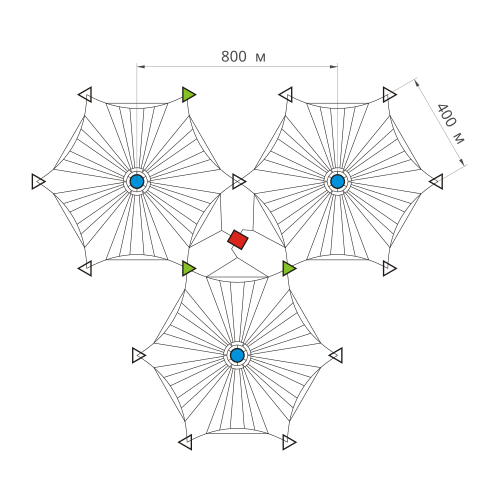
Three umbrella (Schirm) antennas arranged radially around three 210 m guyed steel-tube masts insulated from ground. At the umbrella edges the wires go to grounded 170 m guyed lattice-steel masts. Three of those lattice masts carried two umbrellas, giving fifteen lattice masts in all. The arrangement is an Alexanderson-type resonant umbrella: each leg separately tuned, the whole behaving as a very large omnidirectional magnetic loop (H-field). Tuning was servo-controlled so the plant could be moved across 15–60 kHz. Buried earth radials are described as at least 350 km of conductor.
A 18 km wave on a 210 m mast is electrically short. Umbrellas of this size are inefficient radiators in absolute terms. They were the practical way to get hundreds of kilowatts into the ground-wave / earth–ionosphere waveguide without building an impossible tower. The wet Altmark soil plus the mat is why the site works at all.
WHAT A U-BOAT HEARD
Onboard copy used the Telefunken T3PLLä38 VLF/LF receiver (about 5–33 kHz plus a LF broadcast band), with the DF loop as the submerged antenna. The Funkraum article in this database lists that set beside E437S / T9K39 Main, E52 Köln, and E381S. Interrogation notes on U-boat Archive: with Goliath on the air there could be 15–20 feet of water above the loop in both North and South Atlantic; without it, more like 5–10 feet. Other period tables vary with range, salinity, and whether “depth” means keel, loop, or top of conning tower.
North Sea ~1,000 km: loop depths on the order of 14–24 m (some tables 14–34 m). Mediterranean ~2,300 km: about 12–17 m. Bay of Biscay: up to about 30 m in some listings. Indian Ocean 6,000–8,000 km: about 7–14 m. Cape Town / Malacca Strait notes of 8–12 m under the conning-tower top sit in the same family. Caribbean / off New York: memoir and secondary claims of copy at about 25 m exist. Treat the exact metre as approximate.
Norwegian fjords were a known dead zone. Steep rock and deep water killed the path. Important BdU traffic went out on both HF and VLF so a boat that could not copy one band might still get the other. Goliath did not replace the HF Appell net. It covered the hours when the boat stayed down.
TRAFFIC AND THE REST OF THE SYSTEM
Content originated at BdU (later FdU / OKM channels as the war closed). Encryption was Enigma M4 for the U-boat key nets. Short-signal and weather-short books (Kurzsignale, Wetterkurzschlüssel) lived on HF. VLF was the long broadcast — orders, situation reports, re-broadcasts of boat reports so the pack heard what Control had heard. Kurier (KZG 44/2), covered in the previous article in this database, is an HF burst-keyer experiment of 1944–45. It is not part of Goliath’s modulator chain.
Return path remained HF Morse from the boat’s Telefunken / Lorenz suite: T200FK39 / Spez 406S class 200 W HF, Lo40K39 40 W reserve, Spez 2113 150 W MF beacon, and the small VHF set. A louder downlink did not save the boats. The uplink was still a bearing.
In early April 1945 station staff were ordered north to Heide in Holstein to run the mobile VLF transmitter Felix for the Dönitz government. U.S. troops took Kalbe on 11 April 1945 and used the fenced site as a POW cage. Under Yalta the ground passed to the Red Army (handover 2 July 1945; the cage closed 26 July).
HISTORY AFTER 1945
Soviet specialists, with German engineers including Gutzmann, repaired and test-ran the plant. Russian accounts give a trial start in May 1946. Dismantling then ran summer 1946 into 1947. German local history dates demolition of the remaining buildings to August 1947. Material moved east in a large rail lift — figures of dozens of 50-wagon trains, or “300 wagons,” appear in different retellings. Storage near Leningrad / Vyborg is mentioned. Reassembly was in the Kudma valley, Kstovsky District south of Nizhny Novgorod (Gorky), settlement Druzhnyy, about 1949–52. That station kept the name Goliath (Голиаф). It became the Soviet Navy’s first large VLF plant, later used for submarine broadcast and time signals (RJH90 / RJH99 family in open references) and, from the 1960s, some space-tracking support. Open sources in the 2000s–2010s still describe it as in Russian Navy service.
The Kalbe site retains little more than a mast foundation. Farmers pulled up earth-mat copper after the war because it fouled ploughs. The umbrella geometry influenced later Soviet VLF farms. Goliath is not the Federal German Navy’s postwar DHO38 at Saterland-Rhauderfehn (23.4 kHz, from 1982). That is a separate NATO-era plant.
HOW IT SITS WITH THE FUNKRAUM
The boat never transmits to Goliath. It listens. T3PLLä38 and the loop are the Kalbe end of the room. Köln / Main still copy the HF Appell. Enigma still sits on the bench. Kurier, if fitted, still keys the 200 W HF set on the way home. Goliath is the shore half of the late-war compromise: keep the boat down for incoming traffic; accept that outgoing traffic will still light up Huff-Duff.
CAVEATS ON THE NUMBERS
Power, exact main frequency (16.53 vs 16.55 vs 16.57 kHz), and submerged-copy depths are not internally consistent across Lorenz notes, Kalbe pages, interrogation summaries, and later secondary lists. This article states the spread rather than picking a winner. 1,800 kW is flagged, not adopted. No public wartime circuit diagram of the RF chain was used here. Allied non-bombing is inference from the intelligence value of live traffic plus the absence of a raid in the site histories — not a found targeting order. Depth tables mix units and reference points (loop vs conning tower vs keel).
STATUS
Kalbe plant: built 1941–43, on air 1943–April 1945, Soviet test 1946, dismantled 1946–47, buildings blown 1947. Russian rebuild at Druzhnyy: on air from about 1952, still described in open sources as a Russian Navy VLF station under the same name. Original German ground: agricultural, one visible mast base.
IN ONE SENTENCE
Goliath is the Kriegsmarine’s 1943–45 Lorenz VLF station at Kalbe an der Milde — a three-umbrella, servo-tuned 15–60 kHz plant with about 1 MW antenna-circuit power on a main working frequency near 16.55 kHz — built so BdU could reach submerged U-boats worldwide, then taken apart by the Soviets and rebuilt near Nizhny Novgorod, where a station of the same name still stands.