WHAT IT IS
The RS-28 Sarmat (РС-28 «Сармат»; GRAU index 15А28, 15A28; NATO and US reporting name SS-X-30 in older sources, SS-29 in more recent ones, often called "Satan II" in the press) is a Russian heavy, liquid-fuelled, three-stage, silo-based intercontinental ballistic missile (МБР, межконтинентальная баллистическая ракета). It is being built to replace the Soviet-designed Р-36М2 «Воевода» (R-36M2 Voevoda, GRAU 15А18М, Russian service name РС-20В, NATO SS-18 Satan Mod 5), which has been in service since the late 1980s. It is named after the Sarmatians, the ancient steppe people who lived north of the Black Sea and east to the Urals.
It is designed by the Makeyev State Rocket Centre (ГРЦ имени академика В. П. Макеева, in Miass, Chelyabinsk Oblast), which until now was known mostly for submarine-launched missiles, and it is produced at the Krasnoyarsk Machine-Building Plant (Красмаш, Krasmash). The first-stage engine, designated ПДУ-99, was developed by NPO Energomash and is manufactured by Proton-PM in Perm. The missile is meant to carry a large load of multiple independently targetable re-entry vehicles (МИРВ, MIRV), or the Avangard hypersonic glide vehicle, plus a heavy set of decoys and other missile-defence countermeasures, and to reach targets by the shortest route or by a long route over the South Pole.
Two things need to be kept apart throughout this article. One is what Russian officials and designers say about the missile: a range of 18,000 km or even "more than 35,000 km", a 10-tonne payload, "four times" the yield of any Western equivalent, and a "short boost phase". The other is what outside observers have actually seen: one fully successful flight test in April 2022, a catastrophic silo explosion in September 2024, a failed launch in November 2025, and a successful launch in May 2026. As with every system in this database, almost every performance number is a designer, ministry or reference-work figure and not a measured one, and the places where sources disagree are marked.
Where this site already has a related article it is linked: see A-135 / A-235 Nudol for the interceptor side of the Moscow shield and Don-2N for its battle-management radar; Voronezh, Dnepr and SPRN at Solnechnogorsk for the early-warning chain that would see a launch; Kazbek and Perimeter / Dead Hand for command and control; INS inertial navigation and GLONASS for navigation; and S-300, S-400, S-500 and Patriot for the air-defence systems that Russia says will help protect its missile fields.
QUICK FACTS
Not to be confused with: the R-36M2 Voevoda (the older missile it replaces), the RS-24 Yars and Topol-M (smaller solid-fuel ICBMs), the Avangard (a glide vehicle, not a missile; today carried on a modified UR-100N UTTKh), the RS-26 Rubezh or the Oreshnik (medium-range missiles), or the Poseidon and Burevestnik (nuclear-powered systems). The site has no separate article on those yet.
PURPOSE AND PLACE IN RUSSIAN STRATEGIC NUCLEAR FORCES
Russia's strategic nuclear forces are a triad: land-based ICBMs run by the Strategic Missile Forces (РВСН), ballistic-missile submarines run by the Navy, and long-range bombers run by the Aerospace Forces. The Federation of American Scientists (Bulletin of the Atomic Scientists, May 2026) estimates that Russia has about 324 nuclear-armed ICBMs able to carry up to about 1,092 warheads, in about 41 regiments of 12 divisions in three missile armies, and about 892 of the roughly 1,796 deployed strategic warheads sit on land-based missiles. The ICBM force therefore carries about half of Russia's deployed strategic warheads.
The heavy liquid-fuel missiles are the biggest part of that. IISS estimates that more than one third of Russia's deployed land-based warheads are carried by the RS-20V Voevoda, a missile first deployed in 1988 and life-extended many times. The Bulletin estimates about 40 SS-18 Mod 5 missiles remain, carrying up to about 400 warheads, in the 13th Missile Division at Dombarovsky and the 62nd Missile Division at Uzhur. Those missiles are getting old. IISS writes that further life extensions "will likely become increasingly difficult or incur a greater degree of risk", and that there is no known alternative design that could directly replace the Sarmat if the programme fails. That is the heart of the Sarmat story: it is not just a showpiece weapon, it is the only planned replacement for a large share of the land-based force.
Its job is the same as the Voevoda's was: to be a survivable, high-capacity second-strike weapon in a hardened silo, able to put a large number of warheads, and a large set of decoys, onto targets very far away. The silo-based heavy missile is also the system Russian designers say they would use to defeat a US missile defence, because its size lets it carry more decoys and, in the Russian description, more complicated trajectories.
BEFORE SARMAT: R-36, R-36M AND THE VOEVODA FAMILY
The Sarmat is the successor of a family designed by the Yuzhnoye design bureau (КБ «Южное», Mikhail Yangel, and later Stanislav Us) and built at the Yuzhmash plant in Dnepropetrovsk (now Dnipro), Soviet Ukraine. The R-36 (NATO SS-9 Scarp) entered service in the 1960s. The Council of Ministers ordered the R-36M (15А14) on 2 September 1969, flight tests began in 1973, and it was accepted into service in 1975 (Lenta.ru). NATO called it SS-18 Satan. It was followed by the R-36MUTTKh (15А18, with a ten-warhead MIRV bus) and then the fourth-generation R-36M2 «Воевода» (15А18М), which was developed in the 1980s to survive and strike in conditions where the enemy has missile defences and has already struck the silo with nuclear weapons. Stanislav Us was named a Hero of Socialist Labour in 1990 for the R-36M2.
Published figures for the R-36M2: a two-stage missile, a launch mass of about 211 tonnes, a length of about 34.3 m, a diameter of 3 m, a throw weight of about 8.8 tonnes, and ten MIRVs of about 550-800 kt each over about 11,000 km (CSIS Missile Threat, Missile Defense Advocacy Alliance, Russian MoD pages). Its published accuracy varies widely between sources, from about 220 to 500 m CEP (circular error probable, the radius of the circle that half of the warheads would land inside). RUSI notes that the R-36M2 passed 20 successful flight tests before acceptance into service, and that its silos are reportedly hardened to about 4,000 psi. A Russian source quoted by Russian Wikipedia gives a launch readiness of about 62 seconds for the R-36M2 and a goal of about 30 seconds for the Sarmat; that is an unofficial figure and should be read as such.
The Voevoda family used ampulised propellant: the storable hypergolic components were filled into the tanks at the factory and sealed, the missile was kept in a transport-launch container in the silo, and it could be launched without any fuelling operation. Russian sources describe a storage life of 10-15 years in the fuelled state, extended later to about 25 years. The Sarmat is described in Russian sources as keeping the same propellant combination and the same approach, but I did not find an official statement of ampulisation for the Sarmat, so treat it as a likely but unconfirmed carry-over.
The first-stage engines of that family are the РД-263 (15Д117) and its improved version РД-273 (also РД-263F), single-chamber, oxidiser-rich staged-combustion engines burning UDMH and nitrogen tetroxide. Four of them are bundled into a module: the РД-264 (15Д119) on the R-36M, and the РД-274 (15Д285 in the sources I found) on the R-36M2. Each РД-273 gives about 1.24 MN of vacuum thrust, so the four-engine module gives about 4.95 MN (about 505 tonnes-force) in vacuum.
WHY A REPLACEMENT: AGE, UKRAINE AND MISSILE DEFENCE
Three pressures produced the Sarmat. The first is age: the R-36M2 was built in the 1980s, and its warranty and its extensions run out in the 2020s. The second is industrial dependence. The R-36 family was designed and built in Ukraine, and Russian sources (Lenta.ru, Izvestia) openly say that one aim of the new missile was to end dependence on the Ukrainian defence industry and on the Yuzhnoye bureau and the Yuzhmash plant. Izvestia (November 2022) writes that by 2014 "it became clear that some kind of positive interaction with Ukrainian developers would not work", and that the Voevoda would have to be retired in the early 2020s; that gave the Sarmat programme "an impetus for accelerated development". The new missile was, in that account, entirely Russian: new production technology for the large body, a new propulsion system and a new control system had to be mastered at Russian plants.
The third is missile defence. After the United States withdrew from the 1972 ABM Treaty (announced in December 2001, effective 13 June 2002), Russia says it was "compelled" to rethink how to keep strategic parity (Putin, 12 May 2026). The US Ground-based Midcourse Defense (GMD) system has about 44 interceptors in Alaska and California and is aimed at small attacks from North Korea or Iran, but Moscow's planners have long treated it as a base that could grow. The Sarmat, together with the Avangard glide vehicle, is the Russian answer: carry more decoys, shorten the missile's vulnerable burn, or choose a route the interceptors do not face. Russian officials also cite the US Prompt Global Strike idea (a conventional long-range strike) as a reason, because a heavy silo missile with a large payload is also a hedge against a first strike by conventional means.
A technical argument inside the Russian defence establishment is also worth knowing about, and Russian Wikipedia summarises it. Academician Yury Solomonov (designer of the Topol and Bulava solid-fuel missiles) argued that a large liquid-fuel missile like the R-36M is an "easy victim" for missile defence compared with a lighter solid-fuel missile with a shorter burn. The Makeyev side argued that a bigger missile carries more decoys and can fly further. The decision in the end was to keep both types: the solid-fuel Yars for mobile and silo use, and the liquid-fuel Sarmat for the heavy silo role.
HISTORY AND DEVELOPMENT
WHO BUILDS WHAT
DESIGN OVERVIEW
The Sarmat is a three-stage missile. Early sketches showed only two stages, and most observers took it for a two-stage missile like the Voevoda; after Makeyev published an official image in 2016, some experts concluded that there are three stages, like a space launcher. Russian Wikipedia says the engines of the stages are "sunk" into the propellant tanks and that the propellant tanks are load-bearing with shared dividing bulkheads: both are classical Makeyev and Yangel techniques that save length and weight.
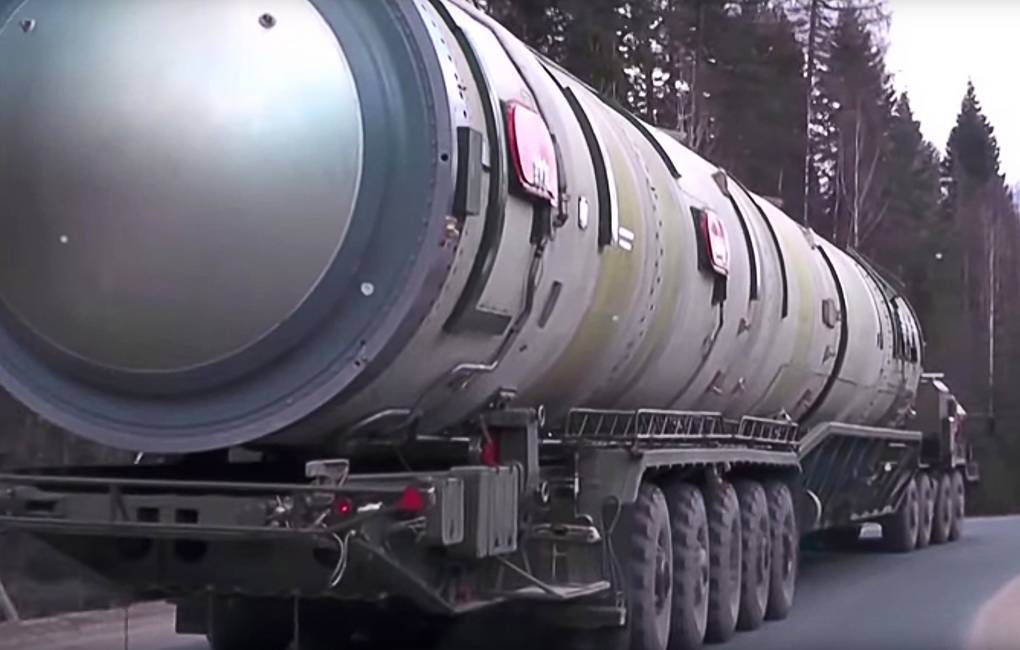
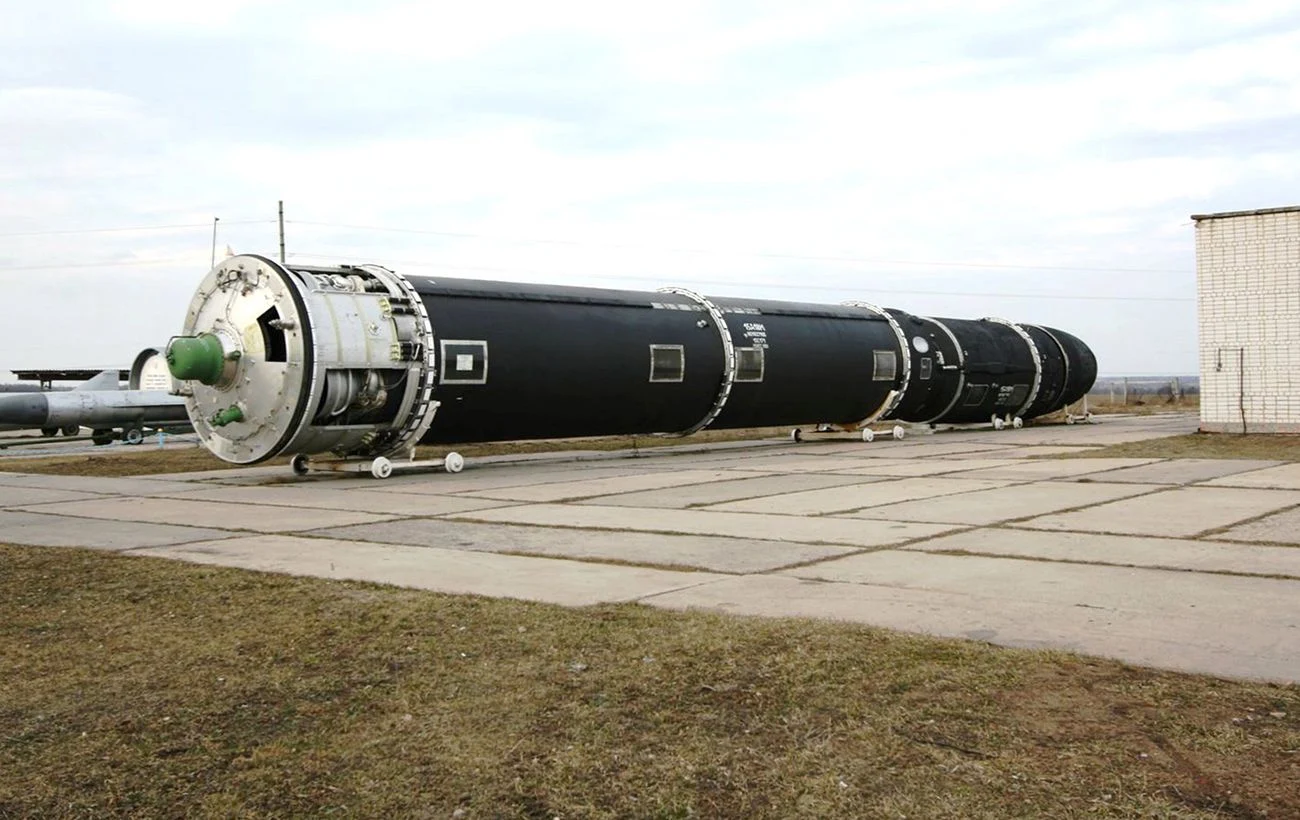
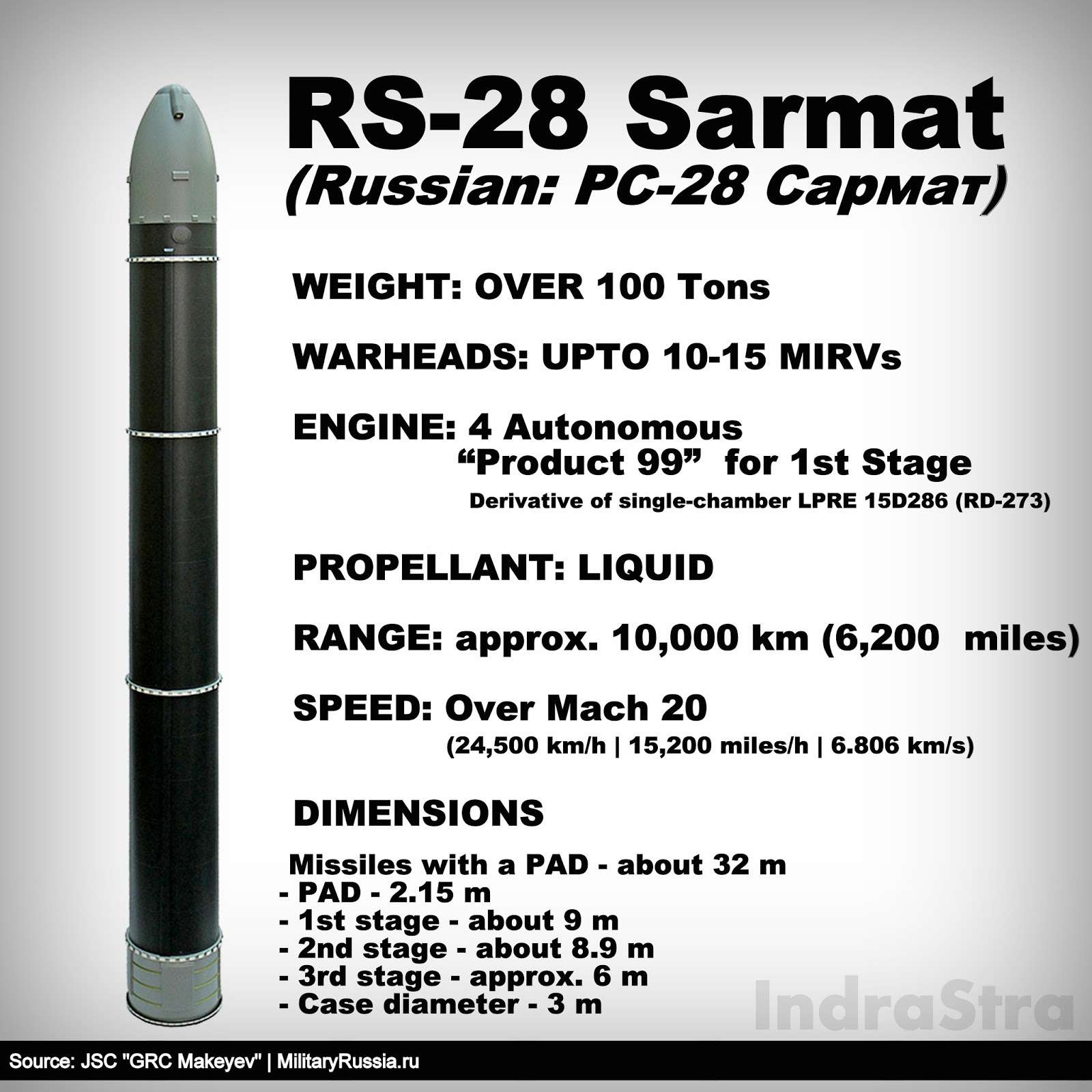
The missile sits in a transport-launch container (транспортно-пусковой контейнер, ТПК) inside a silo. At launch a powder pressure accumulator (пороховой аккумулятор давления, ПАД) pushes it out of the container and silo as in a mortar; the first-stage engines ignite only after it has left. In the infographic on this page, the grey band at the base of the missile is labelled "PAD, 2.15 m".
The three stages and the head section: the infographic (credited to Makeyev and MilitaryRussia) gives the first stage as about 9 m, the second about 8.9 m, the third about 6 m, the PAD 2.15 m, a case diameter of 3 m and about 32 m for a missile "with a PAD". The numbers add up to about 26 m, leaving about 6 m for the stage joints, the post-boost vehicle and the nose fairing (my own arithmetic). The 35.3-35.5 m figure found in CSIS, RIA Novosti and Lenta.ru is described as the length "with head section"; none of the sources says exactly what each length includes, so I show both.
SIZE: THE NUMBERS THAT DISAGREE
PROPULSION
First stage. The first-stage unit is the ПДУ-99 (the infographic shows it as "Product 99", four autonomous engines, a derivative of a single-chamber engine it labels "15D286 (RD-273)"). Open sources agree on the family: the ПДУ-99 is an Energomash design, made by Proton-PM, and described by RUSI and Wikipedia as derived from the РД-274 module of the R-36M2, which is four РД-273 single-chamber engines. Russian Wikipedia says "a modernised version of the РД-264" instead, which is the earlier four-engine module of the R-36M. Both readings point to the same lineage: the Glushko-bureau (Energomash) UDMH / nitrogen-tetroxide oxidiser-rich staged-combustion engine used on the R-36 family since the 1970s. The sources I found give the РД-274 module index as 15Д285 and do not confirm the index "15D286" on the infographic, so I treat the infographic's index as unverified; it is probably the single-engine РД-273 index, but I have no source for that.
The reason a "tried" engine was reused is time: Russian accounts say that bench tests of the propulsion unit were completed "relatively quickly and successfully" (the first successful fire test was in August 2016). Yet engine trouble is still the leading suspect for the failures: RUSI (October 2024) suggests that the effort to shorten the boost phase (see below) pushed the design toward higher chamber pressures and a lighter structure, which brings risks such as combustion instability and "pogo" oscillations; it also mentions, as a less likely idea floated by others, a pulse-detonation engine. Neither is confirmed.
Performance of the engine family. The РД-273 gives about 1.24 MN (vacuum) and 1.13 MN (sea level) with a specific impulse of about 318 s (vacuum) and 296 s (sea level) at 22.6 MPa chamber pressure and a mixture ratio of 2.67 (Encyclopedia Astronautica, Wikipedia). Four of them give about 4.95 MN, or about 505 tonnes-force, in vacuum. Against a mass of 208 t, that is a thrust-to-weight ratio at lift-off of about 2.2 at sea level, or 2.4 in vacuum (my own arithmetic from the family figures; the real figures for the ПДУ-99 are not published). That fits Putin's and Degtyar's claim that the missile accelerates quickly.
Second and third stages. Their engines and thrust are not public. Russian Wikipedia says the missile uses proven engines from the R-36M, but I found no source that names the second- or third-stage engines or gives their performance. They are probably also UDMH and nitrogen-tetroxide engines, and likely come from the Voevoda's second stage heritage or from Makeyev's own naval engines, but that is my inference only.
Propellant. UDMH (unsymmetrical dimethylhydrazine) as fuel and nitrogen tetroxide (N2O4, "АТ" in Russian) as oxidiser, both high-boiling storable liquids that ignite on contact (hypergolic). They are toxic and corrosive but can be stored for years, which is why they are used for silo missiles. They are also why liquid-fuel missile accidents are so destructive: the September 2024 event may have been a launch failure or a fire during defuelling after a cancelled launch (Podvig), and the November 2025 crash left a crater, reportedly about 70 m wide, and a large coloured cloud near the town of Yasny.
THE STRUCTURE
The body diameter of 3 m is the diameter of the silo bore, so the missile is limited in width and gains its capacity from length and from lighter structure. RUSI, discussing commentators' opinions, says the missile is thought to use a lighter orthogrid (rib-stiffened) skin for the first stage, which saves weight but is sensitive to uneven loading near the weld lines. That is a hypothesis and not a confirmed design fact. Degtyar said that the Sarmat uses naval design principles, which usually means tight, thin-walled tanks, common bulkheads and engines nested into the tanks. If so, the missile is a much lighter structure than a Soviet missile of the same size.
Lighter structure matters in the way described by Putin on 1 March 2018: with the same propellant mass, a lighter missile and more powerful engines burn out sooner and further down the road, so less time is spent in the boost phase when the missile is a bright, slow, easy-to-see target.
COLD LAUNCH FROM THE SILO
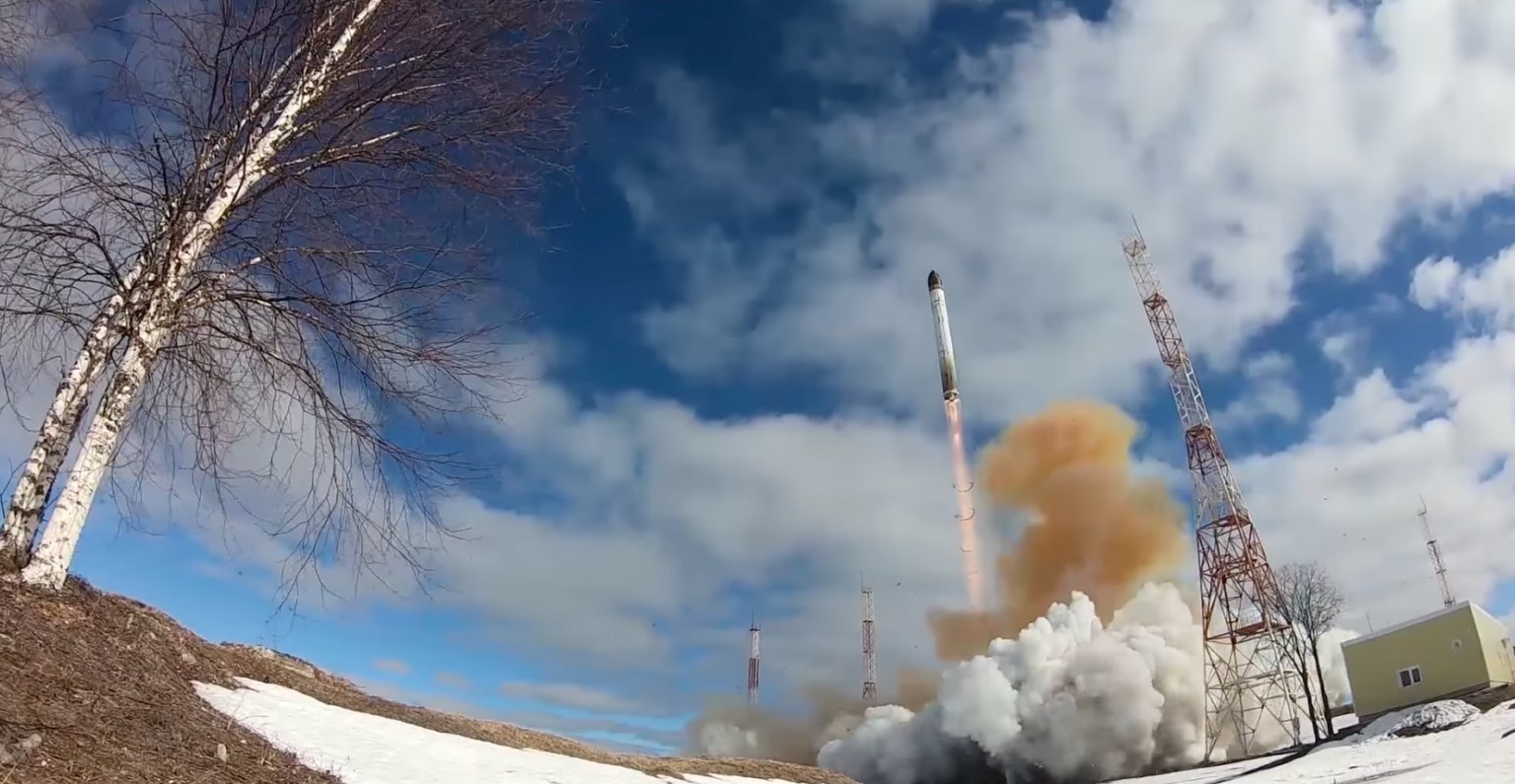
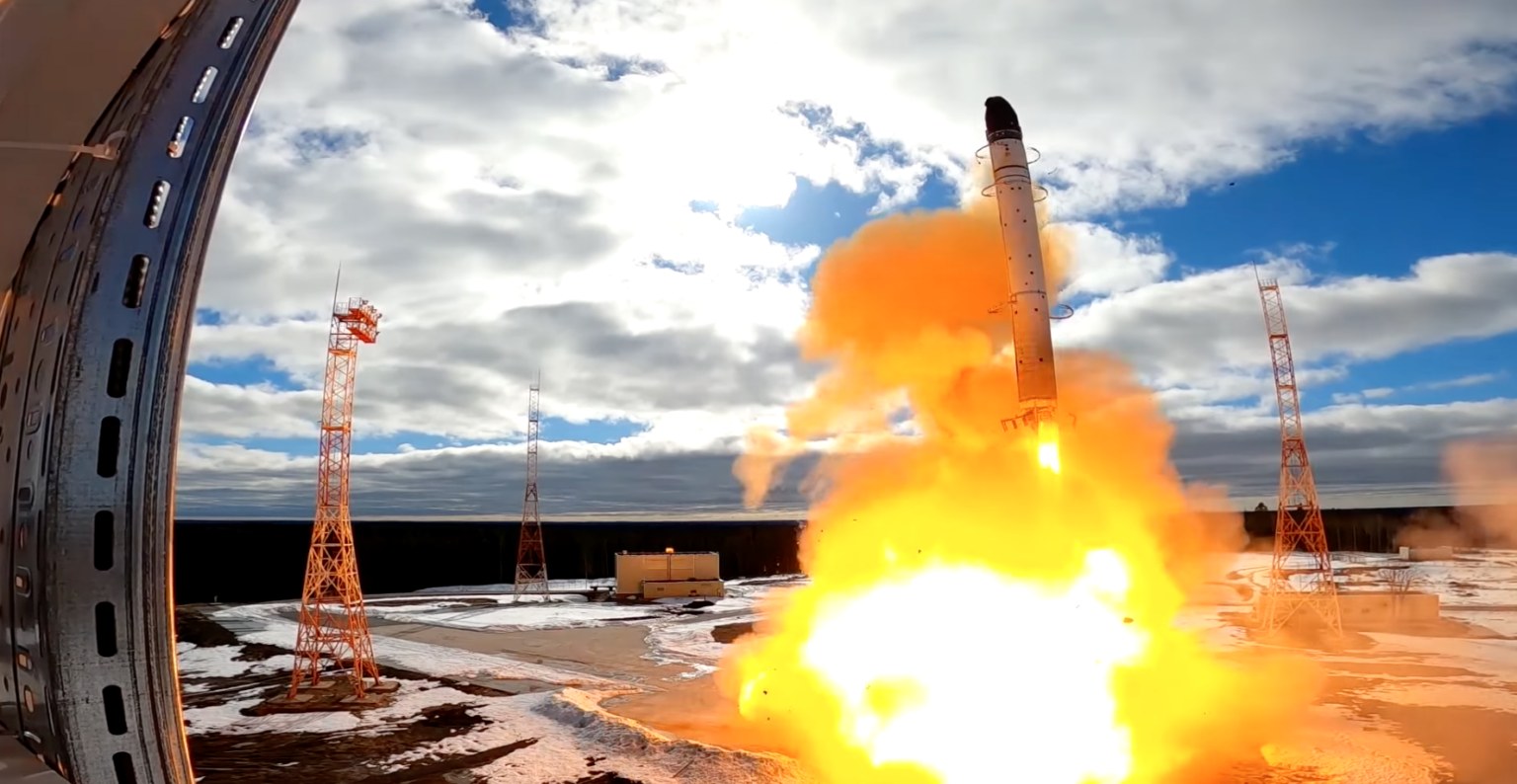
Soviet heavy missiles adopted the "mortar" or cold launch from a canister. At launch a powder pressure accumulator (ПАД) in the base generates gas, pushes the missile and its container out of the silo with force, and when the missile is out and clear, its engines start automatically. This protects the silo from the exhaust of the first-stage engines (which, with about 5 MN of thrust, would damage it) and means the silo can be reused after a launch, which was important in a nuclear exchange. The Russian sources differ on how high the missile climbs before ignition: Russian Wikipedia says 2-3 m, Izvestia says tests "pushed the missile out to a height of 30 m". The difference may be between the container and the missile, or between operational and test launches.
Video of the November 2025 failure showed a cold launch from a silo, which is how Pavel Podvig could rule out the SS-19 (UR-100N, hot launch with Avangard) as the missile involved. IISS identifies the May 2026 launch site as Dombarovsky silo 1A, from NOTAM (airspace warning) analysis and the two towers visible in the launch footage.
THE SILO AND BASING
The Sarmat is designed to fit the R-36M2's existing silos "with minimal modifications of the infrastructure of the positional areas" (Karakayev, 2016, quoted by Russian Wikipedia). In practice, as satellite imagery shows, the silos are being rebuilt: IISS and the Bulletin report that work began in 2021 on the six silos of the 302nd Missile Regiment at Uzhur, adding new command posts, double fences and a layer of hardstanding. IISS writes that upgrades to the regiment's six silos began in 2021 and that "as of mid-2026, the updates to the final two silos appear to be nearing completion"; the Bulletin counted all six launch silos as being at "advanced stages of construction" in March 2026, with no missiles loaded.
Each silo complex is also receiving the new "Дым-2" (Dym-2) perimeter defence system, with automated grenade launchers, small-arms fire and remote-controlled machine guns (Krasnaya Zvezda, 2021, via the Bulletin). Russian press has also written since 2010 about "Мозырь" (Mozyr), a fixed battery of about 100 barrels firing a cloud of metal balls and darts over the silo against incoming warheads and cruise missiles up to about 6 km high. Wikipedia marks that claim as dubious and says development ceased in 1991; the Bulletin does not mention it. I treat Mozyr as an old concept whose present status is unconfirmed.
Bulletin estimate: if the Sarmat replaces all current SS-18s, it would be installed in up to 46 silos, in three regiments at Dombarovsky and four regiments at Uzhur (six regiments of six and one of ten missiles). Kristensen and colleagues also say the missile is planned for deployment with two divisions. The Dombarovsky site (13th Missile Division, near Yasny in Orenburg Oblast) also hosts Avangard-equipped UR-100N UTTKh missiles; the first Avangard regiment (621st) completed its rearmament in December 2021, and the second (368th) was reported complete in December 2023.
Hardness. Silo hardness figures are not official. RUSI says the R-36 silos are reportedly hardened to about 4,000 psi (about 28 MPa), and Russian sources say the silo can survive a nearby nuclear burst thanks to damping containers (Russian Wikipedia). Those numbers need an outside check: a silo is "hard" against blast overpressure but not against a direct hit, and its position is well known to an adversary, which is why active protection and early warning get so much attention.
SPECIFICATIONS (PUBLISHED FIGURES)
WHY THE RANGE NUMBERS DISAGREE
TRAJECTORIES: NORTH, SOUTH POLE AND "FRACTIONAL ORBITAL" ROUTES
A normal ICBM from Russia to the United States flies the shortest route, a great-circle arc over the Arctic, and that is the direction in which US early-warning radars, sensors and interceptors face. Putin said on 1 March 2018 that the Sarmat "can attack targets both through the North and the South Pole". A route over the South Pole would approach the United States from the south, where there are far fewer warning radars and no interceptor sites, and would force an adversary to build an "all-round" defence at far greater cost (Russian Wikipedia, National Interest). The animation shown at the 2018 address was widely reported as showing warheads heading toward Florida by that route. Karakayev repeated in 2023 that the missile could fly over both poles (via Lenta, in the Bulletin).
The idea has a long history. The Soviet R-36orb (deployed in the late 1960s and withdrawn in 1983, commonly cited as limited by SALT II) was a "fractional orbital bombardment system" (FOBS): it put its warhead on a low trajectory almost round the Earth and brought it down before completing one orbit, so that it came in from an unexpected direction without ever having been in orbit in the sense of the 1967 Outer Space Treaty, which bans nuclear weapons in orbit. Several sources say the Sarmat revives that concept. IISS reads Putin's "suborbital" route as the "planned ability to approach the United States from the south, taking a polar or near-polar path", and notes that by using a depressed trajectory the missile should, in theory, stay below the radar horizon for longer.
Two caveats. First, a longer route costs payload: the further the warheads have to go, the less mass the missile can carry, which is why the "southern" version is described by Izvestia as carrying fewer warheads. Second, a depressed trajectory is a lower, flatter path with a shorter time to impact, which gives less warning for the defender of the target but also brings the warheads through denser atmosphere sooner and with higher heating. The southern route is also an advantage only if the defender has not already deployed sensors in that direction; the Bulletin says that the very long range may be more a matter of public relations than operational need.
THE BOOST PHASE: WHY A SHORT BURN MATTERS
An ICBM's flight has three parts: the boost phase (the engines burn, a few minutes), the midcourse phase (a coasting arc through space, about 20 minutes or more), and re-entry (the last minute or two). In the boost phase the missile is a very bright infrared source. US Space-Based Infrared System (SBIRS) satellites detect and classify it. Warheads and decoys are only released after the boost ends, so a boost-phase kill takes out the whole payload at once, and a large liquid-fuel missile with a long burn is the easiest to hit. That is the "easy victim" argument made by Solomonov, and why Putin stressed in 2018 that the Sarmat has "a short boost phase".
RUSI explains the logic: no missile can avoid detection in the boost phase, but a shorter one "could compress the time available for detection, classification and cueing sensors associated with midcourse intercept". It also hedges against a future US space-based sensor layer or space-based interceptors (a Golden Dome-style system, announced in 2025). Makeyev's Degtyar made the same point in 2022: quick acceleration "provides a high probability of defeating the enemy's missile defence system during the active phase of the flight". To get a shorter burn, the designers went for much higher thrust and a lighter body, which, RUSI argues, may be the cause of the programme's trouble. The Russian side has not published burn times for the Sarmat, so none is given here.
A FLIGHT, STEP BY STEP
This is a generalised description built from the published designs and from the way ICBMs of this class are understood to work; the Sarmat's exact sequence is not public.
Flight time for a typical 9,000-10,000 km ICBM route is about 30 minutes (approximate; it depends on the route). A route over the South Pole or an orbit-like path is longer.
GUIDANCE: THE INERTIAL NAVIGATION SYSTEM
An ICBM does not steer for most of its flight; it is aimed during the boost phase and then coasts. What matters is that the engines shut down when the missile has exactly the right position and velocity. The guidance system is therefore an inertial navigation system (INS), which uses accelerometers to measure acceleration and gyroscopes to hold orientation, and then integrates those measurements, twice, to get velocity and position, without any outside signal (see the site's article on INS inertial navigation for the principle). It cannot be jammed, which is a major reason all strategic missiles use it. Its weakness is drift: tiny gyro and accelerometer errors add up over time and cause miss distance.
What the designers say. Vladimir Degtyar (Makeyev chief designer) said in September 2022 that the "Sarmat's onboard flight control system has the ability to correct its trajectory using GLONASS, which makes it possible to ensure high targeting accuracy, including after impact by an air defence missile" (Sputnik interview). That is the only on-the-record description of the guidance that I found: an inertial system with satellite-navigation updates (see GLONASS). It implies a system that can fix its position during the boost phase, and in principle even re-fix after damage, but it also depends on the GLONASS signal being available and not jammed or spoofed, and in a war the signal might be denied. An inertial core is the fall-back.
Astro-inertial correction. Wikipedia's infobox lists "inertial guidance, GLONASS, astro-inertial". Russian popular-science accounts of how a modern MIRV bus works (Popular Mechanics, quoted by Russian Wikipedia) say that the bus takes its exact orientation "by astro-correction and gyroscopes" before it releases each warhead. That is a standard technique: a star tracker measures the angle to known stars to remove accumulated gyro error. The US Trident II uses stellar-inertial guidance as an example. For the Sarmat, though, I found no official statement, so astro-correction is a likely but unconfirmed feature.
Platform type. It is not public whether the Sarmat uses a gimballed gyro-stabilised platform or a strapdown laser or fibre-optic gyro system. Both technologies exist in Russian industry, but any claim about the Sarmat's gyros is a guess. The one source that names NPO Avtomatiki and the Research Institute of Command Instruments as developers (see above) is a blog reading of tender data, and it does not say what kind of gyro is used.
Accuracy. There is no official CEP. Press expectations are "unlikely to exceed 150 m" (Izvestia, 2022). Putin said in May 2026 that the suborbital trajectory both extends the range and "doubles the accuracy", without saying what it is double of. For a sense of scale: published CEPs for the R-36M2 range from about 220 to 500 m. With a warhead of 750 kt, a CEP of 150 m is a good counterforce number against anything short of a very hard silo, but it is not unique: published outside estimates put the US Trident II and Minuteman III at roughly 100-200 m. Those are not official figures either.
Guided warheads. The Avangard glide vehicle does its own guidance in the atmosphere, which is a separate system. A Russian source (Russian Wikipedia) compares it with the US Advanced Hypersonic Weapon, which reached a CEP of about 10 m in its test claims, and says that a guided vehicle would allow a lighter warhead, or a non-nuclear one. A conventional warhead carried on an ICBM has a problem that Russian sources themselves note: the launch could be mistaken by an early-warning system for a nuclear attack.
THE POST-BOOST VEHICLE (BUS) AND MIRV DEPLOYMENT
The bus (ступень разведения, "dispensing stage") is a small manoeuvring spacecraft that sits on top of the last stage. It carries the re-entry vehicles (боевые блоки), the decoys and the chaff, and it has small engines and attitude thrusters, its own computer and its own guidance. It holds the warheads in a ring, then turns, releases one, turns and moves to a slightly different path, and releases the next, so that each warhead is on its own course to its own target. Russian Wikipedia, citing Popular Mechanics, describes the sequence: warheads and look-alike decoys are stowed behind the dispensing stage; it extends booms so exhaust does not hit the warheads; it uses star correction and gyroscopes to hold orientation; it releases the warheads one by one, moving away at low thrust and re-pointing between releases; and at the end it releases a large number of decoys and a cloud of chaff around the warheads.
The Voevoda's bus is known better than the Sarmat's. In 2022 Russian state media showed the RS-20V bus and indicated places for up to 14 MIRVs in two tiers of seven, but the Bulletin says the operational loading is up to 10 (the number declared under START) and that the other four slots would be used for decoys. The Sarmat's bus has not been shown. The Makeyev design has not been published, and Degtyar said only that the missile carries "several dozen different types of payload".
One point on timing: early MIRV buses took 5-6 minutes to release their warheads, whereas modern buses take about two minutes (Russian Wikipedia). A faster release reduces the time the bus is exposed as a single large target in space.
PAYLOADS
A separate Russian suggestion, also repeated by Russian Wikipedia, is that the missile could one day be used as a civilian satellite launcher, as the R-36 became the Dnepr launcher. That is an economic argument for disposing of old missiles, not an announced programme.
DECOYS AND PENETRATION AIDS
Russian sources and Degtyar say the missile carries "special equipment designed to conceal [the warheads] in flight, both within the Earth's atmosphere and outside it". The Russian MoD encyclopedia, cited by Russian Wikipedia, describes the classical set: inflatable warhead look-alikes, spring-out and corner reflectors, chaff (dipoles), and "quasi-heavy decoys", which are actual small rockets with heat shields, boosters, plasma generators and electronic-warfare modules to imitate a warhead's path, glow and radar signature as it enters the atmosphere. Such decoys weigh much more than simple balloons, so the big throw weight of a liquid-fuel missile is useful for carrying them. The Bulletin's statement that four of the Voevoda's bus slots are for decoys shows that the practice is real for that missile.
How well it all works against a real defence is not known. For the US GMD system, which has about 44 interceptors, the National Interest has argued that the Sarmat's countermeasures matter little (cited in Russian Wikipedia), while IISS and RUSI treat the countermeasures as a hedge against a future improved defence. The Moscow-area defence, in turn, is covered in the site's articles on A-135 / A-235 Nudol and Don-2N.
COMMAND AND CONTROL, AND LAUNCH READINESS
Silo ICBMs in Russia are controlled in regiments: each regiment's launch silos are tied to an underground launch control centre (командный пункт, КП) that is hardened and connected by cable, radio and relay to higher command. The Bulletin says Sarmat regiments are getting upgraded launch control centres as part of the silo work. Russia's command and control is described in the site's Kazbek and Perimeter / Dead Hand articles, and the broader picture in Russian C3. The Bulletin says that only three people (Putin, Defence Minister Belousov and Chief of the General Staff Gerasimov) are believed to have nuclear briefcases, and that an order from Putin must be co-signed by one of the other two.
A backup path exists in the form of the "Perimeter" system (known in the West as "Dead Hand"), which in its reported form can transmit launch commands by command rocket if normal communications are lost. The Bulletin also says that the regiment in the 8th Missile Division at Yurya operates the Sirena-M, a system based on the SS-27 Mod 2 ICBM that is believed to serve as a backup launch code transmitter and is not itself nuclear-armed. The Sarmat's own launch procedures are not public. A Russian trade source from 2015 (cited by Russian Wikipedia) says that the fifth-generation automated command system for the Strategic Missile Forces uses only Russian-made electronic components.
Launch readiness is a major argument for silo missiles. Russian sources say the R-36M2 can launch in about 62 seconds, and that the Sarmat's goal is about 30 seconds; both are unofficial. Prepared silo ICBMs with ampulised propellants can sit fuelled and ready for years. Liquid fuel is still less convenient than solid fuel: it is toxic, it corrodes, and it needs checks. RUSI points out that liquid-fuel ICBMs carry more payload but cost more in "system complexity and the time taken to prepare a missile for launch".
SURVIVABILITY AND THE LAUNCH-ON-WARNING PROBLEM
A silo missile only works as a deterrent if it survives an attack or can be launched before it is destroyed. Russia relies on both ideas. The silo is hardened (reportedly to about 4,000 psi for the R-36 family; not official) and is going to have perimeter defences; the missile fields are in the interior, in Orenburg Oblast and Krasnoyarsk Krai, far from any coast; and the early-warning network is meant to give notice of an attack. Russian Wikipedia estimates that a US ballistic missile from US submarines near Russian waters would take about 10 minutes to arrive, and from US territory more than 20 minutes (an unsourced figure for the shorter case); the Russian early-warning network of Voronezh radars (see Voronezh and SPRN at Solnechnogorsk) and infrared satellites could, in principle, detect launches in time for a launch-on-warning response.
The wider air-defence umbrella, described in Russian sources as a layered local missile defence over missile fields, would in the future include the S-500; the Russian Wikipedia article treats this as one element of a layered defence, and the S-300 and S-400 are described as part of it. Whether such a layered defence could stop a determined attack on a silo field is unknown, and it is Russian planning rather than an observed fact. The Russian text also notes that a cruise-missile attack on the silos from the sea would take over an hour to arrive, giving time to launch.
TESTING HISTORY
RUSI notes that the R-36M2 passed 20 successful flight tests before acceptance into service, and IISS that the RS-24 Yars was put on full combat duty in 2011 after three successful tests. By those standards the Sarmat has had a very short success record: two announced successes in more than four years.
THE FAILURES AND THE MAY 2026 SUCCESS, IN DETAIL
20-21 September 2024 (Plesetsk, Yubileynaya site, silo 163/1). Russia had issued airspace warnings for a launch from Plesetsk, and then cancelled them on 19 September. NASA FIRMS fire data first show a fire late on 20 September UTC, and Maxar images from 21 September show a crater about 60 m wide (the Institute for the Study of War gives about 62 m; the French FRS later says about 70 m), burned forest to the east of the complex and four fire trucks. Pavel Podvig wrote that either the launch was tried on 19 September, or it was scrubbed and "the incident happened during the subsequent defuelling of the missile"; "the character of destruction suggests that the missile exploded in the silo". The NYT, citing researchers, said the missile carried no warhead. The Russian Defence Ministry made no announcement. The FRS wrote that the event "most likely put an end to Sarmat testing at the Plesetsk site due to the lack of another silo suitable for launching this heavy vehicle". RUSI's analysis pointed to the engine and structure (see above). This was reported as the fourth Sarmat failure (RFE/RL, counting earlier ones).
28 November 2025 (Dombarovsky / Yasny). A missile launched by cold launch from a silo near Yasny lost control seconds after leaving the silo, tumbled, caught fire and crashed about a kilometre away. Podvig, from video, says the first-stage engine visibly fails at about 7 seconds, and that at about 15 seconds something is ejected from the head section, possibly a payload-salvage sequence. NOTAMs had been issued for both Yasny and the Kura range, which indicates a test with warheads going to Kamchatka. Podvig and FRS (Maire and Marcuz, January 2026) concluded it was most likely a Sarmat; the alternatives, an SS-19 with Avangard and an R-36M2, were ruled out because the SS-19 uses a hot launch, because the silo had been recently rebuilt (work started in spring 2025), and because, Marcuz argued, the R-36M2 had not been tested for more than ten years. The FRS says the cause is unknown: first-stage engine or propellant problems, guidance failure or damage on silo exit are all possible; propellant slosh, pump starvation or cavitation are among the mechanisms it discusses. Russia did not acknowledge it. Twenty-four days earlier, on 4 November, Putin had said the Sarmat would enter combat testing "this year".
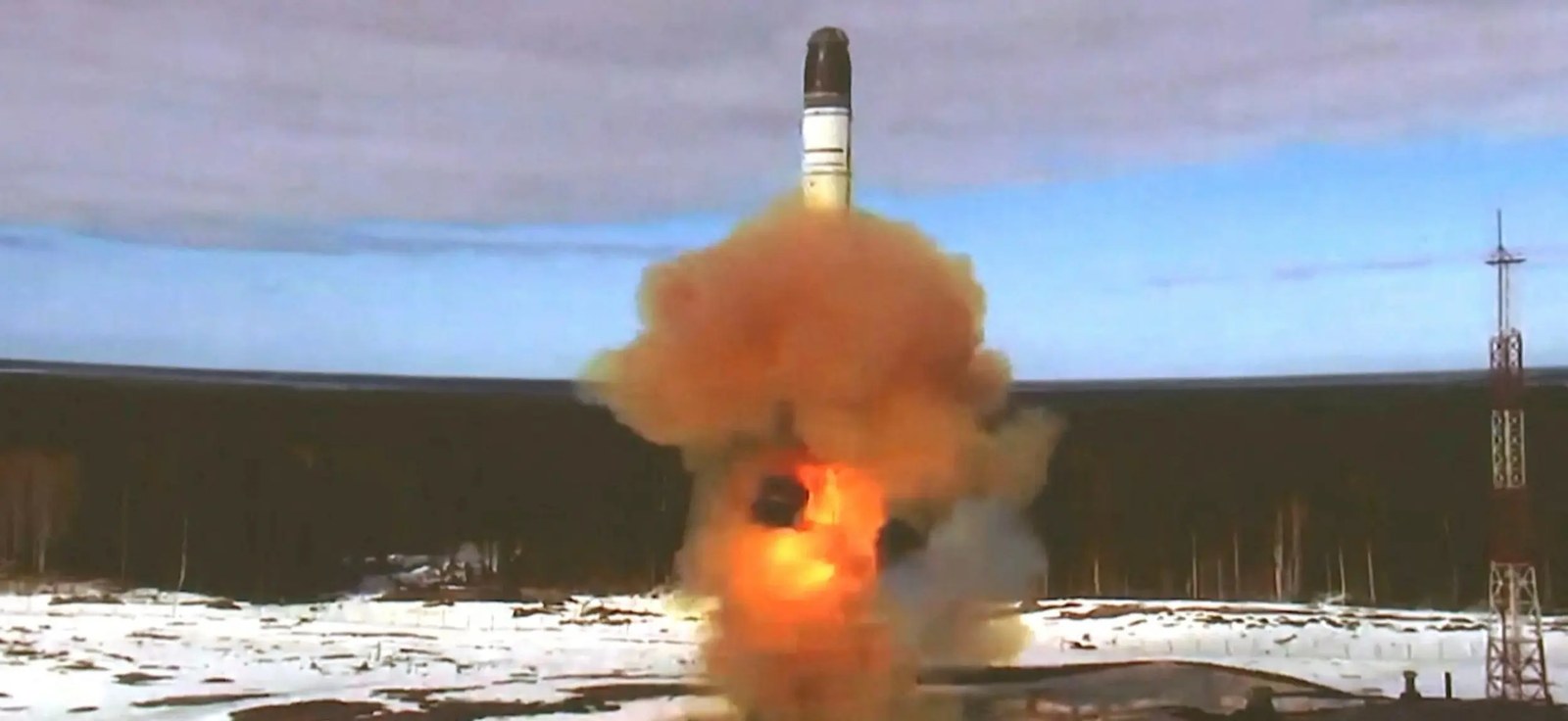
12 May 2026. At 11:15 Moscow time (UTC+3), per Karakayev's report on the Kremlin site, "the Strategic Missile Forces launched the latest heavy liquid-fuelled intercontinental ballistic missile, the Sarmat. The launch was successful." Putin used the occasion to say the Sarmat will be on combat duty by the end of 2026. IISS says the footage and airspace-warning analysis point to Dombarovsky silo 1A, the same one as in November 2025; the Bulletin's photo caption instead says "a test silo at the Plesetsk Cosmodrome" and a hit at Kura "about 5,700 kilometres away", and Russian Wikipedia says the launch was "most likely" in Orenburg Oblast and that no target hit was reported. I follow IISS on the location, which rests on more detail, and treat the hit as claimed only. IISS also finds that preparations seem to have started by March; that heavy vehicles were around the open silo on 10 May; that the silo was open and the ground scorched on 13 May; that NOTAMs suggest postponements around 13 April and 25-30 April; and that US RC-135S Cobra Ball aircraft were operating off Alaska. The Ukrainian outlet Defense Express adds that there is "no objective confirmation that the missile's payload actually reached the Kura range".
INDUSTRY PROBLEMS
The delays are partly about industry. Carnegie's Maxim Starchak (October 2023) wrote that the Sarmat saga "reflects an industry in crisis". RUSI cited staffing problems at Proton-PM. In May 2026, the director general of Krasmash, Alexander Gavrilov, was reported detained in a case of embezzlement and bribery (Kommersant: embezzlement of tens of millions of rubles and a bribe of 3 million rubles for "general patronage"; he had led the plant since 2018). The case is an allegation and the outcome is not known. His powers were ended on 26 May and the former deputy director for production, Alexander Dyukarev, was appointed (Krasmash and TASS). The Moscow Times noted that the arrest was reported a week before the Sarmat announcement. Dallas Analytics, a private firm that says it has leaked internal documents, wrote in July 2026 about delayed shipments to Uzhur in 2022 and said that process violations to save time may have contributed to the arrest of Vladimir Verteletsky, head of a Defence Ministry contracts department, in 2024 (as summarised by Wikipedia; I could not verify this independently).
COMPARED WITH OTHER ICBMS
AVANGARD, POSEIDON, BUREVESTNIK AND THE "NEW" SYSTEMS
The Sarmat was the first of six systems Putin announced on 1 March 2018 (the others being Avangard, Kinzhal, the Burevestnik cruise missile, the Poseidon torpedo and a laser). On 12 May 2026 Putin gave a status summary: Avangard "has been on combat duty since 2019"; Kinzhal since 2017; the Oreshnik medium-range system "since 2025"; and the Poseidon and Burevestnik were "nearing completion". Russia said it tested the nuclear-powered Burevestnik on 21 October 2025 (a flight of about 14,000 km and 15 hours, per General Gerasimov) and the nuclear-powered Poseidon torpedo on 28 October 2025; Putin said the Poseidon warhead is more powerful than the Sarmat's (Reuters, AP). The Bulletin notes that Burevestnik has had nearly a dozen failed tests and that as of March 2026 Poseidon was not believed to be operational. Western analysts call several of these claims exaggerated.
Of those weapons the Sarmat matters most for the numbers, because it is the one meant to replace a large share of the land-based warheads, so its delay matters more than the others'. The air-launched share of the strategic force rests on the Kh-101 / Kh-102 cruise missile (see Kh-101 / Kh-102) carried by bombers such as the Tu-160.
ARMS CONTROL CONTEXT
LIMITS AND VULNERABILITIES
COST (APPROXIMATE)
No reliable Russian figure for the cost of a Sarmat or of the programme has been published in the sources I found, and the value of the August 2022 state contract is not given, so I give none. For context only, the American Sentinel, a smaller solid-fuel replacement for about 400 Minuteman III missiles, is estimated at no less than $141 billion after a 2024 cost breach (CRS, GAO). Russian programmes are not comparable in price terms, because of different wage and industrial structures, and no conversion is reliable.
RUSSIAN STATUS AND MODERNISATION
Duty status. The official Russian position has moved several times, and the dates are worth setting out because the claims and the observations do not match.
Counting the claims. Russia Matters counted at least 13 statements between April 2021 and May 2026 that the Sarmat would soon be deployed, among them nine by Putin himself. IISS says that after only two announced successes, the programme moving to "experimental combat service" is "shaky ground", while noting that given the Voevoda's age Moscow may have to "accept a greater element of risk" in fielding its successor.
Modernisation of the base. The work of rebuilding the Uzhur silos, adding command posts, double fences and hardstanding, began in 2021 and was still going on in 2026. The 302nd Regiment was disarmed so that its six silos could be rebuilt. The next regiments at Uzhur, then those at Dombarovsky, would follow over several years, and the Bulletin says silo upgrades for other Russian ICBMs have taken years each (the Yars at Kozelsk, for instance, was still being finished in March 2026 with only about two missiles loaded each year). A test infrastructure in Krasnoyarsk Krai at Severo-Yeniseysky, announced in 2020, was thought to have been mostly finished by the end of 2024 but had not been seen used (Bulletin). The plan for 20 regiments by 2027 stated in 2019 has been dropped in practice; the Bulletin counts up to 46 silos in seven regiments.
What would count as proof. The signs to look for are: satellite imagery of silo hatches and security signs at Uzhur, missiles delivered in their containers by rail, a Russian MoD statement that a regiment has been put on duty, a Karakayev year-end interview in December 2026, and further flight tests to the Kura range. As of 16 October 2026, I found no confirmation of any of these beyond the May launch and the statements of intent.
STATUS AND OUTLOOK (OCTOBER 2026)
As of 16 October 2026, the RS-28 Sarmat is a missile that has been tested successfully (by Russian and IISS accounts) twice, has failed at least twice in public view, and is declared by Russia to be about to enter its first regiment at Uzhur by the end of the year. No independent source I found confirms that a regiment is on combat duty; the latest reporting I could find, from mid-2026, still describes silo work at Uzhur as nearing completion. A fresh launch to Kura, a Russian announcement in December, or imagery of loaded silos are the next likely milestones.
The wider context is one of an expired New START, with Russia saying it would keep to the limits as long as the US does, a US decision to rebuild its own land-based missile force at high cost, a Russian ICBM force that is about 90 percent modernised by Russian count but visibly slower in silo regiments (Bulletin), and a Russian leader who continues to describe the Sarmat in terms ("more than 35,000 km", "four times the yield") that outside experts cannot verify. The best reading of the evidence is that the Sarmat programme is real and will likely reach some form of operational status, but later than announced, in small numbers at first, and with a record that will take years to prove. The Voevoda will keep serving in the meantime.
WHAT IS UNCERTAIN IN THIS ARTICLE
TIMELINE
RUSSIAN TERMS USED IN THIS ARTICLE
IN ONE SENTENCE
The RS-28 Sarmat (РС-28 «Сармат») is Russia's planned heavy, silo-based, liquid-fuel replacement for the Soviet R-36M2 Voevoda, designed by the Makeyev centre and built at Krasmash around a lineage of R-36 engines to carry some ten warheads or Avangard gliders, decoys and a short-burn trajectory over long or polar routes, but which, after a successful launch in April 2022, a silo explosion in 2024, a failed launch in 2025 and a successful one in May 2026, has still not been independently confirmed on combat duty, although Moscow says its first regiment at Uzhur will stand up by the end of 2026.