WHAT IT IS
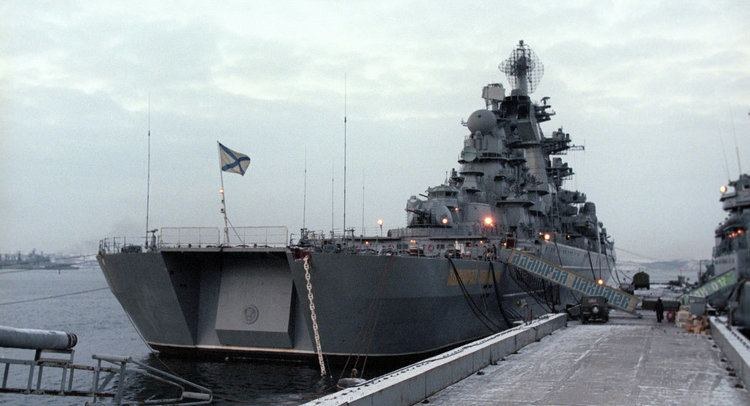
Project 1144 «Орлан» (Orlan, "sea eagle") is the Soviet design for the heavy nuclear-powered guided-missile cruisers that NATO calls the Kirov class. The Soviet and Russian type designation is тяжёлый атомный ракетный крейсер, ТАРКР (heavy nuclear missile cruiser). The press, and most of the West, calls them battlecruisers, and the label fits: at about 250 m long and roughly 24,000 to 28,000 tonnes depending on the loading condition, they are the largest and heaviest surface combatants in the world that are not aircraft carriers or amphibious ships. They are close to the size of a First World War battleship, and they are the only nuclear-powered surface warships ever built that are not aircraft carriers, apart from one American cruiser generation that is long gone (see the comparison section).
Four ships were completed at the Baltic Shipyard (Балтийский завод) in Leningrad between 1980 and 1998: Kirov, Frunze, Kalinin and Yuri Andropov. In 1992 they were renamed Admiral Ushakov, Admiral Lazarev, Admiral Nakhimov and Pyotr Velikiy (Пётр Великий, Peter the Great). A fifth hull, planned as Admiral Flota Sovetskogo Soyuza Kuznetsov, was cancelled in October 1990. Today one ship, Admiral Nakhimov, has been rebuilt almost from the keel up as Project 1144.2M and is finishing acceptance trials. One, Pyotr Velikiy, is tied up with an undecided future. Two have been withdrawn and are being scrapped or are waiting to be.
This is the ship the site is named after. Everything below is split in two on purpose: what Russian officials and designers say, and what outside analysts have actually observed or can reasonably infer. Where the sources disagree, the disagreement is stated instead of averaged away.
IN ONE SENTENCE
A Soviet nuclear-powered hull the size of a battleship, built to carry twenty heavy supersonic anti-ship missiles, the S-300F area air-defence system and an anti-submarine suite far from home, now being reborn as a 2020s missile ship with a universal vertical launcher for Kalibr, Oniks and Zircon.
Related articles already on this site: KN-3 reactor, P-700 Granit, 3M54 Kalibr, S-300, S-400, S-500, Kashtan, Pantsir, VVER, PESA radar, AESA radar, INS inertial navigation, GLONASS, Russian C3, Patriot, Kresta II (Project 1134A), Udaloy (Project 1155) and US 16-inch battleship guns. Weapons the ships share a world with: Poseidon, Avangard, RS-28 Sarmat, RS-24 Yars and 9M730 Burevestnik.
QUICK FACTS
WHY THE SHIP EXISTS: THE DESIGN REQUIREMENT
The easiest way to understand the Orlan is to remember what the Soviet Navy was and was not in the 1960s. It had no carriers that could match the United States Navy (the first Soviet fixed-wing carrier, Kuznetsov, only entered service in 1990 with a very different job). It did have a huge submarine force, long-range missile aircraft (the Tu-95RTs and Tu-22M "Backfire" with the Kh-22), a growing ocean-surveillance satellite constellation and a strong belief that the answer to a US carrier group was a saturating salvo of heavy supersonic missiles from many directions. The nuclear-powered Project 949 Antey submarine and the Project 1144 cruiser are two halves of that idea, with the same missile, the P-700 Granit.
Soviet studies of a nuclear-powered surface warship go back to the 1950s (Project 63, abandoned by about 1959 as too complex and costly). The United States commissioned the nuclear-powered cruiser USS Long Beach in 1961, which is often cited as a reason the Soviet leadership returned to the idea. Design work on what became the Orlan started in 1964. The original concept was a large anti-submarine ship with nuclear propulsion so it could keep working far from tankers, together with an escort for air defence. The two concepts (Project 1144 and a nuclear air-defence escort, Project 1165) were merged into one ship that had to do both. Admiral of the Fleet Sergey Gorshkov, the Soviet Navy's commander-in-chief for almost three decades, is repeatedly described as the patron of the project.
Several features of the design come directly from that history:
The project was approved in its final form in 1972. Kirov was laid down on 27 March 1974 and commissioned on 30 December 1980. In the West, the appearance of a Soviet nuclear battlecruiser is often credited with helping justify the reactivation of the US Iowa-class battleships in the 1980s; Western analysts still argue about how much weight that deserves, and the Iowas were already being discussed for other reasons.
Russian designers also used the Kirov hull as the basis for a very different ship: SSV-33 Ural, a nuclear-powered ocean-surveillance and command ship. It was not a missile cruiser. It was commissioned late, laid up in the early 2000s and scrapped.
THE FOUR SHIPS
Names changed on 27 May 1992. The ships are listed here under both names.
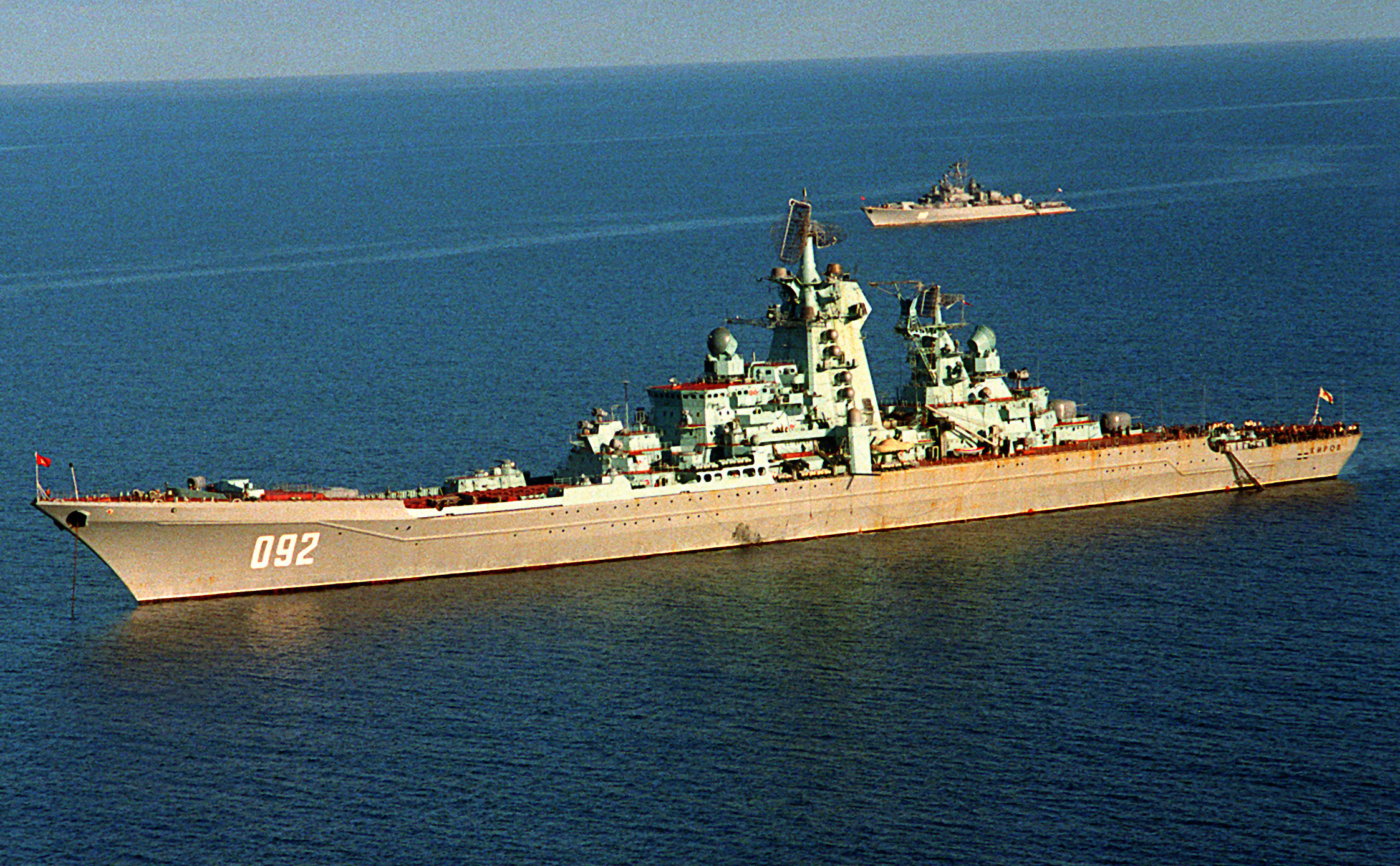
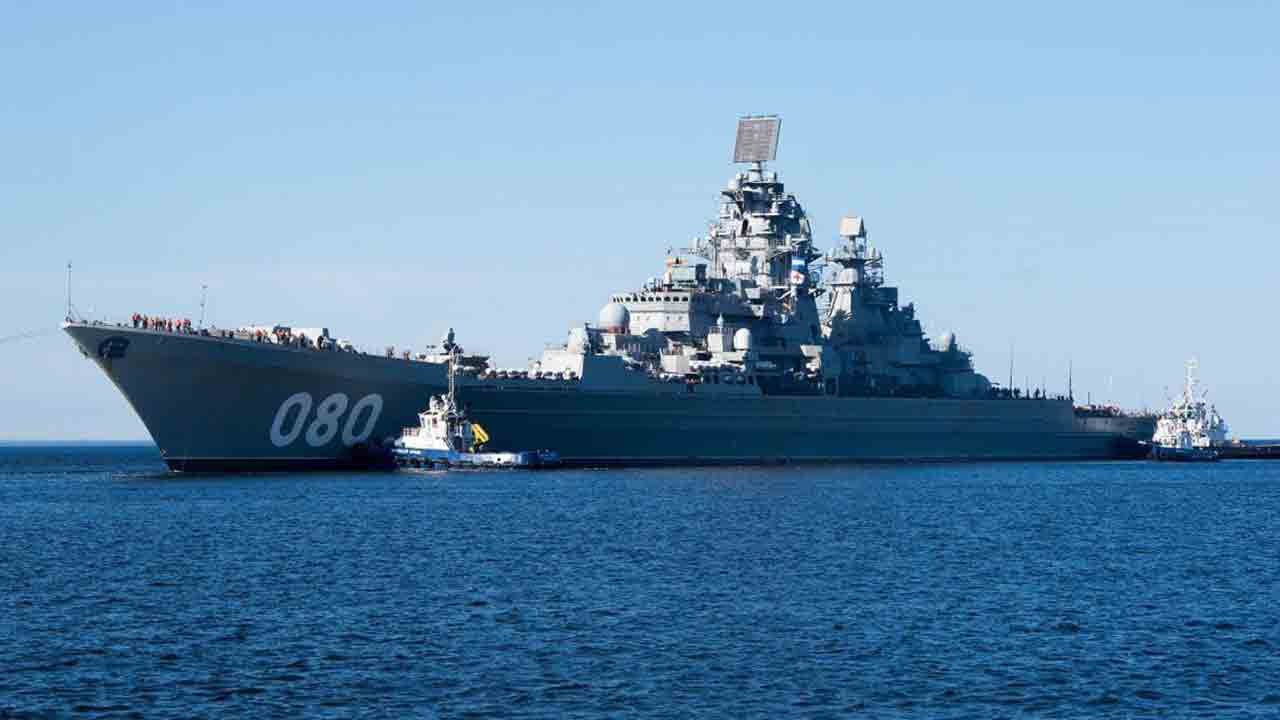
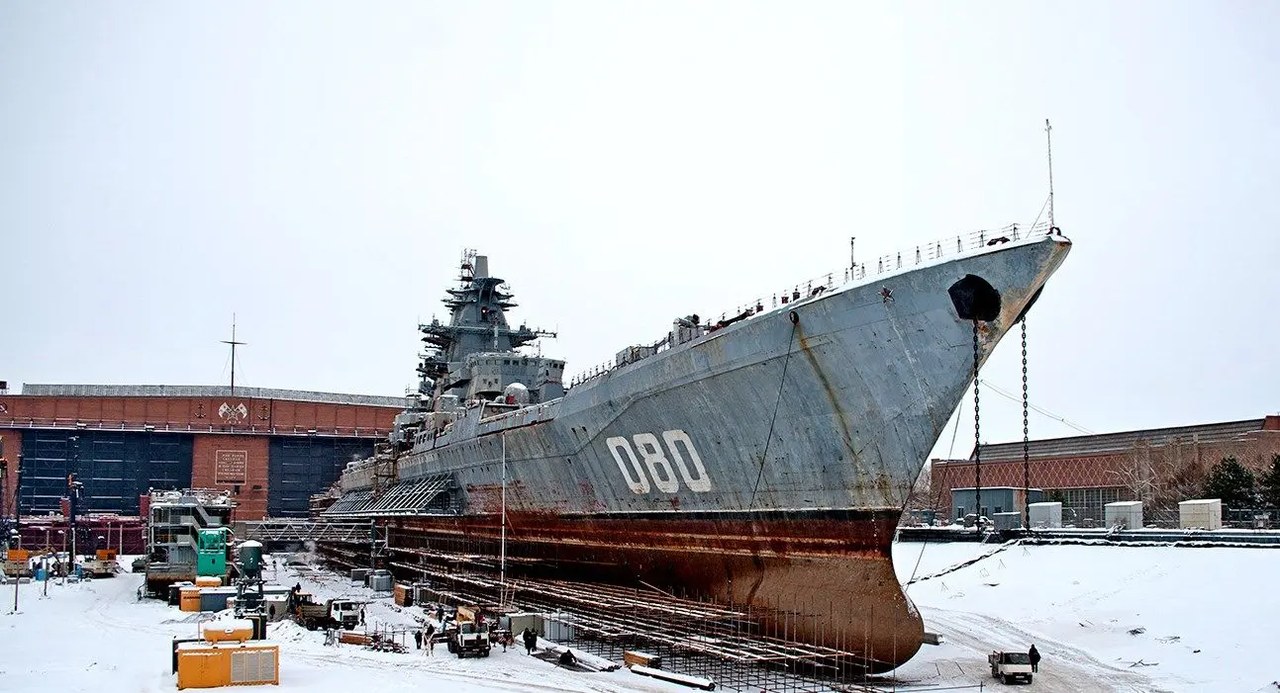
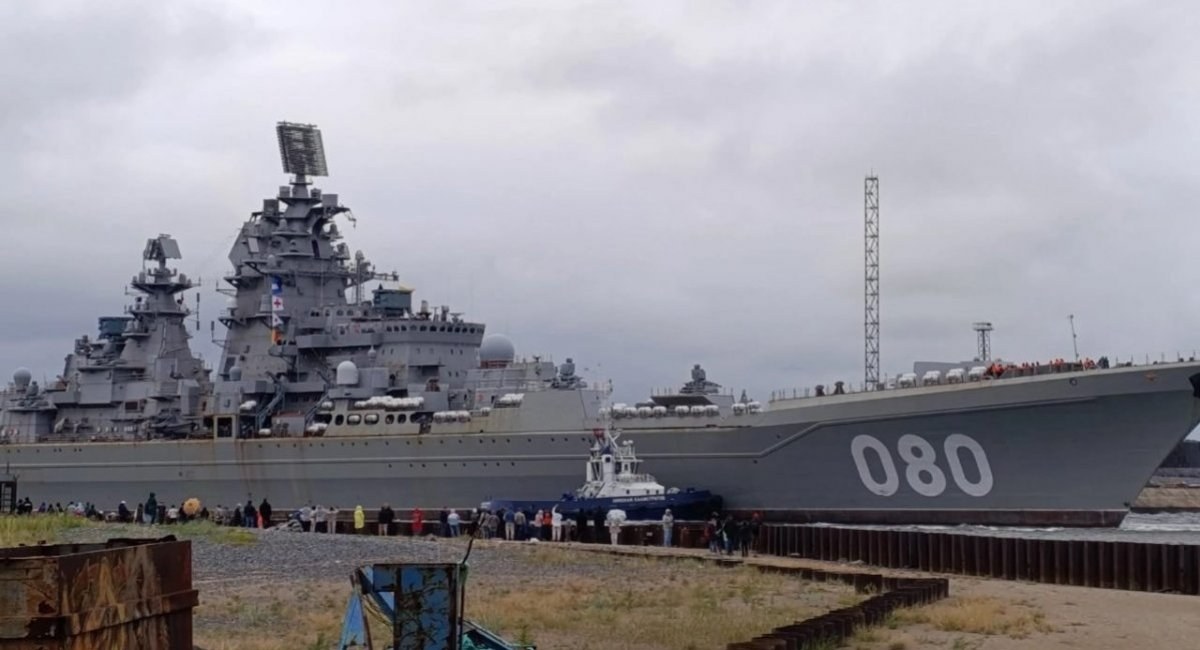
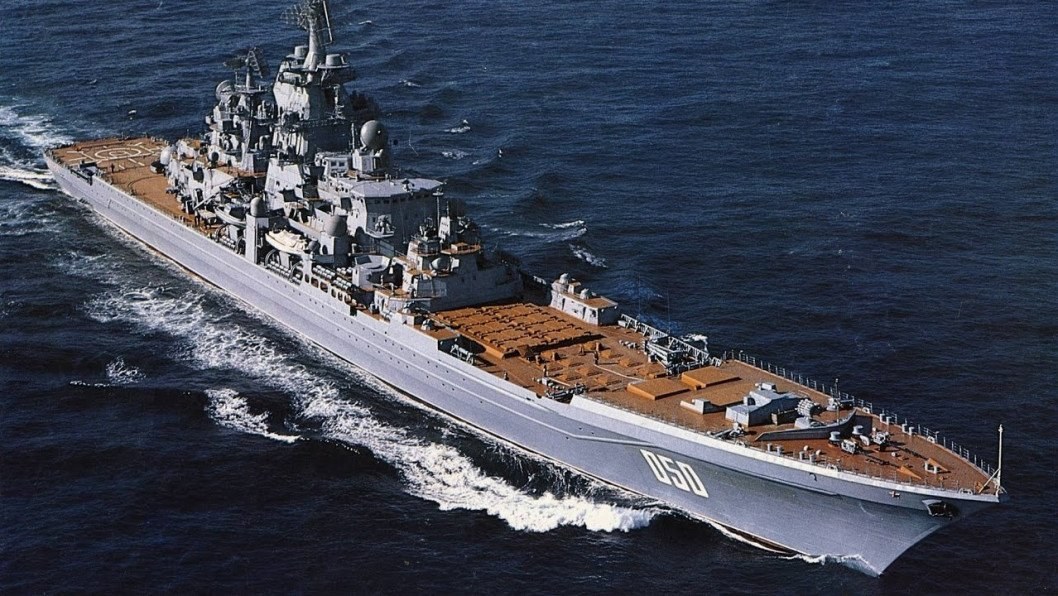
Hull numbers (бортовые номера) on these ships have changed several times. One Russian listing gives Kalinin as 180 (1988), 064 (1989), 085 (1990) and 080 (1994), Pyotr Velikiy as 183 (1995) and 099 (1998), Frunze as 190 (1984) and 050 (1985), and Kirov as 181 (1980) and later 052, 065, 076, 090 and 092. That is worth remembering when you look at the photographs on this page: a number painted on a hull is not a name.
HULL AND LAYOUT
The Orlan has a long forecastle hull with a pronounced sheer and bulbous bow, divided into 19 main watertight compartments, about five decks high and with roughly 1,400 compartments in total, according to Russian descriptions. There is a double bottom and a torpedo-protection scheme. A rounded, high flared bow with a large bulbous sonar fairing at the front, and the quarter-deck cut away for the helicopter deck, are the visual signatures.
Looking along the ship from bow to stern, the layout of the later Project 1144.2 ships is:
The mix of masts and radars is not the same from ship to ship. Even in the Russian Navy, the first ship does not look like the fourth.
SPECIFICATIONS (PROJECT 1144.2)
Figures below are the Russian project-table numbers for the 1144.2 ships unless stated otherwise. Where Western sources give different numbers, that is stated.
THE POWER PLANT: CONAS, KN-3 AND THE PHYSICS BEHIND IT
What CONAS means. CONAS is "COmbined Nuclear And Steam". The ship has two KN-3 (КН-3) pressurized-water reactors and two oil-fired boilers (about 115 to 120 tonnes of steam per hour each, in the figures published for the class). All of them make steam for the same two turbine sets. Cruise and most of the sprint power comes from the reactors; the boilers add steam for the final push to full power and can drive the ship alone at roughly 14 to 17 knots if both reactors are shut down. The details of the reactor itself are in the separate KN-3 article; this section is about why the system works.
A pressurized-water reactor in four steps.
1. In the core, uranium fission releases heat. Water around the fuel does two jobs at once. It is the coolant that carries the heat out, and it is the moderator that slows the fission neutrons down to thermal speeds, because slow neutrons are far better at causing further fission in the fuel. That dual role gives an inherent safety property: if the water heats up or boils, it becomes less dense, moderates less, and the reaction slows by itself. Engineers call this a negative temperature and void coefficient. It is the main reason a PWR is considered safer by design than the graphite-moderated RBMK, where the opposite can happen. The VVER is the civil cousin of the same idea.
2. The water in this primary loop is kept at very high pressure, on the order of 14 MPa (about 140 bar, or 140 times atmospheric pressure) according to engineering sheets, so that it stays liquid at core outlet temperatures near 300 degrees Celsius. At 14 MPa water does not boil until it reaches about 337 degrees Celsius. That is the entire purpose of pressurizing the loop: to carry heat at high temperature without making steam in the core.
3. The hot primary water goes through a steam generator, a bundle of tubes with a separate, lower-pressure water supply (the secondary side) around it. Heat passes through the tube walls and boils the secondary water. The two circuits never mix, so whatever radioactivity gets into the primary loop stays in the reactor compartment. The KN-3 is a two-circuit design with four primary loops per reactor, according to the published description.
4. The secondary steam, which for a naval plant is superheated (heated beyond the boiling point so no droplets remain), drives the turbines. Wet steam would erode the blades. After the turbines the steam is condensed back to water in a condenser cooled by seawater, then pumped back to the steam generator, and the loop starts again. This is the Rankine cycle, the same cycle as in every steam power station.
How efficient can it be? The Carnot limit says that no heat engine can convert more of its heat into work than 1 minus the cold temperature divided by the hot temperature, in kelvin. A steam temperature near 300 degrees Celsius (about 573 K) rejecting heat to cold seawater at, say, 10 degrees (about 283 K) gives an ideal ceiling of about 50 percent. Real plants reach perhaps 25 to 33 percent, because of friction, pump work, finite heat exchangers and the need to keep steam wet-free at the turbine exit.
That gives a useful consistency check on the published numbers. Published shaft power is 140,000 shp, which is about 104 MW. At a realistic 30 percent overall conversion that needs roughly 350 MWt of thermal power. That is close to the 342 MWt total that one Russian description gives, and well below the 2 × 300 MWt requirement quoted in several Western tables. Either the design requirement (600 MWt in total) was never run at full, or the quoted shaft power is lower than what the reactors could support if run flat out, or the "300 MWt each" figure is a rated maximum and not a normal rating. Thermal power is the one KN-3 number that really does wander between sources, and the KN-3 article says so too. I do not have a way to settle it.
Why the power-to-speed relation matters. Resistance of a ship through water rises roughly with the square of speed, so power rises roughly with the cube. Doubling the power gives about 26 percent more speed, because the cube root of two is about 1.26. If the reactors alone deliver about half of the plant's full power, the ship should be capable of about 31 divided by 1.26, or roughly 24.6 knots, on reactors alone. That lines up with the reported 20 to 25 knots on reactors, which is a nice cross-check (and a reminder that this is an approximation, because real resistance curves bend upward near hull speed).
Hull form and the Froude number. A displacement hull's wave-making resistance depends on the Froude number, the speed divided by the square root of gravity times length. At 31 knots (about 15.95 m/s) with a waterline length of about 250 m, the ship's Froude number is 15.95 divided by the square root of 9.81 × 250, which is about 0.32. That is near the upper edge of the efficient range for a long thin hull; the wave resistance rises very steeply above about 0.35 to 0.4. The Orlan's length-to-beam ratio of 250 to 28.5, or about 8.8, is what makes 31 knots possible at all on a displacement hull of this size.
The point of nuclear power on a surface ship. A nuclear plant carries years of fuel in a few hundred kilograms of uranium, so the ship needs no oil tankers following it, which in Soviet thinking meant the ship could operate in the Arctic and North Atlantic or deploy to the Mediterranean and Caribbean without a long logistics chain. Russian descriptions say the plant could supply the electricity needs of a city of about 100,000 people. The price is the cost, the weight of shielding, the crew training burden and, as the history of this class shows, the extreme difficulty and expense of refuelling or dismantling the reactors once the ship is old. That last point is why Ushakov and Lazarev never came back.
The reactor refuelling problem and why it killed two ships. A KN-3 core lasts about ten to eleven years between refuelling according to Russian descriptions. A reactor that has not been refuelled for decades, in a hull with a contaminated and ageing primary circuit, is not a simple thing to restore. By the 2010s the plan to bring back Ushakov and Lazarev had been dropped, reportedly because the reactor cores were in a condition that made recovery of the spent fuel difficult, expensive and potentially dangerous.
The Nakhimov plant. Unlike the weapons, the nuclear plant of the 1144.2M rebuild was reportedly not replaced. Spent fuel was removed starting in 2008, Russian descriptions from the mid-2010s say the reactors themselves would not be touched while their supporting systems were renewed, and later reports speak of the plant being restored and fuelled. The reactor design itself stayed. Reports of the reactors being brought back to power, and of the ship moving under her own power in 2025, circulate in the press, but exact dates for the two reactors vary from source to source and I have not treated any one of them as settled.
ARMAMENT AS BUILT (PROJECT 1144.2)
Armament differs from ship to ship. The summary below is for the 1144.2 ships, with differences noted.
Anti-ship: P-700 Granit (3M45, NATO SS-N-19 Shipwreck). Twenty missiles in fixed angled tubes (СМ-233 launchers) on the forward deck. The Granit is a huge missile: about 10 m long, about 7,000 kg at launch, a 750 kg conventional warhead (a nuclear option is also described). It is covered in full in the Granit article. Published range is about 550 to 625 km on a combined high-low profile, and much less on a low-only profile. Granits can be fired in a single salvo of all twenty, with the missiles coordinating among themselves.
Area air defence: S-300F Fort (3M41, NATO SA-N-6 Grumble). The naval version of the S-300, using a rotating revolver-type vertical launcher (Б-203А) that holds eight missiles in a drum. Twelve drums hold 96 missiles on the 1144.2 ships. The forward Top Dome (3R41 Volna) fire-control radar on the Pyotr Velikiy was replaced by the 4R48 Fort-M phased array (NATO Tomb Stone). Pyotr Velikiy carries a mix: six drums of S-300F and six of S-300FM Fort-M, roughly 48 missiles of each kind (one Russian table counts 46 for the Fort-M half). The missiles are 5V55RM (published range in the 75 to 90 km class), 48N6E and 48N6E2 (about 150 km). Fort-M is also described as able to shoot at ballistic targets, and Pyotr Velikiy has been described as the only ship in the Russian Navy with any ballistic-missile-defence capability. Anything beyond that is a published claim, not a demonstrated capability.
Medium and short-range air defence. Osa-M (NATO SA-N-4 Gecko) twin-arm pop-up launchers on early ships, with 40 missiles; Kinzhal (3K95, NATO SA-N-9 Gauntlet), eight-cell vertical drums, with 64 missiles on Pyotr Velikiy (8 drums) and space reserved for more on the other ships; and on the later ships six Kortik (Kashtan) gun-and-missile modules, each with eight 9M311 missiles and two six-barrel 30 mm guns. See the Kashtan article for how the module works. The other close-in defence is the AK-630M, a six-barrel 30 mm Gatling gun on a single mount. The ship has eight of them on the early ships, with 48,000 rounds.
Guns. One twin 130 mm AK-130 (the automatic dual-purpose turret, fire control by the MR-184 Lev-218 director, NATO Kite Screech) on the later ships; two single 100 mm AK-100 guns on Kirov. The AK-130 is a fast-firing automatic mount with a published reach of about 25 km on the surface. Two 45 mm 21-KM salute guns exist for ceremonial use; they are not a combat weapon.
Anti-submarine. One twelve-barrel RBU-6000 or RBU-12000 launcher (Udav-1, 10 barrels, on ships 802 and 803) on the foredeck; two six-barrel RBU-1000 launchers; ten 533 mm torpedo tubes in two banks of five, which can launch torpedoes and, depending on ship and period, the Vodopad-NK or Vyuga missile-torpedoes. Kirov carries the older twin Metel launcher on the foredeck. Helicopters (Ka-27, Ka-25 on early ships) carry dipping sonar and torpedoes.
Differences between hulls, in one view.
SENSORS AND ELECTRONICS
Published Russian listings give the electronics of the 1144.2 ships roughly as follows. NATO reporting names are in brackets where the match is standard. Fits drifted between hulls and over time, so treat this as a map of the families, not as a photograph.
How radar sees the world, and why the ship needs help. A radar beam travels in straight lines, curving only slightly downward because of the way air density falls with height. The standard rule of thumb for the radar horizon in kilometres is about 4.12 times the square root of antenna height in metres plus the square root of target height in metres. For a ship radar at about 50 m above water, the horizon over the sea is about 29 km. A sea-skimming missile at 5 m is first visible at about 38 km. A missile at 20 km altitude is visible at about 610 km, but a missile at 5 m is not.
This is why a ship cannot rely on its own radars to see a low-flying missile until it is very close. A Mach 3 sea-skimmer covers 38 km in about 37 seconds. The time to react is measured in seconds, which is why close-in weapons (Kortik, AK-630M, Kinzhal) fire automatically and why the S-300F's 160 km class missiles have to be guided through a radar that cannot see the target for most of its flight. The standard solutions are an aircraft or helicopter as an elevated sensor, radar at height (the ship's tall masts), or a satellite or datalink. It is also why the ship is designed with a very tall main mast.
COMBAT INFORMATION SYSTEM, COMMUNICATIONS AND FLEET COMMAND
This is the part of a ship that photographs badly and matters most. A cruiser with twenty Granits and a long-range SAM system is only useful if it can see, decide, talk to the rest of the fleet and receive targeting for weapons that can fly 600 km. Russian sources list the following for the class. Designations are as published; capabilities, bandwidth and security details are not public.
The combat information and control system (БИУС, боевая информационно-управляющая система).
What a BIUS does, in principle: it takes tracks from every sensor on the ship (air-search and surface radars, sonars, electronic-support receivers, optical sets, sensor data received by radio or satellite), associates reports of the same object into single tracks, classifies them (friend, foe, unknown), evaluates the threat, proposes which weapon should engage which target, hands a designation to the fire-control system, and shares the picture with other units. In Soviet practice the computers were domestic digital machines with limited memory; Lesorub-44 would have been a 1980s-generation design. In the Nakhimov rebuild the claim is that the whole combat management system was replaced with a modern digital one, and that is where the fire-control for the 3S14 launchers (control system 3R14N-11442M, in the Russian listing) is integrated.
Space reconnaissance and targeting: Koral-BN (Коралл-БН). The Russian listings include a "МКРЦ" (naval space reconnaissance and target-designation complex) on 1144 and 1144.2, named Koral-BN. This is the shipboard end of the space targeting chain built for the Granit. The original constellation was the Legenda system: radar ocean-reconnaissance satellites (US-A, nuclear-powered) and electronic-intelligence satellites (US-P), which saw ships over the ocean and sent the data to ground stations and to receiving ships. That original constellation is no longer usable in its original form. Its successor, Liana (with Lotos-S and Pion-NKS satellites), has been reported as only partly fielded. In practice, over-the-horizon targeting for these ships would also come from Tu-95RTs and Tu-142 reconnaissance aircraft, Il-38 and Tu-22M3 aircraft, helicopters (the Ka-25Ts in the original concept), submarines and shore radar. The ship's own radar can see about 30 to 40 km; the missile can fly 600. Without a targeting source, the Granit is a very long-range missile with nobody to point it.
Satellite communications.
Satellite communications give a warship a link to the national command structure that does not depend on the ionosphere or on line of sight. The geostationary relay satellites that Russia operates are discussed in the Luch article (for data relay) and the low-orbit store-and-forward system in the Gonets and Rassvet articles. I do not have evidence that the Orlan uses any of those three particular systems; the point is only that satellite relays of those types exist and the ship's complexes are part of the same ecosystem.
Radio communications: Typhoon-2 (Тайфун-2). The Russian listings give Typhoon-2 as the general radio communications complex for 1144 and 1144.2. A warship needs several kinds of radio:
Shipboard radio systems for the Soviet and Russian Navy are linked to the national networks described in Russian C3, which lists "sea: ship and shore naval comms complexes" as one of the pillars. For the wider context of how Russia reaches ships, aircraft and strategic forces, see also Kazbek and Perimeter / Dead Hand. The Orlan is a conventional-missile ship. It has a nuclear-armed option for the Granit in older descriptions, but I know of no public evidence that it has a terminal of the strategic nuclear command system, and nuclear release in Russian practice is held at the national level, not by a cruiser captain.
Navigation. The ships have inertial navigation systems of the family described in the INS article, supplemented by GLONASS and the older radio navigation sources (see GLONASS and CHAYKA for a radio-navigation system of the era). The Nakhimov's navigation complex is reportedly Chardash-11442M. Inertial navigation drifts with time. GPS or GLONASS receivers remove the drift, but satellite navigation can be jammed, which is why an inertial reference is kept. The same logic governs the missiles: Kalibr flies with an inertial unit plus GLONASS and terrain matching, as described in the Kalibr article and the TERCOM article.
Fleet command and control. The Orlan is, by design, a flagship. A fleet commander or a task-group commander can embark with a staff, and the ship has command spaces, a combat information centre, and communications to match. In the Northern Fleet, the chain runs from the fleet headquarters at Severomorsk to the Navy's main command and the Russian national defence control centre; tactical command of a group of ships runs from the flagship by VHF and UHF voice and digital data links, with HF and satellite when the group is far from the coast. How the digital links between ships work is not public: Russian data-link systems are known by designators, but they do not publish network architectures, message formats or encryption. Compare that with NATO's Link 16, which is a public standard. That difference matters in practice: a US carrier group shares one real-time picture across the whole force, and the degree to which Russian ships can do the same is a matter of dispute among analysts. Russian writers describe automated exchange of target data between ships equipped with Lesorub-class systems, and the Granit's own missile-to-missile data exchange is a related capability, but I have not seen independent measurements of how well it works.
Electronic warfare. The ships carry radar warning and jamming sets (Kantata-M, Start-2 in the listings, and Prosvet-M on the rebuild), and decoy launchers (PK-2M). The logic is straightforward: see who is illuminating you with radar, jam the seeker or lure it with chaff or an infrared flare, and fire the decoy at the right moment. See R-330Zh Zhitel for a different, land-based Russian jammer; the physics of jamming (burn-through range, noise power against a radar echo that falls off with the fourth power of distance) is the same.
WHY THIS CLASS IS SPECIAL
Size. Nothing like it has been built since. The only warships larger than the Orlan are aircraft carriers and a handful of big amphibious assault ships. Compare the weights: Kirov displaces roughly 26,000 to 28,000 tonnes fully loaded, a US Ticonderoga-class Aegis cruiser about 9,800 tonnes, and an Arleigh Burke destroyer about 9,000 tonnes. The Orlan is about two and a half to three times heavier than the cruisers and destroyers that most navies call large. The Iowa-class battleships, for comparison, were about 270 m long and about 57,000 tonnes at full load (see US 16-inch battleship guns for what they carried).
Nuclear power on a surface combatant. The United States built nine nuclear-powered cruisers (Long Beach, Bainbridge, Truxtun, two California-class and four Virginia-class ships) and retired all of them by the 1990s as too costly. Nobody else has operated a nuclear-powered surface warship that was not a carrier or an icebreaker, apart from the Russian Orlan and its Soviet-era command-ship cousin. The Kirovs are therefore the only active nuclear-powered surface combatants other than carriers, and in 2026 only Admiral Nakhimov is on her way back to being one in practice.
One ship, many weapons. The typical Western cruiser or destroyer carries one launcher family that can fire a mix of missiles from the same cells. The Orlan carried six different missile families on one hull, and the Nakhimov rebuild changes the balance but not the philosophy.
A salvo weapon. Twenty Granit missiles weigh about 140 tonnes at launch (20 × 7,000 kg). That is the weight of fire that a single Orlan could throw at a carrier group in a few minutes, and no Western surface ship had anything comparable. The Soviet idea was that no air defence could stop it, and the point of the Granit's whole design was saturation.
What the Granit actually does in flight, and the physics.
Mixed air defence. The S-300F Fort is the naval cousin of the land S-300, with the same 48N6-family missiles that were later used in the S-400. The Orlan is one of the few ships in the world with a long-range SAM (about 150 km published) carried in a rotary vertical-launch magazine, and with a phased-array fire-control radar on a fixed mast (see PESA radar for how Fort-M's 4R48 array works in principle). The revolver design means that missiles come out of one open position per drum; the Russian answer to Western criticism is that twelve drums in parallel give a high total rate of fire and that a damaged cell does not disable the rest.
Compared with Aegis. A US Aegis cruiser such as the Ticonderoga class carries up to 122 Mk 41 vertical launch cells, each of which can hold a Standard missile (SM-2, SM-6), an ESSM quad-pack, a Tomahawk or a vertical-launch anti-submarine rocket. Its sensor is the SPY-1 phased array (a passive array fed by a large central transmitter), integrated with the combat system and cooperative engagement. Aegis cruisers also feed the US Navy's ballistic missile defence. The Orlan beats a Ticonderoga on single-ship firepower in heavy missiles and has no counterpart for sheer size. The Ticonderoga is far more flexible in how cells are used and is part of a data network that a Russian ship is not known to have. The best summary is that the two are designed for different problems: the Orlan was built to kill a carrier group with one salvo, an Aegis cruiser to defend one. See Patriot for the US land-based counterpart to the S-300 idea and AESA radar for why most modern ships are moving to active arrays.
Compared with the Iowa-class battleships. The Iowa had 16-inch guns with a range of about 38 km, 12 inches of belt armour and about 57,000 tonnes of displacement. The Orlan has no belt armour over the whole length, a missile battery with ten times the reach, and half the displacement. In a straight fight against a battleship, an Orlan outranges it by more than an order of magnitude; the real comparison is the one that matters in modern naval warfare, which is that armour does not stop a modern missile as well as it stopped a shell.
Where the Orlan fits in Russian strategy. The Kirov-class ships belong to the Northern Fleet, whose main job is to protect the ballistic-missile submarine bastion in the Barents Sea and the Arctic approaches, along with the other systems on this site: the A-135 / A-235 Nudol missile defence for Moscow, S-500 and S-400 air defence, the Voronezh early-warning radars, and the strategic weapons in the Sarmat, Yars, Avangard, Poseidon and Burevestnik articles. A heavily armed ship that can carry 80 land-attack and anti-ship missiles is, in that picture, a conventional strike platform and an air-defence anchor for a task group. Whether it can survive in a modern conflict near an adversary with long-range anti-ship missiles, submarines and satellites is a different question. The loss of the cruiser Moskva in April 2022 is a reminder that big, valuable ships need cover.
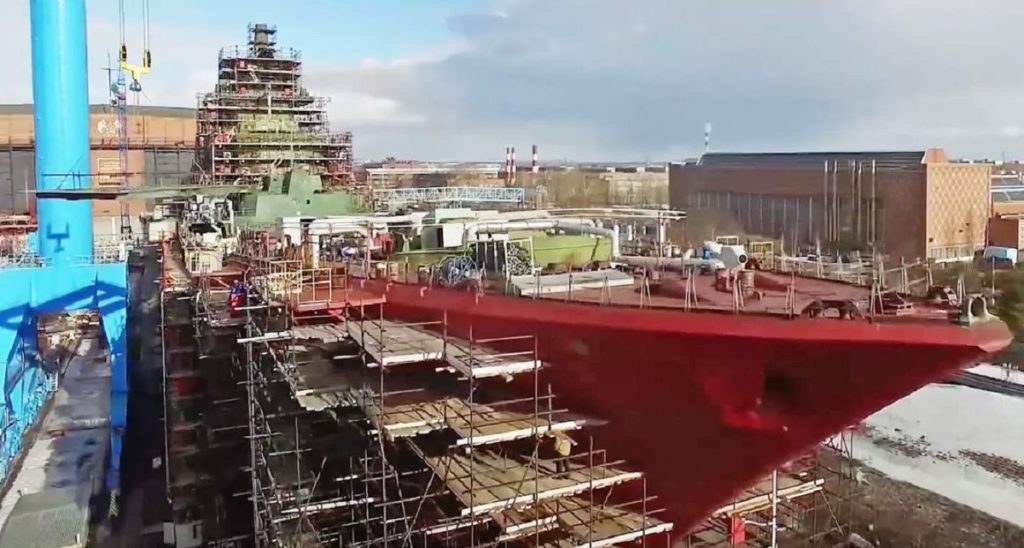
PROJECT 1144.2M: THE ADMIRAL NAKHIMOV REBUILD
What it is. Project 11442М (1144.2M) is the name for the deep modernization of Admiral Nakhimov. The Northern Design Bureau began the design documentation in 2012, and a contract between the Ministry of Defence and Sevmash (Севмаш, Severodvinsk) was signed in 2013 (the sources variously say April or June). The idea is simple to state: keep the hull and the nuclear plant, remove essentially everything else, and install the weapons, sensors, electronics and cabling of a 2020s missile cruiser. Western and Russian press both describe the result as close to a new ship in an old hull. FW-MAG, citing the Navy's commander-in-chief, wrote that combat systems, sensors, electronics, wiring and most internal machinery were replaced outright.
Timeline in outline (all dates as reported).
New weapons, as reported.
New sensors and electronics, as reported. The Russian technical listing for 1144.2M includes the MR-650 Podberyozovik (Подберёзовик) air-search radar, the Fregat-M2 (Фрегат-М2) surveillance radar, MR-231 and MR-232-3 navigation radars, the 5P-20K Monument (Монумент) complex, the Minotaur-ISPN-M1 (Минотавр) sonar, the Anapa-M anti-saboteur sonar, the Amga-M sonobuoy receiver, the Prosvet-M electronic-warfare suite, the Sigma-11442M combat information system and the Ruberoid communications complex. Several of these lists come from sources written before the rebuild was finished and were never confirmed by an official source; they are the best public indication of the intent and not a guarantee of what is on the ship today. The Russian Navy's commander-in-chief did say in 2024 that the ship would have new weaponry, radio-technical equipment and communications, and Zircon.
Why vertical launch, and the physics of a cold launch. The old Granit tubes were angled, sunk into the deck, and used a missile that lit its booster inside the tube. Each tube held a single, very large missile. A 3S14 cell is a vertical tube that the missile is pushed out of by gas pressure (ejection), and only when the missile is clear of the ship does its own booster ignite. This is the "cold launch" concept: the hot exhaust never goes through the ship's structure and there is no need for the big uptake and plenum arrangement that a hot-launch cell (like the US Mk 41) needs to vent flame. A gas generator or compressed gas pushes the missile with an acceleration of a few g for a short stroke, and the missile leaves the cell at a speed of the order of tens of metres per second. Because the cell is a standard size, ten modules of eight can hold whatever the magazine plan calls for, and a missile of one family can be replaced by another without rebuilding the ship. That is what "universal" means here. The S-300F's revolver drums use the same ejection principle with a rotating magazine; that is a different packaging choice with the same physics.
Zircon and the physics of hypersonic flight. The 3M22 Tsirkon is described by Russian officials as a hypersonic cruise missile with a scramjet engine, a speed of about Mach 8 to 9 and a range of 450 to 1,000 km depending on the source and profile. Western analysts generally accept that it is a scramjet-powered missile and tend to estimate lower speeds (somewhere around Mach 6 to 8) and shorter range at low altitude. Russia has also said it has been used operationally; independent confirmation of its performance in combat is limited and contested.
The Poliment-Redut question, in plain terms. Poliment-Redut is a Russian naval air-defence system built around the Poliment multi-function radar (four fixed flat faces, described as phased-array, with a common description of it as active), the Redut vertical launcher and a family of missiles: the 9M96E and 9M96E2 (published ranges of about 40 and 120 km, with an active radar seeker and gas-dynamic control for sharp turns) and the 9M100 (short range, four to a cell). It is installed on newer Russian frigates and corvettes. It is a possible candidate for the Nakhimov, but I have not found proof of it on this ship, and the mid-2010s Russian analysis expected Fort-M. If you want a mental model: the Fort family gets its target illumination from large fire-control radars and fires heavy long-range missiles; Poliment-Redut gives each missile its own radar seeker, so the ship can launch many at once and does not need continuous radar illumination for each. The difference between a passive and an active array is explained in PESA radar and AESA radar.
DAMAGE CONTROL, CREW AND LIFE ON BOARD
The ship has an extensive compartmentation scheme, a double bottom and armoured spaces around the most vulnerable stores, but not a full armour belt. Russian descriptions emphasise redundancy: the automated power plant occupies three compartments, and the oil-fired boilers and the generators give fallback power if the reactors are shut down. The Granit magazines, the command post, the hangar and the fuel and ammunition stores each have their own armoured box, which limits how far one hit can spread. How well this would work against modern anti-ship missiles with 200 to 750 kg warheads is not something that public information can answer, and the class has never been in a combat situation that tested it.
The crew is large (727 to 760 on Soviet tables) because the ship has a lot of weapon systems, a nuclear plant with its own engineering department and a flagship staff. Crew amenities in the old Soviet ships are reported to include a sauna and a pool; I could not verify this in a primary source and the claim is folklore-level. The Nakhimov's crew size after automation is not public.
THE REST OF THE CLASS TODAY
STATUS AS OF 16 OCTOBER 2026
WHAT IS UNCERTAIN
THE PHOTOS ON THIS PAGE
The first picture is the one the article has always carried. The other six were added later, in the order they were sent. Hull numbers are not names: in Russian listings 080 appears as a number for Kalinin (Admiral Nakhimov) in 1994, Pyotr Velikiy carried 099 in 1998, and 050 appears for Frunze in 1985, but numbers were reassigned and I have not confirmed any identification beyond what is visible.
GLOSSARY OF RUSSIAN TERMS
HOW THIS ARTICLE WAS BUILT
Published specifications come from Russian technical listings of the project, Wikipedia, and reporting by the Barents Observer, Izvestia, FW-MAG, RIA Novosti, TASS, Army Recognition and others during 2026. Anything marked as a claim is from an official or a press statement and has not been verified by measurement. Sources written before 2022 are treated as describing intentions. If you see a figure that does not match what you know, treat the table in this article as a starting point and not as the last word.