Home |
Data Base |
Technical |
Radio |
Search
S-300
Family of long-range SAM systems
P-line SA-10/20 | V-line SA-12/23 | F-line SA-N-6
Project Orlan Data Base // public encyclopedia
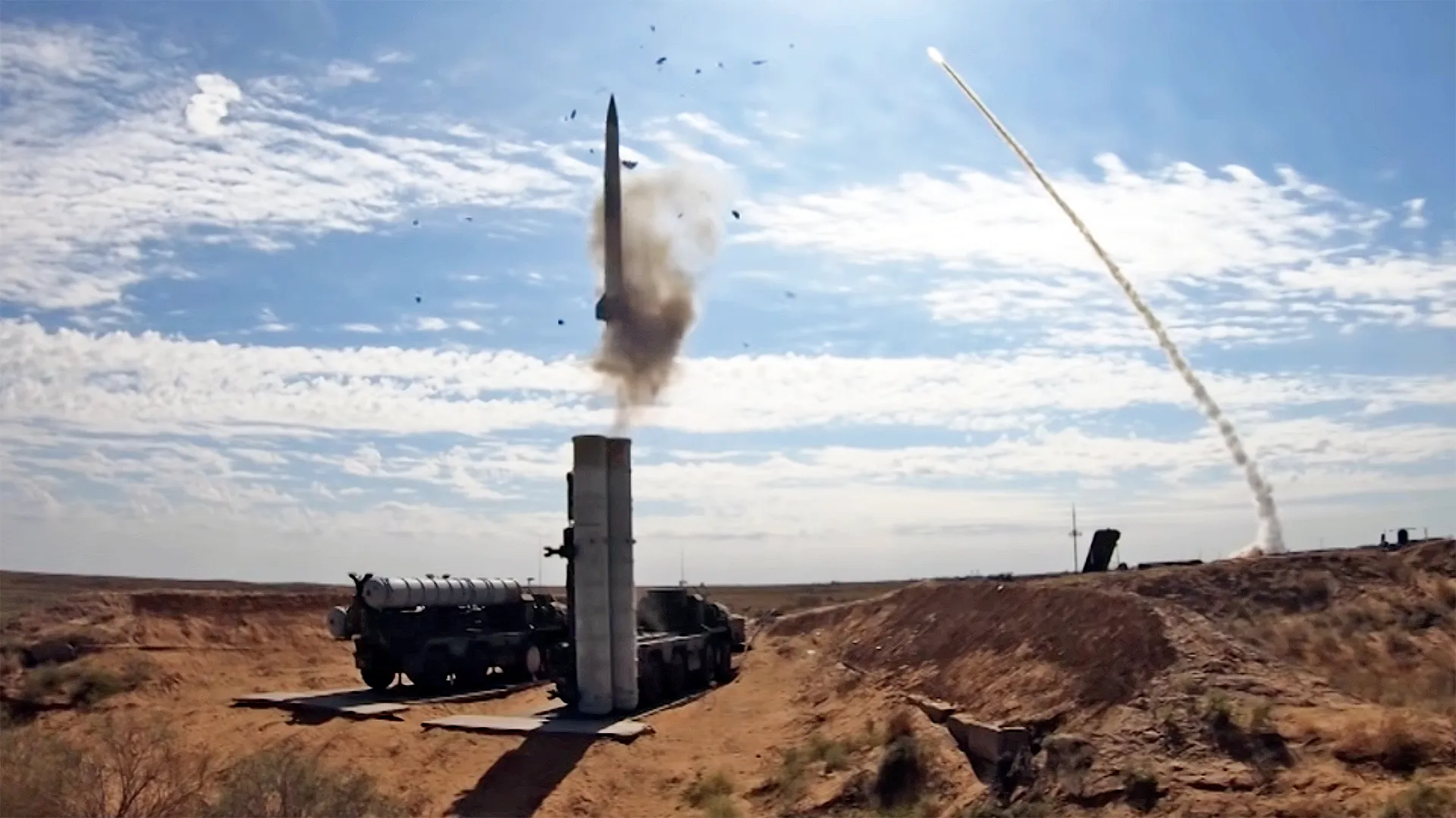
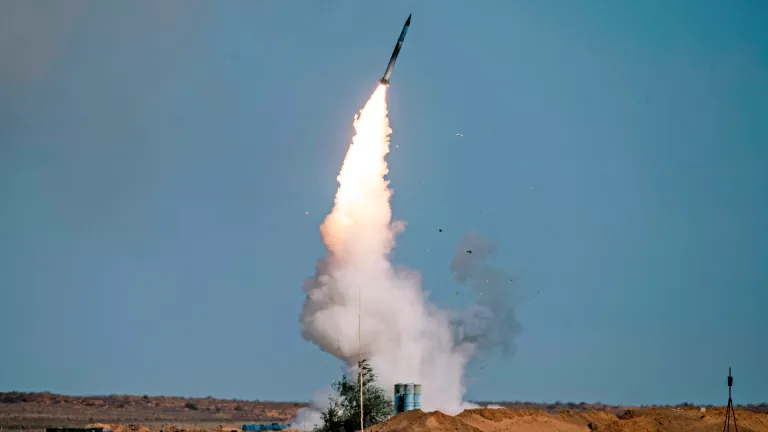
WHAT "S-300" ACTUALLY MEANS
S-300 (С-300) is not one missile and not one battery. It is the programme name for a family of long-range surface-to-air missile (SAM) systems (зенитные ракетные системы / ЗРС, or зенитные ракетные комплексы / ЗРК in Russian usage) that the Soviet Union began developing in the late 1960s. A government decision of 1969 is the date usually given for the programme, and the first system reached service in the late 1970s. The common idea was to replace the single-target, mostly fixed S-75 / S-125 / S-200 sites with a phased-array radar that could follow many targets at once, sealed missile canisters, a computerised command post and a truck-mounted layout that could be moved.
Three separate systems grew from that programme, built by different design bureaus for three different customers. They share the name and a few ideas, but the missiles, radars and vehicles are mostly different:
- S-300P (С-300П) for the national air defence forces (PVO-Strany, "П" for ПВО страны). Designed by NPO Almaz (Raspletin). Wheeled (MAZ) vehicles. NATO names SA-10 Grumble, then SA-20 Gargoyle. This is the numerous and best-known branch, and the direct ancestor of the S-400.
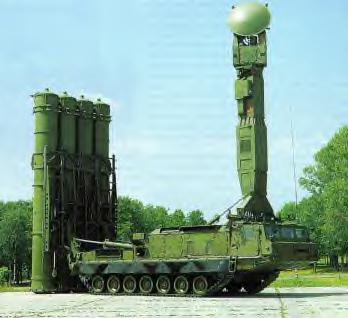
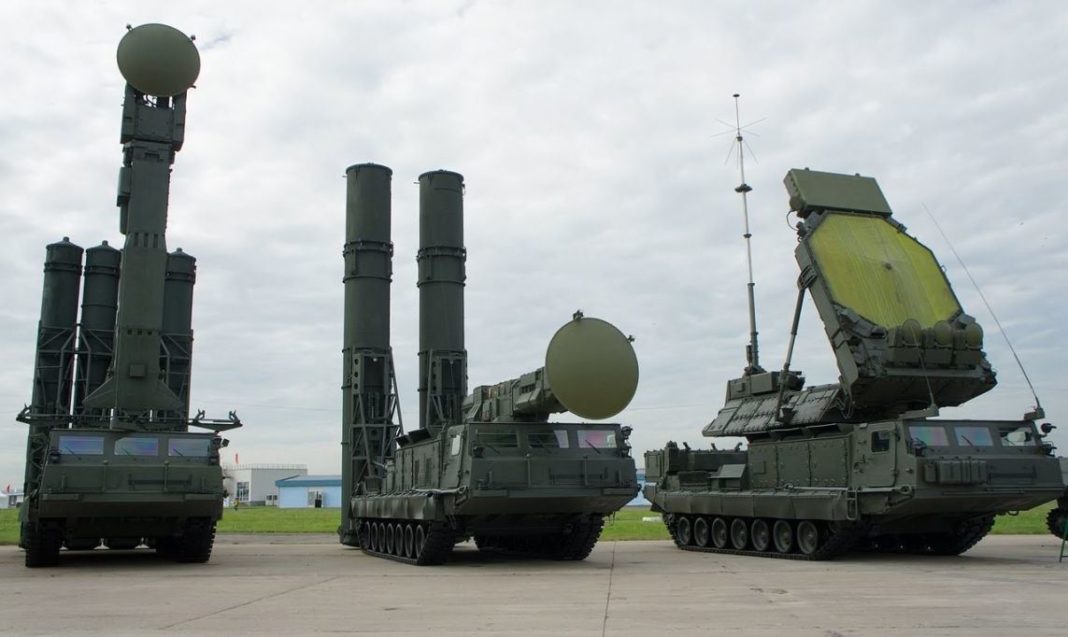
- S-300V (С-300В) for the Ground Forces (army air defence, "В" for войсковая). Designed by NIEMI, later called Antey, with missiles by NPO Novator. Tracked vehicles. GRAU index 9K81. NATO names SA-12 Gladiator / Giant, later SA-23. Built from the start to kill tactical ballistic missiles as well as aircraft.
- S-300F Fort (С-300Ф «Форт») for the Navy ("Ф" for флотская). Designed by the Altair institute, using navalised P-line missiles. Vertical rotary launch drums on cruisers. NATO name SA-N-6 Grumble, later SA-N-20 Gargoyle for Fort-M.
Calling every tall Russian SAM "an S-300" erases that split, and it is the main source of confusion in news reporting. Photos of an "S-300" can show a P-line truck, a V-line tracked vehicle or a ship's launch hatches, and a missile fragment labelled "S-300" can belong to any of several rounds. The S-400 Triumf (see S-400) is the P-line's direct successor and has its own article; the S-500 (see S-500) is a separate, newer programme.
QUICK FACTS
- Developed: late 1960s onward (programme decision 1969, commonly cited). P-line testing finished about 1978; first regiments went on duty around Moscow in the late 1970s.
- Developers: Almaz (P-line system), NIIP / Tikhomirov (radars), MKB Fakel (P-line missiles), NIEMI / Antey and NPO Novator (V-line), Altair (naval). Today all belong to Almaz-Antey (Алмаз-Антей), formed in 2002.
- Production: P-line production through about 2012 is often given as roughly 3,000 launchers and 28,000 missiles (a figure that appears in many reference works; treat as approximate, since no audited count has been published).
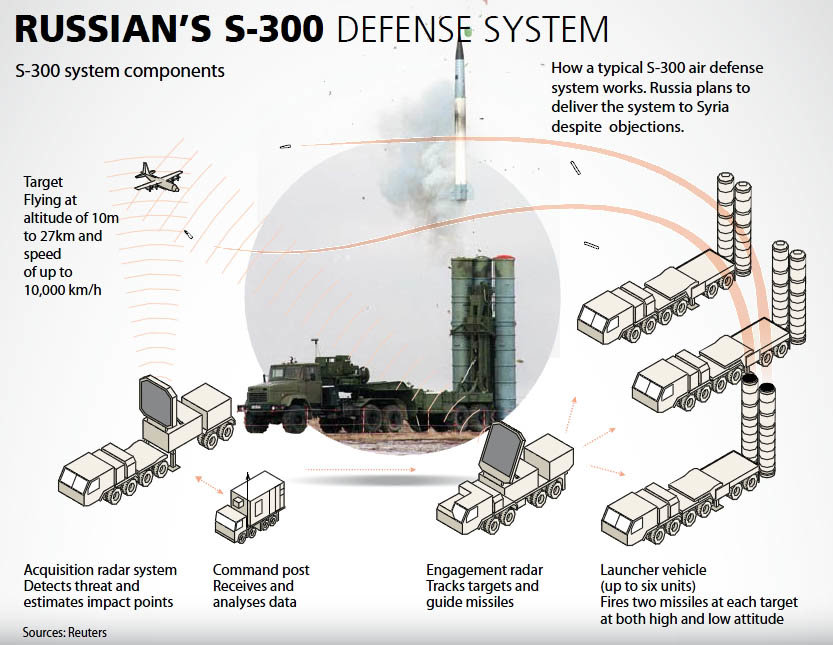
- Basic idea: one engagement radar, up to 12 launchers each with 4 missiles, cold vertical launch, guidance by command and later track-via-missile.
- Range class: about 47 km for the first missile (5V55K) to about 250 km for the best P-line missile (48N6E3 in S-400-era service); the V-line S-300V4 claims up to about 400 km (manufacturer claim).
- Users: Russia, Ukraine, Belarus, Kazakhstan, Algeria, Azerbaijan, Armenia, Bulgaria, Greece, China (imported and copied as HQ-9 / HQ-15 / HQ-18), Iran, Vietnam, Egypt, Venezuela and others. Russia is the main source for new missiles and spares.
HISTORY
- Why it was built: By the mid-1960s the Soviet air defence forces relied on the S-75 Dvina, S-125 Neva and S-200 Vega. All were single-target or few-target systems that needed a long time to set up, and none could handle a mass raid of low-flying aircraft or the new cruise missiles. The S-300 programme was meant to give one battery many simultaneous engagements, shorter set-up and a much harder target for jamming and anti-radiation missiles.
- 1960s-70s, programme and tests: Work began in the late 1960s. Testing took place at Soviet ranges such as Sary-Shagan in Kazakhstan. The first system to reach units was the P-line S-300P/PT around 1978-79, with early regiments around Moscow. A reference work often repeated in English says over 80 S-300P systems were active in 1987, mostly around Moscow (treat as approximate).
- Early 1980s, S-300PS and S-300F: The self-propelled S-300PS entered service about 1982-85 (sources differ; Russia dates it to 1985). The Navy's S-300F Fort was tested at sea on the Kara-class cruiser Azov (commonly reported) and entered service in the early 1980s on the Kirov-class and Slava-class cruisers.
- 1983-88, S-300V: The Army's S-300V (9K81) began entering service in 1983 and is usually described as fully integrated in 1988. It replaced the older 2K11 Krug.
- 1990s, export and the PMU line: The export S-300PMU appeared in the late 1980s and early 1990s; the S-300PMU-1 with the large 48N6 missile followed in 1993 (first sold to China); the S-300PMU-2 Favorit (Фаворит), with the 48N6E2 missile, was presented in 1996 and entered service in 1997. Russia's own versions are S-300PM, PM1 and PM2 (some sources call the late domestic standard Favorit-S).
- 2000s, S-400: Almaz marketed the S-300PMU-3 and then renamed it S-400 Triumf, which began combat duty near Moscow in 2007. The S-300P production lines were wound down in favour of the S-400, though refurbishment and modernisation of old S-300P and S-300V units continued.
- 2010s, V4 and exports: The S-300V4 (also S-300VMD) was developed in the 2010s and delivered to the Russian Army from about 2014. The Antey-2500 export version was sold to Venezuela and Egypt.
- 2010-2016, the Iran saga: Russia signed a contract for S-300PMU-1 with Iran in 2007, then cancelled it in 2010 under UN sanctions and pressure from Israel and the United States. After the 2015 nuclear deal framework, Russia delivered S-300PMU-2 systems in 2016 (see the combat section).
- 2022 onward: The war in Ukraine put the S-300 into large-scale combat on both sides, as an air defence system and, in Russian hands, as a surface-to-surface weapon (see below).
DESIGNATIONS AND NAMING (A CHEAT SHEET)
- GRAU index / complex: S-300PT is 5Zh15; S-300PS is 5Zh15S; S-300V is 9K81; Antey-2500 is S-300VM. NATO / DoD names: SA-10 Grumble (P-line from PT to PMU), SA-20 Gargoyle (PMU-1, PMU-2, PM1, PM2), SA-12 Gladiator / Giant (S-300V), SA-23 (S-300VM Antey-2500 and V4), SA-N-6 (Fort), SA-N-20 (Fort-M).
- Letters: E = export (for example 30N6E, 48N6E2). The "E" parts can differ from domestic equipment, usually in IFF and some modes.
- Russian military terms: дивизион (divizion) is the fire unit that Westerners call a battalion; полк (regiment); бригада (brigade); батарея (battery); пусковая установка (ПУ, launcher); боевая машина (combat vehicle); пункт боевого управления (ПБУ, command post); радиолокационная станция (РЛС, radar); транспортно-заряжающая машина (ТЗМ, reloader).
- China's copies: HQ-9 is a P-line cousin; HQ-15 is a Chinese development of S-300PMU-1; HQ-18 is a V-line relative. China also bought genuine S-300PMU-1 and PMU-2 systems.
HOW AN S-300P ENGAGEMENT WORKS, STEP BY STEP
The details differ by version, but the P-line sequence in a typical PM / PMU-1 / PMU-2 battery looks like this. The numbers are published or advertised figures, not measured ones.
- 1. Search and designation. A regiment-level radar (64N6 Big Bird) and battery-level radars (36D6 Tin Shield, 76N6 Clam Shell for low targets, later 96L6 Cheese Board) sweep the sky. Their tracks go to the command post (54K6 / 83M6 family), which fuses them, drops false tracks and ranks threats.
- 2. Assignment. The command post assigns targets to a battery. In the older PS-era battalion the operator hands the target to the engagement radar (30N6 Flap Lid); in the later layout the command post can run all of the TELs (up to 12) and the radars.
- 3. Track and illumination. The engagement radar (30N6 family, a passive phased array, see How PESA Radar Works) acquires the assigned target in a narrow sector and tracks it. One radar can follow many targets: figures of up to 6 targets engaged at once with up to 2 missiles each (12 missiles in flight) are the classic P-line numbers.
- 4. Launch order. The command post picks a launcher with a suitable missile and orders launch. A launch interval of about 3 seconds between missiles is the usual published figure. Because launch is vertical, the launcher does not need to rotate to aim.
- 5. Cold launch. The missile is pushed out of its sealed canister by a gas generator (a "cold" launch). The rocket motor ignites only after the missile has risen to a safe height, which keeps the exhaust away from the launcher and its crew. Early towed PT launchers used a hot launch and could scorch their own trailer (a known problem); cold launch was introduced with the PT-1 and later versions.
- 6. Climb and turn. The missile climbs vertically, then tips over toward the intercept point using gas-dynamic vanes and fins. The initial climb is pre-programmed. Published acceleration figures of up to about 100 g during the launch phase appear in reference works (treat as approximate).
- 7. Mid-course. The ground radar sends corrections by radio. In the earliest 5V55K missile this was pure command guidance. In later missiles, the radar also illuminates the target and the missile's onboard receiver picks up the reflection.
- 8. Track-via-missile. In the 5V55R and 48N6 families the missile's seeker measures target position relative to itself and relays it down to the radar by data link. The ground computer, with its far greater processing power, calculates the guidance commands and sends them back. This is called track-via-missile (TVM) in the West and SAGG (seeker-aided ground guidance) in Russian-derived descriptions; it is the same idea used by the Patriot (see MIM-104 Patriot).
- 9. Terminal phase and fuzing. In the final seconds the warhead's proximity fuze (a radio fuze, with a contact fuze as backup) detonates a blast-fragmentation warhead. A published figure of 19,000 to 36,000 fragments appears for different missiles. Kill probability is a function of range, geometry and target type; no verified figures exist for combat.
- 10. Assessment. The radar watches the intercept and the command post decides whether to fire another missile at the same track. Firing two missiles per target is the normal doctrine for hard targets.
Because the radar must keep illuminating the target until the missile arrives, a battery that is firing is also emitting, and that is the moment it is most vulnerable to anti-radiation missiles and to drones that home on emitters.
COLD LAUNCH, TVM AND WHY THEY MATTER
- Cold launch: The missile sits in a sealed transport-launch container (транспортно-пусковой контейнер, ТПК). A gas generator pushes it out, and its motor ignites only after it is clear. Advantages: no blast damage to the launcher, near-vertical launch lets the launcher cover 360 degrees without turning, short reaction time, and a re-loadable launcher with sealed rounds that do not need maintenance in the field.
- Launch container life: The sealed canisters keep the missile ready for years without checking. Service life is quoted as about 10 years for missiles in S-400 brochure material (P-line figures are similar in order of magnitude), with life extensions commonly applied to older stock (a major issue for Ukraine and others using 1980s rounds).
- Command guidance (5V55K): Simplest and most jam-resistant at close range, but accuracy falls with range because the radar's angular error grows.
- TVM / SAGG (5V55R, 48N6 and later): Better accuracy at long range and against low-RCS targets, because the missile sees the target from close up. The cost is a more complex missile and the need for continuous illumination.
- Active radar seekers (9M96E, 9M96E2): Used on the P-line only in the upgraded S-300PMU-1 and later versions and on the S-400; the missile has its own radar and does not need illumination in the endgame.
THE S-300P LINE: VERSION BY VERSION
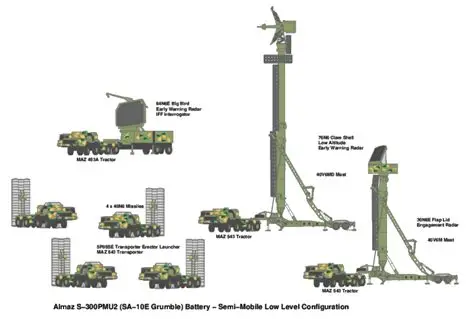
- S-300P / S-300PT (С-300ПТ), SA-10A Grumble. First in service about 1978-79. Towed (semi-trailer) vehicles, so set-up took from tens of minutes to about an hour. First missile 5V55K, command-guided, about 47 km. Engagement radar 5N63 Flap Lid A; search with the 36D6 Tin Shield (also called ST-68U) and the low-level 5N66M Clam Shell radar; a 40V6 mast lifted the Flap Lid or Clam Shell to look over trees. Towed launcher 5P85-1. Later PT-1 and PT-1A upgrades brought the 5V55KD missile (a longer-range, trajectory-optimised round, about 75 km and up to about 93 km class in some tables) and cold launch.
- S-300PS / S-300PM (С-300ПС), SA-10B Grumble. Self-propelled, about 1982-85. MAZ-543 family 8x8 vehicles. The launcher pair is a "master" 5P85S with an equipment container behind the cab and a "slave" 5P85D without it; towed 5P85T launchers also exist. Engagement radar 30N6 Flap Lid B. New 5V55R missile with track-via-missile, about 75 km. Gas-turbine power units (GAP-65) on vehicles.
- S-300PMU (С-300ПМУ), SA-10C Grumble. The export version of the PS-era system, with 5V55K and 5V55R missiles. Radars: 30N6E, 76N6 Clam Shell, ST-68U / 36D6 Tin Shield, and 64N6 Big Bird at regimental level. Early customers included China (from 1993) and Czechoslovakia (its system passed to Slovakia); Bulgaria also operates an S-300PMU, and Greece has an S-300PMU-1 on Crete that was originally ordered by Cyprus.
- S-300PM1 / S-300PMU-1 (SA-20A Gargoyle). Introduced about 1993. New, larger 48N6 / 48N6E missile, about 150 km, with an anti-ballistic missile capability against short-range targets (published as up to Mach 8-class target speed in some tables). New 30N6E1 / 30N6E "Tomb Stone" engagement radar. New 83M6E command and control with a 64N6E Big Bird. Compatible with the later 9M96E and 9M96E2 missiles.
- S-300PM2 / S-300PMU-2 Favorit (Фаворит), SA-20B Gargoyle. Introduced in 1996-97. 48N6E2 missile, about 200 km. Engagement radar 30N6E2, command post 54K6E2 with 64N6E2 Big Bird, and optional 96L6E all-altitude detector, usually on an MZKT-7930 chassis. Up to 12 launchers (mix of self-propelled 5P85SE2 and towed 5P85TE2). Advertised as able to cue older PMU / PMU-1 batteries and even an S-200 battery. This was the last mass export standard before customers moved to the S-400.
- Russian domestic upgrades. Russian S-300PS and PM units were refurbished under programmes to PM1 and PM2 standards. The S-300PM2 / "Favorit-S" is the late domestic standard. In the 2010s Russia kept the S-300P in service as a second-line defence while buying S-400s for first-line regiments.
- Chinese relatives. HQ-9 is a P-line-inspired Chinese system; HQ-15 is a Chinese development of the S-300PMU-1. China has said little about its internal design and Western descriptions vary.
P-LINE MISSILES AT A GLANCE (PUBLISHED FIGURES)
All ranges are the manufacturer's or reference-work figures against an aerodynamic target. They are not measured combat performance and are often quoted at the best altitude.
- 5V55K: Command guidance. Range about 47 km. The first S-300P missile.
- 5V55R: Track-via-missile. Range about 75 km (some tables 90 km). Weight about 1,660 kg, warhead about 130 kg (this is the round most often found as wreckage in Ukraine).
- 5V55KD / 5V55U: Trajectory-optimised derivatives; about 75-93 km in some tables.
- 5V55RM: Naval version for the S-300F Fort; range about 75 km.
- 48N6 / 48N6E: Single-stage, about 150 km. Weight about 1,800-1,900 kg, warhead about 143-145 kg. S-300PMU-1 and Fort-M.
- 48N6E2: About 200 km. Warhead about 150 kg. Favorit.
- 48N6E3 / 48N6DM: About 240-250 km in S-400-era service; warhead about 180 kg. Mostly an S-400 round, but PMU-2 launchers are often said to be able to fire it (reported, not confirmed for each customer).
- 9M96E / 9M96E2: Smaller active-radar missiles (about 40 km and about 120 km), four to a canister slot. They arrive with the S-400; see S-400.
- Canister load: a P-line launcher (5P85 family) carries four large missiles in canisters.
P-LINE RADARS AND VEHICLES
- 5N63 / 5N63S "Flap Lid A": The original engagement and illumination radar of the S-300PT. A passive phased array on a mast-mounted or trailer-mounted antenna, I/J-band.
- 30N6 / 30N6E "Flap Lid B": PS and PMU engagement radar, integrated with a command post; up to 6 targets engaged and 12 missiles in flight in standard descriptions. The export letter E is for versions with simplified IFF.
- 30N6E1 / 30N6E2 "Tomb Stone": PMU-1 and Favorit engagement radars. Instrumented range often given as 200-300 km in brochures and reference works (an instrumented range is a test-range figure, not a combat figure).
- 64N6 / 64N6E / 64N6E2 "Big Bird": Three-dimensional regimental or group acquisition radar, E/F-band (per some sources C-band), electronically steered with mechanical rotation. Figures of about 300 km for fighter-size targets and up to 300 simultaneous tracks appear in descriptions. It is the ancestor of the 91N6E on the S-400; see 91N6E Radar.
- 36D6 "Tin Shield" (ST-68U): Battery-level 3D search radar Detection about 150-175 km at medium altitude, about 40 km against a very low target (published ranges for fighter-size targets).
- 76N6 "Clam Shell" and 5N66M: Low-level detection radar working with continuous-wave techniques; used on a mast (the 40V6 series, from about 24 to 39 m) to extend the radar horizon.
- 96L6 / 96L6E "Cheese Board": All-altitude 3D detector on a wheeled chassis, about 300 km class in descriptions. It lets each battery see low targets without depending on a separate Tin Shield / Clam Shell pair. Ukraine's intelligence service claimed a 96L6 destroyed in Crimea in July 2026 (see the combat section).
- 5P85 launcher family: 5P85-1 (towed, PT), 5P85S / 5P85D (self-propelled master / slave), 5P85T (towed, PS), 5P85SE / 5P85TE (export), 5P85SE2 / 5P85TE2 (Favorit), and the later 5P85SM2-01 and 5P85TM versions.
- Support: 22T6 loaders, 5I57 diesel generators, 63T6 power converters, 1T12 survey vehicle, FL-95 antenna masts for datalinks. A battery is dozens of vehicles, not just the launchers you see in photos.
COMMAND AND CONTROL
- 54K6 / 54K6E / 54K6E2: The battery or battalion command post (пункт боевого управления, ПБУ). It handles target assignment, launcher management and datalinks.
- 83M6 / 83M6E / 83M6E2: The group-level command and control complex; the 83M6E2 is the Favorit command post that includes the 54K6E2 and the 64N6E2 radar. It runs up to 12 launchers.
- Older posts: Baikal-1E and Senezh-M1E command posts can also be used with the older P-line equipment.
- Integration: Polyana-D4 type army posts can tie an S-300V and Buk-M3 together (see Buk-M3). Russian doctrine places Pantsir (see Pantsir), Tor (see Tor) and Kashtan (Kashtan) under the long-range systems as the point-defence layer. Sensor fusion from A-50 airborne radars and ground radars (Nebo-M, Gamma-DE and others) feeds the picture.
- Command links: Radio relay, cable and tropospheric links. The command post can fight off the regiment net if the group link is lost, at reduced capability.
BATTERY, BATTALION AND REGIMENT (ORGANISATION)
The exact organisation depends on version and customer; the figures below are the usual published patterns, not a measured order of battle.
- Early PT battery: one engagement radar (5N63S Flap Lid) and a battery command post, up to six launchers in the field pattern (a typical grouping of two master and four slave), crane and transport vehicles.
- PS / PM battalion (дивизион): a battalion command post with search and combat-control vehicles, plus a fire complex made up of one engagement radar and up to four launch groups of one master and two slave launchers (12 TELs if full). Powered by vehicle-mounted turbines. Radars can be elevated on masts.
- PM / PMU-1 / PMU-2 battery: one 30N6E1 / E2 engagement radar, optionally one Clam Shell, up to 8 launchers of 4 missiles each in a battery (32 ready missiles), or up to 12 launchers under one command post in the "standard division" description. A 54K6 / 83M6 command post and a 64N6 Big Bird at regimental level.
- Regiment (полк): generally three to six batteries or battalions, with a regimental command post and search radar. A late P-line regiment may use 96L6 radars so that each fire unit has its own all-altitude sensor.
- Site layout: launchers are often placed in bermed U-shaped pads, with the engagement radar offset from them. Photos show permanent-looking sites that sit for months, in contrast to the "shoot and scoot" doctrine on paper.
- Setup time: Late P-line brochures give about 5 to 30 minutes to deploy from march, depending on version (S-300PT needed over an hour in early use).
THE S-300V LINE: ARMY AIR AND MISSILE DEFENCE
The V-line is a different system from the P-line, despite the name. It was built by a different bureau for a different customer, and it does not share missiles, launchers or most radars with the P-line. Do not put a 48N6 on a 9A83.
- Designers and role: NIEMI (later Antey) as lead, missiles by NPO Novator. "V" stands for войсковая (field forces). It replaced the 2K11 Krug at army and front level and was meant to cover the troops against aircraft, cruise missiles and tactical ballistic missiles (Lance, Pershing-class targets in the Cold War).
- Vehicles: Tracked GM-chassis vehicles (about 47 t class), which cross rough ground better than the wheeled P-line.
- S-300V (9K81), SA-12 Gladiator / Giant. In service from 1983, integrated in 1988. Two missiles: the 9M83 Gladiator (SA-12A) for aircraft and shorter-range ballistic missiles, about 75 km class, four per 9A83 launcher-radar vehicle; and the larger 9M82 Giant (SA-12B), the anti-ballistic specialist, about 100 km class in early tables, two per 9A82 vehicle. Guidance is inertial plus radio-command in mid-course and semi-active radar in the terminal phase, using illumination from the launcher-radar vehicle (TELAR).
- S-300VM Antey-2500 (SA-23). An upgrade with new 9M83M / 9M82M missiles. The "2500" in the name refers to the claimed maximum range of the ballistic missiles it can engage (km), not the range of the SAM. Brochure figures include an aerodynamic-target range of about 200 km (9M82M), a detection range of about 250 km, a target speed of up to about 4,500 m/s, 24 aircraft or 16 ballistic targets engaged simultaneously, and a short reaction time. These are the manufacturer's claims. Exports: Venezuela (two battalions, delivered about 2012) and Egypt (a contract of about USD 1 billion for four batteries, reported delivered by 2017).
- S-300V4 (С-300В4) / S-300VMD, SA-23. The most recent version. It uses the 9M82MD and 9M83MD missiles with a claimed range of up to about 400 km against high-value targets (AEW aircraft, jammers) at very high speed, plus a modernised command post and radars. Russian state sources said V4 deliveries to the Army began about 2014. Export version: Antey-4000. A deployment to Tartus in Syria in 2016 was widely reported (reported, not independently confirmed for operating status).
- Radars and vehicles (V-line): 9S15 Obzor-3 / 9S15M "Bill Board" (all-round surveillance, also passive), 9S19 / 9S19M2 Imbir "High Screen" (sector radar for the ballistic-missile channel, with passive electronically scanned arrays), 9S32 "Grill Pan" (multi-channel guidance radar), 9S457 command post, launch-radar vehicles 9A82 (2x 9M82) and 9A83 (4x 9M83), loaders 9A84 (2x 9M83) and 9A85 (2x 9M82). The 9S52 Polyana-D4 higher-level post can link S-300V with Buk batteries in an army air-defence brigade.
- Typical battalion: a command-and-designation group (9S457, Bill Board, High Screen) plus fire batteries, each with a Grill Pan and up to six launcher-radar vehicles and loaders. Because the radar function sits on the launcher-radar vehicles, the V-line is more spread out than a P-line battery, and each vehicle emits.
- Chinese relative: HQ-18 is a V-line relative; it is not a copy of the P-line.
THE S-300F LINE: NAVAL FORT AND RIF
- S-300F Fort (С-300Ф «Форт»), SA-N-6 Grumble. The navalised P-line missile (5V55RM, about 75 km class, up to about 5-90 km envelope in various tables) in vertical rotary launcher drums under the deck. The ship's radar suite includes the 3R41 Volna "Top Dome" engagement radar. First installed on the Kirov-class heavy cruisers and Slava-class (Project 1164) cruisers, after tests on the Kara-class ship Azov (commonly reported). A ship's "battery" is the ship: Volna radars, below-deck magazines of eight- or twelve-round drums per the class, and the combat information centre.
- S-300FM Fort-M (SA-N-20 Gargoyle), export Rif-M. Uses the 48N6 missile with track-via-missile; range about 90 km class in tables, target speed up to about Mach 8.5 and a floor down to a few metres. The Tomb Stone-derived radar replaces the Top Dome. Entered service about 1990 and is reported to be installed only on the Kirov-class cruiser Pyotr Velikiy. China bought two Rif-M systems (2002) for its Type 051C destroyers.
- Syria and the Moskva: The Slava-class cruiser Moskva carried Fort off Latakia in November 2015 after the Su-24 shootdown by Turkey, to cover the Russian air group at Khmeimim. She sank in April 2022 after an on-board fire and explosion. Ukraine said two Neptune missiles hit her; Russia said a fire set off ammunition. The S-300F did not stop whatever hit her.
HOW THE LAYERS SIT TOGETHER
The S-300 family is one layer in a longer chain. The usual Russian arrangement runs, from the outside in: early-warning and over-the-horizon radars, the A-135 / A-235 anti-ballistic missile system around Moscow (see A-135 / A-235 Nudol), S-500 / S-400 / S-300P (and V4 for the Army), then Buk-M3, Tor and finally Pantsir and gun systems for the last few kilometres.
- P-line: Protects cities, bases, industry and fixed sites, often in permanent berms.
- V-line: Travels with the field army and is the dedicated anti-ballistic umbrella for it. See Buk-M3 for the medium-range sister system in the same brigade.
- F-line: The cruiser's area air defence.
- Pantsir / Tor / Kashtan underneath: Short-range systems exist because a long-range system with big missiles and slow-turning radars cannot easily cope with low, small, fast or saturating threats. See Pantsir, Tor and Kashtan.
- Radars that help: The 64N6 / 91N6 family (see 91N6E Radar), the 96L6, and large VHF sets such as Nebo and Gamma-DE. How the electronically scanned arrays inside them work is explained in How PESA Radar Works and How AESA Radar Works.
- Not one system: Polyana, Baikal and the 83M6-class command posts can mix P-line batteries and even talk to an S-200 or Pantsir. That network, not the brand, is the real "system of systems".
S-300 COMPARED WITH PATRIOT AND S-400
This is a neutral summary of what is published. Which system is "better" depends on scenario, missiles, radar version and crew training. No fair public head-to-head exists.
- Same era, same basic idea: The P-line (1978 onward) and the Patriot (1984 onward) are both phased-array, multi-target, track-via-missile systems. See MIM-104 Patriot for a detailed description.
- Missiles: The 5V55R is about 1,660 kg with a blast-fragmentation warhead of about 130 kg; Patriot's PAC-2 is much lighter. The S-300PMU-1 / 2 48N6 rounds are heavy (about 1,800 kg) and have a very long range; Patriot's PAC-3 MSE is a small hit-to-kill missile (see the Patriot article). The S-300's published ranges (150-250 km) exceed those of Patriot's established missiles, but published range does not equal engagement success.
- Hit-to-kill: The S-300P does not use hit-to-kill missiles; the 77N6 (S-500 / S-400 era) is Russia's hit-to-kill programme.
- Mobility: Patriot is a more compact battery built around one radar. The S-300P battery is a larger set of vehicles with separate radars and a heavier support tail; the V-line is tracked and distributed.
- Versus S-400: The S-400 keeps the P-line battalion geometry (one 92N6E engagement radar, up to 12 launchers) but adds the 91N6E radar, new missiles (9M96, 40N6), more channels and a more integrated network. See S-400. Many S-400 batteries can still fire 48N6 missiles from older S-300 stock.
- Versus S-500: The S-500 is a new programme aimed at exo-atmospheric intercepts; see S-500.
OPERATORS AND EXPORTS
Reported operators and quantities vary between sources. The list below uses widely published information and avoids numbers that cannot be sourced.
- Russia: The largest operator (P-line and V-line). A regiment-based force. The S-300P/PT has been mostly retired; PS and PM units have been refurbished to PM1 / PM2 standard; the V-line is being upgraded to V4. The S-300F is on the remaining Kirov and Slava ships.
- Ukraine: Inherited a very large S-300P and S-300V fleet in 1991; before 2022 it was reported to have had about 100 batteries in a range of conditions (a figure from one reference work; treat as approximate). Most of those were older PT/PS. Ukrainian sources and press accounts speak of roughly 25-30 S-300PT/PS battalions in various states of readiness when the invasion began in 2022, with the missile stock now depleted.
- Belarus: S-300PS, supplied by Russia from 2007, and further deliveries in the 2010s (reported). Belarus also hosts the S-400.
- Kazakhstan: Received S-300 battalions free of charge from Russia under allied arrangements (reported as 5 in 2014 and 5 in 2015), after a refurbishment programme.
- Armenia: S-300PS, operated in the Karabakh region and in Armenia proper. See the combat section for the 2020 war.
- Azerbaijan: S-300PMU-2, ordered in 2010 for USD 300 million and delivered about 2011.
- Bulgaria: One or two S-300PMU batteries reported in service (small number; check current sources).
- Greece: An S-300PMU-1 system on Crete, originally ordered by Cyprus in 1997; Greece first fired it in a 2013 exercise. In 2022 Greece's defence minister floated a swap of the system for a Patriot, but the prime minister denied that Greece was ready to send it. Reports in 2024-25 about moving it to Armenia were denied by the Greek defence minister in February 2025.
- Slovakia (former): One S-300PMU battery inherited from Czechoslovakia, donated to Ukraine in April 2022 with spares and ammunition (Slovakia's Supreme Audit Office put the residual value at about 69 million euros). NATO allies deployed Patriot batteries to Slovakia in 2022 (Reuters reported US batteries), which Bratislava said would complement the S-300.
- China: The first S-300PMU-1 purchase was in 1993, then the PMU-2; also two Rif-M ship systems (2002) and licensed development of HQ-9 / HQ-15 / HQ-18. The count of S-300 batteries in the PLA is uncertain and large (older western estimates put them above 40 batteries; treat as approximate).
- Iran: Four S-300PMU-2 batteries delivered from 2016. See the combat section.
- Vietnam: S-300PMU-1 (two systems reported purchased about 2009-2010).
- Algeria: S-300PMU-2 in large numbers (several regiments reported), also now S-400.
- Egypt and Venezuela: S-300VM Antey-2500.
- Syria (former): After the Russian Il-20 shootdown in 2018, Russia said it delivered S-300PM battalions to Syria in October 2018; they were reported withdrawn in 2022. Russian-crewed S-300s also operated there from 2015-16.
- Others: Turkmenistan, Uzbekistan, Cyprus (initial order) and several former Soviet states hold various older P-line or V-line systems. North Korea has developed a look-alike (KN-06 / Pongae-5, reported).
COMBAT HISTORY
Performance claims on every side are unreliable unless tied to a particular wreck, a particular missile type and independent confirmation. What follows separates what is documented from what is claimed.
- Syria (2015-2022). Russia put S-300F Fort on the cruiser Moskva off Latakia in November 2015 and deployed S-300V4 and S-300 systems to Syria (the V4 at Tartus was widely reported). In October 2018, after a Syrian S-200 missile shot down a Russian Il-20 during an Israeli raid, Russia said it had delivered S-300PM battalions to Syria; Syrian officials criticised their performance in 2020 after more Israeli strikes. In May 2022 Israeli media reported that Israel said a Russian-crewed S-300 fired at Israeli aircraft over Syria without success (not independently confirmed). The systems were reported withdrawn from Syria in 2022.
- Armenia and Azerbaijan (2020, and after). In the Second Nagorno-Karabakh War (autumn 2020), Azerbaijan used drones, loitering munitions and other strike systems against Armenian air defences. CSIS and other analysts reported that Armenian S-300 batteries were destroyed or put out of action; the fixed systems covering Karabakh were reported out of service by about 19 October. I found no confirmed public report of an Armenian S-300 shooting down an attacking Azerbaijani drone. Greece reportedly considered sending S-300 equipment to Armenia in late 2024; Greece's defence minister denied any decision in February 2025.
- Iran (2024-2026). Iran received four S-300PMU-2 batteries from 2016. Satellite imagery cited by Janes shows the engagement radar of one battery near Isfahan hit by an Israeli strike in April 2024. After the October 26, 2024 Israeli strikes, Western and Israeli sources said the other three had been destroyed; Iran did not confirm this and some analysts doubted how fast it could have been achieved. In the war that began on February 28, 2026, the Israeli Defence Forces said they had dismantled over 130 Iranian air-defence systems, and released video on April 7, 2026 of a strike on a launcher that appeared to belong to an S-300PMU-2 near Kahrizak, south of Tehran. Press reports and analysts (UNITED24 / Defense Express, Le Parisien) said no Iranian S-300 firing had been seen in that war; possible reasons given include jamming, earlier destruction of the radar, or that the destroyed launcher was a decoy or damaged earlier. A defence-news website (Military Watch) reported that satellite imagery in February 2026 showed S-300PMU-2 units redeployed near Tehran and Isfahan. Treat all of this as incomplete: no neutral audit of Iranian air-defence performance exists.
- Ukraine, as an air defence system. Ukraine began the 2022 war with a large legacy S-300P / S-300V fleet and used it against aircraft, cruise missiles and, within limits, Russian ballistic missiles; Slovakia's donated battery arrived in April 2022. Older S-300PT/PS rounds can engage only a limited set of ballistic targets and are not a reliable counter to Iskander-class missiles (analytical assessment). Ukrainian S-300 missiles have also caused unintended ground impacts: the Przewodow, Poland incident of November 15, 2022, where two people died, was investigated as a Ukrainian air-defence missile (an S-300-family round fired against a Russian missile salvo) and not a Russian attack. By 2026 Ukraine's stock of S-300 missiles is described as depleted, and a US-Ukrainian effort to refurbish or replace S-300-class missiles with production starting around late 2026 and an output of 100 to a few hundred missiles a year was described by a retired US Army colonel on PBS NewsHour in August 2026 (a reported plan, not confirmed production).
- Russia, as a ground-attack missile. Since 2022 Russia has fired S-300 missiles at ground targets. They can be launched against fixed coordinates with an inertial and radio-corrected flight; accuracy is poor for a surface-to-surface weapon. Examples reported by Ukrainian officials: 16 missiles at Zaporizhzhia on September 30, 2022 (Ukrainian authorities reported 32 dead and 118 wounded), Sloviansk on April 14, 2023 (eight to eleven dead in different reports), a Nova Poshta terminal at Korotych on October 21, 2023 (eight dead), and Pokrovsk district on January 6, 2024 (eleven dead per local officials). Ukrainian intelligence said in 2026 that Russia is producing an RM-48U strike missile based on old 5V55 and 48N6 stock, with more than 200 produced in 2025 and more than 480 planned for 2026 at up to 50 a month (Ukrainian estimate, unconfirmed independently), and that first combat use was reported in the January 19-20, 2026 attack. See also 9K720 Iskander for the missile these are often grouped with.
- Russia, as air defence. S-300P and S-300V4 batteries operate in Russia, Belarus and the occupied territories. Ukraine claims hits on S-300 launchers, radars and vehicles in Crimea and Russia (examples: near Chornomorske in June 2024, a Rostov-region system in August 2024, and a 96L6 radar in July 2026); Russia says its air defence has intercepted large numbers of missiles and drones. None of these claims can be independently verified in full.
- Moskva (April 2022). The Slava-class cruiser Moskva sank after an on-board fire and explosion; Ukraine said it was hit by Neptune anti-ship missiles. Russia said a fire caused ammunition to detonate. The ship's S-300F Fort was not credited with stopping an attack.
LIMITS AND VULNERABILITIES
- Emitters can be found. A radar that illuminates a target for the whole engagement is detectable. Anti-radiation missiles, drones that home on emissions, and electronic-support aircraft target exactly these emitters. Early S-300PT sites that sat in the same place for months are far easier to find and hit than a battery that moves.
- Fixed sites. Permanent berms and cable-connected layouts make the S-300P less mobile in practice than its set-up times suggest. Moving a regiment's worth of vehicles takes a long time.
- Saturation. A battery has a limited number of channels and ready missiles (about 32 on a full PM battery). Cheap drones and decoys can empty magazines.
- Low and small targets. Radar horizon limits mean low targets can be seen only close to the site, which is why a mast, the 96L6 and short-range systems like Pantsir are used.
- Old missiles. The 1980s 5V55 round has a limited kinematic envelope against modern ballistic missiles. Stocks of old rounds age and their motors and electronics need life extension. This is a larger issue for Ukraine, Armenia and others who cannot buy new Russian rounds.
- Electronic warfare. Reports from 2026 about Iranian S-300PMU-2 not firing at all (see above) are unverified, but they illustrate the discussed possibility that jamming and cyber or decoy effects can leave an intact system useless.
- Operator and network quality. A system is only as good as its sensors, its datalinks and its crews. The S-300's reputation in Syria, Armenia and Iran shows how much of its poor performance came from missing cover, no outside sensors and the other side's preparation, not just from the equipment.
- Surface-to-surface use is not precision strike. Using an S-300 or S-400 missile against a ground target is a poor substitute for a purpose-built ballistic missile, with a warhead designed for aircraft, and a big circular error.
COST (APPROXIMATE)
- Export price of a battery: One reference work gives USD 120-150 million per S-300P battery in FY2010 money (an estimate). Actual contracts vary a great deal with what is included (radars, missiles, support). Examples: Azerbaijan's two S-300PMU-2 battalions at about USD 300 million (2010); a Vietnamese deal for two S-300PMU-1 systems at about USD 300 million (reported); Egypt's Antey-2500 package at about USD 1 billion for four batteries (reported); Venezuela's two Antey-2500 battalions also reported around USD 1 billion. These are estimates from press and reference works.
- Missiles: No reliable public price for the 5V55R, 48N6 or 9M82 exists. I have deliberately not given one.
- Life cycle: A missile has a limited shelf life, so cost includes refurbishment, spares, replacement of canisters and training. This is the real reason many users have moved to newer systems.
PRODUCTION, UPGRADES AND RUSSIAN STATUS
- Production: P-line production ran from the 1970s to about 2011-2012 for the PS/PM models (about 3,000 launchers and 28,000 missiles through 2012, as often cited; unverified). The S-400 replaced the P-line on new production lines.
- Refurbishment: Russia has refurbished large numbers of S-300PS to PM1 and PM2 standards, extending their service life (a typical figure published is about 5 years per refurbishment; check current sources).
- S-300V4: Still in production for the Army's high-end tracked layer (Russian sources); an upgraded Antey-4000 export model exists, without a confirmed export customer (reported).
- Missile stocks and conversion: Russia has reportedly converted older 5V55 and 48N6 missiles into the RM-48U ground-attack missile (Ukrainian intelligence estimate; see above). Almaz-Antey said in a September 2025 statement (TASS) that over the previous year its production of S-350 Vityaz and S-400 equipment had more than doubled and that new types of missiles were in series production. See S-400.
- Status: The S-300P is the still-shooting previous generation in Russia, with the S-400 and S-350 receiving new production. The S-300V4 remains the army's tracked long-range layer. Foreign S-300 operators range from front-line users (Ukraine, Azerbaijan, Armenia, Iran) to second-line holders (Belarus, Kazakhstan and several others).
STATUS AND OUTLOOK (OCTOBER 2026)
All of the following is from public reporting up to mid-October 2026 and may change.
- Ukraine: The S-300 fleet is ageing and short of missiles; a US-Ukrainian refurbishment / replacement project was publicly described in August 2026 (reported, unconfirmed). Ukraine continues to strike Russian air-defence sites including S-300 and S-400 vehicles and radars (Ukrainian claims).
- Russia: Uses the S-300 for air defence and as a ground-attack missile alongside Iskander, and uses RM-48U conversions in growing numbers (Ukrainian intelligence estimates). The S-400 and S-500 take the leading roles in new deliveries.
- Iran: The fate of its S-300PMU-2 batteries after 2024 and the 2026 war is unclear and disputed.
- Syria: Russian S-300 systems were reported withdrawn in 2022; the fall of the Assad government in December 2024 ended the old arrangement.
- Armenia: Rebuilding its air defence with help from France and India; S-300 transfers from Greece were denied by Athens in February 2025.
- Outlook: The S-300 will stay in service for many years because it is cheap compared with new systems and spread across dozens of armed forces, but its missiles are ageing, and the main improvements will come from refurbishment, new missiles in the P-line (9M96, 48N6E3) and replacement by the S-400 and S-350 in the leading customers.
IN ONE SENTENCE
S-300 is three systems that share a 1969-era name: Almaz's wheeled P-line that became Grumble, then Gargoyle and finally the S-400; Antey's tracked V-line that became Gladiator / Giant and then Antey-2500 and V4; and Altair's Fort cells on cruisers, each with its own missiles, radars and a battalion built around one engagement radar and a ring of four-round (P and F) or mixed two- and four-round (V) launchers.
Project Orlan // Underground Information Database