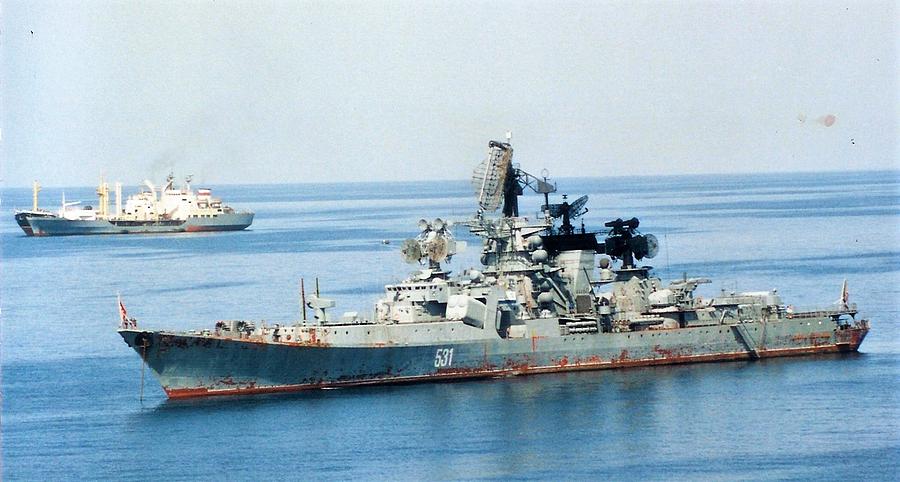
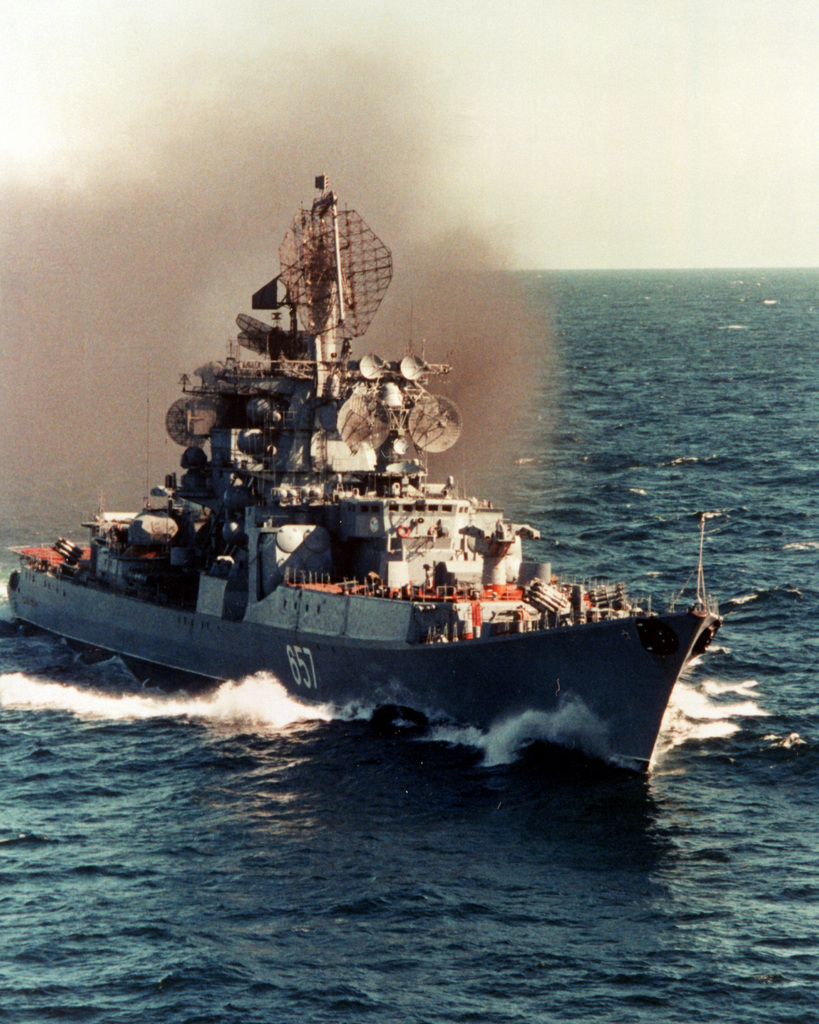
WHAT IT IS
Kresta II is the NATO name for Project 1134A Berkut-A (Беркут-А, “Golden Eagle-A”). In Soviet service the ships were large anti-submarine ships (BPK), not “rocket cruisers” in the P-500 / Granit sense. Ten hulls were built at Zhdanov (Northern Yard), Leningrad, laid down 1966–1975, commissioned 1969–1977, all stricken by 1993.
The number 1143A is the wrong project. Project 1143 is the Kiev-class heavy aircraft-carrying cruiser (Krechet). Project 1134 is Kresta I (Berkut) with P-35 anti-ship missiles. Project 1134A is the ASW rewrite of that hull. Project 1134B is Kara (Berkut-B), the gas-turbine follow-on. Project 1144 is Orlan / Kirov. This page is 1134A only.
Purpose: hunt and kill Western nuclear attack and ballistic-missile submarines on the approaches to the Soviet Union and in the Norwegian / Mediterranean / Pacific screens around a Soviet task group. Secondary jobs: area air defence of that group with M-11 Shtorm, and a limited anti-ship punch once Metel was rebuilt as Rastrub-B.
HISTORY
Project 1134 Berkut (Kresta I) was a 1960s surface-strike cruiser: four P-35 / SS-N-3 Shaddock tubes and Volna SAMs. After the first four, the Navy and the State Committee for Shipbuilding decided the next hulls would drop the anti-ship complex and take the second-generation anti-submarine missile Metel instead. Chief designer for the corrected project: V. F. Anikiev. The change turned a missile cruiser into a BPK on the same steam plant and a stretched 159 m hull.
Lead ship Kronstadt (Kronshtadt), yard No. 721, laid down 30 November 1966, launched 10 February 1968, commissioned 29 December 1969. Nine sisters followed through Admiral Yumashev in December 1977. Northern and Pacific Fleets took the class. They escorted Moskva / Leningrad helicopter carriers and later Kiev-class ships, ran Okean-era exercises, and spent the 1970s–80s on combat service in the Mediterranean and Indian Ocean. All ten were decommissioned 1991–1993 and scrapped. None survive.
The ten: Kronstadt, Admiral Isakov, Admiral Nakhimov, Admiral Makarov, Marshal Voroshilov (renamed Khabarovsk 1991), Admiral Oktyabrsky, Admiral Isachenkov, Marshal Timoshenko, Vasiliy Chapaev, Admiral Yumashev.
DESIGN AND PLANT
Displacement: about 5,640–5,735 t standard, 6,610–6,705 t normal, 7,535–7,670 t full load (cards vary a few tens of tons by ship). Length 158.9 m overall, 152 m waterline. Beam 16.8 m. Draft about 5.8–6.3 m. Crew 379–385 including 42–46 officers. Autonomy 30 days.
Plant: four KVN-98/62-2 (or 98/64-2) boilers, 66 kgf/cm², 470 °C; two TV-12-1 steam turbines, 45,000 hp each, 90,000 hp combined (some Western cards 91–100,000 shp); two shafts, fixed-pitch screws. Speed 32–34 kn on trials (32.5 kn is a common figure). Range: Russian yard card 4,700 nmi at 18 kn and 2,400 nmi at 32 kn; other tables 5,200 nmi / 18 kn and 10,500 nmi / 14 kn. Fuel about 1,690–1,830 t. Electrical: TD-1000 and TD-750 turbo-generators plus four ASDG-500 diesels.
Layout from bow: two RBU-6000, forward B-187A Shtorm launcher, bridge with the two quadruple Metel boxes on the shoulders, lattice masts with Voskhod and Angara, two AK-725 sponsons, two quintuple torpedo tubes, four AK-630 around the after mast, after Shtorm, hangar and pad for one Ka-25. Combat system: MVU-202 Koren-1134A plus More-U tactical data link.
WEAPONS
URPK-3 Metel / SS-N-14 Silex. Two fixed quadruple KT-M-1134A (later KT-100U) launchers, eight missiles. 85R rocket-torpedo: fly 6–55 km, then drop an AT-2U homing torpedo with about 8 km run. That is the ship’s long ASW arm. From about 1986 some ships recoded to URK-5 Rastrub-B with 85RU, which could also fly as an anti-ship missile with a shaped-charge warhead. No Granit, no P-500, no P-35 on this class — those belong to 1144 / 1164 / 1134.
M-11 Shtorm / SA-N-3 Goblet. Two twin B-187A launchers, 48 V-611 (4K60) missiles. Grom-M directors (NATO Head Lights). Range on the order of 22 km against low targets, 32 km high. Upgraded Shtorm-M from 1972, Shtorm-N from 1980. This is area defence for the ASW group, not a carrier-battle-group umbrella.
Guns. Two twin AK-725 57 mm/70, 4,400 rounds, MR-103 Bars (Muff Cob) directors. Four AK-630 30 mm CIWS, 8,000–12,000 rounds depending on the card; MR-123 Vympel-A (Bass Tilt) from ship No. 725 onward — the first four aimed the gatling mounts more crudely. Two 45 mm 21-KM saluting guns.
Close ASW. Two RBU-6000 Smerch-2 (12 tubes, 144 RGB-60 in most English cards; some Russian pages print 192). Two RBU-1000 Smerch-3 (6 tubes, 48–60 RGB-10). Two PTA-53-1134A quintuple 533 mm tubes, ten 53-65K or SET-65 torpedoes, Tifon-1134 fire control. Helicopter: one Ka-25PL (Hormone-A) in a deck hangar, with a small load of aerial torpedoes and buoys. The hangar is why the ship can put a dipping sonar ahead of the hull set.
SENSORS
Air/surface search: MR-600 Voskhod (Top Sail) and MR-310A Angara-A (Head Net-C). Navigation: two Volga and Don-2 / Don Kay. SAM directors: two 4R90 Grom. Gun/CIWS as above. Sonar: MG-332 Titan-2T hull set on later ships (Kronstadt had Titan-2). Underwater telephone MG-26 Khosta. Anti-saboteur MG-7 Braslet. MI-110R / MI-110K submarine-search stations. ESM: Gurzuf / Gurzuf-1 pairs, Zaliv, MRP-11-12 and 13-14. IFF Khrom-KM. Decoys: two PK-2 (ZIF-121) with Tertsia.
CAPABILITIES AND LIMITS
A Kresta II could prosecute a submarine at Metel range if the helicopter or a cooperating Il-38 / Tu-142 or another ship handed a track, then finish with SET-65 and RBU in the inner zone. Shtorm gave the group a medium-range SAM umbrella against strike aircraft and missiles of the 1960s–70s generation. Steam 32 kn kept up with a Kiev or a Moskva. Thirty-day stores and 14–18 kn cruise made Atlantic and Pacific deployments possible.
Limits: eight Metel rounds and no reload at sea worth mentioning. Shtorm is not S-300F. 57 mm and four AK-630 are thin against a saturated anti-ship raid. Hull sonar of the Titan family is not a towed array. No heavy anti-ship missile until Rastrub-B, and even then the load is eight. The class was a specialist BPK, not an Orlan battlecruiser.
STATUS
All ten disposed 1991–1993. The line continued as 1134B Kara (gas turbines, same Metel/Shtorm idea, larger) and then as the Udaloy BPK family. Kresta II is Cold War steel.
IN ONE SENTENCE
Project 1134A Berkut-A — NATO Kresta II — is the ten-ship Zhdanov BPK that replaced Kresta I’s Shaddocks with eight Metel / SS-N-14, two Shtorm launchers and a Ka-25, a 159 m steam hunter built to kill SSBNs on the Soviet approaches, not the 1143 Kiev carrier and not the 1144 Orlan cruiser.