WHAT IT IS
The S-500 Prometheus (С-500 «Прометей»; also associated in open sources with the earlier programme names 55R6M «Триумфатор-М» / Triumfator-M) is a Russian road-mobile surface-to-air and anti-ballistic missile system developed by the Almaz-Antey Air and Space Defence Concern (Концерн воздушно-космической обороны «Алмаз-Антей»). It is intended to sit above the S-400 in the Russian layered air and missile defence structure, adding an anti-ballistic mission against medium-range ballistic missiles and, as claimed by Russian officials, the warheads of intercontinental ballistic missiles in the terminal phase of flight, together with engagement of hypersonic targets and objects in near space. No NATO reporting name has been established in the public sources consulted; the system is sometimes written about with provisional "SA-X" style labels, which are not official.
The system is a development of the S-300/S-400 line in terms of chassis, radar families and the 40N6 missile, but it adds new radars and new long-range interceptors (77N6 series). Almaz-Antey, the Russian Ministry of Defence and Russian state media describe it as having no analogue and as able to engage "the whole range of current and future means of air and space attack" at all altitudes and speeds (Ministry of Defence statement, July 2021, via TASS). That is an official claim and is not independently verified. Almost all performance figures in this article are published or claimed figures, not measured ones.
DEVELOPMENT
CSIS Missile Threat dates the start of the programme to about 2010, shortly after the first S-400 regiments entered service in 2007; Russian sources have placed the earlier design work in the 2000s, and the Triumfator-M name appears in Western analysis from about 2009–2011 (the Air Power Australia technical report by Carlo Kopp, 2011, uses it). Design development was declared complete in 2011, but the date for serial production was repeatedly moved: from 2014, to 2017, to 2021, and in some statements to 2025 (CSIS).
Milestones attributed to Russian officials and state media: Rostec head Sergey Chemezov said in June 2019 that S-500 production had begun, although serial production of the first batch only followed later. In May 2018 reports citing unnamed sources familiar with US intelligence said an S-500 test had hit a target about 482 km away, roughly 80 km farther than the previous known surface-to-air record; this was not confirmed officially. On 25 May 2021 President Putin said S-500 trials were successfully nearing completion and that it was next to be delivered to troops. On 20 July 2021 the Ministry of Defence released the first public footage of a live firing at the Kapustin Yar range (Astrakhan Region) against a "high-speed ballistic target" and stated that the firing confirmed the specified characteristics. On 29 July 2021 a defence-industry source told TASS that a contract for a first batch of more than ten systems had been signed (the contract is described elsewhere as dating from late 2020; Defense News repeats the same "more than 10" figure). On 16 September 2021 Deputy Prime Minister Yury Borisov said state tests had just been completed and first deliveries had begun.
Almaz-Antey is reported to have begun serial production in April 2022 (Kommersant, Janes), and a further contract was reported in August 2022. In October 2023 Defense News (Maxim Starchak) reported that the programme was behind schedule, citing sanctions on electronics, machine-tool problems and labour shortage at Almaz-Antey, based on an anonymous company source and outside experts. The 2021 delivery to the Moscow air and missile defence formation reportedly arrived in a reduced configuration that did not meet the operator's full requirements; experts cited the lack of exo-atmospheric missiles (Defense News).
ORGANIZATION
Open sources do not give an official order of battle for the system. The most commonly cited battery-level composition (CSIS Missile Threat, Wikipedia, Defense Post citing TASS and CSIS) is four radar vehicles plus launchers and command posts, as listed in the next two sections. The numbers of launchers per battalion, batteries per battalion and battalions per regiment are not officially published. Pre-2020 Russian planning reportedly called for ten S-500 battalions (Wikipedia, citing earlier Russian statements, and CSIS), which should be treated as a historical plan, not a fielded figure.
What has been stated officially is the unit structure of the first formation: in December 2024 Chief of the General Staff Valery Gerasimov said the Aerospace Forces had formed a new air and missile defence formation (соединение ВКС) and that the first regiment equipped with the S-500, "capable of solving strategic missile defence tasks", was nearing completion. On 17 December 2025 Defence Minister Andrey Belousov said the Aerospace Forces had for the first time formed a division of air and missile defence (дивизия ПВО-ПРО) and that the first S-500 regiment had taken up combat duty. Location and size were not given.
RADARS AND COMMAND POSTS
The following components are listed in CSIS Missile Threat, Wikipedia (citing Kopp and others) and Defense Post; designations come from open literature and the exact roles vary between sources, so they are marked as reported.
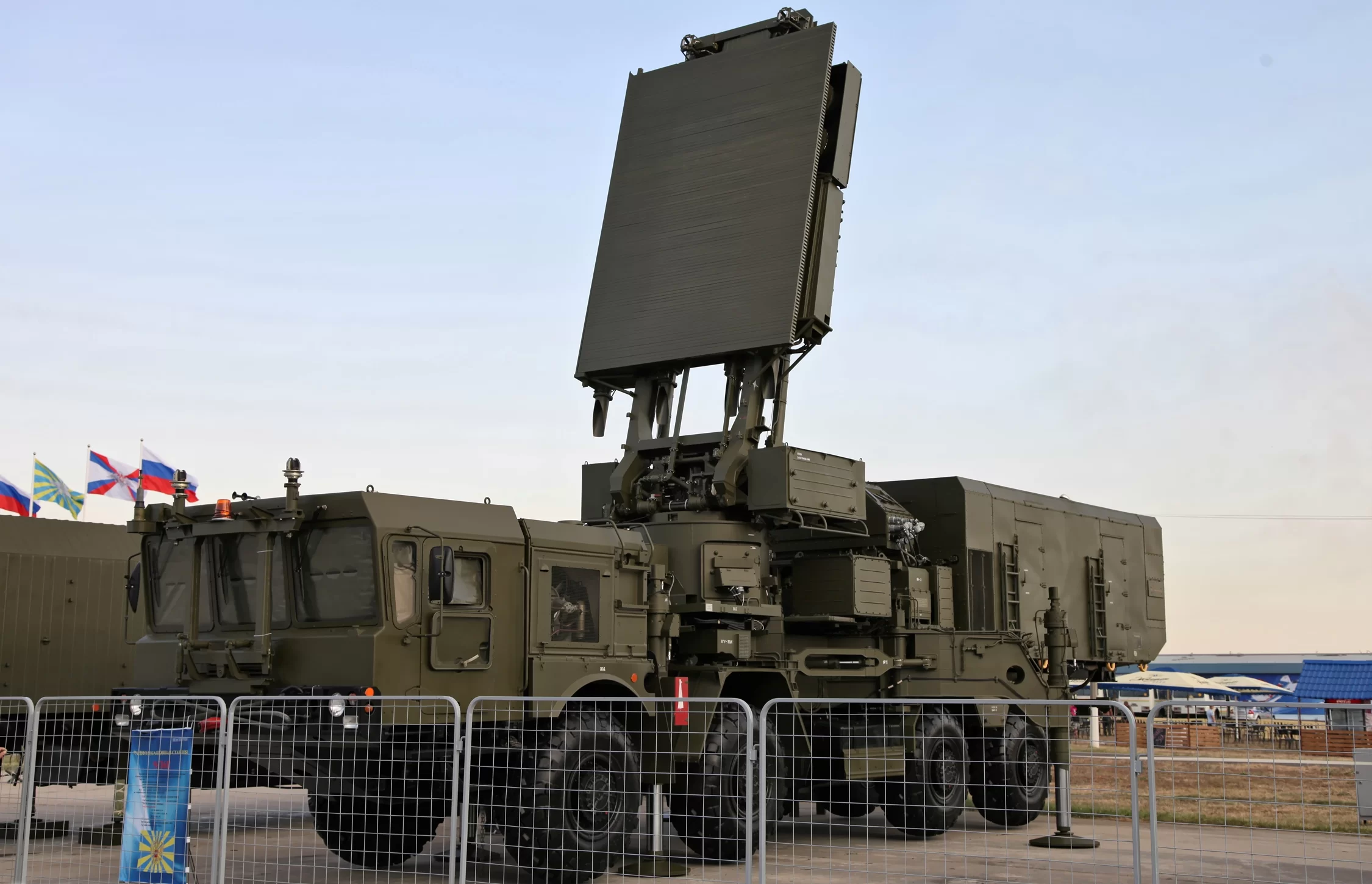
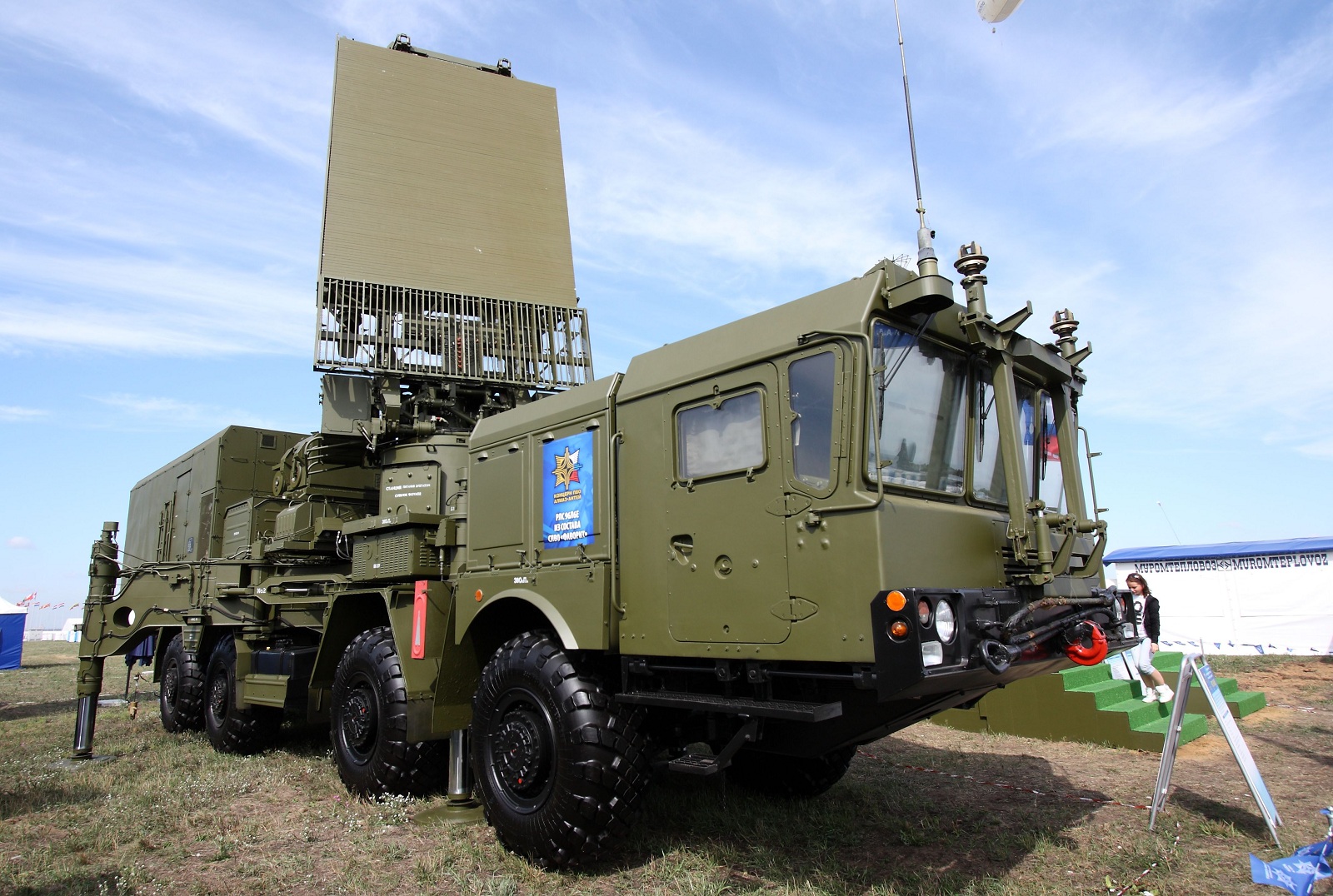
91N6A(M) (also written 91N6E(M)): acquisition and battle-management radar, a modification of the 91N6 (NATO: Big Bird) familiar from the S-400, towed by a BAZ-6403.01 8x8 tractor. CSIS describes it as S-band; the S-400's 91N6E is generally described elsewhere as an L/S-band-class panoramic radar, so the band should be treated as uncertain. Russian reporting in 2026 (via IDRW) discusses software updates to the 91N6E for S-400s drawing on S-500 technology.
96L6-TsP (96Л6-ЦП): upgraded all-altitude acquisition radar, derived from the 96L6 (NATO: Cheese Board), on a BAZ-69096 10x10 chassis. CSIS describes it as C-band.
76T6: multimode engagement radar on a BAZ-6909-022 8x8 chassis, reported as the radar for the 40N6M air-defence missiles.
77T6: anti-ballistic missile engagement radar on a BAZ-69096 10x10 chassis, reported as the radar for the 77N6 series.
55K6MA and 85Zh6-2 (85Ж6-2): command posts on BAZ-69092-12 6x6 chassis (Wikipedia). The 55K6 designation is the family of combat control posts used with the S-300P/S-400 line; the 85Zh6-1 designation is associated with the S-300V4/Antey and is not confirmed for the S-500 in the sources consulted.
The Enisey (Енисей) radar is described by a ВПК.name article of 19 December 2024 as detecting targets in near space to about 2,000 km. This article gives no further identification and Enisey is not confirmed as a component in any other source; treat as unverified. CSIS, citing a 2018 Versia article, gives claimed detection ranges of up to 2,000 km for ballistic targets and 800 km for airborne targets for the radar complex as a whole. The S-500 is also said to be able to use data from the missile attack warning network (СПРН) and to work in an integrated network with S-400 and S-300 or autonomously (ВПК.name).
LAUNCHERS
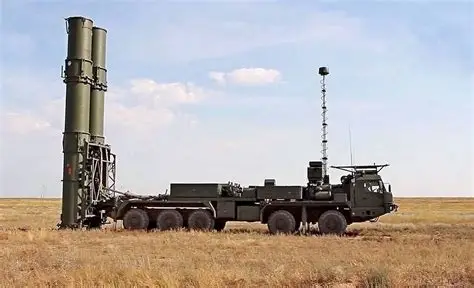
The launcher is the 77P6 transporter-erector-launcher on a BAZ-69096 10x10 chassis (Wikipedia, citing Kopp). Defense Post, quoting TASS, states that a launcher carries either four 40N6M long-range surface-to-air missiles or two 77N6 interceptors in transport-launch containers. Launchers are visible in the 2021 Ministry of Defence footage as large wheeled vehicles with the containers raised for firing. The number of launchers per battery is not published. BAZ (Bryansk Automobile Plant, Брянский автомобильный завод) is the chassis supplier for much of the Almaz-Antey ground equipment.
MISSILES
40N6M: air-defence missile for aircraft and cruise missiles, a development of the 40N6 used with the S-400. Claimed range about 400 km (CSIS, Defense News). Pavel Luzin (CEPA, quoted by Defense News) notes the 40N6 is already in S-400 service and is not unique to the S-500.
77N6-N and 77N6-N1 (77Н6-Н, 77Н6-Н1; sometimes written 77N6-H): anti-ballistic and, as claimed, anti-satellite interceptors. CSIS gives a reported range of 500–600 km. Defense News reports that the 77N6-N was confirmed in development, while the status of the 77N6-N1, reported to be intended for destroying satellites in low orbit and (in 2014 reports) to carry a low-yield nuclear warhead, is unclear. Both are described as hit-to-kill missiles using an inert (non-explosive) kinetic warhead, with outside experts doubting that Russian industry could supply the guidance electronics needed. An anonymous Russian colonel told Defense News that the second stage of the 77N6-N is identical to that of the 9M82MV of the S-300V4, and that the first stage's aerodynamic controls are effective only up to roughly 50 km altitude. These are single-source statements.
Izvestia reported in June 2021 that the S-500 would receive new interceptor missiles able to counter hypersonic weapons, and in February 2024 that the system had been tested against hypersonic targets including ballistic-missile warheads and hypersonic aircraft. Defense News (October 2023) quotes an expert that no such test had taken place and that Russia appeared to lack suitable hypersonic target vehicles. Industry and Trade Minister Denis Manturov said in June 2023 that the S-500 would be able to intercept hypersonic missiles. These remain claims.
PUBLISHED ENVELOPE
All values below are published or claimed figures. They differ between sources and none has been independently confirmed.
Range, anti-ballistic: up to 600 km (CSIS, Defense News, ВПК.name; Russian media in 2023 reported a lower figure closer to 500 km, per Defense News).
Range, air defence (aerodynamic targets): about 400–500 km (40N6M about 400 km per CSIS; 500 km per Wikipedia citing Rossiyskaya Gazeta 2014).
Maximum altitude: 180–200 km is the most cited claim (Wikipedia, Janes, ВПК.name); Russian media reported up to about 100 km in 2023 (Defense News). The Karman line is at 100 km, which is why Russian officials use the phrase "near space" (ближний космос).
Target speed: ballistic targets up to about 7 km/s (Lenta.ru 2012, cited in Wikipedia); hypersonic cruise missiles above Mach 5 (ВПК.name, citing Russian officials).
Targets tracked and engaged: up to 100 tracked and up to 10 engaged simultaneously (ВПК.name); Wikipedia gives up to 10 simultaneous ballistic hypersonic targets. Reaction time under 4 seconds versus under 10 for the S-400 (Wikipedia, citing Missile Threat archive; unconfirmed).
Target set (claimed): medium-range ballistic missiles; terminal-phase ICBM warheads; hypersonic aircraft and cruise missiles; AWACS and other high-value aircraft; fifth-generation aircraft; UAVs; low-orbit satellites; space weapons launched from hypersonic aircraft. Surovikin (Aerospace Forces commander) said in 2020 that the system could destroy satellites and hypersonic weapons in near space. No satellite engagement by the S-500 has been publicly demonstrated.
Longest-range test claim: 482 km, May 2018, anonymous-source reporting (CNBC, The War Zone), not officially confirmed.
Cost: Russian media estimates quoted by Defense News: about 700–800 million USD per system in 2020, up to 2.5 billion USD in 2023. These are estimates only.
ROLE RELATIVE TO OTHER SYSTEMS
S-400 Triumf. The S-500 is not a replacement for the S-400 in the area air-defence role. It reuses the 40N6 missile and radar lineage and is meant to add the ballistic and near-space layer above it; S-500 numbers are small, and Defense News notes the S-400 remains the system in mass production. Starchak notes the S-500 turned out not to be more compact than the S-400, contrary to the original goal (via Luzin). TASS in 2021 wrote that the S-500 "will replace" S-400 systems; that is a Ministry of Defence-era statement and has not matched actual fielding.
S-300V4 / Antey-4000. The S-300V4's 9M82MV missile is reportedly related to the 77N6-N second stage (single anonymous source). The S-300V line was designed from the start for anti-ballistic work, and it is the closest predecessor to the S-500's anti-ballistic mission.
A-135 and A-235 Nudol (А-135 «Амур», А-235 «Нудоль»). These are the Moscow strategic anti-ballistic missile systems with nuclear-armed exo-atmospheric interceptors, run by the same air and missile defence formation that received the first S-500. The S-500 is generally described as supplementing them (Wikipedia, Defense News). Luzin, quoted by Defense News, argues the 77N6-N is smaller than the PRS-1M/53T6 of Nudol and therefore has a lower interception altitude, and that the S-500 lacks true exo-atmospheric interception. The S-500 uses conventional hit-to-kill interceptors, not nuclear warheads, in current descriptions.
THAAD and Patriot. Defense News (Luzin) states the S-500 was originally positioned as better than THAAD, with exo-atmospheric intercept capability, but that on its characteristics it "falls decently short of THAAD" in that respect. Patriot (US) is a lower-tier system than THAAD and the claimed S-500 envelope. Direct comparisons are not possible because none of the S-500's characteristics have been measured in public.
S-550. A planned follow-on described by Russian officials (Putin and Chemezov, November 2021) as an anti-missile and anti-space system with longer reach. Defense News stated in October 2023 that there was no evidence Russia had developed it. A naval version of the S-500 has been reported as possible armament for the planned Lider-class destroyer, which was not operational as of 2022 (Wikipedia, ITAR-TASS 2014); this is speculative.
DEPLOYMENT AND STATUS
Moscow, 2021. Russian officials and Janes reported that the first S-500 entered service with the 1st Special Purpose Air and Missile Defence Army (1-я армия ПВО-ПРО особого назначения), whose primary task is the defence of Moscow. Wikipedia gives dates of 16 September 2021 for entry into service and 13 October 2021 for the first combat duty in the Moscow region (Janes, 14 October 2021). Defense News says this was a reduced-capability initial system.
2024. Gerasimov's 18 December 2024 briefing to foreign military attachés said the first regiment was nearing completion (TASS factbox, ВПК.name). In June 2024 Ukraine's intelligence chief claimed an S-500 had been deployed to Crimea to defend the Kerch Bridge (The War Zone, 12 June 2024); Russian sources did not confirm it. Later reports claimed S-500 failed to stop ATACMS missiles; those claims come from Kyiv Post and National Interest and are not verified, and the type of system involved was not identified by Russia.
December 2025. Belousov announced on 17 December 2025 that the first S-500 regiment had taken up combat duty, along with the first air and missile defence division in the Aerospace Forces (Kommersant, Izvestia, Defense Post). No location, number of launchers or missile mix was disclosed.
Export. Borisov said in September 2021 that India could be a prospective first customer once Russian troops were equipped. In September 2025 reports (ThePrint) said India was interested after S-400 performance in the May 2025 India–Pakistan conflict; in October 2025 reports said India was seeking five more S-400 batteries instead. In 2026, IDRW (via the Russian outlet 1RUS) reported both that Russia would not supply the S-500 to India but could offer technology solutions for S-400 upgrades (April) and that Moscow had offered S-500 with technology transfer (September). These Indian-press items are sourced to unnamed people. Almaz-Antey officials have spoken in 2026 of rising interest from the Middle East and of cooperation with China, Mongolia, India and Africa in general terms; the S-500 itself was not confirmed as offered. Turkey's president said in 2019 that Turkey would co-produce the S-500, which did not proceed (CSIS).
STATUS
As of the latest sources consulted (to late 2026), the S-500 is in limited service in Russia: Russian officials report one regiment on combat duty as of December 2025, within the Moscow-centred air and missile defence structure. It is in serial production at Almaz-Antey at an undisclosed rate. Reported production problems (sanctions, components, labour) and the lack of public evidence for the exo-atmospheric 77N6-N1 missile mean the full claimed capability set has not been shown. The hypersonic and satellite engagement claims remain officially asserted but not publicly demonstrated. The system has not been exported. Reports of combat use in Ukraine come from Ukrainian and Western media and are unconfirmed.
IN ONE SENTENCE
The S-500 Prometheus is Almaz-Antey's still-limited-service successor layer to the S-400, pairing 76T6/77T6 and 91N6A(M)/96L6-TsP radars with 40N6M and 77N6-series interceptors to claim engagement of ballistic, hypersonic and near-space targets out to roughly 600 km and 200 km altitude, figures that remain official claims rather than demonstrated performance.