WHAT IT IS
Poseidon (Посейдон; previously the oceanic multipurpose system Status-6 / Статус-6; NATO reporting name Kanyon; GRAU index 2M39) is a Russian nuclear-powered, nuclear-armed autonomous underwater vehicle — essentially a giant, reactor-driven torpedo designed to cross oceans on its own and detonate a very large warhead near an enemy coast or fleet. It was one of the six strategic systems President Vladimir Putin unveiled on 1 March 2018. Design work is associated with the Rubin Central Design Bureau for Marine Engineering (ЦКБ МТ «Рубин») and a wider industrial group.
Two carrier submarines matter. Project 09852 Belgorod (К-329 «Белгород»), a heavily modified Oscar-II special-mission boat delivered in 2022, is the first operationally relevant carrier and has been used in Arctic testing. Project 09851 Khabarovsk (Атомоход «Хабаровск»), a purpose-built Poseidon carrier based on a shortened Borei-derived hull, was launched at Sevmash on 1 November 2025 and began White Sea sea trials around 16 August 2026. Open reporting says each Khabarovsk-class boat is intended to carry six Poseidons; a second boat (Orenburg) is under construction for the Northern Fleet, while Khabarovsk is slated for the Pacific Fleet.
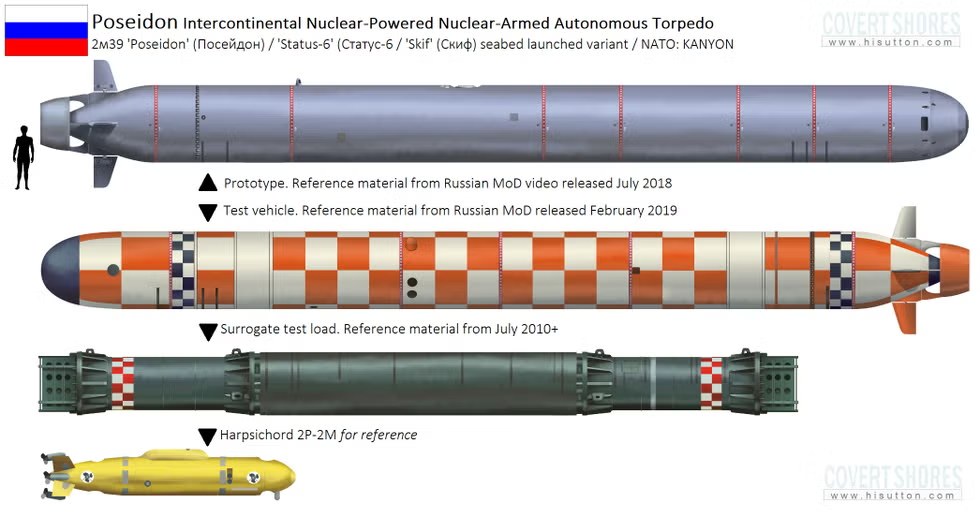
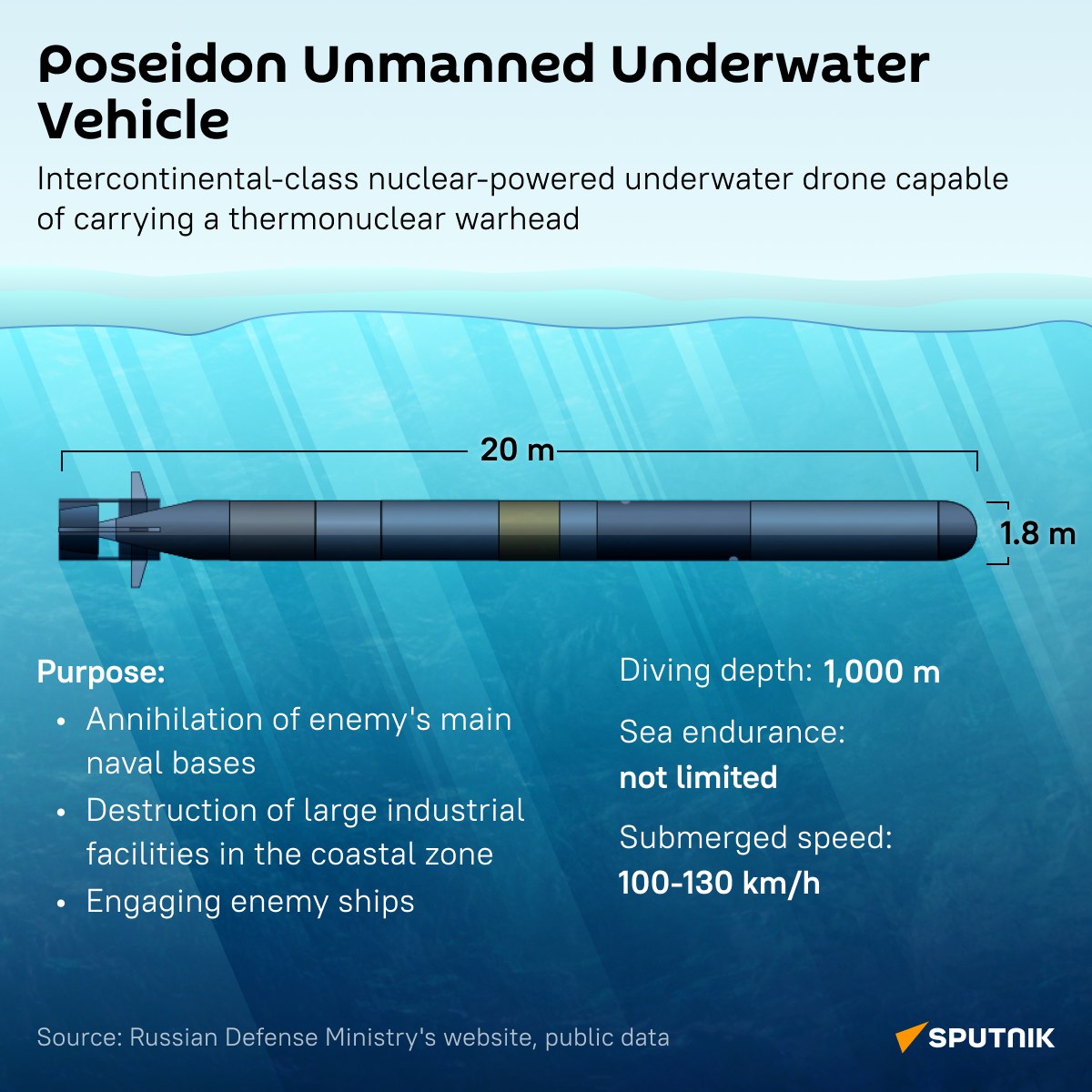
Claims and reality must stay apart. Russian statements describe intercontinental underwater range, depths to 1,000 m, speeds far above conventional torpedoes, a reactor "100 times smaller" than a submarine's, and a warhead "significantly higher" than Sarmat's. Western open estimates put length around 20–24 m, diameter around 1.6–2 m, mass up to roughly 100 tonnes, and speed figures that have drifted over the years from sensational "100 knots / supercavitation" down to more sober Pentagon-linked estimates around 50–70 knots. On 28–29 October 2025 Putin announced the first test in which a Poseidon was launched from a carrier submarine and its nuclear power plant was started for a period of time. Independent confirmation of that test's details was not published. The Bulletin of the Atomic Scientists' 2026 Russia chapter still treated Poseidon as not yet operational as of early 2026.
Related site articles: RS-28 Sarmat, Avangard, RS-24 Yars, 9M730 Burevestnik, Project 1144 Orlan, P-700 Granit, Kalibr, GLONASS, INS, Kazbek, Perimeter, Russian C3, VVER (civilian reactor contrast), Type IXD (historical long-range submarine comparison).
QUICK FACTS
Not to be confused with: conventional heavyweight torpedoes; the VA-111 Shkval supercavitating rocket torpedo; Burevestnik (nuclear-powered cruise missile); or seabed drones like Klavesin / Sarma that are intelligence platforms, not strategic megaton carriers.
PURPOSE: SECOND STRIKE, COASTS AND PSYCHOLOGY
Poseidon is framed in Russian doctrine-adjacent commentary as a guaranteed second-strike weapon: if Russian silos and bombers are destroyed, a submarine-launched autonomous vehicle still reaches an enemy harbour city or naval base days or weeks later. It is also a political weapon. A slow, unstoppable underwater doomsday device is meant to be thought about in Washington and London as much as it is meant to be used. US Defense Secretary James Mattis said in 2018 that it did not change the strategic balance, because the US coastline was already targetable by missiles — a dry way of saying that city destruction does not require a tsunami torpedo.
Secondary missions discussed in open sources include attacking carrier battle groups (where high speed would matter more than stealth) and, in a seabed-container concept sometimes called Skif, loitering on the ocean floor. Minelaying and reconnaissance are logical roles for a large UUV family even if the strategic Poseidon itself is a one-way nuclear weapon.
HISTORY
On 10 November 2015, Russian NTV "accidentally" showed a slide of an oceanic multipurpose system called Status-6 during a Putin meeting — widely assessed as an intentional leak. The Pentagon later confirmed development of an intercontinental nuclear-armed undersea autonomous torpedo. A first test launch from the special-purpose submarine Sarov was reported in late 2016. The public name «Посейдон» was chosen by vote in March 2018 alongside the other new systems. Putin claimed key trials were complete in early 2019; the defence ministry released launch video from Sarov. TASS reported a first production batch for Belgorod in early 2023, without the kind of ceremony that would make the claim easy to verify.
Belgorod joined the fleet in 2022 as a special-mission mothership (Poseidon plus other deep-sea systems). Khabarovsk, laid down in 2014 and long delayed past a 2020 service goal, launched on 1 November 2025. On 28 October 2025 — days after the claimed Burevestnik long flight — Putin said Poseidon had been launched from a carrier and its reactor started. Khabarovsk entered White Sea factory sea trials in mid-August 2026. As of October 2026 the programme is clearly transitioning from secret R&D toward a fielded naval system, but "on combat duty" remains a Russian future tense, not a verified present.
CARRIERS: BELGOROD AND KHABAROVSK
Belgorod (Project 09852) is a rebuilt Oscar-II hull stretched and modified for special missions. It can carry Poseidons and also support deep-diving midget submarines and seabed systems. It has been the workhorse of Arctic Poseidon testing from Northern Fleet waters.
Khabarovsk (Project 09851) is the first dedicated carrier: Borei-derived nuclear submarine without a ballistic-missile compartment, shortened, designed around a battery of (reportedly six) Poseidon tubes. Launch ceremony 1 November 2025 at Sevmash; first sea outing reported 16 August 2026. Destination: Pacific Fleet, where shore infrastructure for Poseidon is under construction. Sister ship Orenburg is under construction for the Northern Fleet; a third hull is planned. Early concepts also mentioned seabed or surface-ship deployment using ice-capable support ships (Project 20180/20183 types) for a Skif-style containerised variant.
HOW IT WORKS: LAUNCH, BOOST, REACTOR, CRUISE
A Poseidon leaves its mother submarine with a chemical booster or expulsion system — Putin's October 2025 phrasing distinguished "launch with a booster engine" from "starting the nuclear power plant." Once clear of the boat and at a safe distance, the reactor is brought up and the vehicle transitions to nuclear-electric (or direct nuclear-thermal/electric hybrid — see below) cruise. It then swims, potentially for days or weeks, toward a programmed area. In a stealthy coastal-attack profile, open Russian-linked analyses describe slow transit at modest depth (tens to a hundred metres) to minimise acoustic signature, then a high-speed dash only in the terminal kilometres. In a fleet-attack profile, speed would be used earlier — at the cost of noise.
THE REACTOR: WHY "100 TIMES SMALLER" IS BOTH IMPRESSIVE AND HARD
A nuclear submarine reactor (see VVER for civilian scale contrast; naval reactors are a different design family) produces tens to hundreds of megawatts thermal and occupies a shielded compartment with pumps, steam generators and primary loops. Packing a useful power plant into a 2-metre-diameter torpedo means stripping almost everything.
Open speculation clusters around two families:
Liquid-metal cooled reactors (lead-bismuth or similar), which Soviet Alfa-class submarines used. They are compact and high-temperature but freeze if coolant solidifies, and they are chemically and radiologically nasty to maintain. Some Russian-facing write-ups simply assert "liquid metal reactor, at least 15 MW" for Poseidon without primary evidence.
Gas-cooled or compact water reactors driving a turbo-generator or thermoelectric stack, then an electric pump-jet. US Cold War studies (GE 601B and related) looked at small gas-cooled concepts for unmanned vehicles; analysts have pointed at that literature as an analogy, not as proof of Russian design.
Putin's "100 times smaller than a submarine reactor" and "starts in minutes" claims (echoed also for Burevestnik in different ratios) are political engineering: they assert that Russia solved miniaturisation and rapid criticality. What outsiders can say from reactor physics is narrower. A compact core can be built. Shielding mass scales with the need to protect electronics and any recoverable components; for a one-way weapon, shielding can be thinner toward the bow and thicker around the warhead electronics. Heat rejection into seawater is actually easier than into air — water is an excellent heat sink — which is one reason a nuclear torpedo is, in some ways, an easier thermal problem than a nuclear cruise missile. Neutronics, corrosion, shock hardness and years of unattended reliability are the hard parts.
Power estimate honesty: public MW figures for Poseidon are not solid. Fifteen megawatts thermal appears in secondary compilations; treat it as an order-of-magnitude guess. Shaft power needed scales with the cube of speed through the water for a given drag — which is why "100 knots cruise across the Atlantic" and "quiet 20-knot transit" are completely different reactor problems.
HYDRODYNAMICS, NOISE AND THE SUPERCAVITATION QUESTION
Drag underwater rises steeply with speed. A pump-jet (ducted rotor) is the natural choice for a large, relatively fast underwater vehicle that wants lower blade-tip noise than an open propeller. Russian open analyses of Status-6 in 2015 published detection-range tables that rose from a couple of kilometres at ~37–55 km/h to tens of kilometres at ~90+ km/h against a Virginia-class-like sonar — illustrating that speed and stealth trade directly.
Supercavitation — enclosing the body in a gas bubble to slash skin friction, as on the rocket-propelled Shkval — has been suggested for a terminal dash. Public imagery of Poseidon has not clearly shown a supercavitation gas generator or flat cavitator nose. Pentagon-linked speed estimates around 56 knots imply a non-supercavitating design. Until better imagery or official data appears, supercavitation should be treated as an unproven option, not a baseline feature.
GUIDANCE
Long underwater transit cannot rely on continuous GLONASS — seawater blocks GNSS. The vehicle needs a high-grade inertial system (INS), likely with periodic aids: bottom contour matching (the underwater analogue of TERCOM — see TERCOM), magnetic maps, occasional buoy or antenna rises if the design allows, and maybe acoustic navigation. "AI guidance" appears in popular summaries; what that means in engineering terms is onboard autonomy for obstacle avoidance and terminal search, not science fiction. Coastal approach would use a programmed aimpoint; anti-fleet use would need sensors to find a carrier group — a much harder problem that is rarely detailed in serious open work.
WARHEAD AND THE TSUNAMI CLAIM
Yield figures in open sources start around 2 Mt and run into tens of megatons in the most lurid Russian TV versions. Cobalt salting (deliberate long-lived fallout) has been speculated since the 2015 leak; it has not been confirmed. Putin's October 2025 remark that the warhead is "significantly higher" than Sarmat's most powerful option is a relative claim without numbers.
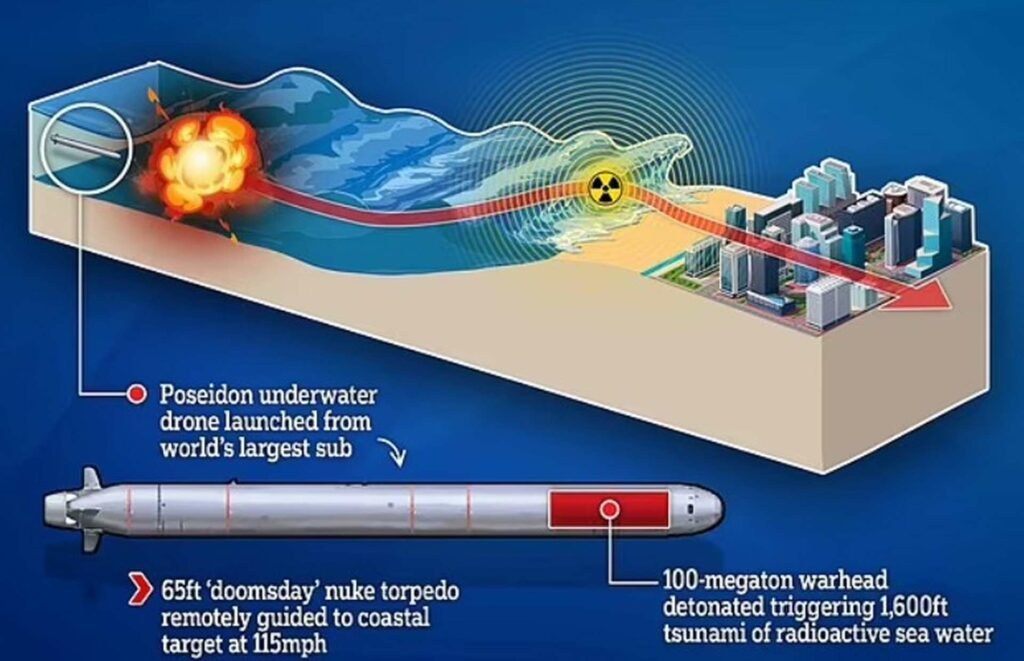
The "500-metre tsunami that washes away continents" claim fails basic wave physics for most scenarios. A nuclear detonation couples energy into the water in a roughly spherical pattern; natural tsunami-generating quakes release energy along long faults and direct waves. Even a multi-megaton burst near a harbour is primarily a blast, thermal, prompt-radiation and local inundation weapon — horrific for that harbour — not a trans-oceanic tsunami machine. Comparisons to the 2011 Tōhoku earthquake (orders of magnitude more energy than any hydrogen bomb) are the usual corrective. Poseidon is dangerous because it is a large nuclear weapon that may arrive from an unexpected axis after a long underwater transit, not because it rewrites oceanography.
CLAIMS VS REALITY
ARMS CONTROL
New START counted ICBMs, SLBMs and heavy bombers — not nuclear torpedoes. Poseidon sat in a treaty gap. After New START expired on 5 February 2026, that gap is part of a wider accounting vacuum. Any future limits would need a new category for nuclear-powered autonomous underwater weapons.
STATUS AND OUTLOOK (OCTOBER 2026)
Belgorod is in service as a special-mission boat; Khabarovsk is on sea trials; a second Khabarovsk-class hull is building; Pacific shore support is under construction; an October 2025 launch-plus-reactor test is claimed. Poseidon is further along than Burevestnik was for most of the 2010s, but it is still best described as entering the fleet support phase, not as a mature deployed triad leg. Production goals of "30+" vehicles on four submarines (2019 reporting) remain aspirational until more boats and more successful full-profile tests appear.
UNDERWATER ACOUSTICS AND DETECTION PHYSICS
Sound is the primary long-range sense underwater. Ambient noise, bottom bounce, surface ducts and the deep sound channel (SOFAR) create a complicated propagation environment. A large vehicle has a large acoustic cross-section for active sonar and, if its machinery is loud, a detectable passive signature. Pump-jets help; isolation mounts help; going slow helps most of all. The 2015 Russian-linked detection-range table that showed roughly 2–3 km detection at 55 km/h versus tens of kilometres at 90+ km/h against a modern SSN sonar is illustrative physics even if the exact numbers are debatable: hydrodynamic noise and flow noise rise steeply with speed.
That is why a "sprint for the last three kilometres" doctrine appears in open discussion. Transit quiet, dash loud. Defenders who only listen for a 100-knot scream may miss a 15-knot crawl across an ocean basin. Defenders who own the approaches with seabed arrays (SOSUS heirs, SURTASS, coastal passive networks) complicate the crawl. Poseidon does not abolish ASW; it changes the search problem's geometry and timeline.
REACTOR SAFETY AND ONE-WAY DESIGN
A one-way nuclear torpedo can accept design choices a manned submarine cannot: thinner biological shielding in some sectors, higher dose to structures, no crew escape path, and a final dive that may destroy the core in the explosion. That does not make peacetime testing safe. A lost Poseidon on the seabed is a naval reactor recovery problem in deep water — comparable in kind, if not in exact technology, to the anxieties that followed lost Soviet submarine reactors in the Arctic. The October 2025 test's careful phrasing ("operated for a certain period of time") leaves open how the article was terminated.
COMMAND, CONTROL AND AUTONOMY RISKS
An autonomous nuclear weapon that may swim for days raises classic C3 problems: how to authenticate a launch order, how to abort, how to prevent spoofing, and what happens if communications fail. Russia's national nuclear C3 (Kazbek, Perimeter, Russian C3) was built around missiles and bombers with minutes-to-hours timelines. A Poseidon already at sea under sealed orders is a different animal. Open sources do not describe the abort mechanism. Any serious treatment of the weapon has to admit that autonomy plus megatons is an escalation-control headache for its owner as well as for its target.
COMPARISON WITH OTHER NAVAL NUCLEAR DELIVERY
A Borei-class SSBN firing Bulava can deliver MIRVs to strategic targets in thirty minutes from launch. Poseidon offers hours-to-days delay, underwater approach, and a single very large warhead. It is complementary in Russian rhetoric (the weapon that arrives after the missile exchange) and inferior as a first-strike clock. Against carrier battle groups, a nuclear-armed high-speed undersea weapon is a different threat than P-700 Granit or modern anti-ship missiles from surface ships and submarines — harder to intercept with SAMs, slower than a ballistic anti-ship concept, dependent on finding the carrier in the first place.
INDUSTRIAL BASE
Sevmash builds the carriers; Rubin designs; the reactor mini-core supplier has not been officially named in the way OKBM or other bureaus are named for submarine plants. Ice-capable support ships of Project 20180/20183 have been photographed in roles consistent with test support. Pacific Fleet infrastructure construction for Poseidon, reported alongside Khabarovsk's assignment, is a multi-year civil-military project — another reason "launched the sub" is not the same as "operational constellation."
ENERGY, RANGE AND THE MYTH OF INFINITE PATROL
Nuclear fuel energy density dwarfs chemical batteries and Otto fuel. In that narrow sense "unlimited range" is fair. In the engineering sense, seals weep, pumps wear, biofouling grows, navigation error accumulates, and political authorities do not want an unsupervised megaton reactor wandering the seabed for months. A useful mental model is: Poseidon can be given an intercontinental fuel budget; it will be given a mission timeline of days to weeks, not years. Claims of indefinite loitering should be read as brochure language.
WARHEAD COUPLING TO WATER AND HARBOURS
Underwater nuclear bursts produce a bubble that expands and collapses, a spray dome, and a base surge of contaminated mist. Against a harbour, shallow water and nearby structures couple energy efficiently into blast and inundation of the port basin. Against a deep-ocean aimpoint chosen to "make a tsunami," most energy is wasted in a circular wave field that decays with range. The militarily serious Poseidon scenario is the destruction of a specific naval base or coastal city with a large warhead delivered from an unexpected underwater axis — not Hollywood continent-washing waves. Fallout and base-surge contamination are real; cobalt salting remains speculative.
BELGOROD AS A SPECIAL-MISSION MOTHERSHIP
Belgorod is not only a Poseidon truck. Open naval analysis has long described it as a host for deep-diving midget submarines and seabed operations — cable work, sensor emplacement, and other special missions that sit in the same secretive Northern Fleet ecosystem as Losharik-class deep vehicles (whose 2019 fire killed 14) . Poseidon rides in that ecosystem. Readers should not picture Belgorod as a Borei-style SSBN that happens to carry a different missile; it is a one-off special-mission boat whose Poseidon role is one of several.
KHABAROVSK CLASS OUTLOOK
If Russia completes three Khabarovsk-class boats with six tubes each, plus Belgorod's load, the notional Poseidon inventory sits near the "thirty-plus" figure floated in 2019 — but only if the weapons themselves are produced, tested end-to-end, and accepted. As of October 2026 one dedicated carrier is on trials and one special-mission carrier is in service. That is a programme in being, not a finished fleet. Orenburg's build pace and the Pacific shore facility will tell the next chapter.
PUMP-JET AND ELECTRIC DRIVE NOTES
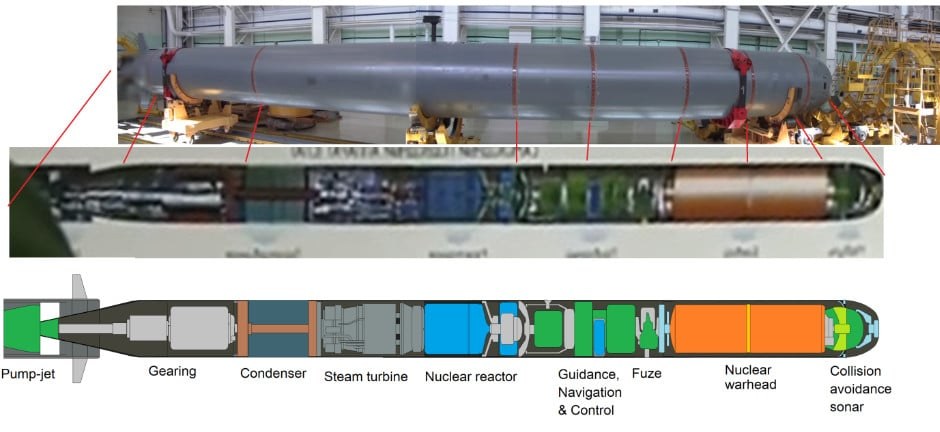
A pump-jet places the rotor inside a duct, shaping inflow and outflow to reduce tip vortex noise and protect the blades. Driving that pump-jet with an electric motor fed by a nuclear turbo-generator (or other conversion path) lets the reactor run at a steadier thermal power while the motor handles speed changes — attractive for a vehicle that must crawl then sprint. Direct mechanical drive from a steam turbine is also conceivable but harder to throttle quietly. Public imagery has shown a shrouded rear consistent with a pump-jet; the gearbox and motor details are not visible. Claims of "AI guidance" should be translated as onboard autonomy software until proven otherwise.
DEPTH BANDS AND SOUND CHANNELS
At ~50–100 m, a vehicle may exploit surface-duct and bottom-bounce geometries that complicate some sonars; at hundreds of metres it enters different regimes, including approaches to the deep sound channel axis in some latitudes. A claimed 1,000 m maximum depth is in the deep-diving military submarine class and would require a strong hull — titanium has been speculated in open forums without proof. Crush depth, operating depth and "dash depth" are different numbers; only a vague maximum appears in secondary sources.
SECOND-STRIKE TIMELINE VERSUS LAUNCH-ON-WARNING
Russian strategic forces emphasise launch-under-attack / launch-on-warning options for the ICBM force (see SPRN and Perimeter). Poseidon is the opposite tempo: a delayed, assured consequence. That makes it a psychological second-strike supplement rather than a first-strike clock. Analysts who call it a "doomsday machine" are reacting to that delay-plus-megaton combination — the sense that even a "successful" disarming strike against Russia leaves harbours dying days later. Whether that fear adds deterrence or merely adds horror is a political judgment; the engineering description remains: slow nuclear UUV, large warhead, submarine launch.
WHAT WOULD CHANGE THE ASSESSMENT
Public release of a full-profile intercontinental swim with recoverable telemetry; confirmation of combat duty on Belgorod or Khabarovsk; clear imagery of the nose (cavitator or not); and a declared yield would all tighten this article. Until then, Poseidon sits in the same evidentiary category as late-stage Burevestnik: real hardware, real carriers, large claims, incomplete independent verification.
LAUNCH TRANSIENTS FROM THE TUBE
Leaving a submarine tube means handling expulsion impulse, depth pressure, and a transition from drowned to self-propelled flight underwater. The chemical booster Putin mentioned exists to clear the boat and bring the vehicle to a speed/depth band where the reactor and pump-jet can take over without endangering the mother ship. Minimum launch depth, maximum launch speed of the submarine, and keep-out zones for friendly forces are all classified; naval practice worldwide uses generous keep-out arcs when testing large underwater weapons.
ARCTIC TEST GEOGRAPHY
White Sea, Barents Sea and Kara Sea ranges are the natural Poseidon playgrounds: nearby Severodvinsk industry, Northern Fleet basing, and relatively controlled access. Novaya Zemlya's nuclear legacy and instrumentation also sit in that geography. Pacific Fleet basing for Khabarovsk will eventually move the operational problem toward the US West Coast and East Asia — a different ASW adversary set (US and Japanese undersea surveillance) than the Norwegian Sea.
COBALT AND RADIOLOGICAL WARFARE — SEPARATING FACT FROM TV
A salted cobalt warhead maximises long-lived fallout by design. It has been a doomsday-fiction staple since the 1950s. The 2015 Status-6 slide's language about rendering coasts unusable invited cobalt speculation; no official Russian statement has confirmed salting. A large "ordinary" thermonuclear warhead already produces catastrophic local effects. This article treats cobalt as an unproven speculation and the multi-megaton coastal nuclear burst as the serious baseline threat.
WHAT THE PHOTOS ON THIS PAGE SHOW
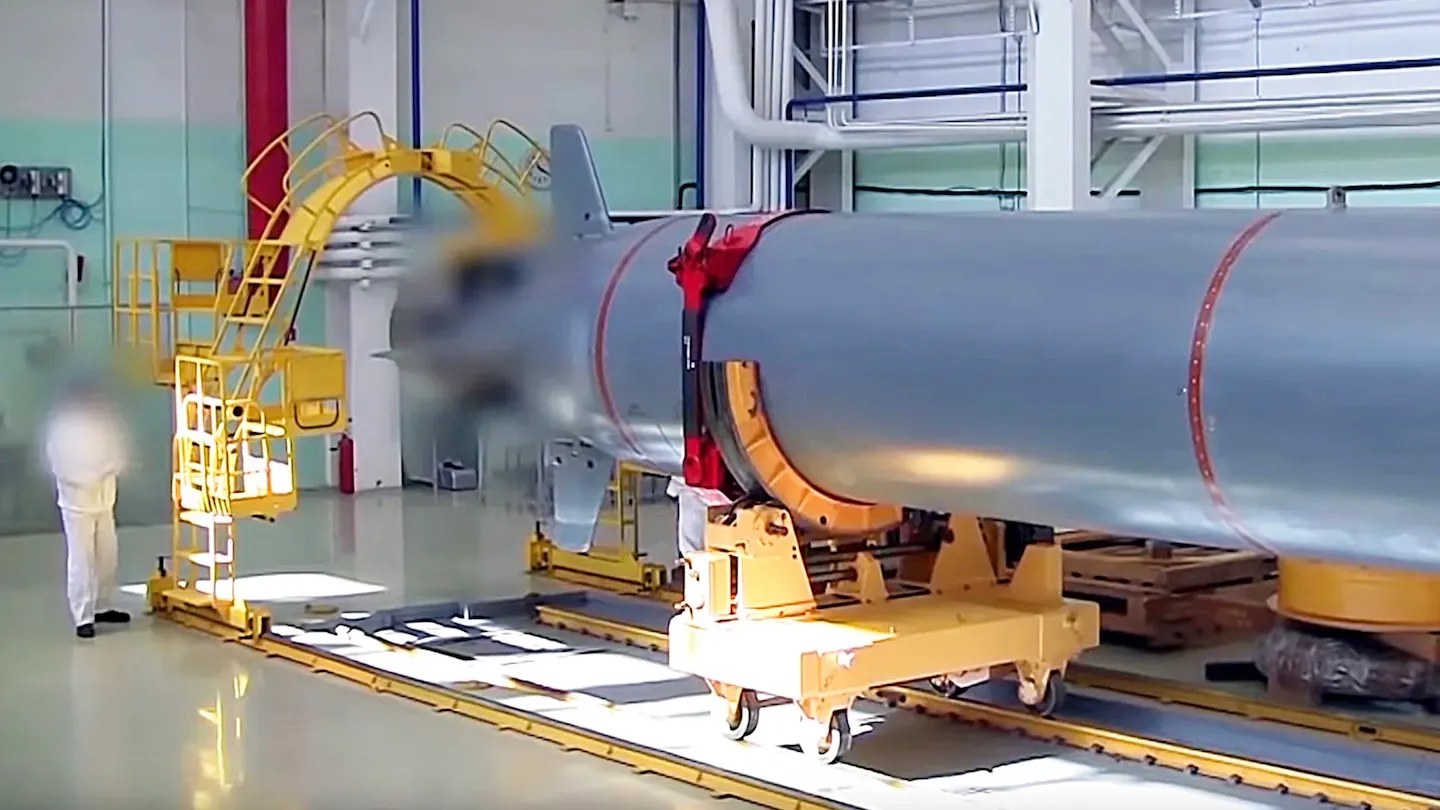
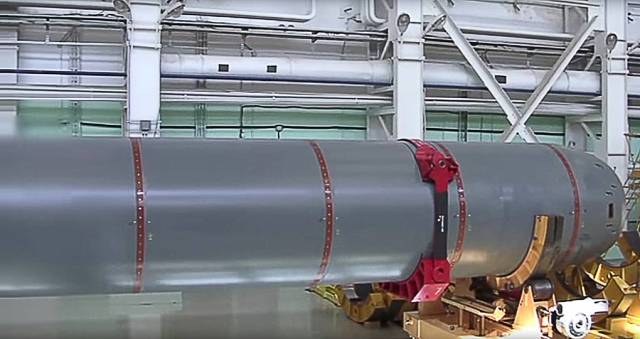
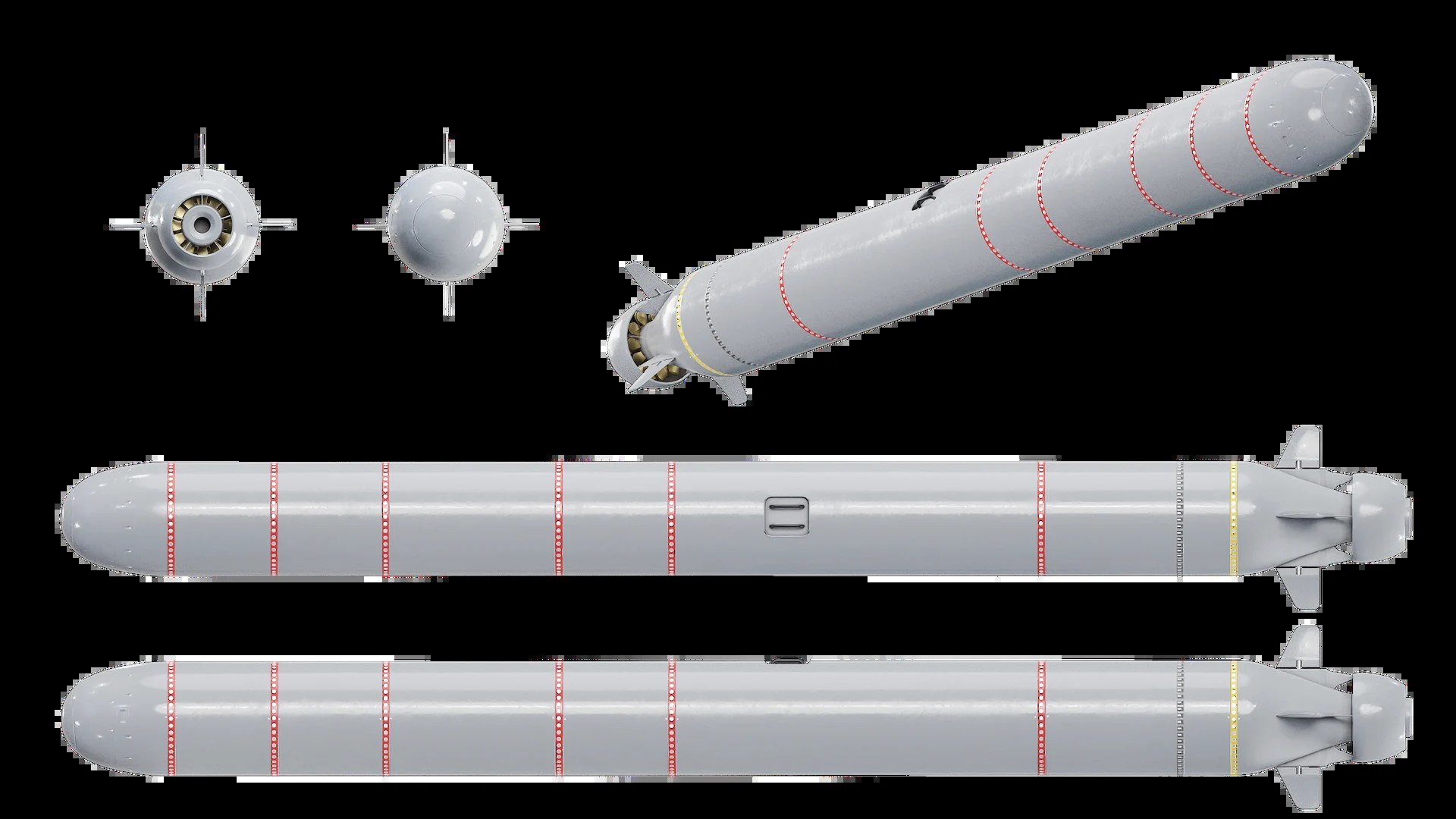
The seven images on this page, in order: (1) a Poseidon body in a factory hall with a worker and gantry; (2) the mid-section with red bands and a red cradle clamp; (3) a composite with an internal cutaway and labelled diagram, which is an unofficial media illustration and not an official Russian drawing; (4) a multi-view 3D render, also unofficial; (5) the Covert Shores comparison drawing of the 2018 prototype, the 2019 test vehicle, a surrogate test load and the Harpsichord 2P-2M small submarine for scale; (6) a Sputnik infographic quoting about 20 m length, 1.8 m diameter, 1,000 m depth and 100 to 130 km/h; and (7) a tabloid-style tsunami infographic claiming a 100-megaton warhead and a 65 ft wave, which is media speculation and not an official figure. None shows a launch from a submarine or the Belgorod, and none is verified detail of the reactor or warhead.
HULL MATERIALS AND STRUCTURAL DESIGN
A 20–24 m vehicle that may dive to 1,000 m needs a pressure hull segment or a carefully engineered flooded/fairing architecture around hard tanks. Titanium alloys appear in Russian deep-submergence tradition (Alfa reactor compartments, special-mission deep vehicles) and are speculated for Poseidon; high-strength steels are the mundane alternative. Buoyancy management — keeping near-neutral buoyancy across fuel/consumable states — matters for long swims. Public photos show a blunt-ish nose and parallel body; they do not reveal internal tankage.
SENSORS FOR COASTAL APPROACH
A city-attack profile can be mostly inertial/geo to a programmed harbour mouth. A carrier-attack profile needs sensors: passive sonar to hear ships, active sonar that risks revealing the attacker, maybe magnetic or wake detectors. Open serious analysis is sparse here because the anti-fleet role may be secondary to the anti-coast role. If Poseidon is primarily a harbour-killer, it is an underwater cruise missile with a megaton warhead; if it is primarily a carrier-killer, it is an ASW problem of the first order. Russian "multi-purpose oceanic system" language keeps both doors open.
ESCALATION AND SIGNALLING USES
Stefanovich and other Russian commentators have noted a signalling option: put vehicles on patrol to demonstrate vulnerability without detonating anything. That option is politically attractive and operationally messy — lost communications, false alarms, and the optics of radioactive reactors swimming near foreign EEZs. Western officials have generally refused to treat Poseidon as balance-changing, while still citing it in nuclear posture documents as a system that exists. Both postures can be true: strategically redundant, politically loud.
FAILURE MODES WORTH RESPECTING
Reactor scram at sea; navigation fault into friendly shipping lanes; hull breach at depth; booster malfunction at launch endangering the mother submarine; warhead fuzing fault. Every one of those is a programme-killer or a crisis if it happens in peacetime. The October 2025 test's limited public detail ("operated for a certain period") may reflect a short reactor run deliberately kept inside a controlled range. Full intercontinental profile tests, if they occur, will be the real reliability gate.
COMPARISON TABLE IN PROSE
Versus a Bulava SLBM: Poseidon is slower to target, single-warhead (per vehicle), underwater throughout, treaty-ungoverned under New START rules, and dependent on specialised carriers. Versus Burevestnik: both use compact reactors for endurance, but one heats air and the other drives a propulsor in water; one is an air-defence problem, the other an ASW problem; both are dirty if they crash. Versus Avangard: Avangard is fast and already fielded in small numbers; Poseidon is slow and still maturing. The 2018 joint unveil packaged them as a set; the engineering realities diverged.
HISTORICAL ANALOGUES
Cold War concepts for nuclear-powered torpedoes and drone submarines resurface whenever reactor miniaturisation looks feasible. US studies in the 1950s–60s explored related ideas and abandoned most of them for cost, control and arms-race reasons. Poseidon is the first publicly acknowledged attempt to field such a vehicle as a strategic nuclear system. That historical loneliness is why every test is news: there is no quiet peer programme to compare reliability curves against.
Naval nuclear propulsion on manned submarines is mature; transferring that maturity into an unmanned 2-metre tube is the leap. Manned boats have crews to fix leaks and scram procedures practised over decades. Poseidon must do its scrams and fault responses in software and hardware alone. That is the reliability argument behind slow deployment even after a headline test.
BASING INFRASTRUCTURE CHECKLIST
To call Poseidon "deployed," outsiders will look for: accepted weapons in inventory; a carrier in fleet service with trained crew; shore handling for reactor-armed torpedoes; secure warhead mates; published or leaked combat-duty ceremony language; and repeated full-profile tests. As of October 2026 the checklist is partially ticked (Belgorod in service, Khabarovsk on trials, Oct 2025 reactor-on claim, Pacific facility building) and partially open (combat duty, full-profile repetition, inventory size).
WHAT IS UNCERTAIN IN THIS ARTICLE
TIMELINE
RUSSIAN TERMS USED IN THIS ARTICLE
IN ONE SENTENCE
Poseidon (Status-6 / Kanyon / 2M39) is Russia's developmental nuclear-powered autonomous mega-torpedo — a roughly 20–24 m reactor-driven UUV meant to deliver a multi-megaton-class warhead against coasts or fleets from Belgorod and the new Khabarovsk-class submarines — with an October 2025 claim of the first launch-plus-reactor test, Khabarovsk on sea trials as of August 2026, and still no independent confirmation that the weapon is on routine combat duty.