WHAT IT IS
Avangard (Авангард, "Vanguard"; previously known under the R&D designation Объект 4202 / Objekt 4202 and the experimental indices Yu-71 and Yu-74; open sources also write 15Yu71 for the guided hypersonic block) is a Russian hypersonic glide vehicle (гиперзвуковой планирующий боевой блок, often shortened to управляемый боевой блок, УББ). It is not a missile of its own. It is a warhead that rides an intercontinental ballistic missile into the upper atmosphere and then glides and manoeuvres toward its target at hypersonic speed, instead of following the predictable ballistic arc of a classical re-entry vehicle.
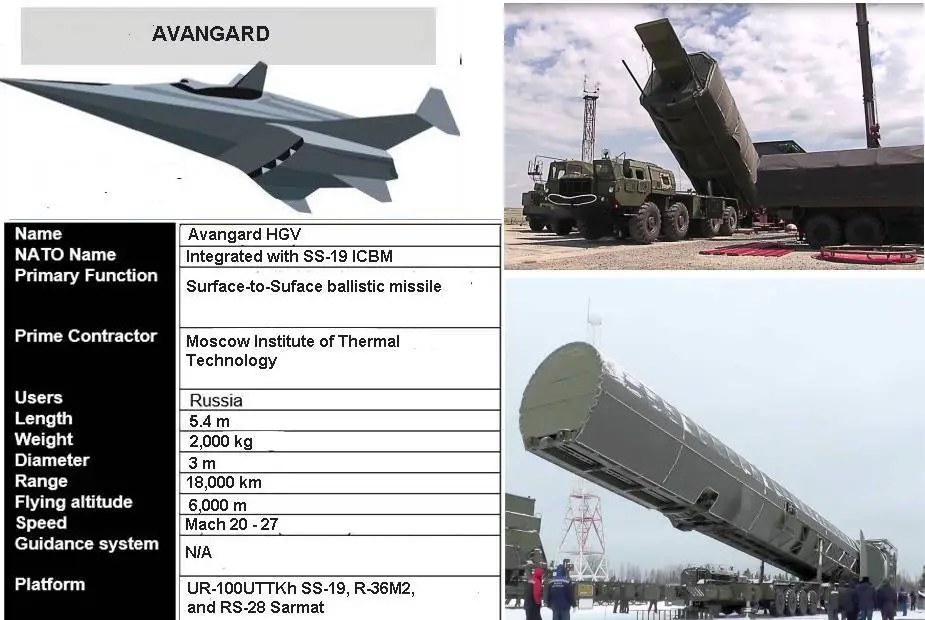
Today the operational carrier is a modified silo-based УР-100Н УТТХ (UR-100N UTTKh, GRAU 15А35, NATO SS-19 Stiletto Mod 3 / SS-19 Mod 4 when carrying Avangard). Russia has said for years that the heavy RS-28 Sarmat will eventually carry Avangard as well. The design work is associated with NPO Mashinostroyenia (НПО машиностроения) in Reutov; serial production of the glide vehicle has been claimed since 2018. The Strategic Missile Forces (РВСН) put the first Avangard regiment on combat duty at the end of 2019 at Dombarovsky / Yasny in Orenburg Oblast (13th Missile Division). Independent tallies in 2025–2026 put about twelve Avangard-equipped UR-100N UTTKh missiles on duty there.
Two things must be kept apart throughout this article. One is what Russian officials claim: atmospheric speeds of Mach 20 to Mach 27, surface temperatures of 1,600–2,000 °C, the ability to manoeuvre horizontally and vertically while wrapped in plasma, and near-immunity to existing missile defences. The other is what outside analysts can actually verify: that a boost-glide vehicle of this class was flight-tested, that a small regiment is deployed on recycled SS-19 boosters, and that the physics of hypersonic glide make midcourse interception hard — but do not make the vehicle invisible, and do not make every published number a measured fact. Where this site already has related articles they are linked: see RS-28 Sarmat for the future heavy carrier; A-135 / A-235 Nudol and Don-2N for the Moscow ABM side; Voronezh, Dnepr and SPRN at Solnechnogorsk for early warning; INS and GLONASS for navigation; S-400, S-500 and Patriot for the air-defence systems that Russia says will help protect its missile fields; and RS-24 Yars, Poseidon and 9M730 Burevestnik for the other exotic systems announced alongside Avangard in 2018.
QUICK FACTS
Not to be confused with: the air-launched Kinzhal (Х-47М2 «Кинжал»), which is a manoeuvring aeroballistic missile, not a boost-glide HGV; the Chinese DF-17 / DF-ZF boost-glide system; the US Common Hypersonic Glide Body; or the nuclear-powered cruise missile Burevestnik, which is a completely different propulsion concept.
PURPOSE AND PLACE IN RUSSIAN STRATEGIC NUCLEAR FORCES
Avangard was presented by President Vladimir Putin on 1 March 2018 as one of six "new" strategic systems meant to guarantee that Russian warheads would still reach the United States even if a future American missile-defence shield became much thicker. Russian officials explicitly tie the programme to the US withdrawal from the 1972 Anti-Ballistic Missile Treaty in 2002. In that framing, Avangard is not about replacing the whole ICBM force. It is a specialised penetrator: a small number of very hard-to-predict warheads that sit on top of existing (and later, new) boosters and complicate the midcourse and terminal defence problem.
In the current force, Avangard is a niche. The Federation of Atomic Scientists / Bulletin of the Atomic Scientists 2026 estimate lists about 12 SS-19 Mod 4 (Avangard) launchers — twelve warheads — against roughly 180 mobile and two dozen silo Yars missiles and about forty remaining SS-18 / Voevoda missiles. So Avangard is a few percent of the land-based warhead count. Its political and technological weight is larger than its numerical weight: it is the first operational hypersonic glide vehicle Russia has publicly declared, and it is the system Moscow uses whenever it wants to argue that missile defence cannot "cancel" the Russian deterrent.
Command and control for Avangard rides the same Strategic Missile Forces chain as the rest of the silo force — see Kazbek, Perimeter / Dead Hand and Russian C3. Open sources have mentioned dedicated Avangard command-post equipment under the name «Бугай» (Bugai), but details are scarce.
HISTORY AND DEVELOPMENT
Soviet work on manoeuvring and hypersonic re-entry vehicles goes back to the 1980s. After the USSR collapsed the effort stalled, then was restarted in the mid-1990s at NPO Mashinostroyenia under the designation Project 4202. Early flights used UR-100N UTTKh boosters from Baikonur and later from Dombarovsky / Yasny. Open tallies count on the order of a dozen tests between the 1990s and 2018, with mixed results. A flight in October 2016 from Dombarovsky toward the Kura range on Kamchatka is widely described as the first fully successful end-to-end test of the modern vehicle. On 26 December 2018 Russia conducted the public "all-up" demonstration: a UR-100N UTTKh launched from Dombarovsky, the glide vehicle flew roughly 6,000 km, and Putin announced that the test programme was complete and that the weapon would enter service on schedule.
Serial production was claimed in 2018. The first regiment was declared on combat duty on 27 December 2019. Rearmament of further silos at Dombarovsky continued into the early 2020s; by 2023–2025 open sources settled on about two regiments' worth of Avangard launchers, totalling twelve missiles. Ukraine's role as a supplier of certain control-system components before 2014 forced a Russian import-substitution programme that delayed the schedule — a detail Russian officials themselves have acknowledged.
Plans to put Avangard on the cancelled road-mobile RS-26 Rubezh were dropped. The official line for years has been that Sarmat will become the preferred heavy carrier. As of October 2026 that remains a statement of intent, not a confirmed operational loadout — Sarmat itself has a troubled test record (see the Sarmat article). In early September 2026, NOTAMs and local warnings around Dombarovsky suggested a planned Avangard flight toward Kura; the launch window passed without an announced flight, and open-source analysis treated the event as a cancellation rather than a failure.
WHO BUILDS WHAT
NPO Mashinostroyenia in Reutov is the design authority for the glide vehicle. The UR-100N UTTKh carrier is an older NPO Mashinostroyenia / Khrunichev-family liquid ICBM that Russia retained in storage specifically for this role after most SS-19s were retired under START. Silo conversion and ground equipment have been associated with KBSM (Design Bureau of Special Machine-Building) and related firms. Thermal regulation for the vehicle has been attributed to NPO Nauka. Votkinsk builds solid-fuel strategic missiles (Topol-M, Yars, Bulava) and is sometimes mentioned in the industrial chain, but Avangard's current booster is liquid-fuelled and not a Votkinsk product. Herbert Yefremov of NPO Mashinostroyenia was publicly decorated in 2020 for his role in the programme.
HOW A BOOST-GLIDE VEHICLE WORKS
A classical ICBM warhead is a ballistic re-entry vehicle (BRV). After the booster and the post-boost bus release it, it follows a Keplerian arc: high apogee (often 1,000+ km on a minimum-energy trajectory), a long coast in near-vacuum, then a steep, largely unpowered plunge through the atmosphere. Defenders who see the boost on infrared satellites and track the midcourse on radars can predict the impact point to within a few kilometres or better, which is why midcourse interceptors and the Moscow A-135 system were built the way they were (see A-135 / A-235 and Don-2N).
A boost-glide vehicle changes that geometry. The booster still lifts the payload out of the dense atmosphere — typically to something on the order of 100 km for Avangard-class descriptions — but instead of continuing on a high ballistic arc, the vehicle re-enters (or stays in) the upper atmosphere and uses aerodynamic lift to glide. It flies much lower than a classical midcourse warhead, at altitudes where there is enough air to generate lift and drag, and it can change heading and flight-path angle with control surfaces or body flaps. To a defender, the track is no longer a simple ellipse. The vehicle can depress, skip, or turn within the limits of its thermal protection and structural loads.
Jane's and other open analyses describe Avangard as a pure glider with no air-breathing engine of its own. That matters. It is not a scramjet cruise missile like some air-breathing hypersonic concepts. Its energy comes from the booster. Once released, it can only trade altitude and speed for range and manoeuvre, plus whatever small thrusters it may have for attitude control outside the atmosphere. Claims that Avangard has a "solid-propellant scramjet" appear in some secondary write-ups; they are not supported by the better open technical assessments and should be treated as errors or confusion with other programmes.
THE PHYSICS: SHOCK HEATING, PLASMA AND WHY THE SKIN GLOWS
At Mach 20 in the upper atmosphere the vehicle is moving on the order of 6–7 km/s. Air cannot get out of the way fast enough; a strong bow shock stands off the nose. Across that shock, kinetic energy is converted into thermal energy. Stagnation temperatures at the nose and leading edges can reach thousands of kelvin. Russian officials have repeatedly cited surface temperatures of 1,600–2,000 °C during the glide. That is in the same ballpark as the heating on a Space Shuttle during re-entry, but sustained over a long gliding flight rather than a single steep entry, and combined with manoeuvres that change the local heating pattern.
Three engineering problems follow directly from that heating.
1. Thermal protection. Ordinary aluminium and even many titanium alloys soften or melt. The vehicle needs a thermal protection system (TPS): typically carbon-carbon or ceramic-matrix composites on the hottest surfaces, with insulation and an internal structure that stays cool enough for electronics and the warhead. Russia has said Avangard uses "new composite materials" and an active thermoregulation system. Exact layups, thicknesses and whether any ablative layer is used are not public. Ablatives (like Apollo heat shields) shed mass as they char; reusable or long-glide composites try to radiate heat away while surviving. For a nuclear HGV that flies once, a mix of ablative and radiative design is plausible, but that is engineering judgment, not a confirmed fact.
2. Plasma sheath and radio blackout. At these speeds the shock-heated air ionises. A sheath of plasma forms around the vehicle. Free electrons in that plasma absorb and reflect radio waves below a plasma frequency that depends on electron density. The result is the same communications blackout that Apollo and Shuttle crews experienced during peak heating — GPS/GLONASS signals and command uplinks can be blocked or heavily attenuated. Putin in 2018 made a point of saying that control of the vehicle remains reliable "amid plasma." How Russia solves the blackout problem (plasma-tolerant antennas, carefully timed manoeuvres, inertial-only terminal guidance, optical windows, or something else) is not public. What can be said from first principles is that any radio link through a dense plasma sheath is hard, so the vehicle almost certainly relies heavily on its onboard inertial system during the hottest part of the glide (see INS).
3. Aerodynamic control in a changing flow. Control surfaces that work at Mach 5 in cold air behave differently at Mach 20 in dissociated, ionised gas. Hinge moments, heating of the actuators, and shifts in the centre of pressure all change with altitude and angle of attack. Russian officials have openly said that control-surface and heat-shield problems were among the hard parts of the programme. That matches what every other hypersonic programme on Earth has found.
A related point that is often misunderstood: plasma makes the vehicle hard to talk to, and it can degrade some radar returns, but it does not make the vehicle invisible in the infrared. A body at 1,600–2,000 °C is an extremely bright thermal source. Modern space-based infrared sensors that watch for missile launches can, in principle, see a hot glider — the question is whether the tracking and fire-control chain can turn that detection into a firing solution against a manoeuvring target. That is a systems problem, not a claim of invisibility.
SKIP-GLIDE, DEPRESSED TRAJECTORIES AND MANOEUVRE
Popular writing sometimes calls Avangard a "skip-glide" weapon, invoking the old idea of a vehicle that bounces repeatedly off the atmosphere like a stone on water (the 1930s Silbervogel concept, or fractional orbital ideas). Open technical assessments of Avangard describe it more conservatively as a boost-glide vehicle that stays in the upper atmosphere and manoeuvres, not necessarily as a multi-skip waverider. A depressed, lifting trajectory already shortens the time a midcourse radar has a clean track and forces interceptors to handle lateral offsets. Whether Avangard actually performs dramatic skips, or simply glides and turns within a corridor, is not something outsiders can settle from public data.
What manoeuvre buys, physically, is uncertainty. An interceptor fired against a predicted ballistic impact point will miss if the target changes heading by even a few degrees at these speeds — a few degrees at 6 km/s is tens of kilometres of cross-range in a minute. The price of manoeuvre is energy and heating. Every turn increases load factor and local heating. The vehicle cannot jink forever; it has a finite energy and a finite TPS budget. So "uninterceptable" is a stronger claim than the physics strictly supports. A more careful statement is: Avangard is designed to defeat the kinds of midcourse interceptors that assume a predictable Keplerian track, and to stress terminal defences that have only seconds to react.
A FLIGHT, STEP BY STEP
The following is a reconstructed sequence based on Russian statements and standard boost-glide engineering. Exact altitudes, times and staging events are not officially published.
1. Cold or hot silo launch of the UR-100N UTTKh. The liquid-fuel SS-19 leaves its converted silo. Boost phase lasts a few minutes. Early-warning satellites (see SPRN) would see the plume just as they would for any ICBM.
2. Separation. Upper stages and any shroud or adaptor release the Avangard vehicle near the edge of space — open descriptions often cite roughly 100 km. From this point the vehicle is on its own.
3. Glide and manoeuvre. The vehicle descends into denser air, generates lift, and follows a path that is lower and less predictable than a classical re-entry. Russian statements emphasise horizontal and vertical manoeuvres. Plasma forms; radio links may drop out; the inertial system carries the navigation load.
4. Terminal phase. In the last portion of flight the vehicle dives toward the aimpoint. At these speeds the timeline for a terminal interceptor (THAAD-class, A-235-class, or future systems) is measured in tens of seconds. Whether any current operational system can reliably kill an Avangard-class HGV is an open debate; Russia says no, Western officials are more cautious and speak in terms of future architectures.
5. Detonation. A nuclear warhead (the deployed loadout) detonates at a programmed height or on impact/fuzing logic that is not public.
GUIDANCE
Public detail on Avangard guidance is thin. By engineering necessity the vehicle must have a high-grade inertial measurement unit — strapdown gyros and accelerometers that can survive boost and then integrate a long, high-dynamic glide (see INS). GLONASS or other satellite updates may be available before plasma blackout and possibly after, but cannot be assumed during peak heating. Astro-inertial fixes (star trackers) are common on strategic re-entry systems and are a reasonable assumption, not a confirmed feature. Accuracy figures (CEP) for Avangard are not officially published. For a nuclear warhead in the high-kiloton to megaton class, CEP requirements are looser than for a conventional precision weapon — hundreds of metres may still be militarily useful — but that is a general nuclear-weapons point, not a measured Avangard specification.
CARRIERS: UR-100N UTTKh AND SARMAT
The UR-100N UTTKh is a 1970s-design two-stage storable-liquid ICBM. Russia kept a stock of them specifically to carry Avangard while Sarmat matured. Using an old booster for a new warhead is not unusual — it is cheaper and faster than waiting for a new heavy missile — but it also means the Avangard force inherits the silo basing, throw-weight limits and vulnerability profile of the SS-19. Each deployed Avangard today is one warhead on one silo that an adversary already has coordinates for.
Sarmat is the intended long-term carrier because of its much larger throw weight (Russian claim: about 10 tonnes) and its ability, on paper, to carry multiple Avangards or a mix of Avangards and conventional MIRVs plus decoys. Putin and others have spoken of "several" Avangards per Sarmat; the figure of three appears in secondary reporting and is not an official loading table. Until Sarmat is independently confirmed on duty with Avangard aboard, the only operational Avangard force is the Dombarovsky SS-19 regiment.
PAYLOADS AND YIELD
Open sources disagree on yield. Figures from "150 kt to 1 Mt" up to "more than 2 Mt" circulate in Russian and Western reporting. None of these are official confirmed numbers. What can be said safely is that Avangard is deployed as a nuclear system, that a conventional option has been mentioned as a design possibility, and that a single Avangard warhead is a strategic, city- or hard-target-class weapon, not a tactical munition. Decoys and penetration aids may ride with the vehicle or with companion payloads on a future multi-HGV Sarmat loadout; specifics are not public.
SPECIFICATIONS (PUBLISHED AND OPEN-SOURCE FIGURES)
TESTING HISTORY
Approximate public picture: research flights from the 1990s onward under Project 4202; mixed success through the 2000s and early 2010s; October 2016 Dombarovsky–Kura success often cited as the first fully successful modern test; 26 December 2018 public all-up test from Dombarovsky with presidential announcement; combat duty declared 27 December 2019. Further routine training launches have been sparse in open reporting. A probable Avangard test from Dombarovsky toward Kura planned for 3–5 September 2026 appears not to have flown (NOTAM analysis). Independent confirmation of individual test outcomes is limited; Russian announcements are the main primary source for "success" language.
COMPARED WITH OTHER HYPERSONIC SYSTEMS
Avangard sits in the same broad category as China's DF-ZF glide vehicle (carried by the DF-17 for regional missions and discussed for longer-range boosters) and the US Common Hypersonic Glide Body family — boost-glide, not air-breathing scramjet cruise. It is not like Kinzhal, which is an air-launched manoeuvring missile derived from Iskander technology (see Iskander and MiG-31). It is also not like Burevestnik, which is a subsonic nuclear-powered cruise missile, or Poseidon, which is an underwater autonomous torpedo. Those three systems were announced together in 2018, but they solve different problems with different physics.
Against classical MIRV buses (as on Yars or Voevoda), Avangard trades numbers for unpredictability: one hard-to-track glider instead of several simpler warheads plus decoys. Against missile defence, it attacks the midcourse prediction problem that systems like GBI or the Moscow A-135 were built around. It does not automatically defeat every future architecture that includes persistent space tracking and high-performance terminal interceptors.
ARMS CONTROL CONTEXT
Under New START, a deployed Avangard on an SS-19 counted as one warhead on one deployed launcher — the treaty counted the warhead, not the "hypersonic" label. New START expired on 5 February 2026 after the United States declined a Russian offer of a one-year voluntary extension of the numerical limits. Russia said it would observe the old caps as long as the United States did. Exotic systems that are not ICBMs, SLBMs or heavy bombers — notably Burevestnik and Poseidon — were never clearly captured by New START counting rules in the same way. Avangard, because it rides an ICBM, was inside the old accounting. Any future treaty that wants to limit HGVs will have to define them explicitly.
LIMITS AND VULNERABILITIES
Avangard does not erase the boost phase. The SS-19 plume is as visible as any other ICBM launch. The silos at Dombarovsky are fixed targets. The vehicle must survive its own heating; a TPS failure is a mission kill. Plasma complicates guidance updates. Manoeuvre spends energy. Numbers are small — twelve warheads do not replace a Yars regiment. And "uninterceptable" is a claim about today's defences, not a law of nature. Those are the practical limits, even if every Russian performance number is taken at face value.
STATUS AND OUTLOOK (OCTOBER 2026)
As of October 2026, Avangard is the only one of the 2018 "superweapons" that is clearly deployed in a combat regiment, albeit in small numbers on recycled SS-19 boosters. Expansion depends on Sarmat's recovery and on whether Russia chooses to rebuild more SS-19s or convert more silos. The cancelled September 2026 test window suggests the programme is still active enough to schedule flights, but also that schedules slip. For the user of this database the practical summary is: Avangard is real, fielded, nuclear, and designed to complicate missile defence — and almost every precise performance number you will read about it remains a claim rather than a measurement.
THERMAL PROTECTION IN MORE DETAIL
Hypersonic TPS design is a balance among conduction into the structure, radiation from the hot surface, and (if used) ablation that carries heat away in the char and gas. Equilibrium skin temperature is roughly set where the heat flux into the surface equals σ ε T4 radiated outward plus whatever is conducted inward. That is why Russian officials can quote 1,600–2,000 °C: those are plausible radiative-equilibrium temperatures for carbonaceous or ceramic surfaces under Avangard-class heat fluxes. Below the outer skin sits insulation — often porous ceramics or multi-layer stacks — then a cool structure that holds the warhead, batteries, actuators and guidance. NPO Nauka's thermoregulation system, mentioned in Russian reporting, likely manages internal heat loads (electronics, actuator waste heat, soak-back after the plasma phase) with heat pipes, fluid loops or phase-change materials; the details are not public.
Leading edges and nosetips see the worst stagnation heating. Blunter noses reduce peak heat flux (the Apollo solution) but increase drag and reduce lift-to-drag ratio. A sharp waverider-like edge flies more efficiently but needs materials that survive higher local temperatures — ultra-high-temperature ceramics (UHTCs) such as zirconium or hafnium diborides in Western research, or Russian equivalents that are not named in open sources. Whether Avangard's planform is a blunt lifting body or a sharper wedge remains one of the open visual questions; artist's renders and museum shapes are not flight hardware.
WHY MIDCOURSE DEFENCE STRUGGLES — AND WHAT STILL WORKS
Midcourse interceptors such as US GBI or the Moscow A-135 Gazelle/Gorgon family were built around a geometry in which the target coasts on a predictable ellipse above the atmosphere for tens of minutes. Discrimination of warheads from decoys, fire-control solutions, and divert burns all assume that geometry. A boost-glide vehicle that never settles onto that ellipse denies the defender the long clean track. The defender's remaining options are: kill the booster during burn (boost-phase intercept — politically and geometrically hard); track the glider continuously from space with infrared satellites and cue a high-performance interceptor; or engage in the terminal few tens of seconds with a very fast missile. None of those is trivial. None is impossible in principle. Russia's "invulnerable" language describes the difficulty of the midcourse problem, not a physics theorem.
Infrared detectability cuts both ways. A 2,000 °C glider is bright; a depressed trajectory may also fly under some radar horizons while still glowing for space sensors. Future architectures that fuse persistent space tracking with left-of-launch and terminal layers are exactly what both US and Russian planners talk about when they discuss the next decade of missile defence — see also S-500 for Russia's own upper-tier ambitions.
COMPARISON WITH CHINESE AND US BOOST-GLIDE PROGRAMMES
China's DF-ZF glider on the DF-17 is the closest operational peer for regional ranges; longer-range Chinese boost-glide concepts have been discussed in US testimony but are less publicly documented than Avangard's regiment. The US Common Hypersonic Glide Body (C-HGB) family under CPS/LRHW is conventionally armed in its first incarnations and still entering service as of the mid-2020s — a different mission (prompt conventional strike) from Avangard's nuclear strategic role. All three countries have rediscovered the same thermal and guidance problems. Avangard's distinction is that Russia declared a nuclear HGV regiment on duty first, on recycled SS-19 boosters, while still waiting on Sarmat for a heavy multi-HGV loadout.
INDUSTRIAL AND FORCE-STRUCTURE NOTES
Twelve launchers are enough for signalling and for stressing an adversary's defence planning; they are not enough to replace Voevoda or Yars. Each Avangard silo at Dombarovsky is also a known aimpoint. The decision to keep SS-19s in service solely as Avangard trucks consumes life-extension effort that could have gone elsewhere. If Sarmat eventually carries three Avangards, the economics of the glider force change; until then Avangard remains a boutique penetrator. Open reporting on Bugai command posts and specialised training suggests the RVSN treats the regiment as a distinct mission set, not just "another silo product."
COST AND STRATEGIC LOGIC
No reliable public unit cost exists. The strategic logic is insurance against a future US (or allied) missile-defence breakout that could, in Russian planning documents, erode the credibility of a purely ballistic retaliatory force. Whether that breakout was ever realistic is a separate debate — many Western analysts argue Russian HGVs are a solution to an exaggerated problem, given how leaky even optimistic midcourse defences remain against large MIRV+decoy attacks from Yars and SLBMs. The counter-argument from Moscow is that insurance is bought before the fire.
BOOST PHASE, WARNING TIME AND THE GLIDER'S CLOCK
From the defender's point of view the clock starts when infrared satellites see the SS-19 plume. Boost lasts a few minutes; then the Avangard vehicle is on its own. Unlike a classical MIRV bus that coasts for twenty to thirty minutes on a high arc, the glider descends into the atmosphere sooner and begins manoeuvring. That shortens the midcourse window and lengthens the period during which only continuous tracking (space IR plus over-the-horizon or coastal radars — see OTH radar, Voronezh and Dnepr for related early-warning and surveillance radars) can hold a fire-control quality track. The physics of the engagement, not just the speed number, is what makes HGVs awkward for legacy midcourse architectures.
PLASMA BLACKOUT AND NAVIGATION ERROR GROWTH
During plasma blackout the vehicle cannot take GNSS updates and may not receive command uplink. Inertial errors grow with time: gyro bias, accelerometer bias and gravity-model mismatch integrate into position error. A strategic HGV that spends many minutes in blackout needs either superb cold-inertial performance, a way to peek through the plasma (shaped antennas, magnetic windows, plasma mitigation), or a guidance plan that does most of its GNSS/astro work before and after the hottest segment. Russian public statements insist control remains reliable in plasma; the engineering means are not shown. For a nuclear yield in the high-kiloton to megaton class, the allowable miss distance is larger than for a conventional bunker-buster — which relaxes the requirement without eliminating it.
FOBS, DEPRESSED TRAJECTORIES AND SOUTH-POLE RHETORIC
Russian officials sometimes discuss Avangard and Sarmat together with polar or southern approaches that avoid the densest northern missile-defence radars. Fractional Orbital Bombardment (FOBS) — briefly putting a weapon on an orbital path — was banned for weapons of mass destruction by the Outer Space Treaty's common interpretation and by SALT-era practice; the Soviet R-36orb was dismantled. A boost-glide vehicle on a depressed long path is not FOBS, but it plays in a similar strategic narrative: attack axes that legacy BMEW radars were not primarily built to cover. Whether any operational Avangard flight would actually fly a southern route is unproven in public data; the December 2018 Dombarovsky–Kura shot was an eastward Russian test range profile.
WHAT THE PHOTOS ON THIS PAGE SHOW
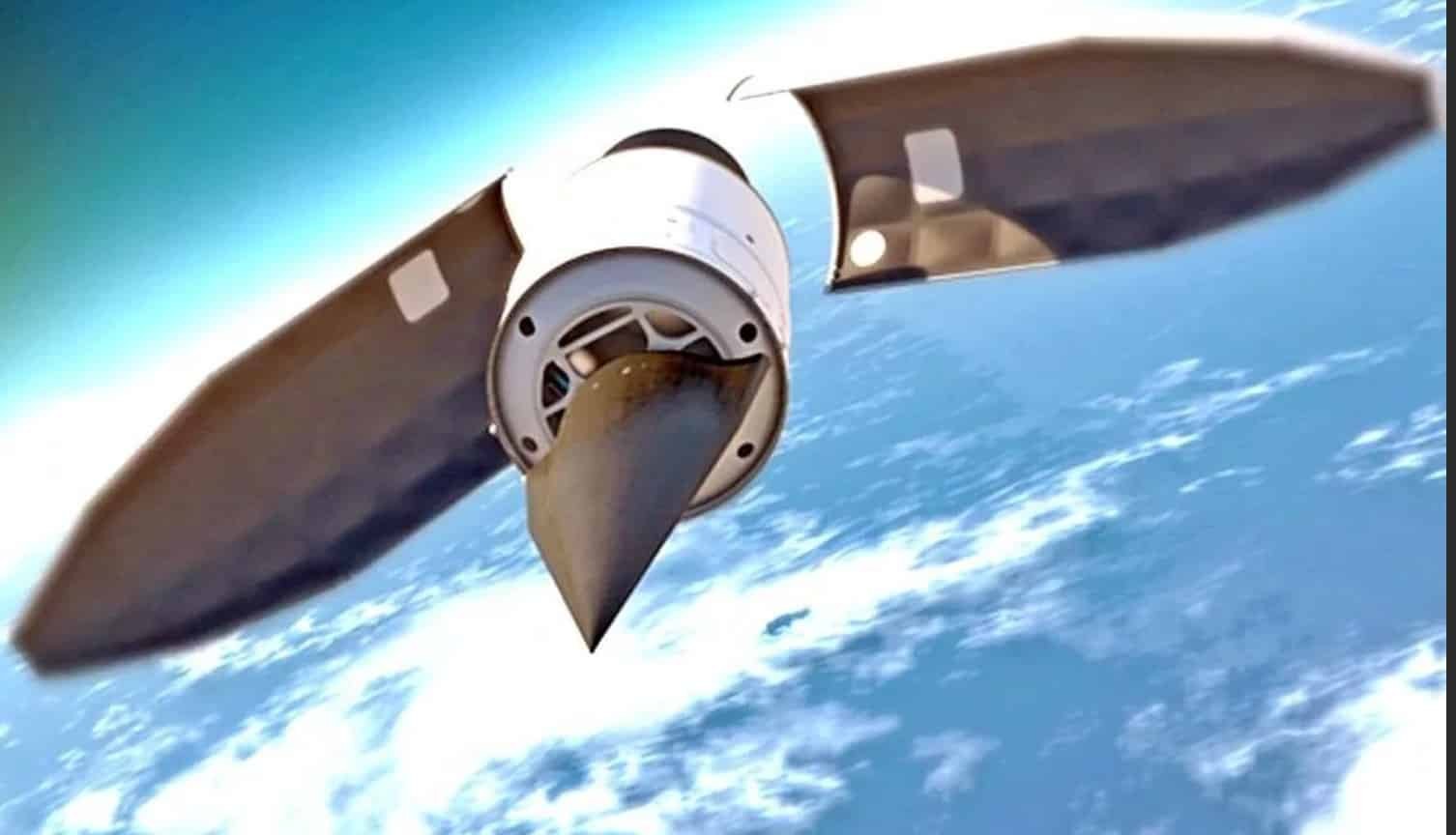
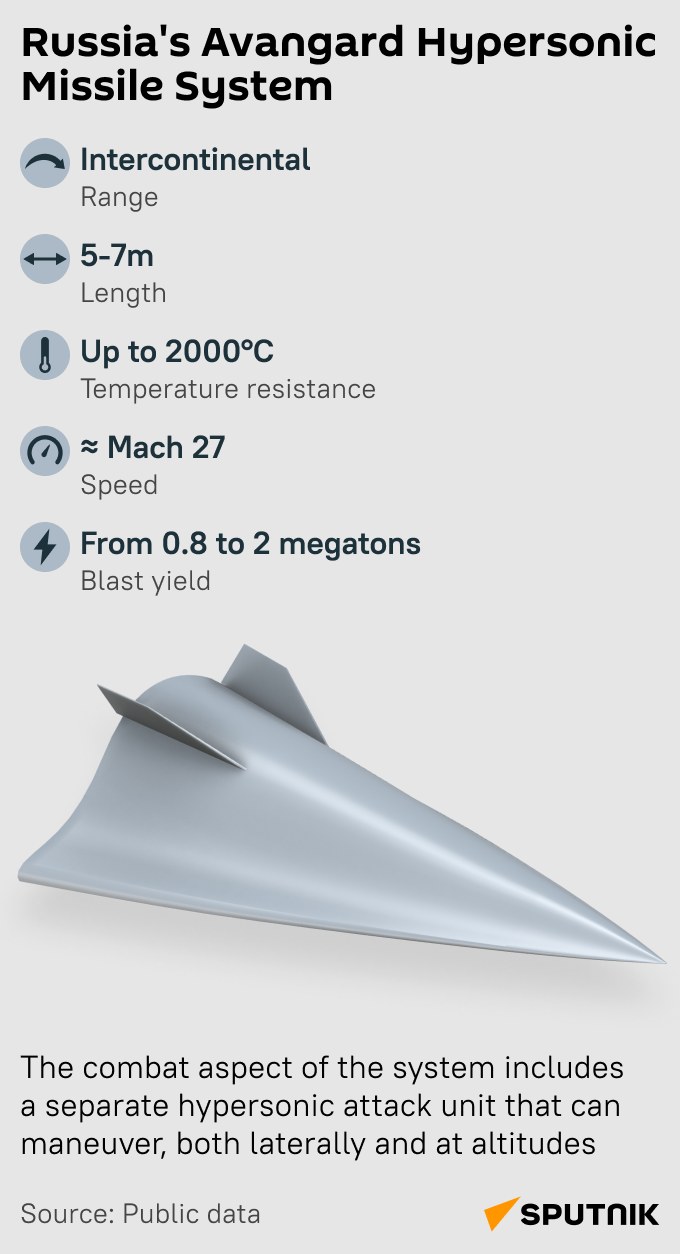
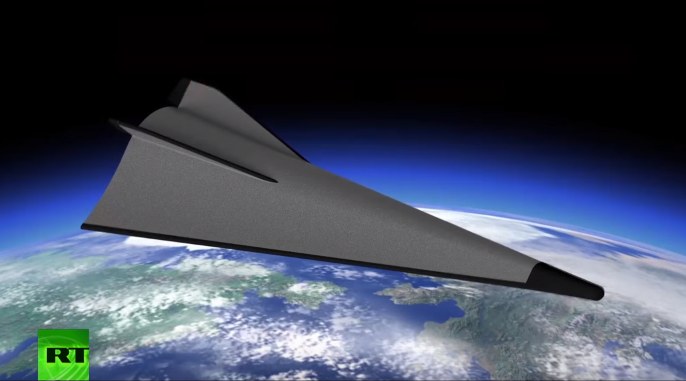
The four images on this page are a specifications collage with TEL-related photos, an orbital-style render of a glide vehicle, a Sputnik infographic, and an RT-style render. None is a verified photograph of the classified flight shape. Readers should treat artistic renders as illustrations of the concept — lifting body, plasma sheath, booster stack — not as mensuration references.
RE-ENTRY PLASMA CHEMISTRY IN BRIEF
Behind the bow shock, temperatures are high enough to dissociate O2 and N2 into atoms and to ionise a fraction of them. Nitric oxide forms; electrons and ions create a conductive sheath. Radio attenuation scales with electron density and collision frequency; as the vehicle descends into denser air the sheath character changes. Heat shields must survive not only equilibrium temperature but catalytic recombination of atomic oxygen on the surface, which deposits additional energy. Western hypersonic literature discusses these effects extensively; Russian open literature on Avangard mentions the plasma problem mainly to boast that it was solved.
CONTROL ACTUATION UNDER HEAT
Fin actuators need power, cooling and hinge-moment authority while the fin root is near material limits. Hydraulic fluid, electromechanical actuators and thermal standoffs are the usual toolbox. Failures here end missions even when the TPS skin survives — which matches Russian officials' admission that control-surface problems were a pacing item. Without public telemetry, outsiders group "control" and "TPS" together as the two hard gates Project 4202 had to pass before the 2018 declaration.
WHAT IS UNCERTAIN IN THIS ARTICLE
TIMELINE
RUSSIAN TERMS USED IN THIS ARTICLE
IN ONE SENTENCE
Avangard (Авангард, Objekt 4202 / Yu-71) is Russia's operational hypersonic boost-glide nuclear warhead — a manoeuvring, plasma-sheathed glider that rides a modified UR-100N UTTKh out of Dombarovsky silos (about twelve on duty as of 2025–2026) and is intended later for Sarmat — built to defeat predictable midcourse missile-defence tracks, with claimed Mach 20–27 speeds and 1,600–2,000 °C skin temperatures that remain Russian assertions rather than independently measured public data.