WHAT IT IS
The 9M730 Burevestnik (9М730 «Буревестник», "Storm Petrel"; NATO SSC-X-9 Skyfall; also referred to in some US intelligence contexts as KY30) is a Russian ground-launched, nuclear-powered, nuclear-armed cruise missile. It is designed to fly at high-subsonic speed for many hours — in the extreme, "indefinitely" — by heating air in a compact nuclear reactor instead of burning chemical jet fuel. It was one of the six strategic systems unveiled by President Vladimir Putin on 1 March 2018. Development is associated with the All-Russian Scientific Research Institute of Experimental Physics (VNIIEF, Sarov) for the power unit and NPO Novator (Yekaterinburg) for the missile, according to Russian press accounts.
The concept is not new. The United States ran Project Pluto / SLAM in 1957–1964, building and ground-testing the Tory nuclear ramjet, then cancelled it because a missile that sprays fission products along its flight path was judged too dirty, too provocative and less useful than ICBMs. Burevestnik is Russia's attempt to make a smaller, missile-sized version of that idea — most likely, according to 2026 MIT analysis, as a direct-cycle nuclear turbojet rather than a pure ramjet.
On 21 October 2025, according to Chief of the General Staff Valery Gerasimov briefing Putin on 26 October, Burevestnik flew about 14,000 km in about 15 hours, performing prescribed vertical and horizontal manoeuvres. Norway's military intelligence later confirmed a launch from Novaya Zemlya; Norwegian radiation monitors did not report a spike. Putin ordered work on employment concepts and deployment infrastructure. Open-source researchers had already pointed to a probable permanent launch area near Vologda-20. As of late August 2026, OSINT reporting again showed Il-976 SKIP telemetry aircraft and support assets at Rogachyovo on Novaya Zemlya consistent with another test preparation. The Nuclear Threat Initiative's 2024 assessment still described a poor early test record: at least thirteen known tests since 2016 with only two partial successes before the more recent claimed flights.
Related articles on this site: Kh-101 (chemical-fuel long-range cruise comparison), Tu-160, Tu-95, TERCOM, INS, GLONASS, RS-28 Sarmat, Avangard, RS-24 Yars, Poseidon, S-400, S-500, Patriot, VVER, RBMK, Russian C3, Kazbek, Perimeter.
QUICK FACTS
Not to be confused with: Kh-101 / Kh-102 (conventional turbofan cruise missiles); Avangard (hypersonic glide vehicle); Poseidon (nuclear underwater vehicle); or Project Pluto's SLAM (US 1950s–60s ancestor concept).
PURPOSE
Burevestnik is meant to defeat missile defence by not flying like a ballistic missile at all. A subsonic cruise missile at low altitude, arriving from an unexpected direction after a ten-hour detour over oceans or the Arctic, stresses a different defensive architecture than midcourse GBI or the Moscow A-135 (see A-135 / A-235, Don-2N, S-400, Patriot). Unlimited endurance would also allow loitering — launch under crisis, hold offshore, then commit — which no chemical-fuel cruise missile can do. Critics (Hans Kristensen and others) note the irony: the longer it flies, the more time defenders have to find it. Supporters answer that finding a low-altitude cruise missile over open ocean is still hard.
HISTORY AND THE NYONOKSA ACCIDENT
Russian accounts date the requirement to the period after the US left the ABM Treaty in 2002. US intelligence detected early flight attempts from 2016. Pan'kovo on Novaya Zemlya and the Nyonoksa naval test range near Severodvinsk became the main associated sites, identifiable in satellite imagery by a characteristic rail-mounted environmental shelter. Kapustin Yar appears to host a similar shelter, possibly for non-nuclear-power-unit tests.
A November 2017 Pan'kovo attempt reportedly flew only about two minutes / 35 km before crashing in the Barents Sea; recovery ships included a radiation-capable vessel. On 8 August 2019, an explosion at Nyonoksa killed five Rosatom-linked specialists and released radioactivity. Rosatom called it an accident involving an "isotope power source for a liquid-fuelled rocket engine." US officials later stated the blast occurred during recovery of a nuclear-powered cruise missile from a previous failed test. Putin subsequently praised the dead as having worked on an "unparalleled" weapon. Not every Western analyst agreed the 2019 event was Burevestnik — Michael Kofman publicly doubted the attribution — but the Skyfall-recovery explanation became the dominant US official line.
Putin claimed a successful test in October 2023 without releasing data Western media could confirm. The 21 October 2025 flight is the first long-endurance claim with specific distance and time, briefed by Gerasimov and tied by Norway to Novaya Zemlya. Putin said specialists once told him such a missile was impossible; he ordered infrastructure and employment concepts. Through August 2026, open sources watched for a follow-on Novaya Zemlya shot.
HOW A NUCLEAR CRUISE MISSILE ENGINE WORKS
A chemical turbojet burns fuel in air to heat the flow; the hot gas expands through a turbine (which drives the compressor) and a nozzle to make thrust. A nuclear air-breathing engine replaces the combustor with a reactor. Air is still compressed; instead of combustion, fission heat raises its temperature; the hot air (and in a direct cycle, entrained radionuclides) expands to produce thrust.
Two architectures dominate the literature:
Direct cycle: Atmospheric air passes through channels in the reactor core and is heated by contact with hot fuel elements. Simple and light. The exhaust is radioactive — activated argon, leaked fission products, and corrosion products. This is what Project Pluto used and what Hecla & Kemp conclude Burevestnik almost certainly uses.
Indirect cycle: A closed primary loop (gas or liquid metal) carries heat from the core to a heat exchanger that heats the airstream. Cleaner exhaust, much heavier and more complex — hard to fit in a cruise-missile fuselage.
A pure nuclear ramjet (Pluto/Tory) needs high forward speed to compress air without a mechanical compressor. A nuclear turbojet uses a compressor/turbine machine and can operate from subsonic speeds after a booster launch — which matches a missile that starts from an inclined ground launcher like a fat Kh-101. Hecla & Kemp's June 2026 paper ("Modeling the Performance of the Burevestnik Nuclear-Powered Cruise Missile," arXiv:2607.01234) almost entirely excludes a ramjet for Burevestnik's size and subsonic profile and favours a direct-cycle nuclear turbojet.
THE MIT PERFORMANCE MODEL (2026)
Jake J. Hecla and R. Scott Kemp built an open modelling toolkit around estimated airframe size, drag and nuclear-thermal cycles. Their central estimates:
These are model outputs, not Russian specifications. They are currently the best physics-based public numbers available, and they explain why Norway's non-detection after the October 2025 test is interesting but not decisive: dilution, altitude, path over water, and detector placement all matter.
Putin's claim that the reactor is "a thousand times smaller" than a submarine reactor but comparable in power should be read as rhetoric. A 4 MWth cruise core is thousands of times smaller in power than a large naval reactor (100+ MWth class) as well as smaller in volume; the "thousand times" line is a political sound bite. The more useful engineering claim in the same speeches is rapid start — "minutes or seconds" versus hours for large reactors — which is plausible for a compact, highly enriched, high-leakage core designed for prompt launch.
RADIOACTIVE EXHAUST AND WHY PEOPLE CALL IT A FLYING CHERNOBYL
In a direct cycle, neutrons streaming from the core activate oxygen and argon in the air; fuel cladding that erodes under heat and oxygen adds fission products to the plume. The missile does not have to "melt down" to be dirty — normal operation is radiologically dirty compared with a sealed reactor. That is why Cheryl Rofer, Thomas Countryman and others have called the concept uniquely reckless, and why Project Pluto died. It is also why a crashed test article on the seabed is a recovery nightmare — the Nyonoksa story in miniature.
For wartime use against an enemy homeland, the designer may not care about the trail. For peacetime testing over or near Russian waters, and for any accident on Russian soil, the trail is a self-contamination problem. That tension has never gone away.
AIRFRAME, LAUNCH AND FLIGHT PROFILE
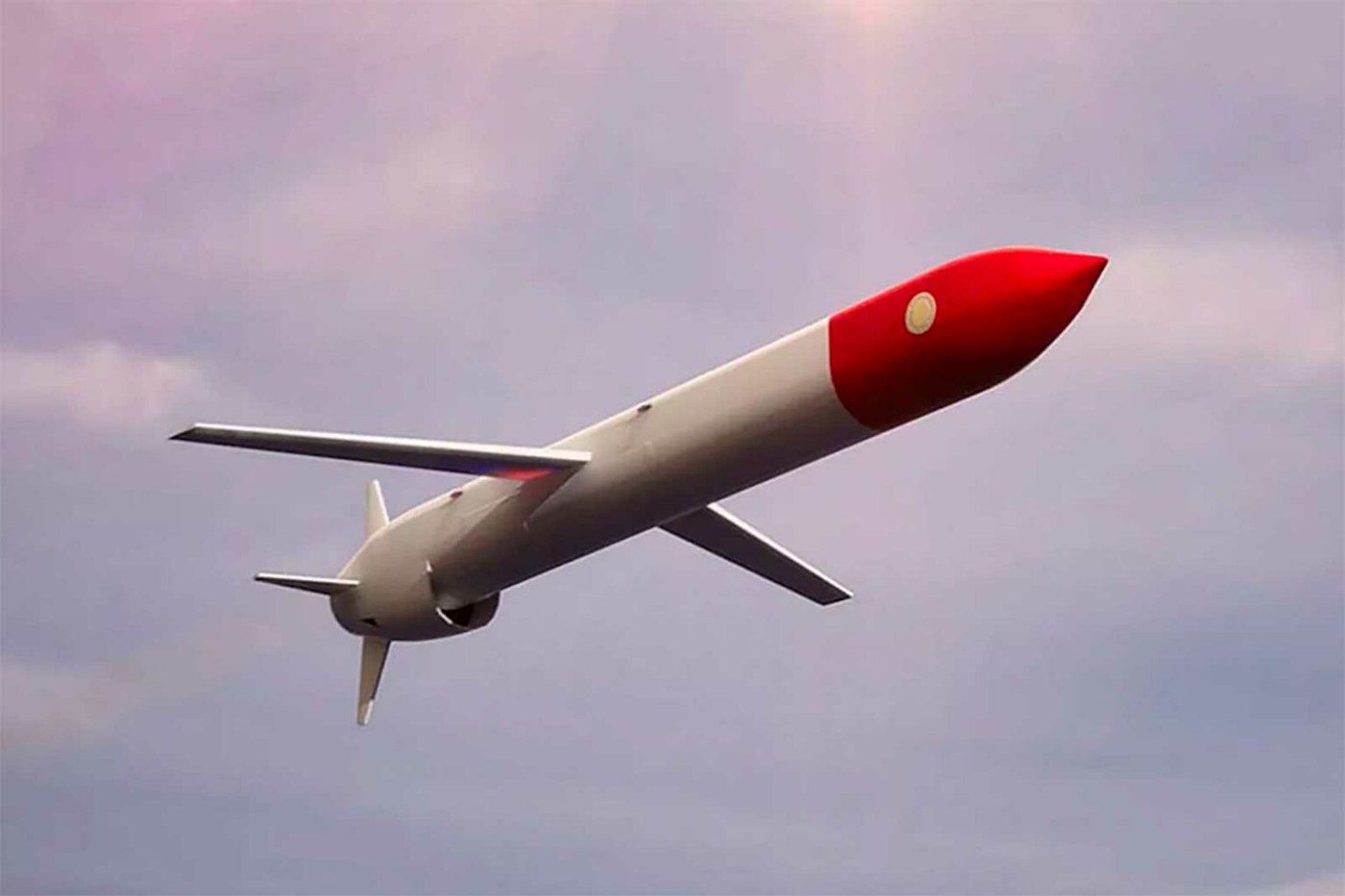
Official video shows an inclined canister launch with a detachable booster, visually in the same family as ground-launched cruise missiles. Russian specialist commentary has described a missile larger and heavier than Kh-101 — top-mounted wings, fuselage protrusions interpreted as reactor air-heating paths — heavy enough that Tu-160 / Tu-95 carriage is unlikely. That matches a ground-based strategic system, not an air-launched theatre weapon.
A nominal profile: booster launch → climb → reactor start → booster discard → long subsonic cruise at low-to-medium altitude with terrain following or sea-skimming legs → terminal manoeuvres into the target. Guidance would combine INS, satellite updates when available (GLONASS), and terrain matching (TERCOM-class techniques). Endurance is limited not by fission fuel but by lubricating oils, bearing wear, electronics, and structural fatigue — as Étienne Marcuz and others noted after the 2025 test.
THE OCTOBER 2025 TEST IN DETAIL
Gerasimov: launch on 21 October 2025; 14,000 km; about 15 hours; vertical and horizontal manoeuvres as planned; range and time "not the limit." Average speed ≈ 933 km/h ≈ Mach 0.75 at typical cold-air cruise altitudes — squarely subsonic. Norwegian Intelligence Service confirmed a Novaya Zemlya launch; DSA/radiation networks reported no spike. No public Russian video of the full flight was released. Putin tasked the military with defining employment modes and building infrastructure. Arms Control Association and others treated this as the first announced long-range nuclear-powered cruise flight. Whether the reactor operated in full direct-cycle mode for the entire 15 hours, and where the missile was destroyed or recovered, were not stated.
BASING
Decker Eveleth and Jeffrey Lewis identified construction near Vologda-20 (southwest of Chebsara, ~475 km north of Moscow) as a probable Burevestnik launch site adjacent to nuclear warhead storage — exactly the kind of fixed strategic cruise-missile base the system implies. Pan'kovo remains the Arctic test end. Fixed basing means the launchers are targetable; the missile's value is in being gone before enemy warheads arrive, or in launching under ambiguous crisis conditions.
COMPARED WITH KH-101 AND PROJECT PLUTO
Kh-101 is a mature air-launched cruise missile with a turbofan, conventional or nuclear (Kh-102) warhead, and range in the thousands of kilometres — but finite fuel. Burevestnik trades cleanliness, maturity and air-launch flexibility for endurance. Pluto/SLAM was a supersonic low-altitude nuclear ramjet the size of a small aircraft; Burevestnik is a missile-scale subsonic turbojet-class design. Same family idea; different engineering point.
ARMS CONTROL
Burevestnik was never cleanly captured by New START, which counted ballistic missiles and heavy bombers, not ground-launched nuclear cruise missiles of this type (GLCM issues belonged to the vanished INF Treaty world). New START expired 5 February 2026. Deployment of Burevestnik would sit outside residual voluntary numerical caps focused on the old triad categories.
LIMITS AND CRITICISMS
Subsonic cruise missiles are shootable by modern SAMs and fighters if detected (see S-400, Tor, Pantsir, Patriot). Radioactive exhaust aids some forms of detection. Accidents contaminate the owner's territory. Cost and specialised personnel are enormous for a niche second-strike / signalling weapon when Yars and SLBMs already provide assured retaliation. Russian commentary (e.g. Dmitry Stefanovich, Nov 2025) itself notes that employment concepts and classification inside the force structure were still being worked out after the October test — a polite way of saying "we built it, now what exactly do we do with it?"
STATUS AND OUTLOOK (OCTOBER 2026)
Moscow presents Burevestnik as having finished its decisive flight test in October 2025 and moved into the deployment-preparation phase. Independent observers can confirm a Novaya Zemlya launch event and a long Russian claim; they cannot confirm combat duty, warhead integration status, or routine reliability. August 2026 activity at Rogachyovo suggested further testing. Earlier Russian press had mentioned adoption "no sooner than 2027." Treat operational status as claimed-not-confirmed. Plans mentioned at award ceremonies for future supersonic or hypersonic nuclear-powered cruise missiles are aspirations, not programmes with public flight records.
PROJECT PLUTO: THE AMERICAN ANCESTOR
Project Pluto (1957–1964) built the Tory-IIA and Tory-IIC nuclear ramjet engines at Lawrence Radiation Laboratory and tested them at Jackass Flats, Nevada. Tory-IIC produced on the order of 500 MW thermal and roughly 155 kN of thrust in ground test — an entirely different scale from Burevestnik's few-megawatt cruise class. SLAM, the missile Pluto would have powered, was to fly at Mach ~3 at low altitude, spraying a radioactive wake across continents, then loiter and deliver multiple warheads. It was cancelled because ICBMs became accurate enough, because the wake was politically insane, and because testing over land was unacceptable. Every serious Burevestnik discussion is, in part, a discussion of why Russia revisited a concept the US abandoned.
DIRECT-CYCLE NEUTRONICS AND MATERIALS
A compact turbojet-cycle core must be small, hot and mechanically integrated with rotating machinery. High enriched uranium (or another dense fuel) is the usual assumption for volume-limited military reactors; Russia has not published the enrichment or fuel form. Cladding must resist oxidation in 1,200–1,600 K air — a brutal environment compared with water-cooled power reactors (VVER) or even graphite-channel designs (RBMK). Carbon-based or refractory alloy elements, coated fuel particles, or other high-temperature reactor ideas from space-nuclear and NTP research are the technology neighbourhood; which neighbourhood Burevestnik actually lives in is inferred, not shown.
Neutron leakage from a small core is high, which is why Hecla & Kemp's activation calculations produce curie-class gaseous activity per hour. Shielding mass to protect the warhead electronics and guidance sits in the nose or mid-body; every kilogram of shield is a kilogram not spent on structure or actuator authority. That mass budget is one reason indirect-cycle designs struggle to fit.
WHY RAMJET IS UNLIKELY AT THIS SIZE
A ramjet needs ram pressure — forward speed — to compress air. Getting a nuclear ramjet up to speed requires a large booster and leaves a gap where the reactor is running but thrust is poor. A turbojet's compressor provides pressure ratio from a standing start (after booster assist to flight speed). Imagery-based size estimates of Burevestnik match a subsonic cruise missile, not a Pluto-scale supersonic low-altitude missile. Hence the MIT conclusion: nuclear turbojet, not nuclear ramjet. Popular articles that say "nuclear ramjet" about Burevestnik are usually echoing Pluto language rather than doing the cycle arithmetic.
DETECTABILITY: RADAR, IR, ACOUSTIC AND RADIOLOGICAL
A subsonic cruise missile is visible to low-altitude radars and AEW aircraft when geometry allows — the same fight Kh-101 already fights. Infrared search tracks a hot nozzle and airframe. The radioactive plume is a niche signature: useful for confirming a test after the fact, less useful for real-time fire control. Kristensen's critique stands: long flight gives defenders time. The Russian answer stands too: time does not help if you cannot find a sea-skimming object in the Pacific until it is hours from your coast. Both statements can be true.
EMPLOYMENT PUZZLES
After October 2025, Putin explicitly said employment modes still needed work. Options discussed in Russian and Western commentary include: one-way strategic strike on a circuitous path; launch-to-loiter as a visible crisis signal; massed launches to swamp air defences; and peacetime patrol concepts that sound more like propaganda than operations (radioactive cruise missiles circling the Arctic are not subtle). Integration with Kazbek and the rest of nuclear C3, physical security at Vologda-20, and crew training for a one-of-a-kind complex all take years after a successful flight test. "Tested" ≠ "ready."
ENVIRONMENTAL AND LEGAL NOTES
Peacetime testing of a direct-cycle nuclear engine skirts the spirit of norms against radiological contamination even when it does not violate a specific treaty clause. The Outer Space Treaty and various test-ban regimes were not written for this air-breathing case. New START's expiry removed even the weak pressure to trade transparency for limits. Domestically, Rosatom's involvement and the Nyonoksa deaths tie the programme to Russia's nuclear-weapons complex in the narrow sense, not only to the missile industry.
CYCLE ARITHMETIC IN PLAIN LANGUAGE
Thrust is roughly mass-flow times exhaust velocity increment. Heating air from compressor-exit temperature to 1,200–1,600 K with fission instead of jet fuel gives a specific thrust in the same family as a modest turbojet. Hecla & Kemp's ~3.45 kN cruise thrust is small by fighter-engine standards — about a third of a single small business-jet engine — but enough for a slender subsonic missile once drag is managed. Climb and hard turns need more power; that is why a chemical interburner shows up in their model as a plausible peak-power helper. None of this requires believing Russian brochure "unlimited" language; it only requires believing that a few megawatts thermal can push a cruise missile.
WHAT "15 HOURS" IMPLIES
A 15-hour flight at ~900 km/h is a European-Russia-to-distant-ocean class distance. It is also long enough for oils to heat-soak, for bearings to declare their quality, and for guidance error to accumulate if GNSS is denied. Gerasimov's line that range and time were "not the limit" asserts margin; it does not publish the failure modes that would appear at 30 or 50 hours. Marcuz's point about non-nuclear fluids remains the right engineering caveat.
TEST SITE GEOGRAPHY
Pan'kovo on Yuzhny Island (Novaya Zemlya) is the cold, remote flight-test end with the rail shelter signature Lewis identified. Nyonoksa near Severodvinsk is the White Sea naval test range tied to the 2019 accident. Kapustin Yar inland is the candidate for booster or non-nuclear-unit work. Rogachyovo airfield supports Il-976 SKIP telemetry and A-50U assets when a shot is imminent. Vologda-20 is the probable peacetime garrison/launch complex near warhead storage. Mapping those five names is most of the open-source geography of Burevestnik.
RELATIONSHIP TO THE REST OF THE 2018 SET
Avangard is fielded; Yars was already fielded; Sarmat is struggling into service; Poseidon has carriers and a claimed reactor-on test; Burevestnik has a claimed 15-hour flight and a base under construction. Together they are a portfolio of asymmetric answers to missile defence. Separately, only Yars (and to a lesser extent Avangard) clearly underwrite day-to-day deterrence numbers. Burevestnik's value is political-technical: proof that Russia can fly a nuclear air-breather, and a future complicating factor for air defence — purchased at the price of Nyonoksa and of a radioactive test programme.
BOOSTER, INTAKE AND EXHAUST GEOMETRY
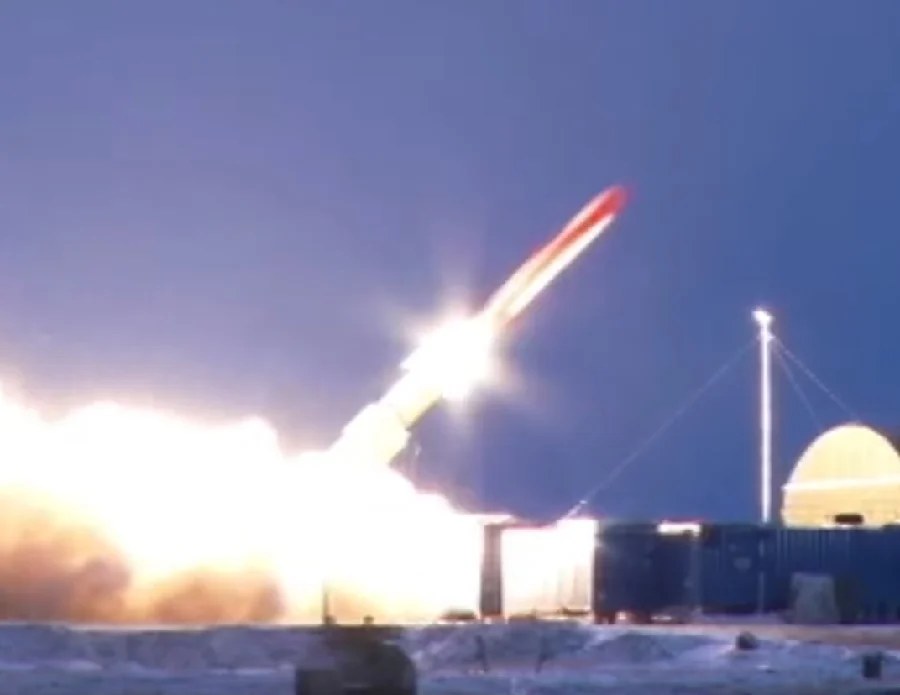
Ground video shows an inclined canister and a bright booster plume at ignition — consistent with a solid or liquid rocket booster that accelerates the missile to turbine-capable flight speed before the nuclear plant takes over. Fuselage protrusions interpreted by Russian specialist press as reactor-air heating paths are the visible hint of a direct-cycle layout: air must enter, pass near or through hot core structures, and exit aft. Top-mounted wings (per Ivanov's VPK commentary) would keep control surfaces out of a hot ventral exhaust. None of these open inferences replaces a cutaway drawing Russia has not published.
COMPARISON WITH KH-101 FLIGHT PROFILE
A Kh-101 launched from a Tu-160 or Tu-95 flies a programmed low-altitude path using INS/TERCOM/DSMAC-class updates over a fuel-limited range of a few thousand kilometres. Burevestnik aims to fly a similar aerodynamic envelope without the fuel limit, from a ground pad, with a reactor substituting for the turbofan combustor. Everything that makes Kh-101 vulnerable — fighters, AWACS, SAM belts, guns on the terminal approach — still applies to Burevestnik. What changes is the defender's uncertainty about when and from which direction the missile will appear, and the attacker's ability to hold the weapon airborne during a crisis. See also TERCOM for the terrain-matching techniques both would use.
HEALTH PHYSICS OF A CRASHED TEST ARTICLE
A seabed or bog recovery of a direct-cycle core after a failed flight is an isotopic nightmare: fission products, activated structures, and possibly damaged cladding. The 2019 Nyonoksa dead were Rosatom specialists, not ordinary missile technicians — a staffing signal that the power unit is nuclear-complex work. Isotopes reported in open coverage after Nyonoksa (including short-lived species consistent with a recent criticality event) matched a reactor-related accident better than a pure chemical explosion. That is the human cost side of the "flying Chernobyl" critique.
MONITORING NETWORKS AND THE OCTOBER 2025 NON-DETECTION
Norway's non-detection of a radiation spike after the October 2025 flight does not prove a clean exhaust. A path mostly over open water, altitude, weather, and the dilution of noble-gas activations can drop concentrations below station thresholds even if Hecla & Kemp's TBq/MW-h figures are roughly right. Conversely, a future flight that crosses closer to dense sensor networks might light them up. Radiological monitoring is a partial, after-the-fact diagnostic — not a substitute for radar and IR tracking of the airframe itself.
WHAT WOULD CHANGE THE ASSESSMENT
A published cutaway; isotope ratios from a well-sampled flight; confirmation of Vologda-20 launchers on duty; and a second long flight with Western tracking overlays would all sharpen numbers. Until then this article treats the October 2025 14,000 km / 15 h claim as a serious official statement tied to a confirmed Novaya Zemlya launch event — and treats combat deployment as not yet independently verified.
INTAKE AIR, COMPRESSOR SURGE AND REACTOR TRANSIENTS
Any turbojet must avoid compressor surge and stall. Adding a nuclear heat source with its own thermal inertia makes throttle transients harder: the core temperature cannot leap as fast as a chemical combustor. Reactor start after booster ignition is therefore a carefully scripted hand-off — matching Putin's emphasis on "minutes or seconds" start as a boast. Climb power above 15 MWth in the MIT model may need chemical augmentation precisely because the core cannot be overdriven arbitrarily without melting fuel.
GROUND INFRASTRUCTURE BEYOND THE PAD
A nuclear cruise-missile base needs warhead storage, reactor/missile mates, security, environmental monitoring, and accident-response teams that ordinary Kh-101 garrisons do not. Vologda-20's proximity to a nuclear weapons storage site in Eveleth/Lewis analysis is not a coincidence; it is the logistics logic of a nuclear-armed, nuclear-powered missile. Deployment delays after a successful flight test often live in this infrastructure layer, not in the airframe.
INFORMATION WARFARE AROUND THE TESTS
Burevestnik announcements arrive timed with other strategic theatre — exercises, Poseidon claims, arms-control deadlines. Separating engineering progress from signalling is part of reading the programme. The October 2025 briefing was real enough for Norway to confirm a launch; the employment-concept caveat in the same political session was also real. Both belong in the record.
WHAT THE PHOTOS ON THIS PAGE SHOW
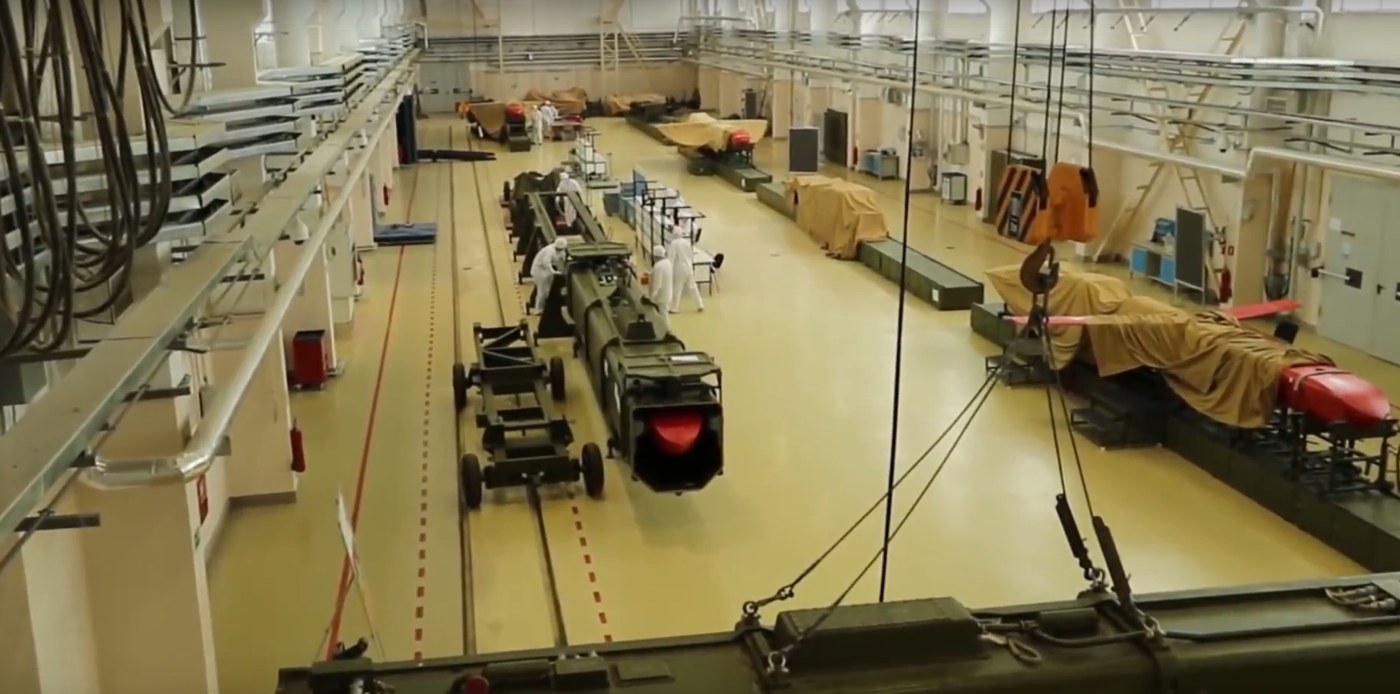
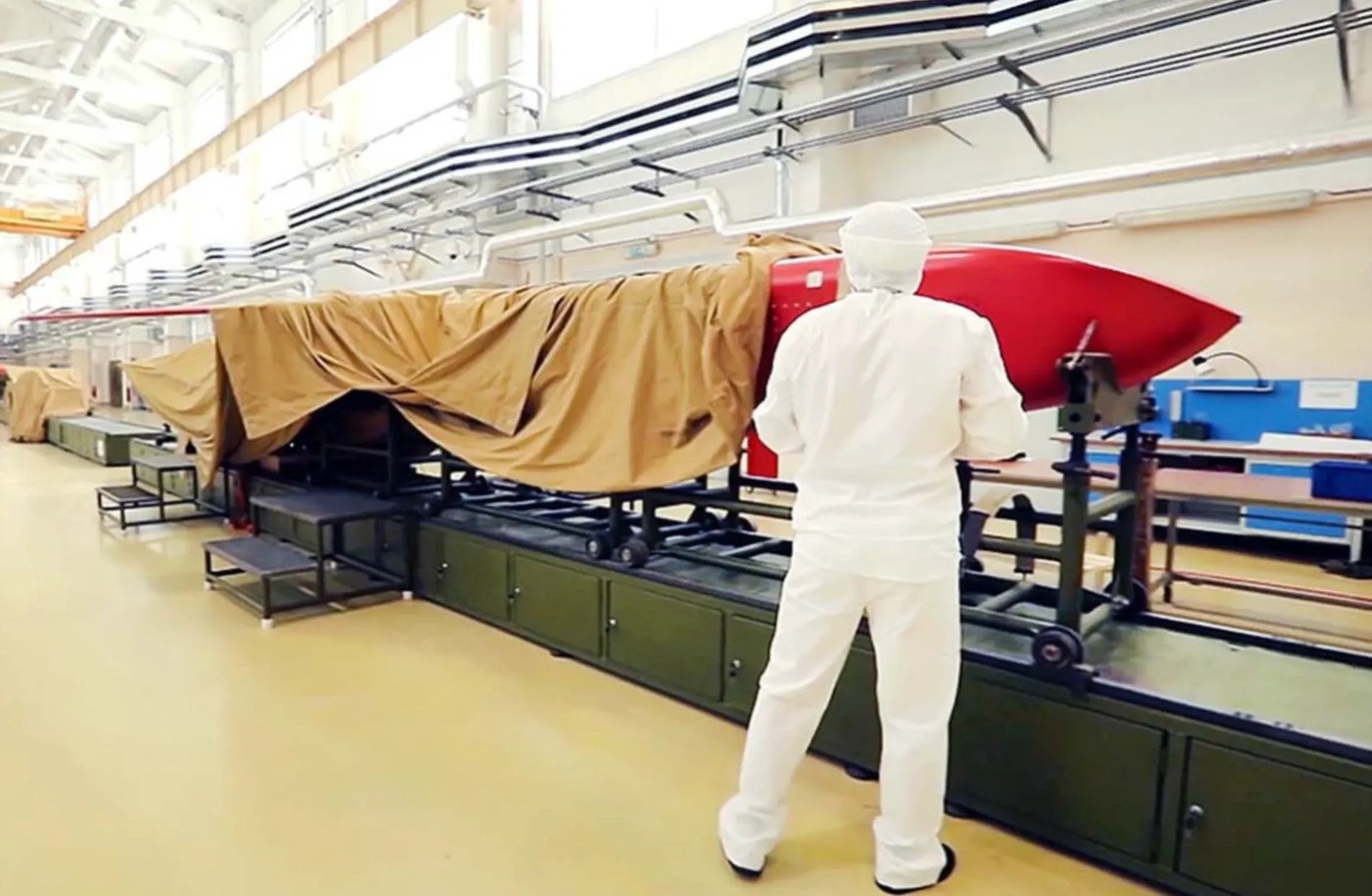
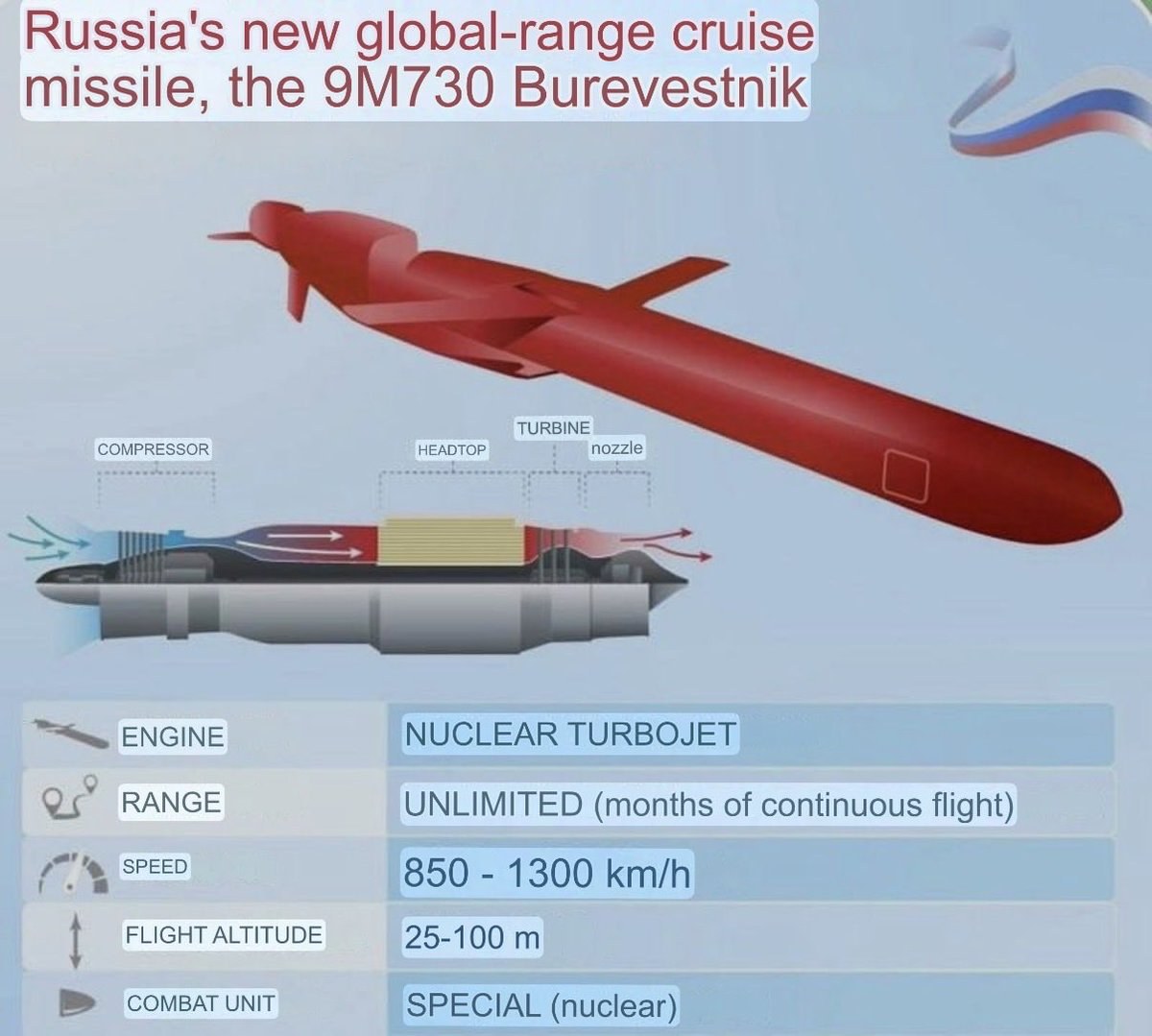
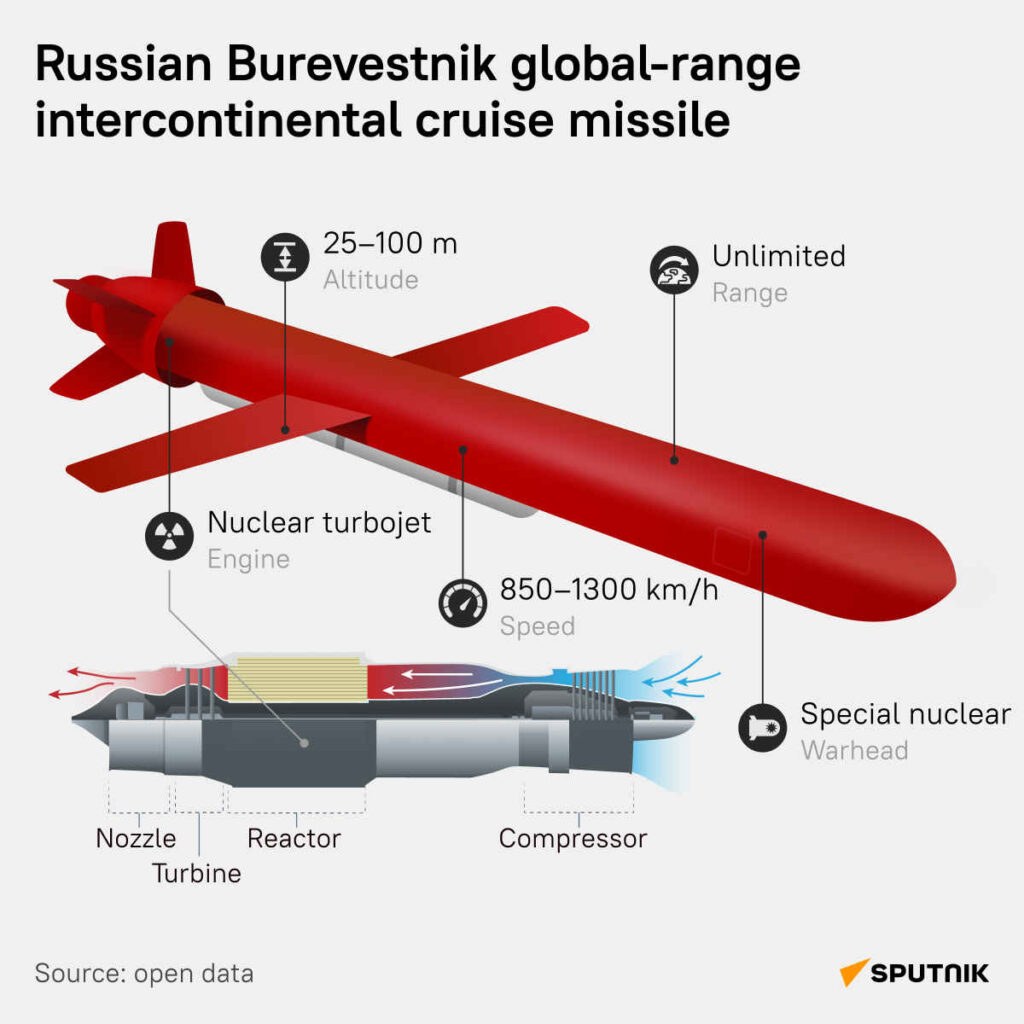
The six images on this page, in order: (1) a white airframe with a red nose cone in flight against a cloudy sky, which may be a render or a video frame and is not a verified test photograph; (2) a dusk ground launch with a bright exhaust flame, a dome and containers on snowy ground, whose date and location are not stated and are not confirmed here; (3) a wide factory hall with workers in white suits and missile sections under tarpaulins; (4) a worker beside a tarpaulin-covered missile with a red nose section; (5) a media infographic titled "Russia's new global-range cruise missile 9M730 Burevestnik"; and (6) a Sputnik infographic. Both infographics show a "nuclear turbojet" cutaway with a compressor, a reactor block, a turbine and a nozzle, and quote a speed of 850 to 1,300 km/h, an altitude of 25 to 100 m and unlimited range. These are unofficial media depictions, not Russian engineering drawings. Their turbine-and-compressor layout conflicts with the direct-cycle reactor view discussed in this article, in which air passes through the reactor core itself and no turbine is needed to drive a compressor. The infographics' figures are press numbers and are not confirmed by any official specification. The factory frames come from video of unconfirmed location and date, and none of the images verifies the reactor, the warhead or the deployment status.
SUBSONIC PENETRATION TACTICS
Low altitude, terrain masking, night, weather, and circuitous routing are the classic cruise-missile penetration toolkit. Unlimited endurance adds the ability to wait for a gap in AEW coverage or to approach from an ocean sector with thinner SAM belts. Massed launches could combine chemical Kh-101/Kh-102 streams with a few Burevestnik oddities to force defenders to honour every track as potentially nuclear and long-endurance. That is an air-defence planner's headache even if each individual subsonic missile remains shootable — see S-400, S-500, Tor, Pantsir and Patriot.
INDUSTRIAL SPECIALISTS AND HUMAN CAPITAL
Nyonoksa killed five specialists who cannot be replaced from a general labour pool. Compact nuclear air-breathing propulsion sits at the intersection of Sarov's weapons-physics culture and Novator's cruise-missile culture. Stefanovich's November 2025 essay noted the astronomical human-capital cost of Burevestnik and Poseidon even aside from rubles. That cost is part of why some Western analysts shrug: every engineer on Skyfall is an engineer not fixing another problem. It is also why a successful 15-hour flight was politically important — to justify the programme after years of failure jokes.
LEGAL STATUS AFTER INF AND NEW START
The INF Treaty, while it lasted, banned ground-launched missiles of 500–5,500 km range (nuclear or conventional). Burevestnik's endurance puts it far outside that band; INF's collapse in 2019 already removed that constraint. New START never fitted nuclear-powered GLCMs cleanly. The February 2026 expiry of New START therefore changes little for Burevestnik specifically, while changing a lot for Yars/Sarmat accounting. Future talks that ignore nuclear cruise and nuclear UUVs will leave the 2018 portfolio untouched.
CIVILIAN SPIN-OFF RHETORIC
Russian commentary sometimes floats civilian uses for compact reactors — Arctic drones, space, underwater exploration. That rhetoric should be separated from the weapon. A direct-cycle dirty exhaust is a terrible civilian product; an indirect-cycle clean derivative would be a different machine. Treat spin-off talk as political seasoning unless a clean civilian design appears.
READING GERASIMOV'S BRIEFING LANGUAGE
Military briefings to Putin are performative documents. "All prescribed manoeuvres" and "not the limit" are success phrases. Absence of crash/recovery language is not proof of a soft landing. Absence of radiation commentary is not proof of a clean exhaust. The useful extractable facts are: date (21 Oct 2025), distance (14,000 km), time (~15 h), launch region (Novaya Zemlya, per Norway), and the political follow-on (prepare infrastructure, define employment). Everything else is colour.
ALTITUDE, MACH AND DEFENCE ENGAGEMENT WINDOWS
At ~Mach 0.75 and low altitude, engagement timelines for a SAM battery that sees the missile at 30–40 km are measured in minutes — longer than a ballistic terminal dive, shorter than a bomber raid. Fighters with IRST and radar can chase. The defence problem is cueing and coverage, not raw kinematics. Burevestnik's trick is to make cueing hard by choosing path and timing; it does not outrun a 48N6 or PAC-3 once locked. Russian claims of "invulnerability" should be read as "hard to find in time," not "impossible to shoot."
Golden Dome / homeland cruise-missile defence debates in the US are the political mirror of this engineering fact. Every public Burevestnik success becomes an argument in someone else's budget hearing for more low-altitude sensors and interceptors — exactly as Stefanovich noted from the Russian side in November 2025.
TEST RECORD SCORECARD (OPEN SOURCE)
Pre-2020: multiple failures, including the 2017 Barents crash and the 2019 Nyonoksa disaster; NTI (2024) summarised at least thirteen tests with two partial successes in the early period. 2023: Putin success claim without independent flight data. 2025: long flight claim with Norwegian launch confirmation. 2026: possible further Novaya Zemlya prep in August OSINT. Scorecard trend: from farce toward a working prototype — still short of a silently fielded force.
WHAT IS UNCERTAIN IN THIS ARTICLE
TIMELINE
RUSSIAN TERMS USED IN THIS ARTICLE
IN ONE SENTENCE
The 9M730 Burevestnik (SSC-X-9 Skyfall) is Russia's developmental nuclear-powered subsonic cruise missile — a direct-cycle reactor-heated air-breather in the best open models, heir to the cancelled US Pluto concept — which Moscow says flew 14,000 km in 15 hours on 21 October 2025 from Novaya Zemlya after a history that includes the deadly 2019 Nyonoksa accident, and which as of October 2026 is in claimed deployment preparation without independent confirmation of combat duty.