WHAT IT IS
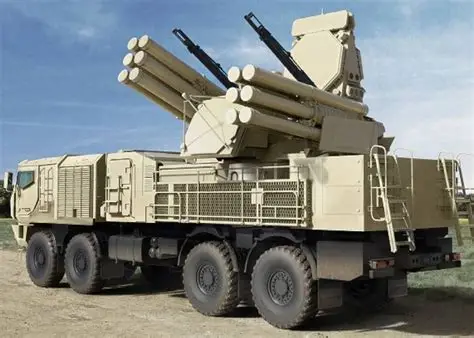
Pantsir (Панцирь, “carapace”) is a Russian combined gun-and-missile short-range air-defence system from KBP in Tula — the same bureau that built Tunguska and the naval Kortik/Kashtan. GRAU index of the baseline family is 96K6. NATO reporting name is SA-22 Greyhound.
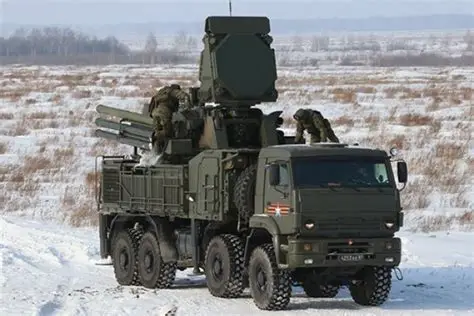
One combat vehicle carries twelve ready 57E6-family missiles in two packs of six and two 30 mm 2A38M twin-barrel cannon. Search radar, tracking radar, and an electro-optical channel sit on the same turret. The job is point defence of a battery, airfield, headquarters, industrial site, or (in the naval mark) a ship: cruise missiles, aircraft, helicopters, PGMs, and later cheap drones. It is the layer under S-300/S-400, not a replacement for them.
Crew is three. A battery is several combat vehicles plus a battery command post and transloader trucks (one transloader per two combat vehicles in KBP diagrams). Vehicles can shoot on the move. Reaction time in maker tables is 4–6 seconds.
LINEAGE
Tunguska (2K22 / SA-19 Grison) was the 1980s tracked hybrid: 9M311 missiles and 30 mm guns for the army’s forward area. Pantsir is the post-1990 attempt to do that job with more missiles, a longer rocket, better radar, and usually a wheeled truck so the system can road-march at 80–90 km/h instead of living at tank speed.
Development starts about 1990. First prototype shown MAKS-1995 on a trailer/early chassis with an enlarged Tunguska-style missile then called 9M335. Money collapsed with the USSR; the UAE order in the late 1990s kept the project alive through redesign. Serial Pantsir-S1 production is dated from 2008. Russian Ground Forces / Aerospace Forces adoption of S1 is November 2012. S2 is cited in service from 2015. Naval Pantsir-M from about 2018–19. SM and S1M are the Syria-and-after generation.
Export unit prices published in open reporting have sat around $13–15 million per vehicle. Built numbers are “200+” in encyclopedia tallies — order of magnitude, not a precise inventory.
THE MISSILE
Export workhorse is 57E6 / 57E6-E. Domestic series use 95Ya6-family indexes in some lists. Two-stage bicaliber solid rocket: booster about 170 mm, sustainer about 90 mm. Length in canister ~3.2–3.3 m. Launch mass ~76 kg, ~95 kg in tube. Continuous-rod / “curtain” warhead ~20 kg. Radio-command guidance with IR and radio direction-finding of the missile. Boost to about 1,300 m/s in roughly two seconds; average speed on an 18 km shot around 700 m/s in one official table.
S1 envelope in KBP figures: missiles 1.2–20 km range, 5 m–10 or 15 km altitude depending on table. Guns 0.2–4 km range, 0–3 km altitude. Target speed up to 1,000 m/s. Single-missile kill probability in brochures 0.7–0.9 by target type.
S1M / later export missile 57E6M-E: peak ~1,700 m/s, ~25 kg kinetic/curtain warhead, engagement stretched toward 18–30 km in Rosoboronexport sheets. SM’s long missile is advertised to 40 km with detection to 75 km. A small anti-drone missile (TKB-1055 in some SM write-ups) is the cheap-round answer to mass UAV raids so the big 57E6 is not wasted on a $20,000 airframe.
Naval Pantsir-M can also be described with Hermes-K in some English pages as a possible extra missile; treat that as optional/unsettled in open sources. The staple naval round remains the 57E6 family.
THE GUNS
Land S1: two 2A38M 30 mm twin-barrel water-cooled guns inherited from Tunguska-M1. About 2,500 rds/min per gun, ~5,000 combined. Muzzle velocity ~960 m/s. Ready load up to 1,400 rounds. HE-Frag, Frag-T, AP-T selected by the crew. This is the inner belt when a missile is already inside ~1 km or a drone is too cheap for a 57E6.
Early 1995-era prototype used slower 2A72 guns. Production S1 standardized on 2A38M.
Naval Pantsir-M does not keep the 2A38M pair. It uses two six-barrel AO-18KD / GSh-6-30K cannon — the Kashtan-M guns — at about 10,000 rds/min combined. That is the shipboard answer to a sea-skimmer or kamikaze boat already inside the missile’s minimum range.
SENSORS AND FIRE CONTROL
S1: two-band 3D search radar plus a dual-band engagement radar (the conical “helmet” 1RS2 / 1RS2-E Shlem family is the famous tracking set) and an optical/IR channel for passive work and missile gathering. Search tables: aircraft with 2 m² RCS at 32–36 km; 20 tracks; 360° azimuth; 2–4 s scan. Engagement channels: two targets on early S1, four on later radars. Salvo of two missiles at one target is supported in radar mode.
S1M / S2 generation: L-band search (RLM-SOC / SOTS type) tracking ~40 targets; EHF/K-band phased-array fire-control engaging four at once. Search reach in S1M export sheets up to 180 km for the detection station in one FSVTS row — that is the radar’s look, not the missile’s kill range.
SM: multifunctional targeting station; detect ~75 km, engage ~40 km. The point of the new radars after Syria was small, slow, low RCS targets that the first S1 search set was not built around.
IFF appears from the production S1 onward. Early 1994 test articles did not have it.
CHASSIS
Common production picture is an 8×8 truck: Kamaz-6560 or later Kamaz-53958 with an armoured cab on SM. Combat mass up to ~20–30 t by chassis. Four hydraulic jacks level the truck to shoot. Tracked experimental and Arctic fits exist: DT-30PM two-section carrier for Pantsir-SA (arctic camouflage, no or reduced gun fit in some photos because of weight/cold). A tracked SM-SV for Ground Forces and VDV completed tests in 2024 according to Russian statements. Wheeled remains the mass version because road speed and cost beat Tunguska’s off-road tank hull.
VARIANTS
Pantsir-S — 1990s prototypes.
Pantsir-S1-O / S1E — optical-heavy early export path; some mounts with 2A72 and eight missiles.
Pantsir-S1 — production standard, 12×57E6-E, 2×2A38M, dual-band tracking radar. 2008 production, 2012 Russian service.
Pantsir-S2 — new search radar, improved tracking, Russian service from 2015; also exported (Algeria cited).
Pantsir-S1M — 2019 unveiling; Syria lessons; 57E6M-E; 40-track search; four-channel EHF radar. Export contract talk from 2021.
Pantsir-SM — 40 km missile / 75 km detect; Kamaz armoured cab; small anti-drone missiles in the mix; intended S1 upgrade path.
Pantsir-SA — Arctic DT-30PM.
Pantsir-SM-SV — tracked maneuver version, tests completed 2024.
Pantsir-M / ME — naval. Two AO-18KD Gatlings, eight ready missiles plus ~32 in a below-deck magazine, separate extra radar on some fits, four simultaneous targets, 20 km / 15 km envelope, 3–5 s reaction, battery of up to four modules. Meant to replace Kortik/Kashtan on new and refitted large combatants (Karakurt-class Project 22800 among the first public hosts; Admiral Nakhimov cited in later reporting).
Special cheap-drone packs and roof-mounted city-defence batteries (Moscow high-rises in wartime reporting) are employment modes, not separate GRAU indexes.
HOW IT FIGHTS ON PAPER
Search radar finds. Tracking radar or optics locks. One to four targets get missiles; a two-round salvo is the high-assurance shot. If the target is inside the gun belt or the magazine is husbanding 57E6s, the 30 mm pair fires. A battery shares tracks so six vehicles are not all staring at the same cruise missile. That is the brochure war.
Combat use in Syria and then in Ukraine showed the system can kill aircraft and many missiles and also that cheap, slow, low drones and saturation raids eat magazines and expose a standing truck. That is why SM adds a small missile and better search, and why city Pantsirs get extra visual lookouts and nets in open reporting. Brochure Pk and real raid geometry are different sentences.
OPERATORS (OPEN LISTS)
Russia is the home user (VKS point defence, army, Arctic units, navy M-modules). Export customers named across public sources include the UAE (launch customer that saved the program), Syria, Algeria, and others in the Middle East, Africa, and Asia. Exact current fleets move with deliveries and losses; do not treat any magazine number as a census.
RELATED SYSTEMS — DO NOT MIX
Tunguska: tracked father, shorter 9M311 missile.
Kortik/Kashtan: naval uncle — same bureau idea, 9M311 + two Gatlings, shorter missile than Pantsir-M.
Palash/Palma: lighter naval hybrid with Sosna-R, not a Pantsir.
Tor, Buk, S-350: different layers. Pantsir is the inner gun-missile shell around an object those systems are too expensive or too slow to guard alone.
STATUS
In production and in combat service. S1 remains the numerous mark. S2/S1M/SM are the radar-and-missile growth path. Pantsir-M is the navy’s Kortik replacement on new small missile ships and selected large refits. The system’s reputation is split: technically a serious point-defence hybrid; politically famous because cameras catch both intercepts and burning trucks. Both halves are part of the public record.
IN ONE SENTENCE
Pantsir is Tula’s post-Tunguska carapace: a truck (or ship turret) with twelve command-guided 57E6 missiles and a pair of 30 mm guns whose job is to stand under the big SAMs and kill whatever comes in low, fast, or cheap — and whose later marks exist because the first war it fought was full of cheap drones.