Mark 38 GFCS (USN fast battleships)
WHAT IT IS
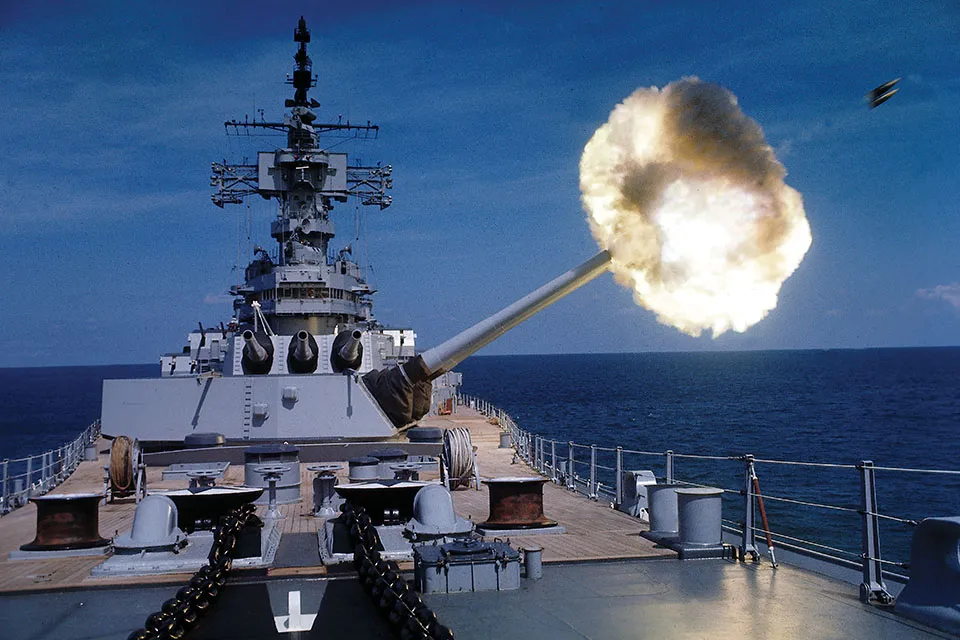
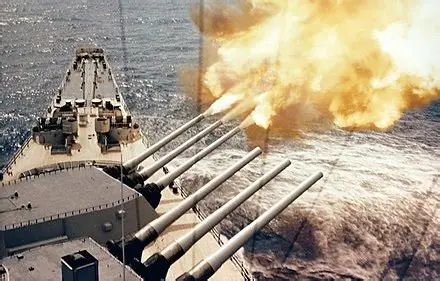
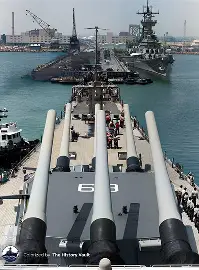
The U.S. fast-battleship main battery is nine 16-inch (406 mm) bag guns in three centerline three-gun turrets — two forward, one aft. North Carolina (BB-55, 56) and South Dakota (BB-57–60) fire the 16"/45 Mark 6. Iowa (BB-61–64, and the unfinished Illinois / Kentucky hulls) fire the longer 16"/50 Mark 7. Same projectile family. Different tube, different turret height, different hoist stack.
“Three-gun,” not “triple.” Each barrel has its own slide, elevating gear, powder hoist and projectile hoist. The three guns in a house can load and fire on independent cycles. They are not one cradle.
The gun is only the last two seconds of a vertical factory that starts in magazines below the waterline. Powder and projectiles never share a trunk. That separation, and the flame-tight scuttles between magazine and handling room, is the lesson of Hood, Invincible, and every magazine fire the Bureau of Ordnance studied.
THE TWO GUNS
16"/45 Mark 6 — designed 1936, at sea 1941. Lightweight successor to the Colorado Mark 5, built to throw the new 2,700 lb Mark 8 AP instead of the 2,240 lb Mark 5 the Colorados were limited to. Bore 16.00 in, 45 calibers (~60 ft tube). Full-charge muzzle velocity with Mark 8 AP about 2,300 fps (701 m/s). Maximum range with that shell about 36,900 yd (33,740 m) at 45°. Design firing cycle ~30 seconds. Loading angle +5°. Elevation +45° / −2° on Turrets I and III; Turret II (superfiring) 0° to +45°. Train ±150°, 4°/s. Elevation 12°/s. Recoil ~48 in. Turret mass on NavWeaps: about 1,403–1,437 long tons.
16"/50 Mark 7 — Iowa. Five calibers more tube (~67.5 ft bore length class). Same 2,700 lb Mark 8 AP at about 2,500 fps (762 m/s) on the short tables; published service figures also list ~2,425 fps / ~40,185 yd for Mark 8 and ~2,690 fps / ~41,622 yd for the lighter 1,900 lb HC. Extreme range tables run past 42,000 yd. Recoiling mass of the gun cited ~292,000 lb. Same +5° load, +45° elevation, three-gun house. Hoist stack is taller: five projectile-hoist stages versus four on the 45-caliber turret.
Why the heavy, slow shell: deck armor at expected battle range. A 2,700 lb AP with a hard cap and ballistic cap hits steeper and heavier than a 2,240 lb high-velocity shot of the same bore. Barrel wear is kinder than a light shell at 2,600+ fps. Colorados could not swallow the Mark 8; their hoists and rammers were sized for the shorter, lighter Mark 5.
SHIPS AND LAYOUT
North Carolina class: North Carolina, Washington. Three Mk 6 turrets. Treaty displacement. Turret II superfires I.
South Dakota class: South Dakota, Indiana, Massachusetts, Alabama. Same nine Mk 6 guns in a shorter, tighter citadel. Armor scheme and machinery spaces change; the gun and the turret internals stay the Mark 6 plant. Museum Massachusetts is the walk-through for this turret.
Iowa class: Iowa, New Jersey, Missouri, Wisconsin. Nine Mk 7 guns. Longer hull, more speed, taller barbettes. Same three-turret plan. 1980s reactivation fired the same tubes with later powder lots and, for a time, the option of the Mark 23 nuclear HC body.
Fire control for all three classes is the Mark 38 GFCS plant (director aloft, Ford Mk 8 rangekeeper in armored plot). The turret also carries its own rangefinder in the rear of the house as local and backup.
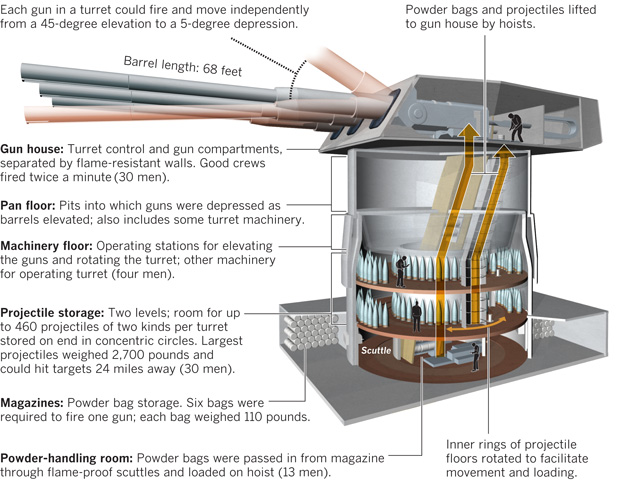
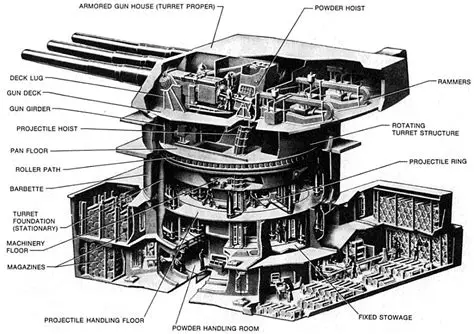
TURRET ANATOMY
From the weather deck down, a U.S. 16-inch three-gun mount is a rotating cylinder sitting on a roller path inside a fixed barbette.
Gunhouse (turret proper). Three slides, three Welin or interrupted-screw breeches opening downward, three chain rammers, three spanning trays / cradles, the turret officer’s booth, pointers, trainers, the optical rangefinder spanning the rear. Armor face, roof, and sides are the thickest steel in the rotating structure. Guns load only at +5°. After the breech is closed the slide drives back to the ordered elevation from plot.
Electric deck / machinery floor immediately under the pan. Training motor (Campbell: 300 hp on the Mk 6 turret), elevating pumps, hoist pumps. Iowa combines some of that hydraulic power: one 75 hp motor on the electric deck driving both cradle and hoist pumps, versus separate 10 hp cradle / 60 hp hoist motors quoted on the 45-caliber stack.
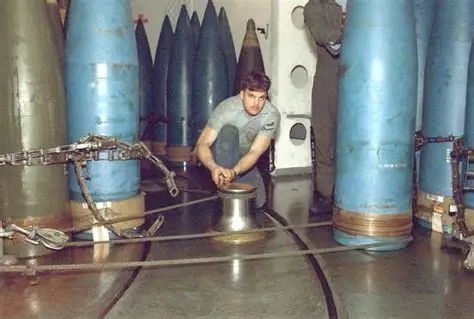
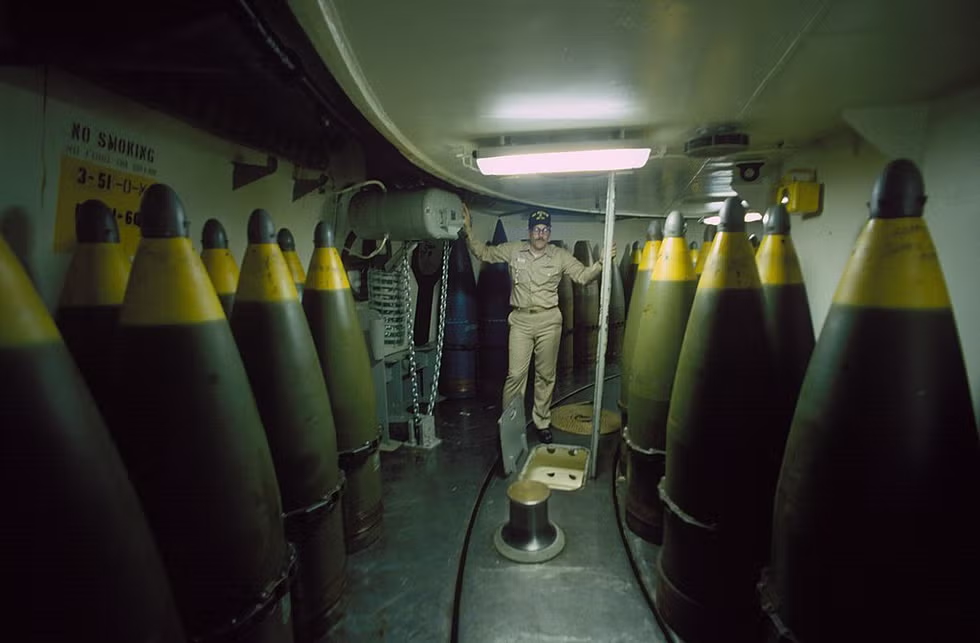
Projectile flats — two rotating rings plus fixed outer stowage inside the barbette. Shells stand vertical, base down, on the rings. Inner “live” rings turn with the turret so a projectile can be parbuckled to its own hoist without waiting for the house to point at a fixed door. Each live ring on the Mk 6 turret has a 40 hp drive.
Powder-handling room at the bottom of the rotating stalk. This is not a magazine. Magazines are fixed, around the handling room, isolated by flash-tight scuttles. On Iowa there is no British-style working chamber mid-barbette; NavWeaps notes the powder-handling room itself is the isolation volume, with a powder circle outside it forming a double wall between hoist and magazine.
Power on a Mk 6 turret (Campbell / Friedman line): 300 hp train; per gun 60 hp elevation, 60 hp rammer, 60 hp shell hoist, 75 hp powder hoist. RPC (remote power control) from the Mk 38 plant slews the house and the slides.
PROJECTILES
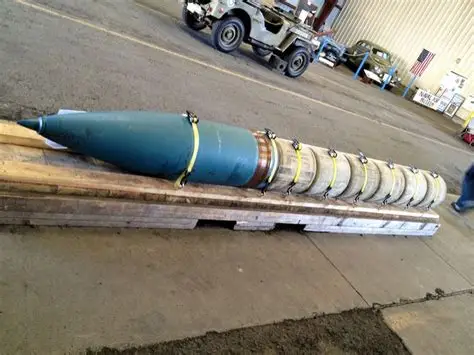
Mark 8 AP — 2,700 lb (1,225 kg), ~72 in long, 40.9 lb Explosive D burster, 0.033 s delay after a ~1.5 in armor threshold. The “super-heavy” ship-killer. Dye loads appear on later mods (1980s redesignations Mk 139).
Mark 13 / 14 HC — 1,900 lb (862 kg), ~64 in, 153.6 lb Explosive D. Shore bombardment and unarmored targets. Instant or 0.15 s delay fuzes.
Also in the family over the guns’ life: target and drill rounds; Mk 19 ICM cargo (submunitions, limited 1960s); Mark 23 nuclear (W23, ~15–20 kt) in an HC-sized 1,900 lb body, 1950s–60s, with inert Mk 24 target twin. Reduced charges exist to spare liners and to steepen fall for shore work.
Stowage (OP 755 for BB-55–60): Turret I 404, Turret II 525, Turret III 404, ship total 1,333 plus 9 drill per turret. Iowa figures commonly cited: Turret I 390, II 460, III 370, ship ~1,220 plus drills. Turret II holds more because the superfiring barbette has a third fixed level.
POWDER
Bag ammunition. SPD or later flashless lots: nitrocellulose grains ~2 in long × 1 in diameter, seven perforations, diphenylamine-stabilized. Grains sewn into silk bags. A full service charge is six bags. Individual bag weight is in the ~110 lb class; full charge on Iowa tables is ~650–660 lb. Bags travel shipboard in metal canisters (often three bags to a can, ~350 lb the can). Reduced charges use fewer bags or a lighter index.
Silk is not romance. It burns clean and does not leave a smoldering scrap in the chamber the way a cotton bag can. Magazines are air-conditioned, sprinklered, and treated as the one compartment that must not flash into the handling room.
SHELL FEED — STRIKEDOWN TO BREECH
Onload / strikedown. Projectiles arrive on deck horizontal. A carrier goes around the body; an electric drum hoist lowers them vertical through a trunk beside the barbette to the second platform. Overhead trolley, then a whip hoist up onto the projectile flat. Iowa: turret trains to a strikedown angle so a boom on the house lines up with the deck trunk. South Dakota / North Carolina: monorails can feed with the turret nearer centerline; museum Massachusetts still shows those trunks and the monorail.
On the flats. Shells live vertical on outer fixed rings and inner live rings. Crew parbuckle — roll with rope and capstan / power buckler — a selected AP or HC onto the live ring, then into the mouth of that gun’s hoist. Left and right hoists are curved; the center hoist is a straight tube. The U.S. did not use a British-style shell cage. The hoist is a hydraulic rack-and-pawl tube. Pawls catch the base; a long-stroke cylinder on the lower flat indexes the stack up one stage per cycle. Several projectiles can sit in the tube at once. That stack is the “ready” supply. There is no pile of loose shells in the gunhouse.
Mk 6 turret: four hoist stages. Mk 7 / Iowa: five, because the barbette is taller. At the gun, a hydraulic cylinder tips the projectile from vertical onto the spanning tray.
POWDER FEED
Cans come down separate trunks into the magazines that ring the handling room. In action, magazine crews pull bags from cans and pass them through flameproof powder scuttles — a rotating or sliding pocket that is never open both sides at once — into the handling room. Handling-room crew (training film count for Iowa: petty officer, three door operators, nine passers) stack six bags into the powder car. Doors shut. The car rides a cable hoist up a trunk that rotates with the turret. Double isolation: magazine → scuttle → handling room → hoist trunk → gunhouse door.
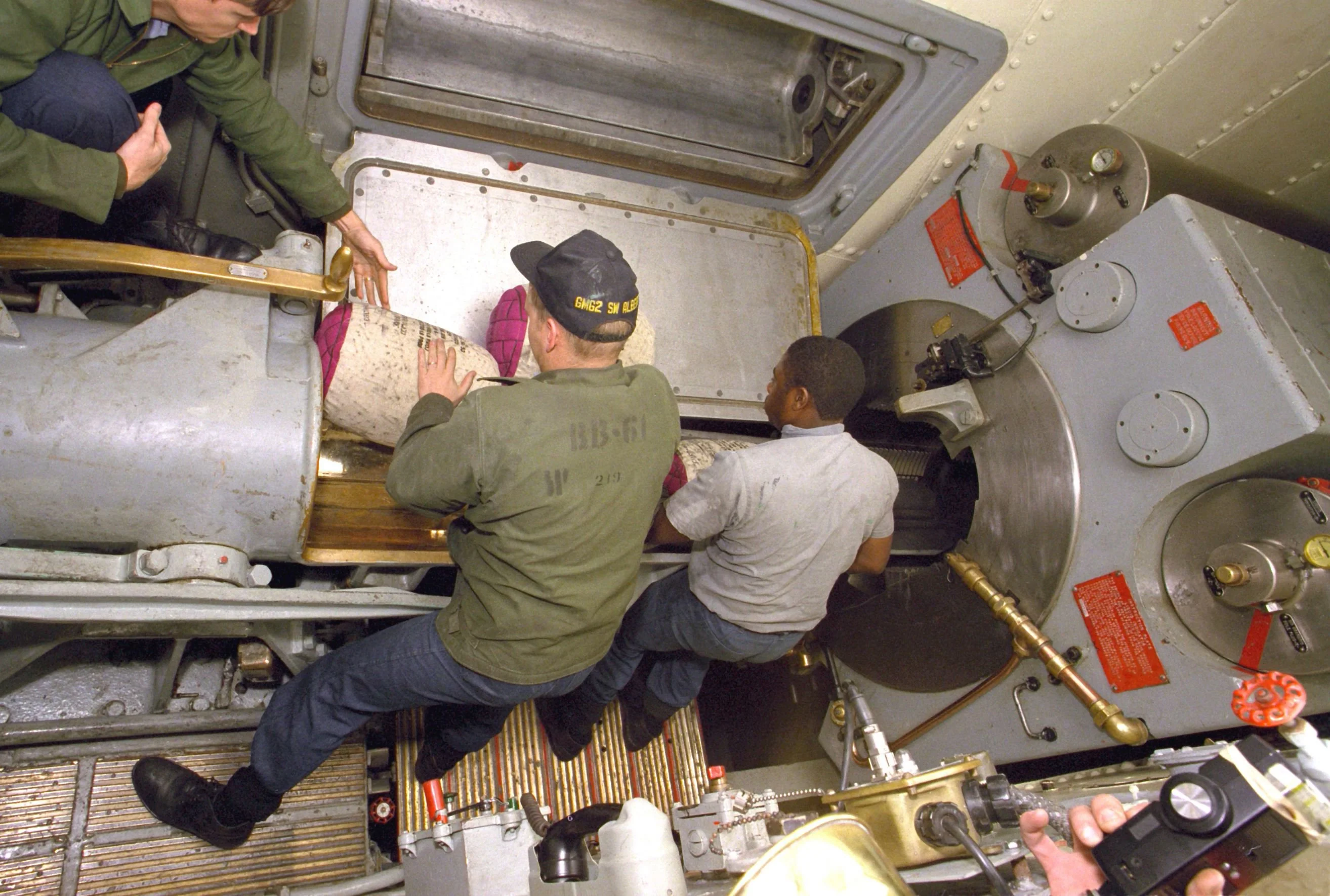
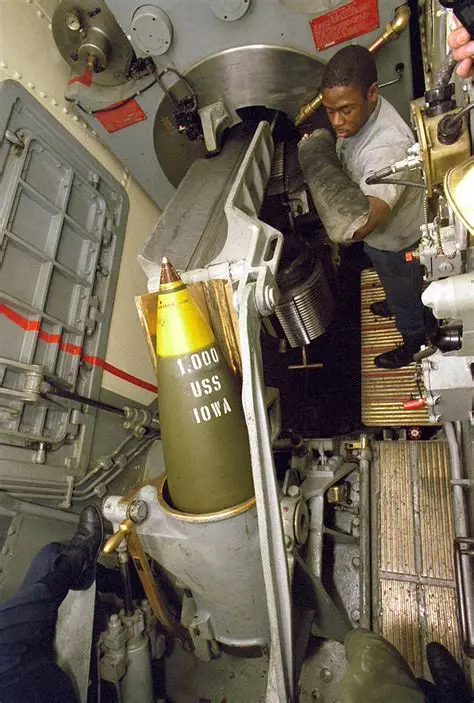
At the breech the powder-trunk door opens as a ramp. Three bags roll onto the tray; the car indexes; three more roll. Gun captain and cradle operator dress the pile. One slow ram sends all six in after the projectile. Two-ram practice exists in some descriptions; period film and Iowa museum procedure put six on the tray and ram once.
THE LOADING CYCLE
1. Gun returns to +5°. Breech opens down. 2. Cradle / spanning tray hydraulics into line with the bore. 3. Projectile arrives from the hoist, tips onto the tray, rammer drives it to the seating. Rammer retracts. 4. Powder door opens. Six bags onto the tray. Slow ram. Rammer retracts. 5. Cradle up. Gun captain “ready.” Breech closes. Primer in the lock. 6. Slide runs to the elevation order from the Mk 38 rangekeeper. Train already follows plot. 7. Firing circuit complete at the stable vertical keys in plot, or in local. Designed interval ~30 seconds per gun if the hoists stay full.
Salvo order on Iowa data sheets: left, right, then center, with 0.06 s delay on the later guns so the blast does not stack on one frame. Recoil at 15° elevation ~0.43 s; counter-recoil ~0.90 s.
WHAT CHANGES BETWEEN THE CLASSES
Tube length and MV (45-cal vs 50-cal). Barbette height and therefore hoist stages (4 vs 5). Iowa strikedown wants the turret trained to a trunk; SoDak / NC monorails are more forgiving on centerline. Iowa powder path is explicitly a no-working-chamber, double-wall handling room. Turret weights and face armor differ with the ship’s armor scheme — South Dakota’s short citadel is not Iowa’s long one — but the feed philosophy is the same: shells inside the rotating structure, powder outside it until the last scuttle.
No Mark 6 barbette was ever pierced in combat. Flash-tightness was therefore never proof-tested by a hit. That is a fact, not a boast.
CAVEATS
Muzzle velocities and maximum ranges shift with charge index, wear, and which table (Mark 8 AP vs Mark 13 HC vs reduced charge). 2,300 vs 2,500 fps is the usual Mk 6 / Mk 7 AP pairing; Iowa museum and range-table pages also print 2,425 fps for Mark 8 service. Stowage counts are OP 755 and later Iowa summaries, not a 1988 load plan. Powder bag weight 110 lb × 6 ≈ 660 lb is the working figure; some sheets say 650.
STATUS
All ten completed ships are museums or memorials. Tubes remain in the houses. Live powder is gone. The cycle can still be walked: strikedown hatch, flats, scuttles, powder car, +5° ram.
IN ONE SENTENCE
North Carolina and South Dakota fight with nine 16"/45 Mark 6 guns, Iowa with nine 16"/50 Mark 7, all in three-gun turrets that store shells on live rings inside the barbette, pass silk powder bags through flash scuttles into a cable car, and ram a 2,700 lb Mark 8 AP plus six bags at +5° on a thirty-second cycle slaved to the Mark 38 GFCS.