WHAT IT IS
Rassvet (Рассвет, “Dawn”) is a Russian low-Earth-orbit broadband constellation built by Bureau 1440 (Бюро 1440), part of ICS Holding (ИКС Холдинг, also written X Holding). The pitch is the Starlink pitch: a lot of small satellites passing overhead, a flat user terminal on the ground, and internet or a private data pipe where fibre and cellular do not reach. Company figures, all of them the company’s own targets and not independently measured: user rate up to 1 Gbit/s, latency up to about 70 ms, Ku and Ka bands, a 5G NTN air interface, and in-house laser inter-satellite links. The company website still advertises an 800 km orbit; the serial satellites that have actually been raised sit near 510 km (see STATUS).
It is not Sfera (Сфера), not Skif (Скиф), not Gonets (Гонец) and not Express (Экспресс). Those are older or parallel Roscosmos programmes, mostly geostationary or sparse-LEO. Rassvet is the LEO mesh Russian officials point to when they say they have a Starlink analogue. Commercial service is targeted for 2027 (Kremlin spokesman Peskov repeated the hope for a quick start on 27 September 2026; Roscosmos deputy chief Boris Glazkov was reported as giving a wider 2027–2028 window for corporate customers).
As of mid-October 2026 Bureau 1440 has launched 38 satellites: six experimental (three Rassvet-1, three Rassvet-2) and 32 serial Rassvet-3 in two Soyuz-2.1b batches of sixteen (23 March and 19 July 2026). One serial satellite has re-entered and two more are falling. That is a few dozen objects, not the thousands that Starlink flies. Every performance number below that is not marked as a calculation or an independent observation should be read as a company claim.
NAMES AND TERMINOLOGY
Bureau 1440 / Бюро 1440. The name alludes to the roughly 1,440 orbits that Sputnik-1 completed before it fell (per Wikipedia’s account of the company history). The project began in 2020 as MegaFon 1440 (МегаФон 1440).
Rassvet-1, Rassvet-2, Rassvet-3. These are mission and generation names. Rassvet-1 (2023) and Rassvet-2 (2024) were three-satellite technology demonstrators. Rassvet-3 is the serial production spacecraft. In the public tracking catalogues the serial birds appear as RASSVET-3 1 through RASSVET-3 32; the six experimental satellites carry no Rassvet name and show up as bare “OBJECT” designations (2023-091 and 2024-092). Bureau 1440’s own launch posts talk about “the first batch” and “the second batch” rather than Rassvet-3.
Other terms used below. ЦУП (центр управления полётами) is mission control. АФАР (активная фазированная антенная решётка) is an active phased-array antenna. Абонентский терминал is the user terminal. Шлюзовая станция is a gateway station. Межспутниковая лазерная связь is laser inter-satellite communication. NTN is 3GPP’s Non-Terrestrial Networks, meaning 5G NR carried over satellites. ISL is inter-satellite link. TT&C is telemetry, tracking and command.
WHO BUILDS IT
Bureau 1440 started in November 2020 as MegaFon 1440, a project office of the mobile operator MegaFon, with about 6 billion rubles announced over two years; Wikipedia’s summary says it was first led by Alexey Shelobkov, head of the Russian server maker Yadro. In November 2021 the State Commission for Radio Frequencies (ГКРЧ) allocated it Ku and Ka band spectrum. Press at the time reported VTB taking a stake of about 15 percent for about 2 billion rubles; I did not re-verify that figure. In 2022 the project passed to ICS Holding in an asset split and was renamed Bureau 1440, with MegaFon staying on as a strategic partner and customer.
ICS Holding is a group that also makes lawful-intercept and traffic-inspection equipment (СОРМ, ТСПУ-class gear); the BBC Russian Service pointed out this link when describing who is behind the “Russian Starlink”. ICS Holding has been on the US OFAC sanctions list since 24 February 2023. As of the checks reported by azmth in September–October 2026, Bureau 1440 itself was not on the OFAC, EU or UK lists.
Roscosmos flies the rockets. The satellites, laser terminals, user terminals, gateway stations and the mission control centre are the company’s. The company describes itself as vertically integrated, with some ground equipment production spread across several Russian cities. The BBC Russian Service notes the awkward fact that a formally private company, unconnected to Roscosmos on paper, depends on military launch infrastructure (Plesetsk) to get anything up.
MONEY AND THE STATE PROGRAMME
Rassvet sits inside the federal project “Infrastructure for Access to the Internet” within the national “Data Economy” (Цифровая экономика) programme. Kommersant reported planned funding to 2030 of about 102.8 billion rubles from the federal budget and about 329 billion rubles of the company’s own money (as planned allocations, not spent money). In 2024 draft budget amendments reportedly set aside 9.35 billion rubles for 66 Bureau 1440 spacecraft (Interfax, as cited by Wikipedia). In January 2023 the company was named in the government roadmap “Advanced Space Systems and Services to 2030”.
The deployment schedule in the federal project passport, as reported by ComNews on 4 August 2026: 156 Rassvet-3 satellites in orbit by the end of 2026 (eight launches planned that year, nine counting the one postponed from 2025); 292 active satellites by the end of 2027 (17 launches cumulative); 318 by the end of 2028 (19 launches); and 383 launched in total by 2030 (24 launches), including 91 spares so that 292 stay in service. The company’s own website in July 2026 was reported to show 156 / 292 / 610 / 900 for 2026 / 2027 / 2028 / 2035, and the Moscow Times has quoted 924 by 2035. Those long-range numbers disagree with each other and with the federal plan, so treat everything past 2027 as aspiration. The end-2026 target is already out of reach: only two launches had flown by mid-October and none was announced.
CONSTELLATION ARCHITECTURE
What is on the record. ITU filings submitted in 2023 for the Rassvet, Rassvet-1 and Rassvet-2 systems described two echelons: an inclined plane at 60° inclination and 500 km, and a polar plane at 88° and 500 km, using Ku and Ka bands plus frequencies for 5G links and inter-satellite links (as summarised by Wikipedia from Russian technical papers). The company’s marketing orbit is about 800 km. What has actually been flown is different again: Rassvet-1 went to a sun-synchronous orbit near 588 km at 98° (rideshare), Rassvet-2 to roughly 800 km per the company’s 5G test description, and the serial Rassvet-3 satellites to a near-polar 82.3° inclination, settling around 510 km.
Why 82.3°. An orbit inclined at 82.3° reaches 82.3° latitude, which covers most of Russia including the Arctic coast, the Northern Sea Route and the Barents/Kara regions, and it is the natural inclination you get launching from Plesetsk (62.9° N) with a Soyuz without a big plane-change penalty. Satellites in a single near-polar family bunch up toward the poles (all the planes converge there) and are thin over the equator. That is a fine trade for a Russia-first network, and a poor one for Starlink-style mid-latitude capacity. Whether a lower-inclination shell, such as the filed 60° plane, will be added is not stated in anything I could find.
Planes and phasing. The company has not published how many orbital planes the serial constellation will use or how satellites are phased within a plane. A 16-satellite Soyuz launch puts the whole pack into one inclination and roughly one plane at insertion near 300 km; the satellites are then spread out by climbing at different rates or at different times. All 292 operational satellites divided over a plane count that has not been disclosed is not something to guess at. The tracking data do show one thing: the first batch collected at about 509–514 km and the second batch has been arriving in the same band from late September.
Footprint math (my calculation, approximate, 25° minimum elevation, flat circular orbit). At 510 km one satellite sees a circle of about 885 km radius on the ground, around 2.5 million km². At 800 km it is about 1,265 km radius and 5 million km². The surface of the Earth is about 510 million km², and Russia is about 17 million km². So at 510 km a single satellite can look at roughly one seventh of Russia at the very best, and covering the whole planet once with no overlap needs on the order of 200 satellites. Real coverage needs multiples of that because footprints overlap, planes are not perfectly spaced and the user needs more than one satellite in view for handover. This is why Ukrainian communications adviser Serhiy “Flash” Beskrestnov’s estimate of 200–300 satellites for round-the-clock coverage over Ukraine (quoted by ISW) is believable, and why 32 is a handful.
Altitude trade-off. A lower orbit (510 km versus 800 km) means about 1.6 times less path distance (about 4 dB less free-space loss), lower latency, a smaller footprint per satellite (so more satellites for the same coverage), and much more air drag, which means a shorter life without thrust and a faster fall for any satellite that stalls. The company has not explained the shift. ComNews noted in July 2026 that the working orbit appeared to have been lowered to about 514 km, and the company did not answer.
THE SATELLITE BUS
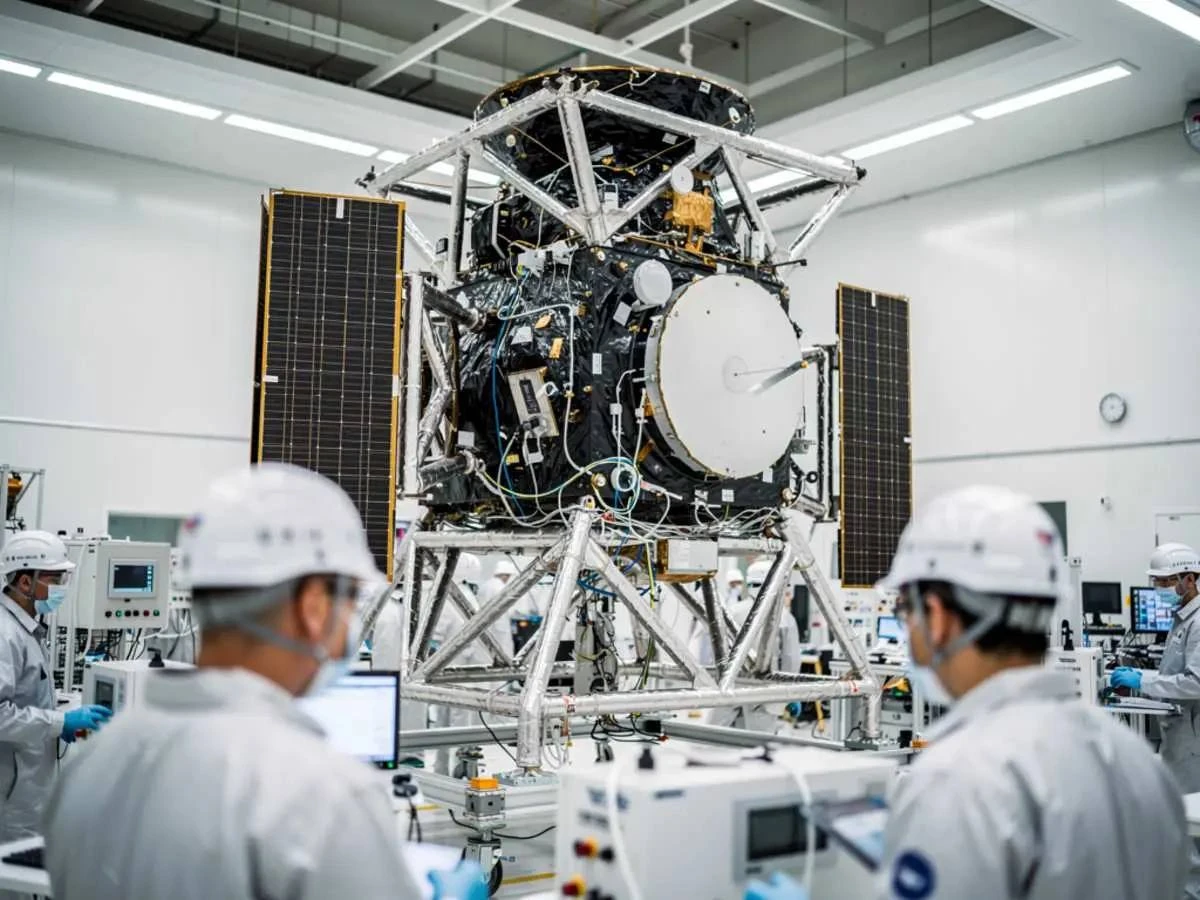
Mass and size. A Rassvet-3 is about 370 kg (Gunter’s Space Page / space.skyrocket.de; some popular tables print higher figures that do not fit a sixteen-pack on one Soyuz). A length of about 4 m and solar arrays spanning about 10 m deployed have been quoted in earlier summaries; I could not re-verify those from a primary source, so treat them as approximate. For scale, the Rassvet-1 test satellites were about 80 kg (about the mass of Sputnik-1’s PS-1), and the Rassvet-2 prototypes about 120 kg (McDowell’s catalogue).
Power. Deployable solar arrays and batteries, described by the company as a “new power system”. A broadband satellite of this class is power-limited by its phased-array amplifiers and by eclipse: at about 510 km a satellite can spend up to roughly a third of an orbit in Earth’s shadow in some seasons, and the batteries run the payload then. Bureau 1440 has not published the solar array power. A satellite that cannot climb or orient its arrays properly runs short of energy, which is one plausible cause of the stalled units, though no one outside the company can say.
Propulsion. Electric (plasma) thrusters on krypton propellant according to Gunter’s Space Page and Wikipedia; the company says plasma thrusters and reported commissioning its own propulsion on the Rassvet-1 satellites in 2023. Electric thrusters give high specific impulse and low thrust, so they are used for a slow climb rather than a quick burn. My calculation of the delta-v for the climb, using the difference of circular velocities (the usual low-thrust approximation): about 120 m/s from a 300 km insertion to 510 km, and about 275 m/s to reach 800 km. Assuming a specific impulse of about 1,500 s (my assumption, not a company figure) that is only about 3 kg of krypton for 510 km and about 7 kg for 800 km on a 370 kg satellite; the larger cost is time. The climb takes weeks to months. At the 300 km insertion height air drag is not negligible, so a satellite that does not start thrusting soon after separation decays: RASSVET-3 17 and 23 never raised their orbits and on 13 October 2026 were at about 235–255 km and falling about 1.6 km a day (azmth).
Attitude control. The bus needs three-axis stabilisation with star trackers, gyros, magnetorquers and probably reaction wheels (standard practice for the class; the company has not published a list). The nadir-pointing phased arrays have to stay on the Earth, the solar arrays have to track the Sun, and the laser terminals need extremely steady pointing. The thruster has to be pointed along the velocity direction during orbit raising, so the satellite flies in a different attitude during the climb than in service; a stuck wheel or a bad star-tracker lock in that mode could stall the climb.
Station-keeping and collision avoidance. A constellation at a shared altitude needs continuous thrust to hold its slot against drag, and a conjunction-avoidance routine. The company has not published how it handles this.
THE COMMUNICATIONS PAYLOAD
Phased-array antennas and beamforming. The company describes active phased arrays on the user terminals; the satellite side is described as an orbital 5G base station with steerable beams (no public beam count or per-satellite capacity). A phased array forms a narrow beam by feeding each element with a controlled phase and amplitude, and can re-point in microseconds with no moving parts. On the satellite the same trick makes many beams, each lighting a cell on the ground, and lets the satellite move the beams to compensate for its own motion. On the terminal it lets a flat panel lock onto a satellite crossing the sky at 7 km/s and hand off to the next one without a gimbal.
Bent pipe versus regenerative. A transparent (“bent-pipe”) satellite only translates frequency and amplifies; the base station stays on the ground in the gateway. A regenerative satellite carries the base station (the gNB, or its distributed unit) on board, demodulates, routes and re-modulates. The company says its satellites work as orbital 5G base stations, which points to a regenerative design, and it pairs this with laser links so that traffic can leave the mesh at any gateway. Whether the satellite carries a complete gNB or a split gNB-DU with the central unit on the ground has not been published. A regenerative architecture is what makes a mesh network possible (the satellite routes packets itself), but it is also what makes a stalled or damaged satellite a hole in the network rather than a dumb relay.
Why on-board processing matters. The round trip between a terminal and the 5G core is the sum of two radio hops and any ISL hops. With an on-board gNB, control signalling such as random access and scheduling terminates in orbit instead of travelling to a gateway and back, which cuts latency, and the satellite can schedule beams and users itself.
5G NTN: HOW THE AIR INTERFACE WORKS
The standard. 3GPP added satellite support to 5G New Radio in Release 17 (frozen in 2022), covering mainly transparent GEO and LEO payloads in low bands, and extended it in Release 18, which brought Ka-band operation (around 17.3–20.2 GHz downlink and 27.5–30 GHz uplink in the 3GPP band definitions) and coverage improvements. Release 19 work covers regenerative payloads with the gNB on board. Bureau 1440 states it uses 5G NTN, Ku and Ka. Whether its Ku mode follows 3GPP band definitions or is an adaptation has not been published; I could not find that detail.
The two problems of LEO. A terminal sees a satellite moving at about 7.6 km/s (about 27,400 km/h at 510 km, my calculation; the company’s Rassvet-2 test quoted about 27,000 km/h at 800 km) and a signal delay that changes by milliseconds during a pass. Two things go wrong in an ordinary mobile network: the carrier frequency shifts (Doppler) and the time of arrival of uplink bursts drifts so they collide in the receiver. The company claimed on Rassvet-2 that it compensated both for a user terminal at roughly 800 km altitude.
How NTN fixes it. The terminal knows its own position from GNSS (GPS/ГЛОНАСС) and receives satellite ephemeris in broadcast system information. It computes the distance to the satellite and pre-compensates its own transmit timing and frequency: this is the “UE-side timing advance and Doppler pre-compensation” of Release 17. The network sends a common timing offset for the cell, and the terminal adds the part it knows about itself. In addition there are larger HARQ and scheduling timers (K-offset and similar) to cover the long round trip, and options such as disabling HARQ feedback where it would stall. Beams are either earth-fixed (the satellite steers beams to hold a cell on the same ground spot) or earth-moving (the cell sweeps across the ground with the satellite); handover then happens between beams of one satellite and between satellites.
Doppler size (my calculation). At 510 km altitude and 25° elevation the radial speed is up to about 6.4 km/s. That gives a frequency shift of about 300 kHz at 14 GHz and about 640 kHz at 30 GHz. That is far outside what an ordinary terminal oscillator would tolerate if uncorrected, and well within what GNSS-aided pre-compensation can remove.
Company test results. On Rassvet-1 (2023) the company reported 48 Mbit/s downlink at 38 ms and 12 Mbit/s uplink at 42 ms to a ground terminal. These are test figures from a handful of small satellites, and no independent measurements of the production Rassvet-3 service have been published (UISC, September 2026).
FREQUENCY PLAN
The State Commission for Radio Frequencies (ГКРЧ) allocated Ku and Ka band spectrum in November 2021. Contemporary descriptions give Ku as roughly 11–19 GHz and Ka as roughly 19–40 GHz in the company’s wording (the strict ITU definitions are narrower), and the ITU filings list separate frequencies for user links, gateway feeder links and inter-satellite links. Exact channel plans, polarisation (typically dual circular or dual linear to reuse a channel) and gateway bands have not been published.
The typical split in systems of this class, and what is likely here, is the Ku band (about 10.7–12.7 GHz downlink, about 14 GHz uplink) for user links and Ka band for gateway feeder links with wide channels. This is the pattern Starlink and OneWeb use; it is stated here as the pattern, not as a confirmed Rassvet assignment. Beams must also avoid geostationary satellites in the same band, which is what the ITU equivalent power flux density (EPFD) limits are for: a phased array has to switch its beam away from the geostationary arc, and the constraint is worst near the equator, where this constellation is thin anyway.
Regulatory friction. In late August 2026 Ukraine’s foreign ministry asked the ITU to exclude Ukrainian territory from Rassvet’s service areas; the ITU confirmed receipt to ComNews on 6 October. Dmitry Medvedev answered on 4 October with a warning of “a full-scale space war”. The ITU has no enforcement power over a signal that Russia chooses to radiate at occupied or contested territory, so the filing is a political and diplomatic step.
OPTICAL INTER-SATELLITE LINKS
What they are. A laser terminal is a small telescope that aims a narrow infrared beam at a neighbouring satellite and receives its beam in return. The link carries data at tens of times the rate of microwave inter-satellite links and the beam is almost impossible to intercept or jam from the ground. The pointing problem is brutal: the terminal has to find the other satellite (acquisition), lock on, and then keep the beam inside a spot a few metres wide at a distance of hundreds of kilometres while both satellites move and vibrate (tracking). Typical designs use a coarse pointing mechanism with a fast steering mirror and a quadrant detector or camera for the final lock, plus feed-forward from ephemeris.
Test record. Rassvet-2 flew the company’s own terminals. Fourteen sessions at 30–220 km moved about 1.5 TB; one session moved 450 GB with no damaged packets; another test run (30 May 2024) moved over 200 GB at 10 Gbit/s with a bit error rate better than 10⁻¹¹. On 25 July 2024 the company announced it had closed laser links between satellites from 30 km out to 1,005 km at 10 Gbit/s and that the terminal had “flight qualification”. Serial Rassvet-3 satellites carry what the company calls next-generation terminals; no public figure for their rate has appeared. The only published laser data rate is 10 Gbit/s. For comparison, SpaceX has publicly claimed about 100 Gbit/s per link on its newer satellites.
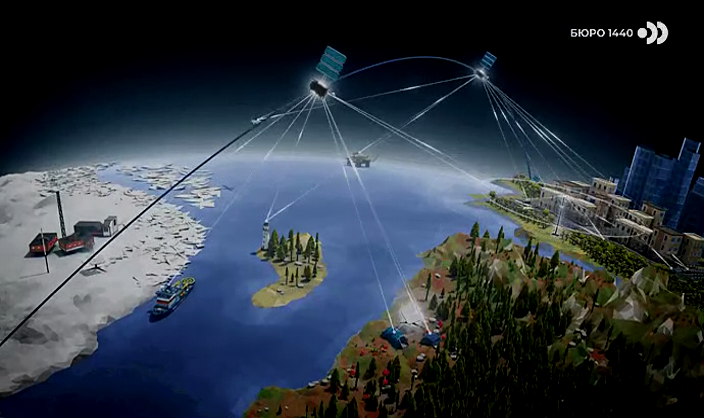
Why it matters. Without ISLs every satellite must have a gateway in view to carry traffic to the ground, so you need a gateway station roughly every few hundred kilometres under the constellation. Russia is large and mostly empty and its Arctic coast and oceans have no sites at all. With ISLs a packet climbs to the nearest satellite, hops along the mesh, and drops to the ground at a gateway that can be on friendly territory, which also lets Russia serve places like the Arctic or a ship at sea without foreign or remote gateways.
Mesh routing. Each satellite carries typically up to four laser links (two in the same plane, two to neighbouring planes); links to neighbouring planes must be steered constantly because relative geometry changes. This is the standard architecture and I have no information that Rassvet differs. The network decides routes dynamically as links come and go and as satellites cross high-latitude regions where plane crossings happen. Whether Rassvet’s routing is distributed or centrally computed is not public.
GATEWAYS, GROUND SEGMENT AND MISSION CONTROL
Rassvet needs three kinds of ground installation: gateway stations (feeder links between the satellites and the terrestrial network), a mission control centre (ЦУП), and TT&C antennas that command the satellites. During the Rassvet-1 flights the company’s own ground segment included five tracking stations distributed across Russia, and the MCC in Moscow took control of the spacecraft after separation. A first video call through a Rassvet-1 satellite in August 2023 involved Deputy Prime Minister Chernyshenko at the MCC in Moscow and the Adygea digital minister on Mount Fisht.
The gateway count for the finished network is not public. With a 510 km shell and 25° minimum elevation a gateway sees a circle of roughly 885 km radius of sky (my calculation), so a gateway spacing of 1,500 km or so covers a line of country; ISLs cut that requirement. Gateways also need fibre backhaul into the operator core and Ka band dishes with tracking and rain-fade margin (rain on the Ka feeder link is handled with site diversity: two gateways a few hundred kilometres apart so that they are not both in a storm).
Public-source information on the core network is thin, but the 5G NTN design implies a standard 5G core (AMF, SMF, UPF) at the operator, possibly with UPF functions pushed toward the gateways. The partnership with MegaFon and a live test on 9 October 2026 of combined satellite and mobile communication with MegaFon and a YADRO base station at the “Digital Solutions” forum show where the company expects the mobile-network handoff to happen.
USER TERMINALS
Hardware. The first Bureau 1440 terminal (shown in November 2025 in Yakutsk and again in 2026) is an active phased-array antenna about 60 × 60 cm and under 15 kg, rated for −40 to +40 °C, and claimed to find and hold a satellite automatically. On 6 October 2026 the company showed three terminals at the “Digital Solutions” forum, including the serial model 1440.УЛЬТРА (1440.ULTRA), 60 × 60 cm and rated by the company at up to 700 Mbit/s forward link, and a 1440.ЗЕМЛЯ (1440.ZEMLYA) version for trains at speeds up to 400 km/h. A company representative at the stand could not give production numbers or price (ComNews, 8 October). Earlier company material also spoke of an airborne module for uncrewed aircraft. UISC points out that the Starlink Mini weighs about 1.1 kg against up to 15 kg for the Rassvet terminal, so the realistic hosts are vehicles, ships, trains, aircraft, command posts and large uncrewed aircraft, not a rifleman or small FPV drone.
Boresight gain (my calculation). A 0.6 m × 0.6 m aperture at 14 GHz has a theoretical gain near 40 dBi at 100 percent efficiency and about 37 dBi at 50 percent, with a beamwidth of roughly 2.5°. A flat array loses gain as it scans away from straight up (roughly the cosine of the scan angle, about 3.7 dB at 65° off boresight, which is what a low-elevation satellite demands), and that is the main reason low-elevation connections are weak.
Power. The transmit power and DC consumption have not been published. A phased-array terminal with a transmitter in every element draws tens of watts at least, and heats up, so a vehicle installation needs a real power feed. Prices and tariffs are unpublished as of 13 October 2026.
Emissions. A terminal transmitting to a satellite is an RF emitter that can be detected and direction-found; UISC makes this point about Russian front-line use. Narrow beams reduce the exposure but do not remove it.
LINK BUDGET BASICS
The link budget is a ledger: transmit power plus antenna gain at the transmitter (together EIRP), minus the path loss, minus atmosphere and rain, plus the receive antenna gain, compared against the receiver noise (G/T, the gain-to-noise-temperature figure of merit). All of these are standard formulas; the company has published no satellite EIRP or G/T, so the numbers below are physics, not Rassvet specifications.
Free-space path loss (my calculation). Straight overhead at 510 km: about 169.5 dB at 14 GHz and about 176 dB at 30 GHz. At 800 km overhead: about 173.4 dB at 14 GHz and about 180 dB at 30 GHz. At 510 km but 25° elevation the slant range grows to about 1,050 km, which adds about 6.3 dB compared with overhead. At 800 km and 25° the range is about 1,560 km. So the 510 km orbit buys about 4 dB over 800 km, and the elevation angle swings the budget by about 6 dB, plus more atmosphere and a lower antenna gain in the same low-elevation geometry.
Rain fade. Rain absorbs and scatters microwaves roughly in proportion to frequency squared or worse. Ku band link margins are typically a few dB in heavy rain and Ka band can lose 10 dB or more in a cloudburst (approximate; it depends on the rainfall rate, the path through the rain and the elevation angle). A low-elevation path goes through more rain than a high one. Techniques: power control and adaptive coding and modulation on the user link, and site diversity on the gateways. Wet snow on a flat terminal is a practical problem in Russia; the company quotes −40 °C operation.
What the budget buys. Shannon’s limit says capacity is bandwidth times log2(1 + signal-to-noise ratio). As an illustration only, not a Rassvet figure, a 250 MHz channel at 10 dB signal-to-noise carries at most about 865 Mbit/s. A claim of up to 1 Gbit/s therefore needs wide channels, good signal-to-noise and a clear sky, and it is a peak, not a promise to everyone in a beam.
LATENCY, THROUGHPUT AND CAPACITY MATH
Propagation. Radio travels at about 300 km per millisecond in vacuum and about 200 km per millisecond in fibre. A satellite at 510 km straight overhead is 1.7 ms away one way; at 25° elevation it is about 3.5 ms. A bent-pipe round trip user–satellite–gateway–satellite–user adds up to a dozen or so milliseconds of pure flight time (my estimate). The company’s “up to 70 ms” figure leaves room for processing, queueing, ISL hops and the terrestrial path. Over long distances a laser mesh in vacuum beats fibre by roughly a third, because vacuum is faster than glass and the satellite route is a more direct arc, though it adds up and down legs.
Capacity. The constellation’s capacity is the number of satellites in view times what each satellite can radiate, divided by how many users are sharing a beam. The company has not published per-satellite throughput, beam count or frequency reuse, so no honest total can be given. What can be said is that 32 satellites in two batches, with many still climbing, is a small fraction of the roughly 200–300 that Ukrainian and company estimates put at continuous regional coverage, and that company figures such as “up to 1 Gbit/s per user” describe a peak.
Terminal count. The company has given estimates (reported by Wikipedia from 2023 interviews) of 1.5–2 million potential subscribers in Russia and up to 12 million worldwide in the commercial plan, with 50 Mbit/s to 1 Gbit/s per subscriber, and the intended customers are mainly corporate, state and government, closer to OneWeb’s market than to Starlink’s mass consumer base. The Bundeswehr analysis reported by NDR and WDR in September 2026 says the Russian plan has the first phase of capacity used exclusively by the military and with user numbers regulated.
PASS GEOMETRY AND HANDOVERS
Orbital speed and period (my calculation). At 510 km a satellite moves at about 7.6 km/s and takes about 94.8 minutes per orbit. At 800 km it moves at about 7.45 km/s and takes about 100.9 minutes.
How long a satellite serves you. With a 25° minimum elevation, the best case for a satellite passing straight over a terminal is about 4 minutes at 510 km and about 6.4 minutes at 800 km (my calculation, ignoring the Earth’s rotation). That means a terminal has to hand over to a fresh satellite every few minutes, and the handover has to be seamless: the terminal tracks the next satellite, the network moves the session (in 5G NTN, a handover or conditional handover, with the core keeping the IP address), and the user sees nothing. In a thin constellation the handover has no next satellite, and the terminal sees gaps. That is exactly what Ukrainian tracking reported in July 2026: windows of connectivity of up to an hour and a half, twice a day, instead of continuous service.
Why the windows exist. Each batch of 16 is in a single orbital family, so the satellites cross a given region in a train, and the gaps between trains are the dead time. Adding satellites in other planes fills the gaps; that is the entire point of the launch cadence.
Independent evidence of service. Company demonstrations in the autumn of 2026 were a remote electronic vote from an Arctic village (Nelmin-Nos, 19 September), an agreement with the coal company Elga signed over the satellite link on 8 October, and an about five-minute video call plus a live broadcast from Krasnoyarsk Krai through the satellite and a Russian base station on 9 October (Digital Solutions forum). ComNews notes this time the company used “one or more” of the 31 serial satellites, which fits a service that is only available in short windows. These are company-run demonstrations, not measurements of continuous service.
NETWORK CORE AND ROUTING
The core network is not described in public sources in detail. The architecture implied by the 5G NTN approach is a conventional 5G core at the operator, with satellites acting as base stations (or distributed units) and the ISL mesh acting as the transport network for traffic between them. User sessions are anchored in a user plane function at or near a gateway so the user’s IP address survives moving between satellites. Routing across the ISL mesh is dynamic, avoids congested or failed links, and has to cope with a topology that changes every few minutes. The company’s stated idea is that satellites route the traffic across the mesh and bring it down at a gateway, so a long-distance user does not need a ground station directly below the satellite.
Traffic control is also a policy matter: Russian internet is subject to СОРМ and TSPU traffic inspection, and the BBC Russian Service and others note that the owning holding builds such equipment, so a controlled national service would be expected to sit behind the same state requirements. That is an inference from the ownership, not a documented design detail.
TT&C AND CONTROL
Each satellite has a command-and-telemetry link, typically in a low-rate band and independent of the user payload, so that it can be controlled even when the payload is off. The company’s mission control centre (ЦУП) commands manoeuvres, reads telemetry and manages the climb. During orbit raising each satellite must be commanded and tracked individually for weeks. Company deputy CEO Dmitry Agafonov said at the Satcomrus conference in September 2026: “We are in the active phase of raising and manoeuvring the spacecraft. By the number of kilometres the satellites cover per day, we are on schedule” (as quoted by ComNews, 8 October).
Failures are visible to outsiders because anyone can track altitude. Open tracking networks, including the Russian SONIKS ground-station network, monitor the satellites independently, and the company has not publicly commented on individual satellites such as Nos. 17 and 23 (United24, 13 October).
HOW IT GETS TO ORBIT
Launcher and site. Soyuz-2.1b, built by RKTs Progress (РКЦ «Прогресс») in Samara, from Plesetsk Site 43 (Плесецк, площадка 43) in Arkhangelsk Oblast. The sources disagree on whether a Fregat upper stage flew on the serial launches: ComNews wrote that the first serial launch used a Fregat-M, while McDowell’s launch log lists a plain Soyuz-2.1b for it, and for the second launch catalogues disagree on whether the object in orbit is a Fregat or the Soyuz third stage. Rassvet-1 and Rassvet-2 used Fregat-M by most accounts.
Dispenser and load. Sixteen satellites at about 370 kg is about 5.9 tonnes of spacecraft before the adapter and dispenser. The launcher releases them at about 300 km on an 82° orbit and they raise themselves with their own thrusters, which avoids the cost of a Fregat burn to the working orbit and lets one Soyuz carry a full pack.
Climb. The climb to the working orbit takes weeks to months. The first batch (launched 23 March) was seen at about 502–523 km by 21 July and at about 509–514 km by September. The second batch (19 July) lagged: on 6 September none had passed about 426 km, and on 13 October 13 of its 16 had reached 484 km or higher, with seven at about 510 km (azmth, from CelesTrak). Militarnyi argued that a verdict on the second batch needed 100–125 days after launch. I would add that a climb that is the same for every satellite would suggest a design or operations issue, and one that differs by satellite suggests individual failures; the data so far show both.
Cadence and the supply chain behind it. One launch every few months is not a constellation. Reaching the federal plan needs a Soyuz roughly every month in 2027 and also a satellite factory able to build sixteen satellites per launch. Ars Technica noted Ukrainian strikes on the factory that builds Soyuz rockets in September 2026 and drone attacks aimed at Plesetsk, none yet with a direct hit on the pad (reporting of Ukrainian claims; I cannot independently confirm damage).
FLIGHT HISTORY
Rassvet-1. Launched 27 June 2023 from Vostochny (Восточный) on a Soyuz-2.1b / Fregat-M that carried the Meteor-M No. 2-3 weather satellite as the primary payload. Three experimental satellites of about 80 kg each in a sun-synchronous orbit near 588 km at 98°; first contact on 1 July 2023. Tests: bus, thrusters, five ground stations, and a ground link at 48 Mbit/s downlink and 12 Mbit/s uplink. McDowell’s catalogue (13 October 2026) now lists all three as failed and unable to manoeuvre, which is plausible for a three-year-old prototype but is a catalogue judgement.
Rassvet-2. Launched in the night of 16–17 May 2024 from Plesetsk Site 43 (about 21:21 UTC on 16 May, which is 00:21 Moscow time on 17 May), alongside Kosmos 2576. Three satellites of about 120 kg. First flight of the company’s laser terminals and 5G NTN payload. Laser: sessions from 30 to 1,005 km at 10 Gbit/s. 5G NTN: terminal-to-satellite link with Doppler and delay compensated, company-described.
Rassvet-3, first batch. 23 March 2026, 17:24 UTC (20:24 Moscow time), Plesetsk, sixteen serial satellites. RASSVET-3 4 re-entered on 6 June 2026. The company told Kommersant on 9 June that the other fifteen were operating normally. McDowell’s catalogue (13 October) counts 13 first-batch satellites active in their working orbit and classifies Nos. 4, 11 and 14 as failed early, though No. 11 is climbing again.
Rassvet-3, second batch. 19 July 2026, Plesetsk, sixteen satellites (RASSVET-3 17 to 32). Not a failure as some September headlines put it, and not a success either: Business Insider and ISW in early September reported that none had reached the working altitude, but by 13 October 13 of 16 had reached 484 km or higher. McDowell’s catalogue classifies Nos. 17, 23 and 26 as failed early, though No. 26 has been climbing again since late September. Nos. 17 and 23 never raised their orbits and are forecast by SONIKS to re-enter around 1 November and 29 October.
LIFECYCLE, DEORBIT AND SPACE DEBRIS
A 370 kg satellite at about 510 km would take years to decay naturally, longer when the Sun is quiet and faster when it is active (approximate; it depends on solar activity and the satellite’s area-to-mass ratio). Modern practice for constellations is active disposal: the satellite uses its thruster to lower its orbit at end of life. I did not find a published Rassvet disposal plan or a quoted design lifetime; one Western note gave about five years, limited by batteries and propellant, which I could not source further. The 2021 Russian anti-satellite test that destroyed Kosmos-1408 shows why Western analysts watch Russian orbital behaviour closely, and a 292-satellite fleet with a 91-satellite replacement allowance implies a turnover of satellites that will need disposal.
The satellites that stalled at low altitude are self-cleaning: those at 235–255 km fall about 1.6 km per day and will re-enter within weeks. A lower working altitude therefore has a side benefit for debris, because failed satellites do not stay up for decades. The flip side is that the same drag drains propellant faster during normal operation.
VULNERABILITIES
Jamming. Ku and Ka band user links use narrow beams from phased arrays. Both the uplink and the downlink of a user terminal are directional, so jamming needs a jammer in the beam or a strong one aimed at the satellite; it is much harder than jamming a VHF net. The Ukrainian side has said countermeasures were being discussed (Deputy Intelligence Chief Skibitskyi, per UISC). The tactic that worked against Starlink in Ukraine was not brute-force jamming but whitelisting terminals, which cut Russian users off on 1 February 2026 (ISW).
Anti-satellite attack. At 510 km the satellites are within reach of kinetic anti-satellite weapons in principle, but a constellation is a hard target for them: each shot destroys one inexpensive satellite and creates debris that endangers everyone. Non-kinetic options (dazzling, jamming of the feeder links) are theoretical here.
Ground segment. Gateways, the MCC and the launch site are fixed locations. Ukraine has attacked Russian space infrastructure with drones (Ars Technica reporting): Plesetsk and the Samara factory. A mesh with lasers reduces the number of gateways, but each one is still a single point of failure for an area.
Cyber. The command link, the core network and the supply chain are the attack surfaces. Satellites that are commanded over the air can be hijacked if keys leak. The company has published nothing about its command authentication; that is normal.
Supply chain, electronics and sanctions. Analysts in Ukraine and the West (UISC, Ukrainian military intelligence) highlight dependence on imported or hard-to-replace parts: radiation-tolerant electronics, laser components, test equipment, power electronics, thruster and attitude-control components and antennas. HUR told Janes that Moscow might not be able to “access components, technologies, and equipment” for further deployments, and former deputy HUR chief Pavlenko said Rassvet deepens reliance on Chinese technology (Kyiv Post). Ukraine’s chargé d’affaires in Washington urged US sanctions on Rassvet’s suppliers (reported 1 October 2026). These are Ukrainian and Western assessments, not verified findings.
Detection. A transmitting terminal can be located. Ukrainian analysts expect to look for a Russian drone’s terminal emissions and to correlate flights with satellite passes; UISC cautions that a pass coinciding with a strike is not proof of control through Rassvet.
COMPARISON WITH STARLINK, ONEWEB, KUIPER, GUOWANG AND QIANFAN
Starlink (SpaceX). More than 11,000 active satellites in CelesTrak’s catalogue on 12 October 2026 (azmth), shells around 550 km and lower (approximate), Ku and Ka user links, lasers on most satellites, a consumer product with terminals from about 1 kg upward. Rassvet is more than two orders of magnitude smaller, has no commercial service, and its terminal is much heavier.
OneWeb (Eutelsat). A mostly polar shell around 1,200 km with about 650 satellites in the first generation (from memory; approximate). It sells to governments, airlines and telecoms rather than consumers, which is the market the company says Rassvet is closest to. OneWeb flies far higher, so it needs far fewer satellites for coverage but has higher latency.
Amazon Leo (formerly Kuiper). About 390 satellites in orbit in mid-October 2026 according to the trackers (KeepTrack, azmth), at altitudes of roughly 590–630 km in its filings (approximate). Still in the build-out phase, so the nearest peer in numbers is Amazon, not Starlink.
Guowang (中国星网). About 220 satellites in orbit by tracker counts in mid-October 2026, for a planned state constellation of many thousands in mixed orbits (filings describe altitudes of roughly 500–1,150 km, approximate). State-owned, with commercial launch variety.
Qianfan (千帆, Spacesail). About 230–257 satellites in orbit per different trackers in mid-October 2026, in a polar-leaning shell at roughly 800 km (approximate). It is the closest numerical peer to Rassvet’s launched count and has had its own early setbacks.
In short. In launched satellites Rassvet is behind all of them. In altitude choice it has moved from the Qianfan-like 800 km on paper toward Starlink and Kuiper-like heights in practice. Its distinct features are a near-polar single-inclination plan aimed at Russia, a state-and-military first-phase customer base, and a heavier terminal.
WHAT IT DOES FOR THE MILITARY NOW
Russian units used Starlink informally early in the war and then lost it: on 1 February 2026 Ukraine and SpaceX introduced a whitelist and speed limit that cut off unregistered terminals, and Russian forces scrambled for alternatives (ISW, Kyiv Independent, Carnegie). Rassvet is the sovereign replacement that does not depend on a California company.
By 31 July 2026 Ukrainian tracking, relayed by ISW, described 12 of the first 16 satellites in an operating formation near 550 km over Ukraine (current tracking data put the same group near 510 km). The reported result was at least two communication windows a day over Ukraine, each up to about an hour and a half. That is not 24-hour Starlink. It is enough to schedule a burst: staff traffic, UAV video or a file transfer, if the terminal is up and the pass is known. Ukraine’s Defence Intelligence (HUR) told Janes on 4 September that it had recorded Russian forces using the first group for satcom for “several hours” by the end of July, and that this could be used for real-time data and for operating reconnaissance and strike UAVs. HUR chief Ivashchenko said on 7 September that 32 satellites are not enough for stable communications and the system’s effectiveness is low. This is a Ukrainian intelligence account.
The Bundeswehr analysis reported by NDR and WDR on 15 September 2026 expects service from the end of 2027 at the earliest, with 288 satellites and “very probably only” conditional operational readiness, and warns that once running, and used exclusively by the military in its first phase, it would give Russian forces their first own capability to control unmanned systems in real time and could improve strike accuracy against mobile targets. ISW wrote that even the present constellation may allow more precise strikes with remotely controlled unmanned systems during limited windows.
Plesetsk is a Defence Ministry site. Polar and high-inclination planes cover the Northern Fleet, the Northern Sea Route and the Arctic bases. A private holding with state money, security-sector-adjacent business lines and state launch support is not a civilian ISP first.
What it could give once built out. If the constellation reaches a few hundred working satellites and the terminal is in series: backhaul for command posts when ground radio (the VHF mesh, R-168 / Azart class radios, ESU TZ) is jammed or out of range; drone control beyond the line of sight, from large reconnaissance and strike airframes first (Geran / Shahed-class and bigger can lift the terminal; small FPV cannot yet); a possible update path for cruise missiles and glide bombs if a seeker or relay can talk Ku/Ka; ships and aircraft; Arctic and ocean coverage via the ISL mesh; independence from Starlink, OneWeb and Western gateways.
Limits. Launch cadence; orbit-raising problems; terminal size, price and power; short satellite lives; 5G NTN is a standard, not an anti-jam waveform; Ku/Ka dies in rain and wants a clear sky; emissions are detectable; continuous Ukraine coverage is a 2027-or-later estimate, not a 2026 fact.
RUSSIAN STATUS AND MODERNIZATION
Official line. On 6 October 2026 Prime Minister Mishustin said at the Digital Solutions forum that a low-orbit constellation of more than 30 satellites is operating over Russia (Vedomosti). On 27 September Peskov said the Kremlin hoped Rassvet would start working effectively as soon as possible. In June 2025 Roscosmos chief Dmitry Bakanov had said the first sixteen serial satellites would fly in December 2025; Kommersant reported in January 2026 that this had slipped into 2026.
Where it fits. Rassvet is the commercial-led, state-financed LEO layer. Alongside it Roscosmos carries the Sfera (Сфера) umbrella programme of multiple constellations (including the Skif (Скиф) broadband component and the Marathon IoT and other plans), and the older Gonets (Гонец) and Express (Экспресс) systems. Of these, Rassvet is the one actually flying serial satellites in 2026.
Modernisation path. Prototype generations (80 kg, 120 kg, now 370 kg) show the usual growth ladder. The company claims in-house laser terminals, in-house thrusters, an in-house terminal family and in-house gateways. The stated roadmap: partial service in 2027, Russia-wide service by about 2030, extended coverage later (the company has spoken of over 70 countries and 900-class numbers by 2035, which are aspirations). Agreements already announced: MegaFon for backhaul to 500 base stations from 2027, Russian Railways for 135 Lastochka and Sapsan trains, Beeline testing from autumn 2026, an agreement of intent with Belarus’s Belintersat, and earlier agreements with Aeroflot for aircraft connectivity.
Open problems. Launch cadence and the Soyuz production base; electronics supply under sanctions; keeping satellites alive at low altitude; deciding the working altitude (the website’s 800 km versus the observed 510 km); terminal cost; and a federal schedule (156 satellites by the end of 2026) that is already missed.
TIMELINE
November 2020: MegaFon 1440 project office starts. November 2021: Ku and Ka frequencies allocated. 2022: project moves to ICS Holding and becomes Bureau 1440. 2023: ITU filings for the Rassvet systems. 27 June 2023: Rassvet-1 launched from Vostochny (three satellites). August 2023: first video call through a Rassvet-1 satellite. 16–17 May 2024: Rassvet-2 launched from Plesetsk (three satellites). 30 May 2024: laser test at 10 Gbit/s, 200+ GB. 25 July 2024: laser links to 1,005 km announced. March 2025: government plan gives 292 active and 383 launched by 2030. January 2026: first serial launch slips from 2025 to 2026. 1 February 2026: Russian access to Starlink over Ukraine cut by whitelisting. 23 March 2026: first serial batch of 16. 6 June 2026: RASSVET-3 4 re-enters. 19 July 2026: second batch of 16. Late August 2026: Ukraine asks the ITU to exclude its territory; ISW calls the second batch a failure to reach altitude. 15 September 2026: Bundeswehr analysis reported. 19 September: Nelmin-Nos remote vote. 29 September: first second-batch satellite reaches about 510 km. 6 October: terminals shown; ITU confirms receipt of Ukraine’s request; Mishustin speaks. 8 October: Elga agreement over the link. 9 October: live hybrid satellite and mobile test with MegaFon and YADRO. 13 October: re-entry forecasts for Nos. 23 and 17 (about 29 October and 1 November).
STATUS
As of 16 October 2026. Launched: 38 satellites (6 experimental, 32 serial). In orbit: 37 of the 38 (the lost one is RASSVET-3 4). About 20 serial satellites were at about 510 km on 13 October and a tracker site showed 22 at working altitude on 16 October; a further group of second-batch satellites was between about 484 and 502 km, with a few more still lower or climbing. Two second-batch satellites (Nos. 17 and 23) are falling and forecast to re-enter at the end of October or early November. The catalogue’s own judgement (McDowell, 13 October) was that 13 first-batch satellites were active in working orbit and 13 second-batch satellites were still raising orbits. No third launch had occurred and none was announced by 13 October; one Russian commentator wrote in early October that a third launch was planned for October, and I could not confirm it. Commercial service remains a 2027 target.
Sources disagree on how many satellites are working: the company says the first batch is normal, Western and Ukrainian trackers count fewer, and independent measurements of throughput, latency and handover on the production constellation have not been published.
CAVEATS AND OPEN QUESTIONS
Company figures (1 Gbit/s, 70 ms, 800 km, 5G NTN, 10 Gbit/s lasers) are targets or test results, not measured service. Satellite counts that “work” vary by source and by definition. Per-satellite power, capacity, beam count, plane layout, number of gateways, disposal plan and satellite lifetime are not public. Figures I calculated myself (path loss, Doppler, footprint, delta-v, pass time) are standard physics at stated assumptions and are approximate. Ukrainian, Western and Russian sources are labelled where used; ISW and HUR statements are Ukrainian-side or Western analyses, and Bureau 1440’s statements are the company’s. Some constellation comparison figures for OneWeb, Kuiper and Chinese systems are approximate and from public trackers or memory.
IN ONE SENTENCE
Rassvet is Bureau 1440’s Ku/Ka, 5G-NTN, laser-linked near-polar LEO internet for Russia: 370 kg satellites launched sixteen at a time from Plesetsk on Soyuz-2.1b, climbing on krypton thrusters to about 510 km rather than the advertised 800 km, with 32 serial satellites up and fewer than that working, enough so far for short communication windows over Ukraine and for company demonstrations, and far short of the roughly 292 working satellites and commercial service the plan promises for 2027.