
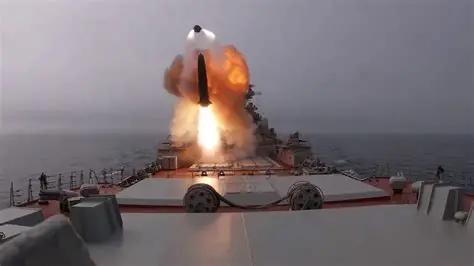
Soviet / Russian long-range anti-ship cruise missile // GRAU 3M45 The P-700 Granit (Russian: P-700 "Granit", meaning "Granite") is a Soviet and Russian long-range, supersonic anti-ship cruise missile. Its GRAU index is 3M45. NATO reports it as SS-N-19 Shipwreck. It was designed to destroy large, well-defended surface groups, especially U.S. carrier battle groups, by firing coordinated salvos from nuclear submarines and heavy surface ships. It entered service in 1983 and remains in limited Russian Navy use on remaining Project 949A Antey (Oscar II) submarines and, until modernization, Kirov-class battlecruisers. Production ended in the early 1990s. Newer systems — P-800 Oniks, Kalibr, and 3M22 Zircon — are replacing it as platforms are rebuilt. The missile exists in surface-launched and submarine-launched forms and can also be used against land targets. It was never exported. By the late 1960s the Soviet Navy judged P-70 Ametist (SS-N-7) and P-120 Malakhit (SS-N-9) too short-ranged against improving U.S. carrier air wings and escorts. A new missile needed roughly 500+ km range, high speed, a heavy warhead, underwater launch, and the ability to attack a whole formation rather than a single ship. Work was formally authorized by a Council of Ministers decree of 10 July 1969. OKB-52 under Vladimir Chelomey received the task. Conceptually the missile sits in the same family as the earlier P-500 Bazalt (SS-N-12), but it was a new design sized for both submarines and large surface ships. Targeting was planned around the Legenda ocean-reconnaissance satellite network (radar and electronic-intelligence satellites), plus aircraft and ship sensors. Academician M. V. Keldysh's institute helped define the space-targeting concept. After launch the missiles were intended to receive mid-course updates and then hunt autonomously. Production is generally given as 1985-1992 (sometimes into 1994). No new missiles have been built since. Chelomey died in 1984; Gerbert Efremov continued the program at NPO Mashinostroyeniya. An experimental ramjet (4D04) was tested and reportedly reached about Mach 4, but the service missile uses a turbojet sustainer. The later P-800 Oniks and the Indo-Russian BrahMos grew out of this design line, not as direct P-700 variants. The Granit is one of the largest anti-ship missiles ever fielded: about 10 m long and 7,000 kg at launch — roughly ten times the mass of a Harpoon. The airframe is cigar-shaped with a prominent annular nose intake, folding swept wings, and cruciform tail surfaces. A stubby solid-fuel booster sits at the tail for launch, including underwater start; it drops away once the KR-93 turbojet takes over. Published figures vary by source and flight profile. Typical open-source values: The conventional warhead is intended to punch into a large hull and detonate inside. Kinetic energy at impact is high because of mass and speed. Soviet and Russian writing often claims that even a damaged missile might still reach the target. Range depends on trajectory. A high-then-low profile gives the longest reach (commonly quoted 550-625 km). A pure sea-skimming run is much shorter. The frequently cited figure of 300 nmi (556 km) sits inside that band. From a submarine the missile is fired from a dry, angled canister while the boat is submerged (typically cited depths on the order of 30-50 m, at low speed). The solid booster lights underwater, the missile broaches, wings unfold, the booster is jettisoned, and the turbojet ignites. Surface ships use similar angled tubes under armored hatches. There is no Western-style vertical cold-launch cell in the original installation. Mid-course flight uses an inertial platform. Updates were planned from Legenda satellites and other reconnaissance assets. After the Soviet collapse that satellite net decayed and is widely described as no longer usable in its original form. Later Russian ocean-surveillance satellites (Liana and related systems) and aircraft such as Tu-95RTs / Tu-142 can still provide targeting in principle. Terminal homing is active radar, with home-on-jam / anti-radar modes against defending emitters. The distinctive feature of Granit is cooperative salvo fire. A typical attack is not one missile but a group — often described as 4-8, and theoretically a full ship or submarine load. In the classic account: Onboard computers were programmed with electronic-warfare and evasion logic. Western and some Russian commentators have questioned how fully the "swarm network" worked in practice. The capability is repeatedly described in Russian technical literature but was never demonstrated in combat. The operational idea was simple: a Project 949A submarine could fire 24 missiles, a Kirov-class cruiser 20, and Admiral Kuznetsov 12. A coordinated ripple was meant to saturate Aegis, fighters, and close-in weapons at once. Granit is too large for ordinary destroyers or standard VLS modules. Only three ship types ever carried it. The primary carrier. Each boat has 24 missiles in 12 paired SM-225 / SM-225A canisters between the inner pressure hull and the outer light hull, angled outward along the sides. That arrangement gives the Oscar classes their characteristic "humped" cross-section. Project 949 (Granit, Oscar I) was the first dedicated carrier. Project 949A Antey (Oscar II) is longer and was built in larger numbers. A boat can fire while submerged. In 2000, Kursk (K-141) sank during an exercise with a full load of 24 missiles. The wreck was guarded and the missiles were later recovered intact. Each ship originally mounted 20 SM-233 launchers in four rows of five under the forward deck, elevated about 60 degrees, with armored covers. Initial deployment was on Kirov (later Admiral Ushakov) around 1980, before formal service acceptance of the missile. Unusually for a carrier, Kuznetsov was built with 12 SM-233A Granit tubes under the flight deck, ahead of the ski-jump. The tubes were part of the Soviet "heavy aircraft-carrying cruiser" legal and tactical concept. Reports from the late 2000s onward said the tubes were removed or slated for replacement by Kalibr/Oniks cells during overhaul. Whether they were physically ripped out is not fully settled in open sources. The ship itself has been out of service for years and is not an operational Granit platform. No operational air-launched P-700 entered service, despite occasional older claims involving Tu-22M. Granit never fought a war. Its entire career has been deterrence, exercises, and fleet presence. First shipboard installation on Kirov. Formal initial operational capability in 1983. Core anti-carrier weapon of the Northern and Pacific Fleets, paired with Oscar SSGNs and the Orlan battlecruisers. Kursk lost in the Barents Sea during an exercise after a torpedo explosion. Twenty-four Granits were aboard and later salvaged. Documented launch from K-410 Smolensk. Russian reports of a Pacific Fleet Oscar II (Omsk) firing Granit during Far East command-staff exercises, in some accounts alongside a Yasen-M boat firing Oniks. Such firings show the stockpile is still live, not that the missile is a growth system. Granit is a legacy weapon. Missiles in magazines are old. Production stopped more than thirty years ago. It is kept serviceable on a shrinking set of hulls while those hulls are either retired or rebuilt around smaller, more numerous cruise missiles. A handful of Project 949A boats remain the main Granit shooters. Open order-of-battle lists for 2025-2026 typically treat as active or provisionally active boats such as Northern Fleet Orel (K-266) and Smolensk (K-410), and Pacific Fleet Omsk (K-186) and Tomsk (K-150), with others in reserve, long refit, or slated for disposal. Project 949AM modernization replaces the 24 giant Granit tubes with cells for up to about 72 Oniks/Kalibr-family weapons. That conversion has been slow. Sanctions and yard capacity have limited how many boats actually leave the Granit configuration. Third-generation SSGNs are intended to give way to Yasen / Yasen-M boats over the next decade. Admiral Nakhimov has had its 20 Granit tubes removed during the long Project 11442M rebuild. In their place are about 80 universal UKSK cells for Kalibr, Oniks, and (as fitted/claimed) Zircon, plus a rebuilt air-defense battery. The ship was in final sea trials through 2025-2026, with fleet return discussed for late 2026 or early 2027. Sister ship Pyotr Velikiy has not received an equivalent rebuild and is the last Kirov still associated with the original Granit battery. Her long-term future is widely expected to be retirement rather than a second Nakhimov-style reconstruction. The other two Kirovs are discarded or being scrapped. Admiral Kuznetsov is not operational. Granit is irrelevant to any realistic future for that hull. Doctrine has already moved on: more missiles per ship, mixed land-attack and anti-ship loads, and (on new platforms) hypersonic Zircon. Granit's remaining value is a very heavy warhead and a still-threatening salvo from any Oscar II that has not been converted. That value shrinks each year as air defenses, sensors, and newer Russian missiles improve. Soviet Navy. Introduced the system. All original platforms were Soviet. Russian Navy. Sole current operator (Northern and Pacific Fleets). India and other customers sometimes appear in low-quality summaries. There is no evidence of export. For its time Granit was a serious answer to the U.S. carrier group: long reach, high speed, a bunker-buster-class warhead, underwater launch, and a planned cooperative attack mode tied to space reconnaissance. Its weaknesses are the other side of the same design. The missile is huge, so few platforms can carry it, and those platforms are loud, expensive, and aging. The original satellite targeting web did not survive the USSR in usable form. Production is over. Newer Russian missiles trade individual mass for numbers, flexibility, and easier integration into universal VLS. As of 2026 the P-700 is best understood as a late-Cold War specialist weapon still found on a few Oscar II submarines and, until Pyotr Velikiy leaves the line, one battlecruiser — not as the future of Russian anti-ship warfare. Principal open sources for this summary include English and Russian encyclopedic entries on P-700 / 3M45, NPO Mashinostroyeniya and missilery technical notes, and 2025-2026 reporting on Kirov and Oscar II modernization. Figures for range, body diameter, nuclear yield, and exact acceptance date vary across Russian and Western references. Where sources disagree, both values are given above.P-700 Granit // SS-N-19 Shipwreck
Designations
Russian name:          P-700 Granit
Missile index:         3M45
Weapon complex:        Granit
NATO / DoD name:       SS-N-19 Shipwreck
Designer:              OKB-52 / NPO Mashinostroyeniya
                       (Vladimir Chelomey; later Gerbert Efremov)
Guidance developer:    TsNII "Granit"
Operators:             Soviet Navy (former), Russian Navy (current)
Development
Requirement
Testing and adoption
Design and Specifications
Parameter              Typical figure
------------------------------------------------------
Length                 10 m
                       (some Russian figures 8.84-9.15 m for the body)
Body diameter          0.85 m (Western sources)
                       1.14 m body / 1.35 m in canister (some Russian)
Wingspan               2.6 m (folding wings)
Launch mass            about 7,000 kg
Warhead                750 kg HE / semi-armor-piercing, or nuclear
                       (FAE also reported)
Nuclear yield          commonly 350-500 kt
                       (some Russian texts as low as 50 kt; figures inconsistent)
Sustainer              KR-93 turbojet
Launch booster         solid-fuel (works underwater)
Speed                  Mach 1.5-1.6 at low altitude
                       Mach 2.5 at high altitude
Range                  550-625 km on a combined high-low profile
                       about 145-200 km if flown entirely at very low altitude
Cruise / attack height tens of meters at sea-skimming
                       up to about 14-17 km on the high leg
Guidance               INS + mid-course update + active radar terminal,
                       home-on-jam
Operation
Launch sequence
Flight and guidance
Salvo ("flock") tactics
Launch Systems and Platforms
Project 949 / 949A submarines (Oscar I / Oscar II)
Project 1144 / 1144.2 Orlan (Kirov-class battlecruisers)
Project 1143.5 Admiral Kuznetsov
Launchers in summary
Launcher       Platform                  Rounds   Arrangement
------------------------------------------------------------------------
SM-225 /       Project 949 / 949A SSGNs  24       Paired angled canisters
SM-225A                                           in the outer hull

SM-233         Project 1144 cruisers     20       Under-deck angled tubes,
                                                  about 60 degrees

SM-233A        Admiral Kuznetsov         12       Under flight deck,
                                                  fixed angle
Service History
1980-1983
1980s
12 August 2000
2016
2025
Current Status (as of 2026)
Submarines
Battlecruisers
Carrier
Replacement path
Operators
Assessment
Notes on Sources
Project Orlan // articles / p700granit
Companion page: Project 1144 Orlan // Kirov class