Related article: Susanin AONS (autonomous optical navigation system)
WHAT IT IS
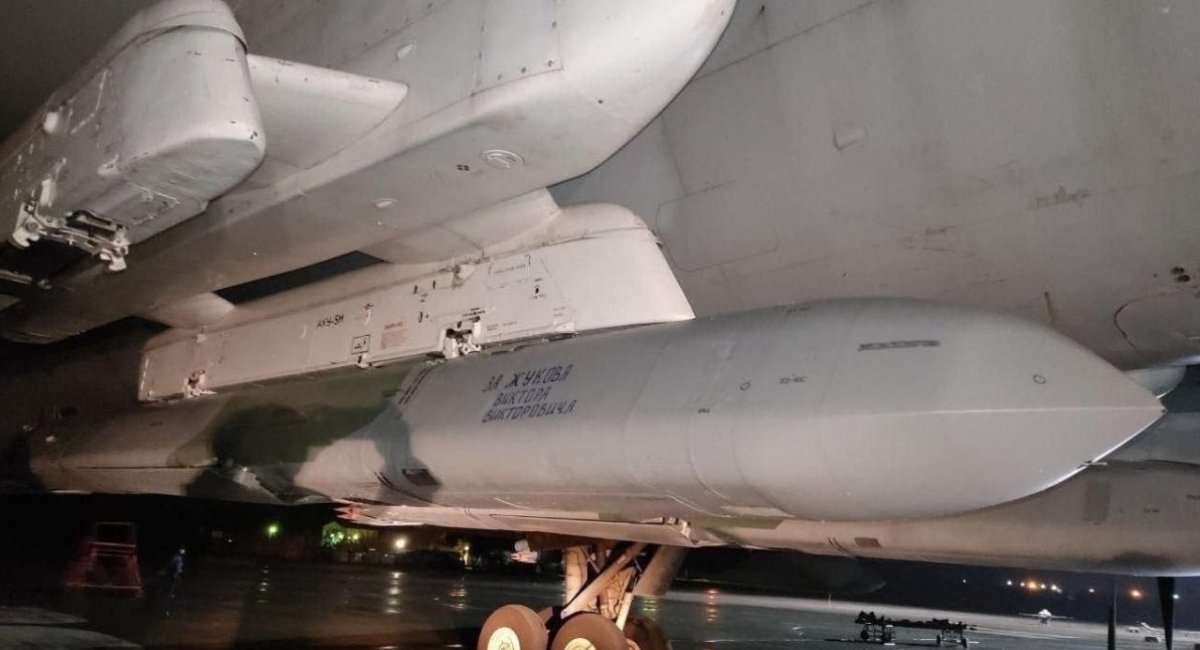
The Raduga Kh-101 (Х-101; pronounced "ha sto odin"; NATO reporting name AS-23A Kodiak) is a Russian long-range, air-launched, subsonic cruise missile designed by the Raduga design bureau (МКБ «Радуга», Dubna, Moscow Oblast), part of the Tactical Missiles Corporation (Корпорация «Тактическое ракетное вооружение», КТРВ). It is a conventional-warhead land-attack weapon intended to be released by strategic bombers from inside Russian airspace and to fly a long, low, terrain-following route to a fixed, pre-programmed target. Its nuclear-armed sibling, the Kh-102 (Х-102; NATO AS-23B), is externally almost identical and carries a thermonuclear warhead.
The missile is a successor to the Soviet Kh-55 (Х-55; AS-15 Kent) and its conventional derivative Kh-555 (Х-555), but it is not a simple modernisation of them. Russian and Western sources describe the Kh-101 as a new-design airframe that reduces radar cross-section through faceted, lifting-body shaping and radar-absorbing materials, with a new navigation suite that combines an inertial navigation system (ИНС), satellite correction (GLONASS) and an optical scene-matching terminal stage. That "stealthy" description comes largely from Russian manufacturer and state-media claims; open sources generally call the missile "low-observable" or "reduced-signature" rather than a proven stealth weapon, and no independent radar cross-section measurement has been published (the figure of about 0.01 square metres seen in Russian Wikipedia is an unverified estimate).
Basic numbers differ by source and are given with their conflicts in the sections below. In short: length about 7.45 m, launch mass about 2,200 to 2,400 kg, a single conventional warhead of about 400 to 480 kg (sources differ), a TRDD-50A small turbofan (about 450 kgf thrust), a cruise speed near Mach 0.58 and a maximum near Mach 0.78, and a range that is officially claimed by Russian sources at up to 5,500 km but is assessed by most Western open-source references at about 2,500 to 3,500 km. The Kh-101 entered service in the 2010s (2012 or 2013, depending on the source), was first used in combat in Syria in November 2015, and since 2022 has become one of the main weapons of Russian strategic strikes on Ukraine.
This page covers the history, design, powerplant, guidance, warheads, range claims, carriers, combat use, interception claims, components found in wreckage, production estimates, comparison to Western and Soviet missiles, and the Russian Aerospace Forces (ВКС России) status of the type. A note on the sources: the Kh-101 is a weapon in an active war, so a large share of the available detail (production rates, interception rates, component lists, modifications) comes from Ukrainian officials and Ukrainian-aligned analysts, and a smaller share comes from Russian officials and state media. This page attributes each claim to its source and shows both figures where sources conflict. Another entry in this database, Susanin AONS, covers a separate autonomous optical navigation system for jet drones that is the unmanned-aircraft cousin of the optical corrector fitted to the Kh-101; it is described under GUIDANCE below.
DESIGNATIONS AND NAMES
Kh-101 is the Russian designation of the conventional missile; the Cyrillic letter "Х" is transliterated "Kh" in English. Kh-102 is the nuclear version. The NATO reporting name is AS-23A Kodiak for the Kh-101 and AS-23B for the Kh-102, as used by CSIS Missile Threat and The War Zone; the "AS" prefix stands for air-to-surface. The factory product designations («изделие») used inside Russian industry are not always published. One sub-variant is known in Russian and Ukrainian reporting as «изделие 504АП» (item 504AP), a Kh-101 fitted with an optical homing and correction system named «Отблеск-У» (Otblesk-U) and a decoy-dispensing block «Л-504» (Russian Wikipedia, citing BBC Russian service and The War Zone).
The Kh-BD (Х-БД, "Х-большой дальности", long-range Kh) is a separate project, described by Russian officials as a longer-range missile in the same family and carried by the Tu-160 strategic bomber. It is discussed under RANGE CLAIMS.
Some Western references use the shorthand "Kh-101/102" for both. When this page says "Kh-101" it means the conventional missile unless the nuclear role is stated.
RADUGA AND THE KH-55 LINEAGE
MKB Raduga (Машиностроительное конструкторское бюро «Радуга») is a Russian missile design bureau based in Dubna, with a history reaching back to the early 1950s, and it has produced many Soviet and Russian air-launched missiles, including the Kh-22 (AS-4 Kitchen), the Kh-55 and Kh-555, the Kh-15 and the Kh-59 family (some of which are products of related bureaus or successors; the exact corporate history is not covered here). The Kh-55 (AS-15 Kent) was designed in the 1970s as a nuclear-armed, long-range, low-flying air-launched cruise missile, with a small turbofan engine that was folded into the body for carriage, and entered service in the early 1980s. Soviet engineer Igor Seleznev is credited in several sources as its chief designer; this attribution is taken from secondary sources and is not independently checked here.
The Kh-55 line gave the Soviet Union a missile of the same general concept as the American AGM-86 ALCM and BGM-109 Tomahawk: a small, subsonic, long-range, terrain-following weapon with an inertial system updated by a terrain-contour-matching (TERCOM) radar-altimeter. The Kh-555 (Х-555) is a later conventional-warhead derivative of the Kh-55 family, and the Kh-55SM is an extended-range variant with conformal tanks (CSIS Missile Threat and other references; the exact ranges, about 2,500 to 3,000 km for the nuclear Kh-55 family, vary by source). The Kh-55/Kh-555 family is still in service and still used against Ukraine; Ukrainian official statements often group Kh-101, Kh-55 and Kh-555 together in interception statistics (see INTERCEPTION CLAIMS).
In the late 1980s the Soviet Union began a programme for a new generation of strategic air-launched cruise missiles. CSIS Missile Threat and Russian Wikipedia both state that design work began in the late 1980s and that full-scale development began around 1995. CSIS gives initial operating capability in August 2003 and entry into service in 2012; Russian Wikipedia gives a first test year of 1999 and acceptance into service in 2013. Missile Defense Advocacy Alliance states the missile was "first tested in 1995". These dates do not agree exactly, and the safest summary is: design work from the late 1980s, flight testing in the second half of the 1990s or around 1999, an initial capability in the early 2000s, and formal service entry in 2012 or 2013. Russian sources link the new-generation project to the political and budget conditions after the Soviet collapse, and Missile Defense Advocacy Alliance links the emphasis on conventional strategic cruise missiles to the 1987 INF Treaty (the treaty banned ground-launched missiles of 500 to 5,500 km range, not air-launched ones, so this link is interpretive).
DEVELOPMENT AND TESTING
Open documentation of the Kh-101 test programme is limited, and much of what is reported comes from Russian Ministry of Defence announcements and Russian press. Russian state media said that the missile was tested from the Tu-160 and Tu-95MS and that its development was driven by the lessons of the Kh-55, particularly the need for lower detectability and greater accuracy against conventional targets. These statements are manufacturer and state claims and are given here as such.
The first public combat use in Syria in November 2015 served as the missile's introduction to the world (see COMBAT USE IN SYRIA). After Syria, Russian sources said that the experience led to improvements. Rossiyskaya Gazeta in January 2018 reported that the Kh-101 had been "improved taking Syrian experience into account" (as cited by Russian Wikipedia); the specific changes were not published. IISS (8 February 2019) reported a Kh-101 test launch at the Pemboy range in Komi in late 2018 and linked it to reporting about the nuclear Kh-102; Russian Wikipedia says the Kh-102 "was tested at the end of 2018 at Pemboy". The exact test programme for the Kh-102 is not public, and Western analysts treat the Kh-102 as an existing and fielded nuclear missile based on the Kh-101 design, but the number of Kh-102 in service is unknown.
Since 2022, the combat experience in Ukraine has been the main driver of modifications. Ukrainian specialists say that Russia has changed the missile in at least four ways during the war (see MODIFICATIONS IN THE WAR). Russian sources do not publicly confirm most of these changes, with the exception of general statements about "modernisation" and the new 504AP sub-variant described in Russian industry and press.
AIRFRAME AND LOW-OBSERVABLE SHAPING
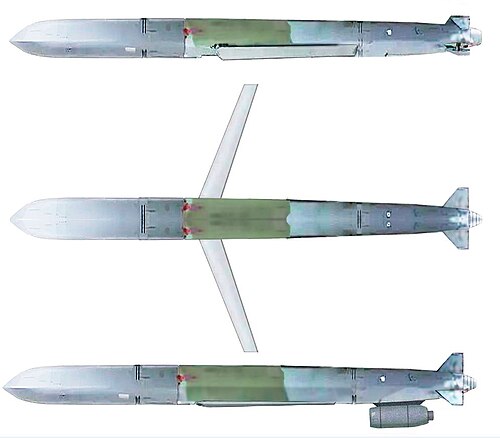
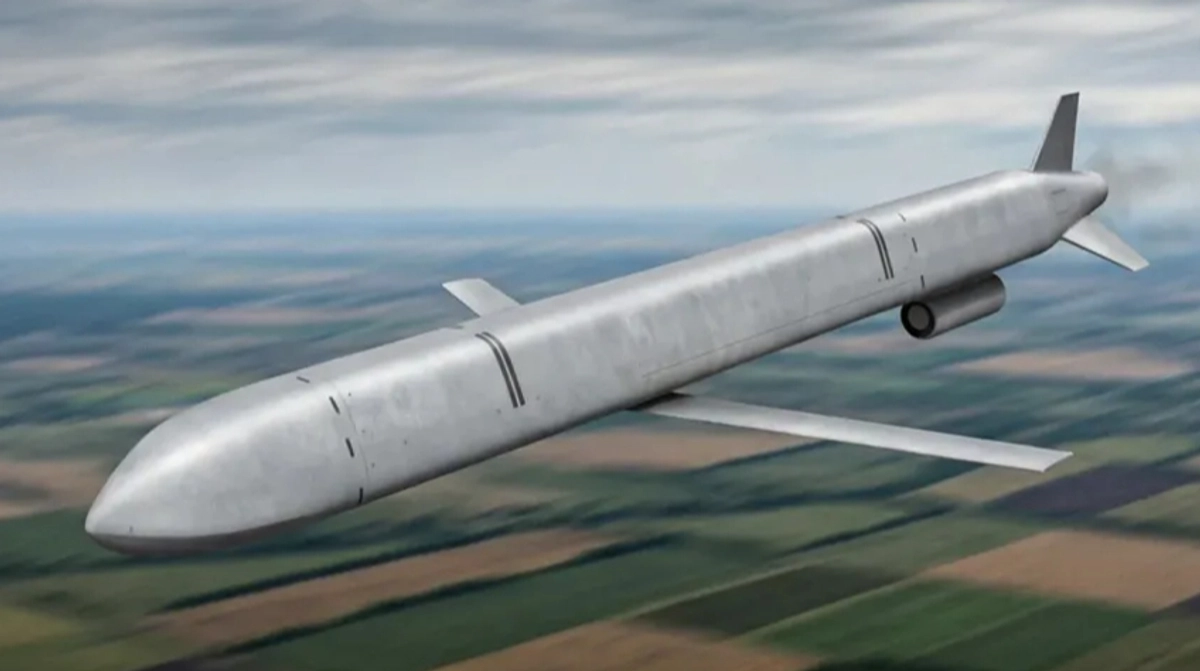
The Kh-101 is a cruise missile with a cylindrical-faceted fuselage, folding wings and tail, and a rear-mounted retractable turbofan. English Wikipedia says that the missile was "specifically designed for air launch, abandoning the circular fuselage cross-section of the Kh-55 for a nose and forward fuselage section aerodynamically shaped to produce lift", a description repeated in many secondary sources. The aim of the shaping is to lower the radar return from frontal and lateral aspects while leaving the lift needed for a long, low-speed flight.
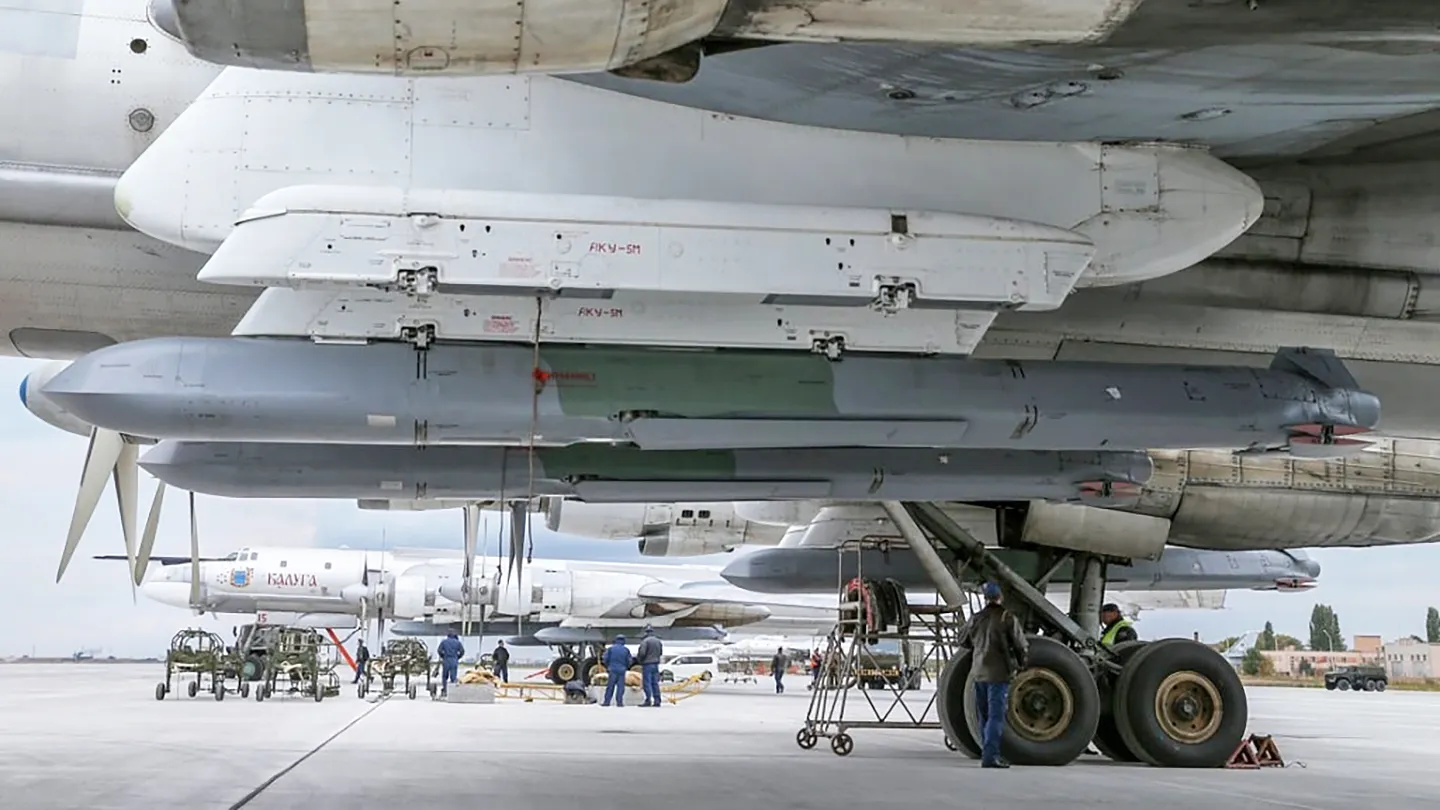
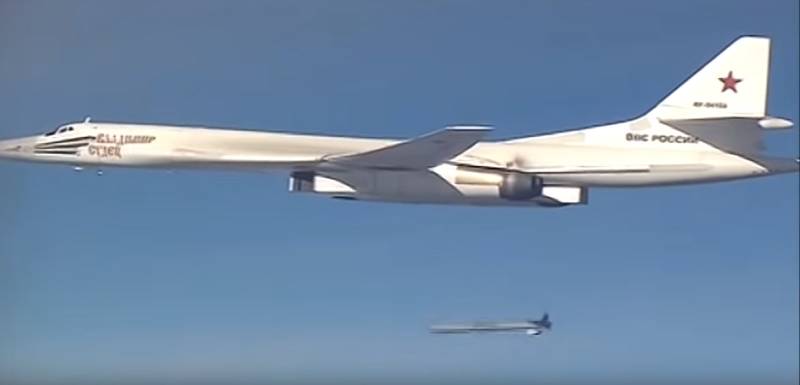
For carriage the missile is compact: the wings fold under the body (by a symmetric rotation of the wing panels around the midsection), the tail surfaces fold sideways, and the engine is retracted inside the body. After release the engine is extended, the tail surfaces open (in a low-wing, "нижний" arrangement according to Russian Wikipedia) and the wings are deployed. This sequence is described in a Ukrainian technical paper (exa.ai library, in Ukrainian) and in Russian Wikipedia, citing Russian sources. The missile is released from a pylon or drum launcher without a rocket booster; CSIS Missile Threat says it is "fired without a booster, using the launching aircraft's momentum at release to give it initial velocity." Further details of the engine deployment timing have not been published.
Dimensions and mass differ by source:
Length: 7.45 m with the warhead section (CSIS, Wikipedia, Russian Wikipedia, Ukrainian paper) — consistent across sources.
Diameter: 0.742 m (Russian Wikipedia, Ukrainian technical paper) versus 0.51 m (CSIS Missile Threat). The 0.51 m figure is also the figure used for the older Kh-55 body and is probably a carry-over; the larger figure is more consistent with the Ukrainian technical paper and with Russian Wikipedia.
Wingspan: about 3 m (Russian Wikipedia) versus 4.3 m (the Ukrainian technical paper). The conflict is not resolved here.
Launch mass: 2,200 to 2,400 kg (Wikipedia, Russian Wikipedia, Ukrainian paper); CSIS says 2,300 to 2,400 kg.
Fuel load: about 1,250 kg (Russian Wikipedia and the Ukrainian technical paper).
The structure is described in the Ukrainian paper as a welded body with an aluminium-magnesium alloy (АМг6) skin, which is a conventional structural material; the radar-absorbing treatment is said by CSIS Missile Threat to be a radar-absorbing composite material, but the exact layout and where the composite is used has not been published. Russian Wikipedia gives a radar cross-section estimate of 0.01 m² and places the flight altitude between 30 to 70 m for the low-level terrain-following phase and up to 6,000 to 10,000 m for the cruise phase. These are unverified estimates rather than test data.
The missile's low flight altitude (the sources give 30 to 70 m above terrain in the final phase) combined with small size, a reduced radar signature and a flight path that avoids known air-defence sites, are the main means by which it is meant to reach its target. It is nonetheless subsonic and relatively slow, and Ukrainian air-defence operators have repeatedly intercepted it (see INTERCEPTION CLAIMS).
ENGINE
Western references (CSIS Missile Threat, Wikipedia, Missile Defense Advocacy Alliance) and Russian Wikipedia state that the Kh-101 uses a TRDD-50A (ТРДД-50А) small turbofan, with thrust of about 450 kgf (roughly 4.4 kN). The abbreviation stands for "турбореактивный двухконтурный двигатель", a bypass turbojet. The Kh-55 family used the R95-300 (Р95-300) engine. One Russian Wikipedia passage names the Kh-101 engine as "Р95ТМ-300" in the sentence on deployment, while its data table says TRDD-50A; this is likely a naming variant or an editing inconsistency and the relationship between the TRDD-50A and the Kh-55 engine family is not established in the sources used for this page. For that reason this page does not claim that the Kh-101 uses an R-95-300 family engine, only that the sources use both names.
CSIS gives a cruise speed of Mach 0.58 and a maximum of Mach 0.78; Russian Wikipedia gives a cruise speed of about 190 to 200 m/s (Mach 0.58) and a maximum of 250 to 270 m/s (Mach 0.78); English Wikipedia gives Mach 0.6 to 0.78 with cruise at 700 to 720 km/h and maximum 970 km/h. Missile Defense Advocacy Alliance gives a maximum speed of 900 km/h. Together these describe a subsonic missile that cruises at about 700 km/h and sprints at less than 1,000 km/h. CSIS estimates a flight endurance of about 10 hours at its maximum range figure; this is an estimate, not an official figure.
The engine is the main reason that the missile is small and slow. A turbofan is fuel-efficient, which supports the long range, but it also gives the infrared signature typical of a small jet, and Ukrainian air-defence reports mention shoulder-launched missiles (Igla, «Игла») and gun systems as well as larger systems being used against it (Russian Wikipedia, citing RUSI).
GUIDANCE AND NAVIGATION
The Kh-101 is a fire-and-forget missile with a pre-programmed route. The published descriptions agree on a combined system: an inertial navigation system (ИНС) corrected by satellite navigation (GLONASS, and, in some descriptions, other constellations), with a terrain-reference method for navigation (CSIS and Missile Defense Advocacy Alliance mention TERCOM, the radar-altimeter terrain-contour-matching method derived from the Kh-55 lineage) and an optical or electro-optical terminal stage that compares a camera image with a stored reference. CSIS describes "GLONASS satellite navigation and TV terminal guidance". Missile Defense Advocacy Alliance says that the computer matches geographical data with pre-loaded images, and that targets can be changed after launch; Russian Wikipedia likewise says the missile has "in principle the possibility of changing the target while in flight", a claim that comes from Russian press.
Accuracy figures vary by source. English Wikipedia gives 6 to 10 m, the Ukrainian technical paper 6 to 10 m, Missile Defense Advocacy Alliance 5 to 6 m CEP, Russian Wikipedia 10 to 20 m (and also quotes a Russian claim of CEP 7 m at 5,500 km); these are all manufacturer or analyst claims that cannot be confirmed in the open. The accuracy at the maximum range is certainly worse than the best-case claim, because inertial errors build up and satellite signals can be jammed or spoofed.
Optical scene matching: The terminal corrector is a form of digital scene-matching area correlation (DSMAC, the same family of technique used in the American Tomahawk). The missile stores reference images of the final area, a downward-looking sensor takes live images, and a correlator computes the position offset that is fed into the inertial navigator. The Kh-101 sub-variant «изделие 504АП» is reported to carry the optical correction system «Отблеск-У» (Otblesk-U). In the industrial chain, the Ukrainian Defence Intelligence parts lists name TsNIIAG, Geofizika-NV and Signal as the makers (from the Susanin AONS article in this database, which cites GUR notes). As with all DSMAC systems, a scene match is a series of update patches rather than a continuous video lock and its accuracy is reduced at night, in snow and under long shadows; this limitation is noted for the Kh-101 in the Susanin AONS article and in general technical literature, but a Kh-101-specific accuracy-at-night figure has not been published.
Susanin AONS: In autumn 2026 Russian war correspondents and a Ukrainian Defence Intelligence (GUR) component note described a separate system called Susanin («Сусанин»), an autonomous optical navigation system («автономная оптическая навигационная система», АОНС) for jet-powered attack drones, reported on the Geran-4 and Geran-5. Rossiyskaya Gazeta compared it to Otblesk-U on the Kh-101. The database has a separate article titled Susanin AONS, which treats it as an unmanned-aircraft system of the same class (a downward camera matched to a stored map strip), not as a component of the Kh-101. This page therefore treats Susanin as related background rather than as part of the missile, and the Susanin article itself says that no open source puts Susanin on a cruise missile.
Ukrainian modernisation claim: In its 11 May 2026 article, the Ukrainian Ministry of Defence said the Kh-101 now has an upgraded combined navigation system that integrates a laser-gyroscope inertial navigation system, satellite guidance and an electro-optical scene-matching correlation system. This is a Ukrainian claim about wreckage analysis and the specifics have not been independently confirmed.
Navigation jamming: Ukrainian and Western officials often say that Russia's GNSS-dependent drones are vulnerable to jamming, while cruise missiles with inertial systems and scene matching are less so. One analysis (Spas Consulting, cited in the results used for this page) argued that Russian land-attack cruise missiles are "far less susceptible to the effects of GNSS jamming and spoofing" than drones such as the Geran-2, and must therefore be intercepted unless they malfunction. That is analyst opinion, not a measured test result.
WARHEADS
Kh-101: a single conventional unitary warhead. The mass is given as 400 kg (English Wikipedia, Russian Wikipedia, Ukrainian technical paper), 400 to 430 kg (Russian Wikipedia's infobox), 450 kg (CSIS Missile Threat) and about 480 kg (a Ukrainian figure quoted by Ukrainska Pravda for "the start of the full-scale invasion"). The type is usually listed as high-explosive fragmentation, penetrating or cluster (submunition) (CSIS, Russian Wikipedia, Ukrainian technical paper). A photograph published by the Ukrainian Ministry of Defence shows a recovered Kh-101 warhead, which The War Zone calls "the standard 9E-2648 warhead from a Kh-101 that came down in Ukraine in March 2022" (The War Zone, 8 May 2024). The warhead designation comes from the Ukrainian picture caption and is reported as such.
Kh-102: a thermonuclear warhead. Yields in open sources vary: 250 kt (CSIS Missile Threat, English Wikipedia, Russian Wikipedia), up to 450 kt (CSIS notes some report this; Missile Defense Advocacy Alliance gives 450 kt) and up to 1 Mt (Russian Wikipedia, citing Rossiyskaya Gazeta of January 2018). The warhead yield is not officially published and no independent source confirms any of these numbers. Arms-control references (for example the Federation of American Scientists/Bulletin of the Atomic Scientists "Russian nuclear weapons" series) count air-launched cruise missiles under nuclear-armed bomber loadouts, but how many Kh-102 exist is not public. Use of Kh-102 in Ukraine has not been confirmed; Russian Kh-101 launches at Ukraine are treated as conventional.
Modified warheads (Ukrainian claims): In March to May 2024, wreckage photos showed a Kh-101 with two warheads. The War Zone (8 May 2024), citing Defense Express (a Ukrainian security publication), reported that a second charge had apparently been fitted, probably with steel fragments, at the expense of fuel and range; the UK Ministry of Defence assessed the twin-warhead modification "has likely reduced the missile's range by half". The Ukrainian Ministry of Defence (11 May 2026) said Russia "sacrificed the missile's excess range (2,500 km)" to integrate a second warhead, and also said that the cluster submunitions now carry zirconium elements to sustain combustion, which it linked to attacks on fuel depots and oil infrastructure. These are Ukrainian official or press claims based on recovered wreckage; Russia has not commented in the same detail.
RANGE CLAIMS AND THE KH-BD
The range of the Kh-101 is the most contested number. The common figures are:
Russian official and state-media claims: up to 5,500 km (RIA Novosti, September 2023, referring to the Kh-101's "maximum range of about 5,500 kilometres"; Russian Wikipedia infobox "~5,500 km").
Missile Defense Advocacy Alliance: 4,500 to 5,500 km.
A Ukrainian technical paper: 5,000 to 5,500 km "depending on data".
English Wikipedia: operational range around 3,500 km. The IISS "Tracking the Components of Missiles and UAVs" report (September 2025) also lists a range of 3,500 km for the Kh-101.
CSIS Missile Threat: 2,500 to 2,800 km, with "unconfirmed reports by the Russian Ministry of Defense" of 4,500 km.
Russian Wikipedia's technical table gives "2,500 to 2,800 km (other data: up to 5,500 km)".
Ukrainian sources describing the missile as used in the war: Ukrainska Pravda (13 June 2026) gives "a range of up to 2,500 km" at the start of the full-scale invasion. The Ukrainian Ministry of Defence says the "excess" 2,500 km range was sacrificed in the dual-warhead version.
Why they differ: the maximum figure of 5,000 km or more is from Russian sources and may be a ferry or ideal-profile figure for a missile with a full fuel load flown on an optimal route, which no independent party has observed. The 2,500 to 3,500 km range is the figure most often used in Western analyses and matches the strikes seen so far, which have mostly been fired from Russian airspace at targets within 2,000 km. Reported launch areas, mainly over the Caspian Sea and the Volga region, are roughly 1,000 to 2,000 km from most Ukrainian targets (an approximate, unofficial distance). The range of the twin-warhead version is said to be about half that of the standard missile (UK MoD, as reported by The War Zone) — in other words, in the region of 1,250 to 1,750 km if the baseline is 2,500 to 3,500 km — but this is an inference rather than a published value.
Kh-BD: In September 2023 Lt Gen Sergey Kobylash, then commander of Russian Long-Range Aviation, said during a visit by Defence Minister Sergey Shoigu and North Korean leader Kim Jong Un to Knevichi airfield in the Russian Far East that a Tu-160 "carries a Kh-BD missile with a range of over 6,500 kilometres" and Shoigu added that there are "two clusters with six missiles each" (TASS and RIA Novosti, 16 September 2023). The War Zone commented that no confirmed imagery of the Kh-BD had been released, that its status was unclear and that it was originally planned to arm the PAK DA bomber; it also noted that the earlier rumour was of roughly 50 percent more range than the Kh-101. The Kh-BD is therefore a Russian official claim, not an independently confirmed weapon. The relationship between Kh-BD and the Kh-101/102 (new missile versus extended-range member of the same family) is not established in the sources reviewed here. The Tu-160 article in this database covers the bomber side of this claim.
CARRIERS AND LAUNCHERS
Tu-160 and Tu-160M/M2 «Белый лебедь»: carries up to 12 Kh-101/Kh-102 internally on two rotary drum launchers of six missiles each (TASS, Russian Wikipedia and The War Zone; the older Tu-160 carried the Kh-55 family on the same layout). The drum launcher is a development of the Soviet rotary launcher used for the Kh-55; the exact launcher designations for the Kh-101 are not verified here. Because the missile is released from inside the weapons bay, the bomber's signature is not changed by external stores.
Tu-95MS and Tu-95MSM («Медведь»): carries eight Kh-101/Kh-102 on four underwing pylons (Russian Wikipedia, citing Rossiyskaya Gazeta; Aviation Week and others). The aircraft was modified specifically for the missile: strengthened pylons and updated avionics to feed the mission data to the missiles. The older internal rotary launcher of the Tu-95MS16 version was designed for the shorter Kh-55; sources say that the Kh-101 is carried on pylons only, but this page does not verify the technical reason. The modernised Tu-95MSM is reported to restore a full external-pylon capability for the Kh-101/Kh-102. The Tu-95 and Tu-160 are the only carriers confirmed by Russian MoD video and by Ukrainian reports of actual launches.
Tu-22M3 / Tu-22M3M: some reference lists (CSIS Missile Threat names Tu-22M3/5 "Backfire C") include the Tu-22M3 as a carrier. Other sources and analysts do not verify this; the Tu-22M3 is generally reported to carry the Kh-22, Kh-32 and Kh-15 families, not the Kh-101. This page therefore lists the Tu-22M3 as an unverified carrier.
Su-34: Missile Defense Advocacy Alliance lists the Su-34 and CSIS lists the "Su-27IB (Su-32)". A 2023 Eurasian Times article said Russia had added a "super capability" to the Su-34, and a Ukrainian outlet (UNIAN) published an analysis questioning the claims and finding no official or technical confirmation of Kh-101 carriage on the Su-34. Based on that, Kh-101 integration on the Su-34 should be treated as unverified. The Kh-101 weighs about 2.3 tonnes and is 7.45 m long, which is large for a tactical aircraft; no photograph of a Su-34 loaded with a Kh-101 was found in the sources reviewed.
Launch practice: Ukrainian reports often say the bombers launch the Kh-101 from the Caspian Sea area and over Russian territory; Ukrainska Pravda says "typically over the Caspian Sea". The Tu-160 home base at Engels (Saratov Oblast) is named in The War Zone's range analysis. Specific launch points are widely reported by Ukrainian sources but are not published by the Russian MoD.
COMBAT USE IN SYRIA
CSIS and Russian sources date the first combat use of the Kh-101 to 17 November 2015, when Russian strategic bombers attacked targets in Syria as part of the Russian air campaign (Missile Defense Advocacy Alliance: "first used the Kh-101 in combat on November 17th, 2015 against Syrian rebel groups outside of Damascus"). Russian Wikipedia lists three days of Tu-160 launches in November 2015 (17, 19 and 20 November), each with a figure of 16 missiles, followed by a launch in February 2016 and Tu-95MS launches on 5 July 2017 and 26 September 2017 of 4 missiles each. The same article notes that "not all of the missiles reached their targets", and that at least one missile fell on Iranian territory about 750 km from the Syrian border, citing IISS. These Russian-Wikipedia numbers combine reports of Kh-101 and Kh-555 launches in some cases, and the Russian MoD did not always state which missile type was used in the November 2015 strikes, so the table should be read as approximate.
The first use of the Kh-101 from the Tu-95MS is attributed to a Russian Ministry of Defence video from November 2016 in a Rossiyskaya Gazeta report (cited by Russian Wikipedia), described as "the first official evidence" of the Tu-95MS firing the missile; Russian Wikipedia also lists a February 2016 launch by Tu-95MS. Sources therefore disagree on the date of the first Tu-95MS Kh-101 use, and the question is not resolved here. The 2015 to 2017 Syrian launches were used to demonstrate the long-range strategic precision-strike capability, and they were followed by public discussion in Russian media about the missile's accuracy; a Russian expert quoted by TASS in November 2016 said the CEP was about 7 m. This is a claim by a Russian expert.
COMBAT USE IN UKRAINE
Since February 2022 the Kh-101 has been used on a large scale against targets across Ukraine. Ukrainian MoD photographs of a recovered Kh-101 warhead date from March 2022. Russian Wikipedia lists a strike on 26 June 2022 in which 14 Kh-101 were fired at Kyiv and its region, with some shot down and four hitting a nine-storey apartment building and a kindergarten, killing one person and wounding six; and notes the use in strikes on Dnipro (July 2022, three dead and 15 wounded), on civilian energy infrastructure in several cities, and on an apartment block in Uman in April 2023 (23 killed, SBU attribution). These details are from Russian Wikipedia, citing Ukrainian and Western press, and the missile type in individual incidents is typically attributed by Ukrainian authorities from wreckage.
Okhmatdyt: On 8 July 2024, a strike hit the Okhmatdyt children's hospital in Kyiv. The Ukrainian Security Service (SBU), Bellingcat (using a 3D model of the missile and photographs of debris) and BBC Russian service said a Kh-101 was used; the Financial Times reported that the missile contained Western components (see COMPONENTS). The Russian Ministry of Defence gave a different account of the incident, which video and debris analyses called into question (Russian Wikipedia, citing Agentstvo and Bellingcat); this page does not adjudicate that dispute. The event is cited here only because it produced much of the public component analysis.
Rate of use: Ukrainian Defence Intelligence data cited by The Kyiv Independent (August 2026) say that 866 cruise missiles were used between January and late August 2026, of which 529 were Kh-101 (about 61 percent), with 119 launched in July after 111 in February. Another summary says that the July 2026 Kh-101 launches were the second-highest monthly count of the year for Kh-101, Kalibr and Kh-32 combined. These are Ukrainian intelligence figures and Russian figures are not published. Kh-101 are generally used in large, mixed salvos with Kalibr cruise missiles, ballistic missiles and Shahed/Geran-type drones, in an attempt to saturate air defences.
Failure rate: Russian Wikipedia, citing IISS (Douglas Barrie, 2022) and others, says "a significant failure rate" was observed in the first phase of the war, with missiles not launching, missing or not detonating; the UK Ministry of Defence said that missiles were lost at launch, including wreckage found in Saratov Oblast. The quality of these early claims is mixed and the failure rate was not officially measured.
Targets and modifications: Strikes are often described as aimed at energy infrastructure, fuel depots, industry and cities; the Ukrainian side calls the campaign "terror". Russian official statements typically describe the targets as military-industrial and energy facilities that support the Ukrainian military. The labels differ by side.
MODIFICATIONS IN THE WAR
The Ukrainian Ministry of Defence stated on 11 May 2026 that its specialists had identified four major upgrades of the Kh-101 since the full-scale invasion: (1) a dual-warhead modification, trading range for a second charge; (2) cluster submunitions with zirconium elements; (3) an upgraded combined navigation system with a laser-gyroscope INS, satellite guidance and an electro-optical scene-matching correlator; and (4) a new SP-504 self-protection jammer suite whose active channel disrupts radar and SAM engagement systems, while the passive channel deploys decoy flares. The ministry presented these as a forced Russian response to the success of Ukrainian air defence, "not a technological breakthrough".
Independent reporting is partly consistent. The War Zone reported flare-decoy use by Kh-101 in Ukraine since at least January 2023 and the sub-variant 504AP, with a revised self-protection system whose function was described as jamming surface-to-air missiles; it also reported the twin-warhead missile in May 2024. Russian Wikipedia says that about 111 units of the modified 504AP were made in 2021 to 2022 (citing The War Zone and Russian media); that figure is a secondary-source estimate. The Ukrainian claims about zirconium submunitions, the laser-gyro INS and the SP-504 designation come from one Ukrainian official source and should be treated as claims until independent analysts confirm them.
One of the less discussed consequences is that the modified missiles may have shorter range, as described under WARHEADS and RANGE CLAIMS. If true, it suggests that the missile is being employed within Ukraine from relatively short stand-off distances, which is consistent with the reports of launches from the Caspian Sea area.
INTERCEPTION CLAIMS
The interception rate is reported by the Ukrainian Air Force and Ministry of Defence and is a Ukrainian claim. Russia does not publish a comparable figure. The numbers, with their sources and dates, are:
About 50 percent in 2022: Russian Wikipedia, citing RUSI and press, says that about half of the Kh-101 fired were intercepted by November 2022.
85 percent (34 of 40 fired) in a single attack in November 2025, according to a Ukrainian press release analysed by Spas Consulting. The analyst warned that the release does not say where, when or how the missiles were intercepted and that it may mean the defence is being heavily stretched.
About 88 percent since the start of 2026, for the Kh-101, Kh-55 and Kh-555 combined, according to the Ukrainian Ministry of Defence (11 May 2026). This is not a Kh-101-only figure.
96 percent for Kh-101 in the large attack of 2 June 2026 (73 missiles launched), against 33 percent for Iskander-M ballistic missiles in the same raid, according to the Konrad Adenauer Foundation "Ukraine Air War Monitor" Vol 17. The same monitor says that the overall cruise missile interception rate in May 2026 was 78 percent, down from 89 percent in April.
Overall air-threat rates: the Ukrainian MoD said the overall rate for drones and missiles was 88.5 percent in April 2026 and an interception rate of 89.9 percent in March 2026 was reported by Euromaidan Press, up from 80.2 percent in December 2025.
These figures show a high interception rate for cruise missiles and a lower rate for ballistic missiles. Caveats: a figure for "intercepted" includes missiles shot down by fire, missiles that failed, and sometimes missiles brought down by electronic warfare, and Ukraine has an incentive to publish high success rates for domestic and foreign audiences. It is also not clear from the statistics whether a missile that falls to the ground and does damage after a failed engagement is counted as intercepted. Western air-defence systems supplied to Ukraine are reported to have been effective against cruise missiles (RUSI, as cited by Russian Wikipedia), and the shoulder-launched Igla has reportedly been used in some interceptions. Interception rates for a subsonic, low-flying weapon of this class are typically high against a layered defence, which is consistent with the Ukrainian figures, but the exact figures cannot be independently verified.
COMPONENTS FOUND IN WRECKAGE
Russian industry officials have stated that the Kh-101 is built entirely from Russian components (Russian Wikipedia says the missile "has exclusively Russian components, unlike previous generations"), but analyses of recovered missiles by Western and Ukrainian investigators say otherwise. The main reports are:
RUSI, "Silicon Lifeline: Western Electronics at the Heart of Russia's War Machine" (8 August 2022): said that all six subsystems of an examined Kh-101 contained large amounts of Western-made microelectronics (as cited by Russian Wikipedia).
Analysis in 2023 (reported by Voice of America and cited by Russian Wikipedia): about 16 Western civil-grade parts or chips in a fragment, including parts from STMicroelectronics, Texas Instruments, Analog Devices and Intel; experts estimated around 50 Western components in a Kh-101 (BBC Russian Service, January 2024, cited by Russian Wikipedia). Russian Wikipedia also cites reports that Xilinx and Vicor parts were found.
Financial Times (reported on 10 July 2024) said that the missile that struck Okhmatdyt contained Western components.
Conflict Armament Research (CAR), September 2022: found that the Russian defence industry uses identical sets of components across different weapon systems, including the Kh-101, Kh-50 and 9M544 missiles (CAR field dispatches page).
CAR/IISS, "Tracking the Components of Missiles and UAVs Used by Russia in Ukraine" (September 2025): described SN-99 satellite-navigation systems, produced by KB Navis, as a component documented in multiple Russian missiles including the Kh-59 and the Kh-101, and found that procurement shifted from European suppliers to distributors and retailers in China and Hong Kong after 2022. It also noted a Kh-101 documented in Ukraine just two months after it had been produced.
CAR, February 2026 (Issue 18): documented the remnants of a Kh-101 in January 2026 whose production markings indicated it had been manufactured fewer than 20 days before its deployment; CAR said this suggested "continued Russian reliance on a resilient – yet evidently strained – supply chain for critical missile components".
A Ukrainian component list for a Kh-101 recovered on 20 January 2026 (serial number given in the document as 3152636174030; the document's publisher was not verified for this page) lists items including a US RAM chip (ISSI, week 21 of 2024), Russian microprocessors (Kurchatov Institute 1890VM2VT, 2024), Texas Instruments buffer chips, Xilinx FPGA chips (USA, some produced in Taiwan), Belarusian chips (JSC "Integral", 2025) and Russian chips (JSC "Mikron", 2025). The presence of 2024 and 2025 manufacturing dates suggests supply into recent months, but the document is a Ukrainian-published list and the chip dates were read from markings that have not been independently verified here.
Ukrainian General Staff, citing Col. Oleksandr Zaruba (13 June 2026): "up to 16 foreign components" in the Kh-101, and Russia's reliance on electronics made in North Korea and Western countries.
It is important to note what these findings do and do not mean. They show that civilian-grade Western and Asian chips, many of which are standard commercial parts sold by distributors, are found in the missile. They do not show that the manufacturers supplied Russia knowingly; the CAR/IISS report notes that many components were probably sold through legitimate channels and then diverted. Sanctions have disrupted some supply routes but have shifted procurement to other markets, according to the same report. Russian sources do not publish their own component analysis.
PRODUCTION
Russian official figures for Kh-101 production are not published. The estimates are from Ukrainian officials, Ukrainian media investigations and Western analysts, and they differ:
Russian Wikipedia (citing the Ukrainian outlet Meduza and others) says 56 missiles were produced in 2021 and 420 in 2023; the source of the 2023 figure is not clear in the text and it should be treated as an estimate.
A Ukrainian investigation by Channel 24 (reported by Euromaidan Press on 8 May 2025) said Russia planned to produce 633 Kh-101 in 2025 (about 50 a month) and 223 in 2026, with factories working three shifts, and that production had risen from 56 in 2021 to 50 a month in 2025. The 2026 figure of 223 is much lower than the 2026 figures of other reports, which means that the plan was changed or that the reports are not reliable.
Ukrainian General Staff, citing Col. Oleksandr Zaruba (13 June 2026): about 40 to 50 Kh-101 a month, with production moved to a 24-hour cycle.
Ukrainian Defence Intelligence (GUR), deputy chief Vadym Skibitskyi, 10 August 2026: 87 Kh-101 produced in July 2026, 140 percent of a planned monthly output of 72 (the same target was set for August). The Kyiv Independent summarised that Russia is "meeting or exceeding" targets for several missile types.
Stockpile (GUR, as reported by The Kyiv Independent and Ukrainska Pravda, August 2026): about 100 Kh-101 as of early August 2026, down from about 150 at the start of 2026, suggesting that missiles are leaving factories almost immediately for combat units. The Kyiv Independent says that the Kh-101 is "being used at roughly the rate at which Russia can currently produce them".
The estimates of production agree on a trend (strong growth from a few dozen a year before the war to several dozen a month) but not on the absolute numbers, which range from about 40 to 87 a month depending on the date and source. A rate of 40 to 50 a month would be about 480 to 600 a year; 72 a month would be about 860 a year. No source in the research for this page gives an independent measurement. Cost estimates also differ: English Wikipedia gives a domestic unit cost of about 2 to 2.4 million US dollars (FY 2025), while Russian Wikipedia gives a launch cost of 13 million US dollars (2022), a figure it traces to Forbes Ukraine and a Voice of America report; the two figures may count different things, and neither is official.
COMPARISON WITH OTHER CRUISE MISSILES
Kh-55 / Kh-555 (Russia): the Kh-55 is about 6 m long and 1,200 kg, with a nuclear warhead of about 200 kt in the Kh-55 and a conventional warhead in the Kh-555 (figures vary by source). The Kh-101 is larger, heavier, has a bigger conventional warhead, is meant to be more difficult to detect, and has modern navigation including optical correction. The Kh-55 family has a nominal range of about 2,500 to 3,000 km and remains in use as the older missile; Russia has also used Kh-55 as decoys, as described in The War Zone, with their nuclear warheads removed.
BGM-109 Tomahawk (USA): a ship- and submarine-launched subsonic cruise missile, about 5.6 m long, with a conventional warhead of about 450 kg (1,000 lb) in the main land-attack versions and a range in the order of 1,600 km for the current Block V (US Navy figures; the range depends on version). The Tomahawk uses TERCOM, GPS, inertial navigation and DSMAC. The Kh-101 is a similar class of weapon but is launched from a bomber and has a heavier airframe and a claimed longer range.
AGM-86B ALCM and AGM-86C CALCM (USA): the AGM-86B is a nuclear air-launched cruise missile carried by the B-52 with a range of about 2,400 km and a W80-1 warhead of a selectable yield, up to 150 kt (US Air Force and FAS data); the AGM-86C/D conventional versions have a shorter range. The Kh-101/102 pair is the closest Russian equivalent: a nuclear and a conventional version on a shared airframe, designed for bomber launch.
Limits of comparison: published figures for all these missiles come from different sources, with different definitions of range (with or without reserves), warhead type and flight profile, so a numerical ranking is unreliable. The main qualitative differences are the Kh-101's claim of lower observability and of longer range, versus the Tomahawk's much larger production history, extensive combat use and in-flight retargeting through a data link in the latest versions.
WHAT IT IS NOT
The Kh-101 is not a hypersonic missile; it is a subsonic cruise missile that cruises at about 700 km/h. It is not a ballistic missile, and it is not the same missile as the Kinzhal (Х-47М2), which is an air-launched ballistic missile.
It is not the Kh-55. The Kh-55 and Kh-555 are the earlier missiles that remain in service, and sources, including Ukrainian official statistics, sometimes group them with the Kh-101 or confuse them.
It is not a proven stealth weapon. The low-observable design is a claim of the manufacturer and Russian media and is supported by the design features shown in photographs, but no verified radar cross-section is available and the missile has been intercepted in large numbers.
It is not the Kh-BD, which is a separate Russian claim of a longer-range missile that has not been independently confirmed in service.
It is not known to carry a nuclear warhead in use against Ukraine. Kh-102 is the nuclear version; no independent source says it has been used in combat.
It is not an anti-ship or anti-radar missile; those roles belong to other Raduga weapons such as the Kh-22, Kh-32 and Kh-31 family.
It is not part of the Susanin AONS system. The Susanin system (see the separate article in this database) is a drone-scale optical navigator; the Kh-101's optical corrector is the older Otblesk-U family.
CAVEATS
Most data on the Kh-101 come from sources with a stake in the war, and the figures should be treated as claims. The Russian figures (range up to 5,500 km, CEP of 7 m, all-Russian components) are manufacturer or official claims. The Ukrainian figures (interception rates, production rates, the four-upgrade list, foreign components) are official or intelligence claims that are partially backed by wreckage but not fully independently verified. Western analyses (CSIS, IISS, RUSI, CAR, The War Zone) are generally more cautious, but they also rely on Russian publications and on Ukrainian access to wreckage.
Specific points of conflict: diameter (0.742 m versus 0.51 m), wingspan (3 m versus 4.3 m), warhead mass (400 to 480 kg), accuracy (5 to 20 m), range (2,500 to 5,500 km), service entry (2012 versus 2013), Kh-102 yield (250 kt to 1 Mt), the first Tu-95MS launch date, carrier aircraft (Tu-22M3 and Su-34 unverified), production per month (40 to 87), and the unit cost (about 2 to 13 million US dollars). The engine designation (TRDD-50A versus R95-type names) and the manufacturer of the engine have not been verified for this page.
Several details have not been confirmed: the full list of Kh-101 carriers, the number of Kh-102 produced, the true radar cross-section, the number of missiles in storage, and whether the twin-warhead and other modifications are standard for new production. Statements about future developments such as the Kh-BD are Russian statements of intent or claims.
The situation is changing quickly. Figures for 2026 come from Ukrainian intelligence statements made in the months before this page was written, and new information may replace them.
STATUS
Russian Aerospace Forces (ВКС России): The Kh-101 is in service with the Russian Aerospace Forces, specifically with Long-Range Aviation (Дальняя авиация), and is the principal long-range conventional cruise missile of the Tu-95MS/MSM and Tu-160/160M fleets. No other operator is known. The Russian Federation has not published a total inventory. A Ukrainian Defence Intelligence assessment of August 2026 puts the stockpile at about 100 missiles, with output of about 87 in July 2026, and states that missiles are being used at a similar rate to production; these are Ukrainian estimates.
Modernisation: The visible modernisation falls into four strands. First, the missile: Russian industry has introduced the 504AP sub-variant with the Otblesk-U optical correction and a new decoy block, while Ukrainian sources say that Russia has used twin-warhead and zirconium-cluster modifications and added an SP-504 jammer suite (see MODIFICATIONS IN THE WAR). Second, the carriers: Tu-95MS aircraft are being upgraded to Tu-95MSM, and the Tu-160 is being rebuilt or newly built as Tu-160M/M2 (see the Tu-160 article in this database), in part to carry the Kh-101/Kh-102 and Kh-BD. Third, the Kh-BD, which Russian officials say exists and is carried by Tu-160 with a range of over 6,500 km, though no independent confirmation was found. Fourth, production: Ukrainian reporting says that output has been increased, with some plants running round the clock, and that the planned monthly output was 72 missiles in mid-2026 (GUR).
Risks and limits: The main constraints are the supply of electronics (see COMPONENTS FOUND IN WRECKAGE), the small number of bomber carriers, the vulnerability of bomber bases to drone attack (the Ukrainian SBU claimed attacks on Russian bomber airfields on 1 June 2025; the effect on Tu-160 is covered in the Tu-160 article), and the interception rate in Ukraine. The Kh-101's future role depends on Russian production capacity, on Ukrainian air-defence performance and on the supply of aircraft that can carry it. Nuclear Kh-102 missiles stay in the Russian strategic arsenal; their number is not public.
Operations: The Kh-101 has been used in Syria (2015 to 2017) and in Ukraine (since 2022), and remains in regular use as of the latest reports reviewed (August to September 2026).
IN ONE SENTENCE
The Raduga Kh-101 (Х-101, NATO AS-23A Kodiak) is a Russian subsonic, low-observable, air-launched cruise missile of about 2.3 tonnes, with a turbofan engine, an inertial, GLONASS and optical-correction guidance suite and a conventional warhead of about 400 to 480 kg (and a nuclear Kh-102 twin), carried by the Tu-95MS/MSM and Tu-160 bombers, first used in Syria in 2015 and fired in large numbers at Ukraine since 2022, with a claimed range of up to 5,500 km but a more commonly assessed range of about 2,500 to 3,500 km, a high Ukrainian-reported interception rate and an estimated production of several dozen missiles per month.