WHAT IT IS
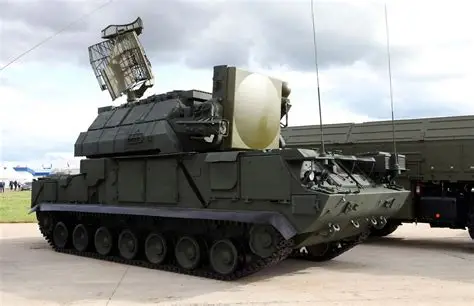
Tor (Russian: «Тор», GRAU 9K330 family, NATO SA-15 Gauntlet) is a Soviet then Russian short-range surface-to-air missile system built so a single tracked — later also wheeled or modular — vehicle can find, track, and kill low-flying aircraft, helicopters, cruise missiles, anti-radiation missiles, guided bombs, and UAVs without waiting for a battery radar net. Search radar, engagement radar, IFF, and the ready missiles live on one transporter-launcher-and-radar (TELAR). That is the design idea: keep up with tanks, shoot on a short halt or, in later marks, on the move, reload from a transporter-loader, and do it inside a 12–16 km bubble.
It replaced Osa (SA-8 Gecko) in the Soviet Army point-defence slot. Naval cousin is 3K95 Kinzhal (SA-N-9), same missile family in a ship magazine, not the same vehicle. Chinese HQ-17 is a related licensed / derived line. Pantsir (covered elsewhere in this database if present) is the later gun-missile companion, not a Tor variant.
Lead plant: Izhevsk Electromechanical Plant Kupol (IEMZ Kupol), now inside Almaz-Antey. Land system accepted 19 March 1986 after 1983–84 trials. Production continues into the 2020s as Tor-M2, Tor-M2K, Tor-M2KM, Tor-M2DT, and export Tor-E2.
PLACE IN THE AIR-DEFENCE STACK
Russian army air defence is layered. S-300/S-400 and Buk own the medium and long fight. Tor owns the last 15 km around a marching brigade, a command post, or an airfield approach. It is meant to catch the weapons that leaked through or were fired inside the outer rings — especially small RCS cruise missiles and, after 2010, drones. A Tor battery is typically several TELARs plus loaders and a maintenance shop (MTO-AG3M1 class), not a separate engagement radar vehicle the way Buk needs a 9S36.
COMBAT VEHICLE
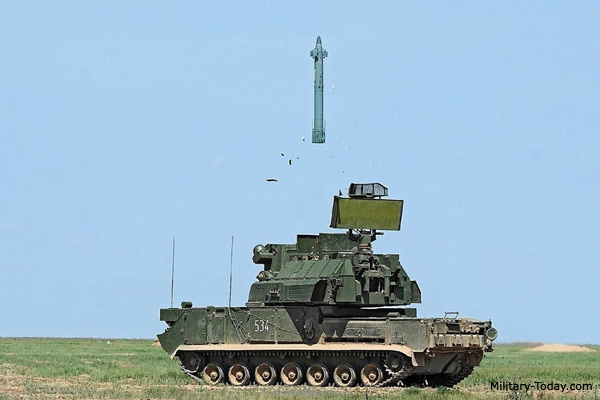
Classic TELAR is 9A330 / 9A331 on a GM-355 then GM-5955 tracked chassis (six then seven road wheels). Handbook Tor-M1 figures: about 34 t, 7.5 m long, 3.3 m wide, 5.1 m high with the search antenna up, 450 mm ground clearance, V-12 diesel around 618 kW / 830 hp, road speed 65 km/h, road range about 500 km, crew three (driver, commander, operator; some early writeups say four). NBC overpressure. Emplace / displace on the order of three to five minutes. Reaction time from a prepared position about 7–9 seconds on M1 figures; a short halt adds a couple of seconds. Fire-on-the-move is advertised from the first generation and is a selling point of M2.
Later hulls: MZKT-6922 6×6 (Tor-M2K / some M2E), Bryansk 8×8 show pieces, and the two-link DT-30PM Vityaz articulated carrier for Tor-M2DT Arctic. Tor-M2KM is a self-contained module that can sit on a truck, a trailer, a warehouse roof, or — after 2015–16 trials — a ship helicopter deck, chained down. Module weight class is well under a full tracked TELAR.
RADARS AND FIRE CONTROL
Top antenna: target-acquisition radar (SOC), F-band pulse-Doppler, originally a truncated parabola, later a planar array on M2. Average power often given as 1.5 kW. Instrument detection on the order of 25 km on M1, 32 km in M2 / E2 brochures, against a fighter-sized target. M2 processing claims: up to 48 plots per revolution, ten or more tracks held. Designation accuracy quoted in older technical notes: about 100 m in range, 20 minutes of arc in azimuth, 2° in elevation.
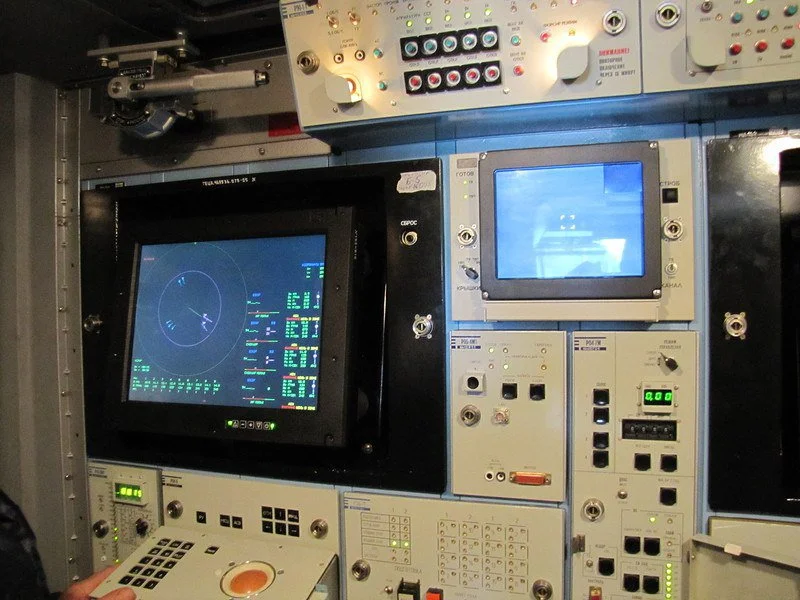
Front face: engagement / guidance radar, G/H then K-band pulse-Doppler PESA (thinned array; one published element count is 570 phase shifters). Sector guidance, not a full-volume AESA. Channels grew with the marks: original Tor one target / two missiles; Tor-M / M1 two targets / four missiles in a roughly 15×15° sector; Tor-M2 four targets / four to eight missiles in a wider 30×30° sector. Optical-TV / electro-optical channel with laser rangefinder is the backup in heavy ECM, published useful range about 20 km. IFF is fitted. Command guidance (ACLOS family): the missile does not carry its own seeker. A radio proximity fuze ends the intercept.
MISSILES
Cold vertical launch from sealed canisters in the turret well. A gas generator pops the round about 20 m up; the solid motor lights once the missile is clear and pointed. Canards and tail antennas; command and beacon links at the back. 9M330 / 9M331 class: length about 2.9 m, diameter 235 mm, mass about 165–167 kg, HE-fragmentation warhead about 14.5–15 kg, burnout speed roughly 700–850 m/s (brochure Mach ~2.8), 30 g class manoeuvre. Engagement box on M / M1: roughly 1.5–12 km in range, 10 m–6 km in height, target speed up to about 700 m/s. Minimum range on the first 9K330 is often given as 2 km; some tables print 100–1,500 m depending on mark and target geometry. Eight ready rounds in two four-packs. Reload on the order of ten minutes with the loader vehicle.
9M338 / 9M338K is the smaller M2-generation round. Sixteen fit where eight 9M331 sat. Published M2 envelope with 9M338K: range out to about 15–16 km, ceiling 10 km, missile speed to about 1,000 m/s, targets to about 1,000 m/s in some factory lines. Mixed load (four old plus eight new) appears in technical discussion; treat mixed-rack numbers as possible, not a confirmed field SOP. Single-shot Pk against a fighter in old Soviet tables ran 0.26–0.75 on 9K330 and 0.45–0.80 on M1 — model values, not combat statistics.
VARIANTS
9K330 Tor (1986) — 9M330, one target channel, GM-355, eight missiles. NATO SA-15A in some older lists. 9K331 Tor-M (1991) — 9M331, two targets, better accuracy. SA-15B. 9K331M / M1 Tor-M1 and Tor-M1T — same missile, M1 often the improved GM-5955 seven-wheel hull; M1T wheeled / towed export layouts. SA-15C in some lists. Tor-M1-2U / M2U straddles the M1 and M2 generations (four-target claim, 10 km ceiling in some Russian service notes). 9K332 Tor-M2 (shown 2007, Russian service from about 2012) — new search antenna, more channels, 9M331 and/or 16×9M338K. Tracked, wheeled (M2K), export M2E, modular M2KM. Tor-M2DT (9K331MDT) — M2 turret on DT-30PM, cold-weather fluids to about −50 °C, Northern Fleet deliveries from late 2018, first dozen vehicles. Tor-E2 — 2019 export “new generation” brochure: 32 km detect, 16 km / 12 km engage, 16×9M338KE, four simultaneous targets. 3K95 Kinzhal — ship system, same missile idea, revolving below-deck drums on Udaloy, Kuznetsov, later hulls. Not a TELAR.
COMBAT USE
Export users include Algeria, Armenia, Azerbaijan, Belarus, China, Cyprus, Egypt, Greece, Iran, and others; Ukraine inherited 9K330 and later pulled some out of storage. The 2020 Nagorno-Karabakh war was the first large UAV test of Armenian Tor-M2KM: open analysis is that a handful of TELARs did not stop a drone-heavy campaign. On 8 January 2020 an Iranian Tor shot down Ukraine International Airlines Flight 752 near Tehran after a ballistic-missile exchange with the United States — a documented fratricide, not a SAM success story.
From 2022 Russian Tor-M1/M2/M2DT have been used in Ukraine as front-line and near-rear point defence against aircraft, cruise missiles, and especially UAVs. They have also been hunted: artillery (including GPS-aided Excalibur on at least two M2DT in early 2023), FPV drones, and loitering munitions. Oryx-class visual counts by autumn 2024 were already in the tens of Tors lost (on the order of sixty mixed marks in one widely cited running list, with Tor-M2 the largest single row). Those lists are floors. The system’s radar-on-the-vehicle signature and the need to radiate to guide a command missile are the usual reasons a TELAR dies once a drone has its grid. Command guidance cannot go fully passive.
WHAT IT DOES NOT DO
It does not replace Buk or S-400. It does not have a fire-and-forget seeker. It does not, in the original eight-round turret, carry a meaningful magazine against a mass FPV raid without reload. It is not Pantsir and has no guns. Naval Kinzhal is a sister, not a drop-in turret on a frigate unless the customer buys the M2KM module and accepts deck-trial limits.
CAVEATS ON THE NUMBERS
Range 12 vs 15 vs 16 km, ceiling 6 vs 10 vs 12 km, detect 25 vs 32 km, missile speed 700 vs 850 vs 1,000 m/s, and “four targets / eight missiles” vs “four / four” all appear in factory and secondary tables for different marks and different missiles. This page keeps the cluster. Unit cost figures from $0.3–0.8 million per missile in press are not contract prices. Russian inventory counts (hundreds of M1-2U / M2 delivered across the 2010s) are MoD / plant statements.
STATUS
In production at Kupol. In Russian Ground Forces, Northern Fleet coastal / Arctic units, and multiple export armies. M2-family vehicles are the current build standard; M2DT exists in small numbers and has already been lost outside the Arctic. The name “Tor” is still the short-range TELAR the rest of the stack assumes will be there when a brigade moves.
IN ONE SENTENCE
Tor is Kupol’s SA-15 family of one-vehicle short-range SAMs — cold-launched 9M330/331 then 16×9M338 command missiles under a folding search radar and a PESA engagement face — built to kill low, fast, small things inside about 15 km, and now a high-demand, high-loss point-defence piece in Ukraine.