WHAT IT IS
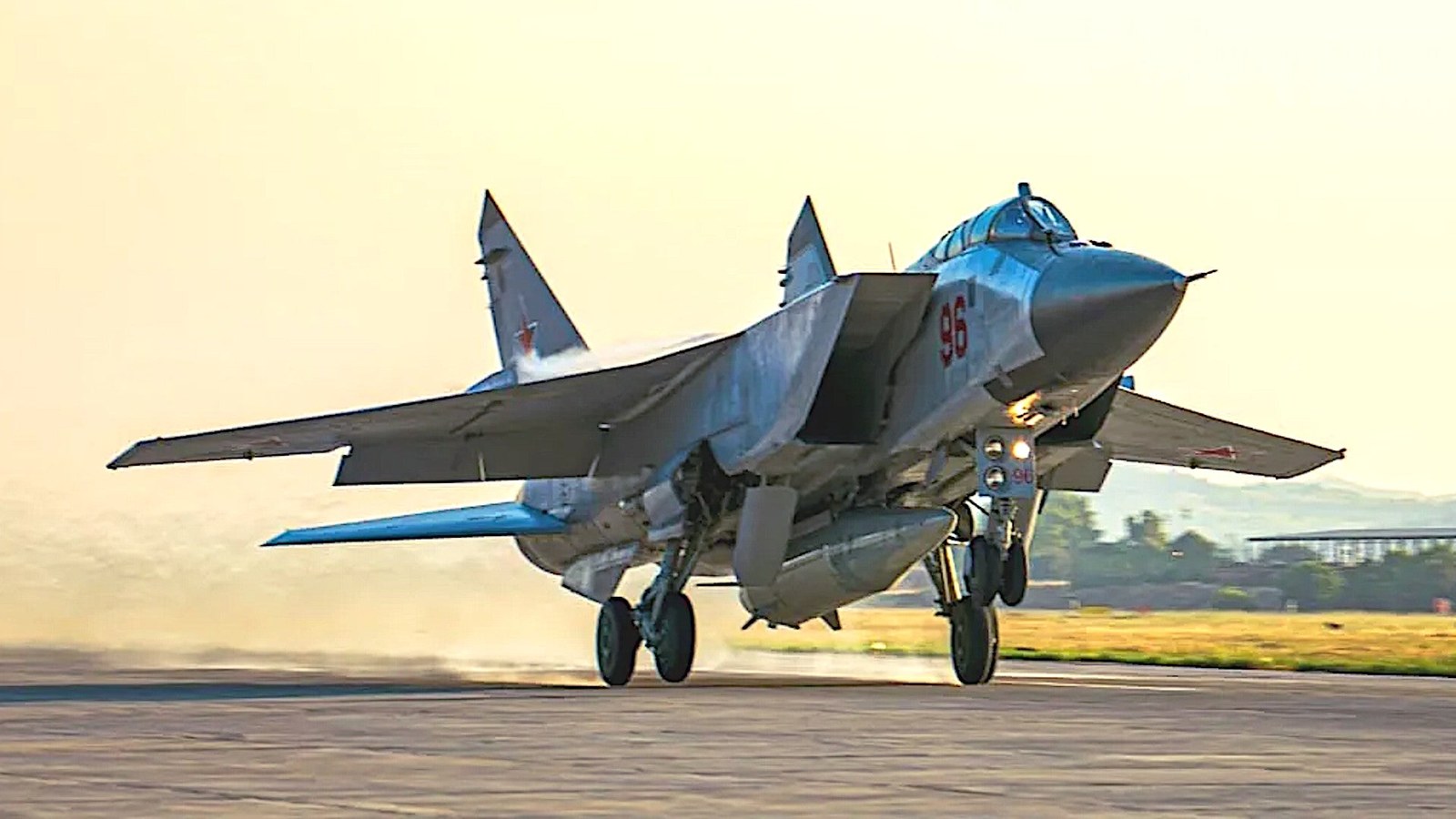
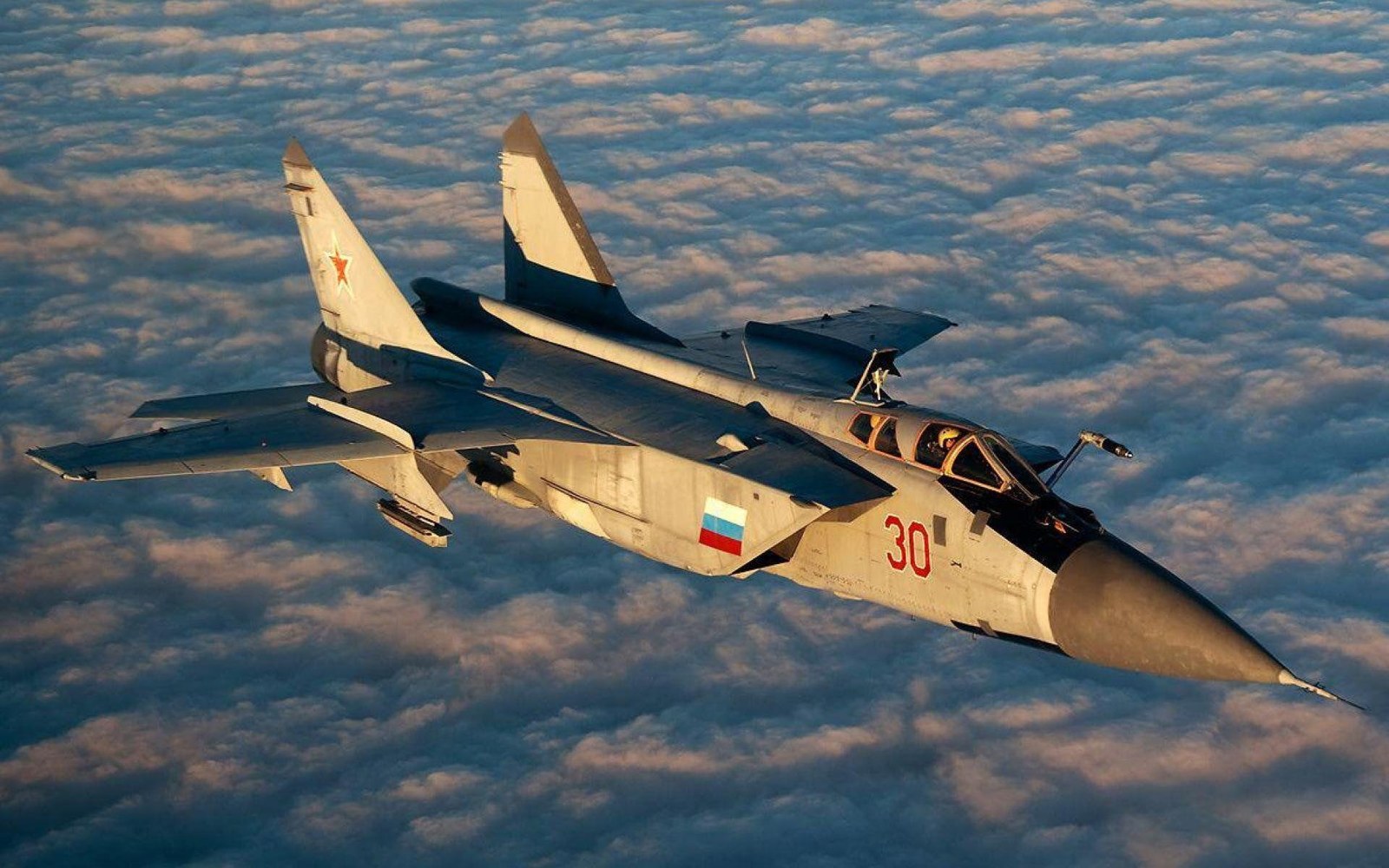
The Mikoyan MiG-31 (МиГ-31; NATO reporting name Foxhound; design-bureau codes Ye-155MP / «изделие 83» for the prototype and «изделие 01» for the first series) is a two-seat, twin-engine, supersonic, high-altitude, all-weather long-range interceptor designed by the Mikoyan design bureau (ОКБ Микояна, OKB-155, today RSK MiG) as the successor to the MiG-25 «Фоксбат» (Foxbat). It first flew on 16 September 1975 and was formally adopted by the USSR on 6 May 1981. Russian Wikipedia calls it the first Soviet fourth-generation combat aircraft. The prototype first flight is credited to test pilot Aleksandr Fedotov.
Its defining features are the N007 «Заслон» (Zaslon, radar designation RP-31) pulse-Doppler radar with a passive electronically scanned array (ПФАР), look-down / shoot-down capability, the ability to guide several long-range R-33 missiles at different targets at once, a digital data link that lets a flight of four aircraft share radar data over a front of roughly 800–1,100 km (sources differ), and a top speed limited in service to about Mach 2.83. It was designed to catch cruise missiles and low-flying bombers across the empty northern and Siberian expanses of the USSR, where there was no dense ground-based air defence network and few airfields.
Production is given as 519 aircraft, built at the Gorky (Gor’kovskiy) aircraft plant, today the Nizhny Novgorod Aircraft Building Plant «Сокол» (Sokol, part of United Aircraft Corporation, ОАК), between 1975/76 and 1994. English Wikipedia calls it the fastest known operational combat aircraft. It is still in Russian service in 2026, in the MiG-31BM and MiG-31BSM modernised forms, and since 2017–2018 a modified version, the MiG-31K, has been the main carrier of the Kh-47M2 «Кинжал» (Kinzhal) air-launched ballistic missile. It is also the aircraft that fires the R-37M very long range air-to-air missile in the war against Ukraine. Kazakhstan was the only other operator and retired its aircraft in 2023.
DEVELOPMENT
Work on a MiG-25 replacement started at OKB-155 in 1968 as «изделие 83», the Ye-155MP. Russian Wikipedia names A. A. Chumachenko as chief designer in the first phase, then G. Ye. Lozino-Lozinskiy during deep engineering and tests; after Lozino-Lozinskiy moved to the «Буран» programme in 1975 the work was led by K. K. Vasilchenko. The requirement was a MiG-25 airframe with a second crew member, much longer range, and a new radar and weapon system able to engage cruise missiles and low-flying targets. The Ye-155MP flew on 16 September 1975. State joint trials (ГСИ) began on 22 April 1976; the first stage ended in December 1978, the second began in September 1979 and ended in September 1980.
The aircraft entered service by a Council of Ministers decree of 6 May 1981 as the interceptor MiG-31 with the RP-31 radar and R-33 missile. Serial production started in 1979 (Russian Wikipedia and TASS, quoting Rogozin) and the first aircraft went to test and trials units; the first production batches were very small (two, three, then six aircraft). Line units began to receive the type from 1980–1983: the first were the 786th fighter regiment (786-й ИАП, Pravdinsk) and the Air Defence Combat Application Centre at Savasleyka («Саваслейка»). In September 1984 the new interceptors went on combat alert at Sokol on Sakhalin. The MiG-31 replaced the Tu-128 and the Su-15 in the Soviet Air Defence Forces (Войска ПВО).
The West learned of the project from Lt. Viktor Belenko, who defected to Japan with a MiG-25P in 1976 and described a two-seat “Super Foxbat” able to intercept cruise missiles. English Wikipedia notes that his description of MiG-23-style intakes did not match the production aircraft.
The programme did not stop with the first series. A major redesign, the MiG-31M («изделие 05»), began in 1984 and flew in 1985 (English Wikipedia; Russian Wikipedia gives 1993 as the date of a “modernisation” and that figure does not match other sources). It had a new radar, a rounded one-piece windscreen, six fuselage missile stations and uprated engines, but only one prototype and six pre-production aircraft were built before the Soviet collapse. The MiG-31M is the origin of the R-37 missile and of the Zaslon-M radar that later returned in the MiG-31BM upgrade. A planned replacement under the name PAK DP (ПАК ДП), with the unofficial name MiG-41, was announced from 2013–2014; English Wikipedia states that the aircraft has not appeared, and no source found shows a flying prototype.
AIRFRAME
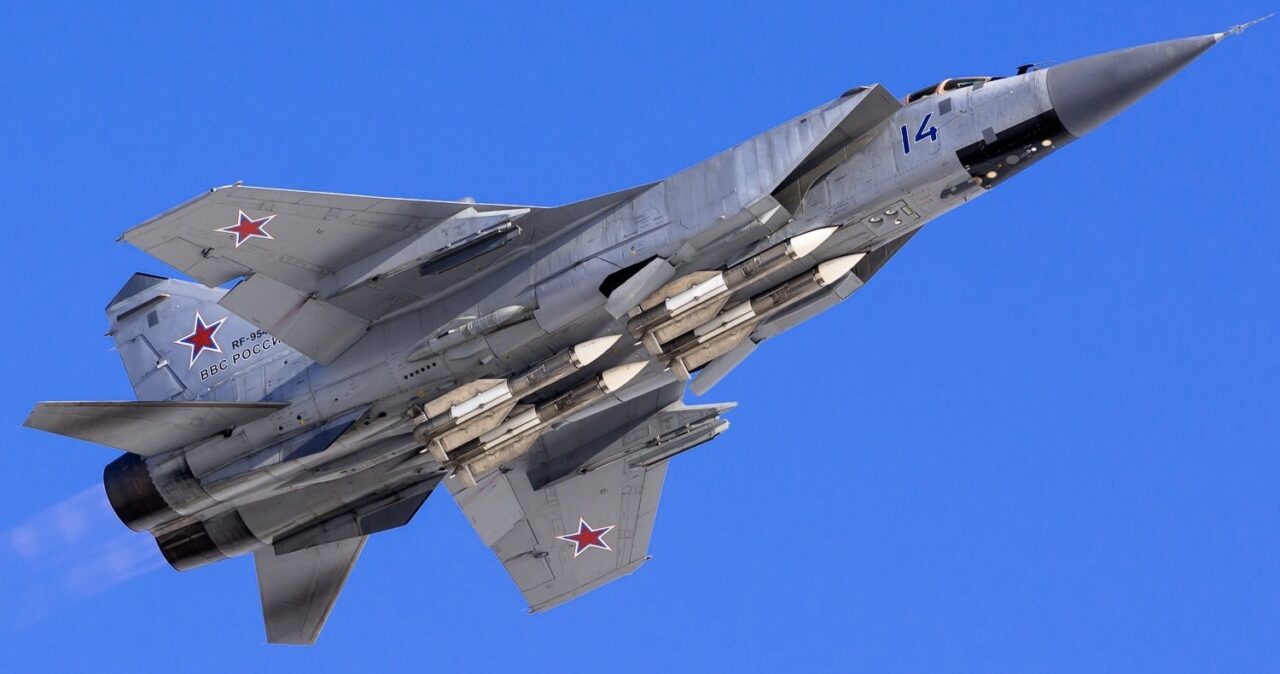
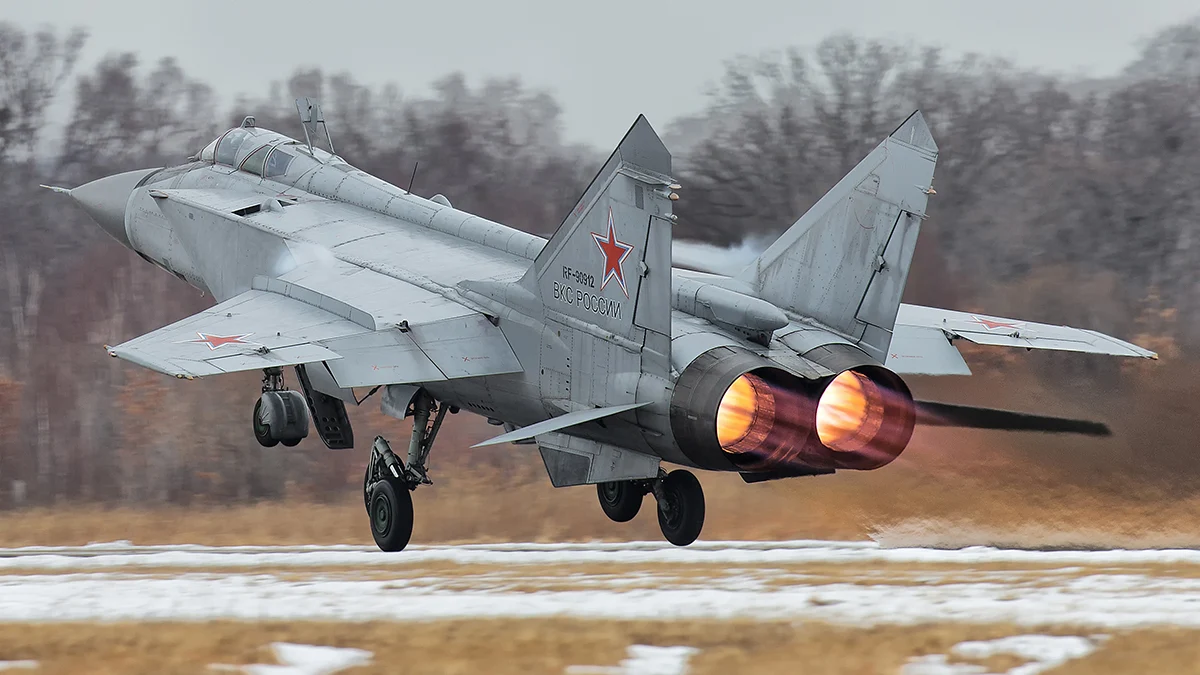
The airframe is based on the MiG-25 but is a substantially new design (English Wikipedia). It is a large twin-engine aircraft with a high-set trapezoidal wing, rectangular side intakes with automatic ramps, twin fins and all-moving tailplanes that move together for pitch and differentially for roll. The wing has a leading-edge sweep of 41 degrees with a 70-degree root extension, three spars, slotted flaps, ailerons and four-section drooping leading-edge flaps (13 degrees); the fins are canted outward at 8 degrees and two ventral fins under the rear fuselage are canted at 12 degrees. The tailplane and rudders are driven by irreversible hydraulic actuators, and the control system is three-channel with the САУ-155 autopilot. Controls are duplicated and the rear cockpit has a telescoping stick.
The fuselage is a welded semi-monocoque of 57 frames in three sections (nose, centre, tail). The nose is aluminium alloy and carries the radar, avionics bay and cockpits. Compared with the MiG-25, less stainless steel was used because the maximum speed and heating are lower. Material shares are given as about 49–50 percent steel, 33 percent light alloy, 16 percent titanium and about 2 percent composites. Russian Wikipedia says the fuselage can create up to 25 percent of the lift and that the four main missiles are semi-recessed in it.
The landing gear is a retractable tricycle. The nose unit has two 660 × 200 mm wheels with a mud guard behind them; each main unit is a two-wheel bogie (950 × 300 mm) with the rear wheel offset outward so each wheel follows its own track, improving use on soft, grass and ice airfields (Russian Wikipedia). A container in the tail holds two brake parachutes, and a retractable in-flight refuelling probe is fitted to MiG-31B and later aircraft. Fuel is carried in fuselage, wing and fin tanks, and two 2,500-litre drop tanks can be carried on the outer wing pylons. The airframe is limited to about 5 g, and English Wikipedia states that the wings and structure are stronger than those of the MiG-25 and allow supersonic flight at low altitude.
ENGINES
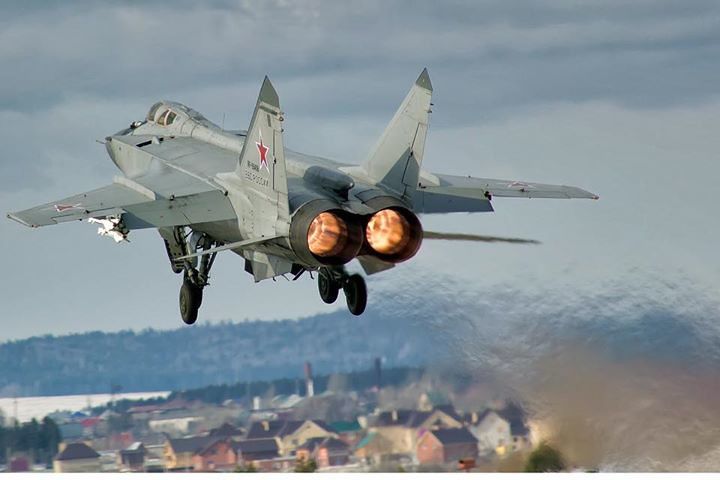
The MiG-31 uses two Soloviev D-30F6 (Д-30Ф6) afterburning turbofans, developed by the Soloviev design bureau (today Aviadvigatel, АО «ОДК-Авиадвигатель», Perm) and built by Perm Motors (Пермский моторный завод). A MiG-31 stands as a monument at the Aviadvigatel main gate in Perm (Russian Wikipedia). The D-30F6 (first run 1979) is a development of the civil D-30 of the Tu-134 (1967) with an afterburner and a supersonic nozzle. It is a two-spool, modular engine with a bypass ratio of about 0.57, a five-stage low-pressure compressor, a ten-stage high-pressure compressor, a tubular-annular combustor and two-stage turbines. The maximum turbine inlet gas temperature is given as 1,660 K, and the dry mass as 2,416 kg (Russian Wikipedia gives 2,146 kg in a table; the text and other sources say 2,416 kg).
Rated thrust is about 9,500 kgf (93 kN) dry and 15,500 kgf (152 kN) with afterburner per engine, quoted consistently by English and Russian Wikipedia. The afterburner is lit by the “fire track” (огневая дорожка) method. Russian Wikipedia says the engine showed afterburner combustion instability in development, which was fixed with a modified manifold (this claim is marked as lacking a source there). The MiG-31M used a more powerful D-30F6M of the same family and the planned MiG-31I is reported to have different engines (English Wikipedia, citing a press report; not confirmed by an official source found).
Performance consequences: with this engine the aircraft is limited to Mach 2.83 at altitude and about Mach 1.23–1.25 at low level. English Wikipedia states that thrust-to-drag is enough for speeds above Mach 3, but such flight risks damage to the engines and airframe. In service the type usually cruises at Mach 2.3–2.55 (2,500–2,800 km/h) at altitude. Russian Wikipedia quotes the air force commander in 2013 as saying the aircraft could no longer be flown above about Mach 1.5 because canopy glass of the right quality was no longer produced; this was a claim made in a state duma hearing and no later official statement confirming or correcting it has been found.
RADAR AND AVIONICS
The core of the aircraft is the weapon control system built around the RP-31 N007 «Заслон» (Zaslon), a pulse-Doppler radar with a passive phased array (ПФАР), developed by NII Priborostroyeniya (НИИ приборостроения, today the Tikhomirov Scientific Research Institute of Instrument Design, Zhukovskiy). It was adopted in 1981. Russian Wikipedia calls the MiG-31 the first fighter in the world fitted with a phased-array radar; English Wikipedia says “among the first” and that it was the only fighter in service with a phased-array radar until about 2000, when the Japanese F-2 entered service with an active array (AESA). Both descriptions agree the Zaslon was an important first for an operational fighter, but note that the antenna is passive (one transmitter, steerable by phase shifters), not active.
Quoted figures for the original Zaslon: detection of a bomber-size target (radar cross-section 19 m²) about 200 km head-on, about 180 km for 5 m²; about 35 km against a 3 m² fighter-size target from behind (50 percent detection probability); automatic tracking and engagement range about 120 km; sources differ on target handling: English Wikipedia says the original radar tracked 10 targets and engaged 4 (later improved to 24 and 6), while Russian Wikipedia gives 24 detected targets with 4 priority targets selected automatically for R-33 missiles. The angular field of view is given as 140 degrees in azimuth and −60 to +70 degrees in elevation. A retractable infrared search and track unit (8TP / 8ТП, range up to about 56 km) is mounted under the nose and cues IR-guided missiles. The radar works in look-up and look-down modes and can detect cruise missiles flying low against ground clutter.
The upgraded Zaslon-M (also called Zaslon-AM in some reports) has a larger antenna (English Wikipedia: 1.4 m) and is fitted to the MiG-31M and MiG-31BM. The program was finished in 1998 and the radar reached the troops from 2008 in the MiG-31BM (Russian Wikipedia). The MiG-31BM detection range for air targets is given as about 320 km and engagement range about 280 km; up to 400 km is quoted for an AWACS-size target of 19–20 m² and about 282 km for 5 m². The BM tracks up to 24 targets and can engage up to 6–8 of them. These are manufacturer and press figures and no independent measured numbers have been found. In April 1994 the Zaslon-M with an R-37 reportedly hit a target at 300 km (English Wikipedia, citing Ilyin 2001).
Data link and group operation: the digital secure link APD-518 (АПД-518) lets four MiG-31 exchange radar data over a distance of up to about 200 km, and the RK-RLDN (АК-РЛДН) link works with ground command posts, including the «Рубеж» automated ground control system (range to about 2,000 km). The leader can use the data link to give targets to up to four less-capable fighters such as MiG-23, MiG-29, Su-15 or Su-27 without those aircraft turning on their radars (English Wikipedia lists these aircraft types, Russian Wikipedia lists MiG-23/29 and Su-19/27). A group of four can reportedly cover a front of 800–900 km (English Wikipedia) or up to 1,100 km (Russian Wikipedia). The type can also exchange target data with the A-50 airborne early warning aircraft.
Navigation and defence: the navigation complex is the КН-25 with two inertial systems (ИС-1-72А) and a digital computer, the «Радикал-НП» (A-312) or A-331 short-range navigation aid, the A-723 «Квиток-2» long-range navigation aid, and the radio-navigation systems «Тропик» (Loran-like) and «Маршрут» (Omega-like). The defensive suite includes the SPO-15SL radar warning receiver and radar and infrared countermeasure dispensers. The MiG-31BM uses a new central computer (English Wikipedia: Baget-55-06; Russian Wikipedia names the older Argon-K as the one replaced or used as the base) and a satellite navigation receiver, with avionics partly shared with the MiG-29SMT.
CREW AND COCKPIT
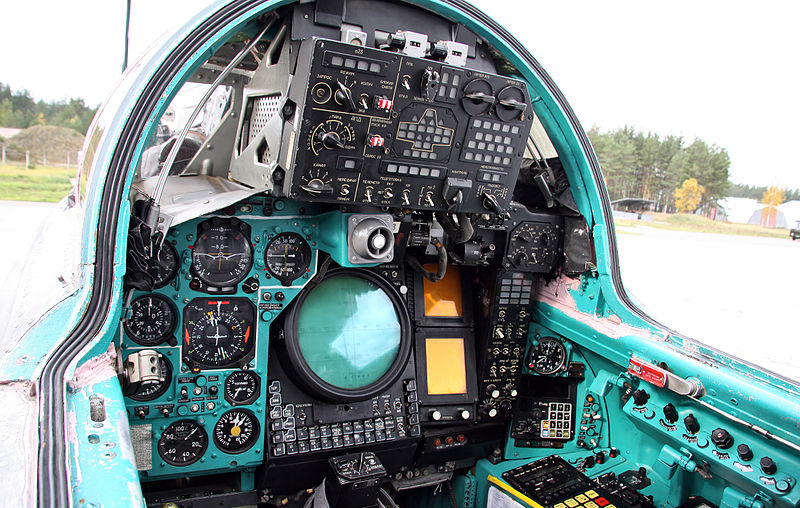
The crew is two in tandem: a pilot in front and a navigator-operator (штурман-оператор, weapon systems officer) behind. The rear seat controls the radar and weapons and is normally not used to fly the aircraft, although a telescoping stick and basic flight controls are fitted there. The two cockpits are pressurised and separated by a 10 mm transparent partition. Each has a hinged canopy section, and the rear cockpit has only two small side windows. Both crew sit on К-36ДМ ejection seats, which are described as usable at any altitude and speed (English Wikipedia: zero/zero).
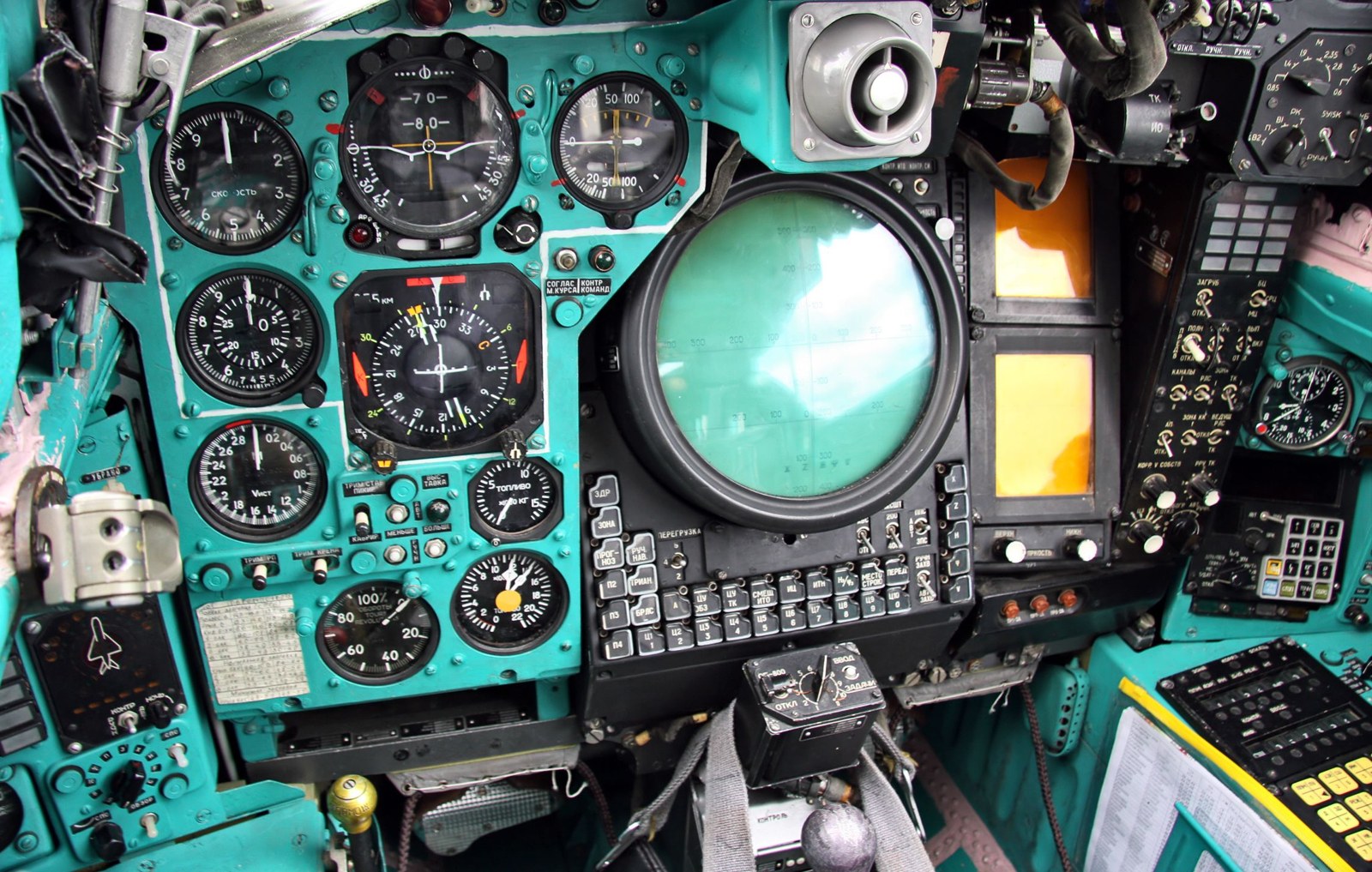
The older cockpits use round analogue instruments and a CRT-style radar display in the rear. In the MiG-31BM the Russian avionics company «Русская авионика» redesigned both cockpits: the pilot has a single 6 × 8 inch multifunction liquid-crystal display on the right of the panel (the same as the MiG-29SMT) and a head-up display, and the navigator has three such displays showing tactical, navigation, radar and weapon-camera imagery. The pilot can now see the tactical picture that previously only the rear seat had. The MiG-31BSM has a heat-resistant canopy glass, one display for the pilot and three for the operator, and a visible periscope above the front canopy (English Wikipedia).
On 11 April 2008 the left canopy section of a MiG-31 flying at about 16,200 m and 2,400 km/h (true speed) was torn off, depressurising both cockpits at an outside temperature below −55 °C. Russian Wikipedia reports that the crew descended and landed safely and were put forward for state awards.
ARMAMENT
Gun: one 23 mm GSh-6-23M six-barrel rotary cannon with 260 rounds, in a fairing on the right side of the fuselage (the MiG-25 had no gun). The rate of fire is quoted as at least 8,000 rounds per minute at normal temperature.
Air-to-air missiles, original MiG-31: four R-33 (Р-33, AA-9 Amos) long-range missiles semi-recessed under the fuselage. Quoted R-33 range is 120 km for the 1981 original and about 160 km for the R-33S (1999); Russian Wikipedia also cites a figure of 304 km for a 2012 version, which I treat as unconfirmed. Four wing pylons (two normally used for drop tanks) carry short and medium-range missiles: the R-40T/R-40TD (AA-6 Acrid, old MiG-25 missile, 80 km for the later R-40RD), R-60 (AA-8), R-73 (AA-11) and, on upgraded aircraft, R-77 (RVV-AE, AA-12) and R-74M.
MiG-31BM: carries up to six R-37M (Р-37М, NATO AA-13 Arrow; export name RVV-BD) very long range missiles. The R-37 was developed by Vympel for the MiG-31M and uses inertial guidance with radio correction and active radar terminal homing. Published figures differ sharply: the official Rosoboronexport RVV-BD data give a launch weight of 510 kg, a 60 kg warhead and a maximum range of up to 200 km, while Russian and Western press figures for the domestic R-37M give 280–400 km (English Wikipedia: 280–400 km depending on the paragraph). The 2022 RUSI report gave about 320 km as the range and said it was fired up to six times per day in October 2022. No official figure is available for the Russian domestic version, so the longer numbers should be read as claims.
Air-to-ground weapons on MiG-31BM and later: Kh-31P and Kh-31A (anti-radiation and anti-ship), Kh-58 anti-radiation, Kh-25MP/MPU, Kh-29T, Kh-59 / Kh-59M, and KAB-500 or KAB-1500 guided bombs. Quoted load limits are up to six Kh-31 or six KAB-1500, or eight KAB-500, with a maximum combat load of 9,000 kg (marked “citation needed” in English Wikipedia; Russian Wikipedia’s specification table gives a 5,000 kg payload on eight stations, so treat 9,000 kg as a maximum figure from older reference works). Russian Wikipedia states at least one use of the Kh-31P in Ukraine has been recorded.
Special weapon: one Kh-47M2 «Кинжал» (Kinzhal) air-launched ballistic missile on the MiG-31K and MiG-31I. See KINZHAL CARRIER below.
SPECIFICATIONS
Figures below are for the baseline MiG-31 / MiG-31B and vary by source and variant. Where two sources disagree both are shown. Sources: English Wikipedia (Great Book of Modern Warplanes, Mikoyan, Combat Aircraft since 1945) and Russian Wikipedia.
Crew: 2. Length: 22.62 m (English Wikipedia), 22.69 m (Russian Wikipedia). Wingspan: 13.456–13.46 m. Height: 6.456 m. Wing area: 61.6 m². Empty weight: 21,820 kg (both). Normal loaded weight: 39,150 kg to 41,000 kg. Maximum takeoff weight: 46,200 kg (English Wikipedia) or 46,750 kg (Russian Wikipedia); the MiG-31M was 52,000 kg.
Fuel: sources do not agree. English Wikipedia gives 16,130 kg internal; Russian Wikipedia’s text says 18,300 litres in 13 tanks, and its table says 17,730 kg (21,888 litres), which are inconsistent with each other. Two 2,500 litre drop tanks can be added.
Powerplant: two D-30F6, 9,500 kgf dry and 15,500 kgf (152 kN) afterburning each.
Speed: maximum Mach 2.83 (about 3,000 km/h) at altitude; Russian Wikipedia lists 3,100 km/h for the MiG-31BM. About 1,500 km/h (Mach 1.23–1.25) at low level. Supersonic cruise 2,500–2,800 km/h (Mach 2.3–2.55). Landing speed about 280 km/h.
Range: about 3,000 km practical range with four R-33 and two drop tanks, without refuelling; about 5,400 km with one aerial refuelling (Rosoboronexport data on the MiG-31E, quoted by both Wikipedias). Without drop tanks the subsonic practical range is about 2,240–2,480 km depending on load. Combat radius is quoted as 1,450 km at Mach 0.8 and 10,000 m, or 720 km at Mach 2.35 and 18,000 m. Flight time is up to 3.3–3.6 hours without refuelling.
Ceiling: Russian Wikipedia gives 22,500 m practical and up to 30,000 m dynamic; English Wikipedia gives “25,000 m +”. Rate of climb: English Wikipedia 288 m/s, Russian Wikipedia 160 m/s at sea level and 250 m/s at 11 km; these are not the same condition and are not comparable. Takeoff run 950–1,200 m, landing roll about 800 m (Russian Wikipedia). Load factor limit 5 g.
Armament: one GSh-6-23M with 260 rounds, four semi-recessed fuselage stations and four underwing pylons.
Record flight: Russian Wikipedia reports that MiG-31BM crews of the 14th Air and Air Defence Army set a non-stop endurance record of 7 hours 4 minutes and more than 8,000 km with three aerial refuellings, dated 2013; English Wikipedia describes the same flight (7 h 4 min, 8,000 km) but cites a 2016 news report, so the date is uncertain.
VARIANTS
Ye-155MP (МиГ-25МП, «изделие 83»): prototype, first flight 16 September 1975.
MiG-31 («изделие 01»): first series. English Wikipedia gives 349 baseline aircraft built at Sokol between 1976 and 1988 within the 519 total (another passage says about 500 of the type were built).
MiG-31DZ / «изделие 01DZ»: same aircraft with the aerial refuelling probe. English Wikipedia says about 100 were produced in 1989–1991 (45 new, the rest converted from earlier aircraft); its avionics cannot be brought up to BM standard.
MiG-31B («изделие 01Б»): second main production version, from 1990, with refuelling probe, improved ECM and radar protection, and the R-33S missile. English Wikipedia ties the new radar variant to the compromise of Phazotron radar information by the engineer Adolf Tolkachev (a claim from the Western literature). MiG-31BS («изделие 01БС»): older aircraft converted to B standard.
MiG-31BM (Большая модернизация, “Big Modernisation”): deep upgrade of MiG-31B/BS with Zaslon-M radar, new computer, LCD displays, HOTAS controls, R-77 and R-37 compatibility and air-to-ground weapons. State tests were completed in 2008 and the first two aircraft entered service that year (Russian Wikipedia, citing Gudok); Russian Wikipedia gives the start of the upgrade work as 1998. Russian officials claim 2.6 times the effectiveness of the base aircraft.
MiG-31BSM: a 2014-contract upgrade of the BS version, similar to the BM with a refuelling probe, new central computer, one display for the pilot and three for the operator, new navigation equipment and a rear-view periscope above the front canopy (English Wikipedia).
MiG-31K: BM-based carrier for the Kh-47M2 Kinzhal. See below. MiG-31I: an advanced conversion of MiG-31K aircraft; TASS reported in April 2024 that the MiG-31I fighters had been fitted with an air refuelling system and that the crews had completed training. English Wikipedia says that it also has other engines, avionics and missiles and a remote launch control system, based on press reports.
MiG-31M («изделие 05»): redesigned interceptor of 1984–85 with a new radar, six fuselage missiles, no gun, uprated D-30F6M engines, a right-side refuelling probe, digital flight controls and CRT displays. One prototype and six pre-production aircraft; no series production.
MiG-31D («изделие 07»): anti-satellite carrier for the 79M6 «Контакт» (Kontakt, 30P6 system) missile, first flown January 1987 (Key.Aero). Two prototypes were built (English Wikipedia; Russian Wikipedia says three went to Kazakhstan). It had ballast instead of a radar, a flat belly and winglets. The programme was suspended in 1991 and, according to Popular Mechanics, the Kontakt system was never tested against a satellite. MiG-31DM with the improved 95M6 missile was a follow-on study.
MiG-31E: export version with simplified avionics, never built in series. MiG-31F / MiG-31FE: planned fighter-bomber and export version. MiG-31LL: flying laboratory for ejection seat testing (Zhukovskiy). MiG-31I «Ишим» (Ishim) and MiG-31S: proposed air-launch carriers for small satellites (about 120–160 kg to low orbit); not built.
«изделие 08» / Burevestnik: some MiG-31BM (aircraft 81, 06 and 94, seen at Zhukovskiy) were modified in 2018 to carry a large new missile (project «293», complex 14K168 «Буревестник»). Open-source analyses (The Space Review, Key.Aero, King’s College London) interpret it as an anti-satellite or small-satellite-launch system, with the mock-up only shown in September 2018. A test was reportedly planned for late 2022 but no evidence shows that it took place (KCL paper). This is not the same project as the nuclear-powered cruise missile that has the same name.
KINZHAL CARRIER (MiG-31K)
The Kh-47M2 «Кинжал» (Kinzhal, “Dagger”) is an air-launched ballistic missile revealed by President Putin on 1 March 2018 as one of six “next generation” weapons. CSIS Missile Threat and several Western analysts assess it as an air-launched derivative of the 9K720 Iskander-M short-range ballistic missile. Reported figures: length about 8 m, diameter about 1 m, launch weight about 4,300 kg, payload about 480 kg, conventional or nuclear warhead, and range of 1,500–2,000 km (Russian officials claim more than 2,000 km including the aircraft’s own radius; the Russian Ministry of Defence reported a test launch to more than 1,000 km in 2019). Russia claims a speed up to Mach 10; CSIS notes that “hypersonic” is somewhat misleading because nearly all ballistic missiles exceed Mach 5 at some point of flight.
The MiG-31K is a modified MiG-31BM. One Kinzhal is carried on the centreline. English Wikipedia reports that the auxiliary power unit used for the air-to-air missiles was removed, so that the aircraft’s sole role became long-range strike. Russia said ten MiG-31K began trial combat duty in the Southern Military District on 1 December 2017 and TASS repeated that number on 5 May 2018; Russian Wikipedia gives the same date. The aircraft shown at the 2018 Victory Day rehearsal and a test launch released on 11 March 2018 (the Russian MoD said the missile hit its target on a range) were the first public views. CSIS noted a 2018 report that the first aircraft were based at Akhtubinsk. Savasleyka (Саваслейка) has also been named as a base: Defense Express says shelters were built there from 2021 for the 44th long-range aviation regiment equipped with MiG-31K; the regiment number has not been confirmed by a second source.
Tactics: the aircraft climbs and accelerates to supersonic speed and launches from high altitude, mostly from Russian airspace (the Ukrainian Air Force reported launches from Lipetsk Oblast on 27–28 July 2025). The missile follows a quasi-ballistic flight path and is hard to intercept; Ukraine has intercepted some with Patriot systems. The Tu-22M3 bomber can also carry the missile (CSIS, TASS 2018 report of range over 3,000 km from the Tu-22M3). In 2025 imagery reportedly showed a Kinzhal-armed MiG-31 refuelling from an Il-78 (Army Recognition, Kyiv Post); this extends loiter time and lets the carrier operate from further away.
Use in Ukraine: Russia’s Ministry of Defence claimed the first combat use on 18–19 March 2022 against an ammunition depot at Delyatyn (Deliatyn) in western Ukraine (CSIS, BBC). Ukraine reported the first Patriot interception on 4 May 2023, and on 16 May 2023 said it shot down six Kinzhals fired at Kyiv (US officials said one may have damaged a Patriot battery, with limited evidence). Counts are uncertain: a Ukrainian-media summary (112.ua, citing the Slovo i Dilo infographic) gives more than 230 launches since 2022, roughly 10+ in 2022, 40+ in 2023, 70+ in 2024, about 100 in 2025 and 10+ in 2026 up to 21 June, with about half intercepted. The Ukrainian Air Force itself reported 86 Kinzhals destroyed by 25 February 2026 and 91 by 2 August 2026, which implies a lower interception share (about 40 percent on 230 launches). One 2025 academic summary (University of South Florida) estimated about 37.5 percent. In June 2025 the Air Force reported 8 of 17 intercepted. These are Ukrainian-sourced figures and are not independently verified.
OPERATORS
Russia (current). Russian Aerospace Forces (ВКС России). Home bases in sources include: the 790th Fighter Aviation Regiment at Khotilovo / Borisovskiy (Tver Oblast); the 4th Centre for Combat Application and Crew Training at Savasleyka (Nizhny Novgorod Oblast); the 764th at Perm Bolshoye Savino; the 712th Guards at Kansk; the 22nd Guards at Tsentralnaya Uglovaya (Primorskiy Krai); the 98th Composite Aviation Regiment at Monchegorsk (Murmansk Oblast, Arctic); and the 929th GLITs at Akhtubinsk (test centre). Russian Wikipedia’s unit list and strengths are partly marked as unsourced and old, so unit sizes are not given here. Russian Naval Aviation (Морская авиация ВМФ): the 7060th air base at Yelizovo, Kamchatka (Pacific Fleet).
Fleet figures from The Military Balance (IISS), as reported by secondary sources: 2023: 85 MiG-31BM and 12 MiG-31K in the Aerospace Forces plus 32 MiG-31BM in naval aviation (129 total). 2024: 88 MiG-31BM and 24 MiG-31K plus 30 MiG-31BM in naval aviation (132 to 142 total, per Defense Express). 2026 edition, as quoted by Russian Wikipedia: 99 MiG-31BM and about 24 MiG-31K in the Aerospace Forces; 9 MiG-31B/BS and 9 MiG-31BM in naval aviation. The figures are estimates and they do not include accident or combat losses.
Kazakhstan (former). Kazakh Air Defence Forces, 610th Air Base at Sary-Arka. Kazakhstan inherited about 50 MiG-31 and retired the type in 2023 (31 listed in 2022–2024 stocks, in storage). The aircraft were put up for auction in 2023. A report that the United States bought them in April 2024 was widely disputed (Business Insider: claims are likely false) and it remains unclear who bought them.
Failed or proposed export sales: Syria (reports of five to eight MiG-31E in 2007, denied by Russia and suspended in 2009), Iran (offers in 1990–92 and about 2001, cancelled under US pressure, per English Wikipedia), India (offered a MiG-25 trade-in and a Russian flight evaluation; the Indian Air Force did not buy), Algeria (offered a trade-in deal in 2005, nothing followed) and Finland (offered in 1992, not accepted). The type has never been exported.
OPERATIONAL HISTORY
Soviet period: MiG-31 regiments were assigned to the PVO and for some years had special-forces (СпН) status. They covered the Arctic, Siberian and Far East approaches. Early service was marked by engine fires and fuel-system faults; Russian Wikipedia lists many accidents from 1979 on, including the 4 April 1984 loss of chief test pilot Aleksandr Fedotov and navigator Valeriy Zaytsev at Ramenskoye, whose cause is given in two different versions (a fuel-system alarm fault or an inter-shaft bearing failure and engine disintegration).
Russian period before 2022: during the second Chechen war MiG-31 and A-50 aircraft watched the airspace over Chechnya. In November 2016 MiG-31 were sent to Syria (Hmeimim); the Ministry of Defence said they would cover the base and control air operations, partly instead of A-50 aircraft. On 26 April 2017 a MiG-31 was shot down by an R-33 fired by another MiG-31 at the Telemba range in Buryatia during an exercise, and both crew ejected; the cause is from a leaked document reported by The Drive (2019), not an official Russian statement. In April 2013 the air force commander told the State Duma that the avionics were 1970s technology that could not be modernised and that the aircraft were stored outdoors with airframe damage; this was the background to the upgrade contracts.
Ukraine, 2022 onward: According to RUSI (7 November 2022), the VKS divided the front into eight zones and kept a pair of Su-35S or MiG-31BM in each zone as a patrol, and the MiG-31BM with the R-37M became “especially problematic” for Ukrainian aircraft; up to six R-37M were fired per day in October 2022. The MiG-31 can launch from high altitude and long range, outside the reach of Ukrainian fighters and most of their air defences, so Ukraine has tried to hit the aircraft on the ground. Russian sources state that a MiG-31 shot down a Ukrainian Su-24 with an R-37M in 2022 (statement by a Russian pilot on Zvezda TV, not independently verified) and a pro-Russian channel claimed an R-37M kill of a MiG-29 in 2023 (no independent confirmation).
Losses and incidents: on 1 October 2022 a MiG-31BM with a full missile load rolled off the runway at Belbek (Crimea), fell over a cliff and exploded; Russian Wikipedia says one crew member, Col. Roman Vdovychenko, died. On 15 May 2024, ATACMS strikes on Belbek were assessed from imagery to have destroyed two MiG-31 (TWZ, Maxar). Oryx counted three MiG-31BM lost by 8 September 2024. On 18 December 2025 Ukraine said it destroyed a MiG-31BM with a full missile load at Belbek with a drone, supported by geolocated SBU video (ISW, TWZ), and on 26 April 2026 the SBU announced it had targeted a MiG-31 at Belbek (Kyiv Independent). These are Ukrainian claims, partly supported by imagery. Non-combat accidents continue: a crash in Krasnodar Krai in July 2024 and a crash on approach in Lipetsk Oblast on 9 October 2025, both crews ejected (Russian Wikipedia).
NATO airspace: on 19 September 2025 three MiG-31 were intercepted by Finnish aircraft over the Gulf of Finland and then entered Estonian airspace for about 12 minutes without a flight plan and with transponders off. They were escorted out by Italian F-35. Estonia requested NATO Article 4 consultations (New York Times, via English Wikipedia).
RUSSIAN AIR FORCE FLEET AND MODERNIZATION
Size. Production of 519 aircraft is the starting point; the Russian fleet is smaller because of age, accidents, retirements and the share kept by Kazakhstan. Estimates from The Military Balance are 129 (2023 edition), about 142 (2024 edition) and about 140 (2026 edition, as quoted by Russian Wikipedia) including the Navy. English Wikipedia’s range for 2020 was 85 to 131 MiG-31BM. Military Watch Magazine says that more than a hundred unused, relatively well preserved airframes remain in storage and can be refurbished, but no official number is available. There is no official fleet total.
Upgrade programme. A first Ministry of Defence contract with Sokol of 2011 covered more than 50 aircraft to MiG-31BM standard, planned for completion by 2019. In November 2014 the ministry signed a second contract with UAC worth more than 30 billion roubles for more than 50 aircraft (planned to 2018), with RSK MiG, the Sokol plant and the Saint Petersburg Zaslon scientific technical centre taking part. A third contract was reported in January 2019 (Interfax), and UAC’s president Yuriy Slyusar then said the whole fleet would be modernised by 2023 (a claim that has not been met: the modernisation was still in progress in 2024–2026). Deliveries: 18 aircraft in 2014; the first 24 reported by Deputy Minister Borisov on 9 April 2015; further batches handed over by Sokol in 2023 (4 December 2023), 2024 (15 July 2024) and later, with UAC and Rostec not giving quantities. Rostec says updated fighters return “with the same flight performance as designed, but with wider functions”.
Life extension. In 2020 the Ministry of Defence announced that the service life of existing airframes would be extended from 2,500 to 3,500 hours, and English Wikipedia reports that the service is expected until at least 2030. The MiG-31BM, BSM and K versions all depend on older Soviet-built airframes.
Production and restart. Serial production ended in 1994. On 8 August 2014 deputy prime minister Dmitriy Rogozin suggested restarting production at Sokol, but it never happened; English Wikipedia says that development of a successor (MiG-41 / PAK DP) was preferred. As of 2026 there is no credible source that the MiG-31 has been put back into production or that a new-build contract exists; Sokol repairs and modernises existing aircraft to the BM and K standards. In July 2026 the head of UAC, Vadim Badekha, said Sokol’s facilities had been offered as a base for series production of light civil aircraft (the plant also builds parts for Il-114-300, MS-21-310 and other types), and a MiG designer, Nikolay Chikunov, said in September 2026 that the MiG-31 still has room for development and that if too little free capacity remains at Sokol after civil work, that would limit it. The deputy minister of industry said Sokol had not been officially chosen. Sokol thus continues to modernise MiG-31, but its future workload is not settled.
2022–2026 developments. The war has increased the number of aircraft on patrol and has made the MiG-31BM with R-37M a priority; Military Watch Magazine says that the Ministry of Defence increased the number of MiG-31 on duty after 2022 by restoring stored airframes (the number and source of this are not official). The MiG-31K grew from an estimated 12 aircraft (2023) to 24 (2024) according to The Military Balance, which would imply a conversion programme, and the MiG-31I with restored air refuelling was reported complete in April 2024. Losses so far: at least three MiG-31BM confirmed by Oryx to September 2024, plus the 18 December 2025 Belbek claim and the 26 April 2026 SBU claim (both Ukrainian statements), and non-combat crashes in 2022, 2023, 2024 and 2025. A 2026 total of losses, combat plus accidents, is not available from a verifiable source.
STATUS
In service in Russia (Aerospace Forces and Naval Aviation) in the MiG-31BM, MiG-31BSM, MiG-31K and MiG-31I forms, and retired in Kazakhstan since 2023. The fleet is roughly 130–140 aircraft (IISS estimates). No new aircraft are being built and the planned successor MiG-41 / PAK DP has not been shown. Sokol in Nizhny Novgorod continues to overhaul and modernise existing airframes, and the Ministry of Defence has extended airframe life to 3,500 hours with service expected to at least 2030. The MiG-31K, together with Tu-22M3 bombers, remains the carrier of the Kinzhal missile in the war against Ukraine, and MiG-31BM aircraft continue to fire R-37M missiles from patrol areas near the front. Combat claims on both sides are mostly unverified.
IN ONE SENTENCE
The MiG-31 Foxhound is Mikoyan’s two-seat, Mach 2.83, D-30F6-powered interceptor of 1975–1981 with the first operational phased-array fighter radar (Zaslon), built at Gorky/Sokol until 1994 (519 aircraft), now kept alive by overhaul at Sokol as the MiG-31BM, BSM and Kinzhal-carrying MiG-31K/I in a Russian fleet of roughly 130–140 aircraft, with no new-build confirmed and a replacement still on paper.