WHAT IT IS
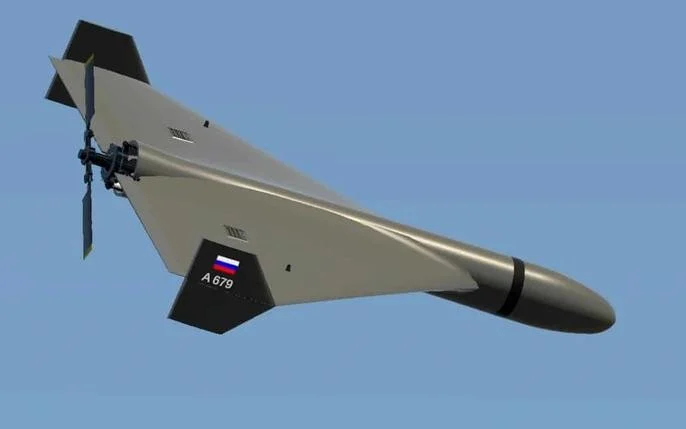
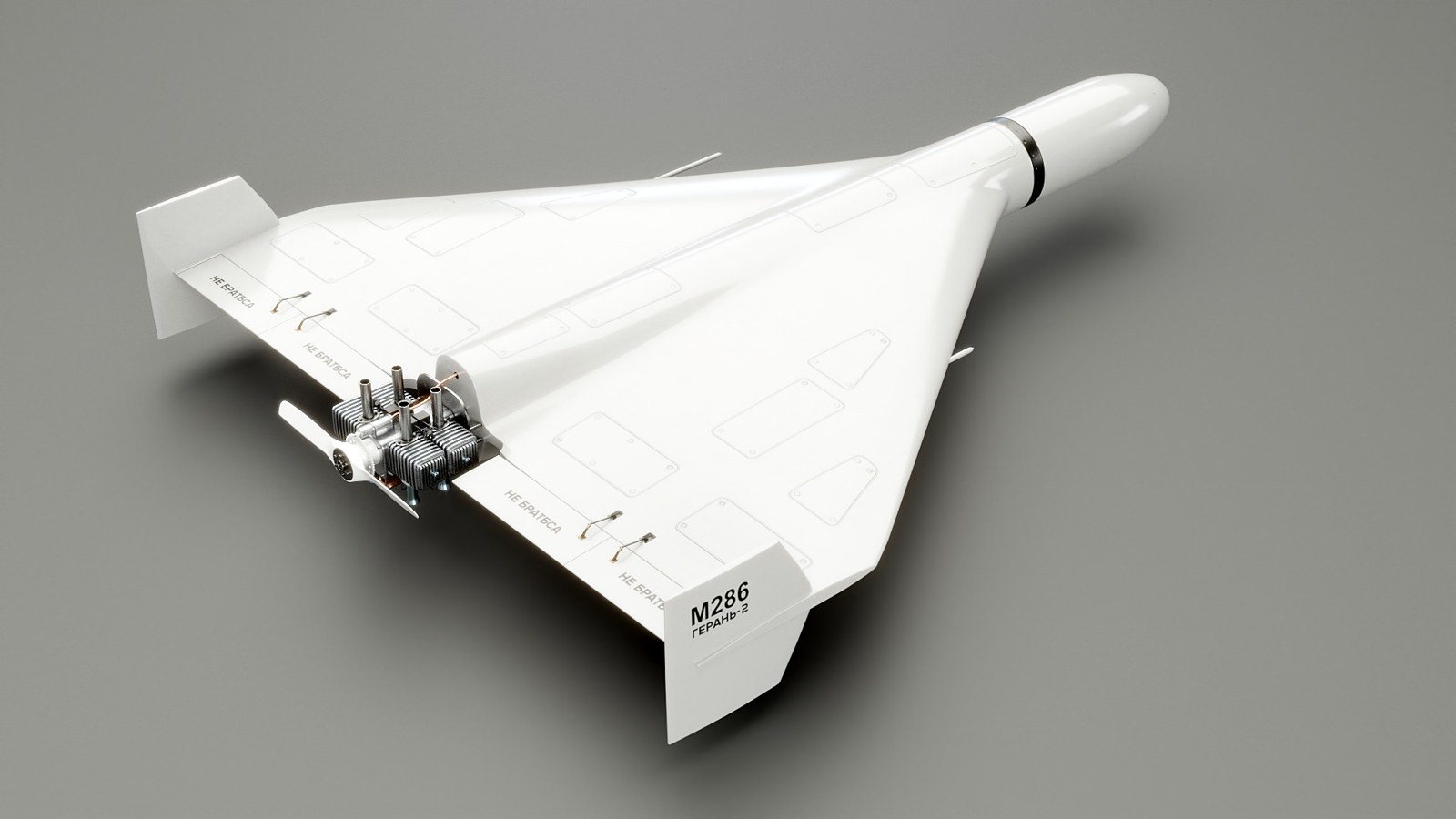
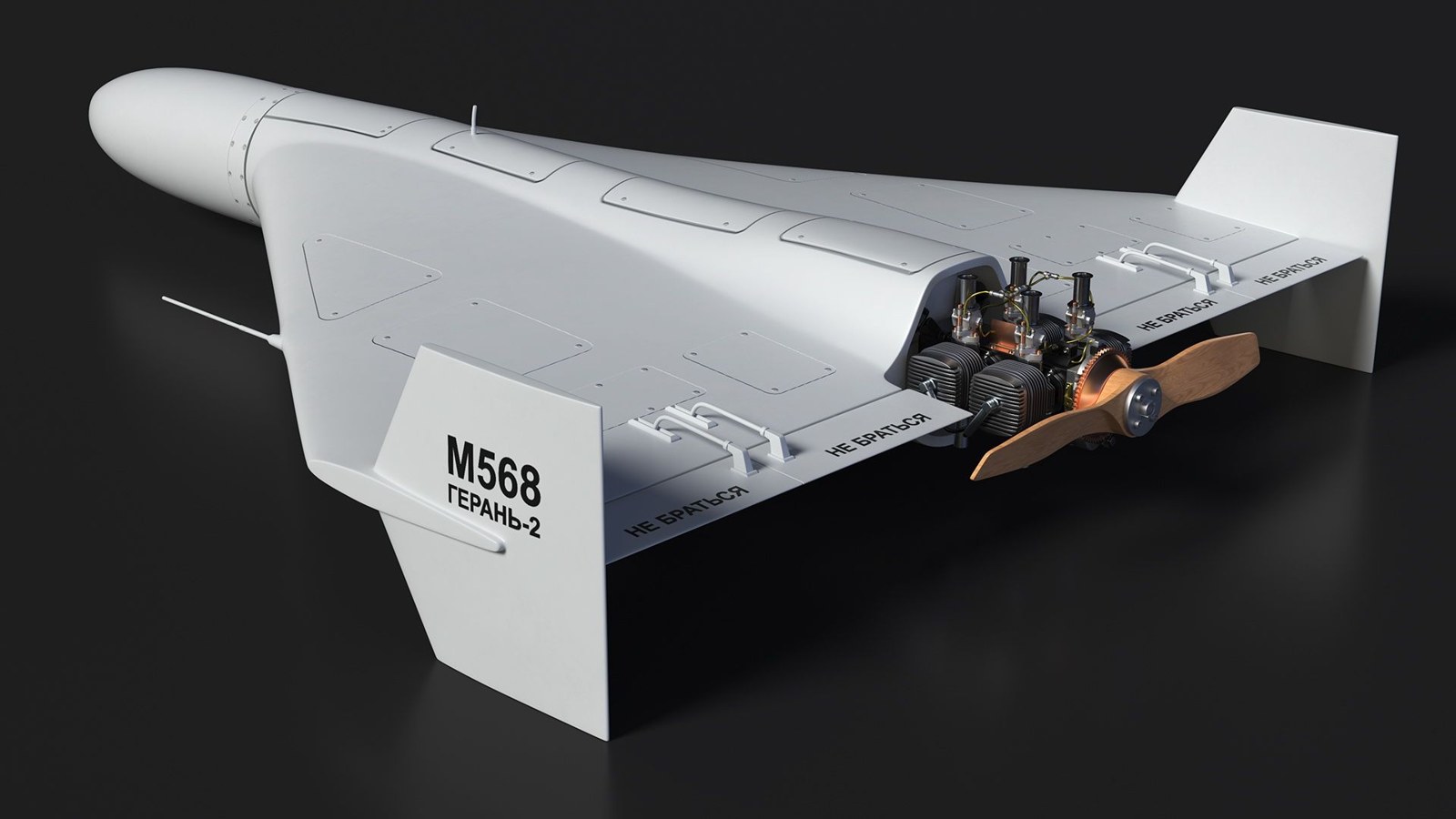
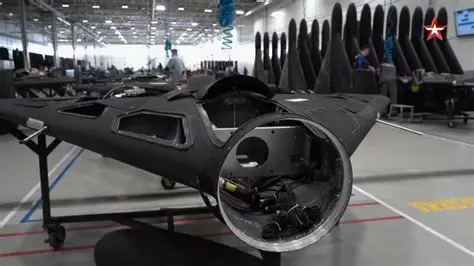
The Герань-2 (Geran-2, "Geranium-2") is the Russian designation for a one-way attack drone (also called a kamikaze drone, suicide drone or, loosely, a loitering munition) that began as the Iranian Shahed-136 (شاهد ۱۳۶, "Witness 136"). It is a tailless delta-wing aircraft with a rear-mounted piston engine driving a pusher propeller, launched from a rail or rack with a rocket booster, and flown to preprogrammed coordinates. The Shahed-136 was designed in Iran and is attributed by the U.S. Treasury to Shahed Aviation Industries Research Center, an IRGC Aerospace Force organization; other sources name the state-owned HESA group as the producer. Russia first used it in Ukraine in September 2022, began producing it at home from 2023, and has since turned it into a family of related weapons that is built in very large numbers and changed continuously.
Three points define the weapon. First, it is cheap and slow by missile standards: it flies at roughly 185 km/h on a small piston engine and carries a warhead of tens of kilograms, but it can be launched in large numbers and reaches far into Ukraine. Second, it is a mass-saturation weapon, mixed with decoys so that air defense has to spend scarce resources on every track. Third, the Russian version is no longer a copy of the Iranian one: navigation, communications, warheads, airframe material and (in the newest versions) the engine have been changed, and CSIS describes the Geran as a platform whose main feature is the speed at which Russia modifies it.
This page is a compiled reference. It uses open sources only (Ukrainian intelligence publications, Ukrainian Air Force reporting, Western think tanks, investigative journalism, Russian state media and Russian Ministry of Defence statements). Almost all hard data on Russian production and use come from Ukrainian sources, which have a wartime interest, and from analysts who reconstruct figures from them. Each figure is therefore marked with its source, Ukrainian claims are marked as claims, Russian claims are marked as claims, and where sources disagree both figures are shown. The subject changes quickly and the page reflects reports available up to mid-October 2026.
NAMES AND TERMINOLOGY
Shahed-136 (Persian: شاهد ۱۳۶) is the Iranian name. In Russian service the weapon is called Герань-2 (Geran-2). Герань means "geranium"; the Russian Ministry of Defence and Russian media use "Geran" for the whole family. Ukrainian officials and many Western reports still call the weapon a "Shahed" regardless of origin, and Ukrainian Air Force reports count "Shahed-type" drones, a category that also includes decoys and other types (see USE IN UKRAINE).
Series letters. CSIS reports that the first Gerans found in Ukraine in 2022 were marked "Geran-2" with the series letter "M" (Iranian-built). Later Russian-built versions carry letters on the wingtips: Ы and К (late 2023) and, according to the same source, later КБ, Ъ, КЦ, Э and КК. The letters indicate production lots or sub-types and were identified by Ukrainian and Western analysts from wreckage; no Russian official explanation of the letters was found.
Related names. Garpiya (Гарпия, "Harpy") and Garpiya-A1 are the Russian drones built by the Izhevsk Electromechanical Plant «Купол» (Kupol), a subsidiary of Almaz-Antey (see KUPOL AND THE GARPIYA-A1). Gerbera (Гербера) is a separate, cheaper decoy drone. Italmas (BM-35) is another Russian Shahed-style drone mentioned in Ukrainian Air Force and analyst reporting. Geran-3, Geran-4 and Geran-5 are the jet-powered successors (see THE GERAN FAMILY).
IRANIAN ORIGIN: THE SHAHED-136
The Shahed-136 was first shown publicly in December 2021 (Wikipedia, citing The Drive). The Iranian designation family includes the smaller Shahed-131, which looks similar but differs mainly in the wingtip stabilisers (Wikipedia, citing Janes). Iran also later presented a jet-powered version, the Shahed-238, in 2023, which is the basis of the Russian Geran-3.
Resemblance to the German Dornier DAR (Drohne-Anti-Radar) of the 1980s has often been noted (Defense Express, cited by Wikipedia). Whether the Iranian design actually copied it is an open question and no reliable source settles it.
The Iranian government has repeatedly denied supplying drones for use in Ukraine. In November 2022 the Iranian foreign minister said Iran had shipped "a small number" of drones to Russia before the war (Reuters). The U.S., UK, France and Ukraine have said otherwise. In May 2023 the White House National Security Council said Iran had provided Russia with more than 400 UAVs, mostly of the Shahed type (Associated Press). In November 2022 UK minister James Heappey said the number used in Ukraine was in the low hundreds. These are government statements, and the true number delivered is not publicly known.
A leaked set of documents reported by Haaretz and The Telegraph in February 2024 said Russia agreed to buy 6,000 Shahed-136 drones from Iran for about US$1.75 billion, paid partly in gold bullion, which would be about US$193,000 per unit (an export price), with a projected cost of about US$48,800 per unit after full localisation. The provenance of the documents cannot be independently verified. Another reading of the same material, attributed by The Telegraph to Anton Gerashchenko, gives about US$290,000 per unit for a 2,000-unit order. CSIS states the deal for production on Russian soil was worth US$1.75 billion and was negotiated about two months after the first Geran-M was seen in Ukraine.
RUSSIAN LOCALIZATION: ALABUGA AND YELABUGA
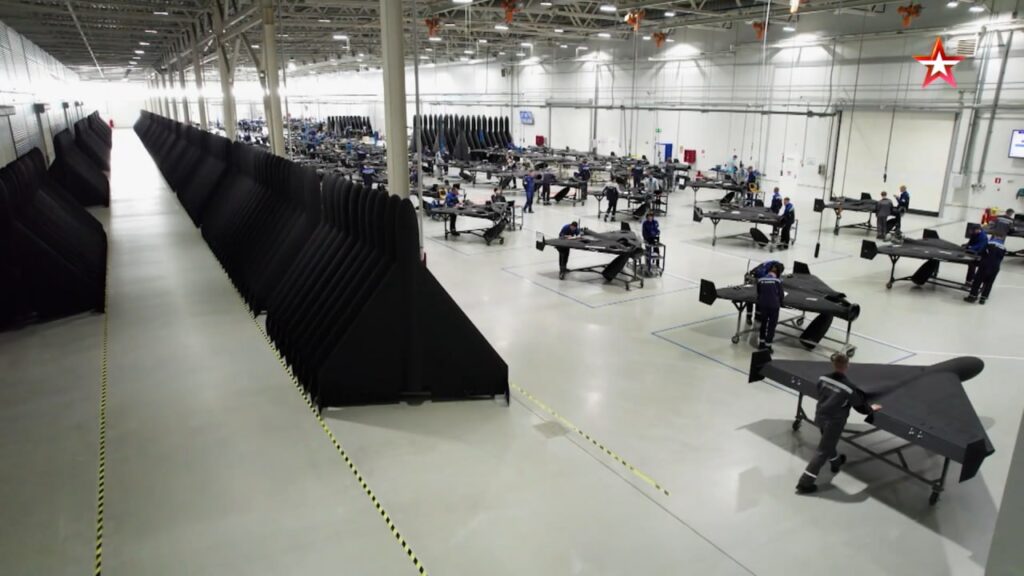
Russian production is centred on the Alabuga Special Economic Zone (ОЭЗ «Алабуга») at Yelabuga (Елабуга) in the Republic of Tatarstan, roughly 1,000 km east of the Ukrainian border (a distance given by drone-warfare.com in its summary of CSIS imagery work). The zone was founded in 2006 to attract Western investors, and CSIS reports that when those firms left after the start of the full-scale invasion, Alabuga turned to drone production. In the first phase components were shipped from Iran for assembly, so the first Alabuga Gerans were nearly identical to the Iranian-built "M" version apart from the letter "Ы" painted on the wingtips (CSIS).
Scale of the site. CSIS Beyond Parallel (March 2026), as summarised by drone-warfare.com, assessed that the factory area had grown since late 2021 from two buildings under construction to a complex of up to 116 buildings across more than 2.8 million square metres, with housing for roughly 20,000 workers finished. An independent satellite assessment from July 2025 documented new housing that could eventually hold about 41,000 people. These are analyst estimates from imagery. Satellite imagery shows buildings and not the number of completed aircraft.
Labour. The programme "Alabuga Start" recruited young women from Africa, Latin America and South Asia, in many cases, according to reports, with misleading promises about the work. The Global Initiative Against Transnational Organized Crime estimated about 800 women from 27 countries took part, with about 90 percent placed on drone assembly. Interpol opened an investigation into human trafficking (reported April 2025). The United Kingdom sanctioned individuals and companies, including several named for recruitment for Alabuga Start, on 5 May 2026 (UK FCDO designations list, as cited by drone-warfare.com). No independent audit of working conditions was found.
Other plants. Kupol in Izhevsk makes the Garpiya variant (see below). The Jerusalem Post (2023) also said production might be set up in Belarus, but no confirmed Belarusian production line was found in the sources used here. Ukrainian intelligence has also said Alabuga makes the Gerbera decoys (Reuters, September 2025).
KUPOL AND THE GARPIYA-A1
CSIS reports that in 2023 the Izhevsk Electromechanical Plant «Купол» (Kupol), a subsidiary of Almaz-Antey, began operating a parallel production site. Its drone is marked К and is also called Garpiya (Гарпия). Ukrainian Air Force reports and analysts such as the Institute for Science and International Security (ISIS) list "Garpiya A1" separately from the Alabuga Geran when counting launches.
CSIS describes design differences between the two lines. The Kupol version replaced the Nomex honeycomb of the Iranian airframe with a thick foam layer between what appears to be carbon-fibre-reinforced polymer skins; swapped the Iranian Mado engine for one of two Chinese copies of the German Limbach design; replaced the Iranian Nasir satellite receiver with the Russian Kometa-M4 inside a B-105 navigation module; replaced the Iranian flight controller with a Russian B-101 board; and used the Russian BSF-50 fragmentation warhead with tungsten balls instead of the Iranian penetrator warhead. CSIS also says Izhevsk drones tend to have higher production quality while Alabuga drones are "scrappier" with ad hoc fixes, and that the relationship between the two sites (competition or cooperation) is "not entirely clear". The Garpiya-A1 is therefore a closely related Russian aircraft built by a different producer, not a different class of weapon, and sources do not always keep the names apart.
AIRFRAME AND DIMENSIONS
Layout: a cropped delta wing with the fuselage blended into the wings and vertical stabilising surfaces at the wingtips; a two-bladed pusher propeller at the rear (Wikipedia). Typical published dimensions are a length of about 3.5 m (11.5 ft in CSIS) and a wingspan of about 2.5 m (8.2 ft in CSIS). The drone-warfare.com assessment notes that published figures span 3.3 to 3.5 m for length and 2.5 to 3 m for span depending on source and configuration.
Mass: about 200 kg for the Iranian version (Wikipedia, citing media), with a maximum of about 240 kg given for the Russian version (Wikipedia, citing Meta-defense). Mass varies with warhead and fuel load, and no official figure was found.
Materials: CSIS describes the early Geran-M airframe as fibreglass lined with carbon fibre and Nomex honeycomb. Conflict Armament Research (CAR), examining Russian-built wreckage in 2023, reported a fuselage of fibreglass over woven carbon fibre rather than lightweight honeycomb, along with "major differences in the airframe construction and in the internal units" compared with earlier examples (as cited by Wikipedia and the New York Times). CSIS says the foam-sandwich construction on Kupol drones may also reduce radar signature, while noting that this is a plausible explanation and not a confirmed one.
Radar cross-section: drone-warfare.com gives an estimate of 0.01 to 0.05 m² in the X-band, stating that it is an estimate. No measured value from an official source was found.
Colour: from November 2023 Gerans were seen painted black for night operations (CSIS). Ukrainian soldiers have also reported the fuel tanks being moved from the wings into the fuselage, armour around the engine, and matte-black coatings (drone-warfare.com, citing Euromaidan Press); these are Ukrainian observations from wreckage.
ENGINE AND PROPELLER
Iranian engine. The Shahed-136 uses the Mado MD-550 engine (also written MD550, made by Oje Parvaz Mado Nafar, "Mado", of Iran). It is described by Wikipedia as a 550 cc four-cylinder two-stroke petrol engine and by CSIS as a 50-horsepower piston engine. Both CSIS and Wikipedia describe it as a reverse-engineered copy of the German Limbach L550E. The Mado company is sanctioned by the United States and the European Union (CSIS). Ukrainian Defence Intelligence (HUR) lists the MD550 and its origin in Iran in its component database "War & Sanctions" (published June 2025).
Chinese replacements. CSIS reports that on the Kupol-built version the Iranian engine was replaced with one of two Chinese copies of the same Limbach design, as a supply-chain hedge. According to Iran Watch (as summarised by drone-warfare.com), a Chinese corporate group acquired Limbach Flugmotoren in 2017 and produced L550 engines through Xiamen Limbach, which was sanctioned in 2024 for supplying Russia; the group then changed its corporate front. Which Chinese engine(s) power which production lot is not documented in a single public source.
Propeller. Wikipedia describes a two-bladed pusher propeller. The propeller material and manufacturer are not documented in the sources used here and are not reported.
Cruise speed: about 185 km/h (Wikipedia, drone-warfare.com). The distinctive engine noise, often compared to a moped or lawnmower, is described in Ukrainian media (TSN, 2022) and was used by acoustic detection networks.
Jet engines for later versions are described in THE GERAN FAMILY.
NAVIGATION AND GUIDANCE
Original design. The Iranian Shahed-136 navigates with a commercial-grade inertial navigation system corrected by civilian satellite navigation (Wikipedia citing RUSI and others). CSIS reports that the Iranian "M" series carried a Nasir satellite receiver and a Sadra navigation unit, combining GNSS with an inertial measurement unit to hold the preprogrammed route when the satellite signal is degraded. In October 2022 an Israeli commentator noted that Russian-made flight control units and GLONASS use had replaced the earlier arrangement (Times of Israel blog, per Wikipedia).
Controlled reception pattern antennas (CRPA). The main Russian improvement against jamming is the CRPA, which uses several antenna elements to null out interference arriving from different directions. CSIS describes the Russian Kometa family: the four-element Kometa-M4 (mid-2023), the eight-element Kometa-R8/M8, a 12-element Kometa-M12, and 16-element versions. CSIS says resilience scales with the number of elements, so more elements can reject more jammers. It also describes Chinese-made CRPA modules (an eight-element circular array by January 2025, 16-element versions from March 2025) on the Alabuga version, while Izhevsk leaned toward Russian Kometa modules. Ukrainian Defence Intelligence (HUR) has published component lists for CRP antennas from the Geran-2; one HUR publication (reported by UNN) said the new CRPA contained only two American-made chips (Texas Instruments and Linear Technologies) and mostly Chinese parts, with the main processing chip made by the Beijing Microelectronics Technology Institute.
Effect on jamming. CSIS cites a Ukrainian Air Force official as saying in early 2026 that electronic warfare could neutralise nearly half of the Gerans launched in some night attacks. Drone-warfare.com notes that a CRPA does not defeat electronic warfare but raises the power and geometry a jammer needs, and that early Iranian airframes were successfully spoofed off course by Ukraine's "Pokrova" system. The effect of any single measure is hard to isolate in public data.
Spoofing and relay. Both CSIS and Ukrainian sources describe repeated Russian adaptation of antennas in response to Ukrainian jamming. Russian technical documents are only available second-hand through Ukrainian analysts and cannot be confirmed independently.
CAMERAS, MODEMS, MESH NETWORKS AND SIM CARDS
The earliest Gerans were fire-and-forget. They flew a preprogrammed path and returned no information on success or failure (CSIS). Several changes since then are documented by CSIS, HUR, Wikipedia and drone-warfare.com:
Cellular modems. In November 2023 Ukrainian forces recovered a Geran with a 4G modem in a 3D-printed box taped to a winglet, with two antennas and a power bank, which CSIS describes as an improvised field modification. By early 2025, according to HUR as reported by CSIS, Geran-2 series Ы and Ъ flew with a standard telemetry module made up of a Raspberry Pi mini-computer and two 3G/LTE modems made by the Chinese firm ZTE, carrying Russian and Ukrainian SIM cards for redundancy (the first version had only a Ukrainian Kyivstar card). By June 2025 almost all Gerans had it, and by the end of 2025 it had moved inside the airframe (CSIS). Ukraine said in April 2026 that Russia placed bulk state orders for SIM cards from a Rostelecom subsidiary for Shahed manufacturers (reported by drone-warfare.com via Euromaidan Press; not independently confirmed here). Ukrainian reporting in 2025 also said some drones carried Polish and Lithuanian SIM cards (ISW).
Mesh modems. From mid-2025 the Chinese XK-F358 mesh modem (Xingkai Tech) was found in Geran airframes. HUR's component page lists it for the Geran-5 (published January 2026). CSIS says each drone with the modem acts as a repeater for others, creating an airborne network that can pass reconnaissance data and remote operator control in real time, and that by early 2026 Gerans of all series took part in this network. Drone-warfare.com adds that Gerbera decoys carry the same type of modem and that in July 2026 Molniya loitering munitions and Gerbera decoys were merged into one mesh network. These descriptions come from Ukrainian and Western analysts; the details of the Russian network are not public.
Starlink. Defense Express reported a Starlink terminal in wreckage after the attack of 24 to 25 September 2024. CSIS considers it an experiment that was not serialised. Wikipedia and drone-warfare.com report further indications of Starlink-linked Gerans by January 2026 (including a claim that the Kharkiv-region train attack of January 2026 was by Starlink-guided Gerans) and a Ukrainian-SpaceX whitelist and registration system introduced in early 2026. These accounts conflict on how widespread the practice was; the scale is unresolved in public sources.
Cameras and computers. HUR documented a Geran-2 configuration designated MS001 in June 2025 with an analog infrared camera and a USB video capture unit, and a transition board for an Nvidia Jetson computer (Ukrainska Pravda; HUR component page published June 2025). In February 2026 HUR reported a Raspberry Pi 5 and a Chinese mini PC running Windows 11 in a reconnaissance variant (UNITED24; The i Paper for Raspberry Pi findings). CSIS reports cameras ranging from cheap security cameras to a Honpho TS130C-01 with long-wave infrared, a laser rangefinder and built-in computer vision. Drone-warfare.com cautions that a capable processor does not establish what software runs on it and that claims of AI control outrun the evidence. The article therefore treats "autonomous target recognition" as unproven; what has been shown is camera and datalink hardware that allows an operator to see and redirect the drone.
Moving targets. Hitting moving ships and trains needs either terminal guidance or an operator in the loop. Wikipedia notes a UK report that a Shahed variant used against moving vessels in 2023 showed signs of an Iridium satellite phone SIM. Ukrainian and other sources have attributed attacks on moving trains and boats in 2026 to remotely guided Gerans, but those attributions come from Ukrainian officials and media and the aircraft type is not always confirmed.
WARHEAD
Iranian values. The Shahed-136 warhead is commonly given as about 30 to 50 kg (BBC and Wikipedia); Janes, citing IRGC statements, reported 50 kg in 2023 and an upgraded 90 kg version (Wikipedia). CSIS describes the Iranian-made "M" series as having a 118-pound (about 53.5 kg) two-stage penetrator warhead.
Russian warheads. CSIS lists the following (converted from pounds, rounded): BSF-50 fragmentation/high-explosive with tungsten balls (about 50 kg, 110 lb); BST-52 shaped-charge with incendiary (about 52 kg, 115 lb); OFZBCh-50 high-explosive fragmentation incendiary and TBBCh-50M thermobaric (about 52 kg each, introduced by January 2025); and KOFZBCh-90 "cumulative-fragmentation-high-explosive-incendiary" of nearly 90 kg on the Ъ series. According to CSIS the Izhevsk plant stacked two BST-52 warheads back to back for a combined payload of nearly 105 kg (about 230 lb), a rare case. Defense Express reported in May 2025 a Russian 90 kg combined-action warhead. ISIS (Albright et al., May 2024) documented the Alabuga warheads. Tungsten-ball shrapnel in Russian Gerans was reported by The War Zone in September 2023, citing Ukrainian officials.
Conflicts. Warhead mass figures differ by source because warhead variants were mixed: 30 to 50 kg (BBC, 2022), 50 kg and 52 kg (Janes; Wikipedia), and 90 kg (Janes; ISIS; Wikipedia for "Russia post 2024"). The warhead in a specific recovered airframe depends on the production lot. No single "standard" mass can be given.
Trade-off. A heavier warhead displaces fuel. Wikipedia, citing a May 2024 ISIS analysis, says the 90 kg version has a smaller tank of about 71 litres and a reduced maximum range of about 650 km. Drone-warfare.com says the 90 kg warhead cuts range toward about 1,000 km from about 2,500 km. These range figures also disagree (see RANGE).
Auxiliary payloads. Reports of additional payloads on Gerans (from HUR, Ukrainian media, CSIS and drone-warfare.com) include PTM-3 anti-tank mines under the wings; an R-60 air-to-air missile on a rail (HUR, December 2025); a 9K333 Verba man-portable air defense missile launcher (HUR, January 2026); decoy missiles; and two FPV drones on top for release during flight (March 2026, CSIS). Armed versions use cameras and a modem so an operator can aim at helicopters or interceptor aircraft. Ukraine's Security Service (SBU) stated that radiation readings on R-60 fragments recovered after Geran-2 strikes on Chernihiv oblast in April 2026 indicated depleted uranium; the R-60M missile is reported to carry depleted-uranium rods. This is an SBU claim as relayed by Ukrainian and other media, and its prevalence is unknown. Drone-warfare.com notes that no public evidence shows an armed Geran has shot down an aircraft or interceptor drone.
SPEED, RANGE AND PERFORMANCE
Speed. About 185 km/h for the piston version (Wikipedia; drone-warfare.com). Interceptor drones have a speed margin over this (see INTERCEPTOR DRONES).
Range. Published ranges differ widely. Janes (citing IRGC) and Wikipedia give up to 2,500 km for the Iranian version with a light warhead; RUSI and other analysts have estimated 970 to 1,500 km and up to 2,000 to 2,500 km (Wikipedia). Drone-warfare.com says range is often reported at 2,000 km or more for the light-warhead version and that it depends on flight profile, fuel, warhead, routing and weather. For a 90 kg warhead the figures are about 650 km (ISIS, via Wikipedia) and about 1,000 km (Meta-defense, via Wikipedia; drone-warfare.com). The Ukrainian experience is of drones crossing the length of Ukraine, reaching Zakarpattia oblast on the Hungarian border for the first time in May 2026 (ISIS analysis, quoted by drone-warfare.com). Range figures are therefore estimates, and a range of about 1,000 to 2,000 km is the most that can be said with confidence without a manufacturer's data.
Endurance and altitude. Typical flight profiles are low and slow, using terrain and gaps in radar coverage; Ukrainian sources have said the drones fly at "extra-low" altitude. No official figure was found.
Mission profile. RUSI argued in January 2023 that the Shahed-136 is used for point-to-point attack like a cruise missile, not loitering, and that calling it a "loitering munition" is questionable. An OCIMF report (August 2023) said the wreckage from ship attacks did not show seekers or sensors. The cameras and datalinks described above change this picture for the newest versions.
LAUNCH METHOD AND RAILS
The Shahed-136 is launched from a rail or rack at a slight upward angle with a rocket booster, which is jettisoned when the piston engine takes over (Wikipedia). Because the launch frame is portable and holds several drones, it can be mounted on the back of any military or commercial truck (Defense Express, cited by Wikipedia). Launch sites and their number are not public.
For the heavier jet versions, drone-warfare.com (citing The War Zone) reports extended launch rails of roughly 280 feet built at Tsymbulova in Oryol oblast in late 2025, with 16 heavy launch positions by mid-2026 and storage for more than 1,000 drones. This is a single-source report and the numbers are not independently verified here.
THE GERAN FAMILY
The Geran-2 is the baseline and, by Ukrainian Air Force counts, remained the most numerous Geran type in 2026. Sources describe the following family; where several sources are cited, the figures differ.
Geran-2. Piston engine, about 185 km/h, delta wing, warhead 50 to 90 kg depending on version. Many subseries: M (Iranian-built), Ы, К, КБ, Ъ, КЦ, Э, КК (CSIS).
Geran-2 MS001. HUR designation for a configuration with an infrared camera and onboard computer (June 2025).
Geran-3. A Russian version of the Iranian Shahed-238 jet drone. CSIS says it used a Chinese Telefly JT80 turbojet and reached about 300 miles per hour (about 480 km/h), twice the Geran-2's speed, but kept the old airframe, which lacked the structure for the loads. Drone-warfare.com says recovered units cruised nearer 300 to 370 km/h. The two figures conflict (claimed or maximum versus observed cruise). HUR said in August 2026 that Russia had halted Geran-3 production (CSIS).
Geran-4. Entered combat around May 2026 according to drone-warfare.com; CSIS says Geran-4 and Geran-5 were introduced in 2026. The Geran-4 has a more aerodynamic version of the delta shape and a reinforced structure. Reported speeds are 186 to 249 miles per hour with a maximum of 311 mph (about 300 to 400 km/h, maximum about 500 km/h) in CSIS, and 350 to 500 km/h in drone-warfare.com. Ranges of about 450 to 850 km are reported (drone-warfare.com). The engine is a Chinese Telefly turbojet (TF-TJ2000A, about 200 kgf) according to drone-warfare.com.
Geran-5. Reported to have been seen in combat around January 2026 with a conventional cruise-missile-like fuselage instead of the delta wing. Published figures (drone-warfare.com, based on Ukrainian reports) give about 6 m length and 5.5 m wingspan, about 90 kg payload, 900 to 1,000 km range and 450 to 650 km/h. HUR's component page for the Geran-5 lists a Telefly TF-TJ2000A engine and an XK-F358 modem (January 2026).
Production balance. On 12 August 2026 HUR said Russia was building about 3,000 Geran-4/5 drones a month and about 2,800 Geran-2 a month, so jet output exceeded Geran-2 output. This is a single-source intelligence estimate. Ukrainian Air Force official Yurii Cherevashchenko said in April that 15 to 20 percent of launched Shaheds had jet engines, and the number of jet drones launched was about 180 in all of 2025 and about 1,400 by early June 2026 (Militarnyi). ISIS estimated 30 to 80 jet drones in May 2026 (best estimate about 50), which contradicts the larger numbers and suggests production and employment are different quantities. The differences are not resolved in public data.
Ukrainian Defence Intelligence deputy head Vadym Skibitsky said in July that Russia slightly reduced intensity and production while shifting to the jet models (RBC-Ukraine, via Militarnyi).
DECOYS AND SIBLINGS: GERBERA, ITALMAS, GARPIYA
Gerbera (Гербера). A cheap decoy drone made of plywood and foam. According to Ukrainian intelligence (via Reuters, September 2025) it has a wingspan of 2.5 m, a maximum weight of 18 kg, a maximum speed of 160 km/h and a range of up to 600 km, with a small rear engine driving a wooden propeller, and is assembled at Yelabuga. Ukrainian intelligence estimates a cost of about US$10,000 each (CNN; Politico). Reuters and analysts note that versions with light warheads or cameras exist, so not all Gerberas are decoys. HUR estimated in 2025 that Russia planned to build 40,000 Geran and 24,000 Gerbera decoys that year (Defense Express, per Wikipedia). ISIS says investigative reporting suggests plans for about 60,000 long-range UAVs and 50,000 decoys in 2026.
Italmas (BM-35). Listed by ISIS among Shahed-type launches and described by drone-warfare.com as having about 200 km range and a 15 to 40 kg warhead. Reliable public technical data are limited.
Parodiya. A decoy name used in Ukrainian reports and in drone-warfare.com. Only the name and role were found in the sources used.
Counting. Ukrainian Air Force daily reports list the total number of "Shahed-type" drones, which includes strike Gerans, Garpiya, Gerbera decoys and other types, and from September 2025 to May 2026 gave the approximate number of Geran-type drones made at Alabuga among them (ISIS). Reading the headline number as the count of armed Geran-2 drones overstates the threat. ISIS assessed that about 64 percent of the total in 2026 were Geran-type strike drones, and drone-warfare.com gives about 59 percent for 2025 and about 71 percent for July 2026. These percentages are analyst estimates.
PRODUCTION NUMBERS AND RATES
No Russian official production figure exists. All numbers below are estimates, Ukrainian claims, or Russian statements without audit, and they conflict.
Planned or claimed numbers. Washington Post reporting in 2023 said Russia aimed to build 6,000 Gerans by summer 2025 at Alabuga (Wikipedia). The Alabuga director said in July 2025 that the plant was producing nine times more Gerans than originally planned (as cited by drone-warfare.com; no baseline was given). Drone-warfare.com says that working from two readings of this claim produces illustrative annual figures of about 18,540 and 24,640, and warns that the director was probably exaggerating. Wikipedia, citing defence-blog.com, says that by late spring 2025 Russia was producing around 170 per day, with a total of about 26,000 produced; this is a derived estimate and not an official statement. HUR estimated in August 2025 that Russia planned to build 40,000 Geran-2 and 24,000 Gerbera in 2025 (Defense Express).
2026 estimates. CSIS estimated about 5,500 drones per month in March 2026 across the Yelabuga complex; drone-warfare.com notes this spans multiple UAV categories and cannot be read as 5,500 Shahed-136 drones. HUR told Militarnyi in August 2026 that Russia built about 2,800 Geran-2 per month (more than 33,600 a year at that rate) at Alabuga, in addition to about 3,000 jet Geran-4/5. Note that 170 per day from the 2025 estimate would be about 5,100 per month, which is far above the 2,800 per month HUR figure. These do not describe the same period or the same definition.
What launches show. ISIS reconstructed Ukrainian Air Force data: 54,538 Shahed-type launches in 2025, of which about 32,200 were assessed as strike Gerans. In 2026 (Shahed-type launches): January 4,442; February 5,059; March 6,462; April 6,583; May 8,161; June 5,749; July 4,891 (drone-warfare.com, summarising ISIS). The daily average of strike Gerans was estimated at about 120 in July 2025, 129 in March 2026, 144 in April 2026 and 167 in May 2026. A change in Ukrainian reporting from about 5 May 2026 means the June and July figures cover only night reporting windows and cannot be compared directly with earlier months. Launches also draw on stockpiles, so they are not a direct measure of factory output.
Ukrainian strikes on supply. Ukraine has attacked inputs: the Caspian cargo ship Port Olya-4 was sunk on 16 August 2025 according to The War Zone; and a Ukrainian FP-5 Flamingo missile reportedly struck the VNIIR-Progress plant at Cheboksary, which makes Kometa antennas, on 10 June 2026 (drone-warfare.com, citing ISIS). No public data show a resulting fall in output.
Components. Foreign electronics have been found repeatedly: Texas Instruments processors, Altera and Xilinx programmable logic, Analog Devices radio parts, Microchip and STMicroelectronics parts and u-blox receivers (ISIS; Wikipedia; drone-warfare.com). Ukraine's National Agency on Corruption Prevention said in December 2023 that the Russian Geran-2 contained 55 parts from the United States, 15 from China, 13 from Switzerland and 6 from Japan (Wikipedia). By 2026, CSIS and HUR describe a shift to Chinese parts. Many components are dual-use and are probably supplied through intermediaries; the presence of a component does not prove the manufacturer supplied Russia directly.
COST ESTIMATES
No audited cost exists. Published estimates, with their sources: US$20,000 to 50,000 per unit for early Iranian-built drones (Guardian, October 2022, per Wikipedia); US$30,000 rising to about US$80,000 after Russian upgrades (RUSI, April 2024); US$30,000 to 80,000 (Wikipedia infobox); US$50,000 to 70,000 for late-2025 hardened versions (drone-warfare.com); and the leaked-document figures of US$193,000 (export price) and US$48,800 (projected localised price) discussed above. Drone-warfare.com states that no open-source figure exists at all for the Geran-4 or Geran-5. The cost to Russia in roubles was not found.
Cost comparison. Ukrainian officials and commentators compare Shahed cost with interceptor cost. President Zelensky said an interceptor drone costs US$3,000 to 5,000 and destroying one Shahed costs about US$10,000, against about US$4 million for a Patriot missile (TSN, via drone-warfare.com). These are Ukrainian statements and do not include sensors, crews and other costs of the air defense system.
USE IN UKRAINE: FIRST USE AND MONTHLY COUNTS
First use. CSIS says the first publicly documented use came when wreckage marked "Geran-2" was recovered near Kupiansk on 13 September 2022. Ukrainian reporting in the following weeks described use around Odesa and Dnipro. Ukraine said it shot down more than 220 between mid-September and mid-October 2022 (AFP, via NDTV). In October 2022 Gerans took part in attacks on the energy system; the Ukrainian military said 46 were launched on 6 October, 24 on 10 October and 47 on 17 October (USIP, via Wikipedia). Use paused for about three weeks in November and December 2022; Ukraine said the pause was to adapt the drones to cold weather and the British Ministry of Defence said it was probably due to stock exhaustion and resupply (Wikipedia). Both explanations are assessments.
2024 and 2025. The Wall Street Journal (May 2024), analysing Ukrainian Air Force data, said Russia had launched 2,628 Shahed drones in the previous six months and Ukraine intercepted over 80 percent, adding that Ukraine uses such statistics for propaganda purposes. ISIS reconstructed 54,538 launches in 2025 and about 7,263 assessed hits. The largest single launch in 2025 was 810 Shahed-type drones on 7 September 2025 in an 823-weapon attack, per ISIS via drone-warfare.com. A combined attack on 13 and 14 May 2026 involved about 1,567 drones over about 38 hours (same source).
2026. Monthly Shahed-type launch totals are in PRODUCTION NUMBERS AND RATES. Peak daily averages and the May 2026 peak of 8,161 are ISIS reconstructions of Ukrainian Air Force reports. The Air Force changed its reporting in May 2026, so later figures are partial. Ukrainian officials also said that in August 2026 Russia started attack cycles of 24 to 32 hours with daytime launches (ISIS, via drone-warfare.com).
Target sets. Gerans have been used against energy infrastructure, ports, rail, gas facilities, industrial sites, cities and military targets. Recorded effects reported by Ukrainian and UN sources include: the UN Human Rights Monitoring Mission verified 2,514 civilians killed and 12,142 injured in Ukraine in 2025, with long-range weapons (missiles and loitering munitions together) accounting for 682 deaths and 4,443 injuries (as cited by drone-warfare.com); the 19 November 2025 attack on Ternopil, in which at least 38 civilians died (Air Force reported 476 drones and 48 missiles); and the 21 August 2026 strike on a shopping centre in Kryvyi Rih that killed at least 16 (CNN, Kyiv Independent, Al Jazeera). The type of drone in the Kryvyi Rih strike is disputed: Ukrainian reports named a jet Geran-4, and other accounts a Shahed-136. These numbers combine drones with missiles in places and cannot be assigned to the Geran-2 alone.
THE POWER GRID AND INFRASTRUCTURE CAMPAIGN
Gerans took part in the first large attacks on the Ukrainian power system in October 2022 (Ukrenergo offices in Kyiv were among reported hits, per Wikipedia citing the Washington Post and others). From autumn 2025 reports describe much larger campaigns: drone-warfare.com, citing Euromaidan Press, counts eight major coordinated waves against power infrastructure in October and November 2025 alone, and the winter of 2025 to 2026 as the heaviest to date, with 19,000 drones, 14,670 guided bombs and 738 missiles used against Ukraine in the period (Euromaidan Press headline, 1 March 2026). Ukrainian officials also said Russia damaged or destroyed more than 200 locomotives in the first half of 2026 (as relayed by drone-warfare.com). These are Ukrainian statements and are not independently audited.
The Russian Ministry of Defence presents the strikes as attacks on military-linked infrastructure. For example, on 8 October 2026 it said Geran crews of the Varyag unit struck a logistics centre, power distribution substations and a mobile air defense system, and on 6 October 2026 it said Varyag brigade crews struck several data centres in major Ukrainian cities (TASS). These are Russian MoD claims, with video, and the effects are not independently confirmed here.
Whether strikes on infrastructure achieve a strategic goal is a matter of analysis. Drone-warfare.com notes that strategic coercion "remains unproven rather than disproven".
INTERCEPTION RATES
Official Ukrainian figures. Ukrainian Air Force reports list launched drones and the number shot down or "suppressed" (neutralised by electronic warfare), so "destroyed" can include non-kinetic defeat. Quoted figures include: a monthly interception rate that climbed from 77 percent in February 2024 to a high of 97 percent in May 2024 (CSIS); 96.58 percent in January 2025 and 82.7 percent in December 2025 (drone-warfare.com); 89.9 percent for missiles and drones in March 2026 (Ukrainian Ministry of Defence); and up to 96 percent for conventional piston Shaheds in some mid-2026 periods (same source). Ukraine claimed 65 to 85 percent in 2022 (Wikipedia).
Caveats. The Wall Street Journal noted in May 2024 that Ukraine uses such statistics for propaganda purposes. The figures use different denominators and weapon populations, include decoys, and count "suppressed" drones. Drone-warfare.com says the series cannot be joined into one curve. A more consistent measure is the share of Shahed-type drones that reached or hit targets: about 6.65 percent in May 2026 and about 8 percent in June (ISIS), or about 10.48 percent of estimated strike Gerans in May. These are analyst reconstructions based on Ukrainian reports. Russian claims of effectiveness (for example the Russian MoD claim that all targets were successfully hit) are not independently verified.
Starlink and decline. Interception fell through 2025 and was widely attributed in Ukrainian commentary to the use of Starlink on strike drones; drone-warfare.com points out that serial integration is dated to December 2025, after most of the fall, and that rising volume, Kometa navigation, the cellular relay network and tactics are all plausible contributors.
INTERCEPTOR DRONES, MOBILE FIRE GROUPS AND OTHER DEFENSES
Early defenses (2022). Ukraine used small arms, anti-aircraft guns (Gepard and ZSU-23-4), short-range missiles, MiG-29 fighters (with some losses, including a MiG-29 crash on 13 October 2022 when a drone detonated near it, per Ukrainian sources cited by Wikipedia) and searchlights. Pilots described that the drones were hard to see on radar among ground clutter (The Drive, December 2022).
Mobile fire groups. Ukraine organised truck-mounted guns and machine guns, missiles and spotters into mobile fire groups. President Zelensky said in June 2025 that roughly a third of Shaheds were destroyed by mobile fire groups (as cited by drone-warfare.com).
Sky Fortress. A network of around 10,000 acoustic sensors (microphones) feeds a computer that tracks the sound of drones; U.S. Air Force General James Hecker gave a unit cost of US$400 to 500 (Wikipedia, citing Defense One and The War Zone).
Interceptor drones. In 2025 and 2026 Ukraine fielded fast interceptor drones. Drone-warfare.com, citing The Economist, says Ukraine destroyed a record 1,704 Shahed-type drones in January 2026, with about 70 percent of kills by interceptor drones. Zelensky said on 20 January 2026 that Ukraine produced up to 1,000 interceptors per day, and that crews, not airframes, were the shortage. The Wild Hornets Sting is the reference platform with a reported unit cost of about US$1,400 to 2,500, a top speed of 315 to 343 km/h, and thermal-camera guidance (drone-warfare.com). Ekonomichna Pravda claimed in July 2025 that 9 of 10 Shaheds shot down were by interceptor drones backed by a former Google chief (Militarnyi); this claim is not independently confirmed and conflicts in scale with the January 2026 figure of 70 percent, because they refer to different periods and methods. Interceptors reached about 50 percent kill rates against the Geran-2 by mid-2026, up from about 10 percent in winter 2025 to 2026, according to Kyiv Independent reporting as relayed by drone-warfare.com. Ukraine also reported the first drone-on-drone kill from a naval drone (Magura V5) on 19 April 2026 (same source).
Helicopters and aircraft. Ukrainian commander-in-chief Oleksandr Syrskyi said in September 2025 that helicopters accounted for some 40 percent of drone kills (Telepolis, via Wikipedia). Russian armed Geran variants with R-60 or Verba missiles were reportedly developed to attack them (see WARHEAD).
Jets. A jet Geran at 350 to 500 km/h cannot be caught in a tail chase by a 343 km/h interceptor (drone-warfare.com), which raises the need for forward-cued interception. Ukraine reported shooting down or suppressing more than 70 of 76 jet drones in one day-time attack on 18 August 2026 (Ukrainska Pravda), without saying which systems did it. Ukraine said it put the Alexa Spatium jet interceptor into service on 21 August 2026 (Militarnyi). No performance figures from the manufacturer were found.
ELECTRONIC WARFARE AND COUNTERMEASURES
Ukrainian electronic warfare: jamming and spoofing of satellite navigation, and radio jamming of datalinks. ISW noted success by Ukrainian EW in September 2024 when several Shaheds failed to reach targets. Russian countermeasures include the CRPA arrays (above), inertial navigation, cellular and mesh datalinks (which Ukraine can also attack), and from May 2026 reported rear-mounted jammers aimed at interceptor drone command links (drone-warfare.com, citing Euromaidan Press); Ukrainian officials described their effectiveness as mixed.
Physical hardening. Ukrainian sources reported Gerans painted black, with armour around the engine and the fuel tanks moved into the fuselage, so that an interceptor must hit a critical area (drone-warfare.com, citing Euromaidan Press). Ukrainian soldiers also reported that in 2025 the drones started to avoid strong light sources en route (Kyiv Independent, May 2025), so searchlights were partly replaced by night-vision gear.
Relay network via Belarus. Ukrainian reports described Russian use of Belarusian cellular towers and balloons for relaying Geran guidance, and a Ukrainian strike in late February 2026 on relay nodes (Euromaidan Press, via drone-warfare.com). These accounts rely on Ukrainian sources.
Tactical use. Ukraine's Air Force has said the drones are sometimes used to probe defences before missile attacks (Wikipedia). Reconnaissance Gerans (MS series) scout routes and mobile air defence units (HUR, June 2025).
USE OUTSIDE UKRAINE AND NATO AIRSPACE INCIDENTS
Interpretation of these incidents is disputed, and the sources cited are Polish, Romanian, Latvian and Ukrainian authorities and analysts. The Russian side has denied deliberate targeting in the Polish case.
Poland, 9 to 10 September 2025. Polish authorities said they detected 19 violations of Polish airspace (AP); drone-warfare.com says at least 19 and up to 23 drones entered and NATO aircraft shot down up to four. A Polish army official told Reuters at least some were Gerbera drones, and a Ukrainian electronic warfare expert said a downed one was a Gerbera decoy without cameras (ISW). Poland invoked NATO Article 4 and NATO began Operation Eastern Sentry on 12 September 2025. The Russian Ministry of Defence said it had not targeted Poland and was open to discussion (AP). Whether the incursion was deliberate is disputed: Poland and analysts such as RUSI's Thomas Withington said it "could well have been" deliberate, while the cause is not established in public sources. Many of the aircraft involved were decoys, so it is not accurate to describe this as a mass Geran-2 attack.
Romania. On 8 September 2024 a drone landed near Periprava in Romania; Romania scrambled F-16s (Romanian Ministry of Defence, via Reuters). Drone-warfare.com reports that a Geran-2 hit the roof of a ten-storey apartment building in Galati on 28 to 29 May 2026, injuring two people, and that the Romanian president announced on 31 May that a technical investigation had identified a Russian-made Geran-2 (Euromaidan Press, Ukrinform and Militarnyi are cited there). The Russian reaction was not found in the sources used here.
Latvia. Reports state that NATO fighters shot down drones over eastern Latvia on 8 June and 14 August 2026 and that Latvian authorities attributed the incursions to Russian electromagnetic warfare. Drone-warfare.com adds that some drones redirected into alliance airspace have been Ukrainian drones displaced by Russian jamming. In September 2024 a drone also fell in Latvia (Reuters).
Moldova and other states. Debris of drones attributed to Russian attacks has been reported on Moldovan and Romanian territory several times; individual incidents were not verified in this review and are not described here. Readers should check current Moldovan, Romanian and NATO statements.
Iran and the Middle East. Wikipedia reports that Iran launched Shahed-136 drones in April 2024 against Israel and during the 2026 war against Gulf states and U.S. bases, and drone-warfare.com reports a drone of Shahed type that struck RAF Akrotiri in Cyprus in early March 2026 and that debris contained a Russian Kometa-M navigation module (reported by United24, Ukrainska Pravda and Quwa). The Kometa-M finding is a reported recovery and its meaning (Russian technology moving back to Iran) rests on those reports; AP also reported that U.S. and European officials said Russia was shipping upgraded drone technology to Iran, which the Kremlin denied.
U.S. and other copies. The United States built the LUCAS (Low-cost Uncrewed Combat Attack System), reverse-engineered from a captured Shahed-136, announced by CENTCOM on 3 December 2025, with a cost of about US$35,000 (CENTCOM, via Wikipedia). Ukraine's Batyar (800 km, 18 kg warhead in the long-range version) and the Artemis ALM-20 (45 kg warhead, 1,600 km, as announced) are also Shahed-style drones, as are Taiwan's Chien Hsiang and the Chinese Feilong-300D (CSIS).
RUSSIAN STATUS AND MODERNIZATION
Organisation. The Estonian Foreign Intelligence Service said in its 2026 report that Russia's unmanned systems branch was established by Vladimir Putin's order in autumn 2025, almost certainly to centralise command, consolidate ad hoc units and standardise tactics, and that the reform is expected to produce around 190 unmanned systems battalions. Eurasia Review reported that the Unmanned Systems Forces had about 87,000 personnel at the end of 2025 with plans to reach 165,000; the 50th "Varyag" Unmanned Systems Brigade is described as using Shahed long-range drones (Defense Express). The Rubikon center is described by the same analysts as a related elite unit. Geran-2 drones appeared at the 9 May parade in Moscow (Estonian report, picture caption). The Russian Ministry of Defence now publicly credits Varyag Geran crews with specific strikes (TASS, October 2026). These Russian claims have not been independently verified.
Production policy. Alabuga is described by its director as the world's largest strike-drone factory (July 2025, cited by drone-warfare.com). The Russian state has not published production numbers or unit costs. Independent satellite imagery shows continuing construction (CSIS Beyond Parallel, March 2026; July 2026 imagery cited by drone-warfare.com).
Modernization pattern. CSIS describes a continuous cycle: modifications are tried in combat, adopted if they work and scaled in weeks. Examples already described: more CRPA elements, cellular and mesh datalinks, cameras, new warheads, air-to-air missiles, anti-tank mines, FPV-carrier concepts, black paint and fuel-tank changes. The strategic shift in 2026 is from the piston Geran-2 to jet-powered Geran-4 and Geran-5, with the Geran-3 reportedly halted (HUR, August 2026). CSIS says Russia hit the limit of what component swaps could do on the original airframe and redesigned the airframe, and that production lines were reorganised. A caveat is that the piston Geran-2 remains in mass use according to Ukrainian reporting.
Constraints. Ukrainian sources report that Russia remains dependent on foreign and Chinese components, including engines (see ENGINE), CRPA chips and modems. Western sanctions have not stopped production according to the same sources, but no public data show the size of any shortfall.
Outlook. No official Russian programme document describing the future of the Geran was found. Statements about future production rates (for example, from Ukrainian intelligence) are estimates.
COMPARISON WITH OTHER LOITERING AND LONG-RANGE STRIKE WEAPONS
Shahed-131. Smaller Iranian relative with a similar layout, with wingtip stabilisers only upward (Wikipedia, Janes). Also reported used by Russia.
Garpiya-A1 and Geran-2. Closely related Russian variants from different plants (see above). Counting systems often keep the two separate.
Gerbera. Much cheaper, lighter and slower; used as a decoy or reconnaissance drone, and sometimes with light warhead (Reuters).
Cruise missiles. A Kh-101 or a Kalibr is faster, heavier and far more expensive. The database has an article on the Kh-101. A smaller low-cost jet weapon, the S8000 Banderol, is also covered in the database. Analysts such as ISW call the class "quasi-cruise missiles" for low-cost jet-powered weapons. The Geran-5 is described as closer to a low-cost cruise missile than a loitering munition (drone-warfare.com).
Western and Ukrainian analogues. The LUCAS (about US$35,000, 18 kg payload, 800 km per Wikipedia and drone-warfare.com), the Batyar and Artemis ALM-20 are Shahed-style weapons. Their stated specifications are producer statements.
What distinguishes the Geran. The weapon is not unusually accurate or fast. Analysts (CSIS; drone-warfare.com) describe the relevant features as numbers, price, range, saturation with decoys, and the speed of adaptation. A weapon hitting one launch in ten is not a precision system; the campaign depends on volume (drone-warfare.com).
WHAT IT IS NOT
It is not a conventional cruise missile. It is slower, has a piston engine (and so a smaller thermal signature than the jet versions), and in the baseline version has no seeker. It is not the same as the Gerbera decoy, though both are made at Yelabuga. It is not the same as the Kh-101, which is an air-launched cruise missile.
It is not an unmodified Iranian Shahed-136. Russian versions have different navigation, composites, engines (in some lots), warheads and datalinks, and Russia no longer depends on Iranian deliveries according to Financial Times reporting (June 2025, per Wikipedia).
It is not a proven autonomous AI weapon. The hardware found (Nvidia Jetson, Raspberry Pi, cameras) shows capability for video processing, but public evidence for autonomous target recognition at scale was not found.
It is not a "Shahed" in every Ukrainian Air Force count. The headline total mixes strike drones and decoys.
It is not invulnerable: Ukrainian forces shoot down a large share of those launched, although the exact share is a Ukrainian claim.
CAVEATS AND OPEN QUESTIONS
Source concentration. Almost all technical details come from Ukrainian intelligence (HUR), Ukrainian military and media, and from analysts who work with those sources. Russian data are limited to MoD videos and press statements. Independent verification of production and loss numbers is minimal.
Aggregation. Launch counts and interception rates are based on Ukrainian reports whose definition changed in 2025 and May 2026, and which combine types. They should not be quoted as the number of Geran-2 drones used.
Engine and parts. The specific Chinese engines and electronics in each lot are known only from individual recovered examples. The Mado MD-550 as the "original" engine and the presence of Chinese copies is documented; the proportion is not.
Warhead and range. Figures are not consistent because versions were mixed. The 90 kg version had less fuel; the claimed 2,500 km is for the light version and rests on IRGC statements reported by Janes.
Starlink, AI and Kometa claims. Reports of Starlink use, AI-based targeting and Russian technology in Iranian drones rest on a few recovered items and on official briefings and are of lower confidence than the component findings themselves.
Rapid change. Jet versions and new tactics are changing fast, and some of the figures in this article (especially for Geran-3, Geran-4, Geran-5 and interceptors) may be out of date within weeks.
No data found. A reliable propeller specification, official Russian production totals, an audited unit cost, official accuracy (CEP), and a verified radar cross-section were not found.
STATUS
As of mid-October 2026: in mass use and serial production in Russia (Alabuga/Yelabuga and, for the Garpiya, Izhevsk); the piston Geran-2 remains in service but, according to Ukrainian intelligence (August 2026), jet-powered Geran-4 and Geran-5 are now produced in larger numbers; Geran-3 reportedly halted; used nightly and, since 2026, increasingly during the day against Ukraine; Russian Unmanned Systems Forces and the Varyag unit use it and the Russian MoD publicises strikes; Ukrainian defence relies on mobile fire groups, interceptor drones, electronic warfare and air defense systems; production estimates range from about 2,800 per month (HUR, August 2026) to much higher category-wide figures and are unverified.
IN ONE SENTENCE
The Герань-2 (Geran-2) is the Russian-built version of the Iranian Shahed-136, a delta-wing one-way attack drone of about 3.5 m length and 2.5 m span with a Mado MD-550 (Limbach L550E copy) or Chinese-copy piston engine, about 185 km/h cruise speed, a warhead of about 50 to 90 kg depending on version, and a range estimated between roughly 1,000 and 2,500 km, first used in Ukraine in September 2022, built in very large numbers at Alabuga (Yelabuga, Tatarstan) and, as the Garpiya, at Izhevsk, fitted over time with anti-jam Kometa antennas, cellular and mesh datalinks and cameras, and now being supplemented by jet-powered Geran-4 and Geran-5, with most data on numbers and effectiveness coming from Ukrainian sources and analysts and not from official Russian figures.