WHAT IT IS
Dnepr (Russian: «Днепр», GRAU 5N86; NATO: Hen House) is the Soviet first-generation over-the-horizon early-warning radar developed by the Mints Radiotechnical Institute (RTI). It is an evolution of the earlier Dnestr / Dnestr-M (5N15 / 5N15M) space-surveillance and warning radars. The job is detection and track of ballistic-missile launches and warheads on the main threat axes, plus contribution to the space catalogue. Tracks go to the SPRN main centre (Solnechnogorsk / Serpukhov-15 lineage).
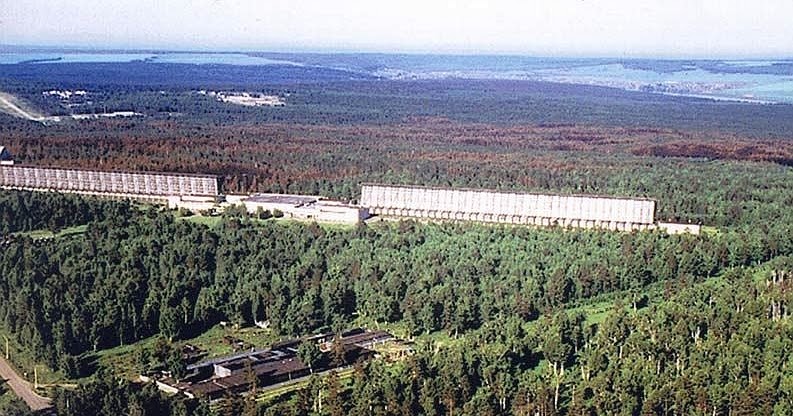
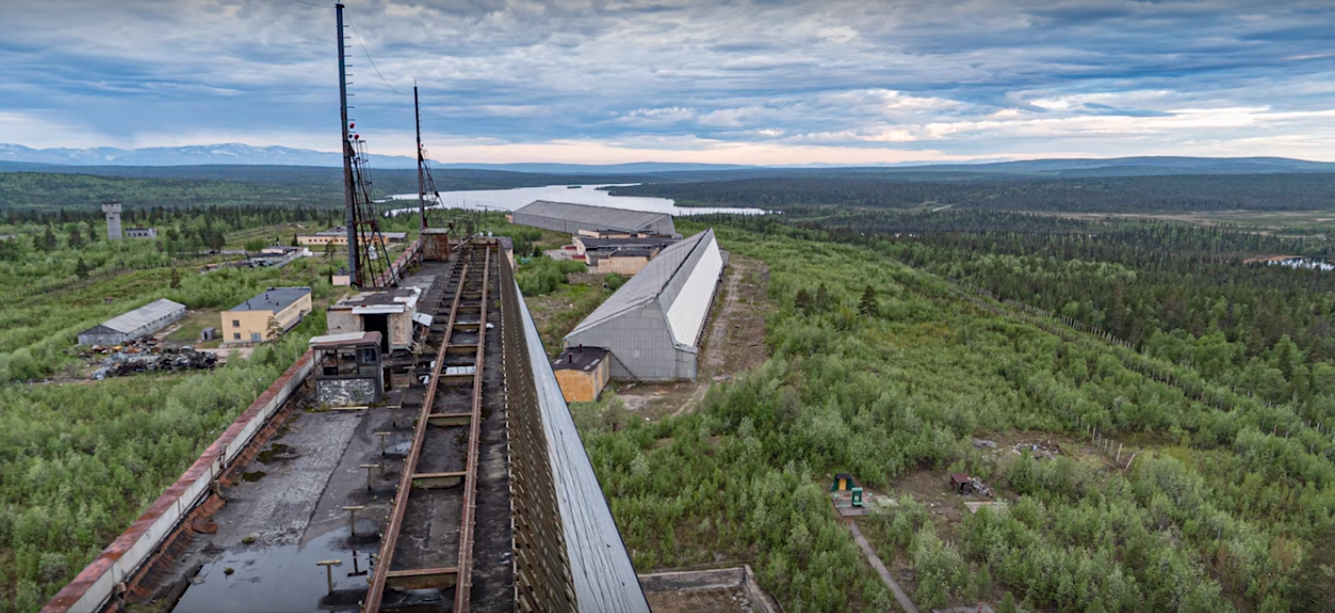
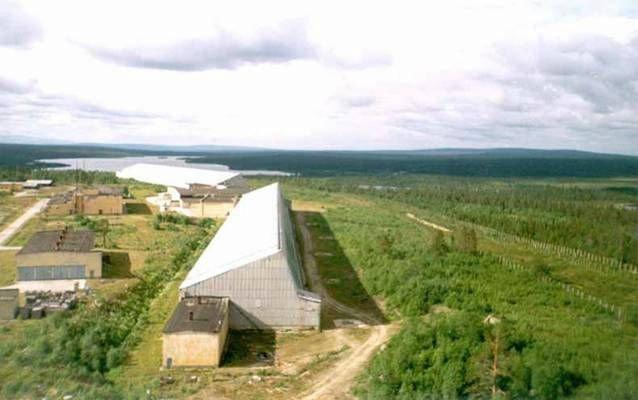
A typical Dnepr site has two long “wings,” each a two-sector horn antenna roughly 250 m long and 12–14 m high. Each wing covers about 60° in azimuth; the pair gives about 120° azimuth and 5–35° elevation. Scan is by frequency steering of the slotted waveguide arrays. The first Dnepr went on duty in 1974 at Balkhash. The SPRN ground layer of the mid-1970s was built on Dnestr-M and Dnepr radars.
HOW IT DIFFERS FROM DNESR
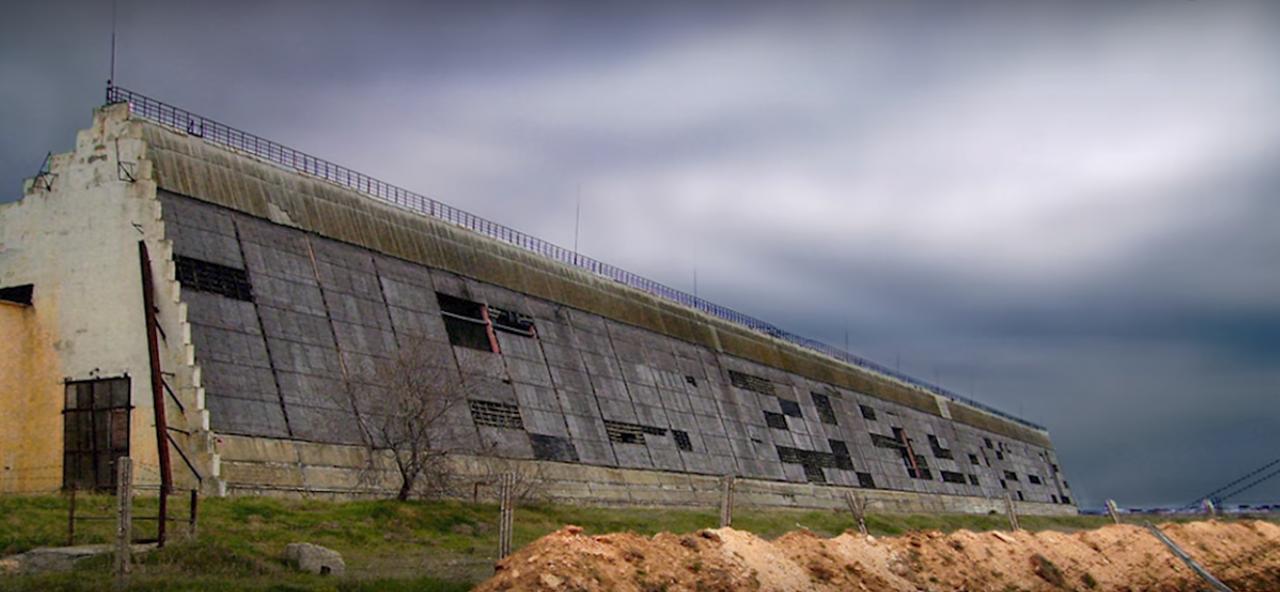
Dnestr was the original space-surveillance set. Dnestr-M adapted it for early warning. Dnepr doubled the azimuth sector per antenna (60° instead of 30°), shortened the horn (about 14 m instead of 20 m) and added a polarisation filter for better elevation accuracy, raised transmitter power and phased the transmitters for longer range (published figures 4,000 km class, some cards higher), and improved low-angle performance and noise immunity. Peak power is described in open sources as exceeding 10 MW; frequency is in the VHF meter band, about 154–162 MHz. Pulse widths and PRFs are variable. The antenna is a large inclined billboard-style array.
SITES
The perimeter network of the 1970s included:
Olenegorsk (Murmansk / RO-1) — northern approaches, later paired with a Daugava receive array.
Skrunda (Latvia / RO-2) — western approaches. Closed and demolished after 1998 under a Russian-Latvian agreement.
Balkhash / Sary-Shagan (Kazakhstan / OS-2) — southern and south-eastern sectors. Long the last foreign Dnepr still feeding Russia; removed from combat duty around 2020.
Mishelevka (Irkutsk Oblast / OS-1) — eastern and south-eastern coverage. Mixed Dnestr and Dnepr arrays; largely superseded by nearby Voronezh.
Sevastopol (Crimea / RO-4) — south-western sector (southern Europe, Middle East, North Africa). Data to Russia under a 1992 lease until about 2009; site later derelict. Russian statements after 2014 spoke of restoration or replacement by Voronezh; open status remains limited.
Mukachevo (Ukraine / RO-5) — western sector. Same lease arrangement, data cut around 2009, abandoned.
A full site often combined earlier Dnestr cells with one or more Dnepr wings so the azimuth sectors overlapped. The 29 October 1976 date is commonly given for the first SPRN combat-duty set (Olenegorsk, Skrunda, Balkhash, Mishelevka). Sevastopol and Mukachevo joined in January 1979.
ROLE IN SPRN
Dnepr was the workhorse over-the-horizon layer from the mid-1970s until the Voronezh high-factory-readiness radars began replacing it. It supplied launch detection and rough trajectory data to the SPRN command post for warning, and handed tracks toward the Moscow ABM system and the SKKP space catalogue. It is not a precision engagement radar. Range and accuracy figures in open literature (roughly 3,000–6,000 km depending on target and source, angle errors of minutes of arc) are consistent with a first-generation VHF array of that size. Later Daryal radars (Pechora, Gabala) and then Voronezh were built to close the gaps and raise resolution.
HISTORY AND FATE
Development lineage runs from the TsSO-P experimental set through Dnestr (space surveillance) and Dnestr-M (warning) to Dnepr under Yu. V. Polyak at RTI. Construction of the perimeter stations ran through the late 1960s and 1970s. After 1991 several sites lay outside Russia. Skrunda was lost by agreement. The Ukrainian pair continued under lease until the late 2000s. Remaining Russian and leased Dneprs were scheduled for replacement by Voronezh; some transmitter sections (notably Olenegorsk with Daugava) stayed in limited use longer. By the mid-2020s the type is residual or closed, not the backbone of the warning network.
NOT THESE
Dnestr / Dnestr-M — the immediate predecessors. Same family, smaller sector or earlier standard.
Daryal — next-generation large PESA (Pechora, Gabala). Different architecture.
Voronezh — current high-factory-readiness replacement family.
Volga — Belarus warning radar, different design.
Duga — the HF over-the-horizon “Woodpecker.” Completely different system.
CAVEATS
Exact radiated power, current operational status of any remaining Dnepr face, and precise range against a given RCS vary by source and are not fully public. Site lists sometimes confuse Sevastopol with Nikolayev. “Hen House” covers the whole Dnestr/Dnepr visual family.
STATUS
First-generation SPRN radar. Most sites closed, demolished, or replaced by Voronezh. Residual or transmitter-only use at a few locations into the 2010s–2020s; no longer the primary warning layer.
IN ONE SENTENCE
Dnepr (5N86, Hen House) is RTI’s first-generation VHF over-the-horizon early-warning radar — twin 250 m wings, 120° azimuth, 4,000 km-class range — that formed the SPRN perimeter from the mid-1970s until Voronezh replaced it, with surviving faces at Olenegorsk, Mishelevka and Balkhash into the later years.