Solnechnogorsk Missile Attack Warning System (SPRN)
WHAT IT IS
Serpukhov-15 is the western ground-control and data-processing post for Russia’s (formerly Soviet) space echelon of the missile-attack warning system (СПРН / SPRN). It flies and listens to the early-warning satellites: first US-K / US-KS and US-KMO of the Oko / Oko-1 programme, now the EKS “Kupol” Tundra birds. Primary job: take infrared and optical launch-flare detections from orbit, run the on-site combat programs, and hand a graded space-echelon product to the 514th Command Post at Solnechnogorsk-7. It is not a radar. It does not sit on Senezh. The 26 September 1983 false alarm that Lt. Col. Stanislav Petrov refused to treat as a raid happened in this hall, not at GTsPRN.
Closed military townlet next to the village of Kurilovo, Zhukovsky District, Kaluga Oblast — historically mailed as Serpukhov District, Moscow Oblast, which is why the place has a Moscow postal legend and a Kaluga fence. Village coordinates used on maps: about 55°06′07″ N, 37°01′57″ E. Roughly 30–35 km northwest of Serpukhov, ~20 km east of Zhukov, a few kilometres north of the A-108 Moscow Big Ring. Distance language in Western copy wanders between “70 km southwest of Moscow” and “90 miles”; the useful fix is Kurilovo / object 455, not the city of Serpukhov itself.
Unit stack on the same campus (all circulate in open lists): 916th Separate Radio-Engineering Node (916-й ОРТУ), v/ch 03340 — the garrison number used for mail and conscript talk; v/ch 22251 — Central Command Post of SPRN US-KS “Oko,” object 455I; v/ch 10205 — a second unit remembered by 1980s draftees on the same hill. Wikimapia language also calls it the Western Command Post (ЗКП) of the SPRN space grouping and the head sample of the Krokus warning-display complex.
PRIMARY JOB
Two functions on one site.
1. Satellite command and control. Uplink/downlink and station-keeping for the western-visible birds. Molniya-orbit US-K / Tundra spacecraft need a ground touch every two or three revolutions or the orbit walks off. GEO / US-KMO slots that look over the Atlantic are this post’s. Seven reserved GEO “Prognoz” longitudes were published by Podvig: Prognoz-1 24°W, -2 12°E, -3 35°E, -4 80°E belong to Serpukhov-15; Prognoz-5 130°E, -6 166°E, -7 159°W belong to the eastern twin at Pivan-1 / Komsomolsk-on-Amur (Lake Hummi). Prognoz-4 can be shared. Pacific-looking slots are out of this station’s useful view.
2. Combat processing of launch infrared. The satellite sees a booster plume. The post decides whether that plume is a ballistic-missile launch against the state, then forwards the packet. Solnechnogorsk fuses it with Voronezh / Daryal / Dnepr / Don-2N. Launch-on-warning and A-135 cueing sit downstream of that fusion, not inside a radome here. Secondary published task of the constellation: watch for nuclear-test flashes. Tundra / EKS briefing language also claims a nuclear-war emergency-communications payload on the new birds.
Duty cycle described by unit-help sites: combat watch about every three to four days for the line crews. 2021 MoD anniversary video (SPRN’s fiftieth year) showed the hall running a scripted U.S. launch: red tactical plot, automatic voice “Attention. Launch. First echelon,” parallel alert toward the ABM system.
HOW THE SPACE ECHELON WORKS
Oko was built at TsNII Kometa under Anatoly Savin. Two satellite generations fed this post:
US-K / US-KS (“Continental Controllable Satellite”). Molniya / highly elliptical orbits so the apogee hangs over the northern hemisphere and stares at U.S. ICBM fields for hours at a time. Four live US-K were the textbook minimum for continuous CONUS coverage; up to nine could be on orbit. Bus: drum, ~2 m long × 1.7 m diameter, ~1,250 kg dry / ~2,400 kg fueled. Main instrument a ~350 kg Earth-pointing infrared telescope with a ~4 m conical sunshield. Two solar wings, ~2.8 kW. First relevant launch Kosmos-775 (8 October 1975). Last US-K: Kosmos-2469 (30 September 2010). ~85 launched.
US-KMO (GRAU 71Kh6), Oko-1. Geosynchronous, NPO Lavochkin. 1-metre infrared telescope under a 4.5 m hood; design life 5–7 years, launch mass ~2,600 kg. First Kosmos-2133 (14 February 1991). Last Kosmos-2479 (30 March 2012); that bird died March–April 2014 after two years instead of five-to-seven. Eight launched. These are the Atlantic-stare slots this post was built to talk to.
EKS “Kupol” / Tundra (14F142). Replacement. Payload and system design TsNII Kometa; bus RKK Energia (Victoria / Yamal family language). First Tundra-11L / Kosmos-2510, 17 November 2015; at least six launched through Tundra-16L / 25 November 2022. Molniya-class orbits in the published table (~38,552 × 1,626 km, 63.37°). Company talk: five spectral bands (UV, optical, three IR), detection of boosters and of higher / faster objects; a claimed wartime comms package. Oko was called “hopelessly outdated” in mid-2000s Russian commentary; Kupol is the reason this post still has a job.
Physics limit that mattered in 1983 and still matters: a single satellite looking at sunlit high cloud near equinox can look like a plume. The combat program was built to demand corroboration — more satellites, then ground radar. Petrov’s shift applied that rule when the new system had not yet earned it.
HARDWARE ON THE GROUND
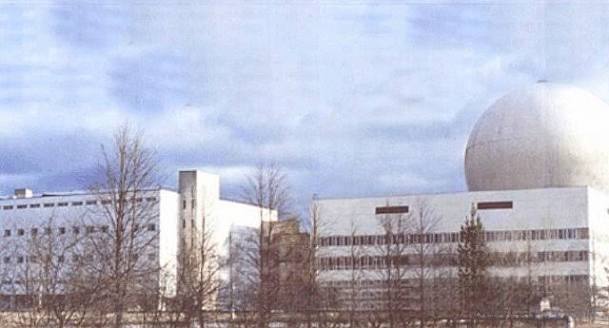
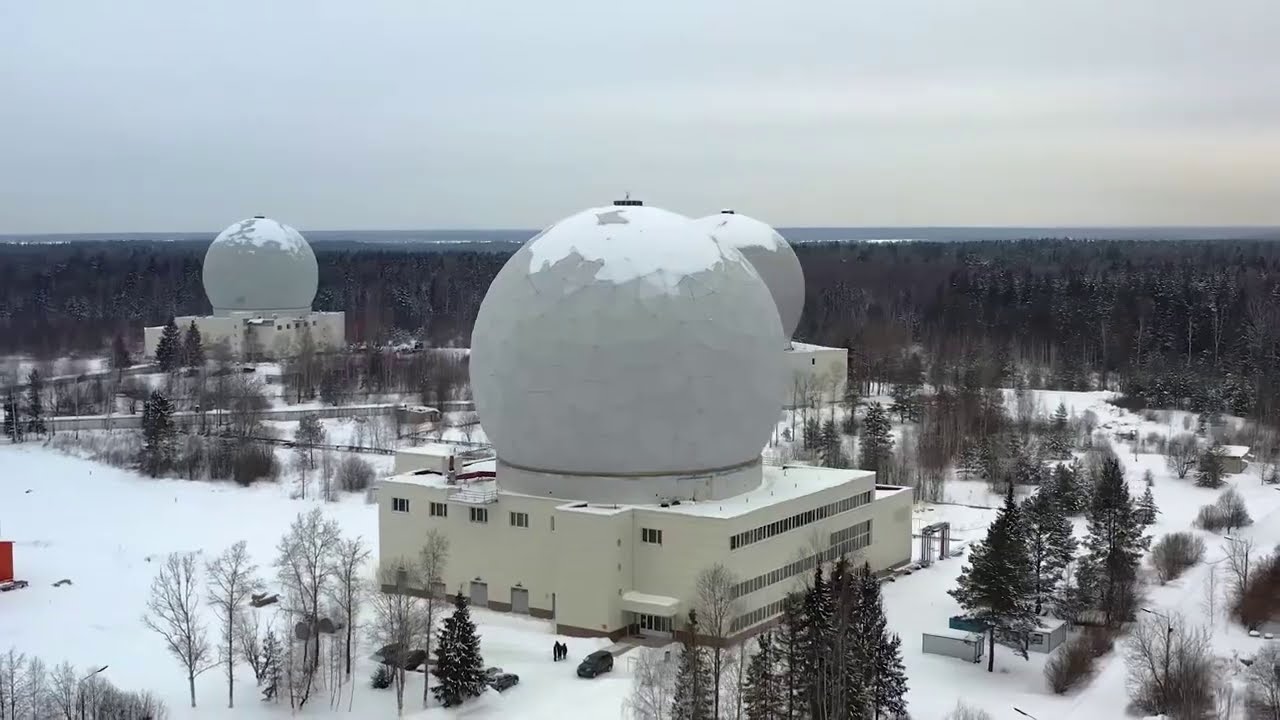
The visible plant is the antenna farm. Open counts: seven domes in older satellite photos, eight white geodesic radomes in the 2021 MoD/Daily Mail stills. Eastern twin at Pivan-1 is described as seven 25-metre antennas under ~45-metre radomes, each antenna ~300 tonnes; Western copy applies the same 300-tonne figure to Serpukhov-15. 2021 footage stepped inside a dome and showed a rotating dish used to talk to the birds — TT&C / data link, not a search radar, even though television captions keep saying “radar.”
Under the domes and in the CP building: receive processors, combat-program computers, operator consoles, the display wall shown in 2021 (red geographic plot, launch data stacked on the right). Wikimapia: this site was the head sample of Krokus — the warning-dissemination and display complex whose production name later attached to the whole SPRN fan-out toward the Kremlin. Period CP computers for SPRN as a system were Kartsev M-10 / 5E66 and the 17L6 six-machine suite at Solnechnogorsk; which exact boxes sat in object 455I in 1982 vs after the 2001 rebuild is unpublished. 2021 interiors look like replaced workstations, not 1970s Kartsev frames.
Landlines and reserved trunks carry the graded product to Solnechnogorsk. The eastern post is the geographic spare for GEO slots this station cannot see, and a reconstitution path if this building burns — which it did.
STAFFING AND TOWN
Garrison “Kurilovo.” Population of the military town quoted in the 3,800–5,000 band; the civilian village of Kurilovo next door is a few dozen. Own school, hospital, fire company, shops. Closed-town status formally dropped around April 2012; housing later re-addressed toward Marinki, Zhukovsky District, while mail for the unit still went 142215 Serpukhov-15, v/ch 03340. Conscript write-ups: CP is a closed room, watch every 3–4 days. Officers of the 916th run the birds and the first-look software; they do not own the nuclear briefcase (that is Service “K” / Kazbek, a different v/ch).
HISTORY
1960: S-25 Berkut Moscow-ring site in the same woods (v/ch 71533 in local histories). 1966: RSFSR Council of Ministers hands the land to the MoD in perpetuity. The hill was also on the A-35 / A-350 ABM map; that battery was not finished here.
Spring 1971: construction of object 455, US-K complex, starts. GPTP “Granit” on the build. 4 October 1971: present unit formed by General Staff / PVO Main Staff directive. 1978–79: US-KMO western commercial-centre construction language in GlobalSecurity; 1979 the node joins the missile-space defence association. 1982: combat duty — the date that matters. First US-K-class launches were already seven years old; the CP is what made them a warning system instead of a science project.
26 September 1983. Shortly after midnight Moscow time the new Oko chain reported a U.S. Minuteman launch, then five. Cause reconstructed later: sun angle + high-altitude cloud near equinox against a recently commissioned program. Duty officer Lt. Col. Stanislav Evgrafovich Petrov (1939–2017) held the warning because ground early-warning radar did not confirm and because a five-shot raid from one satellite was the wrong shape. He waited through the time the first missile should have entered Soviet radar cover. That decision is why this article exists as history instead of as a crater.
1990s–2000s: constellation shrinks. A five-satellite US-K set was rebuilt in 2001, then:
10 May 2001, 02:20 local. Fire in the CP building. Military tried it alone for an hour, called civilians at 03:20. Fire between second and third floors; ~100 firefighters; three-storey structure reported gutted; damage quoted above 2 billion RUB. Space Forces commander Anatoly Perminov: comms lost with four satellites, no casualties, documents and weapons gotten out; cause talked as short circuit / old plant / no money. Contact gone ~12 hours. Molniya birds that miss a couple of passes walk. Immediate losses: Kosmos-2340 and 2351; Kosmos-2342 and 2368 dead within a year from the orbit hit. Podvig’s same-day read: the entire live space echelon was those four US-K. Restart of the centre reported 20 August 2001. Eastern post and remaining ground radars were the hedge.
2010–14: last US-K and last US-KMO. 2015– : Tundra/EKS launches, same two ground posts. 15 February 2021: SPRN fiftieth-anniversary camera tour of this hall.
Subordination follows the rest of SPRN: PVO → 3rd Army PRN / RKKO → Space Troops → VKO Space Command (2011) → Space Forces inside VKS (2015). Still a node of the 820th Main Centre, not a replacement for it.
PLACE IN THE NET
Upstream of Solnechnogorsk, sibling of Pivan-1, consumer of Kometa satellites, peer of the Voronezh belt. Space echelon sees boost; ground echelon sees midcourse. Neither is allowed, on paper, to start a war by itself. 1983 is the worked example.
CAVEATS
03340 / 22251 / 10205 / 455 / 455I all refer to the same hill in different decades. Seven vs eight radomes is photo-date. 300-tonne antennas are the Pivan-1 spec applied west by habit. Combat-computer types after 2001 are unpublished. Tundra sensor numbers are contractor talk. Petrov accounts differ on “one missile then five” vs “five at once”; the hold-for-radar fact is stable.
STATUS
Western SPRN space CP, live, flying Kupol/Tundra and whatever Oko remnants still answer, reporting to Solnechnogorsk. The 2001 fire is why the eastern twin exists as more than a longitude problem.
IN ONE SENTENCE
Serpukhov-15 at Kurilovo is the 916th ORTU / object 455I western command post that talks to Oko and Kupol early-warning satellites through a farm of 300-tonne dishes under geodesic radomes, turns plume detections into a space-echelon warning for Solnechnogorsk — and is the building where, on 26 September 1983, Stanislav Petrov declined to treat a false Minuteman alarm as the start of a war.