WHAT IT IS
The Tupolev Tu-95 (Ту-95, Russian informal name «Медведь», “Bear”; NATO reporting name Bear) is a Soviet four-engine turboprop strategic bomber and cruise-missile carrier designed by OKB-156 under Andrei Tupolev. It first flew on 12 November 1952, entered service with Long-Range Aviation (Дальняя авиация, ДА) in 1956, and in its Tu-95MS form is still flown by the Russian Aerospace Forces (ВКС России). It is the only turboprop strategic bomber ever fielded in quantity, and the only swept-wing propeller aircraft built in large numbers. Total production is usually given as more than 500 airframes of the Tu-95/Tu-142 family; Russian-language sources put Tu-95 production at 1955–1992 and English-language sources at 1952–1993.
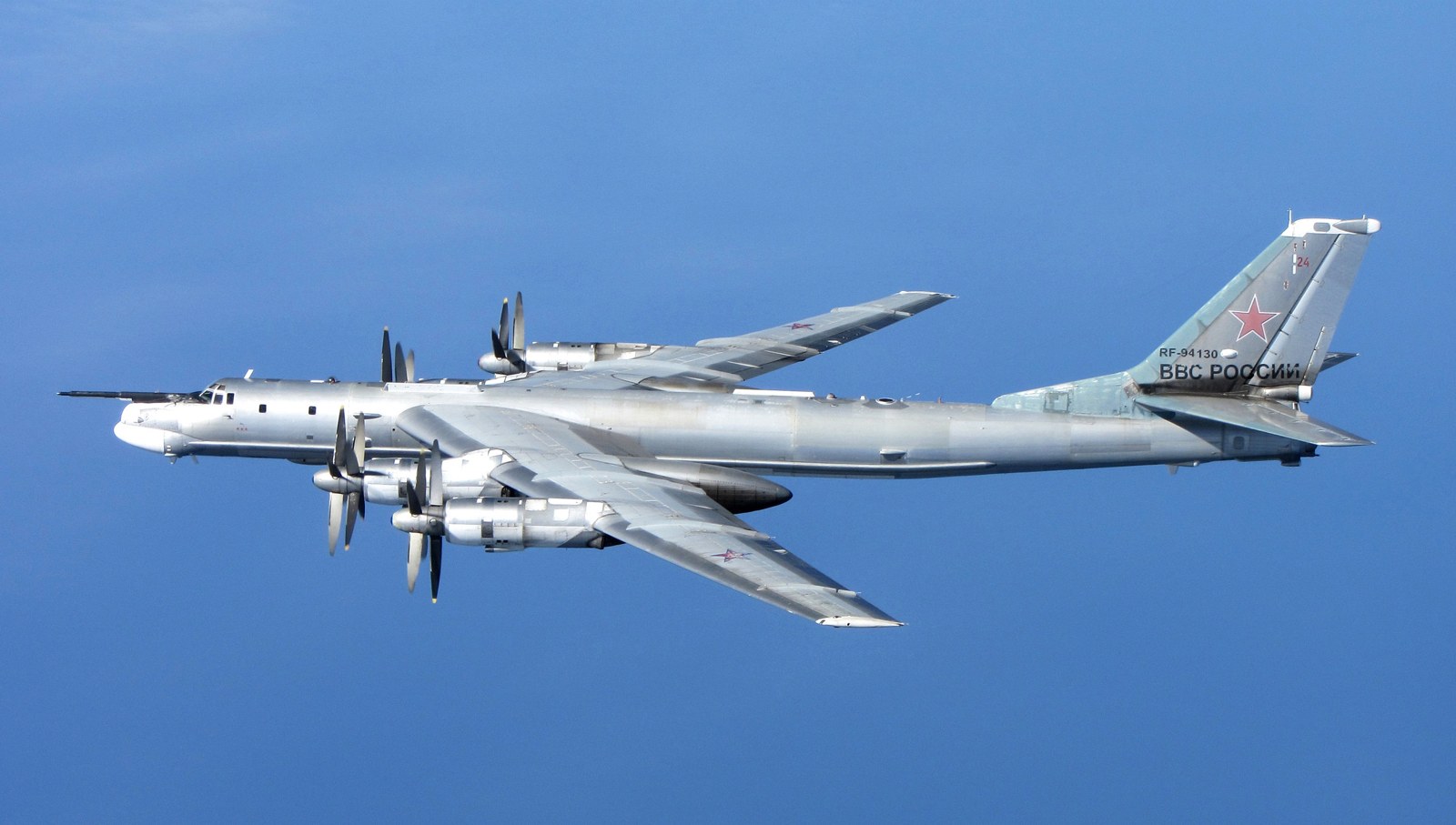
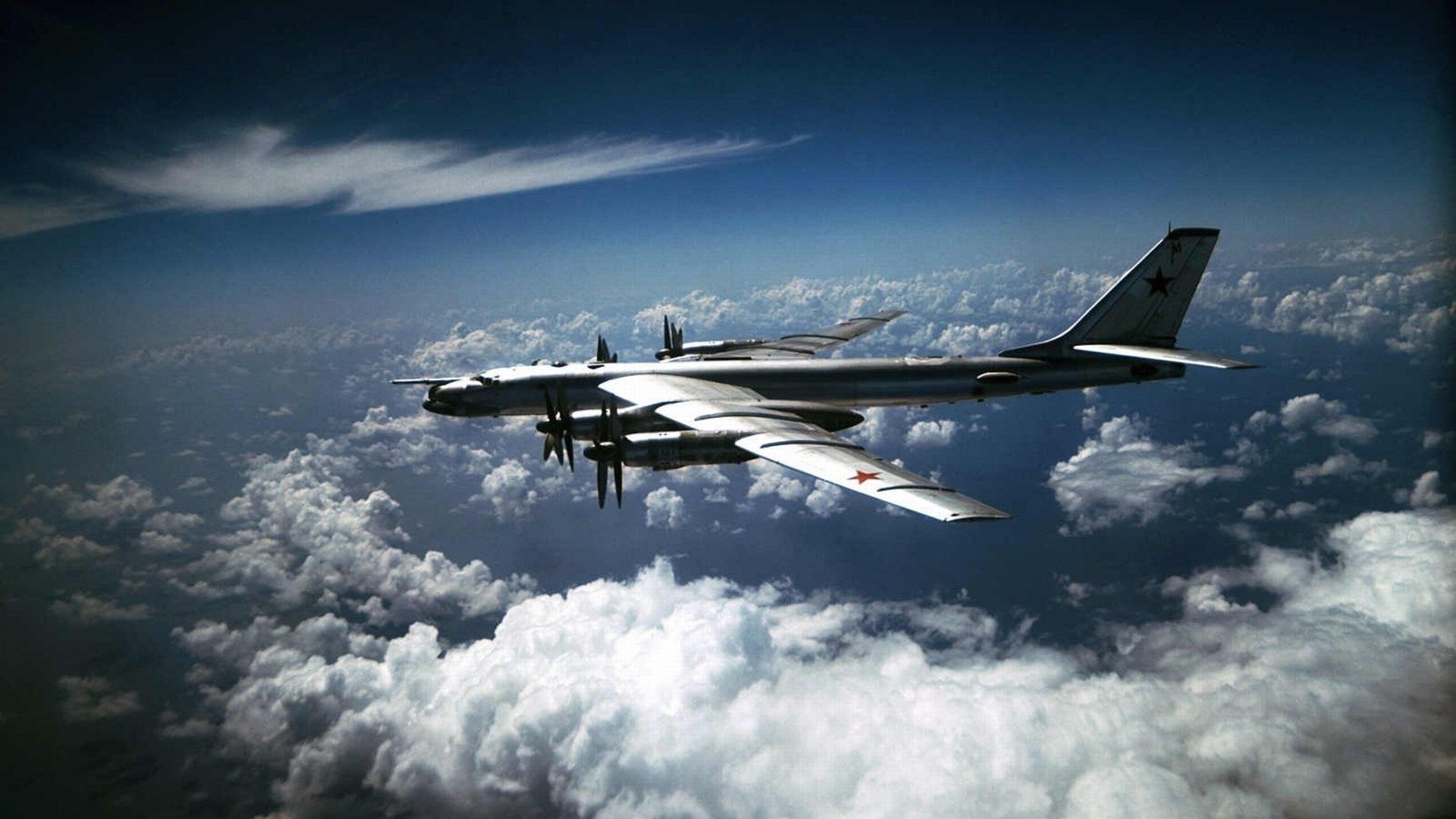
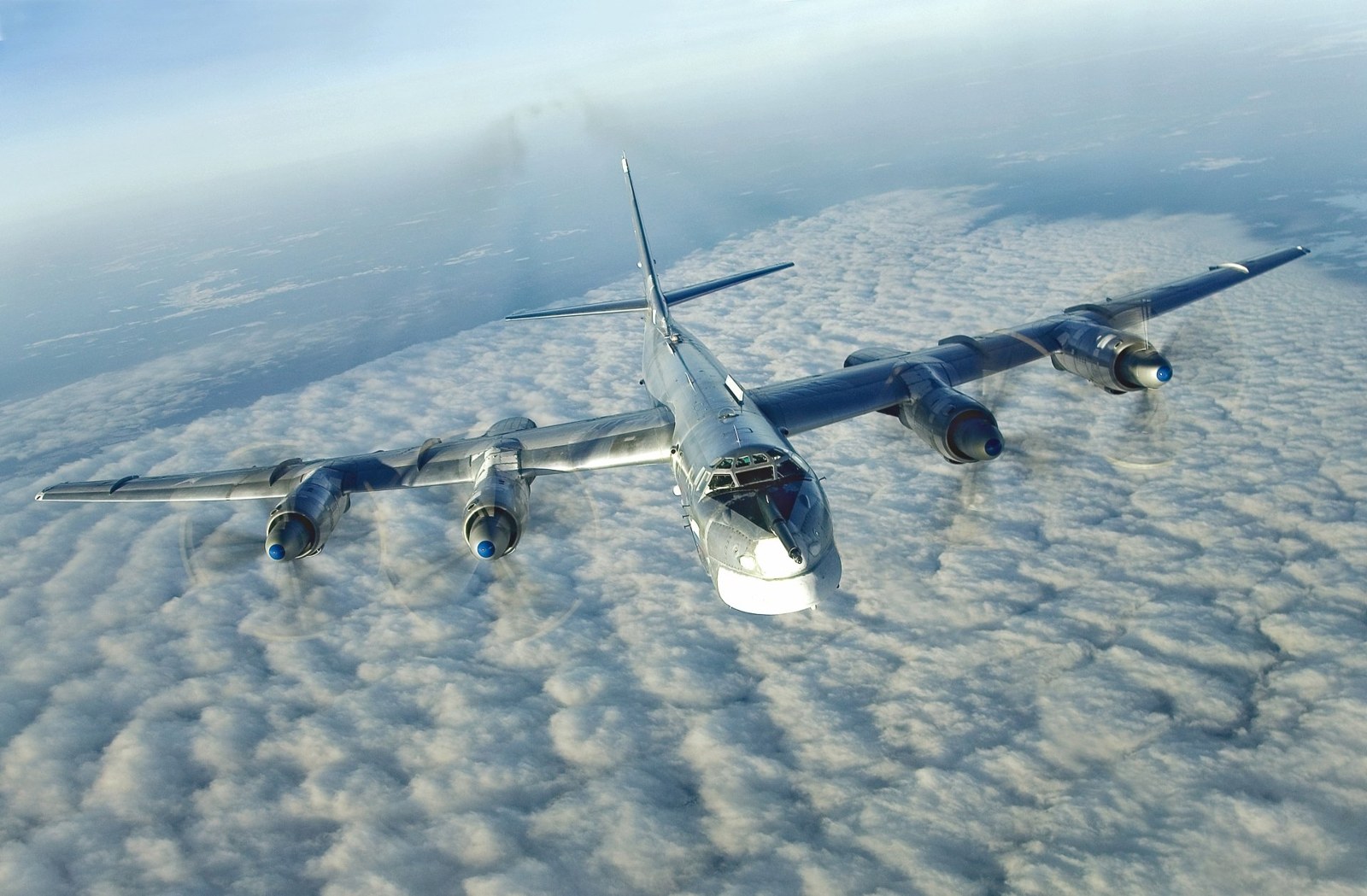
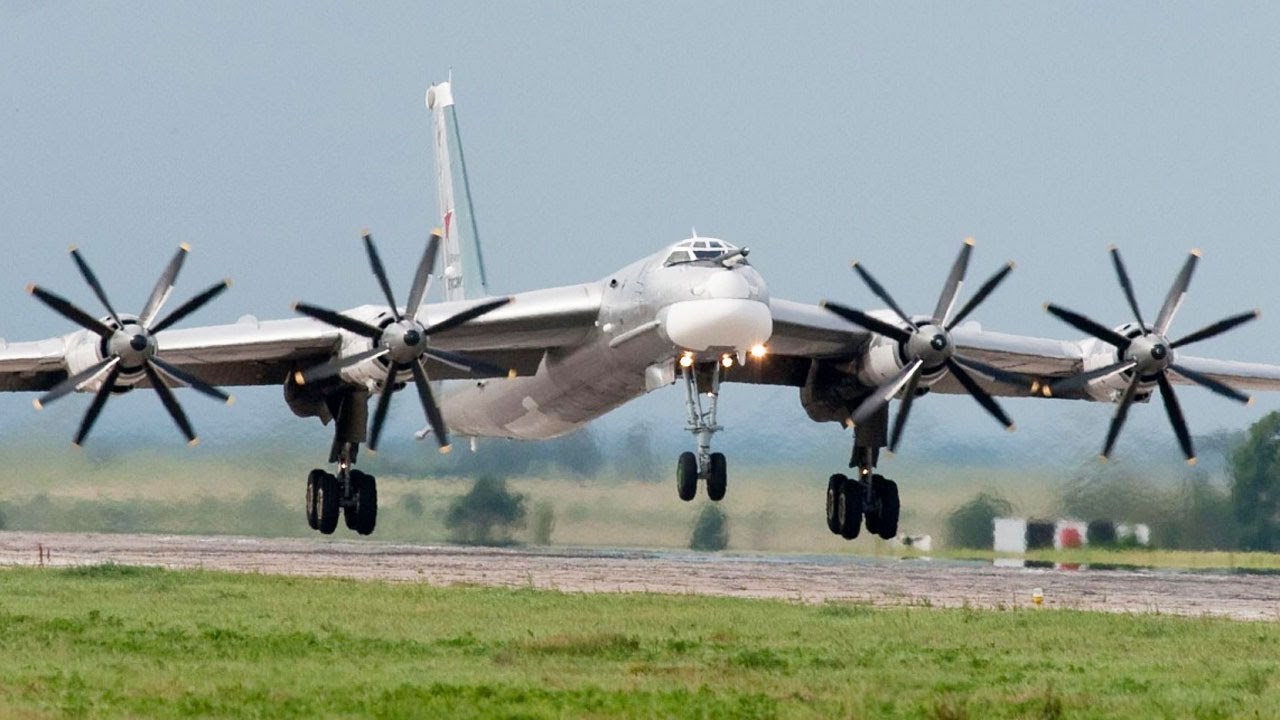
The aircraft is recognisable by its 35-degree swept wing, four long engine nacelles and four pairs of contra-rotating propellers. The propeller tips run at supersonic speed, which makes the Bear one of the loudest military aircraft in service. Its NATO designations run from Bear-A (the original bomber) to Bear-H (the Tu-95MS missile carrier). The type is the basis of three relatives: the Tu-114 airliner (NATO: Cleat), the Tu-126 airborne early-warning aircraft (NATO: Moss) and the Tu-142 maritime patrol and anti-submarine aircraft (NATO: Bear-F), whose airframe in turn became the basis of the Tu-95MS.
The Tu-95 carried free-fall nuclear bombs in the 1950s, including the largest bomb ever detonated, the AN602 “Tsar Bomba”, and later cruise missiles: first the Kh-20 and Kh-22, then the Kh-55 family, and now the Kh-101 and Kh-102. It was first used in combat only in November 2015, in Syria, and has since been used for cruise-missile strikes in the war against Ukraine.
DEVELOPMENT
Background. In the late 1940s the USSR had only the Tu-4, a copy of the Boeing B-29, which could not reach the United States from Soviet territory. Tupolev’s first intercontinental attempt was the piston-engine Tu-85 (1949). In 1950–51 a requirement was issued to both the Tupolev and Myasishchev bureaus for a bomber with an unrefuelled range of about 8,000 km and a payload of about 11,000 kg. Tupolev argued that the turbojets then available were too thirsty for such a range and chose turboprops, which gave better range than jets and more power than piston engines. Myasishchev meanwhile worked on the jet-powered M-4. A Council of Ministers decree of 11 July 1951 (No. 2396-1137) ordered Tupolev to build the “95” in two versions: a first with four paired TV-2F-type engines and a second with four TV-12 engines.
Prototype 95-1. The first prototype, “95-1”, was powered by four 2TV-2F engines. Each was two TV-2 turboprops coupled through one gearbox to a single contra-rotating propeller unit. The TV-2 family was developed by the German team of former Junkers engineers working at the Soviet plant No. 2 under Ferdinand Brandner, with Nikolai Kuznetsov leading the later development. The aircraft made its first flight on 12 November 1952 at Zhukovsky with test pilot Aleksei Perelyot at the controls. On 11 May 1953, on its 17th test flight, a fatigue failure of a gear in the number 3 propulsion unit caused a fire, and the aircraft crashed northeast of Noginsk. Perelyot and three others were killed and five crew bailed out (Russian Wikipedia, citing Aviatsiya-Kosmonavtika 1995). English-language sources describe the same loss as occurring “after six months” of testing.
Prototype 95-2. The second prototype, “95-2”, used the single-shaft Kuznetsov TV-12 (the engine that became the NK-12). It first flew on 16 February 1955 with pilot M. A. Nyukhtikov. The decision to put the aircraft into series production was taken in summer 1955, before factory testing was complete. Series production began at plant No. 18 in Kuibyshev (now Samara, later the Aviakor plant) in 1955; the Russian-language sources date the first deliveries to April 1956, English-language sources to 1956 generally. A first serial bomber unit formed in 1955–56 at Uzin in Ukraine (106th Heavy Bomber Aviation Division).
Naming. For a long time Western intelligence knew the aircraft as the Tu-20, which was its original Soviet Air Force designation. Tupolev’s internal designation Tu-95 was used in practice, and the Tu-20 name faded in the USSR but stayed in Western documents. Early US estimates of the aircraft’s speed (about 640 km/h) and range (about 12,500 km) had to be revised upward several times.
Cold War variants. The first production Tu-95 (NATO Bear-A) was a free-fall bomber. The Tu-95M added improved NK-12M engines and more fuel. The Tu-95K (Bear-B) carried the Kh-20 supersonic cruise missile (the K-20 system). The Tu-95KD added a nose probe for air refuelling, and the Tu-95KM (Bear-C) added improved reconnaissance equipment. The Tu-95K-22 (Bear-G) carried the Raduga Kh-22 anti-ship missile. The Tu-95RTs (Bear-D) was a naval reconnaissance and targeting aircraft with a large ventral radome. The Tu-95MR (Bear-E) was a photo-reconnaissance variant. See VARIANTS below.
Tu-95MS. In the late 1970s and early 1980s the design was reworked around the airframe and systems of the Tu-142M maritime aircraft. The result was the Tu-95MS (factory designation VP-021; NATO Bear-H), a dedicated carrier of the Kh-55 air-launched cruise missile with a rotary launcher in the weapons bay. English-language sources give 1981 as the start of production. Russian Wikipedia says a first batch of six was converted from Tu-142M airframes at plant No. 86 and that the last serial aircraft, built at plant No. 18, was delivered on 20 August 1992, after which the line was dismantled in 1995. In the 1980s US sources sometimes referred to the new aircraft as a Tu-142 until its true designation became known.
Modernization. Starting in the 2000s the VKS studied upgrades of the Tu-95MS. In 2003 the aircraft were made compatible with the conventional Kh-555 missile. A research and development contract was issued to Tupolev on 23 December 2009. Only the Tu-95MS16 aircraft with the K-016 “Sprut” missile initialisation system (built from 1986 onward, about 30–35 aircraft) are being modernized; the older Tu-95MS6 with the K-012 “Osina” system are not. The first step adds external pylons and compatibility with the Kh-101 and Kh-102; the first such aircraft, the Tu-95MS “Saratov”, was rolled out at the Beriev plant in Taganrog in early 2015 and delivered in March 2015. Serial work at the Aviakor plant in Samara began in 2015 (first aircraft: Tu-95MS “Dubna”, delivered 18 November 2015) at a stated rate of about three aircraft per year. The second step, the Tu-95MSM, is a deeper modernization (see AVIONICS and STATUS); its first flight is reported as 22 August 2020, and a new upgrade contract was reported in August 2021.
AIRFRAME
The Tu-95 is an all-metal, four-engine mid-wing monoplane with a round-section semi-monocoque fuselage, swept wing and tail, retractable tricycle gear, and two pressurized crew compartments, one forward and one in the tail. Structural materials are aluminium alloys D16 and V95, steels such as 30KhGSA and 30KhGSNA for highly loaded fittings, and magnesium casting alloys (Russian Wikipedia). Rivets are countersunk and the skin is butt-jointed. The description below applies mainly to the original “izdeliye V” family; the Tu-95MS shares much of its structure and systems with the Tu-142M.
Wing. The wing is a multi-spar box (caisson) design assembled from a centre section, two middle sections and two outer panels, with 35 degrees of sweep. The wing spar passes through the fuselage ahead of the bomb bay, which is one reason the 35-degree sweep was chosen. Each wing has a single-slot electrically driven extending flap on the trailing edge (maximum angle 30 degrees), three-section ailerons, and three aerodynamic fences on the upper surface. The wing box and fuselage contain soft rubber fuel tanks: 66 in the wing box of the early aircraft, 71 tanks on the Tu-95 and 74 on the Tu-95M in total. The long engine nacelles project far ahead of the wing and act as flutter-suppressing masses; the inner nacelles continue rearward into the main-gear fairings.
Tail. The fin and stabilizer are cantilever, swept at about 40 degrees at quarter chord. The stabilizer was fixed on early aircraft; the Tu-95MS has an electrically adjustable stabilizer to widen the permitted centre-of-gravity range. Elevators and rudder have aerodynamic and weight balance. Control is by hydraulically boosted mechanical linkage with a combination of rods and cables, and an AP-15 autopilot. The Tu-95MS also has a KA-142 automatic system that damps aeroelastic oscillations and automatically applies rudder in case of an outer-engine failure on take-off.
Landing gear. The nose leg has two non-braked wheels (1100 × 330 mm). Each main leg has a four-wheel bogie with disc brakes and an anti-skid system, and retracts rearward into the inner engine nacelle with the bogie flipped over. All three legs extend against the airflow. Most Tu-95 variants except the MS have a retractable two-wheel tail bumper wheel to protect the rear fuselage on a tail-down landing.
Fuel and systems. The fuel system is divided into four independent systems, one per engine. Fuel (kerosene grades T-1, TS-1 or T-2) can reach roughly 88.5–100 tonnes on the original aircraft, up to about half of take-off weight. The Tu-95MS uses integral (caisson) tanks and four pressure-refuelling points on the wing; the earlier aircraft were originally refuelled by hand with hoses. A neutral-gas system using carbon dioxide cylinders fills the tank ullage spaces to prevent fire when hit. There are two hydraulic systems (high pressure about 120–150 kg/cm², boost system about 75 kg/cm²), 115/200 V 400 Hz alternating current plus 27 V direct current, and pneumatic systems at 150 kg/cm². Some Tu-95MS carry a TA-12 auxiliary power unit in the base of the fin.
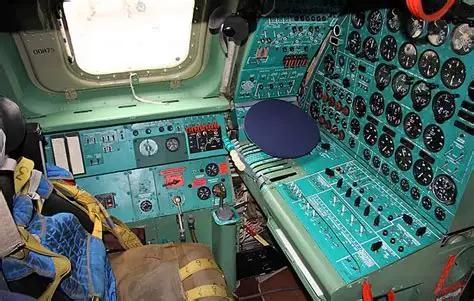
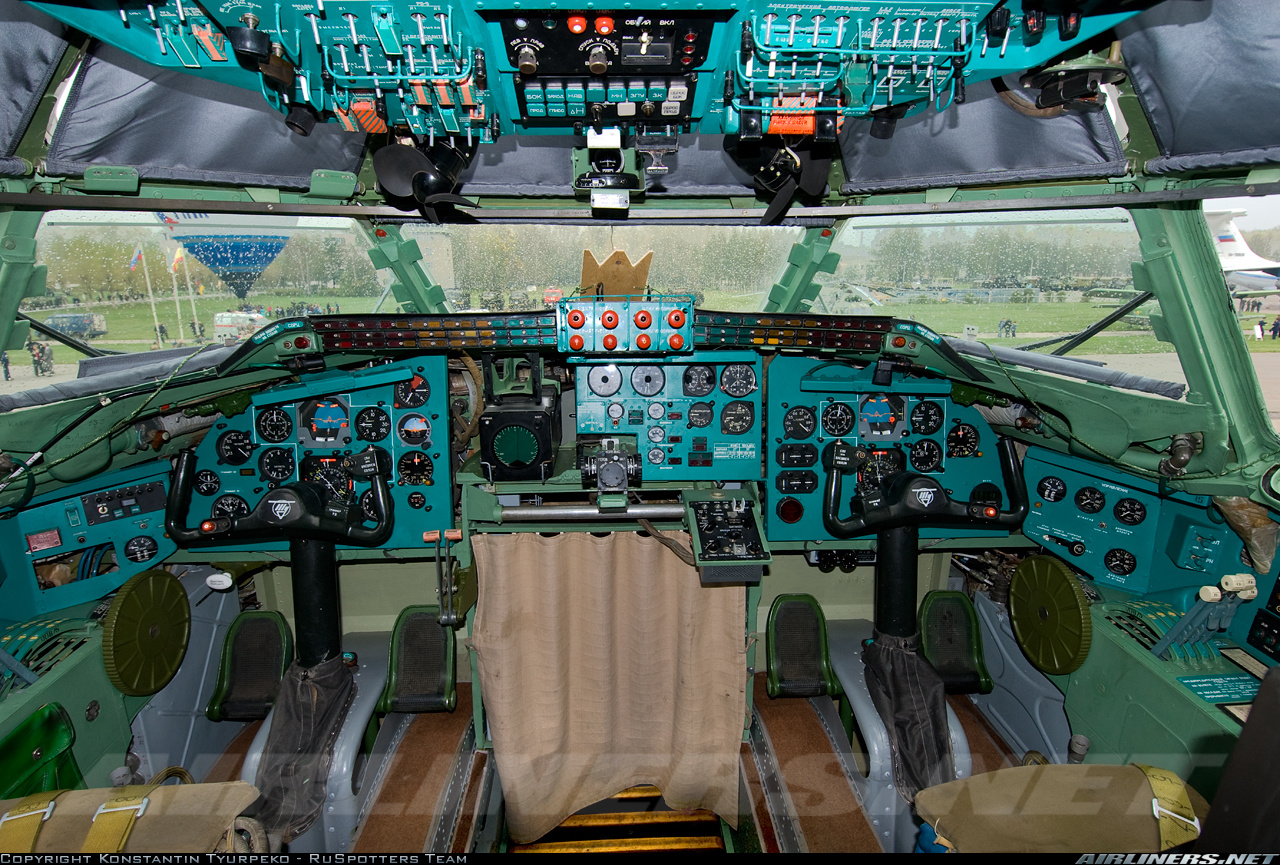
Interior. Interior paint and fittings on the early aircraft were utilitarian, with equipment racks, open pipework and wiring. Crews have described the early variants as uncomfortable on 10-hour-plus sorties, with no galley and only a portable toilet. The Tu-95MS received more attention to crew comfort, with light-green interior paint, emerald-green instrument panels and shadowless red-white cabin lighting (Russian Wikipedia).
Ejection. There are no ejection seats. Emergency escape from the forward compartment is through the entry hatch in the nose-gear bay: the nose gear is forced down and part of the floor is a hydraulically driven conveyor belt with hand-holds that moves the crew toward the hatch. The rear compartment has a jettisonable hatch. The absence of ejection seats is cited as a serious factor in several crashes.
ENGINES AND PROPELLERS
Engine. The Kuznetsov NK-12 (НК-12) was developed at plant No. 2 by a team under Nikolai Kuznetsov, with a significant contribution from German engineers led by Ferdinand Brandner, and built at the Frunze plant in Kuibyshev (today part of PAO Kuznetsov). It is described as the most powerful turboprop engine ever to enter service. Per Russian Wikipedia the engine has a 14-stage axial compressor with bleed valves and a five-stage turbine, and a unified fuel-control system (command-fuel unit KTA-14). The power is delivered through a differential gearbox that splits the single shaft into two counter-rotating outputs and reduces speed.
Ratings by version. The initial NK-12 of the second prototype and early Tu-95 is rated at roughly 12,000 hp (8,950 kW); sources also give 12,500 hp for the initial development model. The NK-12M, NK-12MV and NK-12MP used on later aircraft are rated at about 15,000 hp (about 11,000 kW; 14,795 hp / 11,033 kW is the figure usually quoted for the NK-12MV). The NK-12MV is the version on the Tu-95K/KM, Tu-95RTs, Tu-114, Tu-126 and Tu-142; the NK-12MP is on the Tu-95MS; the modernized NK-12MPM is on the Tu-95MSM. A commonly quoted dry weight is about 2,900 kg and length about 6 m. Cruise-power specific consumption is on the order of 0.16–0.22 kg per horsepower- or kilowatt-hour depending on the source and units, so treat it as approximate.
Propellers. The aircraft uses AV-60 series propellers (AV-60K on the Tu-95; AV-60N on the Tu-114; AV-60T on the modernized Tu-95MSM), designed by OKB-150 (later the Stupino Machine-Building Design Bureau, now NPP Aerosila) under K. I. Zhdanov, who received a Lenin Prize in 1957 for this work. Each engine drives two four-blade, variable-pitch, constant-speed propellers, contra-rotating on a common axis, giving eight blades per engine and 32 blades on the aircraft. The propeller diameter is 5.6 m (some English-language pages list 6.2 m for the NK-12MV, which conflicts with most other sources). Per Russian Wikipedia the propeller speed is 736 rpm, the front propeller turns clockwise and the rear counter-clockwise, the complete propeller unit weighs about 1,190 kg, and the front and rear propellers receive 54.4% and 45.6% of the engine’s power respectively. The blades are duralumin with NACA-16 sections and electrically heated leading edges.
Why contra-rotating. With this power a single propeller would have exceeded about 7 m in diameter, which was unacceptable for the layout, so contra-rotating propellers were adopted. They also cancel torque and recover swirl energy. The same arrangement is why the aircraft is so loud: the blade tips approach or exceed the speed of sound. Russian Wikipedia claims a propeller efficiency of about 82 percent and credits it, with the economical engine, for the Bear’s long range despite a modest lift-to-drag ratio. Treat this as a Russian-source claim.
Feathering and starting. Early NK-12 and NK-12M had manual propeller feathering only. The NK-12MV added automatic feathering when engine torque drops, with forced and emergency (nitrogen-pressure) backup. Engines are started one at a time from ground power through an electric starter and a TS-12 turbine starter; the NK-12MP can be started in left-right pairs.
Operational notes. The NK-12 burns a lot of oil, so the underside of the wing behind the exhaust and the gear fairings are normally coated in black soot. In cold weather the mineral oil mixture thickens so much that propellers cannot be turned, and engines require ground heaters or insulating covers; a special oil MN-7.5U was introduced in the late 1980s that permits starting down to about −25 °C. Replacing an NK-12 is laborious. Production of the engine ended decades ago, and Ukrainian commentators argue that engine life is a limiting factor for the remaining fleet (opinion, not an official figure).
CREW AND COCKPIT
Crew. The Tu-95MS crew is normally given as six or seven. Russian Wikipedia lists seven: aircraft commander, co-pilot, navigator, second navigator, communications systems operator, flight engineer and fire-control commander (командир огневых установок, КОУ). Other sources give six, with an extra navigator depending on mission. Earlier Tu-95 variants carried more people, and the Tu-95RTs reconnaissance version carried ten or eleven, including operators for the Uspekh-U targeting system and for radio-technical intelligence.
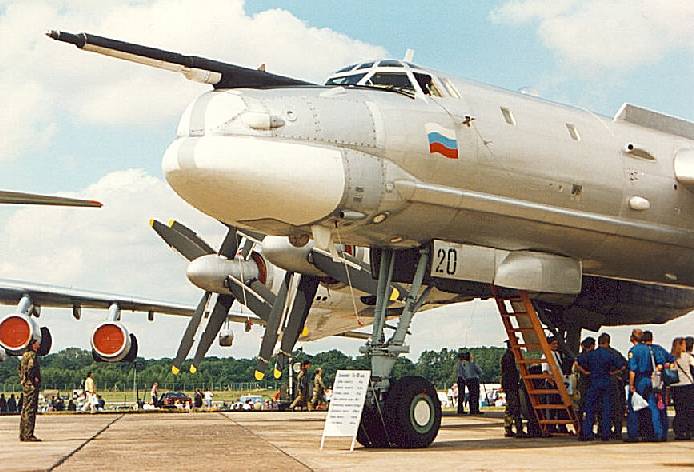
Layout. The forward pressurized compartment contains the pilots’ seats side by side with the flight engineer behind them, the navigator in the glazed nose, and the second navigator and communications operator at stations along the side. Two control columns (штурвальные колонки) and two sets of pedals are used. The nose has a large glazed navigator’s position with a flat sloping lower window. The pilots’ forward windows and navigator’s lower window use electrically heated silicate triplex glass. Entry is by ground ladder through the floor hatch in the nose-gear bay. The rear pressurized compartment contains the fire-control commander and the rear gunner/radio operator with the tail gun and its radar.
Instrumentation. Original cockpits used analogue flight and engine instruments such as the KUS-1200 airspeed indicator, VD-20 altimeter and AGD-1 attitude indicator, with engine instruments for exhaust gas temperature, oil pressure, torque and propeller position, and engine controls on the central console. The crew is on a long-endurance mission profile: the flight engineer monitors the four independent fuel systems and four engines. Missions of ten to fifteen hours and more are routine for the type. A July 2010 record flight by two Tu-95MS exceeded 43 hours with four aerial refuellings.
AVIONICS
Original equipment. The Tu-95 and Tu-95M used the RBP-2 “Rubidiy-MM” panoramic radar linked to the OPB-5 optical bombsight, a PNS “Put-1B” navigation system, an astro-orientator, the SPO-2 “Sirena-2” radar warning receiver and SPS-1/SPS-2 “Natriy” jammers. The defensive guns were aimed by optical sights and the tail ПРС-1 “Argon” gun-laying radar. Reconnaissance versions carried specialist equipment: the Tu-95MR had the Rubin-1D radar and three sets of radio-technical intelligence and three sets of camera equipment, and the Tu-95RTs carried the Uspekh-U system with a ventral circular-scan radar under a large radome.
Tu-95MS. According to Russian Wikipedia the Tu-95MS uses the “Obzor” (У009) radar, a digital navigation suite built around an on-board computer, the K-012 “Osina” or K-016 “Sprut” missile-control system (the latter similar to the system on the Tu-160), Rumb-1B heading-vertical systems, the Bort-42 trajectory-control system, the A-711 “Kremniy” long-range radio-navigation receiver and the A-713M “Koral” coordinate converter. Communications include the R-832M VHF, R-857G HF and a coded-communication suite, integrated under the “Strela-AM” automated communications system.
Tu-95MSM. The deep modernization replaces much of this equipment. Per Russian and English-language sources it includes the new Novella-NV1.021 passive electronically scanned radar in place of the Obzor, a new NVS-021M navigation computing system, SOI-021 information display system, KSU-021 flight control system, an ANS-2009 astro-navigation system, the Meteor-NM2 airborne defensive-aids complex and GLONASS-based navigation. The first-step upgrade also includes new satellite navigation reception, instrument landing system and other navigation equipment. English-language Wikipedia reports that the tail gun turret is removed on the MSM, but I did not find a second source for this, so treat it as unconfirmed. Gefest & T’s SVP-24 sighting and computing system has also been mentioned for Tu-95MS upgrades.
Air refuelling. Most Tu-95 variants after the first production bomber (Bear-A, which had no probe) carry a fixed refuelling probe on the nose, for probe-and-drogue refuelling from tankers such as the Il-78. The Tu-95KD was the first to be fitted with this.
ARMAMENT
Early bomber. The first Tu-95 and Tu-95M carried free-fall bombs: a normal load of 6 tonnes, up to about 12 tonnes or more in overload with reduced fuel (Russian Wikipedia). Nuclear weapons carried over the years include the RDS-4 “Tatyana”, the RDS-6S, the RDS-37 and the RP-30-32 200-kiloton bomb (English Wikipedia), and large-yield weapons that required a loading trench under the bomb bay (the crews’ term for alert duty was “on the pit”, «на яме»). For the AN602 “Tsar Bomba” (RDS-202), dropped on 30 October 1961, a single Tu-95V was modified: bomb-bay doors were removed and the bomb was carried semi-externally on a three-lock beam holder (BD7-95-242).
Missile carriers. The Tu-95K and Tu-95KD carried the Kh-20 nuclear supersonic cruise missile, with a quoted range of 300–600 km. The Tu-95K-22 carried three Kh-22 missiles, two on external pylons and one semi-recessed in the bay. Soviet crews did not routinely fly with live nuclear weapons on patrol: weapons were stored in special bunkers and loading was slow. Russian sources say the only time special munitions were loaded was during the Cuban Missile Crisis.
Tu-95MS and the rotary launcher. The Tu-95MS carries its main load of Kh-55 family cruise missiles on a drum-type rotary launcher in the weapons bay, designated MKU-6-5 (МКУ-6-5), which holds up to six missiles and indexes 60 degrees after each launch, similar to the system on the Tu-160. The Tu-95MS has an autonomous hydraulic system to drive it. The Tu-95MS6 has only the internal launcher (six missiles). The Tu-95MS16 adds four underwing pylons: 16 Kh-55 in total per Russian Wikipedia (six internal and ten external), while English-language Wikipedia, citing Air International, gives 16 Kh-55 or 14 Kh-55SM. The MS cannot carry free-fall bombs.
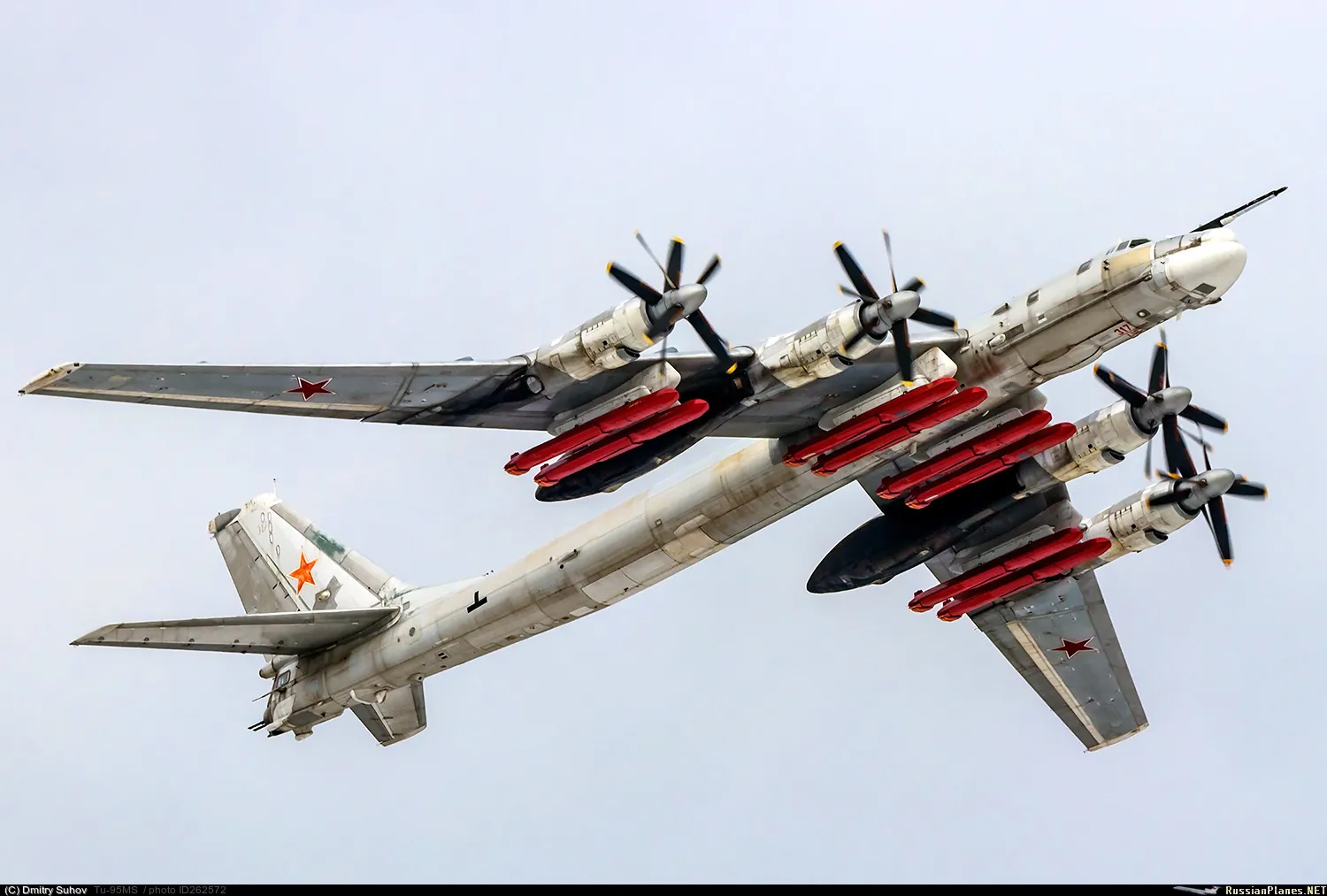
Tu-95MSM and Kh-101/102. On the modernized aircraft four double pylons under the wing carry up to eight Kh-101 or Kh-102 missiles, which are too large for the internal rotary launcher, with up to six Kh-55, Kh-55SM or Kh-555 internal. The external pylons are the main visual difference between the Tu-95MSM and earlier aircraft. A Ukrainian military intelligence statement reported by Defense Express says a Tu-95MS in practice carries up to four Kh-101 per sortie despite the nominal eight; Defense Express itself suggests airframe wear as a reason. This is an inference, not confirmed.
The missiles. Kh-55 (NATO AS-15 Kent): length 6.04 m, diameter 0.514 m, launch mass 1,210 kg, nuclear warhead of 200–250 kt, range about 2,500 km (CSIS Missile Threat). Kh-55SM: conformal fuel tanks, launch mass about 1,500 kg, range about 3,000 km. Kh-555: conventional Kh-55 derivative with a roughly 400 kg warhead. Kh-101 (NATO AS-23 Kodiak), a conventional missile by MKB Raduga with reduced radar signature: length 7.45 m, launch mass 2,200–2,400 kg, warhead about 400–450 kg, TRDD-50A turbofan of about 450 kgf, cruise about Mach 0.58, inertial plus GLONASS and terrain-map correction with an electro-optical terminal seeker. Kh-102 is the nuclear version, with a yield variously stated as 250–450 kt. Range figures differ widely: CSIS gives 2,500–2,800 km as reported, English Wikipedia about 3,500 km, and Russian and some US advocacy sources 4,500–5,500 km. Treat figures above about 3,500 km as claims, not demonstrated performance.
Defensive guns. The early Tu-95 had three twin 23 mm AM-23 gun positions (upper, lower, tail) under the PV-23 system. The Tu-95MS has a single tail turret with two 23 mm guns: Russian Wikipedia says either AM-23 (position DK-12) or a GSh-23 mount derived from the Il-76, while English-language Wikipedia lists two GSh-23. I could not determine from sources which is standard on a given airframe; both are reported.
SPECIFICATIONS
Figures below are for the Tu-95MS unless stated, and vary by source and by variant. Where two sources disagree both are shown. Sources: Combat Aircraft since 1945 via English Wikipedia; Gordon and Davidson 2006 and Moroz 1999 via Russian Wikipedia.
Crew: 6–7. Length: 46.2 m (English Wikipedia); Russian Wikipedia’s table lists higher figures for the MS and MSM (49.9 m and 47.9 m), so treat length as approximately 46–50 m. Wingspan: about 50.1 m (50.04–50.05 m on other tables). Height: about 12.1 m. Wing area: 310 m² (English) against about 290–295 m² (Russian table).
Empty weight: about 90,000 kg (up to 98,500 kg in the Russian table). Maximum take-off weight: 185,000–188,000 kg. Fuel: about 67,200 kg (English) to 87,000 kg (Russian table). Powerplant: 4 × Kuznetsov NK-12MP (Tu-95MSM: NK-12MPM), about 11,000 kW (15,000 hp) each, driving 8-blade contra-rotating AV-60 propellers (5.6 m).
Maximum speed: 925 km/h (English) or about 830 km/h (Russian table for MS and MSM); the original Tu-95 is listed at about 890 km/h. Cruise speed: about 700–710 km/h. Range: 15,000 km (English) against practical range of about 10,500 km (Russian table); a combat radius of about 6,500 km is given for the MSM. Service ceiling: about 10,500–12,000 m (Russian table) to 13,716 m (English). The quoted ranges are for different loads and flight profiles and the discrepancy should be taken at face value.
Armament: tail gun position with 2 × 23 mm cannon; internal rotary launcher for 6 Kh-55 family missiles; external pylons for up to 8 Kh-101/102 (Tu-95MSM) or additional Kh-55 (Tu-95MS16). Missile load up to about 15,000 kg is quoted by English Wikipedia (without citation), and 7,800 kg normal and 20,800 kg maximum by the Russian table for the MS.
Records: in July 2010 two Tu-95MS flew a non-stop flight of more than 43 hours and about 30,000 km through the Atlantic, Arctic and Pacific with four aerial refuellings (Russian MoD, via English Wikipedia and Vesti.ru).
VARIANTS
Tu-95/1 (“95-1”): first prototype, 4 × 2TV-2F coupled turboprops. First flight 12 November 1952. Lost 11 May 1953 after a gearbox fire.
Tu-95/2 (“95-2”): second prototype, 4 × TV-12 / NK-12. First flight 16 February 1955. Later used as a test aircraft; preserved at the Central Air Force Museum, Monino (Russian Wikipedia).
Tu-95 (izdeliye V, NATO Bear-A): first series bomber with free-fall bombs, built from 1954–55; about 30 built by 1957 (some of these were later converted). No nose refuelling probe. Served with the 409th TBAP at Uzin and 1023rd TBAP at Semipalatinsk.
Tu-95M: improved series bomber with NK-12M engines and increased fuel; 18 built 1957–58 per Russian Wikipedia (English Wikipedia says 19).
Tu-95V: single special aircraft for the AN602 “Tsar Bomba”, 1959–61.
Tu-95K (izdeliye VK, Bear-B): carrier of the Kh-20 missile in the K-20 system; three converted plus about 47 new (50 in total), 1956–61. Tu-95KD: air-refuelling probe added, 24 converted. Tu-95KM (Bear-C): Kh-20M and updated electronics, 23 new and 24 converted. Tu-95KU: trainer for the K-20 system.
Tu-95K-22 (Bear-G): conversion of Tu-95KM for three Kh-22 anti-ship/anti-radar missiles under the K-95-22 system; tail gun replaced by electronic countermeasure equipment.
Tu-95RTs (izdeliye VTs, Bear-D): maritime reconnaissance and targeting for the Soviet Navy with a large ventral radome and the Uspekh-U system. First flight 21 September 1962; about 52 built 1963–69 per Russian Wikipedia (English Wikipedia says 40), retired 1993–94. Nicknamed “Vostochny Express” (Eastern Express) in Russian sources. Served with the 392nd Kipelovo and 304th Khorol regiments, with a detachment at Cam Ranh, Vietnam.
Tu-95MR (Bear-E): photo-reconnaissance, four converted from Tu-95M, in service from 1964; later trainers (Tu-95U, NATO Bear-T). Tu-95LAL: flying laboratory for a nuclear-powered aircraft programme, used to test crew radiation shielding; no reactor-powered flight is described in the sources I used. Tu-95N and Tu-95K (experimental): carriers for parasite aircraft (RS and a MiG-19-based SM-20) tests. Tu-95LL: flying engine-test laboratory.
Tu-96: high-altitude project with TV-16 engines and a larger wing, intended to operate at 16,000–17,000 m. Only test work with other engines is reported; not a production aircraft.
Tu-116: two Tu-95 airframes fitted with passenger cabins as a stopgap for the Tu-114; used as VIP and crew transports. One is preserved at Ulyanovsk.
Tu-95MS (VP-021, Bear-H): cruise-missile carrier based on the Tu-142M airframe. Two sub-variants: Tu-95MS6 (internal rotary launcher, six Kh-55 family missiles; K-012 Osina system; about 28–32 built) and Tu-95MS16 (with four pylons for a total of 14–16 missiles; K-016 Sprut system; 56 built per English Wikipedia). Production figures differ widely between sources (Russian Wikipedia: 34 serial plus six conversions, “by other sources 56”).
Tu-95MSM: modernization of the Tu-95MS16 with NK-12MPM engines, AV-60T propellers, Novella-NV1.021 radar, Meteor-NM2 defensive suite, new navigation and display systems and eight external Kh-101/102. About 30–35 airframes are eligible. Reported to cut propeller vibration by about 50%.
TU-142 AND TU-114 RELATIVES
Tu-142 (NATO Bear-F): a long-range anti-submarine and maritime patrol aircraft derived from the Tu-95RTs, first flown in 1963 and built in several versions from 1968 to 1994 (Tu-142M, Tu-142MK, Tu-142MZ, and some command-relay aircraft). Russian Wikipedia says roughly one hundred were built. It has a lengthened fuselage, a different wing with extra area, a ventral weapons bay and different mission systems. It served with the Northern Fleet from Kipelovo and the Pacific Fleet from Kamenny Ruchey. The Tu-95MS uses the Tu-142M airframe, so the two types share a lot, although the Tu-95MS is a missile carrier and not a patrol aircraft.
Tu-114 (NATO Cleat): an intercontinental airliner derived from the Tu-95, ordered in 1955 and dated by Russian Wikipedia to 1960. It has a new double-deck fuselage with a low wing and four NK-12MV engines with AV-60N propellers (5.6 m). 31 were built. On 9 April 1960 a Tu-114 flown by Ivan Sukhomlin set the FAI world record for turboprop aircraft at 877.21 km/h over a 5,000 km closed circuit with a 10,000 kg payload (FAI record 3662; other sources quote 25 tonnes). It is still described as the fastest propeller-driven aircraft in the world by FAI record. Aeroflot flew it until the mid-1970s. The Tu-116 was an interim version made from Tu-95 airframes.
Tu-126 (NATO Moss): an airborne early-warning and control aircraft derived from the Tu-114, first flown in 1962; Russian Wikipedia gives eight series aircraft plus one prototype, based at Shauliai in Lithuania until 1985. Tu-119: a project for a nuclear-powered flying laboratory (1974), using two experimental NK-14A engines and two standard NK-12M; not a production aircraft. The Antonov An-22 and the A-90 Orlyonok ekranoplan also used NK-12 engines.
OPERATIONAL HISTORY
Soviet service. The first units were the 106th Heavy Bomber Aviation Division at Uzin (Ukrainian SSR, formed 1955) and the 79th at Semipalatinsk (Kazakh SSR), later joined by the 73rd at Ukrainka in the Far East. The northern divisions trained for polar routes toward the United States, with dispersal to Arctic snow airfields; the southern aircraft were assigned to NATO bases in Asia and the Indian Ocean. Crews flew roughly 1,200 hours a year according to English Wikipedia. The Soviet and Russian side says that patrol and training sorties did not carry live nuclear weapons. Naval Tu-95RTs flew long reconnaissance missions over the Atlantic, Pacific and Indian Oceans for the Soviet Navy and also supported spacecraft recovery; Russian sources say they had a high accident rate. Western fighters and carrier aircraft intercepted Bears routinely, and several intercept-related accidents are reported (for example a US F-8 Crusader lost in 1967), which are described in Russian Wikipedia.
1961. On 30 October 1961 the Tu-95V dropped the AN602 (Tu-95V, flown from the 1023rd regiment). Russian Wikipedia gives the yield as about 50 megatons of TNT equivalent.
After 1991. Kazakhstan returned the Tu-95MS of the 79th division to Russia from 1992 and they joined those at Ukrainka. Ukraine inherited 23 to 29 aircraft; it transferred 3 Tu-95MS and 581 Kh-55 missiles (along with 8 Tu-160 per Russian Wikipedia) to Russia in 1999–2000 in return for gas debt relief and scrapped the rest with US Nunn-Lugar funding by about 2001. Russian long-range patrols stopped in the 1990s and were resumed on 17 August 2007, when President Putin announced a restart. Intercepts by NATO fighters near UK, Norwegian, Canadian, Portuguese, Japanese and US waters are regular and often reported. In February 2008 Bears overflew the aircraft carrier USS Nimitz at about 600 m in a simulated attack (Russian Wikipedia) and in January 2015 two Bears were intercepted off the south coast of England.
2008–2017. In October 2008 Tu-95MS fired live cruise missiles for the first time since 1984. In July 2010, the 43-hour endurance flight (above). In December 2017 two Tu-95MS landed at Biak, Indonesia, flying more than 7,000 km with refuelling. Since 2019 Tu-95MS have flown joint patrols with Chinese Xi’an H-6 bombers; English Wikipedia counts ten such flights by 2025, the latest reported in December 2025, drawing intercepts by South Korea, Japan and the United States.
Syria. The Tu-95 had its combat debut on 17 November 2015, when Tu-95MS bombers took part in Russian long-range cruise-missile strikes on targets in Syria, launched from Russian territory (Wikipedia, TASS). The Kh-101 was also used in Syria in this period, and Wikipedia gives November 2015 and November 2016 for different first-use claims, so I treat the exact date and type of missile of the first Tu-95 launch as reported but not independently verified.
Ukraine war. Tu-95MS bombers have been part of Russia’s cruise-missile strikes on Ukraine since 24 February 2022. Ukrainian sources attribute missile launches at Vinnytsia (6 March 2022, reportedly Kh-101, launched from the Black Sea area) and Kyiv (26 June 2022, from the Caspian Sea area, reportedly Tu-95MS and Tu-160) to these aircraft. Ukrainian Air Force statements in this role are Ukrainian claims reported by Ukrinform. In September 2022 Tu-95s were relocated from Engels to Olenya on the Kola Peninsula after strikes on the Russian bomber bases. In January 2024 a Ukrainian report counted 11 Tu-95 used in one strike (Defense Express via English Wikipedia).
Engels, December 2022. Explosions occurred at the Engels-2 air base on 5 December 2022. Reports say two Tu-95 were damaged (satellite photos on 6 December showed a Tu-95MS covered in foam) by drone attack. The attack was reported to have used modified Tu-141 reconnaissance drones (The Drive).
Operation Spiderweb, 1 June 2025. Ukraine’s Security Service (SBU) launched a coordinated attack with first-person-view (FPV) drones smuggled into Russia in containers near several airbases, striking aircraft at Belaya (Irkutsk region), Olenya (Murmansk region), Dyagilevo, Ivanovo and attempting Ukrainka. Ukrainian authorities said 117 drones were used and claimed 41 aircraft hit, about half destroyed. Independent assessments were lower: Janes assessed 12 aircraft destroyed (7 Tu-95MS, 4 Tu-22M3, 1 An-12), plus 2 damaged and possibly 8 more damaged; TWZ, using Maxar and other imagery, confirmed at least 6 and probably 7 Tu-95MS and 4 Tu-22M3 destroyed; NBC News found at least 10 aircraft destroyed; US officials told Reuters about 10 destroyed and up to 20 hit; a NATO official said 10 to 13 destroyed; and RUSI’s Justin Bronk counted 8 Tu-95 among 12 bombers. Russia’s Ministry of Defence acknowledged attacks and fires on some aircraft but gave no loss figures. The strike is notable because the Tu-95MS is out of production, so every loss is a permanent reduction of the fleet.
Later strikes and accidents. English Wikipedia, citing Ukrainian media and The Daily Telegraph, reports a Ukrainian drone strike that destroyed a Tu-95 at Engels-2 on 17 July 2026 and another on 28 August 2026; Defense Express independently reports that the SBU used a MICH 2000 drone against a Tu-95MS at Engels on 28 August. A Tu-95MS crashed in the Amur region on 29 September 2026, shortly after taking off from Ukrainka, the first such crash in about 11 years. Reported crew deaths differ between sources (six in Russian Wikipedia, eight in English Wikipedia, citing Ukrainian outlets). These recent items come from Ukrainian and secondary media and should be treated as reported, not officially confirmed. Earlier accidents include a Tu-95MS crash on 14 July 2015 near Khabarovsk in which two crew died, and a take-off accident at Ukrainka on 8 June 2015 that also killed two. Russian Wikipedia counts about 25 Tu-95-family losses to accidents in total, with the data marked “needs checking”.
STATUS
Operator and bases. The Tu-95MS and Tu-95MSM serve with the Russian Aerospace Forces’ Long-Range Aviation: the 22nd Guards Heavy Bomber Aviation Division (6950th Guards Air Base) at Engels-2, Saratov Oblast, with the 184th Guards Heavy Bomber Regiment; the 326th Heavy Bomber Aviation Division (6952nd Guards Air Base) at Ukrainka, Amur Oblast, with the 182nd and 79th regiments; the 43rd Combat Employment and Aircrew Conversion Centre at Dyagilevo, Ryazan Oblast; and detachments at Olenya on the Kola Peninsula. Russian Wikipedia reports 35 Tu-95MS at Ukrainka as of 18 December 2025.
Fleet size. Estimates differ and should be read as such. IISS Military Balance data for 2021 listed about 60 aircraft. Russian Wikipedia cites 29 Tu-95MS and 22 Tu-95MSM (51 total) as of December 2025. A Ukrainian military intelligence (HUR) figure reported by Defense Express says 47 are officially listed as in service but about 38 are combat-capable (late August 2026), and Defense Express estimates about 36 after the 28 August strike and the 29 September crash. An unofficial Russian-language media estimate from 2026 says about 58 Tu-95MS/MSM. Ukrainian aviation analysts give far lower numbers of aircraft actually flying at a given time, ranging from about 12 to as few as 9–10, which is opinion and not a verified count. A reasonable summary is that perhaps 35–50 airframes remain on the books and only a fraction fly at any one time.
Modernization. English Wikipedia reports 21 aircraft modernized by April 2019, 10 delivered in 2019–2020 and 4 in 2021, and says the first batch of the MSM programme was complete in March 2020. TASS reported in 2018 that new engines (NK-12MPM) would extend range. Officially the aircraft is expected to remain in service until at least 2040. The older Tu-95MS6 (about 28–32 aircraft with the K-012 Osina) are not being modernized.
Production and successors. Production ended in 1992 and the line and tooling were dismantled in 1995 (Russian Wikipedia); the NK-12 engine is also no longer in production. Russia restarted Tu-160M production and is modernizing existing Tu-160 airframes. The stealthy PAK DA (ПАК ДА), intended to replace the Tu-95MS and Tu-22M3, has not flown and is reported to be in ground testing (Simple Flying, 2026). I found no credible official plan to restart Tu-95 production; the “production restart” idea appears as a question in Russian and Ukrainian commentary rather than as a programme.
Preserved aircraft. Tu-95 examples are preserved at Monino (Central Air Force Museum), at the Museum of Long-Range Aviation at Engels, and at the Poltava museum in Ukraine; a Tu-116 is preserved at Ulyanovsk. Many Tu-95MS bear names of Russian cities, such as «Саратов», «Дубна», «Калуга» and «Великий Новгород».
IN ONE SENTENCE
The Tu-95 is Tupolev’s 1950s four-engine, 35-degree swept-wing turboprop strategic bomber, powered by Kuznetsov NK-12 engines driving eight-blade contra-rotating AV-60 propellers, which has evolved from a free-fall nuclear bomber into the Tu-95MS/MSM cruise-missile carrier launching Kh-55, Kh-101 and Kh-102 missiles, and which remains in Russian service in dwindling numbers as it has no production line and no flying successor.