WHAT IT IS
Over-the-horizon radar is a class of radar that detects targets beyond the geometric radio horizon of a conventional microwave set. A dish at S-band or X-band looks in a straight line. The Earth is a sphere. An aircraft at low altitude disappears behind that curve after a few hundred kilometres at most. OTH does not raise the tower. It changes the path of the wave.
Two physically different methods share the name. Sky-wave OTH (OTH-B, backscatter) uses the ionosphere as a moving mirror at high frequency, 3–30 MHz, and reaches one to several thousand kilometres. Surface-wave OTH (OTH-SW) launches a vertically polarized wave that diffracts along a conducting surface, usually the sea, and reaches a few hundred kilometres. They are not interchangeable. A Container-class sky-wave field and a coastal surface-wave fence are different machines that happen to be “beyond the horizon.”
WHY MICROWAVE STOPS
Line-of-sight range to a target at height h, from an antenna at height H, is on the order of
d ≈ 4.12 (√H + √h) kilometres
when heights are in metres and standard refraction is assumed. A 30 m tower and a 10 km aircraft give a few hundred kilometres. A cruise missile at 50 m is gone much sooner. Tropospheric ducting can stretch that on some days. It cannot be scheduled. Microwave OTH does not exist as a design school; the name belongs to HF.
SKY-WAVE: THE IONOSPHERE AS A LENS
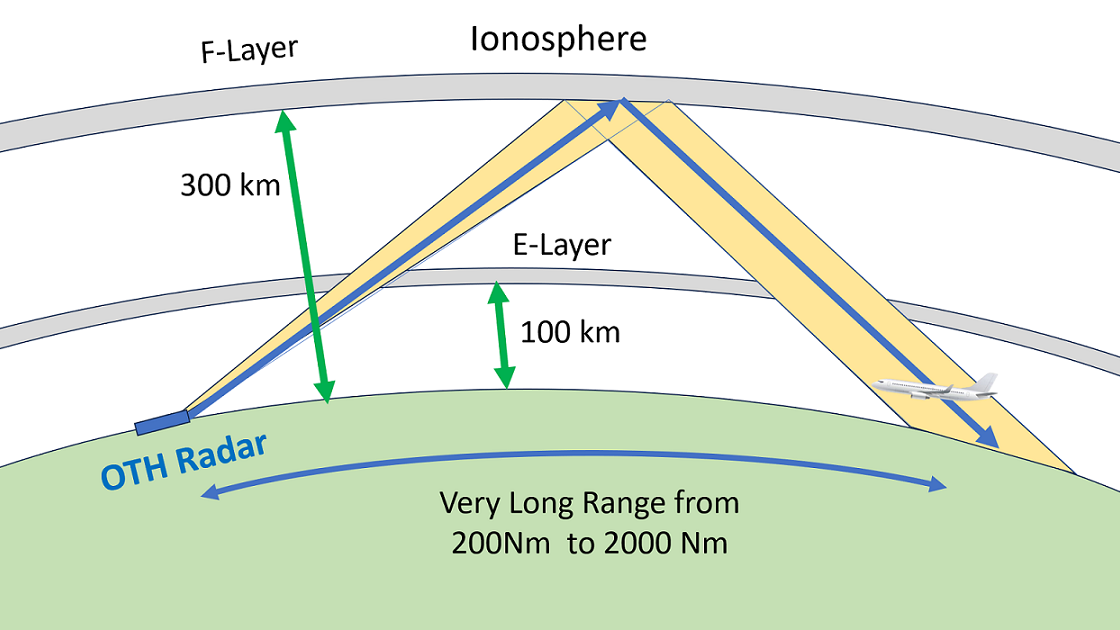
The ionosphere is a shell of free electrons created by solar ultraviolet and X-rays. Density is not uniform. It peaks in layers that move:
D region — about 60–90 km. Present mainly by day. Absorbs the lower HF. At night it vanishes and longer skips open.
E region — about 90–150 km. The Kennelly–Heaviside layer. Useful for medium skip; sporadic-E can appear and vanish in minutes.
F region — about 200–400+ km, often split by day into F1 and F2. The main long-range reflector for OTH-B.
A radio wave in a plasma sees a refractive index that falls as electron density rises. An HF ray launched at an oblique angle is bent continuously, not bounced from a hard sheet. If the density along the path is high enough, the ray turns over and comes back down. That is refraction to the point of total internal reflection. Microwave passes through the same layers and is lost to space. HF does not.
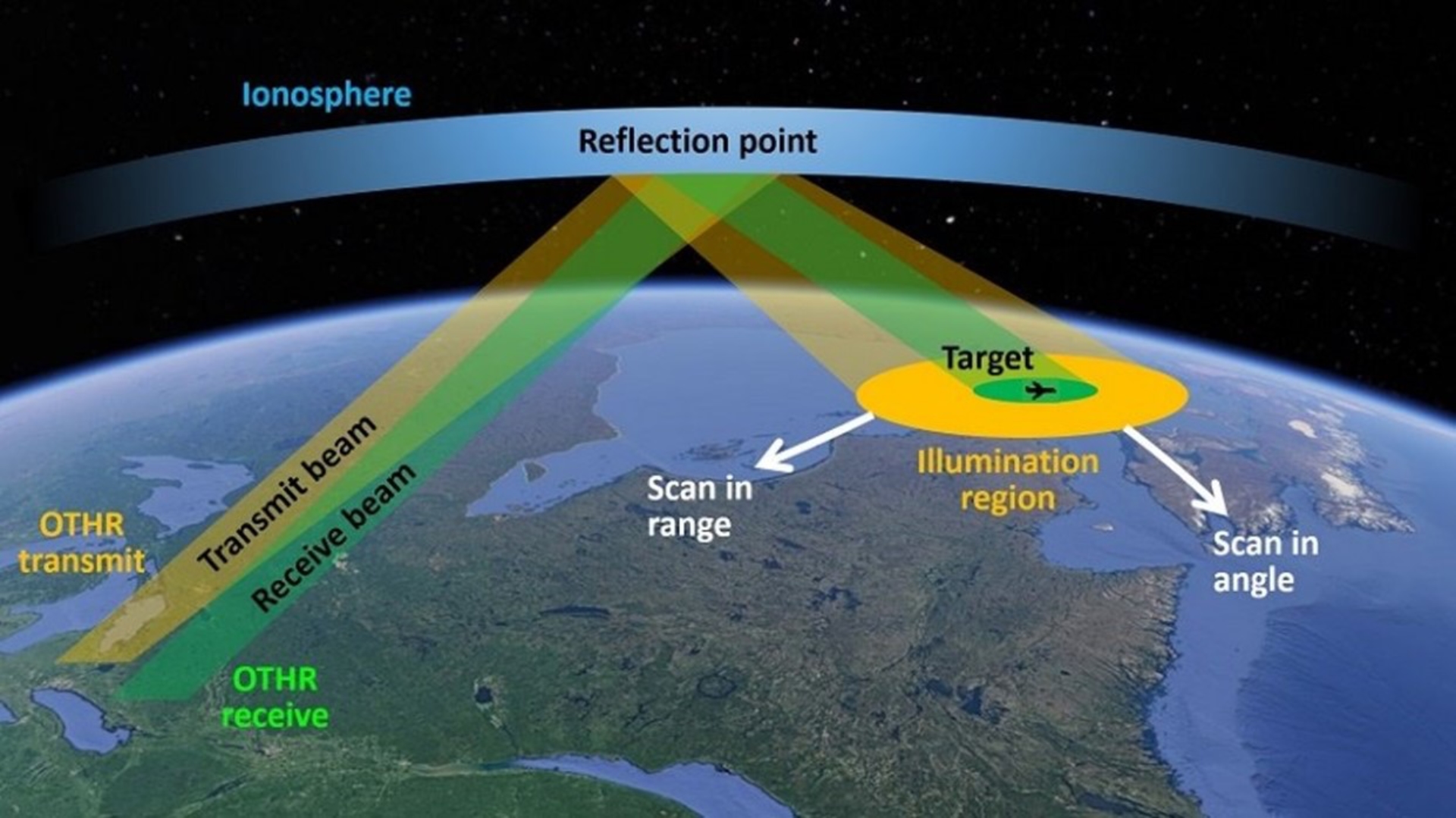
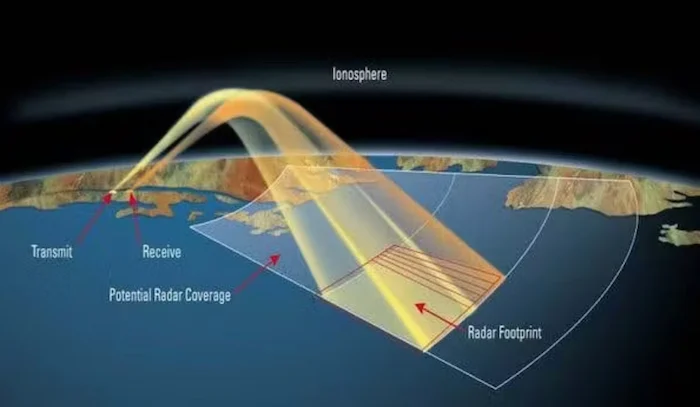
The landing zone of that ray — the skip zone — is hundreds to thousands of kilometres from the transmitter, depending on frequency, takeoff angle, and the height and density of the layer. Energy that hits an aircraft, a missile, or the ground itself scatters. A fraction goes back up, refracts again, and returns. The radar measures delay (range along a crooked path), Doppler (radial speed, after ionospheric motion is modelled out), and angle of arrival at a long receive array (azimuth).
Between the transmitter and the first skip there is a dead zone. The wave has gone up and has not come down yet. For 29B6 that hole is published near 900 km. For other sets the inner edge is typically several hundred kilometres. You cannot put an OTH-B on a coastline and see the beach in front of it.
WHY THE FREQUENCY MUST MOVE
Maximum usable frequency (MUF) for a given hop rises with electron density and falls at night and in solar minimum. Lowest usable frequency (LUF) is set by D-layer absorption. The operating channel must sit between them and must put the skip on the wanted patch of Earth. An OTH radar therefore sounds the ionosphere — often with a separate sounder or with its own backscatter — and retunes, sometimes many times an hour. Solar flares, travelling ionospheric disturbances, and aurora can close a path or paint false tracks. Availability is a weather statistic, not a switch.
That is also why OTH transmitters are notorious on the amateur bands. A high-power pulse train in HF is audible as a knock or a woodpecker across a continent. Duga was the famous case. Container and other modern sets produce a similar signature at lower duty and cleaner modulation (FMOP, FMCW, and related waveforms).
SURFACE-WAVE: HUGGING THE SEA
A vertically polarized HF wave over seawater launches a Norton surface wave. The ocean is a good conductor; the wavefront is pulled around the curve. Ranges of 200–400 km against ships and low aircraft are typical; some coastal systems claim more over open water. Land is a poor conductor and kills the mode quickly. Surface-wave OTH is therefore a maritime and coastal tool. It does not need the ionosphere and can run day and night with fewer frequency acrobatics. It does not see 3,000 km inland.
WHAT MAKES OTH DIFFERENT FROM A DISH
Wavelength. At 15 MHz, λ is 20 m. A beam a few degrees wide needs an aperture of hundreds of metres to kilometres. Sky-wave receive fields look like farms of masts (Container: 144 masts, 1,300 m). Transmit fields are shorter but still hundreds of metres. There is no rotating 30 m dish.
Power and waveform. Path loss on a two-hop ionospheric circuit is severe. Transmitters run high average power. Waveforms are often frequency-modulated pulses or FMCW so that range can be extracted from a long pulse without a one-megawatt spike at every instant. Pulse repetition rates of tens of hertz are common: 50 pps is a published Container figure; lower PRF extends unambiguous range, higher PRF tightens the near picture.
Bistatic geometry. Many sky-wave sets put the transmitter tens to hundreds of kilometres from the receiver so the receiver is not blinded and so each array can be sited for quiet and for look direction. Monostatic OTH exists. Large Russian and Australian examples are often bistatic.
Resolution. Range cells are kilometres, not metres. Azimuth cells are wide. A track is a blob that a microwave battery would not accept as a fire-control plot. OTH is a cueing and raid-warning sensor. It hands a sector to a Voronezh, a 91N6, or a fighter.
Clutter. The same skip that hits the aircraft hits thousands of square kilometres of ground and sea. Ground clutter dominates. Moving-target indication, Doppler filtering, and adaptive cancellation are the radar. An ionosphere that itself moves adds a Doppler smear that must be modelled or the aircraft disappears into weather.
Stealth. Shaping and RAM aimed at X-band and S-band are less effective when the wavelength is the size of the airframe. That is a real physical advantage and a real sales sentence. It is not invisibility in reverse: RCS at HF is a different number, not “always huge,” and ionospheric fading can erase the same target a microwave set would hold.
WHAT IT IS USED FOR
Strategic air and cruise-missile warning at theatre depth — mass takeoffs, raid axes, high-altitude tracks — where line-of-sight radars are still looking at empty sky.
Maritime surveillance with surface-wave sets: ships and low flyers off a coast.
Cueing of fighters and of microwave SAM and early-warning radars.
In some doctrines, a contribution to ballistic-missile and hypersonic warning. Sky-wave coverage to ~100 km altitude is the usual published ceiling; that is air-breathing and high-flying aerospace, not mid-course ICBM in space. Treat “missile detection” in OTH brochures as a wide claim that needs the specific set’s envelope.
It is not fire control. It is not space surveillance of the Okno / SKKP kind. It is not HF direction finding of the Krug-ring kind (Krug only listens; OTH transmits). It is not a replacement for the Voronezh line: those are line-of-sight VHF/UHF ballistic-missile radars with a different horizon problem.
TYPICAL PUBLISHED NUMBERS
Band: 3–30 MHz (sky-wave); lower HF for many surface-wave coasts.
Sky-wave range: about 1,000–4,000 km depending on hop and PRF; 3,000 km is the common Container / brochure figure.
Sky-wave dead zone: several hundred to ~1,000 km.
Altitude (sky-wave air picture): surface to ~100 km in Russian Container figures.
Surface-wave range: typically 200–400+ km over water.
PRF: tens of Hz; 25–100 Hz appears in adaptive-OTH notes; 50 Hz is a repeated Container intercept figure.
Pulse / sweep bandwidth: kilohertz to tens of kilohertz (Container intercepts ~14 kHz).
Receive aperture: 500 m to several km of masts.
Sector: a fixed face looks 60°–120°; multiple faces or a triangle of arrays push toward 180°–240° (Container’s published 240°).
Track load: hundreds to thousands in modern digital sets (Container Ministry copy: 5,000).
Named examples: USSR/Russia Duga (5N77 Steel Yard), 29B6 Container; Australia Jindalee / JORN; United States ROTHR; various Chinese sky-wave and surface-wave nets. They share physics. They do not share a single specification card.
LIMITS THAT DO NOT GO AWAY
Night and day are different radars. A solar storm can be a power-off. The dead zone is structural. Absolute accuracy is poor. The transmitter is a beacon to every HF receiver on the continent. The field cannot hide and cannot pack up in five minutes like an S-400 battery. Those are the costs of seeing past the curve.
IN ONE SENTENCE
Over-the-horizon radar is HF used as a radar — either bent off the ionosphere for a 1,000–3,000 km air picture, or crawled along the sea for a few hundred kilometres — which is why it is a farm of masts and a weather-dependent cueing sensor rather than a dish that can put a missile on a jet.