WHAT IT IS
Automatic Link Establishment (ALE) is the machine that picks an HF frequency and proves two radios can hear each other before a human talks or a traffic modem starts. HF does not stay open. The ionosphere moves, noise rises, a channel that worked at 0900 is dead at 1100. ALE replaces the operator who used to spin the knob, whistle, and wait.
The NATO / US standard family is MIL-STD-188-141 (also FED-STD-1045 / 1049). Generations:
2G ALE — Appendix A. Still the world default. 8-tone MFSK.
3G ALE — Appendix C (ARCS). PSK bursts, links deeper into noise (~−12 dB class vs 2G).
4G / WALE — 141D Appendices G/H. Wideband HF linking.
ALE is the handshake. After the link is up the radio may stay on voice or hand the audio to a data modem (MIL-STD-188-110, STANAG 4285, a national waveform). ALE is not the file transfer.
WHY HF NEEDS IT
An HF net is a list of channels, not one frequency. Day / night, season, solar flux, and local noise change which row in that list is usable. Without ALE an operator sounds each channel, writes a quality score, and calls on the best. ALE stores those scores in a matrix and does the call itself.
HOW 2G ALE WORKS
Idle radios scan a programmed channel list, a fraction of a second per frequency, listening for their own address.
Caller punches an ALE address (like a phone number). Controller picks the best idle channel from the LQA matrix, listens first (listen-before-transmit), then sends a short selective call.
The scanning station hears ALE energy, stops, checks whether the call is for it. If yes, the two controllers handshake. If the path is good enough, both radios drop out of scan and tell the operators “link up.” If not, the caller tries the next channel.
Sounding — a station broadcasts its own address on each channel so others can score it.
LQA (Link Quality Analysis) — BER / SNR / multipath scores written into the matrix that chooses the next call frequency.
AMD — Automatic Message Display, short text on the ALE orderwire without opening a separate data modem.
2G AIR INTERFACE
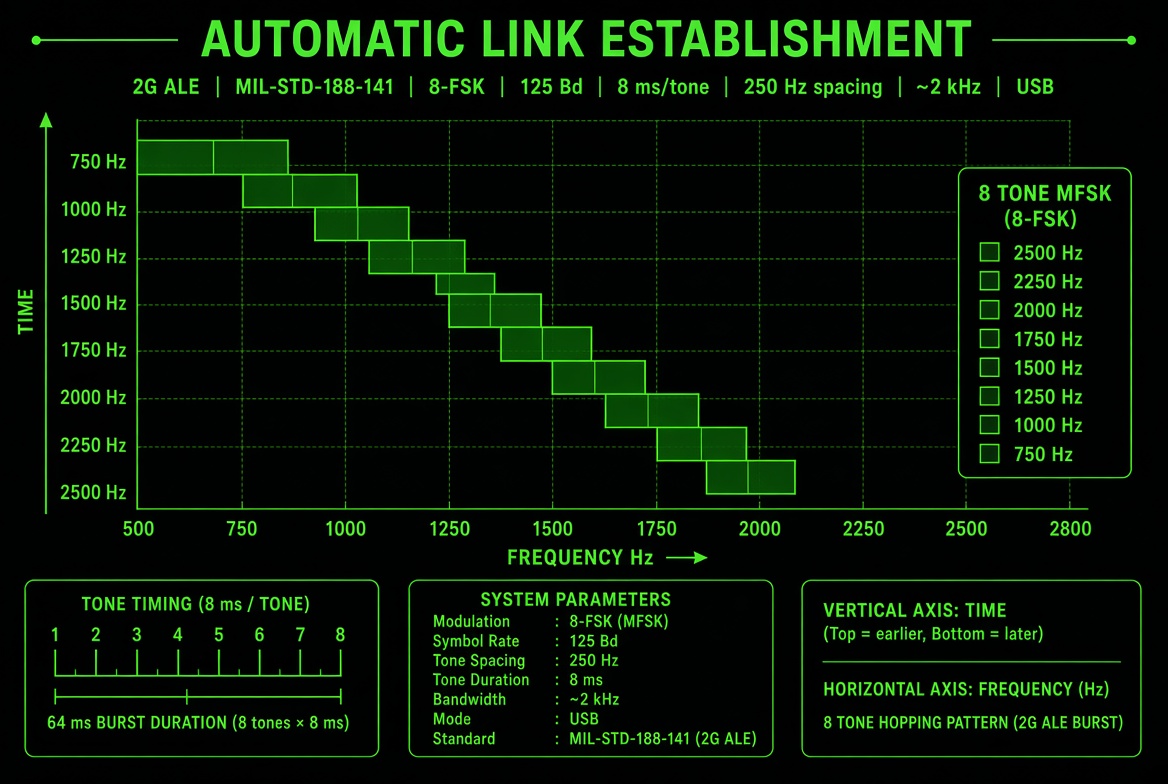
Eight orthogonal tones in the SSB passband:
750 / 1000 / 1250 / 1500 / 1750 / 2000 / 2250 / 2500 Hz
250 Hz spacing, 8 ms per tone → 125 Bd. Three bits per tone → raw 375 bit/s. Occupied width about 2 kHz (some cards say 3 kHz radio channel). USB.
Word: 3-bit preamble + 21-bit data (often three 7-bit ASCII address characters). Golay + interleave → 49 bits, sent three times. Frame types include TO / TIS / TWAS class calls and orderwire commands.
3G IN ONE PARAGRAPH
3G replaces the 8-FSK tweet with short PSK bursts (BW0–BW4). BW0 carries 3G-ALE PDUs; BW1 traffic management / HDL acks; BW2/BW3 HDL/LDL data; BW4 LDL acks. Linking works farther into the noise. 2G remains what most of the planet still scans.
CIS COUNTERPARTS
Russia did not publish a MIL-188-141 clone under that name. On the air the same job is split:
X06 / Mazielka — six-tone MFA selcal that names one embassy and waits.
CIS-3000 — 3000 Bd 8-PSK handshake logged in front of Perelivt and CIS-128; monitor-side analogue of “ALE then traffic modem.”
CROWD-36 — older Serdolik link-establish / chat before the file moves.
Those are not interoperable with 2G ALE. They are the same idea: wake the far end, prove the path, then pass traffic on another waveform.
NOT THESE
MIL-STD-188-110 / STANAG 4285 — traffic modems that ride after ALE.
STANAG 5066 — HF data-link stack above the modem, not the 8-tone call.
Selcal (aviation two-tone) — aircraft alerting, not an LQA matrix.
CIS-3000 / X06 — national calling modes; see their Radio pages.
CAVEATS
“ALE” in logs usually means 2G 8-FSK. 3G sounds different. Addresses are programmed; a decoded TO/TIS string is an address, not a secret. Linking protection (LP) exists in the standard and is not the same as traffic encryption.
STATUS
2G is still the common HF scan. 3G and 4G exist in newer sets. CIS nets keep their own calling waveforms.
IN ONE SENTENCE
Automatic Link Establishment is the HF radio’s autodialer — scan a channel list, score the paths, call an address on the best idle frequency, handshake, then hand the circuit to voice or a traffic modem — standardized in the West as MIL-STD-188-141 2G/3G/4G and done on Russian nets by national selcals such as X06 and CIS-3000.