WHAT IT IS
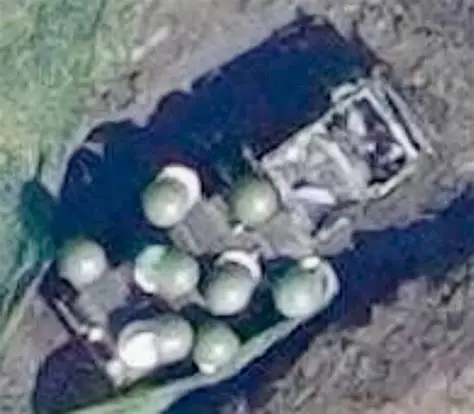
Volna Kupol Garant is a trailer-borne electronic-warfare complex built to deny SpaceX Starlink over a local patch of ground by jamming the satellite’s receive side, not by flooding every user terminal on the dirt. Russian industry and Ukrainian radio specialists describe the same geometry: six trailers, steerable dishes under radio-transparent egg or dome radomes, pointed at the Starlink bird serving that cell, transmitting into the Ku-band uplink that terminals use to talk to orbit. One complete set is credited with a denial footprint of about 20 km² — a circle of roughly 2.5 km radius, or a 4×5 km box in some Russian recaps.
Manufacturer in open reporting: ООО / АО «Русский купол» (Rossiysky Kupol, also written Russkiy Kupol, Russian Dome), registered in Simferopol. Sister product on the same badge: Volna-3M GNSS/UAV jammer carried on Mi-8AMTSh helicopters. Some Russian secondary texts float the alias Peresvet-M; that name is unconfirmed against a GRAU index and should be treated as press reuse of a famous laser covername.
HOW STARLINK IS BUILT TO BE JAMMED THIS WAY
A Starlink user terminal (UT) sends to the satellite in 14.0–14.5 GHz (Ku uplink, ~500 MHz). That slab is cut into eight channels of 62.5 MHz; the UT occupies about 60 MHz inside its assigned channel. All terminals in one geographic cell share the same uplink channel and hop among channels in normal operation. Downlink to the user lives elsewhere (about 10.7–12.75 GHz) and is a different problem. NRAO / SpaceX coordination memos publish those channel widths; they are not a Russian secret. Horizon EIRP of a consumer UT is on the order of a few watts. The satellite receiver in LEO (~500 km) is listening for that weak return.
If a ground station with dish gain and high power puts energy into those same eight receive channels, from the satellite’s point of view the cell’s legitimate uplinks sit under a much louder tone. The bird can still transmit downward. The session dies if the satellite never hears the terminal. That is uplink-side, satellite-receiver overload — “deafen the bird,” in Beskrestnov’s phrasing. The constellation as a whole keeps flying. The next satellite in the mesh can take the cell unless the jammer slews with the pass.
HOW THE COMPLEX IS SAID TO WORK
Eight directed emitters, one per 62.5 MHz sub-band, all pointed at the same passing spacecraft. Barrage / barrage-on-channel interference (заградительные помехи) rather than a smart demodulator war. Tracking is optical-mechanical: rotating mounts under the radomes follow the LEO path. Antennas can stay on the trailers or come off onto the ground or a pad. Power from trailer diesels or a shore line; consumption is described as high, which is expected for continuous Ku EIRP into space.
Antenna census in the public sheet is messy. Beskrestnov and most June 2026 write-ups: six trailers × two dishes = hardware for twelve heads, with eight on the air to match eight channels. VPK.name states the same: twelve modules in the set, eight used for the sub-bands. A minority of reprints say twelve radiating. Until a factory manual appears, the working model is eight live channels plus spare or auxiliary heads on the same wagons.
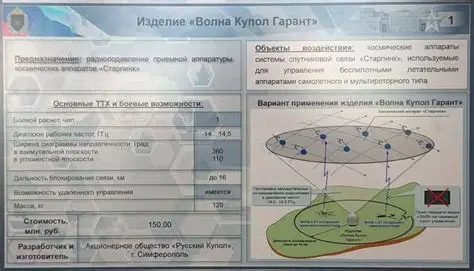
One Ukrainian characteristic dump also prints 360° azimuth, 110° elevation, and a mass of 120 kg. The angles are plausible for a dish farm that must see LEO. The 120 kg figure matches a single pedestal better than six trailers and should be treated as a fragment.
Limits that follow from the architecture even before anyone fires a shot: one satellite at a time per farm (KeepTrack and similar reconstructions); the denial bubble is the intersection of the jammed bird’s receive beam with the geometry of the eight uplinks, advertised as ~20 km²; when Starlink hands the cell to the next vehicle the dishes must re-acquire or the bubble flickers; the farm is a bright Ku emitter and a large radar/optical object.
MANUFACTURER AND MONEY
AO «Русский купол», INN 9102290721, registered 2 August 2023, prospectus Pobedy 245, office 5, Simferopol. Beskrestnov to the BBC: the address is legal, not proof of the assembly hall. One Russian-language recap puts assembly in Sevastopol. Krym.Realii listing of the firm’s catalogue includes other Volna-line boxes sold as sets: Volna-ARM, Volna-Detector, Volna-Azimuth, Volna-Shtraf, Volna-Khrust 360 / 90, Sosed (Volna-2), Sdvig-K (Volna-3). That is a GNSS / drone-EW product family that grew a Starlink-specific farm.
Russian media date the political “Russky Kupol” project to 3 March 2025, attributed to Sergey Aksyonov’s Crimea occupation administration. Unit price in Ukrainian and Russian secondary sources: about 150 million RUB (~$1.5–1.8 million at mid-2026 print rates). TASS, 28 August 2026, unnamed defense-industry source: the system “has proven effective,” serial replication has started, “we have essentially closed the sky to Starlink wherever we need to,” several sets can cover a region, dozens at once could cause a temporary collapse, and the technology could be offered abroad.
HISTORY OF EMPLOYMENT
First public attribution of Starlink suppression by this architecture: Kharkiv axis, 2024 (Beskrestnov; some reprints say 2023 for an earlier EW try). Quiet interval through 2025 in his account. Scale-up in 2026 after Ukrainian mid-range, Starlink-piloted strikes on fuel and the land-bridge logistics (Novorossiya highway / Berdiansk–Melitopol corridor, Crimea energy nodes, Kerch approaches). Reuters, July 2026, quoting Ukrainian drone commanders: jammers of this class installed near towns and military facilities to cut the pilot link on “mid-strike” UAVs that had been treated as hard to jam. Russian print adds object defense — ports, energy, highway cover — as the intended use, not a front-wide blackout of every consumer dish in Ukraine.
Ukrainian troops speaking to El Mundo and to Reuters described a reduction in Starlink effectiveness on those strike routes, not a constellation kill. That is the most cautious field judgment in the open set. TASS’s “sky closed wherever we need” is the producer’s sentence.
EFFECTIVENESS AGAINST STARLINK
Physics supports a local uplink bubble if the dishes stay on the serving satellite and the eight channels are filled above the UT signal at the satellite antenna. A consumer terminal is a few watts; a pointed high-power interferer is not. Residual disruption after the jammer stops is claimed in some reconstructions (receiver AGC / overload recovery) and is unverified in a lab paper.
What the mesh still has: thousands of spacecraft, rapid handoff, channel hopping inside the 500 MHz slab, and a downlink that this farm does not address. Jamming “all of Starlink” from one pad is not the design. Several coordinated farms increase area; they still track birds one pass at a time. Power draw and the six-trailer silhouette set how long a site can sit on a highway before it is a planning factor for the other side. Serial production (TASS, August 2026) is an industry statement that the General Staff wants more umbrellas, not a published table of availability.
RELATED SYSTEMS (SHORT)
Tirada-2S / Tirada-2.3 — MoD SATCOM-suppression station, Elektropribor (Vladimir), contract for 2.3 dated ~2020, two samples delivered summer 2023 after penalty litigation. Official language includes disabling satellite communications from the ground. Catalogue cousin, different factory and era. Separate article later.
14Ts227 Tobol — space-troops EW complex, originally briefed as protection of Russian satellites against unauthorized uplink; 2023 leak material tied experimental use to Starlink near Bakhmut; later Western writing folds Baltic GPS/Galileo disruption into the same name. Strategic / dual-use, not a six-trailer Ku farm.
Kalinka — 2026 Russian roundups: DF / lock on SATCOM emitters including Starlink terminals to ~15 km, Starshield named. Finder more than a dome barrage.
Volna-3M — same firm, helicopter GNSS/UAV jammer. Shows the Simferopol shop already sold directional EW before the Starlink trailer set.
PUBLISHED SHEET (COMPILED)
Name: Волна Купол Гарант / Volna Kupol Garant / Wave Dome Guarantor Maker: Русский купол, Simferopol (reg. 2 Aug 2023); assembly site unpublished Carriage: 6 trailers; 2 dishes per trailer typical; radomes; optional ground mount Radiators on the air: 8 channels (12 heads in the set per VPK.name) Band: 14.0–14.5 GHz Ku uplink, 8 × 62.5 MHz Mechanism: directed barrage into the satellite receive channels Advertised denial: ~20 km² Price: ~150 million RUB / ~$1.5–1.8 million per complex Power: trailer generators and/or mains Crew: one operator and remote control in one Ukrainian dump Serial production: announced via TASS 28 Aug 2026
CAVEATS
No official GRAU index in the open file. No factory EIRP, dish diameter, or PA type. Antenna count and the 120 kg line conflict across reprints. “Dozens collapse Starlink” is a TASS source, not a measured outage. First-look and scale-up dates rest on Beskrestnov plus strike photography that this page does not inventory. Aksyonov-as-founder is Russian local-press chronology.
STATUS
In Russian service language as of late 2026: a fielded, now-serial local Starlink-uplink denial farm used to put a 20 km² communications umbrella over logistics and objects. In Ukrainian field language: a real reducer of Starlink on mid-strike UAV routes, expensive, large, and loud.
IN ONE SENTENCE
Volna Kupol Garant is a Simferopol-built six-trailer farm of Ku-band dishes that points eight 62.5 MHz interferers at a passing Starlink satellite’s 14.0–14.5 GHz receive channels so terminals in about 20 km² lose their uplink — a local “wave dome,” serial after August 2026, sitting beside older SATCOM-EW names Tirada and Tobol.