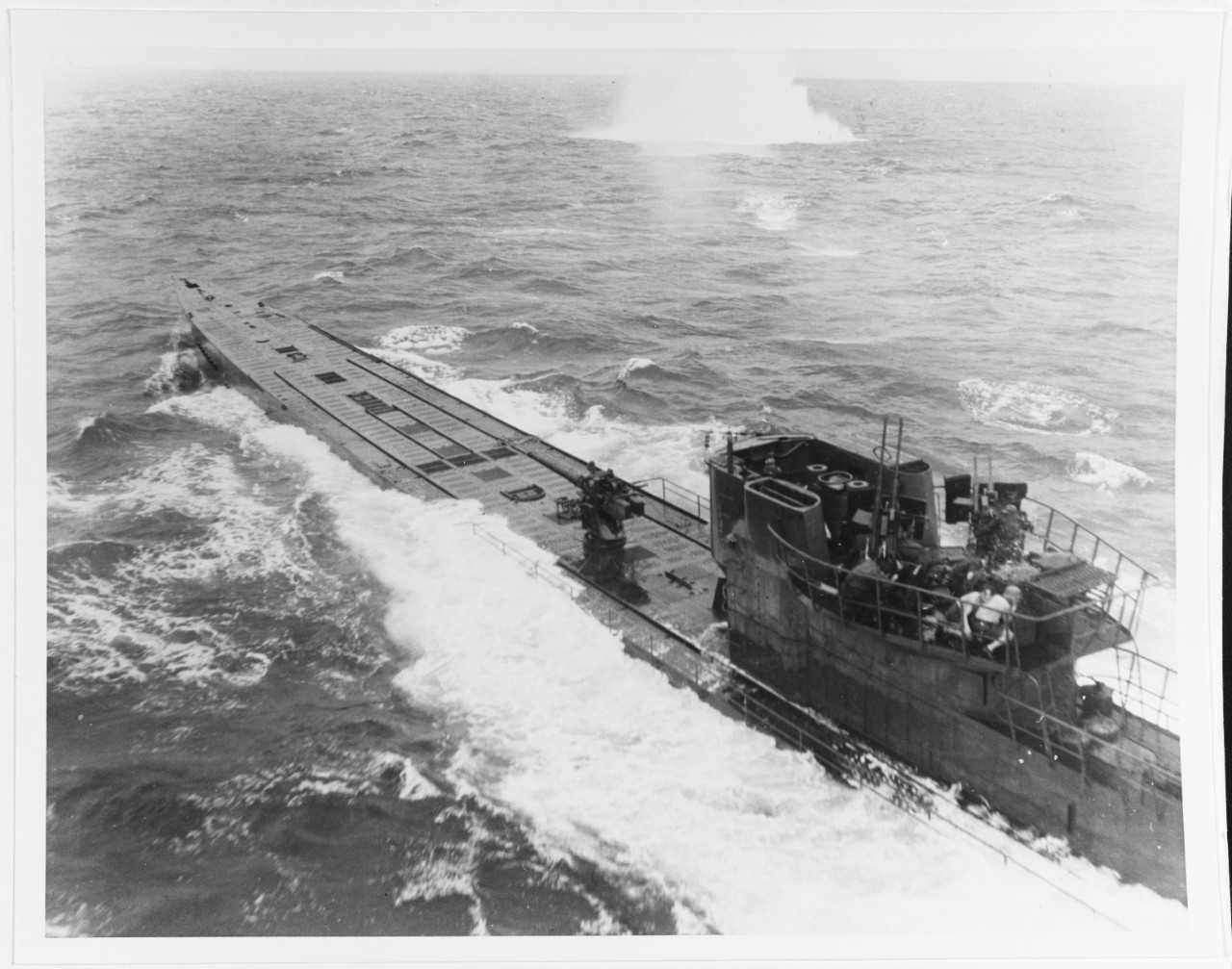
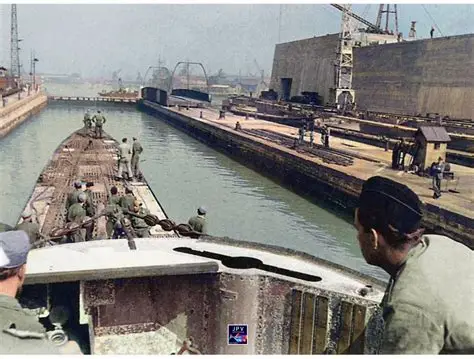
WHAT IT IS
Type IXD is the stretched ocean U-boat. Same 4.40 m pressure-hull diameter as IXC, hull lengthened to 87.6 m overall (pressure hull 68.5 m), beam 7.50 m, draft about 5.35–5.40 m. Displacement on the order of 1,610–1,616 t surfaced, 1,799–1,804 t submerged, ~2,150 t total. Crew 55–63. Dive time on the order of 35 seconds in the German cards. Test depth still the IX family ~200–230 m.
Two different machines share that hull. IXD1 (two boats) stuffed high-speed Daimler-Benz MB 501 diesels into the extra engine room for 20-plus knots, then failed and became cargo boats. IXD2 (twenty-eight boats) used the extra space for slow MWM cruising diesels and ~441 t of fuel — 23,700 nmi at 12 kn or 31,500 nmi at 10 kn, the longest-legged German attack submarine. IXD/42 was the last stretch, mostly cancelled for Type XXI; U-883 completed as a transport.
HISTORY
The design looked back at the Kaiserliche Marine’s U-81–86 cruisers and forward at the South Atlantic and Indian Ocean. AG Weser, Bremen, built the entire D series. First D2s commissioned 1942. They were assigned to far stations that a VII could not reach and that an IXC reached only with a Type XIV cow. Gruppe Monsun based out of Penang, Batavia and later Japanese yards. Some carried the Focke-Achgelis Fa 330 Bachstelze rotor-kite in two watertight canisters abaft the tower for a lookout a few hundred metres up.
As the air war closed the Bay of Biscay, surviving D-boats shifted from combat patrols to cargo: wolfram, opium, rubber, blueprints, passengers, and on the last runs whatever Berlin still wanted in Tokyo. U-864 (IXD2), outward from Norway in February 1945 with cargo for Japan, was sunk submerged by HMS Venturer — the only confirmed submarine-versus-submarine kill with both boats dived.
IXD1 — THE FAILED FAST BOAT
U-180 (Weser 1020) and U-195 (Weser 1041) only. Six Daimler-Benz MB 501 20-cylinder fast-attack-craft diesels, three per shaft, about 9,000 hp combined. Surface speed 20.8 kn on the trial card. Smoke, heat and unreliability made the boat a beacon. Range in that fit was worse than a D2 — about 12,750 nmi at 10 kn, 9,900 nmi at 12 kn. Fuel of its own about 203 t.
Both were rebuilt 1943–44: MB 501s pulled, conventional Germaniawerft / GW F46 or MAN diesels fitted, bow tubes (and on the transport conversion the useful torpedo rooms) ripped out for cargo. Load about 252 t plus their own bunkers. Flak only. U-180 left France 20 August 1944 for the Far East and vanished in the Bay of Biscay three days later, probably mined. U-195 reached Jakarta 28 December 1944, later refuelled Monsun boats south of Madagascar, and was commissioned by Japan as I-506 after the German surrender.
IXD2 — THE RANGE BOAT
Twenty-eight commissioned: U-177–179, 181–182, 196–200, 847–852, 859–864, 871–876. Plant: two supercharged MAN M9V40/46 nine-cylinder diesels, ~2,200 hp each (4,400 hp) for high speed, plus two MWM RS34.5S six-cylinder cruising diesel-generators (~500–580 hp class each) so the boat could loaf on the surface and charge at the same time. Electric: two SSW 2GU 345/34, ~500 hp each. Battery two × 62 AFA cells, later boats four groups. Screws ~1.85 m.
Speed 19.2 kn surfaced, 6.9 kn submerged. Fuel on the high cards ~441–442 t. Range: 5,600 nmi at 16.5 kn, 23,700 nmi at 12 kn, 31,500 nmi at 10 kn, ~32,300 nmi diesel-electric at 10 kn. Submerged ~57–115 nmi at 4 kn depending on the table and battery fit. That is three times an IXA and more than double an IXC.
WEAPONS — D2 COMBAT FIT
Six 53.3 cm tubes, four bow two stern, 24 torpedoes (two more than IXC). Mine substitute 48 TMA or 72 TMB. Deck gun 10.5 cm Utof L/45 with 150–180 rounds on early boats, landed like every other IX as air power grew. Flak: 3.7 cm and 2 cm, later twin 2 cm and Flakvierling on the wintergarten. Fa 330 kite on many Monsun boats. Schnorchel on some late hulls (U-863, U-864 among them).
Electronics followed the war: FuMO 30 then FuMO 61 radar, GHG hydrophones, Metox then Bali / Palau FuMB. Same 1943 problem as IXC — the boat was large on centimetric radar and slow under water.
HOW THEY WERE BUILT
All D-boats from AG Weser. The extra ~11 m is more tankage and a longer engine room, not a wider pressure hull. Outer casing and saddle tanks scaled up. Cost and time above an IXC. Seventy-eight D-class hulls were ordered; XXI ate the rest of the slips. IXD/42 (U-883 completed, U-884 wrecked fitting out) kept the D2 plant idea and was finished as a transport with stern tubes only.
CREW LIFE
Seven extra men over an IXC and a longer tube do not make a liner. Patrols to the Indian Ocean ran four to six months. Heat in the engine room on a D1 with MB 501s was proverbial. D2s lived on the cruise diesels for weeks of 10 kn steaming, then the MANs for a burst. Fresh water, food and nerves were the limits, not fuel. A Fa 330 launch from a rolling casing in the monsoon was a specialist job. Penang and Batavia were relief only if the boat arrived.
HOW D DIFFERS FROM THE OTHER IX AND FROM VII
VII: North Atlantic pack boat, 67 m, 14 fish, ~8,500 nmi. IXC: 76.8 m, 22 fish, ~13,450 nmi / 10 kn, two MAN only. IXD2: 87.6 m, 24 fish, MAN plus MWM cruise pair, 31,500 nmi / 10 kn. IXD1: same stretch as D2, six MB 501s, then a cargo conversion with no tubes. XIV milch cow fuels them; it is not a D. XXI is the submerged successor that cancelled the rest of the D/42 orders.
USE CASE
Independent war against shipping in the South Atlantic and Indian Ocean; Monsun station in Japanese-held ports; late-war cargo to and from Asia. Strength is fuel and two extra torpedoes. Weakness is size, dive, and a 6.9 kn submerged dash. After 1943 an IXD that ran the Bay of Biscay on the surface was betting the boat.
STATUS
All wartime. Most D2s sunk on passage or on station. U-195 survived as I-506. U-180 lost on the cargo run. No operational survivors as German boats.
IN ONE SENTENCE
Type IXD is the 87.6 m stretch of the IX cruiser — D1 the two-boat MB 501 experiment rebuilt as 252 t transports, D2 the twenty-eight-boat MAN-plus-MWM Monsun raider with 31,500 nmi at 10 kn and 24 torpedoes, the longest-range attack U-boat Germany put in the water.