WHAT IT IS
The 91N6E is the panoramic acquisition and battle-management radar of the S-400 Triumf (40R6) surface-to-air missile system. It belongs to the 30K6E command set, together with the 55K6E combat control post. Its published tasks are detection and track of aerodynamic and ballistic targets, IFF interrogation, angle measurement on standoff jammers, and supply of a recognized air picture and target designation to the 55K6E, which then assigns tracks to 98Zh6E fire units and their 92N6E engagement radars.
NATO reporting name is Big Bird, inherited from the earlier 64N6 / 5N64 family (also reported as Tombstone in some Western lists). The 91N6E is a higher-power, fully digital development of the 64N6E2 with the same general antenna architecture. The export letter E denotes the version supplied without Russian IFF and, according to secondary sources, with possibly reduced combat characteristics relative to domestic 91N6 / 91N6A sets.
LINEAGE
5N64S — original Big Bird on early S-300P configurations. 64N6E / E1 / E2 — S-300PMU-1 / PMU-2 Favorit acquisition radar; instrumented performance below the later 91N6; a published 64N6 figure for a MiG-21-class target is about 260 km. 91N6 / 91N6E — S-400 set; instrumented range 600 km; higher peak power to support the 48N6E3 and 40N6 engagement envelopes. 91N6A — modernized domestic set associated with later S-400M configurations. 91N6M — further development associated with the S-500 Prometey; published maximum range 640 km.
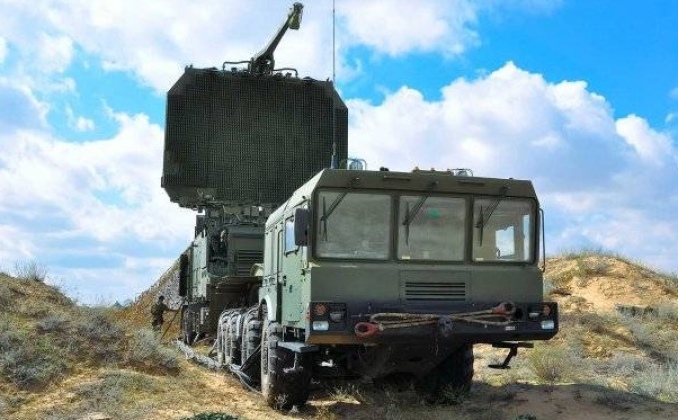
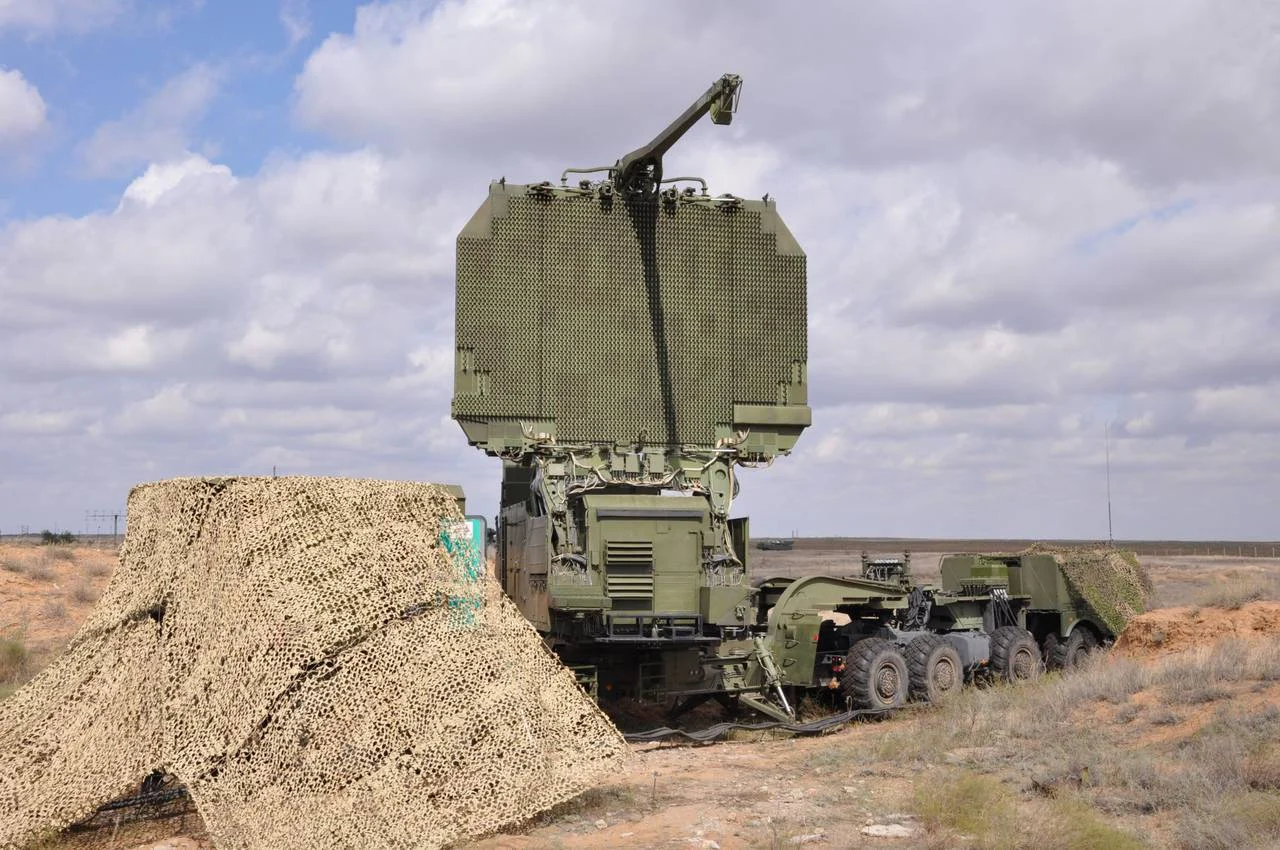
Manufacturer lineage is NIIIP (Tikhomirov / Almaz-Antey radar cooperation). The 91N6E is readily distinguished in photographs from a 64N6E by the MZKT-7930 8×8 tractor in place of the older MAZ-class prime mover.
ANTENNA AND WAVEFORM
The radiating structure is a Janus-faced, space-fed passive phased array: two main faces mounted back-to-back, each a reflection-type array with on the order of 2,700 phase shifters. Electronic beam steering is provided in both elevation and azimuth. Mechanical rotation of the whole assembly supplies 360° azimuth coverage; electronic steering supplies sector search and track within each face. The antenna drive can also be stopped and the face mechanically tilted upward to extend elevation coverage in ballistic-search modes.
Published operating modes include continuous rotation, sector scan, stopped-antenna electronic scan, and additional mechanical tilt. Rotation rates of 5 or 10 revolutions per minute are listed in radar handbooks. Pulse-to-pulse frequency agility is described as the principal ECCM feature. High-duty-cycle transmit waveforms are used in fixed-sector electronically steered search.
The hardware is split between two shelters: one for the array, transmitters and receivers; one for processing and operator positions. The pair travels and deploys as a single radar complex on the MZKT-7930.
FREQUENCY
Russian system descriptions classify the 91N6E as a decimetric (UHF/L-class in Russian usage) panoramic radar. Western radar catalogues list 2.9–3.3 GHz, i.e. S-band. Popular English accounts of the S-400 often print “L-band.” The 2.9–3.3 GHz figure is the most specific open technical listing; the Russian “decimetric” label is the manufacturer-family wording. The 91N6E is not the X-band 92N6E engagement radar and is not a VHF stealth-search set.
PUBLISHED PERFORMANCE
Instrumented range: 600 km. Simultaneous tracks: up to 300. Coordinate accuracy (handbook): about 200 m in range, 0.5° in angle. Azimuth coverage in circular search: 360°. Elevation coverage against aerodynamic targets in regular search: on the order of 14° (one system table prints 360° × 14°). Ballistic-search sector: on the order of 60° in azimuth by 75° in elevation in the same class of tables (predecessor 64N6 special-sector elevation to 75°).
Detection range is a function of radar cross-section, altitude, and clutter. The 600 km figure applies to large, high-altitude aircraft. Secondary analyses give roughly 200–230 km against a 0.4 m² ballistic-class RCS. Low-altitude cruise missiles and small UAVs are limited by the radio horizon; a target at 50–100 m altitude is typically visible only to some tens of kilometres from a ground-mounted array. That gap is why an S-400 grouping is completed by the 96L6E all-altitude detector and, when available, VHF sets such as Nebo-SVU or the multi-band Nebo-M, and L-band sets such as Protivnik-GE or Gamma-DE.
Target-speed handling in S-400 system specifications reaches 4,800 m/s. Secondary writing credits the 91N6E with improved tracking of objects at very high speed relative to the 64N6E2, which is the reason the radar is cited as the acquisition sensor for the system’s 60 km-class ballistic-missile intercept belt.
PLACE IN THE S-400 NET
The 91N6E does not illuminate missiles. Mid-course updates and terminal engagement are the 92N6E’s function, except where a 40N6 uses its own active or passive seeker beyond the engagement radar’s horizon. The 55K6E fuses 91N6E tracks with data from attached radars and from higher command, including A-50/A-50U airborne early warning when that link is available, and distributes designations to one or more 98Zh6E battalions. Rosoboronexport describes the 91N6E explicitly as the sensor that “detects and tracks aerodynamic and ballistic targets, determines nationality, and provides radar information to the 55K6E.”
A 40V6M/MD mast can be associated with other S-400 radars to raise low-altitude coverage; the 91N6E itself is the large rotating Big Bird on the MZKT tractor, not the mast-mounted 30N6/92N6 family illuminator.
MOBILITY
Standard prime mover: MZKT-7930 8×8. Planned industrial shift toward BAZ Voshchina tractors (BAZ-6403.01 cited for towing the Big Bird and 40V6 masts) appears in older Almaz-Antey fleet-standardization notes. Emplacement time for the S-400 as a whole is published as five to ten minutes from the march; the radar is part of that timeline, not a separate fixed site.
LIMITS
The 91N6E is a high-power, rotating, space-fed PESA. It is not an AESA. Stealth-shaped fighters are a reduced-RCS problem at S-band; Russian practice is to pair the S-400 with VHF early-warning radars rather than to treat the 91N6E as a stealth-only sensor. Frequency-agile as it is, a high-duty search radar remains an emitter that can be geolocated. The instrumented 600 km bubble is not a 600 km engagement zone: missiles, horizon, and the 92N6E’s own reach set those limits.
STATUS
The 91N6E remains the standard acquisition radar of exported and domestic S-400 command sets. The 91N6M is the S-500-associated growth path. Combat use of S-400 batteries implies corresponding use and loss of 91N6E vehicles; open reporting treats those events as part of the wider system’s record rather than as a separate radar scorecard.
IN ONE SENTENCE
The 91N6E Big Bird is the S-400’s 600 km, 300-track, dual-face space-fed PESA acquisition radar — a higher-power digital 64N6 on an MZKT-7930 — which builds the air picture for the 55K6E command post and does not itself guide the missiles.