WHAT IT IS
The Buk-M3 (Бук-М3; GRAU index 9K317M) is a Russian tracked, self-propelled medium-range surface-to-air missile system for army air defence (войсковая ПВО), designed by the Tikhomirov Scientific Research Institute of Instrument Design (НИИП им. В. В. Тихомирова, NIIP), part of Almaz-Antey. It is the newest member of the Kub/Buk line. It is intended to engage manoeuvring aerodynamic targets (aircraft, helicopters, cruise missiles, UAVs), tactical ballistic missiles and, secondarily, radar-contrast ground and surface targets, under heavy electronic and fire opposition. The export version is marketed as Viking (Викинг, 9K317ME) through Rosoboronexport.
NATO / US DoD reporting name: the sources found (English Wikipedia, Russian Wikipedia, GlobalSecurity) give SA-27 Gollum. No source found uses the name "Gryphon" for the Buk-M3. The earlier Buk generations are SA-11 Gadfly (Buk, Buk-M1) and SA-17 Grizzly (Buk-M1-2, Buk-M2). Reporting names are Western designations, not Russian ones.
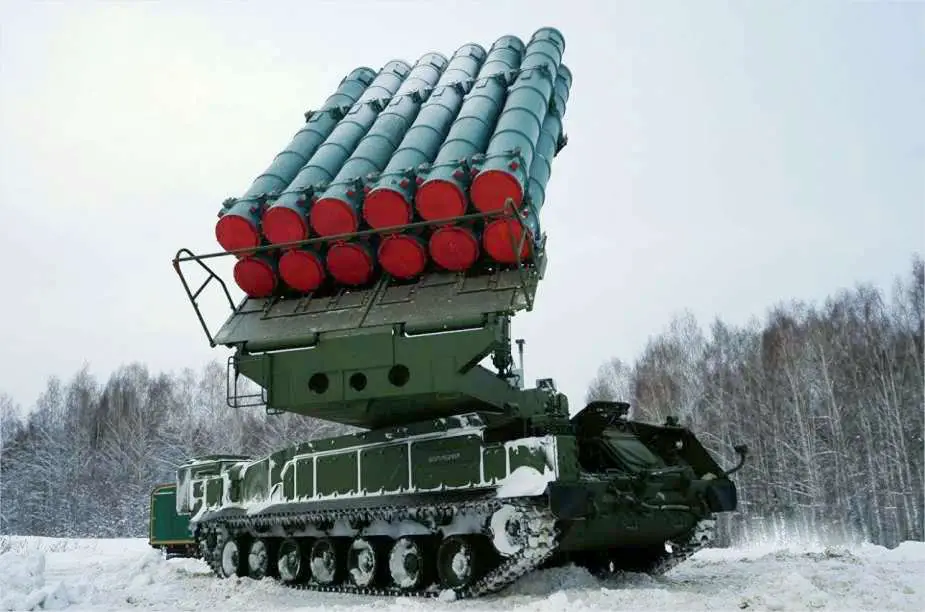
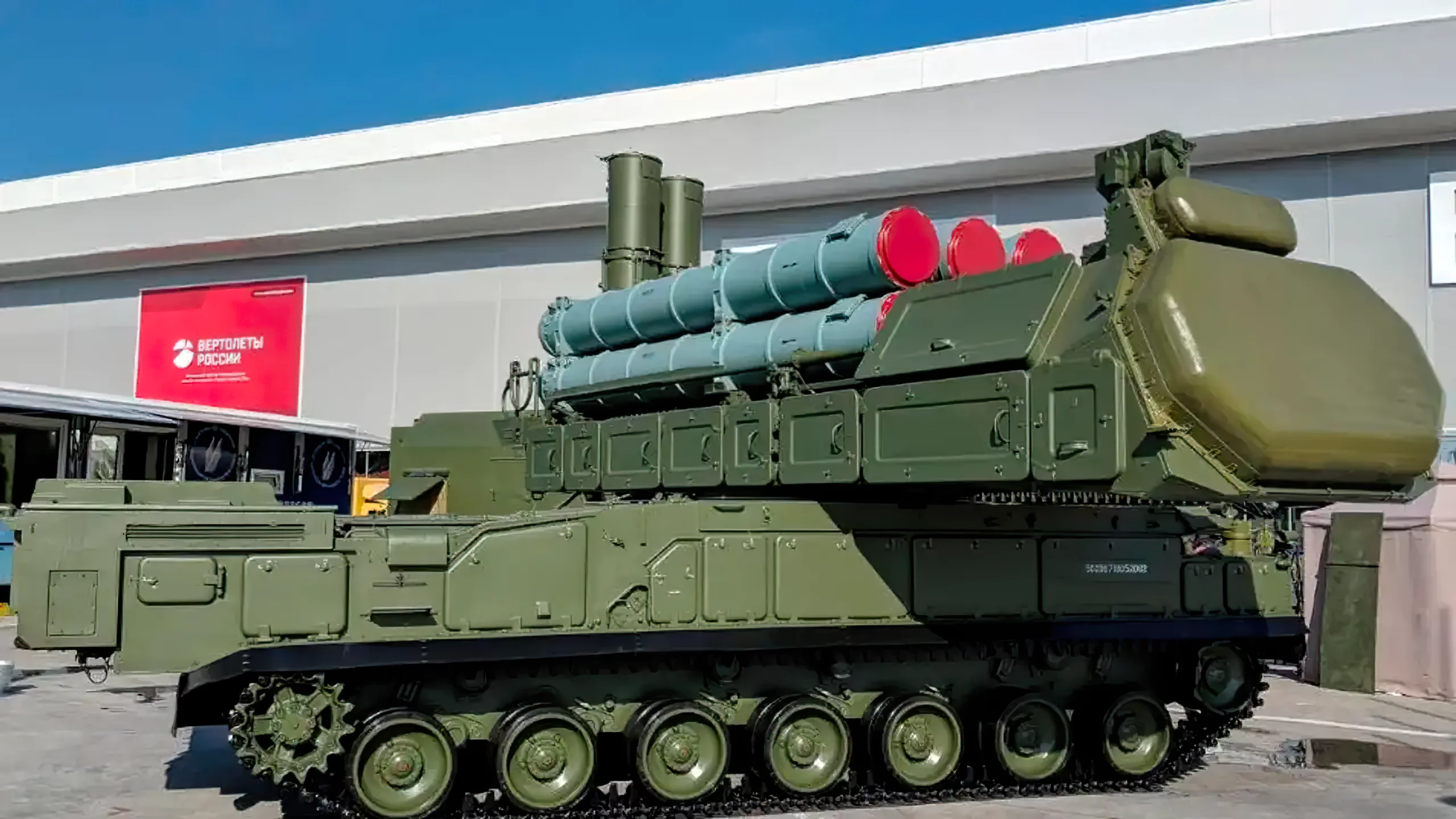
Its main differences from the Buk-M2 are a new electronic base, a new multifunction radar, a tracked launcher carrying six missiles in sealed transport-launch containers instead of four on open rails, a new missile (9M317M) with longer reach and speed, and a 36-target battalion channel count. All performance figures below are manufacturer or Russian state-media figures unless stated, and none are independently verified.
DEVELOPMENT
The Buk line began as the successor to the 2K12 Kub (SA-6 Gainful). Development of the 9K37 Buk was ordered on 17 January 1972, with NIIP as lead designer and Novator responsible for the missile. An interim Buk-1 (a Buk TELAR working inside a Kub battery) was accepted in 1978, and the full 9K37 Buk entered service in 1980 after state trials in 1977–1979. The 9K37M1 Buk-M1 followed in 1983 with better radars, kill probability and jamming resistance. The 9K37M1-2 Buk-M1-2 (export name Ural; SA-17 Grizzly) entered service in 1998 and introduced the longer-ranged 9M317 missile while still accepting the older 9M38 family. The 9K317 Buk-M2 (developed from 1988 per Wikipedia, accepted around 2008) added a PESA-type fire-control radar and a mast-mounted illumination radar (9S36).
Work on the Buk-M3 started in 2007 on the Buk-M2 base with new electronic components. Russian officials in 2007 forecast service entry in 2009, which did not happen. Serial production was then forecast for 2013, and by the end of 2013 the Ministry of Defence was giving 2016 as the delivery year. A Russian Ground Forces announcement on 24 October 2016 (Deputy Defence Minister Yuri Borisov, reported by Rossiyskaya Gazeta) stated that the first Buk-M3 battalions had entered the Ground Forces. English Wikipedia also reports an Almaz-Antey announcement in June 2016 of a successful firing at Kapustin Yar against a ballistic target; this is a manufacturer claim.
Rosoboronexport began promoting the export Viking in March 2018. A naval relative also exists: the 3S90M / 3K90M Smerch (Russian Navy) and the export Shtil-1 use the vertically launched 9M317M / 9M317ME missile. These are separate shipboard installations, not the land system.
ORGANIZATION
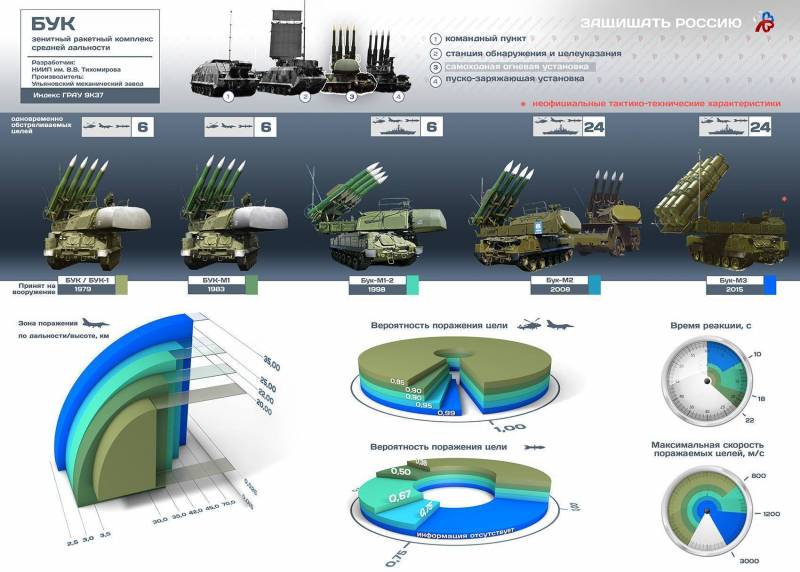
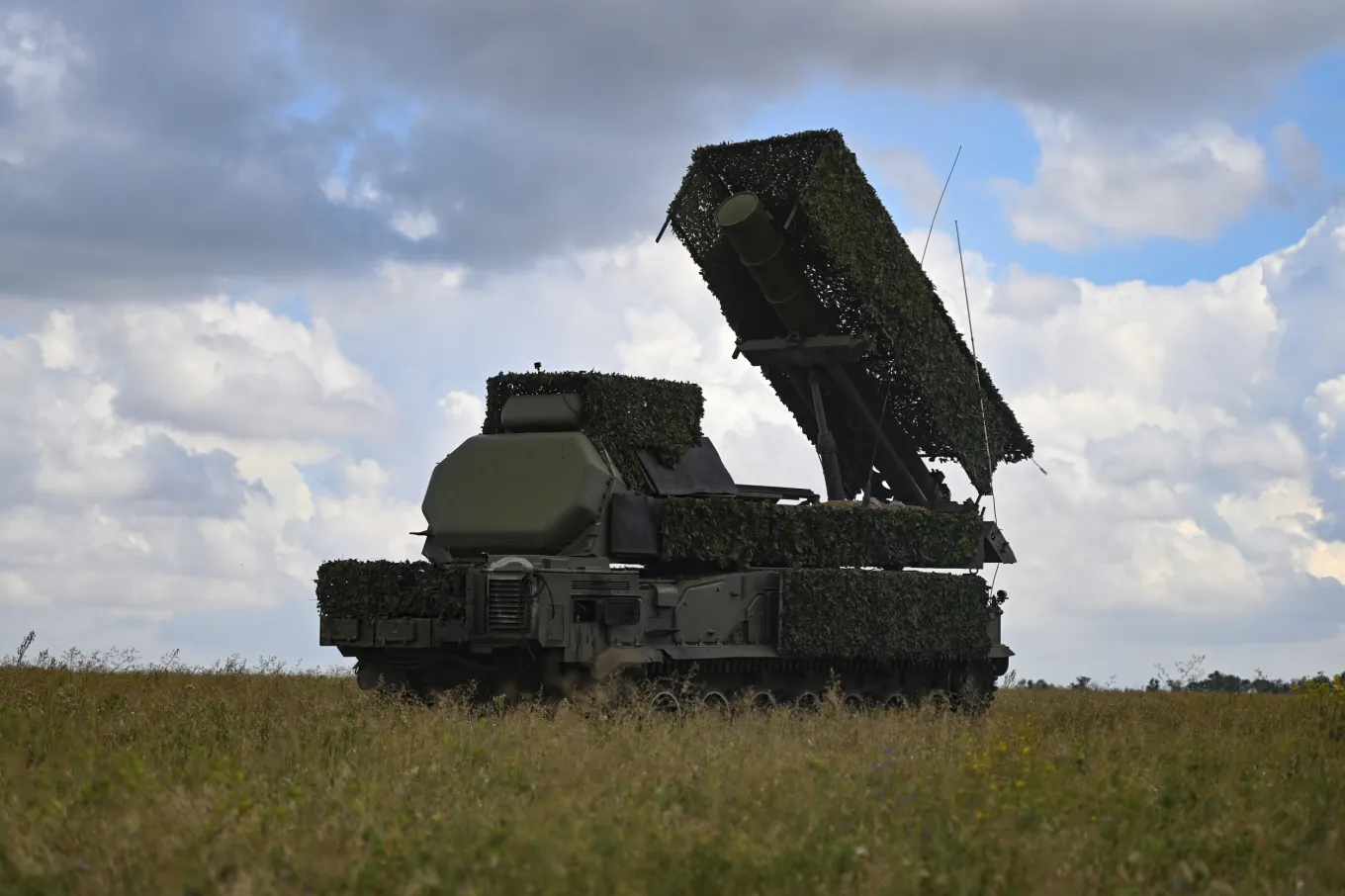
The Buk-M3 is organized as a zenitnyi raketnyi divizion (зенитный ракетный дивизион, battalion). Russian sources list these elements: command post 9S510M (9С510М), which the sources associate with the 36-target channel figure for the battalion; surveillance radar 9S18M3 (9С18М3); target-detection and designation station 9S36M (9С36М) on a telescopic mast; self-propelled fire unit (СОУ, TELAR) 9A317M (9А317М); launcher (ПУ, TEL) 9A316M (9А316М); and transporter-loader (ТЗМ) 9T243M (9Т243М). Support vehicles, maintenance and test equipment complete the set but were not itemized in the sources used.
The exact count of vehicles in an M3 battalion was not found in a source I could verify. For the Buk-M2 generation, English Wikipedia describes a standard battalion as a command vehicle, a target-acquisition radar, six TELARs and three TELs. The Rosoboronexport Viking release (2018) gives a battery logic of two firing units: 6 targets per TELAR, and 18 ready missiles per two combat units (compared with 8 for the Buk-M2E). That is consistent with one TELAR (6 missiles) plus one TEL (12 missiles). Treat battalion vehicle counts for the M3 as unconfirmed.
Each TELAR can also work autonomously: Rosoboronexport states that the 9A317ME engages up to 6 targets from its own launcher plus an attached 9A316ME launcher, launching up to 12 missiles and sending radio correction commands to them. The system links to higher command posts and other air defence systems; the Buk family has been described as integrating with Polyana-D4, Baikal-1ME, Ranzhir and Senezh command systems, but I did not find a source stating which of these the M3 specifically uses.
RADARS
9S18M3 (9С18М3). Three-coordinate, coherent pulse, centimetre-band surveillance radar with electronic beam scanning in elevation (Russian Wikipedia). It replaces the 9S18M1 family (the Buk-M2 uses the 9S18M1-3, listed at 160 km against a 1–2 m² target). I did not find a verified detection range for the 9S18M3 itself.
9S36M (9С36М). Target-detection and illumination radar on a vehicle with a raised mast (the Buk-M2 version, 9S36, is listed with a 21 m mast and a ±60° sector). Russian Wikipedia gives its tracking performance as range 2.5–70 km, altitude 0.005–35 km, target speed up to 3,000 m/s. It also states that, like the Buk-M2, the M3 uses the mast-raised radar so as to detect a cruise missile at 10 m altitude out to 40 km. The mast lets the radar see over terrain and tree lines, which matters for low-flying targets.
9A317M multifunction radar. The radar on the TELAR was created under the development project "Avtoritet" (ОКР «Авторитет»), developed by NIIP (Russian Wikipedia). It is a phased array that performs target acquisition, tracking and missile guidance. The TELAR also has a TV/thermal-imaging sight for passive detection and tracking by day or night in any weather, so the vehicle can track without radiating. The sources (Russian state media and Wikipedia) state that missile guidance can be done by seeker only, by command, or in a mixed mode.
Almaz-Antey and state-media accounts also say the radar can detect targets at about 5 m altitude and that practical firings confirmed engagement of anti-ship missiles flying at such heights (TV Zvezda, 2016). That is a manufacturer-side claim.
LAUNCHERS
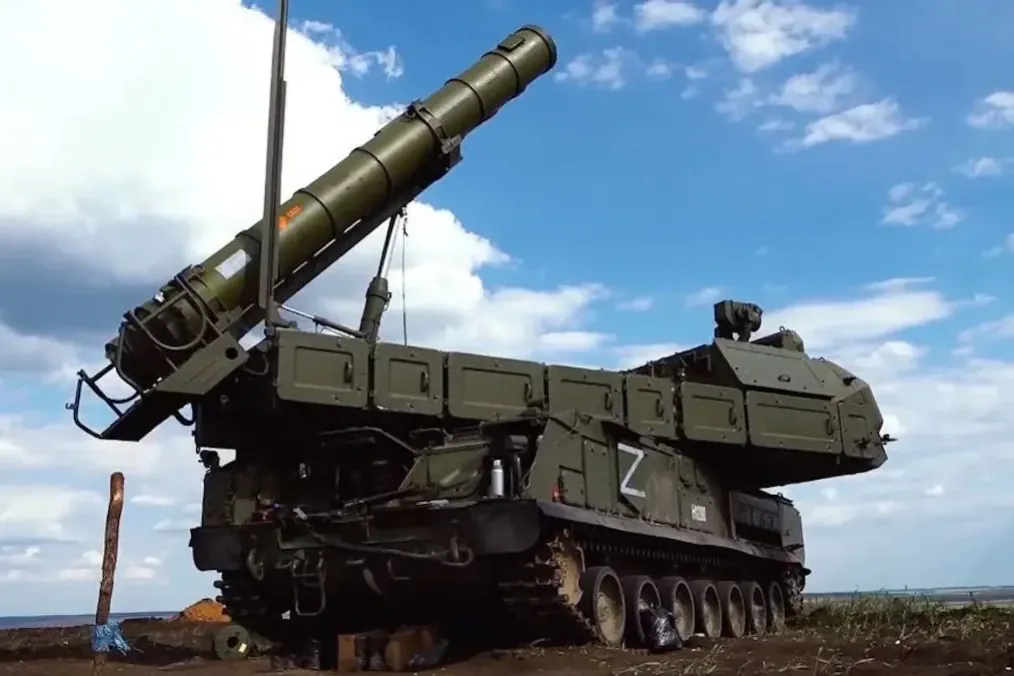
9A317M TELAR (СОУ). Tracked, with a turret that carries the multifunction radar and a raised launch ramp with 6 missiles in sealed transport-launch containers (ТПК), against 4 open-rail missiles on the Buk-M2 TELAR. The chassis was designed at the Mytishchi Machine-Building Plant (ММЗ, now Kalashnikov Concern); GlobalSecurity names the GM-569A with a 710 hp multi-fuel engine, 70 km/h maximum road speed and 500 km range. Russian Wikipedia says the chassis has a new hydromechanical transmission with electronic control, a new crew interior and mine-blast protection for the crew. The TELAR assembly is associated with the Ulyanovsk Mechanical Plant (UMZ). The launcher mechanics were developed by NPP Start in 2006. In 2015 it was reported that all-aspect launch from vertical or inclined containers was possible.
9A316M TEL (ПУ). A similar tracked vehicle without a radar, carrying 12 missiles in containers on a raised ramp. It can fire missiles but needs a TELAR to supply target data and guidance.
9T243M transporter-loader (ТЗМ) delivers reload containers; developed and produced at NPP Start (Russian Wikipedia). A wheeled option on the Minsk MZKT-6922 chassis was reported for the M3 as planned, to be built in Belarus; I did not find evidence of fielding.
The Buk-M3 TEL can also fire the older 9M317 missile (Missilery.info), so mixed loads with Buk-M2 equipment are possible according to that source.
MISSILES
9M317M (9М317М; export 9M317ME). Single-stage solid-propellant missile with a dual-mode (boost-sustain) motor with longer burn time than the 9M317. Published data (Missilery.info, which is based on Russian manufacturer material): length 5,180 mm, maximum body diameter 360 mm, tail span 820 mm, launch mass 581 kg, mass in container 1,040 kg, warhead 62 kg, maximum speed 1,550 m/s (about Mach 4.6), maximum available overload 24 g. English Wikipedia lists the same 581 kg and Mach 4.6 figures.
Warhead: Russian sources describe an HE-fragmentation / rod-type warhead with directional detonation and a radar proximity fuze, said to engage targets as low as 5 m (TV Zvezda, 2016). The warhead mass of 62 kg is also given for the naval 9M317M(E). The claim that it can penetrate high-strength materials comes from Russian state media.
Guidance: this is a point where the sources disagree. Russian Wikipedia says the 9M317M has an inertial system with an ACTIVE radar seeker. Missilery.info and GlobalSecurity say inertial guidance with SEMI-ACTIVE radar homing. English Wikipedia describes the naval 9M317ME as inertial with radio correction and semi-active terminal homing, and separately lists the 9M317A / 9M317MAE as the active-radar-homing versions (NIIP reported testing the 9M317A in 2005 with about 50 km range). In this article the safe statement is that the M3 uses inertial mid-course guidance with radio correction and radar homing; whether the production 9M317M seeker is active or semi-active is not established from the sources used. I have not used any designation such as 9M317MM because no source supports it.
9M317 (older). The Buk-M1-2 / Buk-M2 missile: about 710–720 kg, 5.55 m class, 3–50 km, up to Mach 4 target speed, 24 g. The 9M38M1 (690 kg, 70 kg warhead, Mach 3) is the earlier Buk-M1 missile and is not used for the M3 mix as a primary weapon.
9M318 is a separate Belarusian missile for the Buk-MB2 / MB3K upgrades (about 70 km claimed, active seeker). It is not a Russian Buk-M3 missile.
PUBLISHED ENVELOPE
Range: 2.5–70 km (Russian sources, Missilery.info, GlobalSecurity). The export Viking is advertised by Rosoboronexport at 65 km, almost 1.5 times the Buk-M2E.
Altitude: 15 m to 35 km in Missilery.info and English Wikipedia; Russian Wikipedia and the 9S36M figures use 5 m (0.005 km) as the lower limit. The two numbers describe different things (missile engagement versus radar tracking floor), and both are manufacturer-side.
Target speed: up to 3,000 m/s.
Channels: 36 targets for the battalion (command post 9S510M). Missilery.info says up to 6 targets per TELAR, which matches the Rosoboronexport statement for the Viking. Rosoboronexport also cites a cruise-missile engagement range up to 20 km and helicopter ranges of 60 km moving and 12 km hovering for the Viking (read from a partly garbled web page; treat as approximate).
Kill probability per missile: the Almaz-Antey / Zvezda figures include 0.9999 against a non-manoeuvring air target, 0.8 against a cruise missile; English Wikipedia lists 0.95 for aircraft, 0.7 for a tactical ballistic missile and 0.8 for a cruise missile. These are manufacturer claims and cannot be used as predicted combat results. The 0.9999 figure in particular should be treated as a marketing number.
Reaction time and time-to-deploy for the M3 were not found in a verifiable source. The Buk-M2 figures in Wikipedia (about 5 minutes from the march, about 20 seconds from short halts, 10–15 minutes when the mast radar is used) should not be assumed to apply to the M3. The claim that the M3 can destroy ATACMS comes from Russian state media; English Wikipedia notes it had not been tested as of 2016.
COMPARISON TO BUK-M1 / M2 AND OTHER SYSTEMS
Buk-M1 (SA-11): 4 missiles per launcher, range 3.3–35 km, altitude 15 m–22 km, 9M38M1 missile. Buk-M1-2 (SA-17): 9M317, range to about 42–50 km, altitude 15 m–25 km. Buk-M2E (SA-17): 4 missiles on open rails, range 3–50 km (45 km quoted for the export model), 24 channels per Wikipedia's comparison table, 9S36 mast radar. Buk-M3: 6 missiles in containers, 2.5–70 km, up to 36 channels, 1.5 times the transportable ammunition, kill zones and simultaneous targets of the Buk-M2 (Missilery.info's wording).
Against the S-300V4 / Antey-2500 and the S-350 Vityaz: the Buk-M3 is a shorter-range, army-level system; Wikipedia places the Buk below the S-200/300/400 and above Tor and Pantsir in the Russian layered defence. I did not compare numbers for the S-350 or for NASAMS because I did not have verified figures from the same kind of source. One sourced data point: Finland replaced its older Buk-M1 with NASAMS 2, citing electronic warfare concerns. A claim that the Viking can use Antey-2500 launchers to extend its range to 130 km appears in English Wikipedia from Russian sources and is not confirmed here.
OPERATORS AND COMBAT USE
Russia is the only confirmed operator. The Military Balance 2020 (via Russian Wikipedia) counts at least 60 units. Russian Wikipedia lists units said to have Buk-M3, including the 67th, 53rd and 61st air-defence brigades and the 35th separate motor-rifle brigade; English Wikipedia says three brigades were fully equipped by December 2017 (citation needed in the source) and that deliveries were still reported in September 2025 (PRIME, Russian news agency). Egypt has been reported to have requested Buk-M3 missiles, not systems. I found no confirmed export delivery of the Viking.
Ukraine war: the Buk family has been used by both sides. Ukraine operates older Soviet Buk-M1 systems (some adapted to fire US Sea Sparrow missiles). For the M3 specifically, the claims found are all Ukrainian official or Ukrainian media statements: the General Staff announced two Buk-M3 destroyed on 23 February 2024; Unmanned Systems Forces claimed a Buk-M2 and two Buk-M3 destroyed in Kursk Oblast on 7 April 2025; and in October 2025 video showed a drone riding on a Buk-M2 or Buk-M3 before it exploded. Ukrainian media also report that Russian Buk crews were short of missiles in late 2025, with some vehicles carrying only one or two. On 10 October 2025 Russia claimed to have shot down Ukrainian Flamingo cruise missiles, one with a Buk, with the variant unspecified. All of these are single-party claims, are not independently verified, and loss claims do not show system performance; they do show that the launchers are priority targets for drones and long-range strike. In March 2026 a Kyiv Independent report quoted the Ukrainian Unmanned Systems Forces as saying Kub launchers were being deployed to cover Buk losses in some areas.
Do not confuse the M3 with the Buk that shot down Malaysia Airlines Flight MH17 in July 2014 (an older-generation Buk, years before the M3 entered service).
STATUS
The Buk-M3 is in production at Ulyanovsk and in service with Russian ground-forces air defence since 2016, with deliveries still being reported as of late 2025. It remains the most modern Buk and the intended replacement for the Buk-M1 and Buk-M2. The performance published for it comes from Almaz-Antey, NIIP, Rosoboronexport and Russian state media, and has not been demonstrated independently. Combat reports are limited and mostly one-sided.
IN ONE SENTENCE
The Buk-M3 (9K317M, NATO SA-27 Gollum per available sources) is NIIP / Almaz-Antey's latest tracked medium-range SAM, combining a 9S510M command post, 9S36M mast radar and 9A317M / 9A316M launchers carrying 6 and 12 container-packed 9M317M missiles, with a claimed 2.5–70 km range, 35 km ceiling and 36 target channels per battalion.