WHAT IT IS
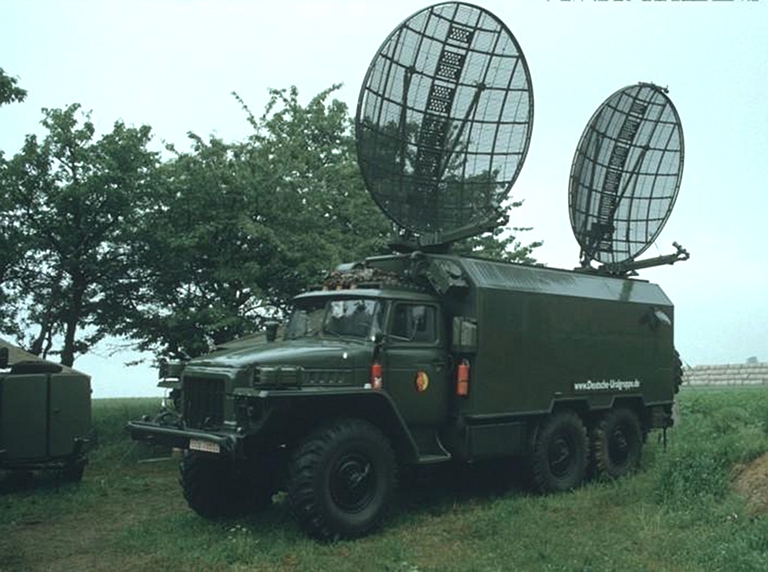
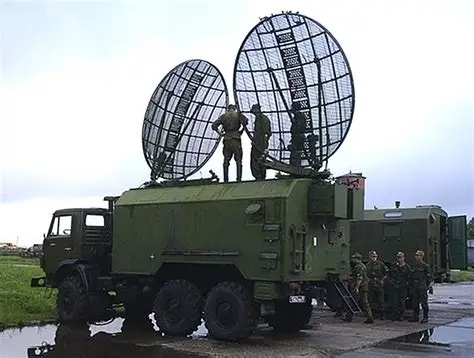
R-423 «Бриг» (Brig) is the late-Soviet / Russian / Ukrainian-built family of mobile centimetre-wave troposcatter stations for army and front radio nets. MNIRTI (Moscow) designed it; Krasnoyarsk Iskra / related plants built truck sets; Ukraine kept producing export and relocatable variants after 1991. The silhouette that identifies the family is two mesh (or solid) parabolas on opposite sides of a shelter or truck roof, folded inboard for the march, raised and aimed a few degrees above the horizon for the hop.
Index is R-423, not R-432. R-432 «Горизонт» is a later Belarus AGAT-Control Systems tropo station developed with Chinese industry. Same physics, different box and country.
Brig replaced and outgrew R-412 Torf. Computer-museum history of Soviet radio-relay: from 1985–2001 the inventory took R-423-1, R-423-2, R-423-2A and relatives, quoted as ~1.5× throughput, ~15× ECM hardness, ~1.5× interval, and more simultaneous directions than the generation before.
VARIANTS
R-423 — the complex name. R-423-1 Brig-1 (OP1.100.028) — front-net station, 1981. High-power digital tropo. Vehicle 13D on KamAZ-4310 plus a generator vehicle; early sets used Ural-375D for the support truck. Impulse multiplex sits alongside, not inside every shelter. Ukraine still lists and exports this generation. R-423-1A / -1M / -1KF — automobile, modernized, and kung/furgon (box-body) layouts. KF is the “container with two ears” look. R-423-2 Brig-2 — army-net station of the same complex. R-423-2A Brig-2A — the set RusArmy documents as the Torf-A replacement: KamAZ-4310, towed ЭД 2×8-Т400-1ВПС generator, lower PA than Brig-1, digital to 480 kbit/s. R-423-2M, R-423-AMK — later automobile / container. Ukrainian recognition guide: AMK in KK3.1.01.2 container or URAL-4320 kung, two ~2.5 m dishes that fold irradiators-down toward the centreline on the march — the photograph that started this thread.
HOW THE HARDWARE IS ARRANGED
Two dishes because tropo fades. Space diversity (metres of separation across the roof) plus frequency and/or polarization. Brig-2A kit list on RusArmy: antennas И117-1 ×2, rotators И117-2 ×2, transmitters И13 ×4, exciters И205 ×2, modems И247 ×4, two receivers, then the channel pack (П-331-3Б ×3, П-331-S/L/TCh) and an R-159 for the order-wire. That is a two-direction station, not a single pipe.
Brig-1 antenna in the rusarmy/open tables: paraboloid about 2.65 m, horizontal polarization, ~10 MHz transmitted spectrum. AMK recognition photos use ~2.5 m. Gain on one 2A sheet: 38 dB.
Transport: KamAZ-4310 is the standard tractor for 2A / 1A. Station + crew mass on the 2A sheet 13,500 kg. Crew 3. Deploy ~20 minutes. Power: 380 V three-phase; 2A consumes 8 kW and tows a ~20 kW class genset depending on the listing. Brig-1’s 13D van is a dedicated apparatus truck with operator, TX bay, LNA (“Kontur-P2”), and the usual NBC/heater kit.
RF AND THE PATH
Band, both main marks: 4435–4555 MHz and 4630–4750 MHz (same neighbourhood Groza later occupies). About 220 fixed frequencies on the Brig-1 table. Modulation: PSK-class at 48 / 480 kbit/s; double-split / higher-order at 2×480 and 2048 kbit/s on the front set.
Power: Brig-1 tables give 1.5 kW and two transmit chains. Brig-2A tables give 220 W max (another sheet 200 W) and receiver noise figure 7 dB. Frequency diversity on one 2A write-up: eight frequencies, 2.6 MHz apart. Receive diversity on Brig-1 is quoted as 8–12-fold in the long-line planning figures.
This is not a 50 Mbit/s 2025 modem. It is 1980s–90s digital tropo sized for staff multiplex.
RATES AND RANGE
Brig-1 (front), MNIRTI / AusAirPower / museum table: 2 048 kbit/s at 150 km, or 64 kbit/s at 230 km. Long-line planning (many intervals): 48 kbit/s × 9 hops, 480 kbit/s × 11, 2×480 × 13, 2048 kbit/s × 22 — all drawn to a 2 000 km backbone. Two relay stations in the local scheme; 18 telephone channels on one sheet; 48 / 480 / 2×480 / 2048 kbit/s digital modes.
Brig-2A (army), RusArmy interval table:
1.2 kbit/s — 230 km both ways 2.4 — 210 km 4.8 — 190 km 9.6 — 170 km 48 kbit/s — 130 km both ways / 190 one way 240 kbit/s (4 tone channels) — 90 / 160 km 480 kbit/s (9 tone channels) — — / 140 km one way
Line length on the 2A header: 450 km. Worst-month range on another 2A sheet: ~210 km. Two communication directions. Analog: up to 9 tone channels.
Those two tables are why Brig-1 and Brig-2A are not the same truck. One is a front pipe that can be chained toward 2,000 km. The other is a shorter, leaner army hop that replaced Torf.
JOB IN THE C2 STACK
Field reference network: army and front command posts, over terrain that will not take a line-of-sight R-409 / R-419 tower line and that should not depend on a Globus/Meridian or Yamal slot. Interfaces are the Soviet channel family (tone, telegraph, digital group, Impulse multiplex on the front set). The station talks to the rest of the node through the usual entry panel — radio-relay, cable, satellite van — so tropo is one bearer among several.
Two dishes aimed at the next common volume, not at GEO. Elevation is low. A south-high solid dish on the same front is Liven, not Brig.
HISTORY
MNIRTI’s centimetre digital tropo after Baget / Atlet-D. Brig-1 designed 1981, fielded through the mid-1980s. Brig-2 / 2A follow as the Torf replacement (Torf itself was Krasnoyarsk, 1970s). R-423-1KF dated 1993 in the MNIRTI table — post-Soviet box-body, same 2 048 kbit/s / 150 km class. Ukraine inherited the drawings and still offers mobile and static-relocatable R-423-1 via Ukrspetsexport. Russian Signal Troops kept 2A / AMK-class trucks in the 2010s–20s inventory. The two-ear shelter is what combat footage and recognition guides still tag.
NOT THESE
R-432 Gorizont — Belarus, AGAT, China cooperation, 150–180 km class digital tropo, different index. R-416GM — LOS radio-relay, mast, ~40 km, often captioned tropo in 2024–26 strike videos. Groza-1.5 — 70 kg cabinet, one 1.5 m dish, 2020s civil/dual-use, 25–50 Mbit/s tropo. R-441 Liven — SATCOM, dish up and south.
CAVEATS
Brig-1 1.5 kW versus Brig-2A 200–220 W are different marks; do not average them. 2 000 km is a multi-hop plan, not one interval. Dish diameter 2.5 vs 2.65 m is AMK photo vs Brig-1 table. Ukraine-built and Russia-held sets share the silhouette and not necessarily the same modem vintage. Combat-loss tallies specific to R-423 are thinner than R-416GM because tropo vans sit farther back.
STATUS
Still the Russian army tropo you can type-classify from a photograph. Ukraine still manufactures the -1 line for export. Newer Russian portable tropo (Groza, Ladya) is the shrinking path; Brig is the truck that taught the doctrine.
IN ONE SENTENCE
R-423 Brig is MNIRTI’s 1981-onwards two-dish, 4.4–4.75 GHz tactical tropo family — Brig-1 at 1.5 kW / 2 Mbit/s @ 150 km for front backbones, Brig-2A at ~220 W / 1.2–480 kbit/s @ 90–230 km on a KamAZ — the camo shelter with a mesh ear on each side that replaced Torf and is still the Russian army tropo silhouette.