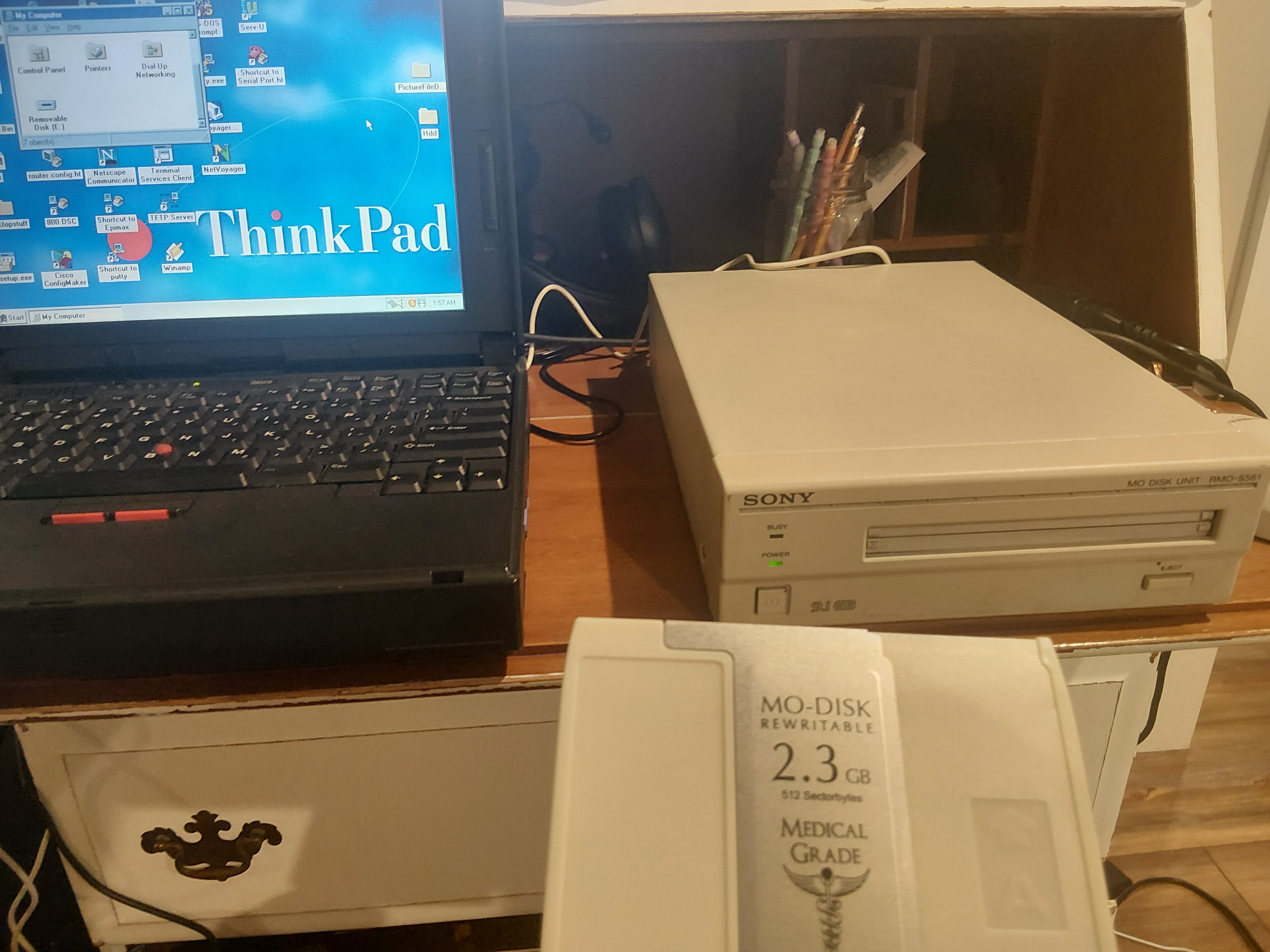
WHAT IT IS
A magneto-optical (MO) disk is a rigid plastic platter in a shuttered cartridge that stores bits as perpendicular magnetic domains in a rare-earth / transition-metal film and reads them with a laser via the polar Kerr effect. Writing is thermomagnetic: the same laser heats a micrometre-class spot past the film’s Curie point so a modest coil on the far side of the disk can flip that domain. At room temperature the coercivity is enormous. A fridge magnet does nothing. A stray field that would scramble a floppy does nothing.
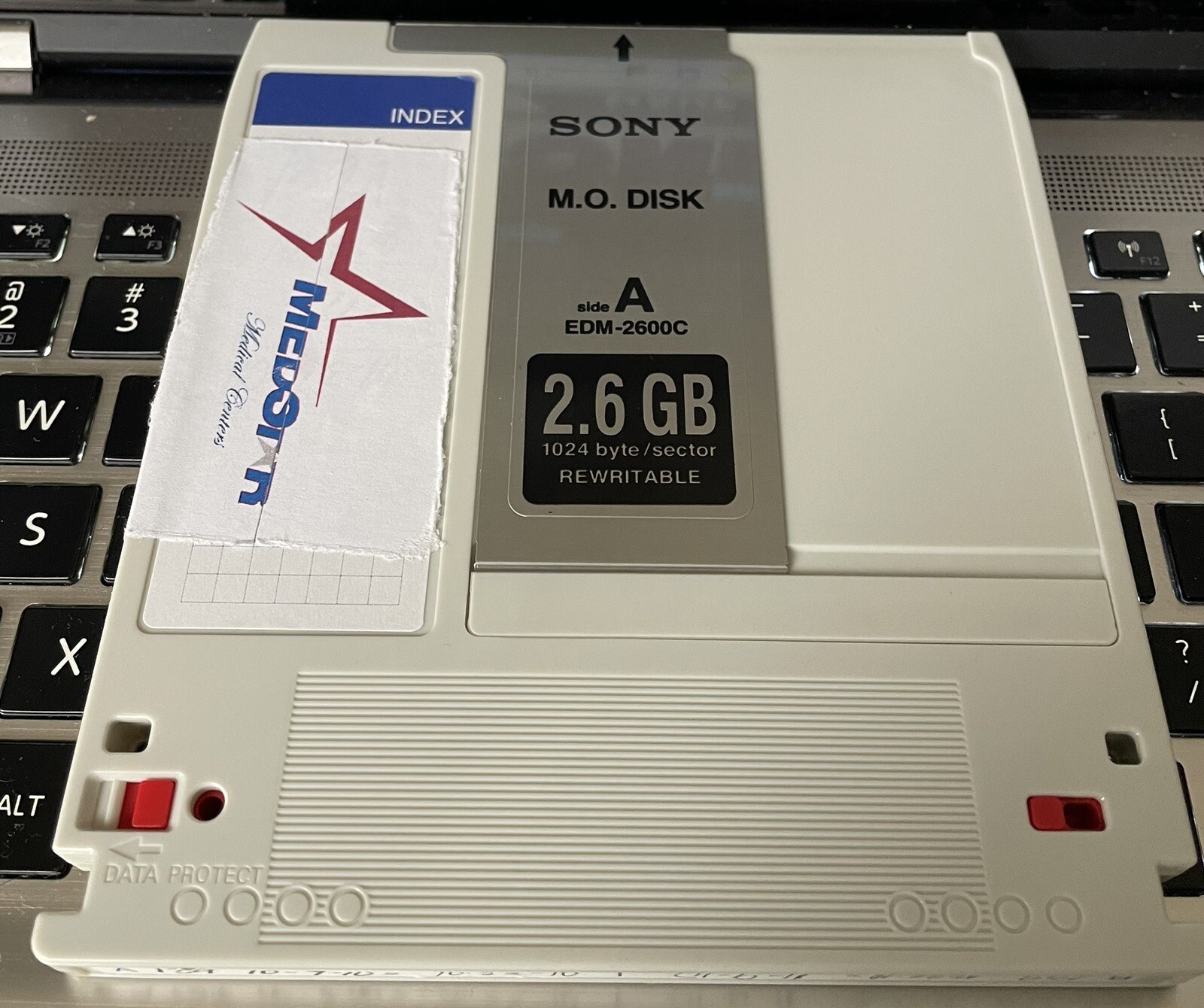
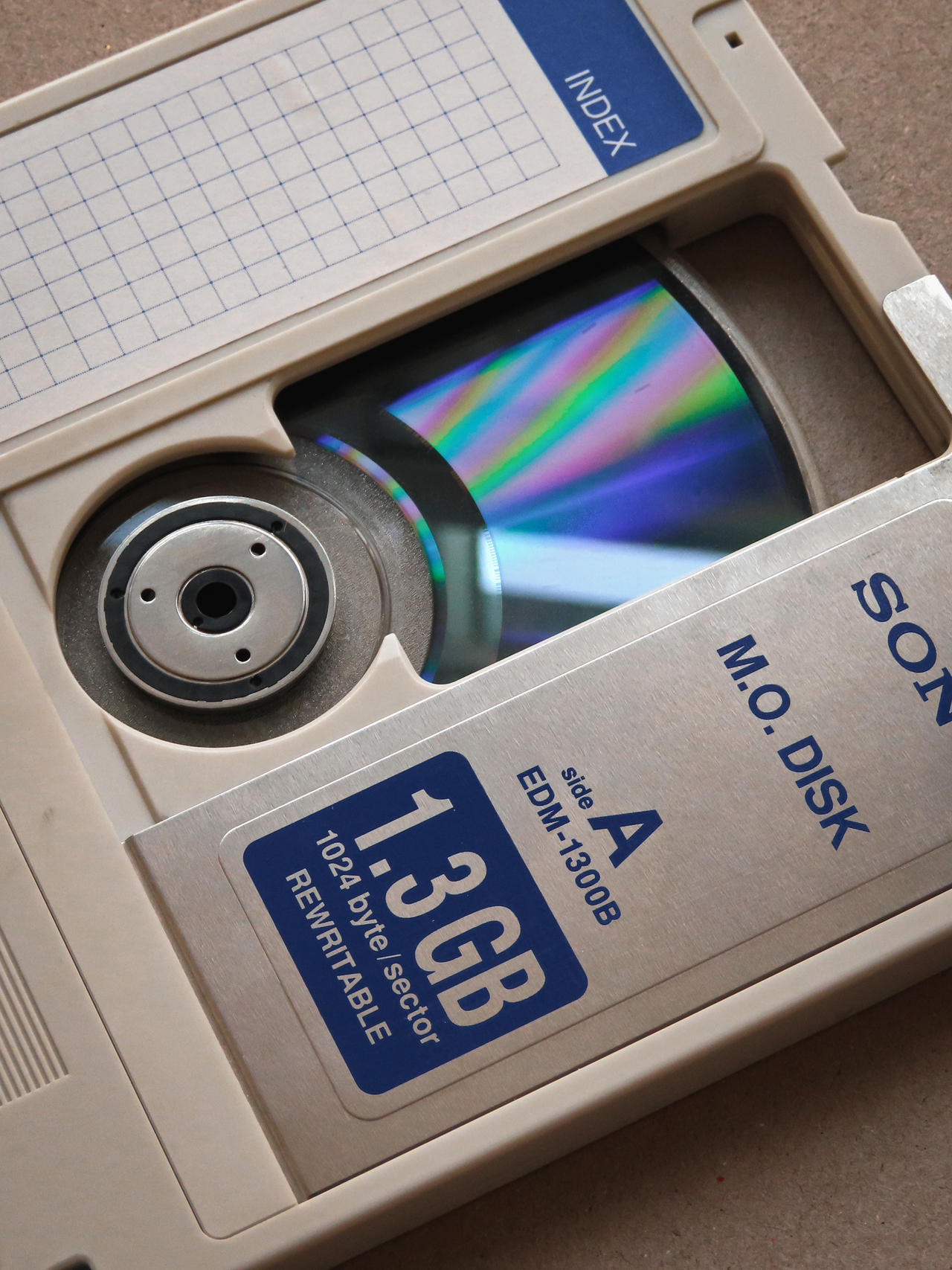
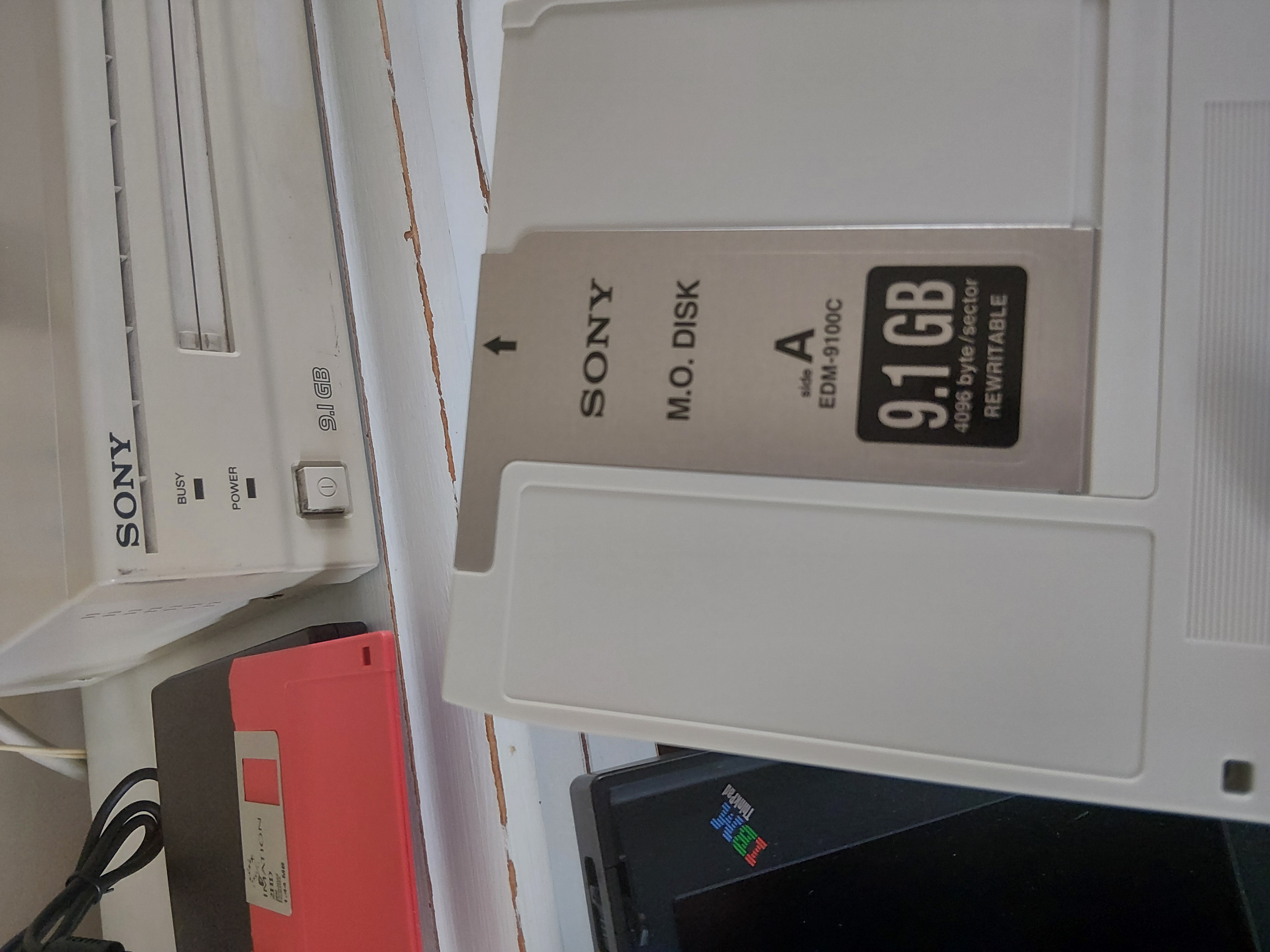
It is not a CD-RW (phase-change amorphous/crystalline). It is not a hard disk (inductive or GMR head flying on the data). It is not MiniDisc in the consumer sense, though MiniDisc is the same physics in a 64 mm shell with ATRAC. Computer MO came in two cartridge families: 90 mm / 3.5-inch (single-sided, 128 MB → 2.3 GB) and 130 mm / 5.25-inch (usually two-sided, 650 MB → 9.1 GB class, capacity split by face).
HOW A BIT IS WRITTEN
The recording film is an amorphous ferrimagnet — typically TbFeCo or a cousin. Rare-earth and transition-metal moments point opposite. Composition is chosen so a compensation temperature sits near or below room temperature (net magnetization near zero, coercivity spikes) and the Curie temperature sits in a laser-reachable window, roughly 400–600 K. Heat the spot. Net moment collapses. The bias coil’s field, only a few hundred oersted, sets the direction. Cool. The domain freezes. That domain is now a bit with a lifetime measured in decades if the film chemistry holds.
Classic ISO MO is two-pass. Pass one: laser heats, coil set to “erase,” the track becomes a uniform 0. Pass two: coil reverses, laser pulses the 1s. Then a verify pass on many drives. That is why early MO felt slow next to a hard disk. LIMDOW (Light Intensity Modulated Direct OverWrite) stacked extra magnetic layers so laser intensity alone selected write-versus-erase in one pass — about a third faster, fewer rewrite cycles quoted on some media (~1 million vs ~10 million for standard).
HOW A BIT IS READ
Low-power polarized laser, same objective, same spot size. Reflection from a perpendicular domain rotates the polarization by a fraction of a degree (typical Kerr rotation ~0.2–0.5° at 780 nm). A polarizing beam splitter and a differential photodiode pair turn that tiny rotation into a clean 0/1. The drive designer wants Kerr signal high and raw reflectivity under ~30%. Multilayer dielectric stacks on the disk exist to boost the Kerr rotation and protect the metal.
Servo is continuous-groove ISO optical servo, not a hard-disk servo writer. The laser follows a pregroove; embedded marks give sector IDs. Sector size on late Fujitsu 3.5-inch media is 2048 bytes formatted — computer disk, not CD-ROM 2048-by-accident.
WHAT THE HARDWARE IS
Cartridge. Hard shell, spring shutter, like a fat floppy. Disk is clamped to a hub. 90 mm is one-sided and does not flip. 130 mm is two-sided; the operator or the jukebox turns it. Dust and fingerprints hit the plastic window, not the film.
Drive optics. 780 nm-class IR laser (later gens shorter where density demanded), collimator, polarizer, beam splitter, objective on a two-axis actuator (focus + tracking), return path to the quad / Kerr detectors. Same family of pickup as a CD drive, plus polarization optics.
Bias magnet. A coil or small electromagnet on the opposite side of the platter from the lens, or arranged so the field threads the spot. It does not fly. It does not touch. It only has to win while the spot is hot.
Spindle and loader. Several thousand rpm (Fujitsu late 3.5-inch sheets list ~3,600–5,500 rpm depending on media). Load/unload a few seconds. Seek on a 3.5-inch unit ~20–25 ms class; 5.25-inch libraries were slower because the mass and the robot dominate.
Electronics. SCSI target firmware in the serious units. IDE/ATAPI and later USB bridges on 90 mm desktop boxes. Cache 2–8 MB typical on late Fujitsu. The host sees a removable disk, not an authoring session.
HOW IT HOOKS TO A COMPUTER
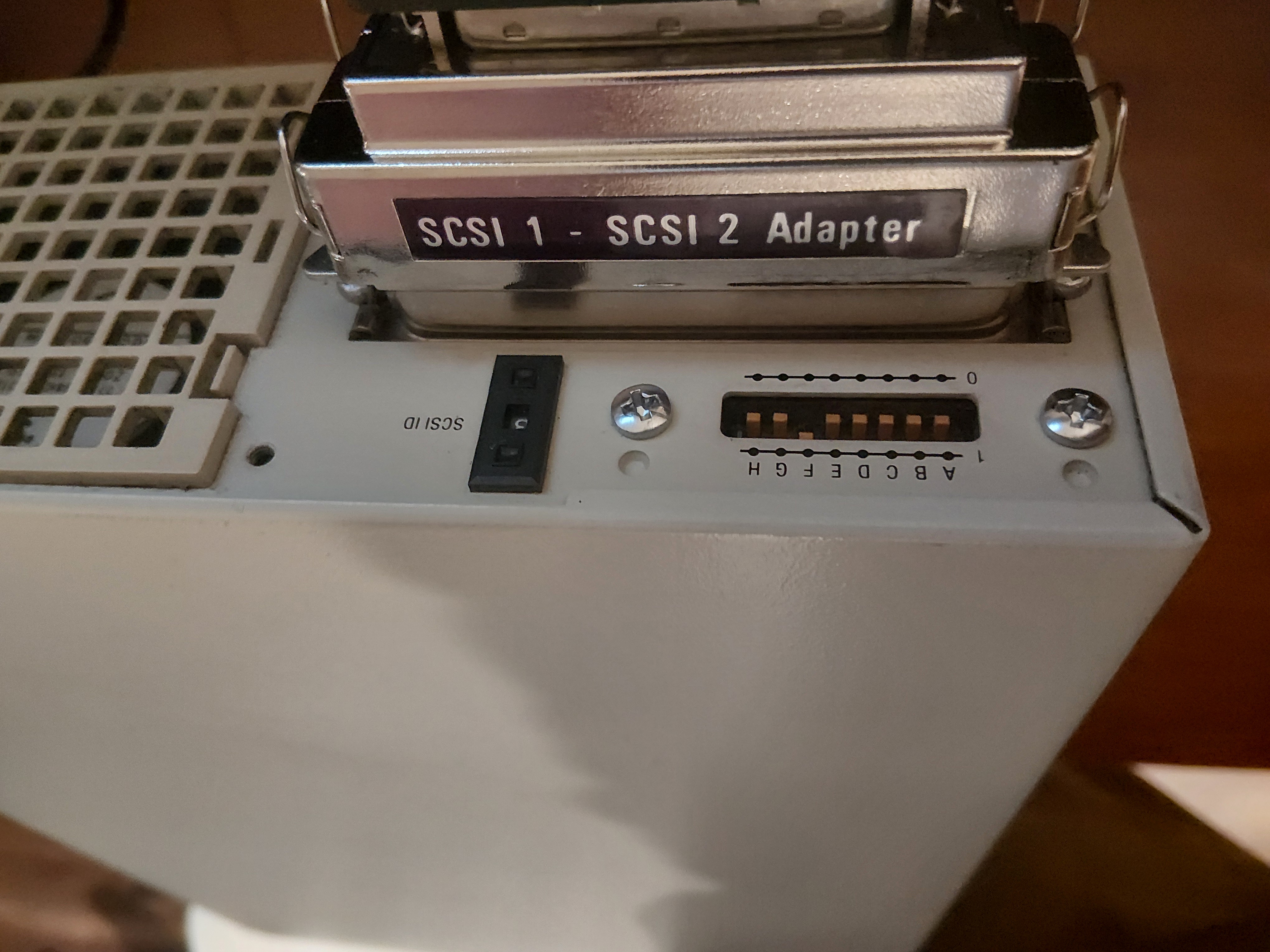
5.25-inch drives were almost always SCSI — 50-pin narrow, later Wide Ultra2 LVD in library boxes. They show up as SCSI type “Optical Device.” Format them, put FAT, HFS, ext, or the vendor’s archival filesystem on them, and they behave like a slow, huge floppy. HP, Maxoptix, Sony, Plasmon jukeboxes (16–hundreds of platters) sat on the same SCSI bus as the host and needed library software to pick a slot.
3.5-inch (Fujitsu DynaMO and clones): internal SCSI-50 or IDE 40-pin slim bays, external SCSI or later USB. Capacities 128 / 230 / 640 MB / 1.3 / 2.3 GB with backward read of older cartridges in a given family. A Windows or Linux box mounts them as removable volumes. No special burning program. That is the operational difference from CD-R.
MiniDisc is the consumer fork: same Kerr/Curie physics, 64 mm disk, ATRAC compression, optical-digital or analog line, not a SCSI volume of raw files (Hi-MD later blurred that).
WHY IT IS GOOD AT LONG-TERM STORAGE
1. Room-temperature coercivity is huge. The bit is not a weakly held in-plane domain on oxide paint. Compensation-point films are magnetically stubborn until you supply the laser. Airport X-ray and desk magnets are irrelevant.
2. The data is under plastic, in a cartridge, on a rigid substrate. No oxide flake, no exposed floppy window, no CD dye that forgets in a hot attic the same way. Vendor archive figures: 30–50 years in climate (Fujitsu cited ANSI/PIMA IT9.26-class estimates and a 50-year line on 3.5-inch media). That is chemistry plus darkness plus temperature, not magic.
3. Rewrite endurance. Standard MO: on the order of 10 million write cycles; LIMDOW lower but still orders above CD-RW’s thousand-cycle class. Read cycles quoted even higher. The failure you actually see is a dead drive laser or a seized shutter, not a worn-out sector map.
4. Contactless read/write. Nothing flies at 10 nm. A scratch on the cartridge window is not a head crash.
5. You can unplug the medium. Like LTO, the archive is a shelf object. The drive can die; the cartridge does not spin 24/7. Medical imaging and legal shops bought 5.25-inch libraries for that reason when 2.6 GB per platter still looked large.
What it is not: immune to heat above design, to delamination of cheap multilayers, or to format obsolescence. A 1994 128 MB disk is readable only if you still have a drive that speaks that ISO generation. The physics aged well. The SCSI card did not.
HOW IT DIFFERS
Versus HDD: removable, shock-tolerant medium, slow seek, two-pass write, no flying head.
Versus CD-R/RW / DVD: magnetic bit plus Kerr read, not pits or phase-change; random-access filesystem without a burn session; far higher rewrite count; cartridge instead of a bare disc.
Versus floppy / Zip: optical tracking and thermomagnetic write, not a contact head on oxide; capacity jumped two orders; field immunity.
Versus LTO: random access inside a platter, no streaming robot required for a single disk; much less capacity per piece after 2005; no serpentine wraps.
WHO BUILT IT AND WHAT CAME AFTER
Sony, Fujitsu (DynaMO), HP, Maxoptix, Plasmon, Olympus, Konica. ISO/IEC 10089 (130 mm) and 10090 (90 mm) kept the cartridges interchangeable inside a generation. Sony’s UDO (Ultra Density Optical, announced 2000, phase-change successor aimed at the 9.1 GB MO slot) tried to take the library business with 30–60 GB class media and a ~50-year archive claim; it did not restart a desktop market. Hard disks and then LTO/object storage ate the capacity curve. Fujitsu stopped the 3.5-inch line. The remaining population is archival closets and people who still have an MCM3130SS on a SCSI card.
CAVEATS
Capacities on 130 mm media are per cartridge until you notice they are two-sided. Kerr angles and Curie windows are material-family numbers, not one alloy. “50-year” is a vendor estimate under storage standards, not a clock on a disk in a garage. MiniDisc ATRAC is not a raw MO volume.
STATUS
Out of new production as a mass computer peripheral. Media and drives still trade used. The physics remains the cleanest answer to “rewritable optical that magnets cannot eat.”
IN ONE SENTENCE
Magneto-optical storage writes bits by laser-heating a ferrimagnetic film past Curie so a bias coil can freeze a perpendicular domain, and reads them by Kerr rotation — a cartridge disk that mounts like a SCSI or IDE volume, shrugs off magnetic fields, and was bought for 30–50 year archives until hard disks and tape outgrew it.