WHAT IT IS
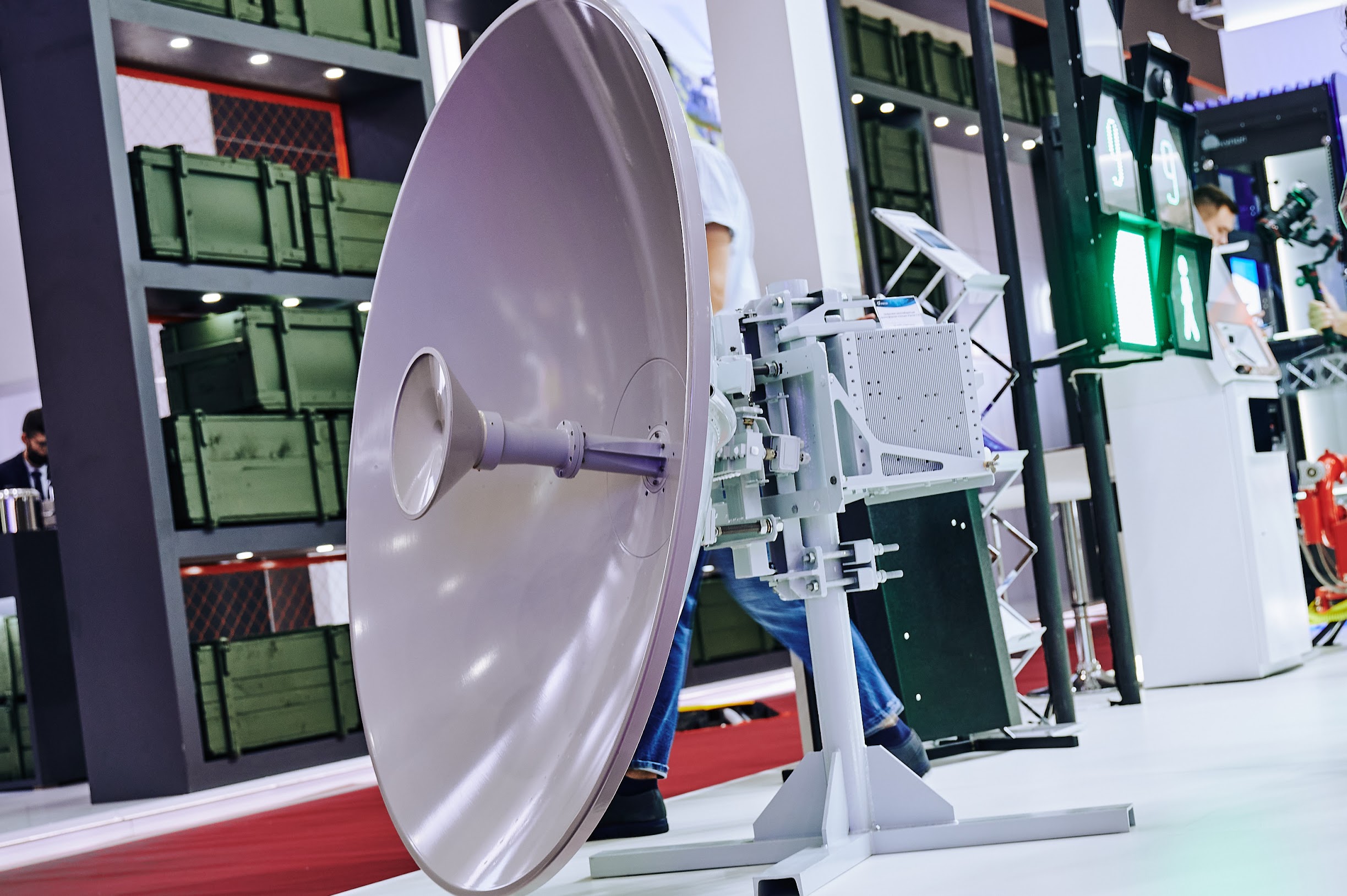
Groza (Russian: «Гроза», “Thunderstorm”) is a small digital troposcatter / radio-relay terminal built by JSC NPP Radiosvyaz in Krasnoyarsk (19 Dekabristov Street), inside the Roselektronika holding of Rostec. The current production face is Groza-1.5. The “1.5” is the dish: a 150 cm parabolic antenna on a roof, a short mast, or a tripod. The radio itself is a cabinet about the size of a compact refrigerator — published 70 kg, 1700 × 1550 × 1140 mm — that two or three people can shift without a Ural.
It is dual-mode. In troposcatter the dish looks into the lower atmosphere and lives on forward scatter. In radio-relay it runs as an ordinary line-of-sight microwave hop at a much higher rate. A link needs two stations. The maker pitches it to the Ministry of Defence, FSB and other siloviki as well as to Arctic industry: mountains, Far North, coasts, remote fields, roads and rail — anywhere a cable or a leased bird is expensive or missing.
It is not the OTs-14 Groza rifle, not the suitcase FPV jammer sold under the same nickname, and not MNIRTI’s truck-borne R-423 Brig. Same physics as Brig. Different crate.
HOW IT IS BUILT
Published Radiosvyaz / Rostec / QRZ cluster:
— Band 4435–4750 MHz (maker pages also write 4400–5000 / “4.5–5 GHz”). Same C-band slice as Brig and as Comtech MTTS.
— Transmitter output 100 W in the QRZ spec sheet.
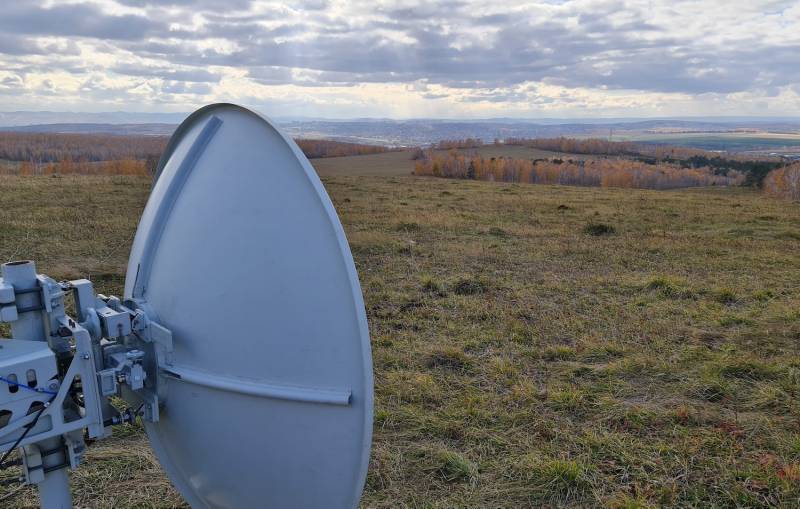
— Antenna Ø 1.5 m, separate from the cabinet. Roof, mobile mast, or tripod. Name of the set is the dish.
— Cabinet 70 kg, 1.7 × 1.55 × 1.14 m.
— Temperature −50 to +65 °C. Wind load quoted 20–25 m/s. Yamal trial ran unsheltered.
— Duplex. Maker page: “duplex multichannel” in 4400–5000 MHz.
The selling box inside is a high-speed digital tropo modem with “neural-network” processing. Rostec language: the modem trains on the path, pulls the useful signal out of noise, and the 2024 algorithm pass nearly doubled tropo throughput versus the previous modem. That is the Russian answer to Comtech ACM — adaptive coding against a fading common volume — dressed as AI. Independent teardown of the weights is not public.
A civil vendor sheet circulating for Groza-class gear (GKRCH decision 19-53-07-2, 24 December 2019) adds colour that Radiosvyaz press hits do not always repeat: 80 MHz modem bandwidth, full duplex with frequency split, rate ladder from 47 kbit/s to 50 Mbit/s switched by hand, spectrum spreading + FHSS for “concealment,” claimed minimum SNR −26 dB. Treat that sheet as a reseller cousin until the factory reprints it. The factory numbers below are the ones Rostec will stand on.
RATES AND RANGE
Troposcatter mode (indirect, over-the-horizon):
— Early / baseline brochure: up to 25 Mbit/s.
— 2024 upgraded modem deliveries: 45.5 Mbit/s, radius talk 210 km.
— Lab: 50 Mbit/s.
— Yamal, October 2025: path >63 km, 49.9 Mbit/s, “equivalent range” >87 km, −50 °C, wind, no shelter. Rostec called it a tropo speed record.
Radio-relay mode (direct LOS): brochure up to 155 Mbit/s. That is why one photograph looks like a mast hop and another looks like a dish aimed into empty sky.
Maker site krtz.su collapses the pitch to “up to 50 Mbit/s tropo / 155 Mbit/s relay.” Vestnik Svyazi citing the factory: 45.5 Mbit/s and 210 km, with a promise to raise both. One integrator page has floated 300 km; that is not the Rostec line. Planning factor remains: surveyed path, two terminals, ACM/modem sliding the rate when the volume goes quiet.
HISTORY
Radiosvyaz is an old Krasnoyarsk microwave house (it also built the R-412 Torf tropo family in the Soviet tactical line). Civil small tropo under the Groza name was shown by Roselektronika on 31 October 2019 as Russia’s first civil digital compact tropo station with a neural-net modem. State Radio Frequency Commission decision 19-53-07-2 the same December is the paper that lets 4–5 GHz civil tropo exist.
Industrial Development Fund (FRP) put about 335 million rubles of concessional conversion-program money into the project in 2021. Director Rinat Galeyev told TASS serial production of the modernized Groza was planned by end of 2023. September 2024: Rostec announced first deliveries of the neural-net modem revision. October 2025: Yamal Arctic trial and the 49.9 Mbit/s clip. A QRZ write-up at that wave said Radio Svyaz had assembled about 20 stations / 10 two-ended kits. “Sdelano v Rossii — 2025” put Groza-1.5 on the science-and-technology shortlist.
Radiotekhnika 2025 paper by Basisty, Nelidov, Anikiev, Kovaleva, Kharebin (NPP Radiosvyaz + Reshetnev Siberian State University) frames Groza-1.5 against the U.S. move to restuff AN/TRC-170 with modern codes (2 → 20 Mbit/s on the old interval) and argues the civil compact station as import-substitution and a lighter fleet.
WHO IS SUPPOSED TO USE IT
Factory text lists MoD, FSB, other power ministries, and civil users. Public photography and press are Arctic / industrial / dual-use. No GRAU index has been printed. If the set appears on the Russian side of a Ukrainian still — camo or grey cabinet, one 1.5 m dish on a tripod or short mast, elevation too low for GEO and too high for a 40 km LOS relay — that is a civil/paramilitary terminal in army hands, the same pattern as Yamal VSATs. Confirmed combat serials are unpublished. Confirmed in-service Russian army tropo you can still hang a type number on remains R-423 Brig.
HOW A DETACHMENT WOULD EMPLOY IT
Two cabinets, two dishes, generators or site power. Survey the path so both 1.5 m beams share a common volume a few degrees above the horizon. For tropo, accept that 50 Mbit/s is a good day at tens of kilometres and that 210 km is the envelope with the rate down. For a short clear shot, flip to radio-relay and take the 155 Mbit/s class. Guy the dish; 20–25 m/s is the brochure wind, a hurricane leftover is not. The cabinet is the modem, PA and control — not a truck shelter with two diversity ears. Single-dish compact tropo lives on coding rather than classic quad space-and-polarization diversity. That is the trade that made the set portable.
PLACE IN THE STACK
Above R-416GM-class LOS relay (~40 km, mast, often mis-captioned tropo). Beside MNIRTI Ladya (compact military tropo, 4.4–5.0 GHz, jam-resistant interfaces) — different institute, same idea. Below truck Brig when the staff still owns an R-423. Alternative to Yamal/Express VSAT and to Rassvet when the bird is jammed or the slot is unpaid. Western peer is Comtech COMET / light MTTS, not the 1 kW quad-diversity trailer.
CAVEATS
Almost every number is a Rostec or factory release. 25 / 45.5 / 49.9 / 50 Mbit/s are the same modem generation told at different moments. 210 km vs 87 km “equivalent” vs 63 km trial path are different sentences; do not collapse them. 100 W is one spec sheet. Vendor FHSS / −26 dB SNR / 80 MHz figures are not on the Rostec bulletins. Production beyond the “ten kits” snapshot is not a published inventory. Ukraine combat use is inference from silhouette, not a type-classified loss list.
STATUS
In production and delivery as of 2024–25. Arctic trial public. Dual-use. Smallest Russian tropo set with a current press office.
IN ONE SENTENCE
Groza-1.5 is NPP Radiosvyaz’s 70 kg, 100 W, 4.4–5 GHz cabinet plus a 1.5 m tripoded dish — a portable tropo/relay terminal that Rostec quotes at 25–50 Mbit/s over-the-horizon (49.9 Mbit/s on a 63 km Yamal shot) and 155 Mbit/s line-of-sight, sold to industry and the power ministries as the bird-free hop that two people can move.