How Over-the-Horizon Radar Works
WHAT IT IS
Duga (Russian: «Дуга», “Arc”; GRAU 5N32; NATO: Steel Yard / Steel Work) is a Soviet over-the-horizon backscatter early-warning radar developed by NIIDAR. It was built to detect ballistic-missile launches at intercontinental range by bouncing high-frequency signals off the ionosphere and listening for the return. The characteristic 10 Hz pulse train was heard worldwide on shortwave from 1976 to 1989 and nicknamed the Russian Woodpecker by amateur radio operators.
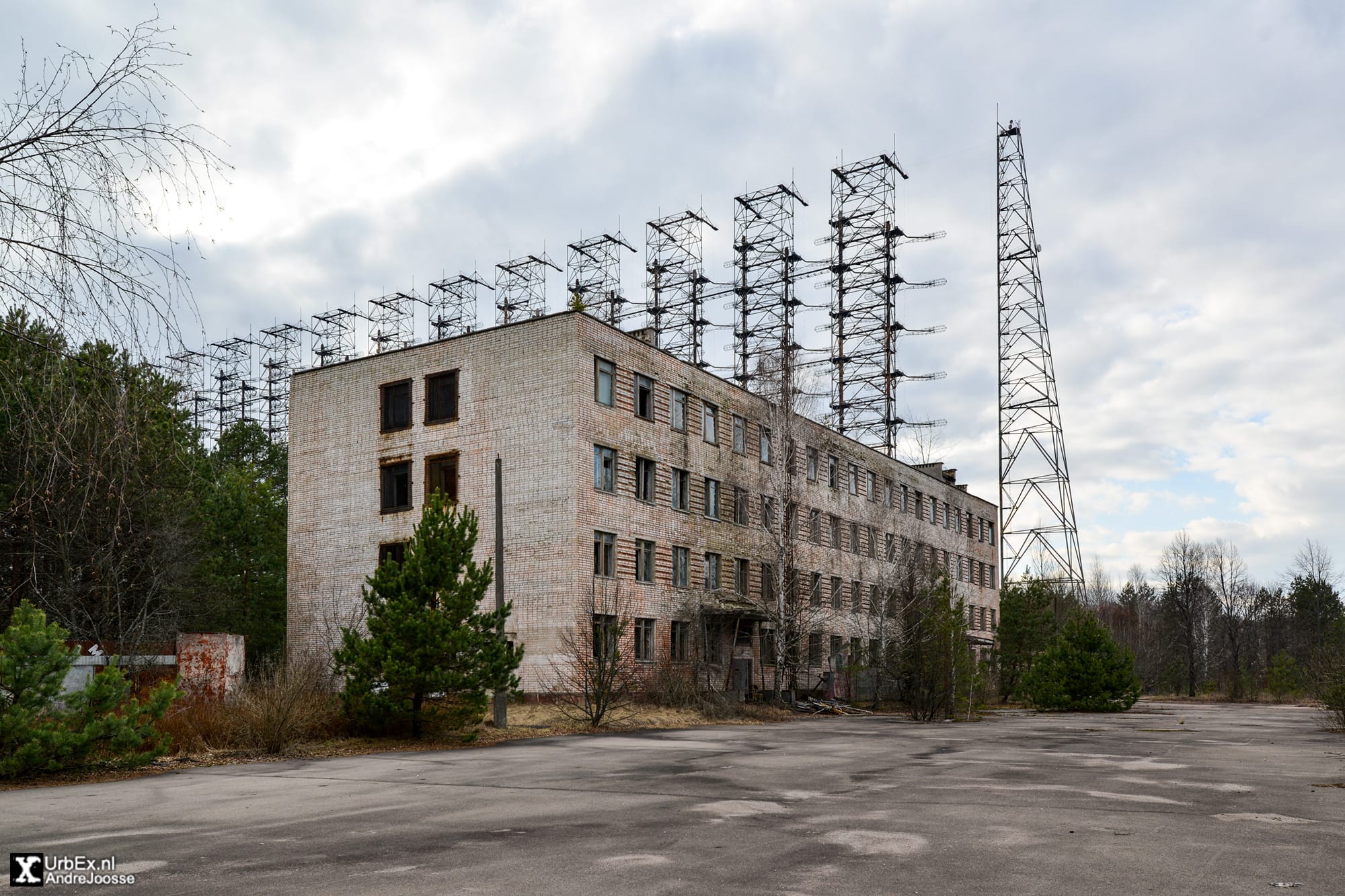
Two operational complexes were fielded. The western node (often called Duga-1 or Chernobyl-2) had its receiver curtains west-northwest of Chernobyl and its transmitter about 50–60 km northeast near Liubech / Chernihiv. The eastern node sat near Komsomolsk-on-Amur (Bolshaya Kartel / Lian area). An earlier experimental set (N-17 / Duga-1) had operated near Mykolaiv. The Chernobyl receiver is the one that remains standing inside the Exclusion Zone.
HOW IT WORKS
Conventional radar is line-of-sight. Duga used HF skywave. A high-power transmitter illuminated a chosen patch of the ionosphere. Part of the energy reflected forward and illuminated the ground or the lower atmosphere far beyond the horizon. A distant receive array listened for the backscatter. A missile launch leaves an ionised trail and a Doppler shift; the system looked for that signature against the clutter. Frequency was chosen for the maximum usable frequency to the target sector and was hopped as the ionosphere changed. Typical dwell was on the order of seven minutes per frequency.
The pulse was not a simple on-off. Each pulse carried a 31-bit pseudo-random binary sequence (BPSK), bit width about 100 µs, giving a roughly 3.1 ms pulse. Pulse repetition was most often 10 Hz (PRI about 90–100 ms); 16 Hz and 20 Hz modes were also observed but rarer. Occupied bandwidth of a pulse was typically about 40 kHz, sometimes wider. An 1988 FCC study placed the observed band at 7–19 MHz; operators logged it more widely (roughly 5–28 MHz) as it followed the ionosphere. Peak power figures in open sources run from about 10 MW ERP upward; some Russian accounts cite 40 MW class. Average power was far lower because of the low duty cycle.
ANTENNAS
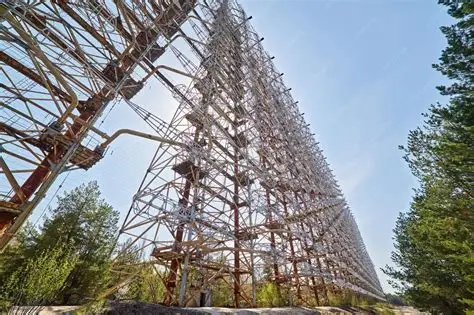
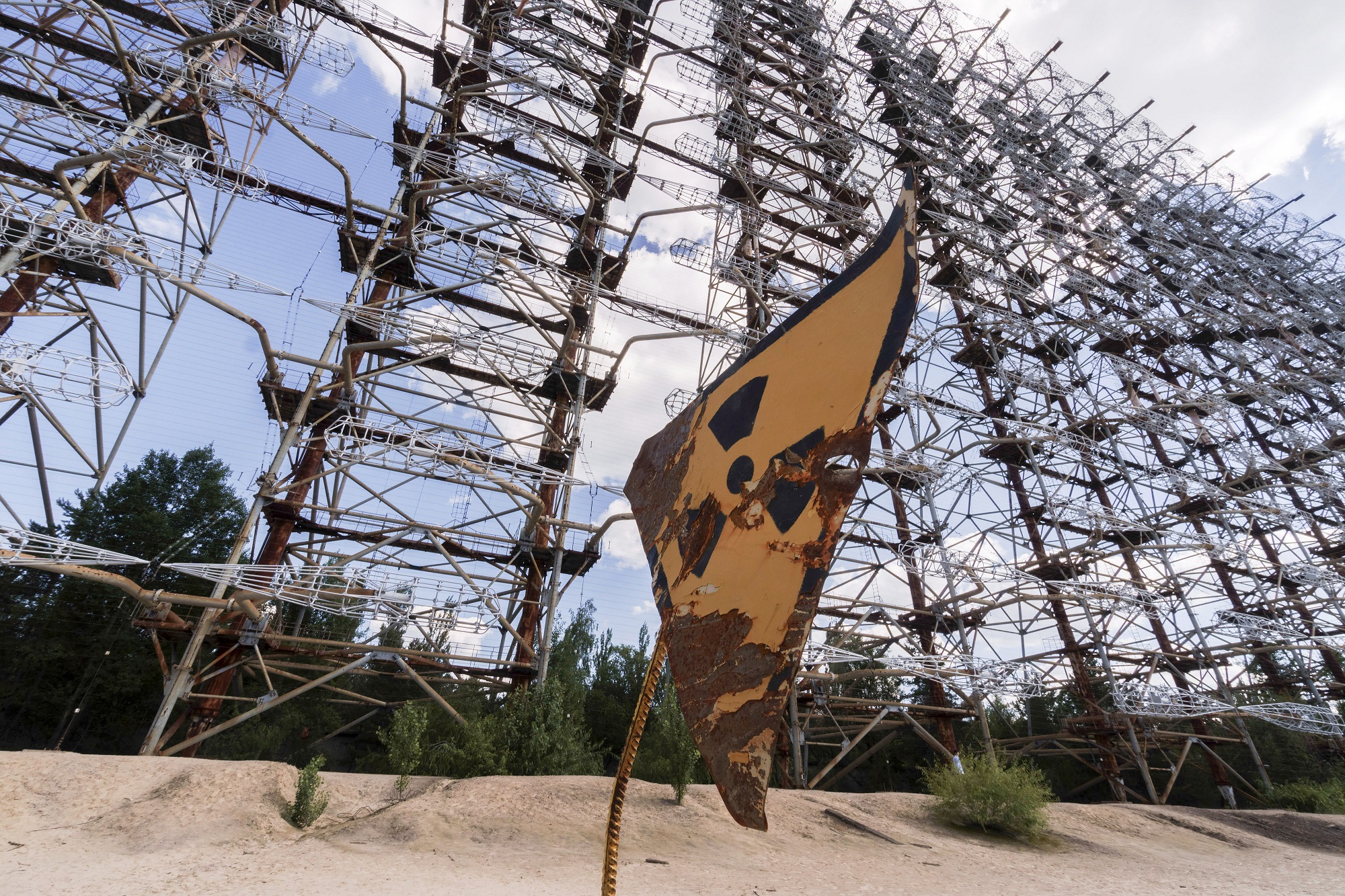
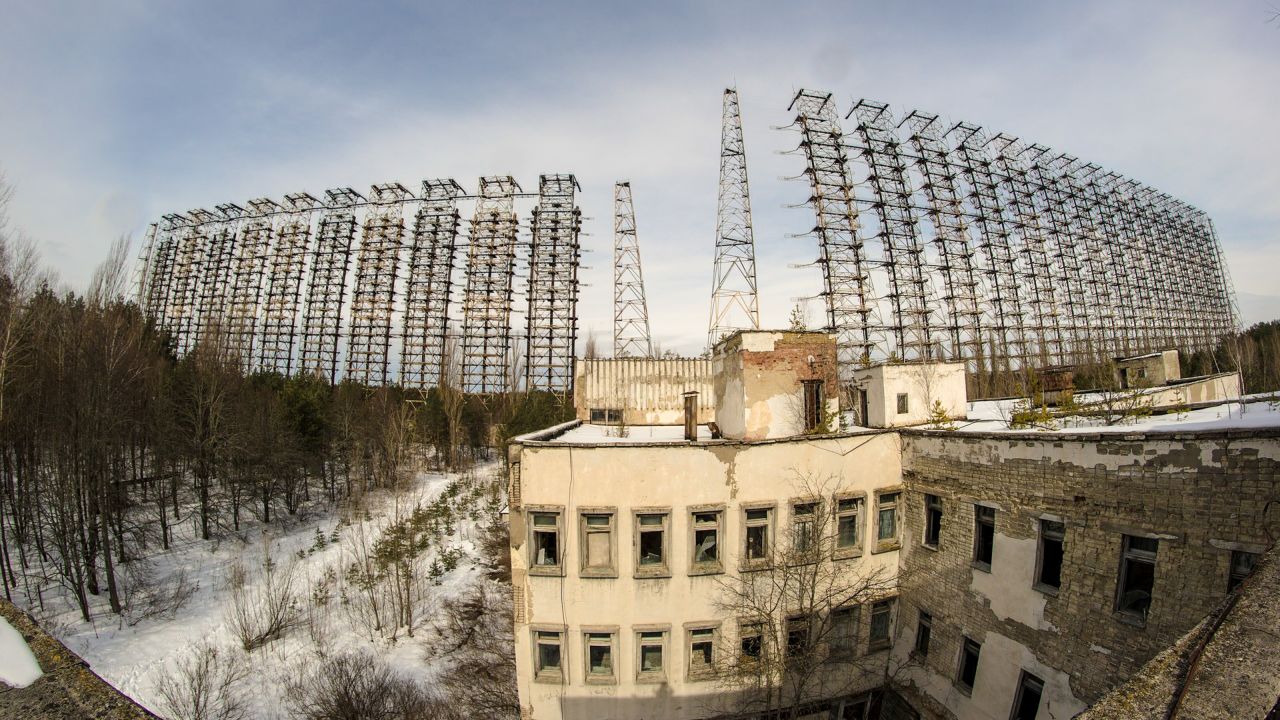
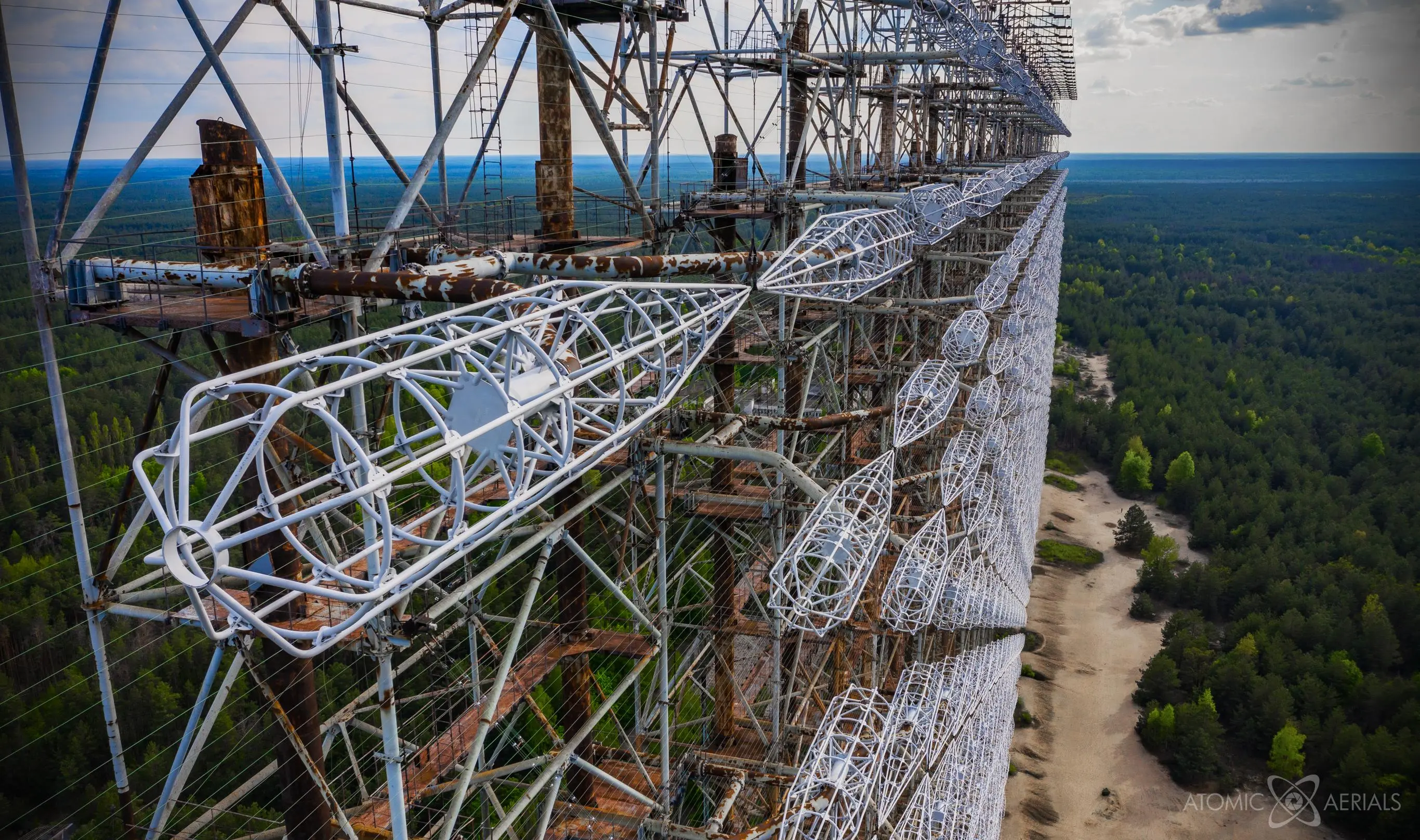
The famous Chernobyl structure is the receive array: two curtain arrays of cage dipoles in front of a wire-screen reflector.
Low-band curtain: masts about 135–150 m high, length about 300–500 m (commonly cited near 460 m).
High-band curtain: about 100 m high and 230–250 m long.
Combined frontage is often rounded to 700 m; weight estimates reach about 14,000 tons. The transmitter arrays, tens of kilometres away, were smaller and lower (on the order of 85 m high in some descriptions). Separation of transmit and receive reduced self-interference. The eastern complex used the same bistatic layout. A circular “Krug” auxiliary array of vertical elements is also described at the Chernobyl site for ionospheric sounding or calibration.
SITES AND HISTORY
Experimental work near Mykolaiv in the mid-1960s demonstrated detection of ballistic-missile launches at about 3,000 km. Full-scale construction of the two combat nodes began in the early 1970s. The eastern station reached experimental operation around 1981 and combat duty on 30 June 1982. The western node’s receiver garrison (Chernobyl-2, roughly 1,000–1,500 personnel) was disguised on maps as a children’s camp. First widespread Woodpecker reports date from July 1976. Both stations were affected by frequency conflicts with aviation and broadcasting; a 1985–86 modernisation attempted to mitigate this.
The Chernobyl receiver stopped on 26 April 1986 with the reactor accident; the site lay inside the new Exclusion Zone and was never returned to full service. The eastern station was taken off combat duty on 14 November 1989 after a fire and was not restored. By the end of 1989 the Woodpecker was gone from the bands. Satellite early-warning systems and the conventional over-the-horizon radars (Dnepr, then Daryal and Voronezh) had taken the mission. The Chernobyl curtains remain the largest surviving example.
PERFORMANCE AND LIMITS
Claimed detection range in open accounts runs from about 3,000 km to 9,000 km or more, depending on ionospheric conditions and target. The system could see launches from the continental United States and from Soviet test ranges. It was sensitive to auroral disturbance, to deliberate jamming, and to the ordinary variability of the HF channel. It never fully replaced the line-of-sight early-warning radars; it was an additional, long-range, weather-dependent layer. Interference complaints were global; some commercial and amateur receivers added “Woodpecker blankers.”
NOT THESE
Dnepr / Dnestr — VHF over-the-horizon early-warning arrays (Hen House). Different band, different architecture.
Daryal / Voronezh — later large phased-array warning radars.
Cobra Mist — the U.S. HF OTH experimental radar at Orford Ness. Same general class, different design.
Container / 29B6 — modern Russian OTH radar. Successor generation, not Duga.
CAVEATS
Power (10 MW vs 40 MW), exact antenna dimensions, and achieved range differ across Western listener reports, FCC measurements, and later Russian accounts. “Duga-3” is a common Western label for the Chernobyl node; Russian sources more often call the pair Duga-1 (west) and Duga-2 (east) under the 5N32 index. Transmitter and receiver coordinates are well established; internal transmitter details are not.
STATUS
Both operational nodes offline since 1986–1989. Chernobyl receiver array still standing inside the Exclusion Zone. Eastern site dismantled.
IN ONE SENTENCE
Duga (5N32, Steel Yard) is NIIDAR’s HF over-the-horizon early-warning radar — bistatic curtains up to 150 m high, 10 Hz BPSK pulses at 7–19 MHz and multi-megawatt power — that the world heard as the Woodpecker from 1976 to 1989 and whose Chernobyl receive array still stands in the Exclusion Zone.