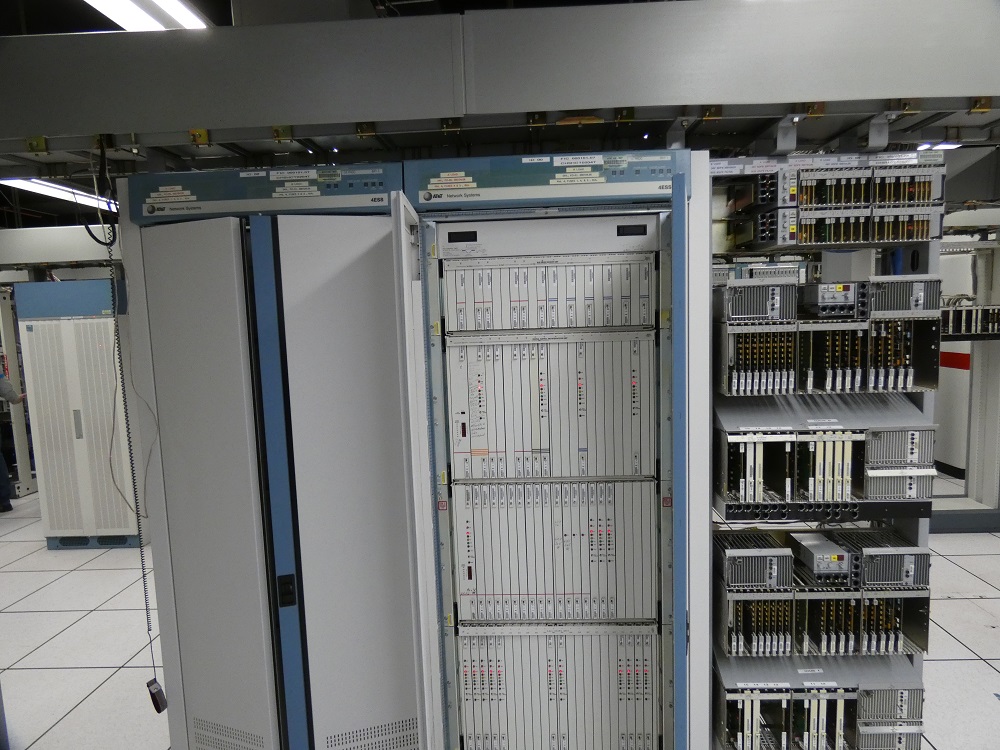
WHAT IT IS
The No. 4 Electronic Switching System (4ESS) is Western Electric / Bell Labs’ first large digital Class 4 toll tandem — a trunk-to-trunk machine that never sees a subscriber loop. It replaced the 4A/4M crossbar tandems that had carried North American long distance since the 1940s. First cutover: Chicago, 17 January 1976. Last classic frame installed: Atlanta, 1999. Peak AT&T long-haul fleet about 145 machines. Half were built in Lisle, Illinois; half in Oklahoma City.
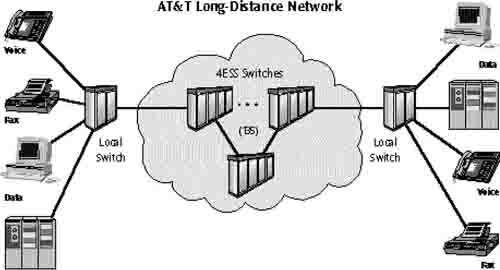
It does not ring your phone. A Class 5 end office (1ESS, 1AESS, 5ESS, DMS-100) does that. When the called number is not on the same Class 5, the call climbs into Class 4. The 4ESS interconnects those offices, other tandems, and international gateways. In the old DDD hierarchy that sat under Classes 1–3 regional/sectional/primary machines; after hierarchy flattening it was simply “the AT&T toll tandem.”
NSA documents call a 4ESS access RIMROCK. That is why the TITANPOINTE article names these frames inside 33 Thomas Street (CLLI NYCMNYBW): three major 4ESS units lived there, two AT&T and one Verizon-owned unit later retired. The switch is the tap point. The building is the fortress around it.
WHAT A CLASS 4 DOES
Trunk in, trunk out. PCM (later packet) from one carrier facility to another. Routing, screening, WATS, 800/900, mass announcement, international gateway, and — once Common Channel Interoffice Signaling arrived — SS7/CCS7 instead of in-band MF that any blue box could sing at. Billing and AMA once lived on the tandem; later much of that moved down to Class 5. The 4ESS still kept the network map and the SS7 links that made “the long-distance cloud” one machine from the caller’s point of view.
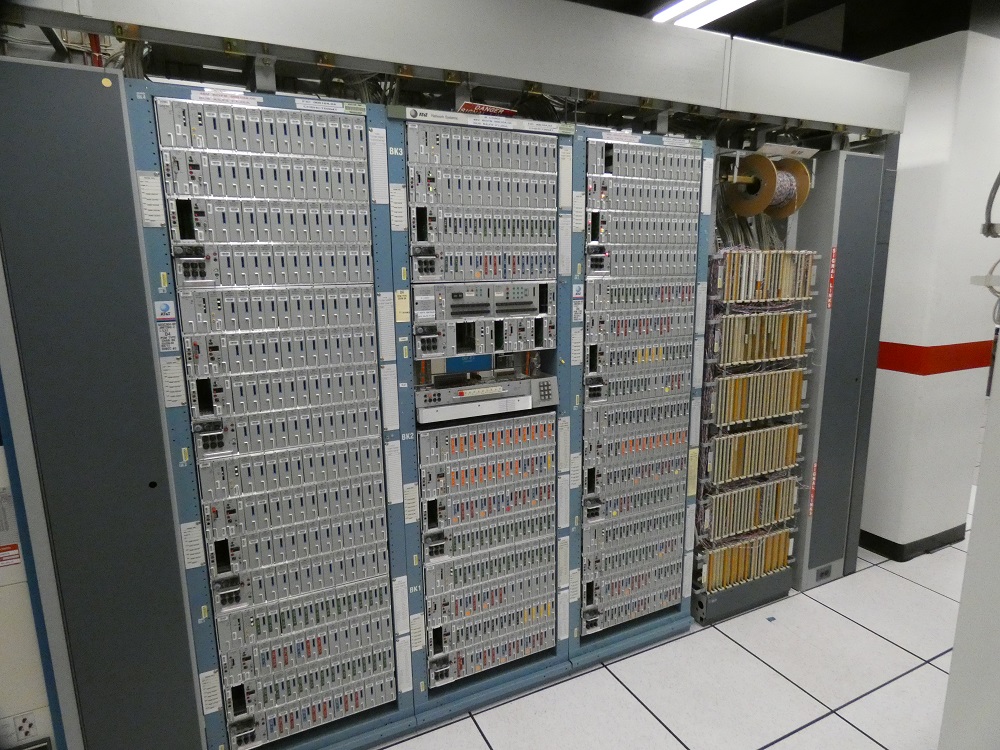
Original published capacity: 107,520 trunks and more than 500,000 calls per hour. A full office was on the order of 100+ equipment bays and up to about 5,000 square feet — larger than a basketball court — sitting on the 200–300 psf floors of a Long Lines house.
HARDWARE — CLASSIC 4ESS
Three piles of iron.
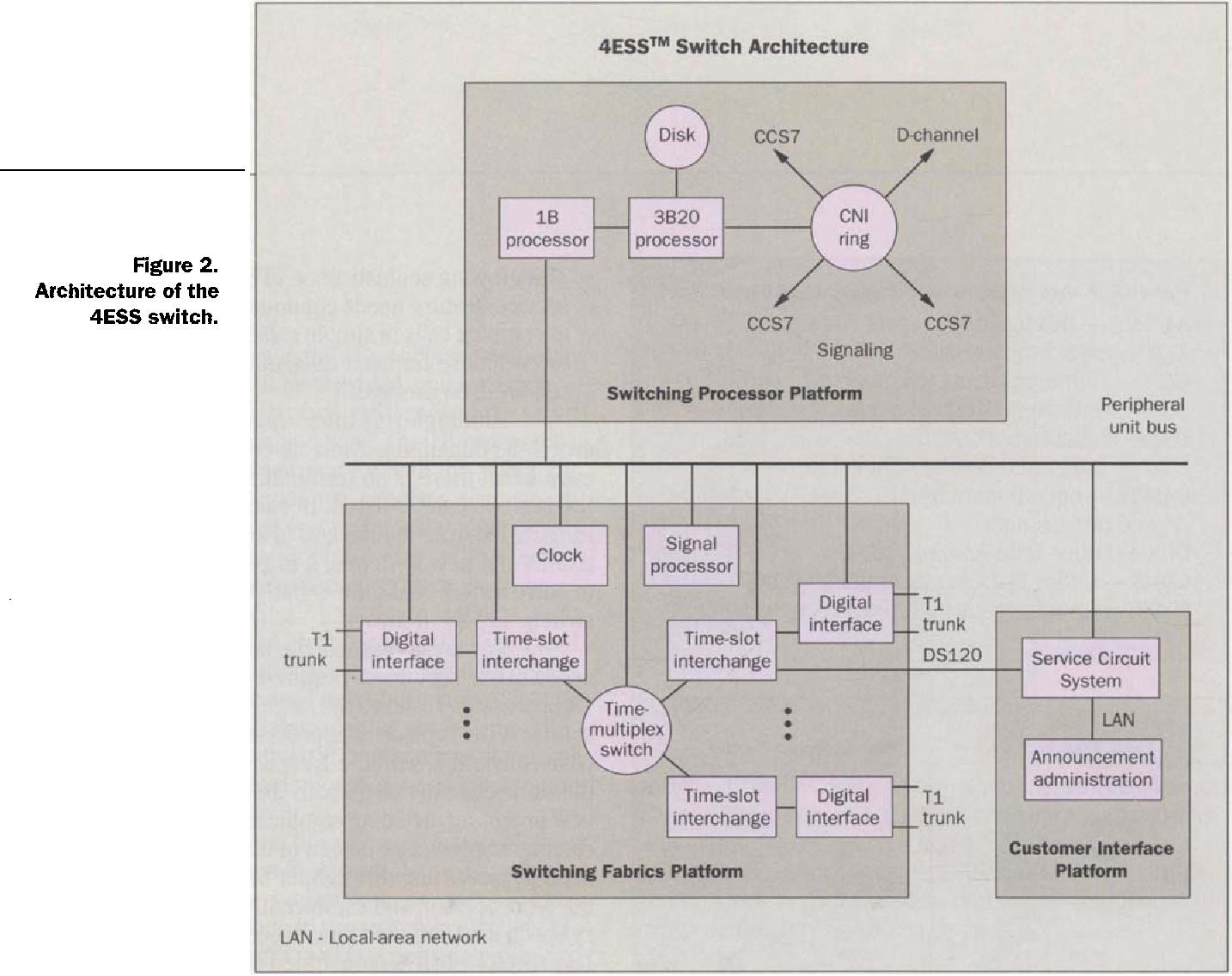
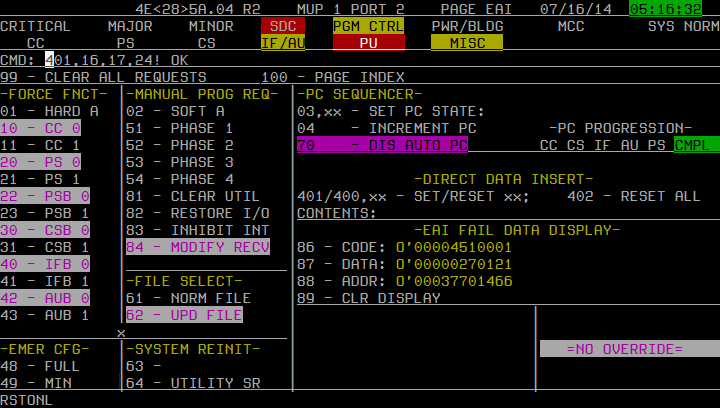
Processor. First the 1A Processor (same family as 1AESS, roughly five to eight times the 1ESS CPU). Later every surviving machine moved to the 1B. Central control, call store, program store. Auxiliary unit bus and peripheral unit bus. Master control console (MCC) for craft; emergency-action interface on that console when the office is sick. Stored-program control in assembly, EPL, and EPLX.
4E Attached Processor System (4EAPS). A 3B20D, later 3B21D (~1995 conversions), running DMERT and 4EAPS code. Disk for program and office data (the old “1A file store” became partitions). Attached Processor Interface into the 1A/1B. The same 3B complex hosts the Common Network Interface (CNI) ring: dual serial ring of peripheral processors that terminate SS7/CCS links. Signaling, OS interface, and AMA/call-data processing sit here. When N4E first arrived, shops kept duplex 3B21 + CNI cabinets for a while because that signaling island was the hard part to emulate.
Switching network. Digital time-space fabric. Time-slot interchange (TSI) frames plus a time-multiplexed switch (TMS). Classic description: time–space–space–space–space–time. Solid-state crosspoints, not reed matrices. An 8×8 in each TSI and a 256×256 TMS, time-shared. Timing plant for the PCM highway. The same fabric attaches test access, tones, and announcements. Four-wire throughout — it is a toll machine.
Peripherals terminate T1/T3 and later optical carrier into the TSI. The office talks MF and DP for the dinosaurs and CCS7 for everything that matters.
WHO OWNED THEM
Western Electric built them; Bell Labs designed them; Long Lines and the operating companies cut them over. After 1984 divestiture most of the fleet became AT&T long-distance assets. A smaller set stayed with RBOCs as LEC tandems; those were generally replaced earlier by 5ESS or Nortel DMS-200/250. Independents and competitive IXCs more often bought DMS-250 instead of 4ESS. Lucent inherited the product line; Alcatel-Lucent then Nokia inherited the replacement.
CLLI codes for these offices end in T (tandem). Mark Cuccia’s preserved AT&T 4ESS list is the census of the classic fleet through retirement. 33 Thomas Street’s NYCMNYBW is the Long Lines / TITANPOINTE example in this database.
HOW THE NETWORK SAT ON THEM
Pre-divestiture: hierarchical DDD. A long-distance call left Class 5, hit a Class 4 toll, and if needed climbed Class 3 / 2 / 1. 4ESS ate the 4A/4M layer first, then much of the rest as crossbar died. Post-divestiture AT&T long distance was a mesh of 4ESS tandems plus later 5ESS “edge tandems” on thinner routes. International gateway 4ESS frames sat on the coasts and at a few inland houses that saw foreign trunk groups — exactly the “foreign gateway switches” in the TITANPOINTE / BLARNEY write-ups.
SS7 made the mesh intelligent: number translation, LNP, 800 dips, ISUP setup. The CNI ring is the 4ESS’s SS7 face. Without it the machine is just a PCM cross-connect with a 1970s brain.
N4E — NEXT GENERATION 4ESS
AT&T and Lucent tried for years to replace 4ESS without throwing away the call-processing software. New 1B silicon was too expensive. A full port of the 1A/1B code was too large. Emulation on 5ESS did not stick. The path that shipped is emulation: keep 4ESS and 4E APS software, throw away the 1B frames and most peripherals, run the brain on ATCA blades and COTS servers.
Product name in the field: Nokia N4E-N1B (New 4ESS). Platform pieces from the Alcatel-Lucent / Nokia gateway line: 7520 Media Gateway, 5400 Linux Control Platform, 1310 OMC-P, plus MRV console servers. First cutover reported at 85 West Congress, Chicago, early 2012, in the hole left by Chicago 51T — 200+ frames out, on the order of 16 frames of N4E in, nine of those still duplex 3B21/CNI in the earliest generation. Later vintages shrink further.
AT&T’s 2026 retirement note: classic 4ESS ≈ 100+ bays / 5,000 ft²; N4E ≈ four bays / 28 ft² (pool-table language). Same Class 4 job, same 4ESS logic as far as the SS7 network is concerned, far less power and cooling. New N4E offices also appeared on routes that never had a classic 4ESS, taking work that 5ESS edge tandems had been doing.
Hobbyist/industry count by late 2025: on the order of 45 N4E tandems versus ~145 classic 4ESS at peak — fewer offices, not a one-for-one rebuild of 1999 capacity. Voice minutes had already left for wireless and IP.
RETIREMENT
Replacement began around 2012–13 and accelerated in the 2020s. By October 2025 a handful of classic frames remained. Last lower-48 classic 4ESS: Lansing, Michigan (LNNGMIMN50T / 044-T), traffic drained then powered down 10 December 2025 after 38 years (in since May 1987). Last classic 4ESS anywhere in the AT&T network: Anchorage. AT&T announced that power-down on 29 July 2026. Telephone World’s running list then read: no classic 4ESS left; only N4E. January 1976 to July 2026 is fifty years of the architecture.
WHAT IT IS NOT
Not a 5ESS (Class 5 / local, sometimes pressed as a small tandem). Not a 4A crossbar. Not a 1ESS. Not DMS-250. Not a softswitch that speaks only SIP; N4E still presents as a 4ESS to the SS7 world even while the media path is a 7520 gateway. Not the FAIRVIEW internet SNRC at 811 Tenth Avenue — that is packet peering, not this TDM tandem.
CAVEATS
Peak counts wander between ~129 and ~145 AT&T plus a few LEC machines. N4E site count (~45) is an enthusiast census, not an AT&T 10-K line. Exact fabric diagrams and 1B instruction listings are still mostly Bell System Technical Journal / proprietary. Whether every TITANPOINTE-era 4ESS at 33 Thomas was physically yanked or only logically drained is not in the public retirement notes.
STATUS
Classic 4ESS: extinct on the AT&T long-distance network as of mid-2026. N4E: the remaining Class 4 voice tandem plant, pending AT&T’s stated push toward a fully IP fiber network by 2029. The software personality is still 4ESS. The room it needs is not.
IN ONE SENTENCE
4ESS was Bell’s digital Class 4 toll tandem — 1A/1B processor, 3B APS, CNI/SS7 ring, TSI/TMS fabric, ~145 offices from Chicago 1976 to Atlanta 1999 — and N4E is Nokia’s ATCA emulation of that same machine in four bays, which finished killing the original frames when Anchorage powered down in 2026.