WHAT IT IS
WWVB is the National Institute of Standards and Technology low-frequency time and frequency station at Fort Collins, Colorado. It broadcasts a continuous 60 kHz carrier, phase-locked to the national atomic time scale, with a digital time code. Most radio-controlled clocks and watches in North America set themselves from it. The carrier itself is a frequency reference traceable to NIST; the modulation carries year, day, hour, and minute.
Effective radiated power is 70 kW. Frequency uncertainty is held below about 1 part in 1012. The site is the same general complex that has long hosted WWV (2.5–20 MHz) and once hosted WWVL (20 kHz).
WHY 60 kHz
Sixty kilohertz is low enough to propagate in the earth-ionosphere waveguide with usable strength across the continent, stable enough that the carrier can be a frequency standard, and high enough that a practical top-loaded antenna still radiates. Groundwave by day, skywave contribution at night. A consumer ferrite-rod or small loop can copy it indoors over most of the lower 48. It is not a voice station and not a two-way service.
ANTENNAS
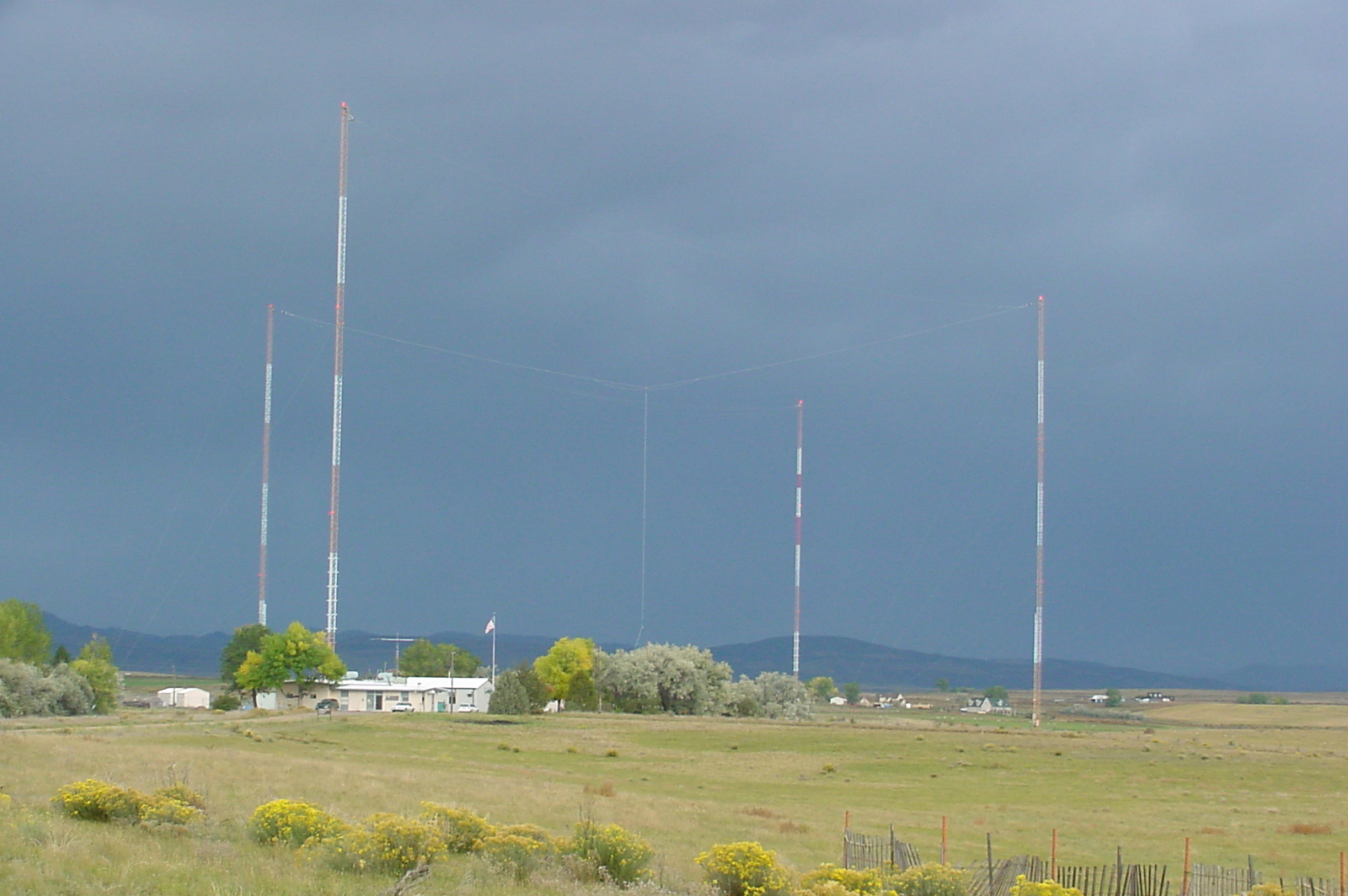
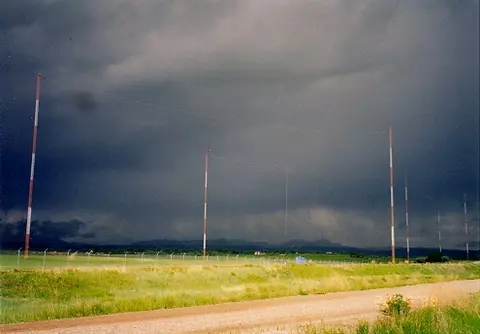
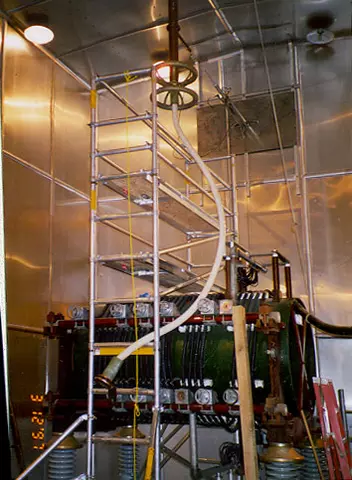
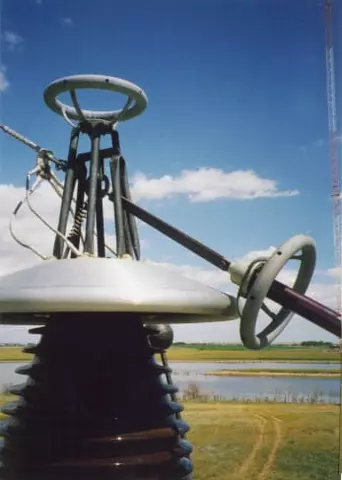
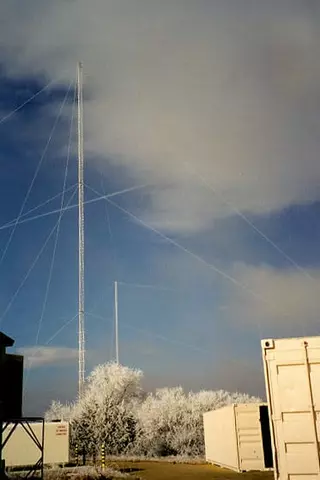
Two identical top-loaded monopoles, spaced 857 m apart, built in 1962 and refurbished in 1999. The north antenna was first used for the WWVL 20 kHz broadcast (shut in 1972); the south was built for WWVB. Each is four 122 m towers in a diamond, with a capacitive top-hat of cables suspended between them and isolated from the towers. A downlead from the center of the hat is the feed. The hat raises the current in the vertical radiator. At 60 kHz the wavelength is 5 km, so even a 122 m tower is electrically short; the top-load is what makes the efficiency usable.
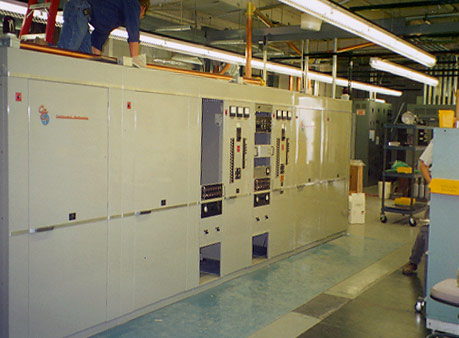
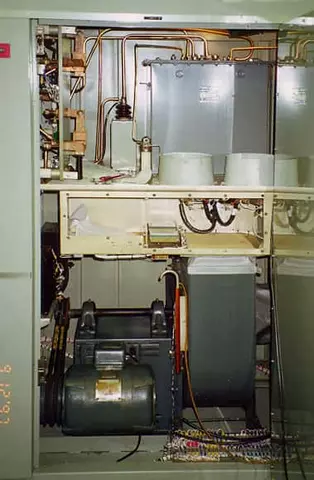
Published efficiencies are about 50.6 percent (north) and 57.5 percent (south). Driven together the pair is about 65 percent efficient. Three transmitters are on site: one for each antenna in normal service, one standby. Each transmitter is a pair of combined power amplifiers. The time-code console feeds both so the two antennas radiate the same carrier and the same modulation.
THE AMPLITUDE TIME CODE
The legacy code, on the air in essentially this form since 1 July 1965, is pulse-width modulation by reduced carrier, one bit per second, one frame per minute. At the start of each UTC second the carrier is dropped 17 dB (from 70 kW ERP to 1.4 kW). It is restored after:
0.2 s — binary 0
0.5 s — binary 1
0.8 s — position marker
(The drop was 10 dB until 1 January 2006, when it was deepened at the suggestion of a clock maker so the edge would be easier to detect.) Markers frame the minute and identify the fields. The data are binary-coded decimal: minutes, hours, day of year, year, a UT1 correction (DUT1), and flags for daylight-saving time, leap year, and leap second. A complete frame is 60 bits and describes the minute that is beginning. Simple envelope detectors in consumer clocks recover it. Noise, interference from switching supplies, and long night-time paths are why a cheap clock sometimes takes minutes to lock or fails indoors.
THE PHASE TIME CODE
On 29 October 2012 NIST added an independent phase-modulated code on the same carrier, leaving the amplitude code untouched so old clocks still work. Binary phase-shift keying: a 0 keeps carrier phase, a 1 inverts it 180° for that second. The PM frame is also one minute long but is not the same bit map. Time is carried more compactly (a minutes-since-2000 field plus parity from a Hamming code, among other changes). A receiver that tracks phase — a Costas loop or a squaring loop — can pull the new code out of deeper noise than an envelope detector can pull the old one. Carrier recovery for a frequency standard still works; the BPSK is designed so it can be stripped.
Both codes run together. A 1960s-style radio clock ignores the phase flips. A modern chip can use either or both.
HISTORY
Experimental 60 kHz broadcasts as KK2XEI began in Boulder in July 1956, low power, mostly continuous wave, to show that LF was a more stable frequency reference than HF WWV. WWVB proper went on the air from Fort Collins on 5 July 1963 at 5 kW, later 7 kW, then 13 kW, and stayed near that level until a late-1990s power increase to the present 70 kW ERP. WWVL (20 kHz) shared the site from 1963 to July 1972. The time code arrived 1 July 1965 and made the radio-controlled clock possible. Format changes since then have been small on the amplitude side; the 2012 phase overlay is the large one. The station is part of the NIST time-and-frequency distribution set that also includes WWV, WWVH in Hawaii, and the internet time services.
WHAT A CLOCK ACTUALLY DOES
A radio-controlled clock keeps its own quartz time, wakes a 60 kHz receiver on a schedule, looks for the one-minute frame, checks the markers and the BCD consistency, and steps or slews the display if the received time is trustworthy. Outdoors or near a window it may lock in one or two frames. Indoors, or under a switching power supply, it may need many frames or fail until night when the skywave is stronger. The phase-modulated code exists so newer receivers can lock in the places the amplitude code cannot.
NOT THESE
WWV / WWVH — HF time-and-frequency stations (2.5–20 MHz), voice plus tones. Different band, different job.
WWVL — the 20 kHz experimental companion, off since 1972.
DCF77 — German 77.5 kHz time station, same idea, different code.
MSF / JJY / BPC — British, Japanese, and Chinese LF time stations.
NAA / NLK — Navy VLF fleet broadcasts near 24 kHz. Not time standards.
CAVEATS
ERP, transmitter output, and antenna efficiency are different numbers; 70 kW is the stated ERP. Exact current transmitter model and the full PM bit map live in NIST special publications. Propagation, not the station, is why a given clock works in one room and not the next.
STATUS
On the air from Fort Collins. Amplitude code since 1965, phase code since 2012, 70 kW ERP.
IN ONE SENTENCE
WWVB is NIST’s 60 kHz Fort Collins time station — two top-loaded monopoles, 70 kW ERP, a one-bit-per-second pulse-width time code since 1965 plus a 2012 BPSK overlay — the signal that sets radio-controlled clocks across North America and doubles as a traceable frequency reference.